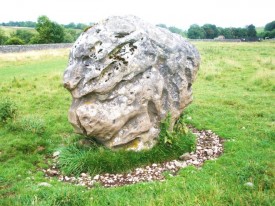
The Linton Stone, North Yorkshire
SE0042 6317. Standing in a field just opposite St Michael & All Angels church at Linton, near Grassington, is a 6-foot-high boulder. The limestone boulder is round-shaped and covered in large holes or pockmarks along with grooves caused by erosion over thousands of years. In the same field there are other recumbent stones, though these are much smaller in size. And built into a wall not far from the banks of the River Wharfe there are three smaller limestone boulders. The largest of these is obviously a glacial erratic that was deposited here by the retreating ice flows some 11,000-13,000 years ago at the last Ice Age.
It could be that the boulder and what’s left of these other stones originally formed a pagan stone circle; these stones being moved into position in prehistoric times by a tribe of ancient people living beside the river. The boulder and the other scattered stones form an alignment, but many have been robbed away by local farmers. Near the entrance to St Michael’s church on church road stands the stump of an Anglo-Saxon cross which means the site was Christianised at some point between the 7th and 9th centuries AD.
Copyright © Ray Spencer, The Journal of Antiquities, 2012 (updated 2025).

 The Journal Of Antiquities