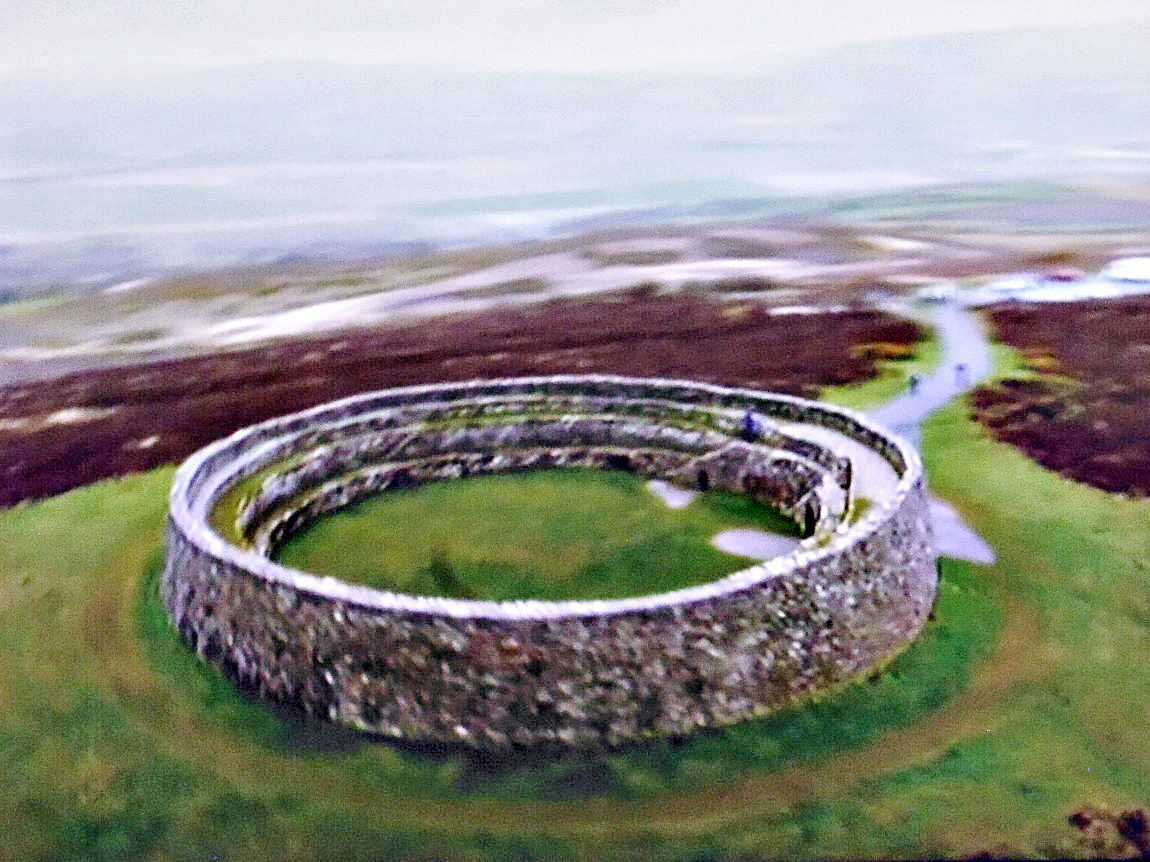
Grianan of Aileach Stone Fort on Inishowen Peninsula, Republic of Ireland.
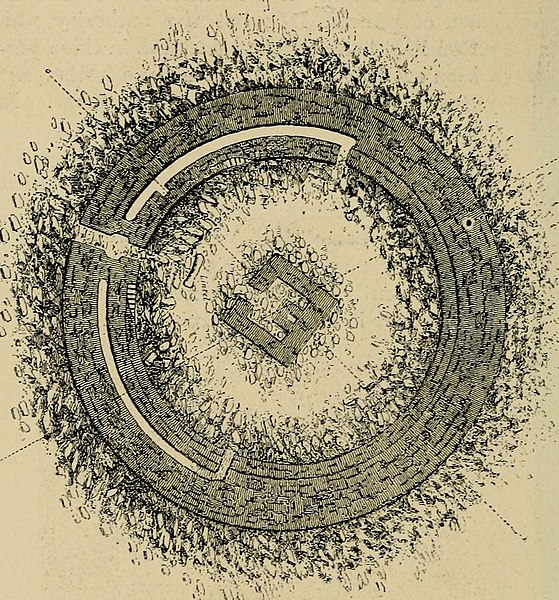
Image from The Journal of The Royal Soc. of Antiquaries of Ireland 1915. (Wikipedia Commons).
Irish Grid Reference: C 3664 1972. On the summit of the 800-foot-high Greenan Mountain at Carrowreagh on the Inishowen Peninsula in County Donegal, Republic of Ireland, is the virtually intact ancient stone fort known as ‘The Grianan of Aileach’ or ‘Greenan Fort’ (a stronghold of the Ulster royal family), which is a well-preserved ringfort dating from around 1700 BC and inhabited up until at least the end of the 11th century AD. St Patrick was said to have preached the gospel at the fort in the 5th century. In the late 8th century AD the fort was probably rebuilt. From the monument there are good panoramic views of the Inishowen Peninsula and two Irish lochs; Swilly and Foyle. The Grianan fort is located near the N13 Letterkenny road, 5 miles northwest of Derry (Londonderry) and 7 miles southeast of Fahan. Legend tells us that the fort was partly or wholly destroyed at the beginning of the 12th century by a Munster chieftain in revenge for the kings of Ulster having destroyed his royal palace some years previously. However, the fort was restored more or less to its original layout and structure in the late 1870s by a local antiquarian, despite there being another local legend saying “that it would never be rebuilt” as all the stonework had apparently been taken away in order to stop such a thing ever happening again. The site is in the care of Heritage Ireland.
Richard Jones writing in 2005 tells us that: “Grianan of Aileach occupies a spectacular location on top of Greenan Mountain, which at 245m (803ft) high provides fine views over loughs Swilley and Foyle, and is a truly impressive and impregnable ring-fort, or cashel, steeped in mystery. Its name has been translated as ‘Stone Palace of the Sun’, ‘Fortress of the Sun’ or even ‘Stone Temple of the Sun’. Although it has been heavily restored, its origins are most certainly ancient and stretch far back into the foggy mists of time. It is thought to date from around 1700 BC and has the distinction of being one of only five sites in Ireland that are marked on the Egyptian geographer Ptolemy’s (c 90-168) 2nd-century map of the world.
“From the 5th to the 12th centuries the fort was the stronghold of the O’Neill kings of Ulster. There is a tradition that the fort was destroyed in 1101 by Murtogh O’Brien, the ruler of Munster in retaliation for the O’Neills having destroyed his royal seat at Kincora some 13 years previously. O’Brien demanded the annihilation of his enemy’s stronghold, and to ensure that it could not be rebuilt he instructed each of his soldiers to take a stone away from the fort as they left. Grianan of Aileach was finally reconstructed between 1874 and 1879 by Derry antiquarian Dr Walter Bernard, although there is some doubt about the accuracy of the interior restoration.”
Richard Jones also goes on to say: “Whether or not the restoration is true to the original layout, there can be no doubt that the site itself is both magical and impressive. According to legend it was constructed in Ireland’s ethereal past by Dagda the god-king of the mystical Tuatha de Danann to protect the grave of his murdered son Aedh. Another tradition holds that the Cashel was the palace of hibernation for the Celtic sun goddess, Graine, and as such was once a place of sun worship. Whatever its original, it is difficult not to be moved by this windswept place. You feel dwarfed by its mighty walls which stand 5m (17ft) high and 4m (13ft) thick, and you come away believing implicitly that this mystical place of rare beauty could only be the work of Ireland’s ancient gods.”
Treasures Of Britain (1968) tells us that Grianan of Aileach is: “A large, well preserved, though much restored drystone circular fort, probably dating from the 5th to the 12th century. It consists of three outer rings of defences surrounding the fort proper, with three internal stepped terraces and stairways. There are galleries in the thickness of the wall.”
Island’s Own Magazine says of the stone fort: “It is one of the royal sites of Gaelic Island. According to the Annals of the Four Masters, the Grianan was originally erected by the De Dananns under their king, Dagda, about 1700 BC. Its primary purpose is supposed to have been sun worship, hence the name. According to legend, St. Patrick visited the Grianan and preached the gospel in 442 A.D. Following the Battle of Clòtteach in 789 A.D. it is thought that the Grianan of Aileach may have been built to celebrate Cenél nÉogain’s victory over its rivals – inside the pre-existing prehistoric hillfort as a visual symbol of their new mastery. The Grianan commands panoramic – and strategically important – views of important Lough Swilly and Lough Foyle waterways. The Grianan of Aileach ceased to be a royal residence in 1101, however, the fort was restored by Dr. Walter Bernard during 1874 to 1878, including the walls and main stone features.”
Sources / References & Related Websites:-
Ireland’s Own Magazine (Various publication dates), Channing House, Rowe Street, Wexford.
Jones, Richard, Mystical Britain And Ireland, New Holland, London, 2005.
Treasures of Britain, AA Treasures of Britain, Drive Publications Limited, London, 1968.
https://heritageireland.ie/unguided-sites/grianan-of-aileach/
https://en.wikipedia.org/wiki/Grianan_of_Aileach
Image from Wikimedia Commons:- https://commons.wikimedia.org/wiki/File:Journal_of_the_Royal_Society_of_Antiquaries_of_Ireland_(1915)_(14779372521).jpg
More info here: https://www.irishhistory.com/ulster/county-donegal/an-grianan-of-aileach-co-donegal/
Copyright © Ray Spencer, The Journal of Antiquities, 2024
 The Journal Of Antiquities
_(14779372521).jpg)