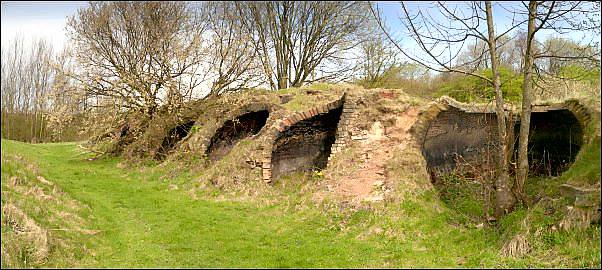
Old Coking Ovens or kilns beside the Canal near Oswaldtwistle. Photo courtesy of the late Donald Jay.
NGR: SD 7375 2848. An Industrial Heritage and Archaeological site located beside the Leeds and Liverpool Canal near Oswaldtwistle, about halfway between Accrington and Blackburn, Lancashire. Locally known as Fairy Caves, but they are, in fact, coking ovens or kilns, which are still in a reasonably good state of preservation, despite the passage of time. Blackburn Road (A679) runs alongside the canal here, and Church Kirk (St James) can also be seen from here. A wharf (basin) and a short canal arm where the coke and coal were loaded onto barges can still be seen beside the three banks of coke ovens at the northern side of the cut. Nearby is the site of Aspen Colliery, now largely grassed over, although there are some remains still visible, which were all part of the Aspen Valley coal mining complex that opened around 1810 but closed down in 1930, and the associated coking ovens were abandoned at the same time. However, more recently, the more than twenty brick-lined and grass-covered ovens, which resemble conical-shaped beehives, have become ‘a place of exploration and adventure’ for local children who call them “fairy caves”. In 1977, the site was placed on a schedule for preservation and subsequent listing.
Rowland Joynson, writing in 1975, gives some very useful information regarding the Aspen Valley’s ‘fairy caves’. Mr Joynson says that: “Oswaldtwistle Civic Society have had under consideration the question of the future preservation of some old “beehive”coke ovens. They are on the site of the former Aspen Valley Colliery.
“Most people think of that site as being in Church, but it is actually in Oswaldtwistle, although it is on the border of the area designated for the Church Centre Action Plan.
“Mr Jack Broderick, the secretary of the Hyndburn Local History Society and myself, knowing that the local Civic Society were interested in these remains, decided to go over to Aspen Valley to have a look at the site. The area has become an obvious playground for children, who have no idea of their origin and purpose, not for that matter have many adults. There were some children actually playing there when we arrived, although they quickly disappeared except for one boy. He said the children called them the “fairy caves”— and so indeed that is what they look like to all intents and purposes. There is no doubt whatsoever that children play hide and seek in them, and there are, of course, the inevitable scrawlings on the walls in several places. The small boy who followed us around said it had been more interesting than having been at school.
“To our surprise, the former coke ovens turn out to have survived in a remarkably good state of preservation. Our feelings were that at the least nothing should be done to destroy them and that if possible they should be protected. Whether they are of great importance to industrial archaeology, it would be for the trained industrial archaeologists at university level for instance, to say, but there are good grounds for believing that they are of some archaeological importance. They are certainly mentioned in Owen Ashmore’s “Industrial Archaeology of Lancashire”, which is in Accrington Library.”
Mr Joynson goes on to say that: “Coke, it seems, was originally produced by burning coal in heaps in the open air. The coal was carefully piled and sealed over with slack and set alight. About 1760 coke was produced in an oven. Banks of brick-built ovens, fire-brick-lined and igloo-shaped, each about 12 cubic feet capacity with a door and a chimney in the roof, are known as beehive ovens. The process was to fill the oven with coal slack, seal the door with fire clay and then ignite the coal. With a controlled air intake combustion was completed in about 48 hours. Not all the ovens in the bank were coking at the same time. The heat from two out of a bank of eight was directed through a system of intercommunication flues to preheat the other ovens before firing commenced, thus making the most economical use of the heat before it was wasted through the chimney. The end of the 19th century saw the distillation of coal in coal-heated retorts. Crude gas was given off and the residue was coke. Tar and ammonia products were then produced in the purification process of the crude gas.
“Owen Ashmore in his book, says that the beehives were usually grouped in batteries of at least three, and that these were sometimes at the collieries themselves. He then points out that ovens were often built near canals for convenience of transport, and it is in this connection that he mentions the ovens on the Leeds and Liverpool Canal at Church.
“We counted two banks of ovens with 17 in each. Some are in a better state of preservation than others. Beyond, there is a smaller site of seemingly four or five ovens. These are in an excellent state of preservation and the glazing of the brickwork caused by the intense heat of the oven is well preserved. Here also there is an interesting tunnel which was apparently the ventilation shaft which carried the heat from one oven to another. The brickwork inside looks quite polished, and it would not be surprising if children wriggle through it. It looks an open invitation to something of that kind.” Nevertheless, walking on top of the ovens is not without its dangers. There are holes in the turf where the chimneys have formerly penetrated. At one place there is a fairly large square hole which seems to have been the base for a fairly large chimney to serve the whole battery.”
Mr Joynson adds to the above. He tells us that:“At Aspen there is an inlet from the canal near the former colliery which would allow for the loading of coke onto canal barges.” This basin may have been partially filled in. Miss W. Hogan, the Secretary of Oswaldtwistle Civic Society, tells me that she thinks it has been partly filled in at some time by British Waterways. Whether this is so or not, the site is very weed-grown, marshy and choked with rushes. How deep the mud is goodness knows. But one would imagine it might be dangerous if a child penetrated into it. The wooden bridge over the entrance to the former quay looks very frail. I walked across it gingerly when I went along the embankment last Summer, but on this last visit we did not venture to cross, nor did some people who came walking along the embankment during the afternoon. They preferred to walk around the weed-grown former quay.”
And finally, Mr Joynson tells us more about the former Aspen Colliery: “The former [Aspen] colliery shaft looks as if it may have been filled in either wholly or partially. There is certainly a pile of rubble on the top, but there is a firm fence round it with a newly-posted notice, “Danger, keep out”. The site, Miss Hogan tells me, is owned by Hyndburn Council, but there is a small electricity substation nearby. One has to admit to having spent a most fascinating afternoon wandering about [the] site. The old flywheel mounting of the colliery is still in existence and some of the bricks lying about bore the inscription “St John’s Colliery”. According to Mr. David Hogg’s “History of Church and Oswaldtwistle”, Aspen pit was sunk in 1869, Rhoden in 1889 and Town Bent in 1892. All this followed the closing of pits on the uplands where the accessible seams were exhausted, Bank Moor and Belthorn having closed in 1853. In 1909 water from the old workings at Bank Moor burst through and eventually flooded Aspen Mine. One boy was killed and 21 trapped underground for some time. Miss Hogan, however, tells me that she understands the colliery remained in existence until 1920, when it was closed because of flooding. I myself seem to have some recollection of seeing the old pit cage there when passing on the railway nearby.”
Richard Peace, writing in 1997, gives directions for the coke ovens: Access: Just off the A679 running north of Oswaldtwistle, wedged between the Leeds-Liverpool Canal and the railway line. Cross over the canal by the bridge at map ref: SD 734284.”
Sources & References:-
Joynson, Rowland, Join Joynson, Clough & Son, Great Harwood, Lancs, England, 1975.
Peace, Richard, The Curiosities of England – LANCASHIRE CURIOSITIES, The Dovecote Press Ltd., Stanbridge, Wimborne, Dorset, 1997.
Welsh, Mary, Walks from the LEEDS-LIVERPOOL CANAL, Cicerone Press, Milnthorpe, Cumbria, 1996.
https://historicengland.org.uk/listing/the-list/list-entry/1016943
https://en.wikipedia.org/wiki/Aspden
More info here: https://digspag.org.uk/aspen-coke-ovens-walk/.
https://archaeologydataservice.ac.uk/archsearch/record.xhtml
Copyright © Ray Spencer, The Journal of Antiquities, 2025.
 The Journal Of Antiquities