The Journal Of Antiquities

Ancient Sites In Great Britain & Southern Ireland


1 Comment

Meir ny Foawr, Knocksharry, Isle of Man

OS grid reference: SC 2758 8495. The prehistoric site of Meir ny Foawr, near Knocksharry, at the far western side of the Isle of Man, is a former Bronze-Age stone circle; however, not much of it has survived, and some of its quartz boulders may have been robbed away over the centuries. This collection of boulders in a sort of part circle is located on the side of the hill called Lhergy Dhoo Uplands and is nearly half a mile southeast of Lhergydhoo house, in Kirk German parish. It can be reached on footpaths to the east from Switchback road, and the stones can be seen for many miles around. However, there is a dearth of information regarding the site. The little village of Knocksharry is 1 mile to the north on the A4 road, while the town of Peel is 2 miles to the southwest along the same A4 coastal road, overlooking the beautiful Doon Bay.

Meir ny Foawr stone circle is also known locally as ‘the Devil’s Fingers’ or ‘the Giant’s Fingers’ indeed many Megalithic monuments in the Isle of Man are in some way associated with the devil, or some mythical giant. The structure covers an area of around 30 feet (9.4 metres) and is formed by five large white quartz boulders in a sort of horseshoe shape, rather than a circle, though it may originally have been a circle? Three of the stones lean over at the north side, while that in the centre is 7 feet high and may represent the altar; the three leaning stones are considered to be part of the original burial chamber. When the site was excavated some Bronze-Age urns were dug up. On the periphery, there are a couple of smaller stones known as outliers. So, in fact, we might consider calling this a ring cairn or cairn circle? We must assume, therefore, that there was at one time an earthen mound covering the stones here at Meir ny Foawr?

The area around Knocksharry is rich in ancient remains. There is the prehistoric site of Crosh Mooar about 1 mile to the northeast of Meir ny Foawr – this was a Bronze-Age burial mound – but sadly it was almost destroyed in the early 1900s. And there are several cairns and tumuli dotted around the immediate area; at Knocksharry there is a Bronze-Age cemetery which is located close to the ruins of an early Christian chapel. Here three badly damaged funerary urns were excavated.

Sources:

Hulme, Peter J., More Rambling In The Isle Of Man, The Manx Experience, Douglas, Isle of Man, 1993.

The Ancient And Historic Monuments Of The Isle Of Man, The Manx Museum And National Trust, Fourth (Revised) Edition, Douglas, 1973.

http://www.isle-of-man.com/manxnotebook/iomnhas/v035p446.htm

http://www.isle-of-man.com/manxnotebook/fulltext/pn1925/gn.htm

Copyright © Ray Spencer, The Journal of Antiquities, 2014 (updated 2023).


Onchan Celtic Crosses, Isle of Man

St Peter's Church, Onchan, Isle of Man (Photo Credit: Wikipedia)

St Peter’s Church, Onchan, Isle of Man (Photo Credit: Wikipedia)

NGR: SC 4005 7814. Inside St Peter’s church on Church Road, Onchan, Isle of Man, there is a collection of carved Celtic cross-slabs from the 7th-12th centuries AD. The present-day church stands on what was quite obviously a religious site back in the Dark Ages, although the first church which was dedicated to St Conchan (Connachan) was established in the 12th century when it was called Kirk Conachan – that dedication lasted for hundreds of years until a re-dedication to St Catherine and, then to St Peter in the 19th century. St Peter’s church is located on Church Road, just off the main A2 (Whitebridge Road), at the south side of Onchan. The village of Onchan stands on the headland at the north side of Douglas Bay – the Manx seaside town being 1 mile south, while Baldrine is 2 miles north on the A42.

Norse Cross at Onchan by Br Olsen (Photo Credit: Wikipedia)

Norse Cross at Onchan by Br Olsen (Photo Credit: Wikipedia)

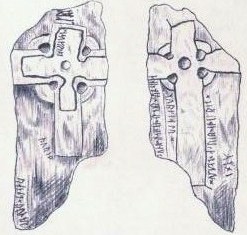
There are 6 cross-slabs in the church although one shows strong Norse origins, and there is an early Christian gable cross which originally stood on the roof of an ancient keeill, a small early primitive Christian chapel. One of these called ‘Thurith’s Cross’ stands at just over 4 feet tall, is of Norse origin, and dates from the 11th-12th century. It is decorated with a crude cross on both sides as well as ring designs, but of most interest here are the runic inscriptions (both sides). These inscriptions are in short bursts: (front) krus isukrut thurith – ‘Christ / Thurith carved the runes’ (back) asunr raisti ift kui nusina murkiaum – ‘the son erected this cross to the memory of his wife muirkiaum’ and then: ukikat aukrathikr – ‘I examined / read the runes and interpreted etc’.

The Kirk Conchan Cross is a wheel-head cross at just over 2 feet high. It may date from the 9th century. This is a broken slab that has a cross and four rings with plait-work designs and, also interlacing strap-work (in low relief); there are also two creatures that might be dogs – one of which has two heads! And, the Fylfot Cross is almost 5 feet high and is said to date from the 10th century. This cross-slab has a ‘fylfot’ design as its cross, similar perhaps to the swastika symbol. Again we have dog-like creatures at either side of the cross. This slab came from the keeill chapel which stood on this site before the 12th-century church was built.

There are another three slab-crosses all of which are Celtic in origin and date from the 7th-9th centuries. These are broken, but they are still interesting because of the carved crosses, circles, plaitwork, strapwork, spiralls, numerous other Celtic-style designs and, again there are strange animals, including the usual dog-like creatures. Also, there is what is referred to as a ‘gable-end cross’ which is 12th century and supposedly came from the roof of the old keeill chapel. This primitive little chapel stood here just prior to the 12th-century church of Kirk Conachan; its remains are still visible in the churchyard.

Encased in the wall close to the crosses is a 17th-century silver chalice that is said to have been used by King Charles I at his last communion before his execution in Whitehall, London, in 1649, after which he was revered as King Charles the Martyr, with a cultus in parts of England as well as three church dedications.

There is little if any information on St Conachan, Connachan or Concenn who supposedly became bishop of Sodor and Mann in 540 AD, and has given his name to the village. He is sometimes identified with St Adamnan, the Irish saint who was a missionary in Scotland during the 7th century, and a contemporary of St Columba whose “Life” he wrote, but due to the ‘later century’ in which he lived this would seem not to be the case. To confuse things even more St Christopher, the 4th century Roman martyr was at some point ‘patron’ of the church at Onchan!

Sources:

http://en.wikipedia.org/wiki/Onchan#

http://en.wikipedia.org/wiki/Manx_runestones#

Kermode, P.M.C., Manx Crosses, Bemrose & Sons Limited, London,1907.

The Ancient And Historic Monuments Of The Isle Of Man, The Manx Museum And National Trust, Fourth (Revised) Edition, Douglas,1973.

Copyright © Ray Spencer, The Journal of Antiquities, 2014 (updated 2024).


Dolmen du Couperon, Rozel, Jersey, Channel Isles

Dolmen du Couperon (Photo Credit: Wikipedia)

Dolmen du Couperon (Photo Credit: Wikipedia)

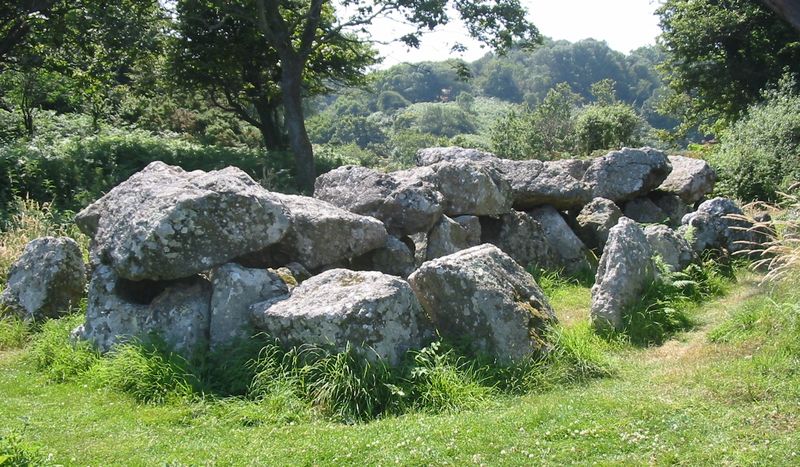
Latitude: 49.234347. Longitude: 2.035263. On the headland at the north side of Jersey, in St Martin’s parish, stands the ancient monument Dolmen du Couperon, a late Neolithic gallery-grave that was partially restored in the early part of last century. Also known as Le Couperon and Le Couperon Dolmen. The monument stands 50 metres across the field to the west of Rue de Scez and the 17th century brick-building known as the guardhouse. Just to the north of the monument is the beautiful Jersey coastline of Rozel Bay, and a few miles further west the little village of Rozel. Dolmen du Couperon stands at the side of a field overlooking the seashore of the north Jersey coastline, a haven for holiday-makers; the nearest town being St Helier several miles to the south-west. Although the monument has been partly restored a couple of times it is still in a reasonably good state of preservation.

The gallery of this ancient tomb is roughly 8 metres long, while the whole monument across is 4 metres wide. It is formed from two parallel rows of upright stones and, above them large slabs laid rather ‘haphazardly’ across make up the roof. And 18 smaller upright stones or peristaliths surround the grave (at each side) and indicate the width of the original low, covering mound, which was made of stones, although the kerb may originally have continued in a straight line, instead of curving round like it does today. When it was being partially restored back in 1868 and 1919 some of the outer kerb-stones seem not to have been put back into their former positions, in particular the stone at the east side is not in situ – the thinking being that it should perhaps have been halfway along the gallery, acting as a sort of ‘dividing stone’? And the portal stone has been positioned so as to block the gallery’s entrance at the east side, but again this ‘may’ not be in its original position. The tomb is thought to date from the late Neolithic period (3,250-2,850 BC).

No significant artefacts were excavated from the gallery-grave, apart that is from fragments of flint and pottery. Could the tomb have earlier been robbed by treasure-seekers? And of the few finds here, no knowledge exists as to where these were taken to! But all in all this is a very nice ancient monument.

Sources:

Dillon, Paddy., Channel Island Walks, Cicerone Press Ltd., Milnthorpe, Cumbria, 1999.

http://en.wikipedia.org/wiki/Jersey_dolmens#

http://en.wikipedia.org/wiki/Le_Couperon_dolmen_and_guardhouse

http://www.prehistoricjersey.net/Le_Couperon.shtml

http://www.megalithic.co.uk/article.php?sid=10561

Copyright © Ray Spencer, The Journal of Antiquities, 2014.


2 Comments

St Mary’s Well, Cefn Meiriadog, Denbighshire, Wales

Ffynnon Fair at Cefn, Denbighshire (Photo Credit: Wellhopper)

Ffynnon Fair at Cefn, Denbighshire (Photo Credit: Wellhopper)

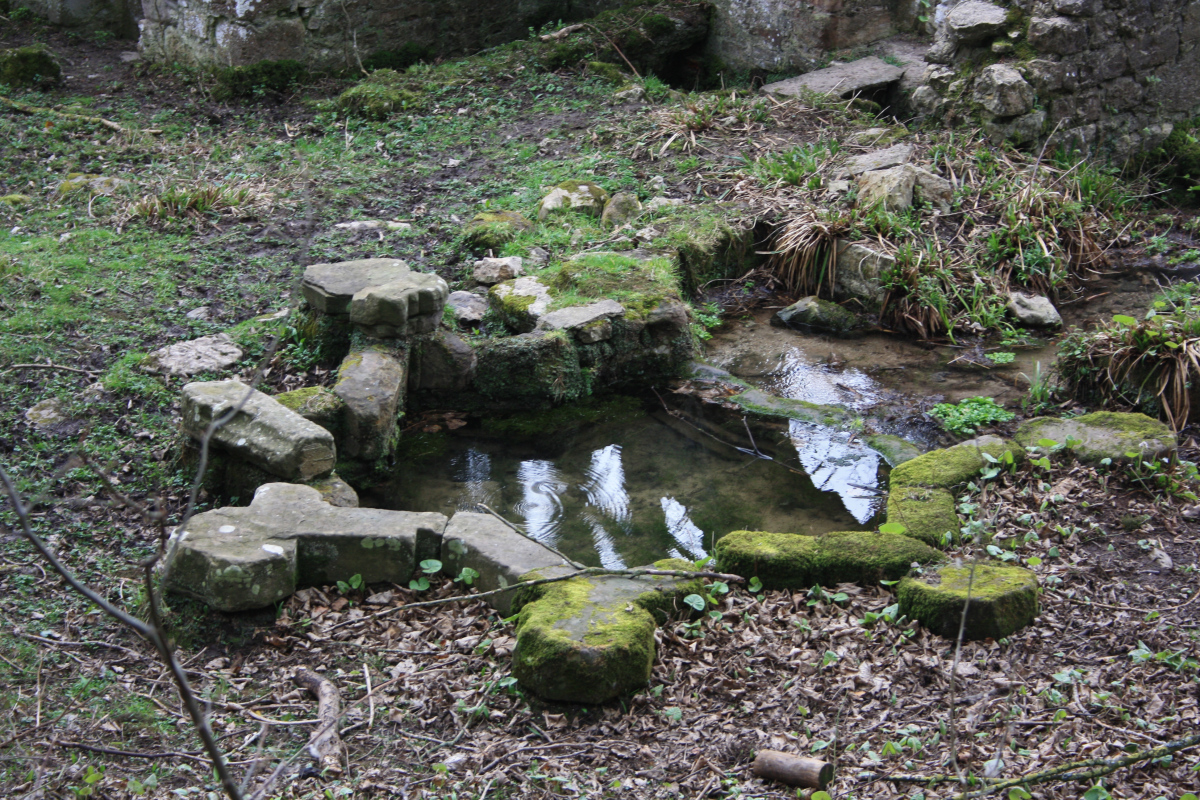
NGR:  SJ 0292 7107. Some 2 miles to the south-west of St Asaph and hidden away in a wooded area near Cefn Meiriadog – stands St Mary’s Well (Ffynnon Fair) and its associated chapel (now in ruins), once a much-visited Roman Catholic pilgrimage centre. The site is of interest because of its ornate well-basin, considered to be very similar in design and age to the well-chamber at St Winifred’s Well, Holywell, which was linked to St Mary’s on the main pilgrims route across north Wales and, like that famous well – St Mary’s (Ffynnon Fair) was renowned for its healing properties. And, like St Winifred’s Well – St Mary’s does have “very cold water”. The well and its associated ruined chapel are located on private land beneath some trees, close to the river Elwy, in the hamlet of Wigfair, Cefn Meiriadog parish, Denbighshire, a mile or so to the north-west of Trefnant. It is difficult to reach but from the A525 make for the bridge over Afon Elwy, then go left into the lane. A footpath runs close to the site, but access is ‘not good’ from the gate! Go across the fields and into the valley just to the north of the river to reach the well site in Chapel Wood, which is, sadly, becoming ‘very’ overgrown and forgotten.

The well chapel (Capel Ffynnon) was built in the 13th century, or it was rebuilt in 1500 along with the octagonal, star-shaped well-basin and attached cistern (bath); the rest of the building consists of a chancel, of a later date, a north and south transept, while the holy well stands at the far-western side of the chapel. Water from the well flows along a channel in the south transept, before meandering down to the river – Paul Davis ‘Sacred Springs’. Davis thinks the well basin had some form of elaborate vaulting over it, probably contained within a projecting wing, and so the building originally had a cruciform plan. Could the chapel have been in use at some stage as a religious hostel for pilgrims visiting the holy well – and paying homage to Our Lady at the same time. Unfortunately, the chapel is now in a very ruinous state, leaving the star-shaped well open to the elements. Some of the 15th-century Perpendicular windows retain their splendid decorative work – as do the doorways.

Water in this holy well was known to cure infertility and eye disorders, according to Audrey Doughty in her book ‘Spas And Springs Of Wales’. As this well basin looks broadly similar to that at St Winifred’s Well, in Flintshire, and given the size of the chapel could it be that the benefactor was the saintly Lady Margaret Beaufort, Countess of Richmond and mother of King Henry VII (1443-1509) – almost certainly she would have had the money to build something on such a grand scale. Audrey Doughty says the well structure is 8ft (2.4m) square; she also says that it “had without doubt been in use for very many centuries before it is said to have been rebuilt”.

St Mary’s well would have been visited by Roman Catholic pilgrims and probably Protestant pilgrims as well up until the late 17th century, when the well and chapel fell into disrepair, although the well may have continued to be in use. Apparently, it is said, that up to 1640 marriages were performed here, but whether these were legal or illegal is uncertain, though a priest could ‘be payed’ to come and perform the marriage ceremony if required! Francis Jones in his acclaimed work ‘The Holy Wells Of Wales’ says of the well: “it flowed within a small well-chapel now in ruins”, and goes on to say that: “it was ruined in Lhuyd’s time who says that the ‘gwyl’ of Mary was held there”. Jones is, of course, referring to Edward Lhuyd, the 17th-century English antiquarian who visited north Wales towards the end of the 17th century. Gerard Manley Hopkins (1844-89) the Jesuit priest and poet visited the place and wrote a little bit of prose about it; and a poem was written about St Mary’s Well at Cefn by Mrs Felicia Hemans (1793-1835), who lived at St Asaph in the early part of her life.

Many thanks indeed to Wellhopper for the use of his photo, thanks sincerely. Check out his website: http://wellhopper.wordpress.com/2012/02/26/ffynnon-fair-st-marys-well-cefn-meiriadog/

Sources:

Coflein:  http://www.coflein.gov.uk/en/site/306714/details/FFYNNON+FAIR%2C+WELL+CHAPEL/

Davis, Paul., Sacred Springs, Blorenge Books, Abergavenny, 2003.

Doughty, Audrey., Spas And Springs Of Wales, Gwasg Carreg Gwalch, Llanrwst, Wales, 2001.

http://why-lydia.livejournal.com/9288.html

Jones, Francis., The Holy Wells Of Wales, University of Wales Press, Cardiff, 1992.

Copyright © Ray Spencer, The Journal of Antiquities, 2014 (updated 2024).


London Stone, Camden, Greater London

London Stone (Photo Credit: Wikipedia)

London Stone (Photo Credit: Wikipedia)

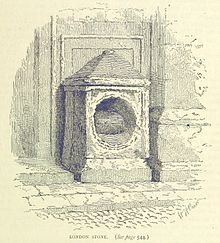
OS grid reference: TQ 3267 8090. Hidden away in a recess at the front of what was the Bank of China on Canning Street, Camden, London, close to the Cannon Street Underground Station, is the so-called London Stone, a relic perhaps of Roman Londinium. Sometimes also called ‘the Brutus Stone’ or ‘Britto Stone’ after the Celtic leader of the same name who was hailed as king of what would become London, according to The Legend. It is actually a squat round-shaped stone that is now much diminished in size and which may, in fact, have been a 15th-century boundary stone? The stone’s location is close to the corner of St Swithins Lane and nearly opposite Bush Lane. St Paul’s Cathedral is 1 mile to the west, while the River Thames and London Bridge are about a quarter of a mile to the south of Canning Street.

London Stone and its former stone surround (Photo Credit: Wikipedia)

London Stone and its former stone surround (Photo Credit: Wikipedia)

At the front of the W.H.Smith building at no.111 Canning Street in a specially designed stone recess stands the curious ‘London Stone’, a round-shaped stone that could be part of a Roman altar that was dedicated to the goddess, Diana, so says Geoffrey Ash in his great work ‘Mythology Of The British Isles’. It was apparently set up by Brutus, grandson of Aeneas of Troy, a self-styled king of what would become “London”. Brutus is said to have had a palace on the site of the present Guildhall about 1 mile to the southwest, beside the river Thames. The stone is 1 foot 5 inches high by 1 foot 9 inches wide and is made of Limestone that was quarried in Rutland, though it has been suggested that it is Bath stone? It sits securely behind a decorative iron grill, fronted by a very nicely carved outer recess made of Portland stone, at the top of which there is an information plaque; the inner recess is surrounded by thick glass for extra security.

The stone originally stood at the north side of Canning Street, where it was set into a niche in the south wall of St Swithin’s Church, close to the Mansion House, according to Janet & Colin Bord ‘Mysterious Britain’. St Swithin’s church was demolished after it suffered from being bombed during the 2nd World War; the stone was moved to the Guildhall Museum, then eventually to its present site in Canning Street.

According to documentary evidence, the stone was in existence in 1100 and 1188, and in the 16th century it was mentioned again by the antiquary John Stow, who was to describe it as: a great stone called London Stone, fixed in the ground very deep, fastened with bars of iron, and otherwise so stronglie set that if carts do runne against it through negligense the wheeles be broken, and the stone itself unshaken”. In the work ‘Mysterious Britain’ the Bords say that: “Although there is no tradition of it being used as a stone of initiation, the London Stone is of great intiquity and was held in veneration by the citizens who would make binding pacts across it and issue proclamations from it”.

It would appear, therefore, that over many hundreds of years folk, maybe travellers and pilgrims, have been chipping away and breaking pieces off the London Stone to take away as a relic in case it possessed some sort of magical healing power – it may well have done so – and if that be the case it would have originally been a much bigger block of stone, maybe even some sort of pagan altar in the time of the Romans, or maybe from ancient Britain, long before the Romans ever came to Britain but, Brutus who was a Celtic leader – had set his eyes on our shoreline! If he did ever come to Britain and reside at London, then it would have been roughly 1100 BC?

The author James MacKillop says in his ‘great tome’ ‘Dictionary Of Celtic Mythology’ says that Brutus was a progenitor of the British people. He was leader of the Trojans and had “dreams” of the Temple of Diana beyond the setting sun. After invading the island [Britain] he defeats the mythical giant Gogmagog and then establishes law upon the land named for him – Britain (Prydain). But actually Gogmagog was killed by being hurled over a cliff by another giant called Corineus of Cornwall who was a champion wrestler of great strength and valor – Reader’s Digest ‘Folklore Myths and Legends of Britain’. Very gruesome-looking stone effigies of Gogmagog and Corineus stand inside the Guildhall in King Street. Geoffrey of Monmouth mentions the legend of Brutus and the giants in his work ‘History of the Kings of Britain’ (1136). More likely than not London Stone was a ‘Milliarium’, a stone that was used to measure road distances in both Roman times, and long after that. And there is the famous saying: ‘So long as the Brutus Stone is safe, so long shall London flourish’.

Sources:

Ash, Geoffrey., Mythology Of The British Isles, Methuen, London, 1993. 

Bord, Janet & Colin., Mysterious Britain, Paladin (Granada Publishing), London, 1984.

MacKillop, James., Dictionary Of Celtic Britain, Oxford University Press, Oxford, 1998.

Photo Credits:  http://en.wikipedia.org/wiki/London_Stone

Reader’s Digest,  Folklore Myths and Legends of Britain, ( Second Edition), Reader’s Digest Association Limited, London, 1977.

The Megalithic Portal:  http://www.megalithic.co.uk/article.php?sid=8349

Copyright © Ray Spencer, The Journal of Antiquities, 2014.


Winter Hill Stone, Keighley Moor, West Yorkshire

Winter Hill Stone, Keighley Moor.

Winter Hill Stone, Keighley Moor.

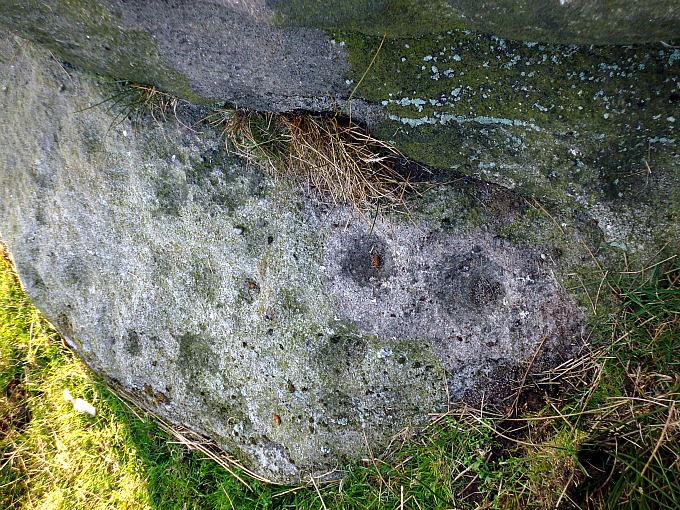
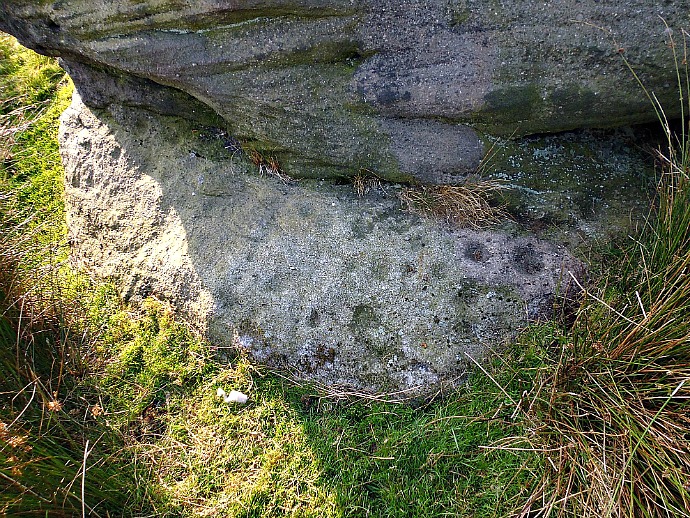
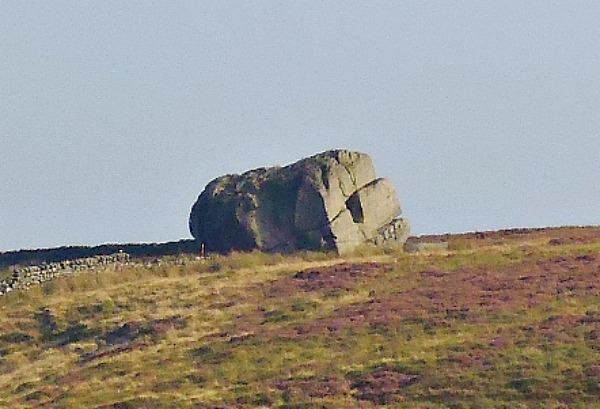
OS grid reference: SD 9828 4197. Upon Keighley moor (western side) and overlooking Cowling stands the Winter Hill Stone, a large weather-beaten boulder that has many faint cup marks at its base and others on top. The stone lies some 630 yards to the northwest of Hitching Stone, on the Yorkshire-Lancashire border, which is a huge block of gritstone. It is from Winter Hill Stone that the winter solstice sunrise can be seen, so obviously a place

Cup-Marks on Winter Hill Stone.

Cup-Marks on Winter Hill Stone.

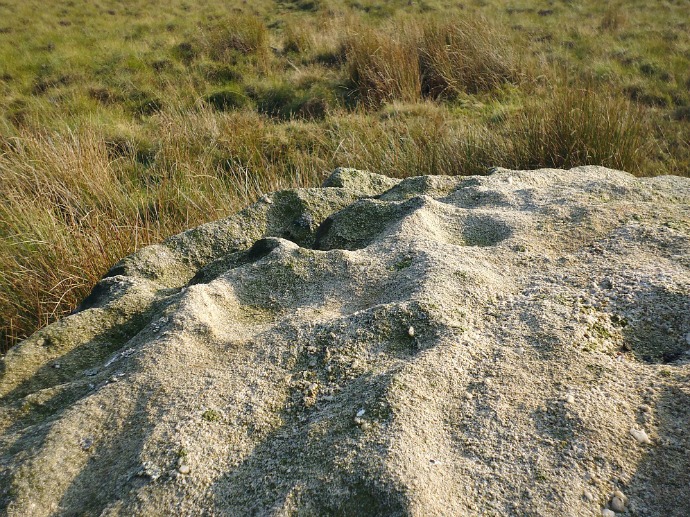
of great reverence in prehistoric times; the cup marks being carved in the Bronze Age. To get to this stone it is “best” to follow the footpath opposite the small carpark, on Buck Stone lane, close to Wainman’s Pinnacle, then head in the general direction of the Hitching Stone, but after some 460 yards (at the little wooden gate) veer off to the south-west and, a further 380 yards brings you to Winter Hill Stone, close to the western edge of the moor overlooking the hamlet of Over Dean. The village of Cowling is 2 miles to the west and Cross Hills a further 4 miles north along the A6068 road.

Winter Hill Stone (Top).

Winter Hill Stone (Top).

This large rounded, weather-worn stone is quite prominent upon the flat-shaped Winter Hill, but sadly the cup markings around the stone’s base are now much less prominent – indeed some of them are barely legible to the eye. There are at least 17 tiny cup marks that are eligible, the rest are very faint, but on the top of the stone more cup marks are quite well-defined, indeed over time they have become deeper and wider due to the constant weathering; the strange grooves and ruts are also the result of erosion to the soft gritstone. The hill on which the boulder stands is ‘so named’ because the winter sun can be seen to rise from [here] behind the Hitching Stone over to the northwest. There are many, many other boulders and stones littering the moor, one or two also look as if they “might” have very faint cup marks on them. In particular, a boulder some 380 yards to the south-west of Winter Hill, looks a likely candidate. It is highly likely that there were ancient settlements somewhere on the moor, but obviously these are now hidden beneath the thick, dense carpet of ferns and heather which seem so relentlessly to have taken over.

The author Paul Bennett in his epic work ‘The Old Stones of Elmet’ says: “Although there are some cups higher up the rock, oddly the majority are just above ground level. This makes little sense until one realises, thanks to its name, that the winter solstice sunrise was observed from here rising up behind the gigantic Hitching Stone on the near skyline.”

Hitching Stone.

Hitching Stone.

The Hitching Stone (OS grid ref: SD 9866 4170) is a huge glacial erratic block of gritstone the size of a small house that was deposited here at the last Ice Age. It reputedly weighs over 1,000 tonnes. Large fissures run vertically through the rock, one of which was caused by a fossilised tree that has worn away; while one side of the rock bears a large oblong-shaped hole that people climb into. There are some Victorian inscriptions on the stone while at the top a deep natural basin containing rainwater that is never known to dry up, even in long dry spells of weather. Long ago local folk visited the stone in order to participate in various games, and the site was also a meeting place for local councils and parliaments – Bennett ‘The Old Stones of Elmet.’ The Hitching Stone stands on the Yorkshire-Lancashire boundary.

And in the interesting little book ‘The Pendle Zodiac’ by Thomas Sharpe we are told that the Vernal Equinox sunrise behind the Hitching Stone is in alignment with Pendle Hill. Sharp goes on to say: “Where natural markers (and even some of these have pecked ‘cup and ring’ markings) are absent, the ancestors would have incorporated standing stone monoliths to time the alignments and to receive into the landscape, etheric vitality from the luminaries.” Pendle Hill beacon is roughly 14 miles, as the crow flies, to the southwest of Winter Hill Stone and  Hitching Stone.

These large gritstone boulders on Keighley Moor were laid down thousands of years ago at the last Ice Age by a massive glacier moving southwards, and retreating as it did so. Over time the boulders (erratics) themselves are slowly weathering-away due to the often wet, windy climate upon the moor. Nowadays, however, these strange, often round-shaped boulders and stones have become waymarkers and sentinels that seem to loom up on the barren, unforgiving landscape, taking one by sudden surprise!

Sources:

Bennett, Paul., The Old Stones of Elmet, Capall Bann Publishing, Milverton, Somerset, 2001.

Sharpe, Thomas., The Pendle Zodiac, Spirit Of Pendle Publishing, 2012.

http://davidraven-uk.blogspot

Copyright © Ray Spencer, The Journal of Antiquities, 2014 (updated 2023).


1 Comment

Ballycrovane Ogham Stone, Co. Cork, Southern Ireland

Ballycrovane Ogham Stone (Photo credit: Peter Ribbans - Geograph)

Ballycrovane Ogham Stone (Photo credit: Peter Ribbans – Geograph)

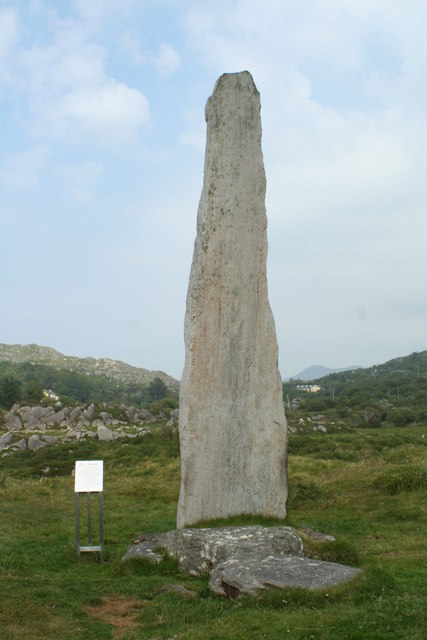
Irish grid ref: V 6569 5291. On the windswept headland to the south of Lough Fadda, at the far-western point of County Cork, Southern Ireland, stands the ancient monument which is known as Ballycrovane Ogham Stone, a very tall standing stone (menhir) which has an Ogham inscription carved on its edge. But this tall, thin pillar-stone pre-dates the Ogham inscription by over two-thousand years – back to the Bronze-Age, at least. The ancient standing stone is located in a field on the top of the hill overlooking the harbour at the south-side of Kenmare Bay – at Ballycrovane on the Beara Peninsula (Ring of Beara) – a few hundred-yards south-east of the ‘Faunkill and the Woods’ road and the little coastguard station, then with ‘possible’ access through the farmyard*. Ballycrovane is 2 miles to the south-west of Ardgroom village and the R571 road; the village of Eyeries being a further 2 miles to the south-east. [*The stone is on private farmland, so you “might” have to pay a small fee to visit the monument!]

Ballycrovane Ogham Stone is said to be ‘the tallest Ogham stone in Ireland’ and probably in Europe, for that matter. It stands at a very impressive 17 feet (5.3 metres) and is said to be several feet below ground, but it is only a very slender pillar-slab and it tapers slowly away to the top. At the eastern edge there is an Ogham inscription which is becoming difficult to see because of weathering. This stone was obviously erected here during the Bronze-Age, with the notches being carved onto it in more recent times, probably during the 3rd-5th centuries AD. The inscription is now thought to recall someone called Deich and Toranus – the full Latin translation being: MAQI DECCEDDAS AVI TURANIAS which would be ‘Of the son of Deich a descendant of Torainn’, but could the inscription in fact be a kind of dedication or memorial to the Deisi – the ancient tribe that inhabited Ireland – during the 3rd-4th centuries AD? We may never know that question.

Ogham was the ancient (Goidelic) language of the Celts who inhabited the western fringes of Britain in pre-Roman times, but it was still being used by the ancient Britons up until the 5th-7th centuries AD – the so-called Dark Ages, at which time many Ogham memorial stones were Christianized with a carved cross. The script consisted of a series of short notches or strokes, carved vertically and also slanting on the edges of grave-covers and some standing stones, similar in fact to the wording and epitaphs that we see on gravestones in churchyards today. Antiquarians and historians in this particular field have now been able to translate, in Latin form, these usually short inscriptions by following the Ogham script alphabet, the key to which was in the 14th century Book of Ballymote.

The author James MacKillop in his work ‘Dictionary of Celtic Mythology’ says of the Ogham language: “The earliest form of writing in Irish in which the Latin alphabet is adapted to a series of twenty ‘letters’ of straight lines and notches carved on the edge of a piece of stone or wood. Letters are divided into four categories of five sounds.” MacKillop goes on to say: “Ogham inscriptions date primarily from the 4th to 8th centuries and are found mainly on standing stones; evidence for inscriptions on wood exists, but examples do not survive. The greatest concentration of surviving Ogham inscriptions is in southern Ireland; a 1945 survey found 12 in Kerry and 80 in Co. Cork, while others are scattered throughout Ireland, Great Britain, and the Isle of Man, with five in Cornwall, about thirty in Scotland, mainly in ‘Pictish’ areas, and more than forty in Wales. South Wales was an area of extensive settlement from southern Ireland , including the migration of the Deisi.” 

Sources:

MacKillop, James, Dictionary of Celtic Mythology, Oxford University Press, New York, 1998.

Photo copyright:  http://www.geograph.org.uk/photo/507477

© Copyright Peter Ribbans and licensed for reuse under this Creative Commons Licence.

Reader’s Digest., Illustrated Guide to Ireland, The Reader’s Digest Association Limited, London, 1992.

Scherman, Katherine., The Flowering Of Ireland,  Victor Gollancz Ltd., London, 1981.

The Megalithic Portal:  http://www.megalithic.co.uk/article.php?sid=12

Copyright © Ray Spencer, The Journal of Antiquities, 2014.


Dupplin Cross, Dunning, Perth And Kinross, Scotland

Duppling Cross (originally at Cross Park Field, Forteviot)

Duppling Cross (originally at Cross Park Field, Forteviot)

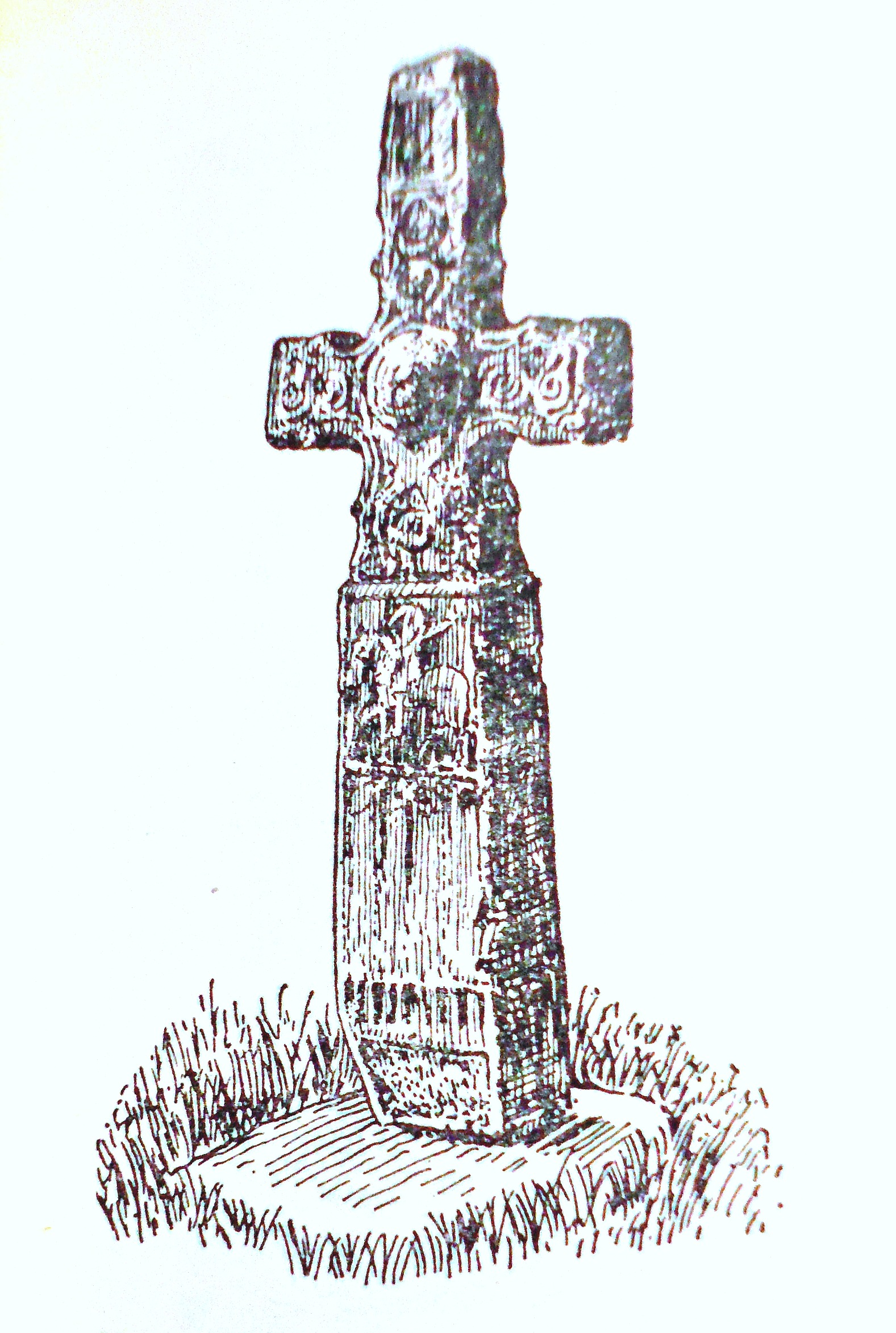
OS grid reference: NO 0190 1448. This very splendidly carved free-standing cross which is known as Dupplin Cross, has in recent years been re-housed inside the ancient church of St Serf at Dunning in the Strathearn region, Perth & Kinross, for safety’s sake as it originally stood on a hill at Cross Park Field near Bankhead Farm 1 mile to the north of Forteviot, Perth & Kinross (Os grid ref: NO 0505 1896). Forteviot was one of the Pictish ‘royal’ capitals and a palace is said to have been built there. The Dupplin cross is, infact, a Class III Pictish stone – the shaft displaying human figures and a Latin inscription – while the head of the cross has Celtic-style decoration. And also in the church, there is a Pictish cross-slab and also a Viking (hogback) tombstone. The early 13th-century church of St Serf (Servanus) is located in the centre of the village of Dunning, 3 miles south of Forteviot, 3 miles south-east of the A9, and 7 miles south-west of Perth.

Dupplin Cross (front & east side) by J. Romilly Allen.

Dupplin Cross (front & east side) by J. Romilly Allen.

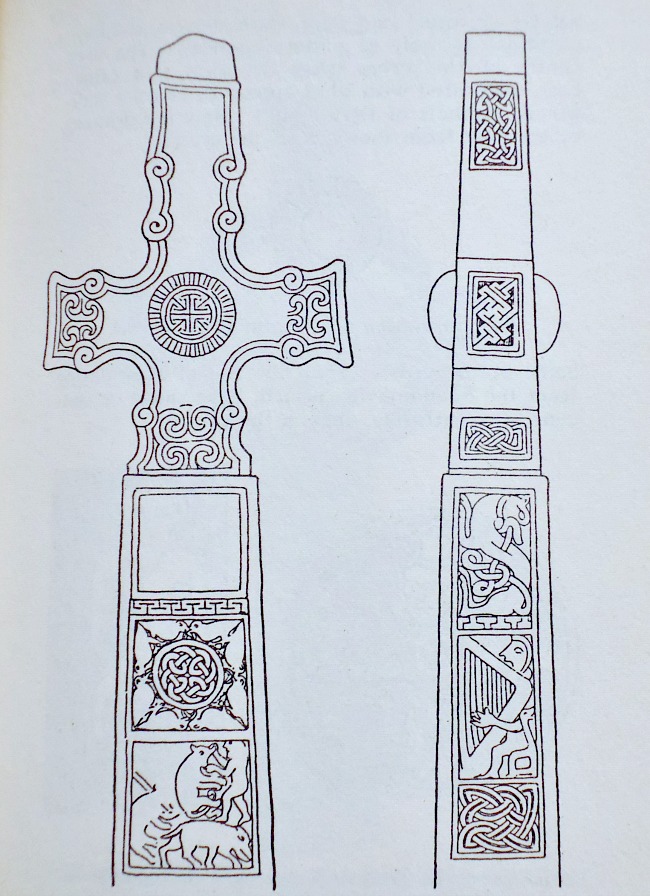
The cross is made of local hard sandstone and is 8 feet 6 inches high and 3 feet wide across its arms, and it is said to date from about 900 AD, so quite late for a Pictish stone. It is a Class III Pictish cross, but it does not have any symbols as such, although there are numerous warrior-like figures and also Biblical characters as well as ornate decoration described as being ‘Celtic’ in style. On the front face of the cross roll moulding and little spirals at intervals on the arms – with a raised circular boss at the centre which, according to the very detailed work ‘Symbolism Of The Celtic Cross’ by Derek Bryce, is “decorated with what appear to be solar radiations, symbols of Divine light”; the boss itself having a tiny cross on it. The shaft (front side) has three panels, one of which is now known to have a Latin inscription recalling the Pictish King Custantin, son of Wuirgust (Constantine Mac Fergus); the other two depict birds with crossed and interlinking beaks and legs surrounding a raised boss of interlacing, and David (from The Old Testament) tending the lion’s paw, with two more animals at the side.

The opposite cross-face has roll moulding, but the decoration in the boss is damaged, and the arms have scrollwork and key-patterning at the top. Both edges of the cross have interesting carvings – that at the left side has three panels (top) and three more on the shaft (lower) with a beast biting its tail, a man probably David seated playing a large harp, and cord-plait work. The right edge (top) has four panels of interlacing and three more on the shaft (lower) with two dogs sitting on their haunches with paws touching, two warriors on foot with sheilds and spears, and knotwork. The opposite shaft face has three panels showing a warrior on horseback, four warriors on foot holding shields and spears, a hound leaping on another animal, which is perhaps a hind, and key-patterning separating it all, according to Elizabeth Sutherland’s very thorough work ‘The Pictish Guide’.

Also in St Serf’s church is a Pictish Class III sandstone cross-slab of the 10th century? This has a broad-type Wheel or ring cross in high relief which is 3 foot 10 inches high. This slab was dug up from beneath the floor under the church tower about 1900. The cross at the top is, rather oddly, repeated lower down the slab, but only about half of it has been carved; the sides of the slab have typical Celtic interlacing, now rather worn. And a tombstone of the 10th or 11th century is thought to be a Viking hogback. This has a cross carved upon its front-side and cable moulding at its border.

St Serf or Servanus, patron of Dunning Church, founded a monastic school at Culross, Fife, in the early 6th century. Traditionally, he baptised and tutored St Kentigern (Mungo); and is perhaps wrongly accredited with the title: Apostle of Fife. He died in 560 or 580 and his feast-day is usually held on 1st July.

Sources:

Bryce, Derek., Symbolism Of The Celtic Cross, Llanerch Enterprises, Felinfach, Lampeter, Wales, 1989.

Jackson, Anthony., The Pictish Trail,  The Orkney Press Ltd., St Ola, Kirkwall, Orkney, 1989. 

Sutherland, Elizabeth., The Pictish Guide,   Birlinn Limited, Edinburgh, Scotland, 1997.

Copyright © Ray Spencer, The Journal of Antiquities, 2014.


The God Stone, St Luke’s Churchyard, Formby, Merseyside

The God Stone, Formby, Merseyside.

The God Stone.

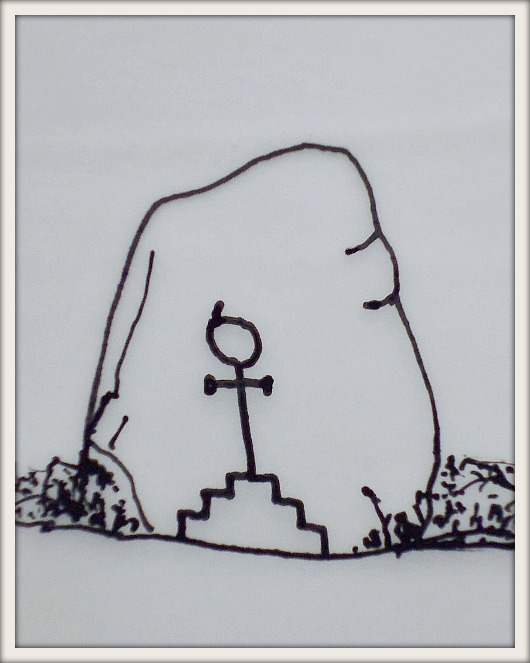
OS grid reference: SD 2800 0671. At the western side of the town of Formby, Merseyside, close to the seashore and just along St Luke’s Church Road, stands the parish church of St Luke and, almost hidden in the churchyard (west side) is The God Stone, a small oval-shaped stone that is inscribed with a thin cross standing upon some steps. It is also known as The Corpse Stone or The Cross Stone. The present 19th century church stands on a pagan site, but probably from about the early 10th century it was settled by Vikings from Ireland or perhaps the Isle of Man; the stone being placed there at that time, or maybe earlier? Also of interest in the churchyard is the wooden cross, and in the church porch the 15th century gravestone of a local giant! The seaside town of Southport is 6 miles to the north on the A565, while Crosby is 5 miles south on the same road. Liverpool city centre is 10 miles to the south.

The God Stone stands at the west side of the churchyard beneath some trees. It is 1 foot 6 inches high and is oval in shape, but below ground it becomes a short stumpy shaft which tapers away. It was apparently moved to its present position in 1879. In the early 10th century Formby (Fornebei) was a Viking settlement and a pagan one, but by about 960 the site was Christianised and, later in the 12th century a chapel was established, which would become St Luke’s. There were at least two churches on this site previous to the present-day church, which was built in 1855. It would, therefore, seem that the God Stone became a sort of marker or “rebus” to which the newly converted could ‘congregate around’ and be baptised “at” by Christian missionaries. At some stage, maybe a few centuries later, a Calvary cross was carved onto the stone by missionaries (as a representation of Christ). The curious little stone with its steps below a thin incised cross which has a circle or orb at the top (perhaps a Norse runic symbol) that ‘might’ signify commitment to Christ and ‘the climb up the steps to the cross’, and the nearness to heaven and then ‘eternal life’ (the afterlife).

In the Middle Ages and more recent times, and also to some extent in pre-Christian times, corpses were ceremononially carried around the stone three times, or maybe more in order to contain the spirit of the departed and prevent it from coming back to haunt the relatives, according to Kathleen Eyre in her book ‘Lancashire Legends’. She goes on to say that: “The practise of carrying the corpse three times around the churchyard was witnessed by an English traveller to Holland a few years ago”.  Though the author does not say who that traveller was!

Also in the churchyard there used to be an old wooden cross of uncertain age (encased in zinc) and standing upon tiered stone steps (there is now a more modern wooden cross in its place), and also the 18th century village stocks. In the church porch there is the cracked 15th century gravestone of a local giant. Actually he was none other than Richard Formby, a local man and one of the ancient family of Formby’s, who was the armour-bearer of King Henry IV (1399-1413) and who died in 1407. His tombstone was brought to St Luke’s from York Minster where it received its crack when a wooden beam fell onto it during a fire at the minster in 1829. Apparently, Richard was seven feet tall. An inscription on the gravestone reads: “Here lies Richard Formby formerly armour-bearer of our Lord and King, who died on the 22nd Day of the month of September in the year of our Lord 1407. Upon whose soul may God have mercy”- Kathleen Eyre ‘Lancashire Legends’. Housed inside the church is a crude 12th century font which came from the first building on this site. 

Sources:

Eyre, Kathleen., Lancashire Legends, The Dalesman Publishing Company Ltd., Clapham, North Yorks, 1979.

Fields, Kenneth., Lancashire Magic & Mystery, Sigma Leisure, Wilmslow, Cheshire, 1998.

http://stlukes.merseyside.org/history.html

Copyright © Ray Spencer, The Journal of Antiquities, 2014.


2 Comments

Rough Castle Roman Fort, Bonnybridge, Stirlingshire, Scotland

Rough Castle Roman Fort (Photo Credit: Wikipedia)

Rough Castle Roman Fort (Photo Credit: Wikipedia)

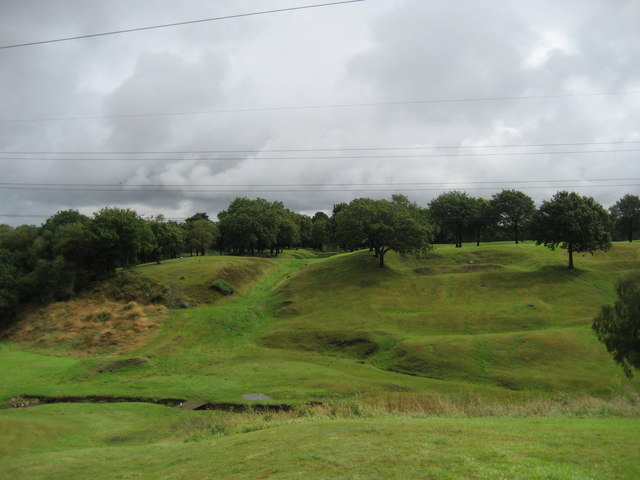
Os grid reference: NS 8435 7985. About halfway between Bonnybridge and Tamfourhill in the Falkirk region of Stirlingshire, in what “was” the ancient kingdom of Dumnonia, are the very well-defined earthworks of Rough Castle Roman Fort, a 2nd century Roman military site attached to the Antonine Wall (south side), which is ‘said’ to be one of the best preserved forts in Scotland, and certainly one of the most notable in Britain, according to the work ‘Ancient Monuments Scotland’, an HMSO guide. Although it was only a temporary fort it was well endowed with a number of military buildings and, at the east-side a bath-house, the foundations of which were discovered during a number of Archaeological excavations in the early 1900s. The fort was built upon a north-facing and very commanding escarpment, beside a ravine into which the Rowan Burn flows, which no-doubt aided the security of the fort somewhat. The town of Falkirk is 1 mile to the east and Larbert is 2 miles north.

Antonine Wall near Rough Castle (Photo Credit: Wikipedia)

Antonine Wall near Rough Castle (Photo Credit: Wikipedia)

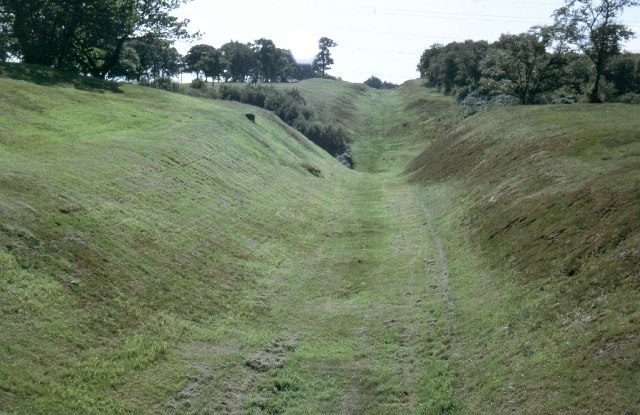
The fort stands at the south-side of the Antonine Wall (part of the north-west frontier) and, in particular, the section behind the fort (north and north-west side) with its deep-ditch and rampart is one of three that are extremely well-preserved, although the actual Roman wall itself, or what constituted as a wall at the time, has mostly disappeared leaving only the earthworks as a reminder. The Antonine Wall, built about AD 143, is actually a V-shaped ditch which was 15 Roman feet wide with a rampart of turf on a stone base, a military way that ran for 36 miles (40 Roman miles), linking the Firth of Clyde at Old Kilpatrick in the far west, to the Firth of Forth at Bo’ness in the east. It was built soon after AD 143 to a planned line, earlier set out by Julius Agricola (c 80 AD), by the legate Lollius Urbicus and named after the emporer at the time, Antoninus Pius; but militarily it was nothing like Hadrian’s Wall, although it was called ‘a permenent frontier’ at the time of building, and that’s what it was to remain – in the landscape at least.

Rough Castle For, a drawing by William Roy 1755 (Photo Credit: Wikipedia)

Rough Castle Fort, a drawing by William Roy 1755 (Photo Credit: Wikipedia)

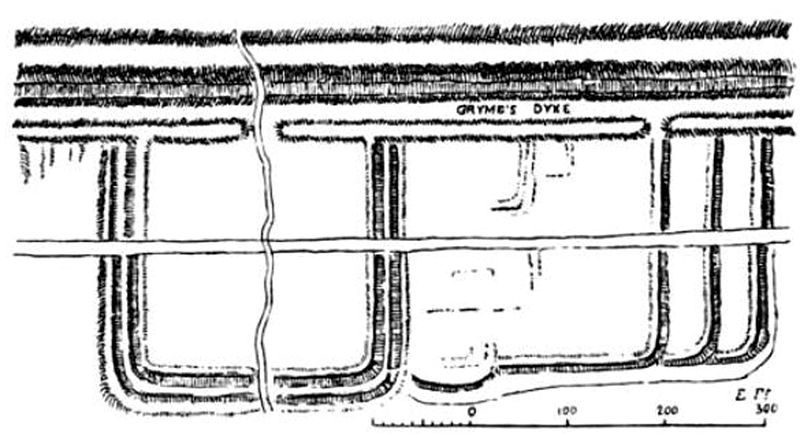
The Rough Castle fort covered about 1 acre, so fairly small compared to some of the forts in England and Wales. It was called a ‘wall fort’ because it abutted up against a Roman wall, in this case the Antonine Wall. Typically it was square-shaped with curved corners but with no lookout towers, although there were the usual four side entrances at the N.S.E.W. Built around 142 AD as a temporary fort, spaced at a two mile interval with its near neighbours – Seabeg to the west and Watling Lodge to the east; at Watling Lodge there is another well-preserved section of the Antonine Wall. But Rough Castle only lasted for just over 20 years, and by 163-4 AD the wall and its 19 small forts and 14 temporary forts were abandoned, Hadrian’s Wall further to the south being occupied instead! However, for a short period around 210-11 AD Rough Castle was re-occupied. The double ditches and ramparts of the fort, and its annexe are well-preserved, especially at the east, south, and western sides, that at the north-side being the much deeper defensive ditch and steep rampart of the Roman wall.

During Archaeological excavations in 1902-3 the foundations of numerous buildings were discovered within the fort and, in the annexe a bath-house, including: an headquarters block, barrack block, commandant’s house and a granary; also a series of defensive pits (lilia) outside the Antonine ditch on the left front of the fort were found, according to the work ‘Ancient Monuments Scotland’, which goes on to say that: “Two inscriptions identify the garrison, the 6th Nervian cohort”, one of six infantry units of up to 500 men from north-eastern Gaul who were honoured with the title ‘Brittanica’, according to the very excellent work of I. A. Richmond ‘Roman Britain’. Further excavations took place at the fort in 1932, 1957 and 1961.

Sources:

Bedoyere, Guy de la., The Finds of Roman Britain, B.T. Batsford Ltd., London, 1989.

Breeze, David. J., Historic Scotland, Batsford Ltd., London SW6, 1998

Canmore/Rcahms Site Page  http://canmore.rcahms.gov.uk/en/site/46803/details/rough+castle/

H. M. Stationery Office, Ancient Monuments Scotland, Illustrated Guide, Volume VI, Edinburgh, 1959.

Photo Credits (nos 1&3)  http://en.wikipedia.org/wiki/Rough_Castle_Fort

Photo Credit (no 2)  http://commons.wikimedia.org/wiki/File:Antonine_Wall_near_Rough_Castle_Fort.jpg

Richmond, I. A., The Pelican History Of England 1 Roman Britain, second edition, Penguin Books, Harmondsworth, Middlesex, 1963.


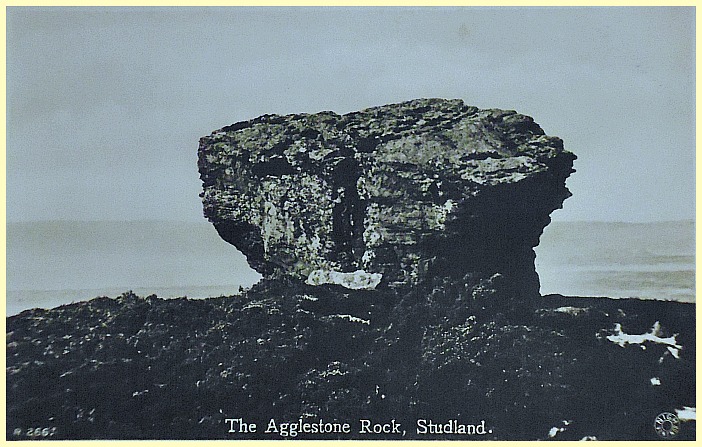
The Agglestone, Studland Heath, Isle of Purbeck, Dorset

The Agglestone on Studland Heath, Dorset.

The Agglestone on Studland Heath, Dorset, early 1900s.

OS grid reference: SZ 0236 8282. On Studland Heath, 1 mile north-west of the village of Studland on the Isle of Purbeck, stands a strange rock formation called The Agglestone, which has now fallen on its side. Locally, it has associations both in myth and legend with the devil, who is said to have hurled the rock from the Needles on the Isle of Wight, to where it stands today but, as we all know and is often the case, he missed his target by many miles. But this strange rock formation has been gradually eroded away over many thousands of years by natural forces, ie the weather. The town of Swanage is 2 miles to the south, while Corfe Castle is 5 miles to the west, just off the B3351 Wareham road.

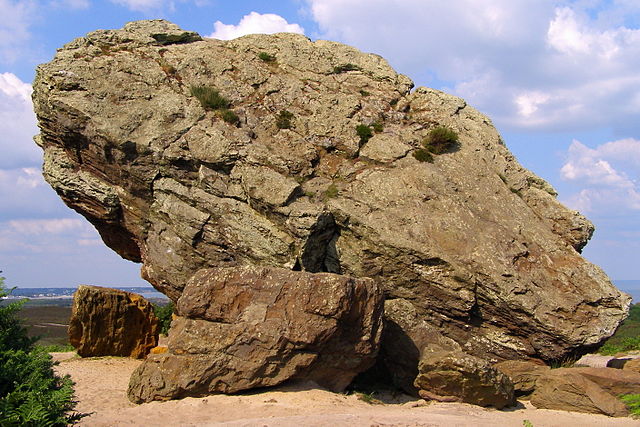
The Agglestone close-up (Photo Credit: Wikipedia)

The Agglestone close-up. Photo Credit: Jim Champion (Wikipedia)

The strange-shaped Agglestone Rock is 20 feet high and is estimated to weigh 400 tonnes. It is perched upon a conical-shaped hill and is made of tertiary Sandstone, according to Wikipedia. Also known as the Devil’s Anvil, due to the shape we see today, or the Devil’s Nightcap. The name Agglestone could in fact be a derivation of Eagle Stone and, maybe locally ‘wobble stone’ because “aggle” is the local name for ‘wobble’ or ‘wobbly’, apparently! It is said, according to the myths and legends associated with the rock, that the Devil in anger decided to hurl it from the Needles on the Isle of Wight (where he just happened to be standing) to Corfe Castle to which he had taken a dislike, according to Janet & Colin Bord in their book ‘The Enchanted Land,’ or perhaps the city of Salisbury where the great cathedral stands, or was he aiming at Bindon Abbey near Wool in Dorset. It is also possible, I would think, that the Devil intended the large rock to hit Christchurch, Dorchester, or maybe even Wimborne Abbey; in fact, just about any Christian community in the south and south-west of England was in his reach, and quite a reach that would be!

Sources:

Bord, Janet & Colin., The Enchanted Land, Thorsons, Hammersmith, London W6, 1995.

Photo Credit:  Jim Champion:  http://en.wikipedia.org/wiki/Agglestone_Rock

http://www.megalithic.co.uk/article.php?sid=12260

Copyright © Ray Spencer, The Journal of Antiquities. Updated 2021.


2 Comments

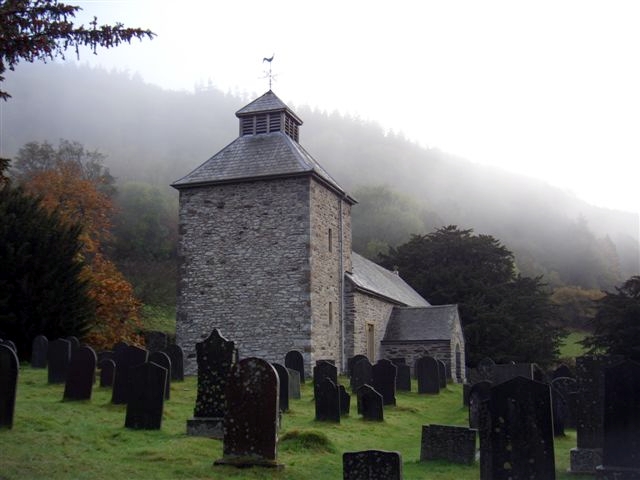
St Melangell’s Church, Pennant Melangell, Powys, Wales

St Melangell's Church, Pennant Melangell (Photo Credit: Wikipedia)

St Melangell’s Church, Pennant Melangell (Photo Credit: Wikipedia)

OS grid reference: SJ 0241 2654. In the valley of the river Tanat, at the foot of the Berwyn mountains, northern Powys, is the lonely and remote hamlet of Pennant Melangell and St Melangell’s Church, which is dedicated to a 7th or 8th century Welsh princess called Melangell or Monacella, patron saint of hares and rabbits. The partly Norman church houses the 12th century shrine of St Melangell as well as her grave; also in the church are two 15th century wood-carvings depicting the saint’s legendary life, two medieval stone effigies, and a Norman font. The church at Pennant, its original name being Llanmelangell-yn-Pennant, has been a place of devout pilgrimage since at least the 10th century. About a quarter of a mile to the south of the remote hamlet amongst an outcrop of rocks is the saint’s so-called stone bed (Gwely Melangell). The hamlet of Pennant Melangell lies just off the B4391, whilst the town of Bala is 8 miles to the northwest, the village of Llangynog is 2 miles to the east, and Lake Vyrnwy is 4 miles due south.

According to legend, Melangell was the daughter of King Cyfwlch Addwyn – the very same Cyfwlch who is mentioned in the ‘Tales of Culhwch & Olwen’ as being a member of King Arthur’s court; he was also said to have been related to St Helen of Caernarvon, the famous Helen Llwddog (Helen of the Legions) who married the Roman general, Magnus Maximus (Macsen Wledig), although a few have considered her to be of Irish birth, and perhaps the daughter of a King Jowchell? Melangell fled from her father’s court to avoid marrying an unsuitable partner, wishing instead to seek a life of prayer and devotion to God. She came upon the wooded valley of the Tanat (c590 AD), finding it much to her liking; indeed she lived in a cave at Gwely Melangell to the south of the present-day hamlet that bears her name. Here in an outcrop of rocks the saint’s so-called stone bed is to be found, although the stone is probably a natural-rock feature. Soon local people got to know of Melangell and came to see her, some women even left their babies for her to nurse; to Melangell all wild creatures were very dear to her, even the trees and flowers gave her great pleasure.

But the best part of ‘The Legend’ says that one day a local prince Brochfael Ysgthrog of Pengwern came hunting in the valley, and when one of his hounds gave chase to a hare it ran for protection beneath St Melangell’s robe. When the prince came upon this sight he was literally ‘stopped in his tracks’ at the very sight of such a radiant young woman, his hounds refusing to kill the hare. Prince Brochfael, having inquired as to her name (she informed him it was Melangell), then asked her to marry him, but she told the prince that that was not possible because ‘she only wanted to live her life for Christ in peaceful Pennant’. Prince Brochfael was not really surprised at her answer, so instead he gave her some land at Pennant on which to build a nunnery for local women (c604); the present-day church presumably stands on the site of that building.

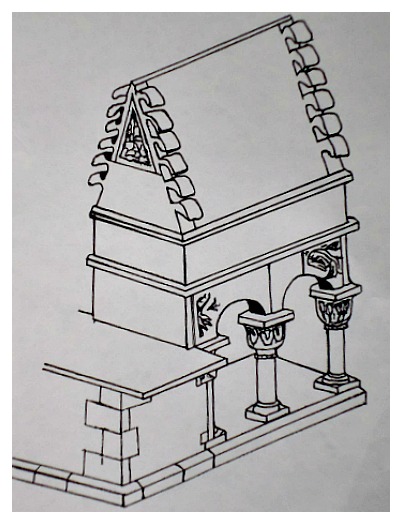
St Melangell's Shrine at Pennant Melangell Church.

St Melangell’s Shrine at Pennant Melangell Church.

In the early part of the 7th century St Melangell died and she was buried in the church, or chapel, one of two that had stood here prior to the present-day building, which stands in a circular churchyard, a feature that means it is a sacred site and possibly a Bronze-Age settlement? The yew trees are thought to date back 2,000 years, and some of the foundation stones of the church may date back to 800 AD. Today the building houses The Melangell Centre, but in the chancel stands the shrine of St Melangell, dating from 1170, a Romanesque structure that was beautifully restored in 1958 and, which originally stood at the east side of the church in the Cell-y-Bedd (Cell of the Grave) where the saint was ‘said’ to have been buried. A stone slab believed to have once marked the saint’s grave is now built into the apse floor. Here at this remarkable stone structure pilgrims sought a miraculous cure, offering their prayers and votive messages to St Melangell, which continues today in one form or another.

On the restored oak loft-screen are two 15th century wood carvings which are part of a frieze that depict ‘the legend’ of Melangell and Prince Brochfael, and in the chancel two 14th century stone effigies, one of which is Melangell with a hare at her side, while the other is of Prince Madoc ap Iorwerth Drwynden, son of Owain Gwynedd, king of North Wales. Madoc was treacherously murdered at Bwlchgroes by his own brother’s followers so that his brother, Dafydd, could ascend to the throne of Powys before his time. The carved 15th century rood-screen, now also restored, is a delight as is the 12th century Norman font.

The killing of hares and rabbits has long been forbidden in Pennant Melangell because it is believed they are sacred animals under the protection of St Melangell; the people in the parish still honour this custom. She is patron saint of hares and rabbits, which are known locally as ‘Monacella’s little lambs.’

Sources:

Photo Credit: http://en.wikipedia.org/wiki/File:Eglwys_Santes_Melangell.JPG

Barber, Chris.,  More Mysterious Wales, Paladin, London W1X, 1987.

Jones, Andrew., Every Pilgrim’s Guide To Celtic Britain And Ireland, The Canterbury Press, Norwich, Norfolk, 2002. 

Spencer, Ray.,  A Guide to the Saints Of Wales and the West Country, Llanerch Enterprises, Felinfach, Lampeter, Wales, 1991. 

Spencer, Ray., Historic Places in Wales – An Exploration of the Fascinating and Mysterious, (Unpublished Manuscript), Nelson, Lancashire, 1991.

Copyright © Ray Spencer, The Journal of Antiquities, 2014 (updated 2023).


The Rock Cones Of Urgup, Cappadocia, Turkey

Urgup in Cappadocia (Photo Credit: Wikipedia)

Urgup in Cappadocia (Photo Credit: Wikipedia)

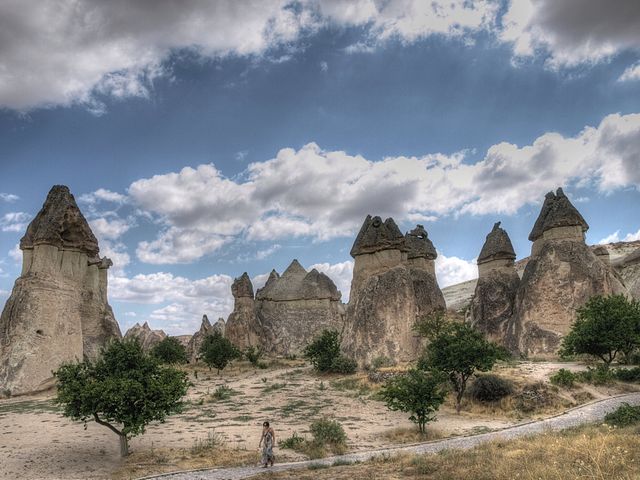
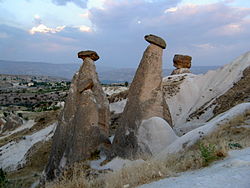
Latitude 38.660046 & Longitude 34.853611. On the Anatolian Plain in the Zelve region of Cappadocia, some 140 miles south-east of the capital city Ankara and 2 miles north-east of Goreme, stand the famous Rock Cones of Urgup, with hundreds of naturally-formed rock citadels: pinnacles, cones, domes, columns and pyramid-shapes, resembling giant mushrooms, which are known locally as Fairy Chimneys.

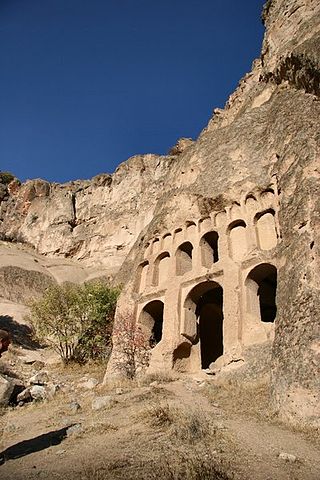
Since the 4th century Christian ascetics have sought sanctuary in some of the larger rocky structures and carved out churches and chapels from them, indeed some of the rock faces, nearby, have some quite astonishingly ‘beautifully’ hewn-out places of refuge and worship, while underground there are literally hundreds of subterranean cave-like dwellings, with passage-ways linking rock-cut rooms and buildings, many on different levels, with boulders that could be rolled into position across doorways in case of attack. But going further back – in the 1st century AD St Peter the Apostle is said to have brought Christianity to Anatolia, and then in the 4th century St Basil, bishop of Caesarea (now called Kayseri, 50 miles to the east), urged monks and hermits who were fleeing from persecution to follow an ascetic life on the Plain of Urgup and the Goreme Valley, nearby.

Fairy Chimneys of Cappadocia (Photo Credit: Wikipedia)

Fairy Chimneys of Cappadocia (Photo Credit: Wikipedia)

There are many hundreds of rock pinnacles, resembling lofty chimneys that seem to nearly touch the sky in places, which have been shaped by erosion and the softer rock around them gradually worn-away over millions of years to form the alien, moon-like landscape of today; many of the pinnacles being over 100 feet high (30-40 metres) and having windows and doorways, many even being joined together to form communities of people, with many more having churches and chapels built inside them. And below ground there are vast cavenous-like structures: tunnels, galleries, and passage-ways, with several different levels of underground buildings and rock-cut rooms. The main entrances have large boulders standing ready in position so that they could be rolled across in case of an attack from the outside, and if any would-be invader did get inside they would find the maze of passage-ways bewildering, if not down-right dangerous, and they would be dealt with in due course! A few of the larger, more interesting churches still retain their original medieval frescos, a lasting tribute to the monks and hermits who painted them many centuries ago.

A Rock Church in Cappadocia (Photo Credit: Wikipedia)

Rock Church,  Cappadocia (Photo Credit: Wikipedia)

These underground towns, cities, and communities of people would have been largely self-sufficient; they even had their own stables attached – both above and below ground, and also their own water supply through pools and large stone tanks. However, by the 13th century the rock chimneys of Urgup were being abandoned, and only a few solitary hermits and priests continued to live here in an equally solitary residence, but the man-made rock churches and chapels did continue to be ‘in use’ until more recent times, and today they are a tourist attraction, with some 600 or so churches surviving both at Urgup and at nearby Goreme – including the churches of St John the Baptist, St Barbara, St Basil, Church of the Apple and Tokali.

The geography of the Urgup and Goreme area is summed up as being: these strange rock formations were shaped over 8 million years or so to form what we see today. The cones or pinnacles have survived because they are formed from a much harder rock than the soft rock plateau that had originally surrounded them -which has worn away to leave the strange chimney-like shapes and, at the top of each cone a bulbous lump of basalt and small boulders has fused together, providing protection to the lower rock structure itself, looking like a sort of top-knot, perhaps, and giving each cone a chimney-like appearence – hence the local name ‘fairy chimneys.’

In the Reader’s Digest book ‘Strange Worlds Amazing Places’ the geography of this region is outlined in detail: “The process that shaped this unique landscape began when the volcanoes of Cappadocia erupted about 8 million years ago. They deposited countless layers of ash, lava, debris and mud, raising the altitude of the land by more than 1000 feet (300m) to form a prominent plateau.”

“Millions of years of compression turned the volcanic ash into a soft, pale rock called tufa. This was overlaid by a thinner layer of dark, hardened lava known as basalt. As the basalt cooled, it contracted and split, laying itself open to the erosive action of the weather. Streams and floods crisscrossed the plateau, cutting ever deeper, and earthquake shocks and winter frosts helped break up the layers of tufa and basalt.”

“Today the process of erosion continues, slowly wearing down the pinnacled landscape and exposing the multi-coloured layers of earth. These range from the palest tufa, through tones of ochre, russet and deep chestnut (caused by mineral impurities), to the black of the basalt.” Another Reader’s Digest publication ‘Book of Natural Wonders’, tells a similar story.

Sources:

Reader’s Digest, Strange Worlds Amazing Places, The Reader’s Digest Association Ltd., London W1X, 1994.          

Reader’s Digest Book Of Natural Wonders, The Reader’s Digest Association, Inc., New York, 1980.

Michael’s Guide Turkey, (series editor: Michael Shicor), Inbal Travel Information Ltd., Tel Aviv, Israel, 1990. 

Photo Credits:  http://en.wikipedia.org/wiki/Cappadocia

http://www.turkeytravelcentre.com/blog/cave-churches-cappadocia/

Copyright © Ray Spencer, The Journal of Antiquities, 2014.


2 Comments

Rosamond’s Well, Blenheim Park, Woodstock, Oxfordshire

Fair Rosamund's Well, Blenheim (Photo Credit: Philip Halling - Geograph)

Fair Rosamund’s Well, Blenheim (Photo Credit: Philip Halling – Geograph)

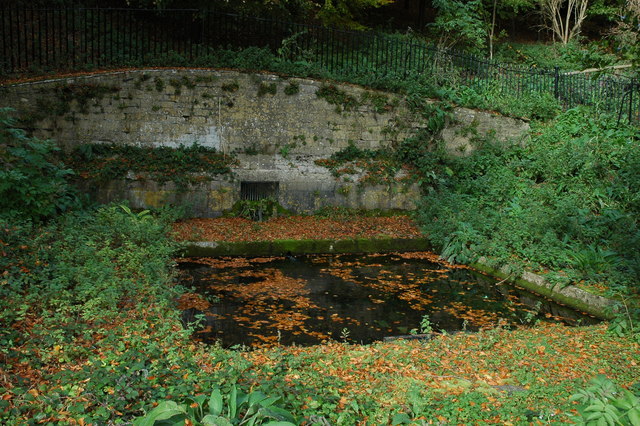
Os grid reference: SP 4365 1647. At the north-side of the lake in Blenheim Park at Woodstock, Oxfordshire, is Rosamond’s Well, also known as Fair Rosamund’s Well. It takes its name from Lady Rosamond de Clifford who was to become the lover (Mistress), for her sins, of King Henry II, although probably not ‘entirely’ out of her own choosing! Fair Rosamond, it is said, was “supposedly” murdered by a very jealous Queen Eleanor in about 1175, or was she? But back in the 12th century the well was called Everswell, maybe because it was ‘never ever’ known to run dry, even in the driest spells of weather; and in the past the water had some curative properties as pilgrims were wont to come here and partake of it in bottles – in those distant times, but in fact the well has only been named after Rosamond since the 16th century. The village of Woodstock is a quarter of a mile east of the well, while Bladon is half a mile south, and the town of Long Harborough 2 miles south-west on the A4095 road.

Godstow Nunnery Ruin (Photo Credit: Wikipedia)

Godstow Nunnery Ruin (Photo Credit: Wikipedia)

Poor Rosamond was buried at Godstow nunnery, a house of Benedictine nuns dedicated to St Mary and St John the Baptist, which is now in ruins beside the river Thames, near Oxford. It was founded by the widow Edith Launceline in 1133, dissolved in 1539, and almost destroyed during the Civil War in 1645 or 46. Today the ruin acts as a pound for local farm animals. There are only fragmentary remains of the precinct wall and chapel of abbess’ lodging, according to Frank Bottomley in his book ‘The Abbey Explorer’s Guide’, 1981. The nunnery ruins are two-and-a-half miles north-west of Oxford city centre.

Today the well looks quite neat and tidy, and is surrounded by a fence, in what is a very tranquil setting close to the north bank of Blenheim Lake – in the green and wooded grounds of Blenheim Palace. The well is actually a large square-shaped pool paved all around with flat paving stones, while at the head of the pool a high, curving wall with carvings, and a square opening for the water to issue into the pool itself; the water then flowing out into the lake. Foliage and trees grow at either side of the structure, which is soon to be restored. The water is usually quite near to the top of the pool, indeed it is never known to go down by much nor to dry up when there is a prolonged spell of dry weather. Close by is Rosamond’s Bower where Lady Rosamond, daughter of Walter de Clifford, lived before her untimely death (in strange circumstances) at the age of 35 in the year 1175 – murdered, according to the legend, by Queen Eleanor after she had found out that Fair Rosamond was her husband’s concubine. However, it is said that only the king knew the route to Rosamond’s secret bower, a sort of underground labyrinth built for her by King Henry.

Fair Rosamond was buried at the Benedictine nunnery of Godstow in Oxfordshire. In the book ‘A Thames Companion’ by Prichard & Carpenter, the authors say: “On the main stream of the river, Godstow comes next with its ruined nunnery and legend of Fair Rosamond, of which Aubrey wrote (in a manuscript note inside his copy of Plot’s Natural History of Oxfordshire, now in the Bodleian Library): This Rosamond, ye fair daughter of Walter Ld. Clifford, and forced to be Concubine to K. Henry ye 2d, who builded for her at Woodstock an house or Labyrinth under the ground, much wherof at this day is to be seen as also is a goodly Bath or Well, called to this day Rosamund’s Well. In the end she was poysoned by Q. Elianor, some write, and being dead, was buried at Godstow in a house of Nonnes besides Oxford. Not long since her grave was digged, where some of her bones were found, and her Teeth so white (as ye dwellers there report) that the beholders did much wonder at them.”

Sources:

Photo Credit: © Copyright Philip Halling and licensed for reuse under this Creative Commons Licence.

Geograph: http://commons.wikimedia.org/wiki/File:Fair_Rosamund’s_Well,_Blenheim_-_geograph.org.uk_-_1015851.jpg

Wikipedia: http://en.wikipedia.org/wiki/Godstow

Bord, Janet & Colin., Sacred Waters, Paladin Books, London W1, 1986.

Bottomley, Frank., The Abbey Explorer’s Guide, Kaye & Ward Ltd (The Windmill Press), Kingswood, Tadworth, Surrey. 1981.

Prichard, Mari & Carpenter, Humphrey., A Thames Companion, (2nd Edition), Oxford University Press, Oxford OX2, 1981.


1 Comment

The Sandbach Crosses, Cheshire

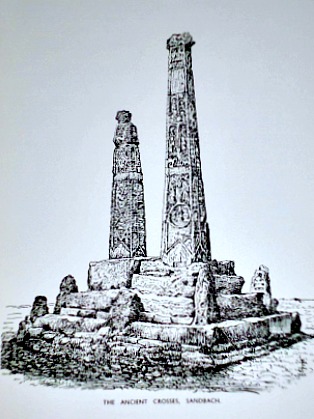
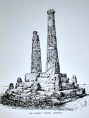
The Ancient Crosses, Sandbach (1886)

The Ancient Crosses, Sandbach (1886)

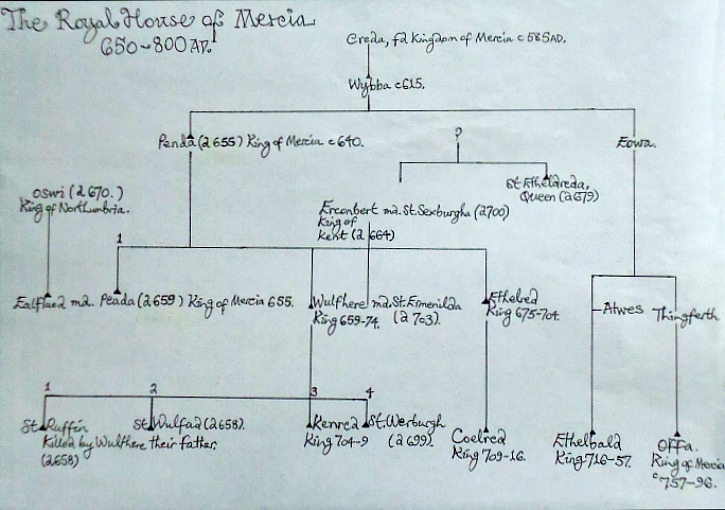
OS grid reference: SJ 7587 6082. In the cobbled market-place opposite the High Street at Sandbach, Cheshire, and at the back of St Mary’s church – are two tall Anglo-Saxon crosses known as The Sandbach Crosses, said to date from the 8th or 9th century, or maybe even earlier. They are in fact Mercian crosses because this area came under the jurisdiction of that kingdom during the 7th century AD, which was ruled by the pagan King Penda, and his son Paeda, who became a Christian; the crosses being ‘supposedly’ set up to commemorate the conversion to Christianity of Paeda following his business trip to the kingdom of Northumbria where he married a Christian princess called Alchfleda or Ealfleda, daughter of King Oswy. Four northern missionary priests: Adda, Betti, Cedd and Diuma accompanied the newly-married couple back to Mercia, and there the four ‘holy men’ set about spreading ‘the word of God’ in the kingdom of Mercia itself, perhaps even establishing a monastery at Sandbach, according to the Venerable Bede. They appear to have been succesful, especially when Paeda succeeded his father as king of Mercia in 655; Paeda died four years later in 659. The crosses ‘were’ said to have been set-up a few years earlier in 653 AD.

Both crosses were heavily restored after being virtually destroyed by Puritans in 1614 and then suffering the fate of being used as building material in various structures, in a well, and even as paving-stones in the town’s streets. The carved, sculptured stones that formed the two crosses were eventually very hurridly taken away to various places in Cheshire (by some eminent local notaries) – before being brought back and re-erected in the market-place at Sandbach in September 1816.

In the work of the antiquarian Miss E. Egerton ‘The Saxon Crosses – Sandbach, Cheshire – An Illustrated Description And History’, regarding the destruction of the crosses she says that: “Sir John Crewe took several pieces to Utkinton , and set them up as ornaments in his grounds. When he died they were taken to Tarporley, to the Rectory by Mr. Allen, where Mr. Cole, a distinguished Antiquarian, saw them, made drawings of them, and now they are to be seen in British Museum along with his other M.S.S. Later these stones were found to be deposited at Oulton Park, owned by Sir John Egerton. For a number of years the Crosses remained in a state of mutilation, but as Sandbach grew the inhabitants decided to have the Crosses restored and re-erected.”

But the two sculptured crosses, despite being battered about, are still “outstandingly” well-carved with scenes from the bible and notable moments from royal Mercia in the mid-7th century AD. It is thought highly likely that a third small cross once stood beside the two in the market-place, indeed the pieces of carved stone on the ground beneath St Mary’s church-tower, nearby, may have come from that ‘lost’ cross?

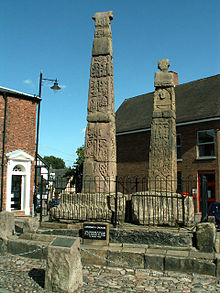
The taller of the two high crosses is almost 16 feet (4.8) metres high, while the smaller one is almost 11 feet (3.3) metres high, although they would originally have been taller if they had not lost their cross-heads. The carvings are in varying sized sections (panels) down each face and, although these carvings do not always quite match-up, generally they are pretty good considering what they had been through!
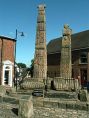
Sandbach Crosses (Photo Credit: Wikipedia)

Sandbach Crosses (Photo Credit: Wikipedia)

The taller cross is made-up of eight pieces of stone, some more recent, standing upon a large base and a stepped plinth, decorated with biblical scenes in sections (panels). At the top there is a broken, round-shaped  cross-head, now only a quarter of it remains. The east face is apparently the most interesting, maybe because it deals with Christ’s crucifixion, his baptism, and also “his” transfiguration in early Christian motifs. In the centre Christ on the cross with the two Mary’s at his side, and the emblems of the four evangelists formed by the limbs of his cross, while below that Jesus in the manger, with an angel above and an ox at each side. At the top, just below the head, two mutilated figures and, below that the intruments of the passion – a hamer and pair of pincers. Toward the bottom ‘The Annunciation of the Virgin Mary’ and above her the holy ghost in the form of a dove. Below that a circle with the Virgin Mary, St Elizabeth and St John.

The west face shows Christ’s passion: near the top four figures may be the evangelists, while further down Christ is bound with a cord, with a man in front dragging him (by the cord) towards Pilate. At the centre Simon of Cyrene carries the cross, and in front of him a figure carrying a club, or a lance, and just below the middle the Angel Gabriel visits Zacharias (seated) in the temple; the bottom panel shows two dragons. The north face has ‘The Descent of the Holy Ghost’ with a long-tailing dragon; the other panels going downwards have ten Apostles in two columns, each in his own compartment but on a different level, although ‘seemingly’ able to communicate with his neighbour! And the south face is adorned with interlacing, filigree work, and vine-scrolls, and a number of animals trapped inside the scrolls – representing John the Baptist in the Wilderness.

The smaller cross is largerly a 19th century reconstruction, its broken Maltese-style head may have come from a third small cross. It is made up of many panels in which there are numerous creatures and human figures. The north face depicts Paeda’s journey to the north. At the top two dragons with their tongues interlinked, below that two rows of compartments or rooms with a figure inside (walking), some carrying dagers in their hands. While the south face shows more figures, these ones quite well-carved and clear, in arched compartments and holding staves, while at the bottom two angels are looking upwards.

The Royal House Of Mercia.

The Royal House Of Mercia.

The east face consists of five diamond-shaped compartments. At the top a bull (meaning strength) with its head inclined backwards, while below that a human figure inside the diamond-shape with his hands ‘going’ into his sides, maybe representing King Penda, and above and below the king’s noblemen. In the centre of the cross Alchflaeda, princess of Northumbria, with her two attendants. At the bottom King Paeda of Mercia in a diamond-shape with two noblemen. The west face is damaged at the top, but the lower section is very good. Here we have the conversion to Christianity of Paeda with a dove coming to rest on his shoulder, while below him in arches are his many followers, and at the bottom two angels looking up.

Sources:

Anderton, Bill., Guide To Ancient Britain, Foulsham, Slough, Berkshire, 1991.

Burgess, Rodger., Cheshire – Secrets from the Past, Sigma Leisure, Wilmslow, Cheshire, 2000.

Egerton, E, Miss., The Saxon Crosses – Sandbach, Cheshire – An Illustrated Description And History (2nd Edition), Chester, 1934. (Reprinted by: The Rotary Club of Sandbach, December 1986).

English Heritage: https://www.english-heritage.org.uk/daysout/properties/sandbach-crosses/history-and-research/

Wikipedia: http://en.wikipedia.org/wiki/Sandbach_Cross

Copyright © Ray Spencer, The Journal of Antiquities, 2014.