The Journal Of Antiquities

Ancient Sites In Great Britain & Southern Ireland


San Miguel de Arrechinaga, Markina-Xemein, Biscay, Northern Spain.

Latitude 43.267458. Longitude 2.49396. The little Basque town of Markina-Xemein in the Pais Vasco, province of Bicay, north-eastern Spain is much like any other town in the Basque Country, but here we have a very curious site. The little church and hermitage of San Miguel de Arrechinaga stands just across the bridge at the western side of the town on the Xemein Etorbidea road. It is built around three huge megaliths or, a dolmen? The town is situated on the main B1 633 road running north-east to south-west. Bilbao is some 26 miles to the west, while the town of San Sebastian is about the same distance to the east.
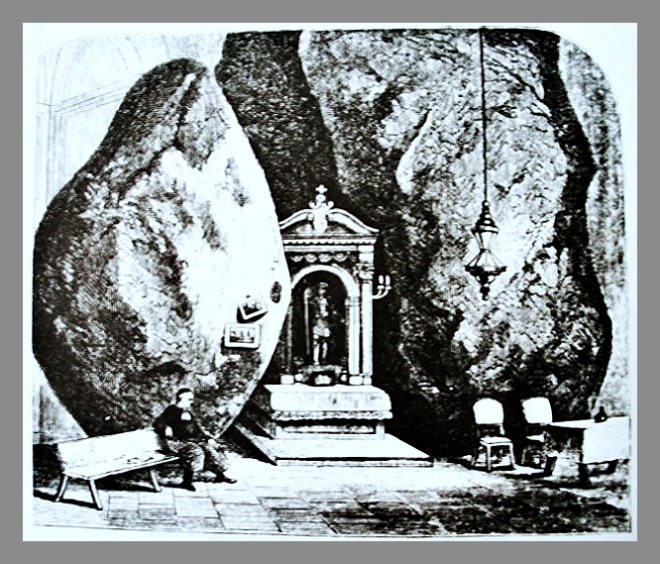
San Miguel de Arrechinaga, Markina-Xemein, Spain

Although the huge stones within the sanctuary of San Miguel’s church have often been referred to as a prehistoric dolmen, it is almost certain they are not. In fact, they owe more to geographical history. The three odd-shaped, gnarled and distorted boulders are probably the eroded remains of a huge rock outcrop from the hillside that was formed in the Tertiary period many hundreds of millions of years ago, perhaps 40 million years ago? At least that is the general consensus. So, in other words, they are a natural feature, and nothing to do with prehistory.

In the Middle Ages, according to legend, a local hermit came to live here and built his cell beneath the huge stones. His name was perhaps St Pollonio. Later, a church was built around the three stones and the hermitage, a site that was by that time revered as a place sacred to St Michael the Archangel, patron saint of high places. In the 18th century a new church was built around the curious stones. The three stones support each other in an interlocking sort of way; the largest of the three at the back lies over the top of the front two stones, supporting the whole structure. At the front and between the stones stands the main altar and a shrine inside which stands a very nice statue of St Michael (San Miguel) and a reliquary of St Pollonio – the whole thing looking as though it were made to be this way. A 14th century altar-piece can be seen in the church – though this is often locked away for security reasons. The floor of the church is hexagonal, while the roof is pyramid-shaped with a cupola in the centre of the ceiling and a rather large, radiating key-lock boss. St Miguel’s entrance door has an upper axis over which stands a belltower.

Legend says that a young man must pass three times underneath the huge stones if wishing to be married the following year; this is said to still take place even today. One rather far-fetched local legend claims that St Michael killed and then buried the devil beneath the boulders long ago before the church was built on the site – something that is said of other churches with a dedication to this saint located upon high places or rocky outcrops.

Sources:-

Fergusson, James., Rude Stone Monuments In All Countries, London, 1872.

Click on the following link  http://www.blogseitb.us/basquetourism/2010/11/28/san-miguel-de-arretxinaga-a-very-peculiar-church/

Click on the following link  http://hispanismo.org/senorios-vascongados/5613-curiosidades-san-miguel-de-arrechinaga-marquina-vizcaya.htm

© Copyright, Ray Spencer, 2012.


St Boniface Church, Papa Westray, Orkney Isles

English: St Boniface Kirk, looking towards Westray

St Boniface Kirk, Papa Westray (Photo credit: Wikipedia)

OS grid reference: HY 4882 5270. At the far north-west corner of Papa Westray overlooking the cliffs of Runnapitten, about half a mile north of the hamlet of Holland and a little to the west of Kirk house, stands the tiny medieval church of St Boniface. This was the site of a 7th or 8th century monastery and the probable site of a Pictish settlement. But the area around the church also has some Bronze-Age and Iron-Age antiquities – there was a 10-foot-high prehistoric roundhouse, or broch, just east of the church where an Iron-Age settlement existed, though nothing much remains of that now, apart from the earthworks. In the churchyard of St Boniface’s there is a Viking hog-back gravestone, which would also mean there was a Viking settlement here, and part of an early Pictish cross-slab – originally there were two stones with crosses carved onto them, excavated in the churchyard. These were removed for safety to nearby museums.

The little church (kirk) dates from the 12th century but there was probably a monastery on the site back in the 7th or 8th century AD, founded by St Boniface, bishop of Ross in Scotland; indeed the place is sometimes called Munkerhouse (monks’ house). St Boniface and his Celtic monks would have served the Pictish community here and converted this dark age tribe to Christianity at the beginning of the 7th century. Historians place the death of St Boniface at c. 630 AD, though some have placed his death in the early 8th century. He founded over one hundred churches in the north of Scotland, including the one on Papa Westray, Orkney. His feast day is given as 14th March. In 1700 the little church was enlarged, but by 1930 it had been abandoned and left to become ruinous. However, in 1993 it was fully restored both inside and out, and is now in use once again for services.

Close to the churchyard wall, amongst more modern gravestones, there is a Viking hog-back tomb stone from the 11th or 12th century? although this is now very worn and it is difficult to see any of the carving. According to legend, this marked the grave of Earl Rognavald Brusison who was the nephew of St Magnus the martyr of Kirkwall. Close by, part of a Pictish cross-slab; the main part of the stone being removed for safety to the National Museum of Scotland at Edinburgh. This slab was carved with a circular cross and also an incised cross. In 1966 a second Pictish cross-slab was excavated from the north-east corner of the churchyard. This had a Pictish-style cross and a circle with a small decorative cross inside, but for safety reasons is now housed in the Tankerness House Museum in Kirkwall.

Sources:-

Tait, Charles., The Orkney Guide Book (Edition 2.1), Charles Tait Photographic, Kelton, St.Ola, Orkney, 1999.

Armit, Ian., Celtic Scotland, B T Batsford, London, 2005.

Click on the link for a photo of the hog-back tombstone at St Boniface. http://www.google.com/imgres?num=10&hl=en&biw=1093&bih=503&tbm=isch&tbnid=hdKQOtI930kZnM:&imgrefurl=http://globetrotter-games.com/travel/Photo2002Orkney/OrkneyIndex.htm&docid=c-A3Oe3fBHqsfM&imgurl=http://globetrotter-games.com/travel/Photo2002Orkney/020912_051_Papa_Westray_-_Hogback_at_St_Boniface.jpg&w=400&h=267&ei=k6tgUOzmHuK-0QWvmYCICQ&zoom=1&iact=hc&vpx=637&vpy=166&dur=6330&hovh=183&hovw=275&tx=169&ty=129&sig=116874016552324944431&page=4&tbnh=138&tbnw=173&start=40&ndsp=15&ved=1t:429,r:8,s:40,i:236

Copyright © Ray Spencer, The Journal of Antiquities, 2012.


Holy Cross Church, Ramsbury, Wiltshire

OS grid reference: SU 2738 7159. Holy Cross Church is located near the high street in the centre of the village of Ramsbury – off the A419 Hungerford to Swinden road, halfway between Marlborough and Hungerford – on the north bank of the river Kennet. Hungerford is 4 miles to the south-east, while Marlborough is 4 miles to the south-west. The 13th-14th century limestone church stands on the site of an Anglo-Saxon settlement from around 900 AD at which time, or later, the first church was given “minster” status and a bishopric created in 909 AD. Housed in the church are parts of two Saxon preaching crosses, two Saxon coffin lids and some other, later, medieval stones.

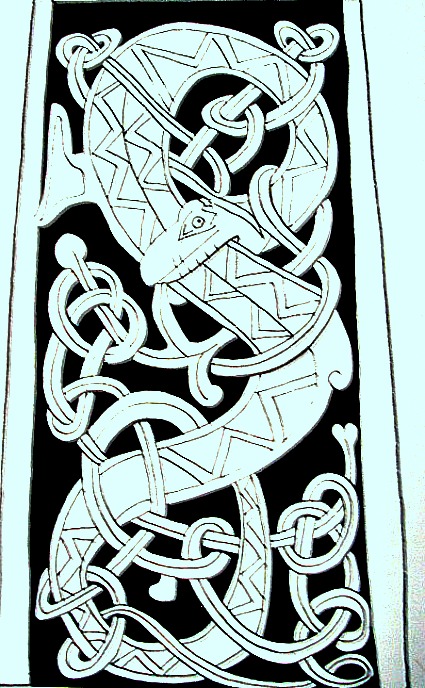
Lower face of the Ramsbury cross

At the western end of the north aisle there are several Anglo-Saxon and medieval artefacts. Three large stone fragments make up part of a 9th-11th century cross-shaft that is locally referred to as ‘the great cross of Ramsbury’. These ancient fragments have now been reconstructed as best as can be. On the front face is a rather “friendly” looking serpent that is coiled-up in a lengthwise position and, strangely enough, it appears to be biting its own body, whilst in between and around it there is some very nice interlacing in the form of long, interweaving plant stems or tendrils. This is said to be of Anglo/Danish origins and of the Ringerike-style of carving, something that was popular in Wessex at this particular time in history. The sides and the top section of the cross have knot-work and circles or wheels. On the opposite side there is more interlacing and another creature. And there are some fragments of a second Anglo-Saxon cross-shaft. These artefacts were discovered built into the south wall during restoration to the church back in 1891.

There are also two rather fine “coped” coffin lids from the 9th-10th century AD, one of which has a carving of a bishop, the other shows foliation in the form of scrolls and pointed stems or barbs. This style of workmanship is thought to be similar to that often seen on hog-back tombs from the north of England, and again of Danish/Viking origins. Also, part of a medieval stone-slab with a stepped cross (in relief) and other cross fragment from the 13th century.


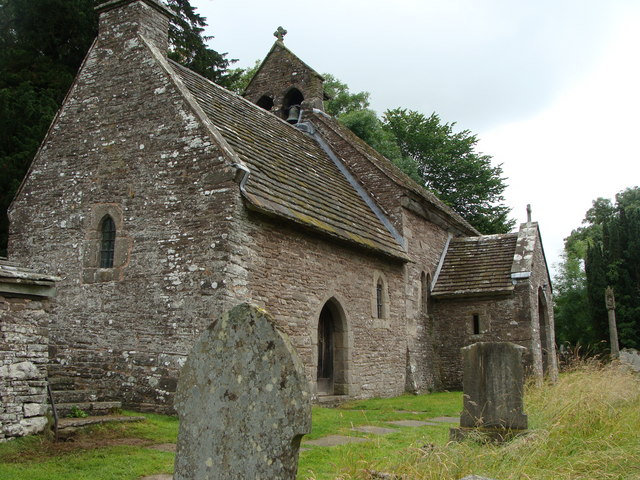
St Beuno’s Church, Llanveynoe, Herefordshire

OS grid reference: SO 3030 3136. The medieval church of St Beuno and St Peter at Llanveynoe (Llanfeuno) stands in a remote hamlet along a narrow country lane, 2 miles north of Longtown above the Olchon Valley, close to the Here-fordshire and Monmouthshire border, at the edge of the Black Mountains. The town of Hay on Wye is 8 miles to the north. The little church houses two ancient stones with incised crosses and an inscription, while in the churchyard a curious thin cross can be seen.

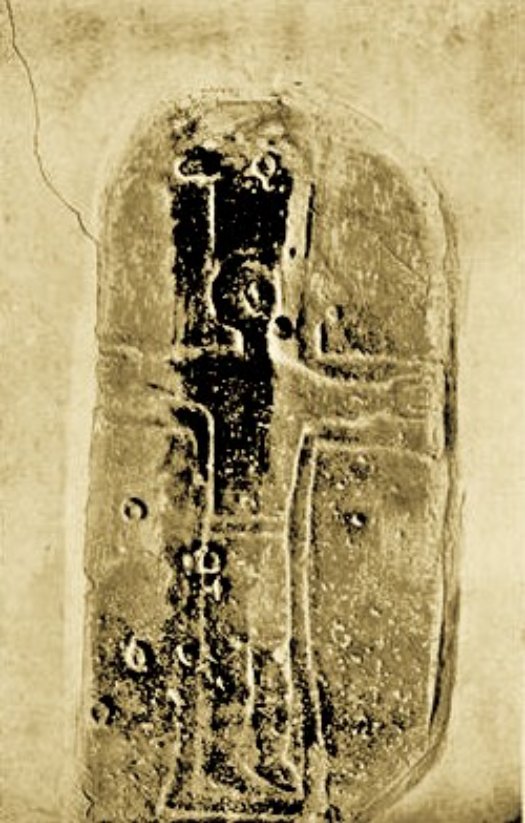
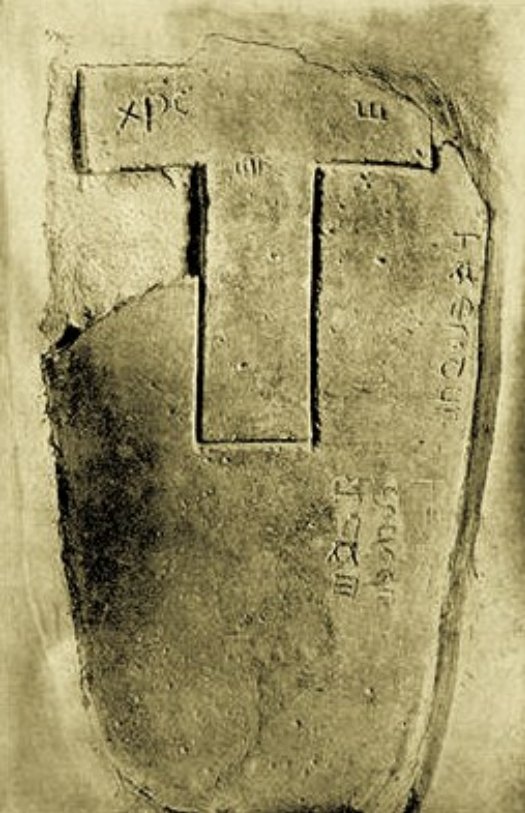
Cemented into the south wall of the church are two stones. One of these shows Christ crucified. He wears a tunic and his arms are out-stretched with his feet in a standing position, head leaning slightly to one side. Tiny holes or pockmarks can be seen in the stone, suggesting that it could be part of a pre-Christian, pagan altar? Next to it, another stone shows signs of damage. This has only half an incised cross, an inscription, and alpha and omega symbols. Both stones are thought to date from between the 7th-10th centuries. The inscription is difficult to read because it is damaged and, also quite tiny Latin lettering. It reads:- HAES: DUR FECIT CRUCEM STAM and when translated is something like ‘Haestar made this cross’. At the top of the stone XPC the Greek Chi Rho and the letters IHC the Greek word for ‘Christ Jesus’. A fourth stone with a carved cross was found in the wall of a barn half a mile further along the Olchon Valley; this is now built into the church’s north wall, while a fifth stone with an inscription was discovered in the valley back in the 1870s but was badly broken during the construction of a road. This stone, or what’s left of it, is now in the south wall.

Outside in the churchyard among the more recent gravestones stands a 5-foot high thin, short-armed Celtic-style cross. This has a channel running down its shaft. It seems to have been used in recent times for a water channel. This was found in the 1870s and brought to the churchyard for safety. The date is probably 10th century?

St Beuno came to Llanveynoe in 600 AD and founded a small monastery on what was a pagan site. This was either situated where the church now stands, or on the site of Olchon Court, close by. Indeed, recent archaeological excavations in the grounds of the court have found what could be the foundations of a monastic building. Beuno was born in 560 AD at Berriew in mid-Wales, but his education was at Caerwent in south Wales under St Tangus (Tatheus). He was the nephew of that great Welsh saint, Cadoc, and his grandfather was non-other than King Brychan of Brecknock (Brecon). After a few years stay at Llanveyno, Beuno headed north back to Berriew where he attended and ministered at his father’s funeral. From there he travelled north to the district of Tegengle and what is now Holywell, Flintshire, where his niece St Winifred was living. His most famous monastery was at Clynnog Fawr on the Lleyn Peninsula, but he established another 10 churches in north Wales. St Beuno died at Clynnog Fawr in 640 or 642 AD.

The Llanveynoe Carved Stone, Herefordshire

The Llanveyno Carved Stone,  Herefordshire.


Copyright © The Journal of Antiquities, 2012 (updated 2023).


Gallarus Oratory, Co.Kerry, Southern Ireland

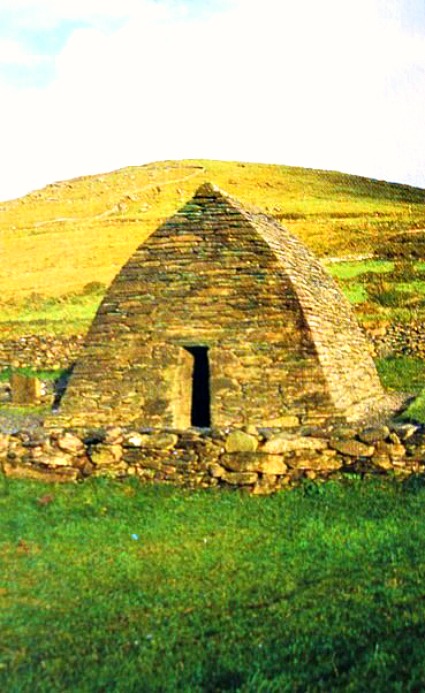
Irish Grid Reference: Q3930 0490. This rather strange-shaped 16-foot-high building stands in countryside to the west of the village of Gallarus on the Dingle Peninsula, west of the R559 road. The site overlooks the beautiful Ard Na Caithe harbour. The building is referred to as ‘the church of the foreigners’; these so-called foreigners being early Christian pilgrims. Local people call it ‘the upturned boat’ because that’s exactly what it looks like but, in fact, it is a small Dark Age oratory-style church, and according to some historians, a temple.

Gallarus Oratory, Southern Ireland.

The oratory is thought to date from the early 8th century AD but it could be a 12th century building. It is built of shaped stones placed tightly together without any mortar with walls that are over 3 feet thick. Inside, the building measures 10 feet by 15 feet and has a corbel-style, vaulted roof. There is a tiny round-headed window and a narrow door measuring 5 foot 6 inches high. Over hundreds of years the oratory has been well protected from the elements due to it’s curved, slanting shape, allowing rain to run off leaving the building in a resonably dry condition.

Gallarus oratory has been called the best example of it’s kind in Ireland, perhaps even the oldest. In some respects it reminds us of the pyramids at Giza in Egypt and, there is quite obviously some association with cosmic energy and spiritual significance attributed to the strange, curved almost pointed little building that it is. It certainly stands out. There is a visitor centre near the oratory. Close by there is a slab-stone standing in the middle of a group of rocks. This 3 foot-high stone has a circle with a cross inside it and an inscription recalling ‘Colum Mac Dine’. The stone may date from the 6th-8th century AD.

Copyright © Ray Spencer, The Journal of Antiquities, 2012.


Partrishow Church, Forest Coal Pit, Powys

St Issui’s Church at Partrishow. Photo: Ruth Sharville, Wikipedia.

NGR: SO 2788 2243. The secluded little church of Partrishow, Patrishow or Patricio, can be reached along winding, narrow country lanes, 1 mile north of Forest Coal Pit, over-looking Afon Grwyne Fawr Valley, at the foot of the Gader Fawr. The market town of Abergavenny is 5 miles to the south, while Crickhowell is about the same distance to the southwest. The hamlet of Partrishow consists of just a few farmhouses along with the little medieval church of St Ishow (Issui) and its graveyard, and just down the lane in the cwm, the holy well of Ffynnon Ishow, a site of pilgrimage down the centuries.

Parts of the church date back to the 11th century, although much of it is from the 13th-14th century, with some restoration taking place in 1908-9. When you enter the 14th-century porch with its old holy water stoup, you are immediately taken right back into the Middle Ages; the building is just a sheer delight, its whitewashed walls, pre-Reformation paintings, gorgeous decorated oak rood-screen and other antiquities are a pleasure to see. The closed-off room at the west side is a hermit’s cell and chapel that dates from the 11th-14th centuries and is called ‘Eglwys-y-Bedd’ or grave of St Ishow; indeed the saint is said to lie under the altar that has six consecration crosses, rather than the customary five. In 1908 human bones were discovered under the wall. Also at the west end, a painted skeleton is a “figure of doom” holding a scythe, hourglass and spade. The painting has been whitewashed over many times, but it always mysteriously reappears again.

The carved font dates from 1055 AD, making it the oldest in Wales. It has a Latin inscription to Genillin or Genyllin Voel, the son of Prince Rhys Goch, Lord of Ystradyw, and prince of Powys. When translated the inscription reads:- Menhir made me in the time of Genillin. In front of the rood-screen there are two stone altars, each having five consecration crosses carved onto them, these representing the five wounds of Christ’s passion. The beautiful Irish oak rood-screen and loft is renowned throughout Wales, said to be of Flemish design, but more probably made by Welsh craftsmen in 1500. The screen is carved with figures representing St Mary the Virgin, St John the Apostle and a fearsome fire-breathing Welsh dragon.

In the churchyard stands a 12th-13th century preaching cross standing on three steps, its octagonal shaft leading up to the lantern that is more recent in date, but which has a number of figures carved upon it, including St Issui. Giraldus Cambrensis (Gerald of Wales) is said to have preached his sermon on the 3rd crusade at the cross in 1188 during his famous tour of Wales. The small square building at the front of the church was used as the parson’s stable.

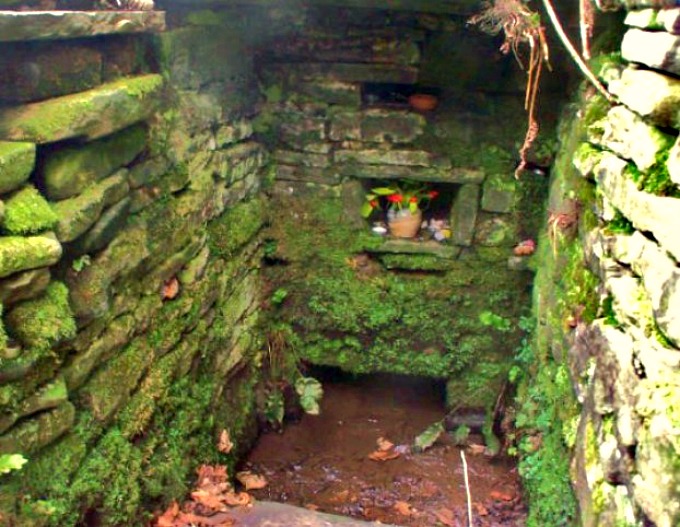
Back down the lane in the cwm on the left-hand side stands Ffynnon Issui (St Ishow’s well). Some steps lead down to the well situated close to the Nant Mair brook (St Mary’s stream). One of the steps has a Maltese cross. The well is inside a 1 metre-high drystone-wall well-chamber with a slab for it’s roof. There are some niches to allow pilgrims to place offerings or flowers; the water runs into a small square basin at the bottom. According to legend, St Issui, a 6th-century hermit lived beside the well, so the well is of a pre-Christian date, the holy man using the water to baptise local people. But the saint was murdered by a man who sought shelter with him but had refused to be converted to Christianity; the site of this martyrdom became known as Merthyr Issui. In the Middle Ages pilgrims began to come to the holy well to be healed of various diseases and this continued up until the 19th century. But even today people come here and leave crosses made out of twigs and partake of the water in the hope that they, too, will receive a miraculous cure. Coins are also occasionally thrown into the well for good luck!

St Ishow’s Holy Well (Ffynnon Ishow), Partrishow, Powys.

References & Sources:-

https://en.wikipedia.org/wiki/St_Issui%27s_Church,_Partrishow

Copyright: © Ray Spencer, The Journal of Antiquities. 2012.


3 Comments

Kilpeck Church, Herefordshire

NGR: SO 4449 3051. The little Herefordshire village of Kilpeck is 2 miles east of the A465 Hereford to Abergavenny road at Wormbridge and 7 miles south-west of Hereford. It is noted for its outstandingly beautiful 12th-century Norman church with many carvings that are greatly influenced by the Celtic, Norse and also medieval (Romanesque) periods in history. It is now dedicated to St Mary and St David, its original dedication was to St Pedic or Pedoric, hence the name Kilpeck. This 6th-century Celtic saint, a follower of St David or St Dubricius (Dyfrig), had a cell here and later a Saxon church sprang from that in the 7th or 8th century. At the back of the church there is a round-shaped churchyard indicating that this was a sacred site before the coming of the Celtic, Christian church.

In 1140-1150 the building that we see now was built over the Saxon building  – although as is always the case some restoration has taken place in more recent times. By 1143 the church of Kilpeck was placed under the care of the Benedictine abbey of Gloucester giving it a monastic status; the monks came and built a small cell here soon afterwards. All the carvings that we see here are from the late 12th century and were probably all done by the Hereford school of stonemasons. The church survived being abandoned in the 14th century, the Reformation of the 16th century and the Puritans of the 17th century, in fact, the place looks as if it has only just been built, especially as it is always kept well whitewashed and in a most excellent state of repair.

English: Kilpeck church The church is dedicate...

Kilpeck church (Photo credit: Wikipedia)

Kilpeck church is renowned for its very beautifully carved Norman south door, carved chancel-arch, nave and vaulted apse. Part of the nave (NE corner) may date from the 11th century. The font is Norman but the holy water stoup could be pre-Conquest; this is carved with animal heads and a pair of hands holding two heads. But it is the many carvings on the outside of the church that do it justice for there are so many to see. The exterior of the south door has double columns and a richly carved tympanum over the top. A vast array of carvings can be seen on the doorway including snakes, human heads, foliage, birds, dragons, warriors, medallions and a green man. The tympanum shows what is almost certainly the Tree of Life.

On the exterior walls running along the corbel table below the roof there are many strange, comical and often quite ugly carvings. These include two men fighting, a dog and rabbit, the lamb of God and cross of Jesus, a vulgar sheela-na-gig displaying genitalia, two dragons fighting, green men, a warrior entwined, human heads, a cat and dog and, a pig. But there are others too. A walk around the church is well worth it. Close to the church are the earthworks of an 11th-13th century Norman motte and bailey castle.

Copyright © Ray Spencer, The Journal of Antiquities, 2012.