The Journal Of Antiquities

Ancient Sites In Great Britain & Southern Ireland


1 Comment

The Alkincoats Cross, Colne, Lancashire

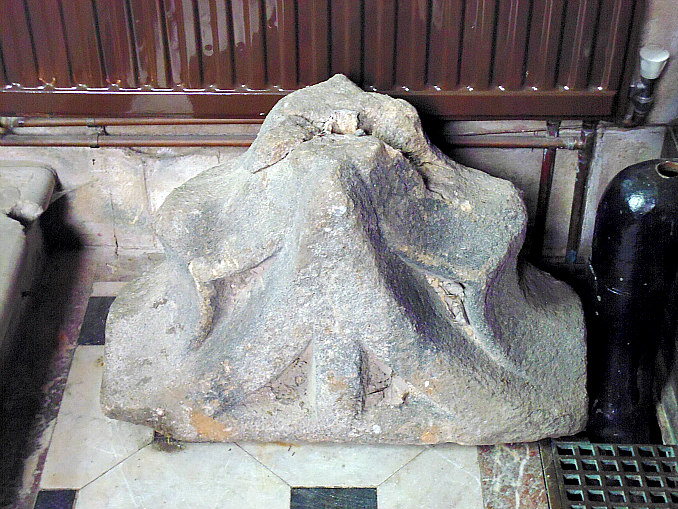
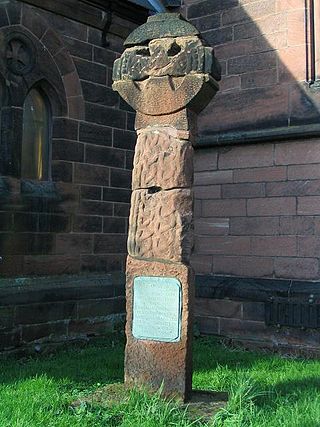
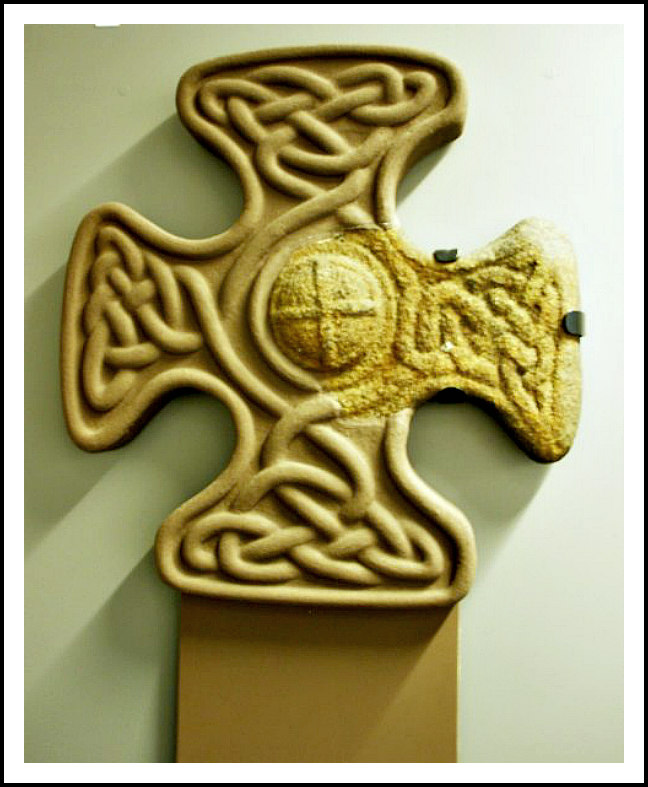
The Alkincoats Cross in Colne Public Library.

The Alkincoats Cross in Colne Public Library.

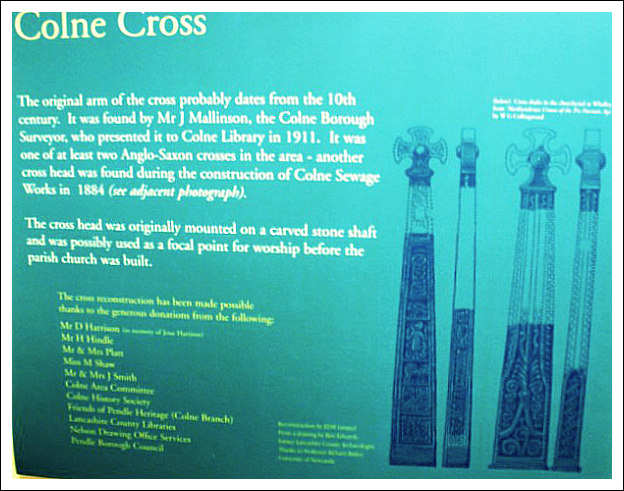
OS grid reference: SD 8789 4094. The Alkincoats Cross or Colne Cross is a small section of an Anglo-Norse cross-head now located in Colne Library on Market Street. It was dug up in the grounds of Alkincoats Hall, a building that was built sometime after 1540 and was the home of the Parker family of Browsholme. The hall was demolished in 1958. Today all that remains of the hall is Alkincoats Farm at the north side of the large park, close to Red Lane, which is named after the old hall. But it seems there was a 12th-13th century religious building and maybe a chapel belonging to the Knights Hospitallers on the site; they had been given the land by John de Lacy (Dixon, John, 1990). But before that there may have been a late Saxon settlement of some kind. The cross-head section is one of three found in the colne area in the late 19th early 20th century. It has carvings that are similar to the decoration found on the Whalley Crosses, and so it must date from the 10th-11th century AD and be a pre-Conquest cross fragment.

History of The Colne Cross at Colne Library.

A History of The Colne Cross at Colne Library.

The cross-head fragment was dug up from the garden of Alkincoats Hall in the early 1900s having been buried for well over 450 years, probably to avoid it being smashed at the Reformation, or more likely it was already broken up and thrown down to the ground where it was lost. It is an arm section from an Anglo-Norse cross-head and is decorated with knot-work interlacing that is often described as being Celtic in origin, and in the middle there is a small raised boss with a tiny, thin cross in its centre. The rest is a very good reconstruction. It was presented to Colne public library in 1911 by the then Borough Surveyor, but may have stood in Colne parish church at some point. When the cross was whole it would have been quite a tall preaching cross and probably stood at Alkincoats (Alcancotes) – where the local Christian community and probably pilgrims from further afield could congregate on saints’ feast-days and other church festivals – prior to the building of St Bartholomew’s parish church, in Colne.

The Alkincoats Cross, also known as The Colne Cross, has often been confused with The Swinden Cross and Greenfield Cross, but these two fragments seem to be distinct from that found in the garden of Alkincoats Hall. There may well be other fragments of the late Saxon Alkincoats cross ‘still’ buried in the grounds where the old hall once stood. Who knows. Local author John Clayton in his work ‘Valley of the Drawn Sword’, says of the Alkincoats cross fragment: “It is not clear if this was of the free-standing type……or part of another type of sculpture.” He goes on to say: “The carved stonework of these crosses is taken as evidence that they were related to the Christian church, perhaps they were sited at convenient locations where numbers of people could be brought together to hear a priest give his sermon. They may also have marked a previously holy site of the British, and were assimilated by the new Christian culture.”

Sources:-

Clayton, John A., The Valley Of The Drawn Sword, Barrowford Press, Lancashire, 2006.

Dixon, John & Mann, Bob., Historic Walks Around The Pendle Way, Aussteiger Publications, Barnoldswick, 1990.

https://en.wikipedia.org/wiki/Alkincoats_Hall

http://www.pastscape.org.uk/hob.aspx?hob_id=45470

© Copyright, Ray Spencer, 2016.


3 Comments

St Oswald’s Church, Winwick, Lancashire

Carving on Tower of St Oswald's Church at Winwick, Lancashire.

Carving on Tower of St Oswald’s Church at Winwick, Lancashire.

OS grid reference: SJ 6038 9283. St Oswald’s parish church is located on Church Walk, off Golborne Road, in the middle of Winwick Village, in Lancashire (it used to be in Cheshire). It is a largely 14th-century building on the site of a pre-Conquest chapel and prior to that a pre-Christian, pagan temple. The church houses an 8th-9th century cross arm section, an ancient font, old inscriptions and a Medieval rood beam. And on the exterior tower wall there is an interesting carving of a pig next to a statue of St Anthony. According to legend, Oswald, king of Northumbria, came to Winwick a few years before he met his death at the hands of King Penda of Mercia, near Oswestry, or according to some historians, he was killed in battle at Maserfield in Shropshire, in 642 AD, at the age of 38. There is a St Oswald’s Well, ½ a mile to the north of Winwick at Hermitage Green; the town of Newton-le-Willows is 1 mile to the north on the A49 road.

Winwick Church Cross (Illustration/Diagram.

Winwick Church Cross (Illustration/Diagram.

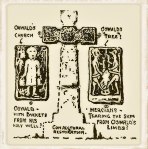
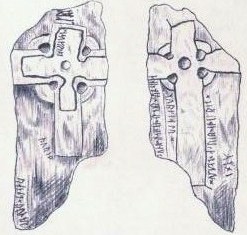
In 1873 part of a Saxon cross was dug up in the churchyard and for some years it was kept there, but it was eventually brought into the church and is now displayed on the windowsill in the Gerard Chapel at the NE side. These are the arms of a tall Saxon preaching cross, dating maybe from the 8th century, which may even have been used by St Oswald himself? Although the carvings are faint, most can still be made out. The front face has key patterns, and there is interlacing and scrollwork. At one end a priest carries two bells or maybe water containers (St Oswald’s Well), while at the other end a saint, probably Oswald, is being martyrd and two soldiers are hanging the saint up-side down from a tree – each having a foot on his face. On the reverse side: three creatures with legs and tails coiled together, and a more recent inscription to the memory of Roger Lowe, who gave this cross as a gravestone in 1793.

The church font on a modern pedestal in the Gerard Chapel could date from the 11th century, or a little earlier, but it was damaged by Puritans, and there is still some Norman masonry to be seen. In the vestry there is part of the Medieval rood beam – the rood loft having long since been destroyed; while the Oak lectern is recent but it has a canopy and carved figure of St Oswald. There is also a Jesse window, and two interesting carved heads at the bases of two columns (north aisle) could be Celtic in origin (Mark Olly, 1997). In 1643 and 1648 two Civil War battles took place at Winwick and the church of St Oswald was used as a stable by soldiers.

On the outside tower wall (west side) there is a carving of a pig next to statues of St Anthony and St Oswald. Legend says that a pig was instrumental in the building of the first church. According to author Ken Howarth ‘Ghosts, Traditions & Legends Of Old Lancashire’, “A pig was seen running away from the site of the new church being built to commemorate St Oswald…..as it ran away, it was heard to scream “We-ee-wick, we-ee-wick, we-ee-wick” from whence the town, according to this particular legend, got its name. The pig then took up a stone in its mouth and carried it to the spot where the church should be built. This remarkable animal apart from talking, then moved all the stones the men had laid to the new sacred site.” But Howarth tells us that another source says: “it is the pig of St Anthony that is preserved in the west front of the church.” The pig is the symbol/badge of St Anthony of Egypt, who died in the mid-4th century AD.

In 1828 three human skeletons of gigantic proportions were discovered 8-10 feet below the chancel. They are thought to have dated from the pre-Christian period and to have been associated with a Druidical temple which stood on the site; maybe they were sacrificial victims? The place of St Oswald’s martyrdom is considered by some historians to be at Makerfield near Winwick, Lancashire, rather than Maserfield in Shropshire.

Sources:

Fields, Kenneth., Lancashire Magic & Mystery, Sigma Leisure, Wilmslow, Cheshire, 1998.

Howarth, Ken., Ghosts, Traditions & Legends Of Old Lancashire, Sigma Leisure, Wilmslow, Cheshire, 1993.

St Oswald’s, Winwick Church

http://www.mysteriousbritain.co.uk/england/cheshire/legends/st-oswalds-church-winwick.html

Olly, Mark., Celtic Warrington And Other Mysteries – Book One – North To East, Churnet Valley Books, Leek, Staffordshire, 1997.

© Copyright, Ray Spencer, 2016.


1 Comment

St Eithne’s Grave, Eileach An Naoimh, Argyll and Bute, Inner Hebrides

Aethne's Grave on Eileach an Naoimh (photo credit: Gordon Doughty Geograph)

Aethne’s Grave on Eileach an Naoimh by Gordon Doughty (Geograph)

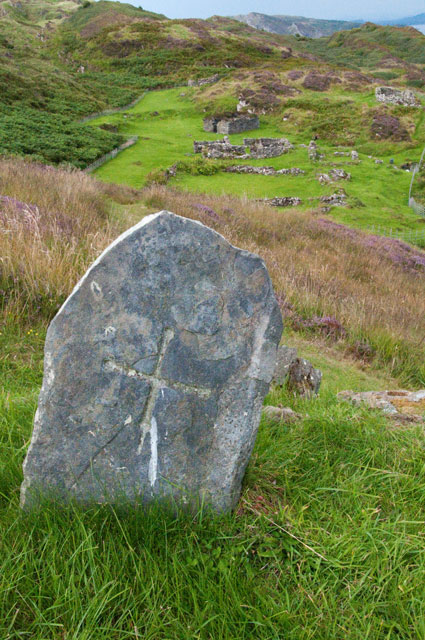
    OS grid reference: NM 6302 0964. The little Scottish island of Eileach-an-Naoimh (Rock of the Saint) is one of the Garvellach Islands, in the Firth of Lorne, and is the reputed burial place of St Eithne, mother of St Columba, making it a ‘holy island’. On this very remote, windswept island are the scant remains of a Celtic monastery with beehive huts, two chapels and a graveyard with three crosses, and 80 metres to the south-west is the traditional site of St Eithne’s grave, which is marked by a grave-slab bearing an incised cross. In old texts the island was called Hinba. And to this little island St Columba and other ‘saintly’ figures came from time to time for a deeper solitude and contemplation – this fact being borne-out because the island was, and still is, largerly inaccessible. There are no ferries or steamers alighting in Port Cholumcille, but some pilgrims do visit the island and pay their respects at St Eithne’s grave, though they have to hire their own boats! The island of Mull is 6 miles to the north and Scarba 4 miles to the south-west, while the mainland of Argyll is 6 miles away.

    Author Reginald B. Hale in his work ‘The Magnificent Gael’, tells us that: “Eithne came of the royal line of Leinster kings. Her husband Felim macFergus was a chieftain of the dynastic family of Ui Neill, heirs of the mighty Niall-of-the-Nine Hostages, High king of Ireland. So their little son was born a prince of the Blood Royal and would inevitably live his life in the glare of the political limelight. His parents had every reason to hope that someday he might hold the scepter of the High King and reign at Tara.

    “But the child also had another heritage. His great-great-grandfather Niall had been a heathen and an unabashed slave raider. However several of his sons had been converted by St Patrick, the ex-slave who brought Christianity to the Irish. One of these sons was Conall Gulben, king of Donegal. St Patrick with his staff marked a cross on King Conall’s shield and from then on his descendants took as their symbol a Hand grasping a Cross. From the time of his conversion his clan had been staunch for the faith. So it was that Felim macFergus, grandson of Conall, was himself a deacon of the Church and his son was born into a devout Christian family.”

    Hale goes on to say that: “Felim and Eithne took their child six miles to Kilmacrenan to be baptized by the priest Cruithnechan which is pronounced “Crenan”. He was christened Colum, which in Latin is Columba. He also received the traditional family name of Crimthann that means a fox, an animal admired by the Gaels.”

    But we know that Columba was born beside Lough Gartan in Co Donegal (521 AD) where there are the Medieval ruins of what is locally called St Eithne’s Convent. And there is a St Eithne’s Well at Termon. The site of St Columba’s birth, near the southern shore of the lough, is marked by the so-called ‘Natal Stone’, and nearby are the saint’s holy well, the Stone of Lonliness, and the saint’s ruined church. His birth was miraculous we are told. St Eithne had a dream in which she was given a beautiful robe with colours similar to the wild flowers, but the wind blew the robe away. However, the wind-blown robe grew in size and spread out to cover the land, mountains and islands – this being a sort of divine portent regarding her son who would eventually take Christianity to the northern Pictish High King, Brude, and his people sometime after 565 AD – at a time that was “dark” in many respects, but for St Columba it was a time of ‘great joyfulness’.

    In 563 AD Columba set sail for Iona and was accompanied by members of his family including his mother and also disciples and servants. Later, he founded a great monastery on the island which became a college of learning; he took the message of Christ to the Picts and established many other monasteries and churches in Scotland. His mother retired to the Island of Hinba (Eileach-an-Naoimh) where she was cared for by Ernan, who was St Columba’s uncle and also prior of the monastery of Hinba, founded by St Brendan. Women were not allowed in the monastery. St Eithne died and was buried on the island in the mid to late 6th century. Her ‘reputed’ grave is located on the Peak of Hinba, 80 metres south-west of the monastery, where a circular enclosure (11 feet in diameter) with three standing stones marks the site, one of these being a grave-marker (2½ feet high) bearing a thin equal-armed Greek cross with terminals, beneath which is a thinner spike. And there are a number of recumbent stones and a kerb running around the site. The grave seems to be positioned so as to look out over the Firth of Lorne.

    But some historians question the grave-site. A few think that it may in fact date from the Iron-Age, or earlier, and others think it may be the burial site of more than one person? But I think it should be pointed out here that the type of burial that was around in prehistoric times was more than likely to have existed well into the early Christian period – the so-called Dark Ages of the 5th-7th centuries AD.

The Monastery Chapel, Eileach an Naoimh by Gordon Brown, Wikipedia.

Monastery Chapel, Eileach an Naoimh by Gordon Brown, Wikipedia.

    The monastery on Eileach-an-Naoimh often ascribed to St Brendan, rather than St Columba, is a ruin consisting of low drystone walls with a number of bee-hive huts (hermits cells) around it, one of which is a double construction. There are two small ruined chapels that are said to date from the 9th-12th centuries and a graveyard with three stones bearing incised crosses, and also a circular feature that is probably an early Christian grave, maybe that of Ernan the first prior? The monastery was probably burned c 800 AD and thereafter it suffered from a number of attacks by invaders from overseas, including the Vikings. The monastic site on Eileach an Naoimh is probably the oldest religious ruin in Scotland.

Sources:

Hale, Reginald B., The Magnificent Gael, R.B.Hale, Otawa, Canada, 1976.

http://www.geograph.org.uk/photo/2014435    © Copyright Gordon Doughty and licensed for reuse under this Creative Commons Licence

https://canmore.org.uk/site/22364/garvellachs-eileach-an-naoimh

https://en.wikipedia.org/wiki/Eileach_an_Naoimh   Photo by Gordon Brown Creative Commons Attribution Share-alike license 2.0

Newton, Norman., The Shell Guide To The Islands Of Britain, David & Charles, Newton Abbot, Devon, 1992. 

The AA, Illustrated Road Book Of Scotland, The Automobile Association, 1963.


The Headless Cross, Anderton, Lancashire

The Headless Cross, Anderton, Lancashire.

The Headless Cross, Anderton, Lancashire.

    OS grid reference: SD 6189 1301. The Headless Cross, also called the Grimeford Cross, stands near the old village stocks at Anderton in Lancashire, to the east of the M61 motorway, and is ‘said’ to date from the late Anglo-Saxon period – the 11th century. Anderton is a suburb of Adlington. It is located beneath trees on a grassy area at the junction of Grimeford Lane, Rivington Lane and Roscoe Lower Brow, opposite the Millstone public house. Over time it has been used as a sundial and a guidepost for directions to nearby towns – its cross-head having being taken to nearby Rivington church. The remaining shaft is decorated on all its four sides with carvings which are rather strange, if not curious, and most unlike other Saxon wayside crosses of a similar date. It may originally have marked the “true” centre of Grimeford village though this does not now exist According to local legend, there used to be a medieval chapel with an underground tunnel close to where the cross now stands, and also there have been a number of reports of ghostly happenings in this area – locally these ghostly, poltergeist-like characters, being referred to as boggarts!

    The pre-Conquest cross was apparently discovered during the construction of the Lower Rivington Reservoir (1852) – the bottom section was brought to its present position, while the top section showing a helmeted Viking figure was sent to the Harris Museum at Preston, and the cross-head displayed in Rivington church, a few miles away. It has taken on the look of a stone bird-table! But it used to have a sun-dial on top of its flat plinth and it has been in use as a guide-post, giving directions to the towns of Blagburn, Boulton, Preston and Wiggin. Today the cross-shaft is around 3 feet high but originally it would have been double that. On the front there is the lower part of a human fugure (two legs) which is presumably the same figure as that on the shaft in Preston museum! On its other three faces there are geometric ‘wavy lines’ in the form of Greek frets (T-frets) within a trellis, and also vinescrolls. The flat stone on top of the shaft is post Medieval and the base-stone is much more recent.

Sources:

Grimeford Cross, Adlington, Lancashire

http://www.megalithic.co.uk/article.php?sid=11076

http://lancashirefolk.com/2013/11/17/20/

The AA, The Illustrated Road Book Of England & Wales, The Automobile Association, London WC2, 1961.


Church of St John the Divine, Holme-In-Cliviger, Lancashire

Church of St John The Divine, Holme-in-Cliviger.

Church of St John the Divine, Holme-in-Cliviger.

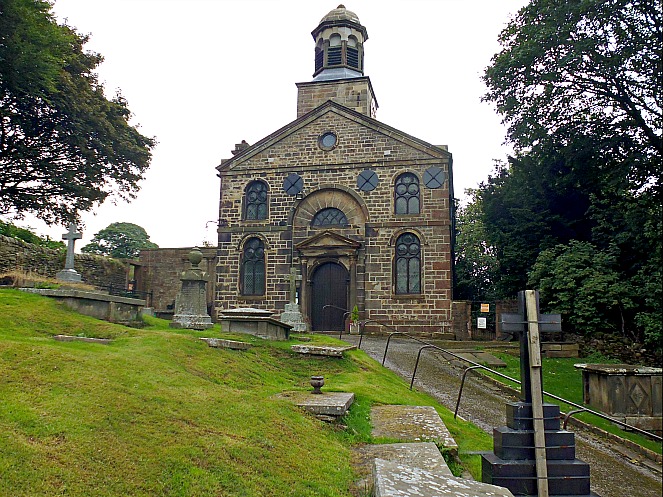
OS Grid Reference: SD 8763 2852. On Burnley road (the A646) at Holme Chapel, Cliviger, also called Holme-in-Cliviger, is the late 18th century church of St John the Divine, or sometimes St John the Evangelist. The building houses two sections of a late medieval cross-head, which may have come from the ruins of Whalley Abbey in Lancashire. The present church stands close to the site of a 16th century chantry chapel that had fallen into disrepair and had to be demolished (1788) – the present church being built upon the hill through the benefices of the Whitaker family of Holme, Cliviger, between 1888-1894, in particular Dr T. D. Whitaker, the eminent historian and antiquarian. Also of interest in the church are the beautifully carved 15th century misericord stalls, 19th century font, pulpit and wall tablets. St John’s is located opposite The Ram Inn, Holme Chapel, 2 miles south-east of Burnley and 5 miles north-west of Todmorden

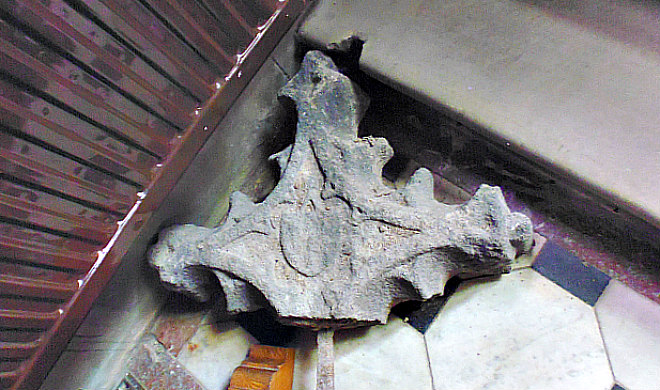
Top Section of Gothic Cross-Head at St John The Divine Church, Holme-in-Cliviger.

Top Section of Gothic Cross-Head at St John’s.

On display in the chancel of St John’s, at either side of the altar, are two sections of sculptured stonework – two parts that make up an ornate late Medieval cross-head of the 15th century. Originally, the two sections were fixed together and stood on the top of a stone gateway at the south side of the church. In recent years the cross-head had become unsafe and so it was brought into the church. It has been described as ‘being in the style of Gothic’ from the late Medieval period. On the front the Sacred Heart with the five wounds of Our Lord’s passion affixed to a cross are depicted; the three cross-arms are intricately carved with crockets – while the lower stem goes down through a narrow arched shape with short, stepped crocketing to the sides of that.

Bottom Section of Cross-Head at St John's, Holme-in-Cliviger.

Bottom Section of Cross-Head at St John’s, Holme-in-Cliviger.

It would seem that the cross-head was brought to St John’s from the ruins of Whalley Abbey, Lancashire, in the late 18th century by Reverend Dr Thomas Dunham Whitaker (1759-1821), an eminent historian, writer and antiquarian, whose family had lived for hundreds of years at ‘The Holme’ in Cliviger, and who was responsible for building St John’s in c 1790, at a cost of £870, which was “defrayed by the Whitaker family.” It is believed that two members of the Whitaker family had ‘actually’ resided at Whalley Abbey in the 15th century, but whether they were in hiding because of ‘their Roman Catholic faith’, we do not know. The church of St John is a beautiful sandstone building (in the Doric/Classical style) with parapet and a nice little cupola, or bell-turret, on its roof, according to the delightful work ‘All O’er t’Parish, by Peter Pomeroy & The Urban Studies Group of The Burnley Teachers’ Centre, 1983. St John’s was enlarged in 1897. It is a Grade II listed building.

Also in this church, there are two very beautifully carved 15th century oak misericord stalls, which again are thought to have been brought here from Whalley Abbey by Dr T. D. Whitaker. We also learn of Dr Whitaker’s great interest in what turned out to be a Roman ceremonial helmet and mask at Ribchester. This came to light when a child was seen kicking around a strange-shaped object. Whitaker arranged for the object to be taken for examination, and later it was found to be a highly decorated Roman artefact. A replica is on display in Ribchester Roman Museum, while the original is in the British Museum, again according to Peter Pomeroy & The Urban Studies Group, 1983.

A fine bust of Dr T. D. Whitaker can be seen in St John’s church along with some wall tablets of the Ormerod and Whitaker families, a 19th century alabaster font and a painting of General Scarlett (1799-1871), the heavy brigade hero of Balaclava in the Crimean War, whose grave is in the churchyard. The present pulpet replaces an earlier three-decker pulpet and sound-board, which was apparently purchased in Leeds and was “perhaps” originally brought from the ruins of Kirkstall Abbey; the old pulpet having become dilapidated and unusable due to its age.

Source:-

https://en.wikipedia.org/wiki/Thomas_Dunham_Whitaker

Pomeroy, Peter I. & The Urban Studies Group of The Burnley Teachers’ Centre., All O’er t’Parish – A Second Stroll Around Cliviger, Lancashire County Council Library and Leisure Committee, 1983.

Copyright © Ray Spencer, The Journal of Antiquities, 2015.


1 Comment

Ancient Crosses at Ilkley by A.W. Morant, F.S.A.

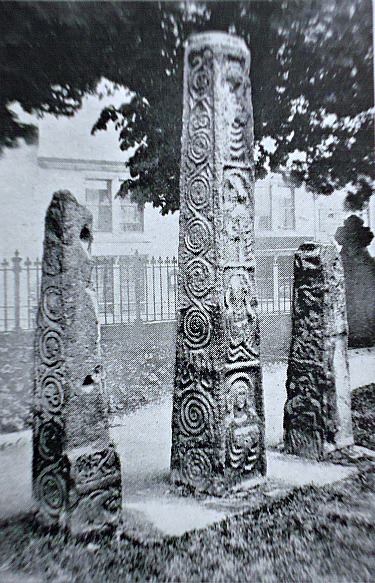
Ilkley Saxon Cross-Shafts used to stand in the churchyard.

Ilkley Saxon Cross-Shafts used to stand in the churchyard.

OS Grid Reference: SE 1163 4782. All Saints parish church is located on Church Street (the A65) in the centre of Ilkley, west Yorkshire, near the River Wharfe, and housed within are three Anglo-Saxon cross-shafts. Originally, these ancient crosses had stood at the side of the church in the churchyard, but due to the ever-increasing fears of erosion they had to be brought inside the church. The church site is an ancient one, dating from the 8th century, but the present building is a restoration of 1860; the church here stands on the site of a Roman fort (Olicana) and there are re-used Roman altar stones in the fabric. The crosses are referred to as ‘Paulinus Crosses’, but they are probably of a later date than St Paulinus, perhaps from the 8th-11th centuries, and though many of the carvings are now very eroded, they are still quite magnificent to look at. The following is the work of A. W. Morant – which was published in ‘Stories & Tales Of Old Yorkshire’, 1993, but which originally appeared in the work ‘Old Yorkshire’, 1882.

    “In Whitaker’s “History of Craven,” we have the following account of these interesting remains of a bygone age:-

    “In different parts of the churchyard are the remains of three very ancient Saxon crosses, wrought in frets, scrolls, knots, &c., which Camden, with that propensity to error, from which the greatest men are not exempt, conjectured to be Roman, only because they were placed within the precincts of a Roman fortress. But they are of the same kind, and probably of the same age, with the three crosses of Paulinus at Whalley, and with three others remaining in Leland’s time at Ripon, which there is great reason to ascribe to Wilfrid. “One thing,” saith that venerable antiquary, “I much noted, that was three crosses standing in rowe at the est ende of the chapel garthe. They were things antiquissimi operis and monuments of some notable men buried there; so that of the old monasterie of Ripon (the work of Wilfrid) and the town I saw no likely tokens after the depopulation of the Danes in the place, but only the waulles of our ladie chapelle and the crossis.” Such is Leland’s conjecture as to the occasion of their being erected; but from the same number, three in every instance, it is reasonable to suppose that they were early objects of religious reverence, alluding to the mystery of the Holy Trinity.

Ancient Crosses at Ilkley, (Illustration)

Ancient Crosses at Ilkley, (Illustration)

“The three crosses are now placed on the south side of the churchyard,…..and have been carefully examined and described by the late Mr. Wardell. That in the centre is the most entire, and is about eight feet in height; the others have been seriously mutilated by having been at one time made use of as gate posts, but are now, it is hoped, placed beyond the reach of further injury. These venerable relics are sepulchral monuments of the Saxon  period, and of the same description as those of which only a few fragments remain at Leeds, Dewsbury, and other places. They are elaborately carved with scroll work and with figures of men, birds, and animals. The centre one, which is 16 inches by 14 inches at the base, tapering to 11 inches square at the top, bears on the north side the symbols of the Evangelists, in oblong compartments, human figures in flowing robes, each with the head of the animal which is his symbol, surrounded by a glory, and holding the book of the gospel. St. John, the uppermost, has the head of an eagle; St. Luke, the next, that of a bull; St. Mark, that of a lion; and St. Matthew, a human figure. The south side contains the figure of our Lord, and there appears to have been an inscription above his head, then a device composed of two animals whose lower extremities are knotted together; and then two other monstrous figures. The remaining sides have scroll-work, with representations of fruit and leaves. (Just to add a note here: the central cross-shaft has had a cross-head fixed to the top. This was apparently recovered from the River Wharfe in 1884 and may, or may not be, the original head).

    “The eastern one is about five feet in height and one foot square at the base, tapering to nine inches at the top, very much defaced and worn—having been used as a gate post; it bears two men facing each other, then two animals, with their lower extremities interlaced, then two others, and lastly two birds. The remaining two sides—for the fourth is mutilated—are composed of scroll-work.

    “The western one is about four feet in height, and much more worn and defaced than the others; it has on one side a scroll and the figure of an ecclesiastic in robes, holding a book; the designs on the other sides are almost obliterated. In this stone the mortice hole for fixing the cross is yet to be seen.

    “In the year 1868 a fragment of another cross of this period…….was found on removing the foundations of some old cottages, nearly opposite the church; it has on the upper portion of one side a human figure, with hands raised in the act of prayer. The other sides bear the usual scroll-work ornamentation.” 

                                                                                                   A. W. Morant,  F. S. A. Leeds.

Source:-

Morant, A.W., Stories & Tales Of Old Yorkshire (orig edt. by William Smith, 1882-3. Selected & edt. by Dawn Robinson-Walsh, 1993, Printwise Publications, Tottington, Bury, Lancs., 1993, [Stories & Tales Of Old Yorkshire selected from the work ‘Old Yorkshire’ 5 vols, 1882-3]. 

Copyright© Ray Spencer, The Journal of Antiquities, 2015.


1 Comment

St Helen’s Well, Eshton, North Yorkshire

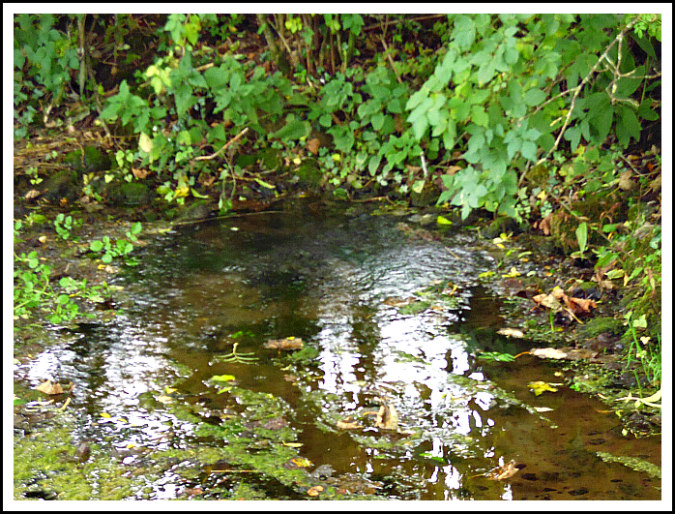
St Helen's Well, Eshton, North Yorkshire.

St Helen’s Well, Eshton, North Yorkshire.

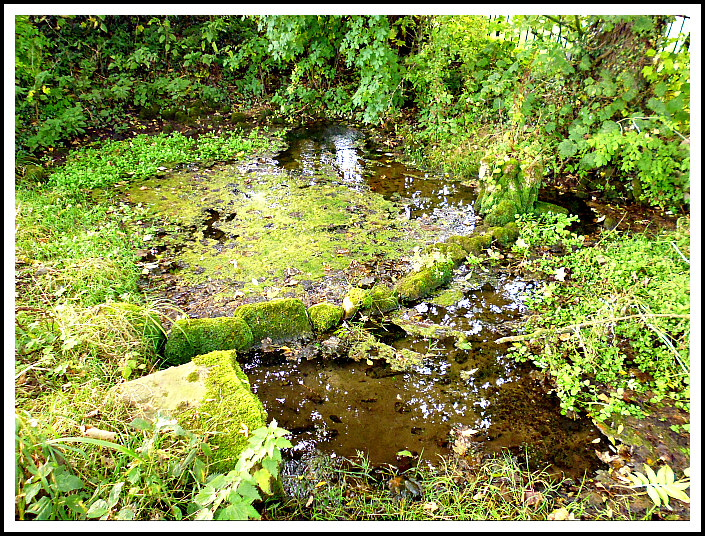
     NGR: SD 9309 5704. St Helen’s holy well stands in a walled and railed-off enclosure beside Eshton Lane, tucked in between the water-works and a wooded area, about halfway between Gargrave and Rylstone – in what is the district of Craven, north Yorkshire. Skipton lies a few miles to the east. The holy well has been a sacred site, not just since the late Roman period, but ‘long’ before that. However, almost certainly it had been ‘a sacred place’ in the so-called Dark Ages when the well/spring was dedicated to St Helen, the wife of Constantius Chlorus and mother of the first Christian emperor of the Roman Empire, Constantine the Great, who was converted to Christianity in 312 AD. St Helen, also known as Helena, died in 330 AD; she was much honoured in the west where her feast-day was celebrated on 18th August. A number of churches and holy wells were dedicated to her in the north of England and a few in the south and south-west of England.

St Helen's Well at Eshton.

St Helen’s Well at Eshton.

    In the Anglo-Saxon age and later the Medieval period it became a place of pilgrimage and healing; the water of the well having the miraculous ability to cure diseases and ailments of the body.Today the well is still ‘a sight to behold’ with the water gushing forth (often with gusto) into the circular-shaped pool – although the carved stones that apparently lie in the pool are very often well below the mud and water-level! An ancient cross was found opposite the well in the 18th century, but then it went missing, though later pieces of this were deposited in St Andrew’s church at Gargrave.

    The authors John & Phillip Dixon in ‘Journeys Through Brigantia’ (Volume One), say that: “The practice of regarding water, and in particular a well, as having sacred and healing qualities is well attested among the Celtic peoples. Holy wells have their origins in the pre-English period and many occur on a number of Roman sites in West and North Yorkshire. With the coming of Christianity the pagan deities to whom the wells were dedicated were converted and replaced by a Christian saint — St Helen was especially popular in those early times.

    “St Helen was the mother of Constantine the Great and said to be of Northern British origin, an ancestor of Coel Hen Godebog — the post-Roman overlord of Northern Britain who came down in legend as ‘Old King Cole’. After her conversion to Christianity she made an energetic and devout pilgrimage to Jerusalem, and founded several churches in Palestine.

    “Her popularity began to crystallize about seventy years after her death after the story went round that she was privileged to discover the cross of Christ on the site of the Passion. She is usually depicted wearing a crown and holding a long T-cross” (John & Phillip Dixon, 1990).

    It was Geoffrey of Monmouth who ‘claimed’ that St Helena was a British princess and of the family of Old King Cole, but she was, according to David Farmer in his work ‘Oxford Dictionary of Saints’, born at Drepanum (Helenopolis) in Bithynia. Maybe Geoffrey had genuinely mistaken Bithynia for Britain, or that he hoped and wanted her to originate from Britain! Her son Constantine the Great did, however, have strong associations with Britain, particularly the city of York, known as Eboracum to the Romans.

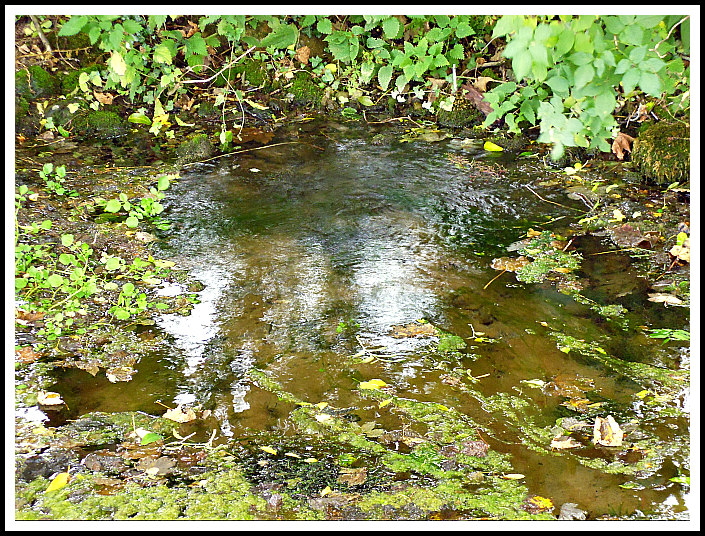
St Helen's Well at Eshton in North Yorkshire.

St Helen’s Well at Eshton in North Yorkshire.

    The water issues from a hole low down in the bank below the railings and flows into a circular shaped pool. At the front and sides of this pool (in a curved formation) there are a number of shaped stones that make up the outer perimeter of the sacred pool. Just in front of the point of entry for the water coming in there are ‘said’ to be two carved stones that resemble Celtic stone heads, but these are often covered by thick mud – and therefore not often visible – unless you feel around for them with your hands! The water goes out into a more modern drain at the side of the wall entrance. In the past devout people used to hang coloured rags on the branches of a tree, though this seems to have ceased now. There are records of a chapel existing in Chapel Field, close to the holy well but this has gone. In the 18th century an Anglo-Saxon cross was discovered opposite the well (John & Phillip Dixon, 1990), but this then to disappeared. It’s thought the carved stones in St Andrew’s church, Gargrave, are from “this” site opposite St Helen’s Well. According to John & Phillip Dixon the cross was very similar to the ones in Whalley churchyard, dating probably from the 11th century.

Sources:-

Dixon, John & Phillip., Journeys Through Brigantia (Volume One) Walks in Craven, Airedale and Wharfedale, Aussteiger Publications, Barnoldswick, 1990.

Farmer, David., Oxford Dictionary Of Saints, Oxford University Press, 2003.

Copyright © Ray Spencer, The Journal of Antiquities, 2015.


Kilmalkedar Monastic Site, Dingle Peninsula, Co Kerry, Southern Ireland

Kilmalkedar Church, Co Kerry (Photo credit: Wikipedia)

Kilmalkedar Church, Co Kerry (Photo credit: Wikipedia)

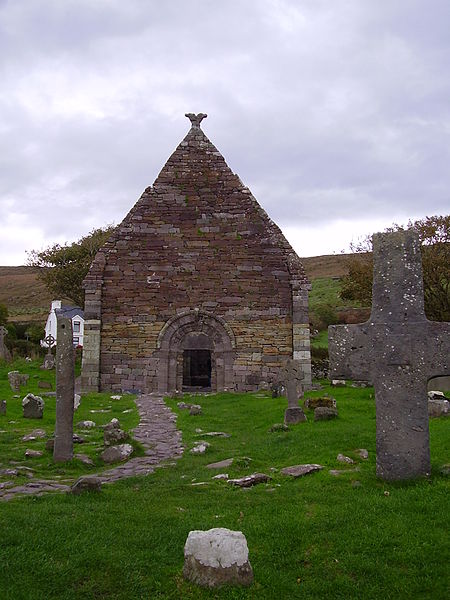
Irish grid reference: Q 4030 0620. Just off the R559 Cois Farraige (or the Carrig) road to the east of Murreagh on the Dingle Peninsula, Co Kerry, stands the 7th-century Kilmalkedar Monastic Site, also known as Cill Malcheadair. Here we find a small 12th-century roofless Romanesque church, a rare Dark Age sundial, an Ogham and Latin inscribed stone and some cross-inscribed slabs, one of which is called ‘the Alphabet Stone’ and, there are some pre-Christian holed ‘balaun’ stones, holy wells and early medieval grave-markers – in what is a ‘very’ beautiful and holy setting in the far southwest of County Kerry, 5 miles north-west of Dingle on the R559 road.

The first church and a monastery were established here at Kilmalkedar in c 600 AD by St Maol-cethair (Maolcedar), the son of an Irish king (of Ulster). A building called ‘St Brendan’s House’, actually an oratory, can also be found here and, close by the pilgrims’ road (Cosan na Naomh) leads on to Mount Brandon from where St Brendan departed for foreign lands in the mid-6th century. About 1 mile to the southwest of Kilmalkedar is the famous boat-shaped building known as ‘the Gallarus Oratory’, which dates maybe from the 8th century. The Celtic monastery of Kilmalkedar is known from history to have been a renowned school of learning during the early medieval period.

The ancient roofless Romanesque chapel dates from the mid-12th century, though there was obviously an earlier religious building on this site, maybe dating back to the Dark Ages when both St Brendan and, later St Maolcethair were in residence here. There are a number of very beautiful architectural features in the church. It consists of a chancel and nave – the chancel measures roughly 6 metres by 5 metres – while the nave is roughly 8 metres by 9 metres. The church is said to resemble the more famous Cormac’s Chapel at Cashel, County Tipperary.

In the excellent article ‘Marking The Passage Of Time’ by Patrick O’Sullivan for the Ireland’s Own magazine we are informed that the church was: “built in the Romanesque style of the twelfth century, typical features being the round-headed doorway and the high pitched gables”. But there are a number of other features too including the barrel-vaulting and a lower section of the corbelled stone roof, and some carved window surrounds have survived. The chancel dates from 1200; and the west doorway has a ‘tympanum’ with carved stone head. O’Sullivan in his article goes on to say: “The original roof of the church has long since given way but the East Window, known locally as Cno na Snaithaide, the eye of the needle, still remains. It has long been the tradition for pilgrims to pass through the window nine times, especially at Eastertime, when it was believed that doing so would grant them the promise of eternal life”.

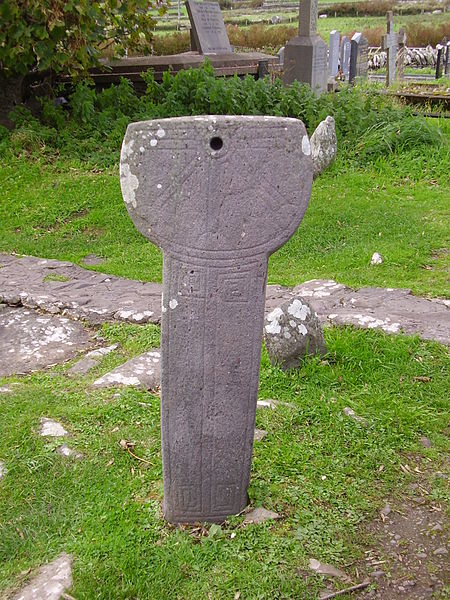
Standing in the chancel is the famous ‘Alphabet Stone’, dating probably from the 6th century AD, which is 4 feet high, but is broken at the top. On its west face the Latin alphabet and an earlier inscription DNI which is probably ‘domini’. The north face has a thin, damaged cross while the south face has an equally thin Latin cross with scrolled ends. And outside in the graveyard a 6-foot-high slender Ogham stone with a little round hole at the top. The Latin inscription on this is: ANM MAILE INBIR MACI BROCANN which is translated as: ‘In the name of Mael Unbir, son of Brocan’, and on the opposite side (along the edge) is the Ogham notch inscription reading the same. This stone is thought to date from the 5th or 6th century AD.

Kilmalkedar Sundial Co Kerry (Photo credit: Wikipedia)

Kilmalkedar Sundial Co Kerry (Photo credit: Wikipedia)

Also in the churchyard is a 4-foot high rectangular-shaped stone with sundial markings beautifully carved onto it. O’Sullivan says of this: “The beautiful sundial is marked with segments which correspond to the divisions of the monastic day”. He goes on to say: “The northwest face meanwhile is decorated with a cross of arcs, the later now thought to be a symbol of pilgrimage, as it appears on many stones associated with early pilgrimage routes”. And further he says: “While the lines on the Kilmalkedar sundial end in half moons, or semi circles, other examples have lines that end in three-pronged forks. There are two decorative fret motifs at the top of the shaft of the Kilmalkedar sundial, everything about it evocative of an age when the pilgrims made their way to the holy mountain. It is the easiest thing in the world to picture some of them stopping by the sundial, telling the time of day from the way in which its face was shadowed by the sun”, he says.

There are a number of interesting early Medieval grave markers set among the more modern gravestones, these may indicate where monks from the monastery were buried between the 8th-12th centuries. Also, there are two holy wells – one for St Maolcedir, founder of the monastery here, and the other belongs to St Brendan whose ruined, roofless oratory (St Brendan’s House) stands 50 metres to the north. St Brendan’s holy well is located at the south-east side of his two-roomed oratory.

Also in the churchyard, a hefty and tall slab cross with a thin (unfinished) cross carved onto it, and a number of early medieval grave markers in the form of crosses, including a small T-shaped tau cross. These probably mark the graves of the monks who lived at the monastery between the 8th-12th centuries AD.

Some 50 metres to the north, near St Brendans House, there are two pre-Christian balaun stones with several depressions or bowl-like holes in them – though what these were originally used for is uncertain, maybe milk, or some other substance was placed in the holes as a kind of fertility aid, or for healing purposes? During the early Christian period these holes may have been used by missionaries for holy water and, subsequently baptism of the local people. Close by is the pilgrims road (Saint’s Road) which leads from Kilmalkedar to Brandon Mountain from where legend says St Brendan the Navigator sailed across the Atlantic Ocean on his long journey to other lands back in the mid-6th century AD, according to Katharine Scherman in her delightful book ‘The Flowering of Ireland’.

Sources:

Bord, Janet & Colin., Mysterious Britain, Paladin Books, London, 1974.

The Antiquities of Kilmalkedar: Dingle Peninsula, Co Kerry

http://irishantiquities.bravehost.com/kerry/kilmalkedar/kilmalkedar.html

http://de.wikipedia.org/wiki/Kilmalkedar

O’Sullivan, Patrick., ‘Marking The Passage Of Time’, Ireland’s Own, (Various Dates), Wexford, Ireland.

Scherman, Katharine., The Flowering of Ireland, Victor Gollancz Ltd., London, 1981.

Copyright © Ray Spencer, The Journal of Antiquities, 2012 (updated 2023).


Mab’s Cross, Standishgate, Wigan, Lancashire

Mab’s Cross, Standish-gate, Wigan, Lancashire

OS grid reference: SD 5853 0628. At the east-side of Standishgate, just off Wigan Lane, Wigan, Lancashire, stands the rather weather beaten monument known as Mab’s Cross, Mabel’s Cross, or Wigan Cross, which dates probably from the 14th century. It is named after Mabel de Bradshaw, wife of Sir William de Bradshaw, of Haigh Hall in Wigan. But there is an interesting, though an also somewhat sad and painful story to tell that has long been associated with the old Wigan Cross, a tale of deep remorse and, at the same time, unrequited love. In All Saints parish church in Wallgate, Wigan, stands the altar-tomb of Mabel and her husband William de Bradshaw, a now rather forlorn and sorrowful monument with effigies of the two – whose legend has continued down through the ages since they both rested here in the 14th century. The cross is located by a footpath in a garden at the front of Wigan Girls’ High School, just to the north of Wigan town centre, and a little to the west of the A49 (Central Park Way).

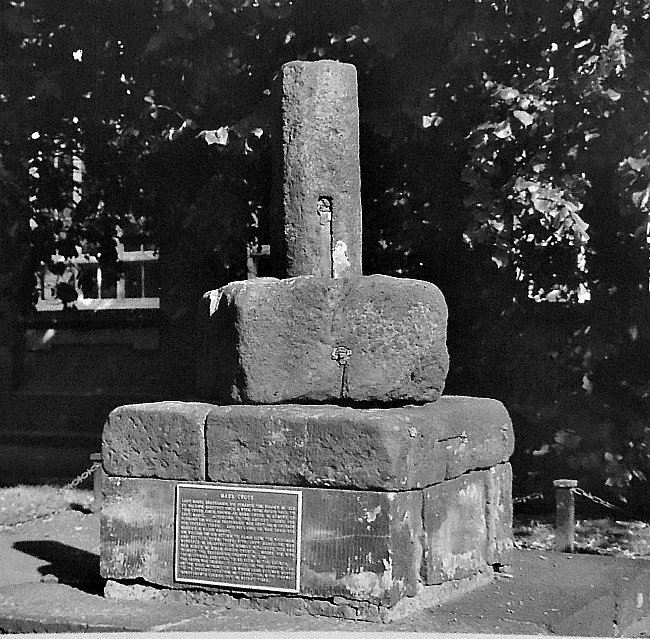
Mab’s Cross or Wigan Cross is very battered and worn from centuries of wear and tear, weather, and other damage. It stands at 2.3 metres (6 foot 5 inches) high; its stump could be a remnant from the Saxon age, though more likely it is medieval – mid 13th century. Its large step is more modern, probably not the original step(s), but the plinth is well-worn and is made up of a large slab on top of gritstone blocks with a plaque attached to this, while the worn and broken stump is socketed into a large, rough base. The monument was moved to its present position in 1922 from the opposite side of the road. It is surrounded by railings and is grade II listed.

The often-told and very sad story, with minor variations, about the life of Lady Mabel de Bradshaw (Bradshaigh) of Haigh Hall, Wigan, is this: Mabel’s husband Sir William became involved in a local rebellion against the powerful Earl of Lancaster, known as the Banastre Rising, but this proved unsuccessful so he was forced to flee abroad to escape his enemies, according to author Kenneth Fields in his work ‘Lancashire Magic & Mystery’. Almost certainly Sir William goes off to fight in the crusades (c1314), but 10 years pass by with no sign of him returning – Mabel believing him to be dead – she decides to marry a Welsh knight, Sir Osmund Neville. Then, eventually Sir William turns up in Wigan market-place dressed as a beggar; Mabel recognises him and they finally return to Haigh Hall. But upon finding out what has transpired in the intervening years, he confronts Sir Osmund on horseback, and in the deadly combat Sir Osmund is killed at the place called Newton Park (Newton le Willows). The two are then ‘said’ to have lived happily together at Haigh Hall – at least that is the theory!

Mabel’s confessor now orders her to do penance for what she has done. She is told to walk barefooted and barelegged on pilgrimage once every week from Haigh Hall to Wigan Cross [Mab’s Cross], a distance of 2 miles, which she does do for the rest of her life, but now Mabel is re-united with Sir William and is happy once again? Sir William de Bradshaw dies in 1333 and the almost saintly Mabel builds a chapel for him (1338) in Wigan parish church (the Bradshaw Chapel) also The called Crawford Chapel; she then has effigies carved on his tomb, one of her husband cross-legged and wearing armour, with sheild at his shoulder – his sword almost drawn from the scabbard and, one of herself in a long robe next to his; and on the sides of this the whole ‘sorry story’ is told in detail with various sculptures, including one of Lady Mabel with candle in hand praying at the foot of her cross. Mabel died in 1348 at the age of 30.

Of other interest in All Saints church is a Roman stone, part of an altar dedicated to their god Mithras, built into the splay of one of the windows of the tower, a relic from when the Romans had a fort or settlement (Coccium), possibly on the outskirts of the town at Castle Hill, Hindley, and where legend says: King Arthur fought one of his many battles. Author Joseph P. Pearce in his work  ‘Lancashire Legends’ says: “The Roman road leading from Warrington to Preston and Walton-le-Dale, passed through the very centre of the town of Wigan, bearing the traffic of the Legions and the Guilds and Traders of old.” The present church is 19th Century, but it stands on the site of the Roman station of Coccium and a Saxon church. Close to the church stands the medieval Haigh Hall – where the famous Bradshaw family lived and which is still haunted by the ghost of Lady Mabel.

Sources:

Fields, Kenneth., Lancashire Magic & Mystery, Sigma Leisure, Wilmslow, Cheshire, 1998.

Howarth, Ken., Ghosts, Traditions & Legends Of Old Lancashire, Sigma Leisure, Wilmslow, Cheshire, 1993.

http://www.prestonhistoricalsociety.org.uk/gallery-image?id=fd1a0be60126e19506ac2d9e488c65f8

http://www.wiganarchsoc.co.uk/content/History/Mabs_Cross.htm

Pearce, Joseph P., Lancashire Legends, The Ormskirk Advertiser, 1928.

© Ray Spencer, The Journal of Antiquities, 2014. Up-dated (2019).


4 Comments

St Barnabas Churchyard Cross, Bromborough, Wirral, Cheshire

Cross at St Barnabas Church, Bromborough (Photo credit: Peter Craine - Geograph)

Cross at St Barnabas Church, Bromborough (Photo credit: Peter Craine – Geograph)

OS grid reference: SJ 3490 8221. On Church Lane in Bromborough, Wirrral, stands the 10th century St Barnabas Churchyard Cross, where at the south-side beside the church porch stands this heavily re-constructed Anglo-Saxon wheel-head cross. There are apparently some other carved stones, possibly of Saxon origin, in the garden of the nearby parsonage; and in the churchyard there is an interesting 18th century sundial and, close-by stands the 19th century market cross. St Barnabas’ church is located in the centre of the village on Church Lane to the west of the river Mersey – at the east-side of the Wirral Peninsula. Birkenhead lies 3 miles to the north on the A41 road while Ellesmere Port is 3 miles south-east on the M53. Bromborough is thought to be one of the many contenders for the Battle of Brunanburh (937 AD), though there is ‘much’ debate about that.

The first church ‘may’ have been established here in 928 or 934 AD, but there may have already been a monastery here, and then a Norman foundation which stood for several hundred years, though the present red Sandstone parish church is of 1862-4. There may have been Viking incursions into the area during the 9th and 10th centuries, which is why it is sometimes assumed the cross shows some ‘tenuous signs’ of Scandinavian influence, though it is generally regarded as being Saxon carving. Early chronicles suggest that the first church, and quite possibly [the monastery] were founded by Aelfthryth, or Ethelfleda, Lady of the Mercians, sometime around 912 AD. Lady Ethelfleda was the daughter of King Alfred the Great.

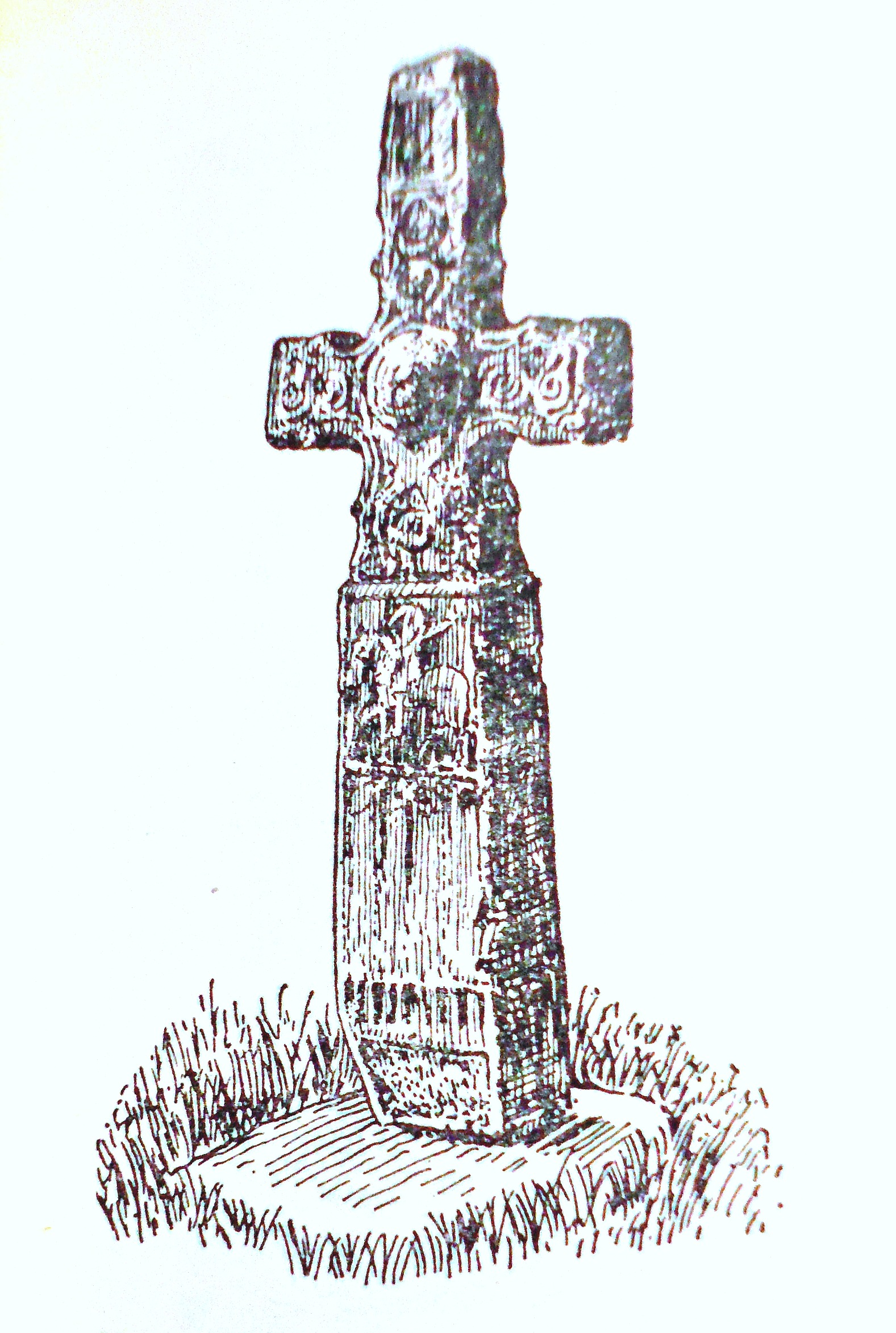
The Saxon preaching cross was put together from three fragments of Saxon stones that originally resided inside the church, and was re-erected beside the porch in the churchyard in 1958. It looks to be quite a crude monument and something of a mish-mash of the three seperate carved stones ‘haphazardly put together’ that are thought to date from the 9th-10th centuries. These pieces of carved stone originally stood in the present church and, indeed in the earlier Norman foundation before that. The sculptured wheel-head is quite basic really, with only faint carvings across its middle; the only other bit of carving is a long panel of worn interlacing on the shaft, below which a plaque* is attached recalling its history and which, rather sadly spoils the monument. The two parts of the wheel-head above and below the middle (carved) section look to be of a later date, possibly the 12th-16th century?

Also of interest in the churchyard is a 18th century sundial. This may originally have been part of the market cross. It stands upon two square-shaped steps on a base, and has a thin tapering shaft with a square top and dial. The date is recorded as being 1730.

In front of the churchyard stands the very tall market cross with square-shaped pillar standing on an eight-stepped plinth, supporting a fine ornamental top. Author Derek Bryce in his book ‘Symbolism Of The Celtic Cross’ says of this monument: “The cross at Bromboro in Cheshire stands on a stepped pyramid base, the steps of which are clearly not intended for treading…..the cross is surmounted by a sphere and sundial, which have since been replaced by a cross ecclesiastical.” The steps (plinth) of the cross are clearly medieval, maybe 13th century, the rest is from 1874.

Sources:

Bryce, Derek., Symbolism Of The Celtic Cross, Llanerch Enterprises, Felinfach, Lampeter, Wales, 1989.

* http://www.geograph.org.uk/photo/2257157

http://list.english-heritage.org.uk/resultsingle.aspx?uid=1015600

Photo Credit: http://en.wikipedia.org/wiki/St_Barnabas’_Church,_Bromborough

Copyright © Ray Spencer, The Journal of Antiquities 2014 (Updated 2023)


Onchan Celtic Crosses, Isle of Man

St Peter's Church, Onchan, Isle of Man (Photo Credit: Wikipedia)

St Peter’s Church, Onchan, Isle of Man (Photo Credit: Wikipedia)

NGR: SC 4005 7814. Inside St Peter’s church on Church Road, Onchan, Isle of Man, there is a collection of carved Celtic cross-slabs from the 7th-12th centuries AD. The present-day church stands on what was quite obviously a religious site back in the Dark Ages, although the first church which was dedicated to St Conchan (Connachan) was established in the 12th century when it was called Kirk Conachan – that dedication lasted for hundreds of years until a re-dedication to St Catherine and, then to St Peter in the 19th century. St Peter’s church is located on Church Road, just off the main A2 (Whitebridge Road), at the south side of Onchan. The village of Onchan stands on the headland at the north side of Douglas Bay – the Manx seaside town being 1 mile south, while Baldrine is 2 miles north on the A42.

Norse Cross at Onchan by Br Olsen (Photo Credit: Wikipedia)

Norse Cross at Onchan by Br Olsen (Photo Credit: Wikipedia)

There are 6 cross-slabs in the church although one shows strong Norse origins, and there is an early Christian gable cross which originally stood on the roof of an ancient keeill, a small early primitive Christian chapel. One of these called ‘Thurith’s Cross’ stands at just over 4 feet tall, is of Norse origin, and dates from the 11th-12th century. It is decorated with a crude cross on both sides as well as ring designs, but of most interest here are the runic inscriptions (both sides). These inscriptions are in short bursts: (front) krus isukrut thurith – ‘Christ / Thurith carved the runes’ (back) asunr raisti ift kui nusina murkiaum – ‘the son erected this cross to the memory of his wife muirkiaum’ and then: ukikat aukrathikr – ‘I examined / read the runes and interpreted etc’.

The Kirk Conchan Cross is a wheel-head cross at just over 2 feet high. It may date from the 9th century. This is a broken slab that has a cross and four rings with plait-work designs and, also interlacing strap-work (in low relief); there are also two creatures that might be dogs – one of which has two heads! And, the Fylfot Cross is almost 5 feet high and is said to date from the 10th century. This cross-slab has a ‘fylfot’ design as its cross, similar perhaps to the swastika symbol. Again we have dog-like creatures at either side of the cross. This slab came from the keeill chapel which stood on this site before the 12th-century church was built.

There are another three slab-crosses all of which are Celtic in origin and date from the 7th-9th centuries. These are broken, but they are still interesting because of the carved crosses, circles, plaitwork, strapwork, spiralls, numerous other Celtic-style designs and, again there are strange animals, including the usual dog-like creatures. Also, there is what is referred to as a ‘gable-end cross’ which is 12th century and supposedly came from the roof of the old keeill chapel. This primitive little chapel stood here just prior to the 12th-century church of Kirk Conachan; its remains are still visible in the churchyard.

Encased in the wall close to the crosses is a 17th-century silver chalice that is said to have been used by King Charles I at his last communion before his execution in Whitehall, London, in 1649, after which he was revered as King Charles the Martyr, with a cultus in parts of England as well as three church dedications.

There is little if any information on St Conachan, Connachan or Concenn who supposedly became bishop of Sodor and Mann in 540 AD, and has given his name to the village. He is sometimes identified with St Adamnan, the Irish saint who was a missionary in Scotland during the 7th century, and a contemporary of St Columba whose “Life” he wrote, but due to the ‘later century’ in which he lived this would seem not to be the case. To confuse things even more St Christopher, the 4th century Roman martyr was at some point ‘patron’ of the church at Onchan!

Sources:

http://en.wikipedia.org/wiki/Onchan#

http://en.wikipedia.org/wiki/Manx_runestones#

Kermode, P.M.C., Manx Crosses, Bemrose & Sons Limited, London,1907.

The Ancient And Historic Monuments Of The Isle Of Man, The Manx Museum And National Trust, Fourth (Revised) Edition, Douglas,1973.

Copyright © Ray Spencer, The Journal of Antiquities, 2014 (updated 2024).


Dupplin Cross, Dunning, Perth And Kinross, Scotland

Duppling Cross (originally at Cross Park Field, Forteviot)

Duppling Cross (originally at Cross Park Field, Forteviot)

OS grid reference: NO 0190 1448. This very splendidly carved free-standing cross which is known as Dupplin Cross, has in recent years been re-housed inside the ancient church of St Serf at Dunning in the Strathearn region, Perth & Kinross, for safety’s sake as it originally stood on a hill at Cross Park Field near Bankhead Farm 1 mile to the north of Forteviot, Perth & Kinross (Os grid ref: NO 0505 1896). Forteviot was one of the Pictish ‘royal’ capitals and a palace is said to have been built there. The Dupplin cross is, infact, a Class III Pictish stone – the shaft displaying human figures and a Latin inscription – while the head of the cross has Celtic-style decoration. And also in the church, there is a Pictish cross-slab and also a Viking (hogback) tombstone. The early 13th-century church of St Serf (Servanus) is located in the centre of the village of Dunning, 3 miles south of Forteviot, 3 miles south-east of the A9, and 7 miles south-west of Perth.

Dupplin Cross (front & east side) by J. Romilly Allen.

Dupplin Cross (front & east side) by J. Romilly Allen.

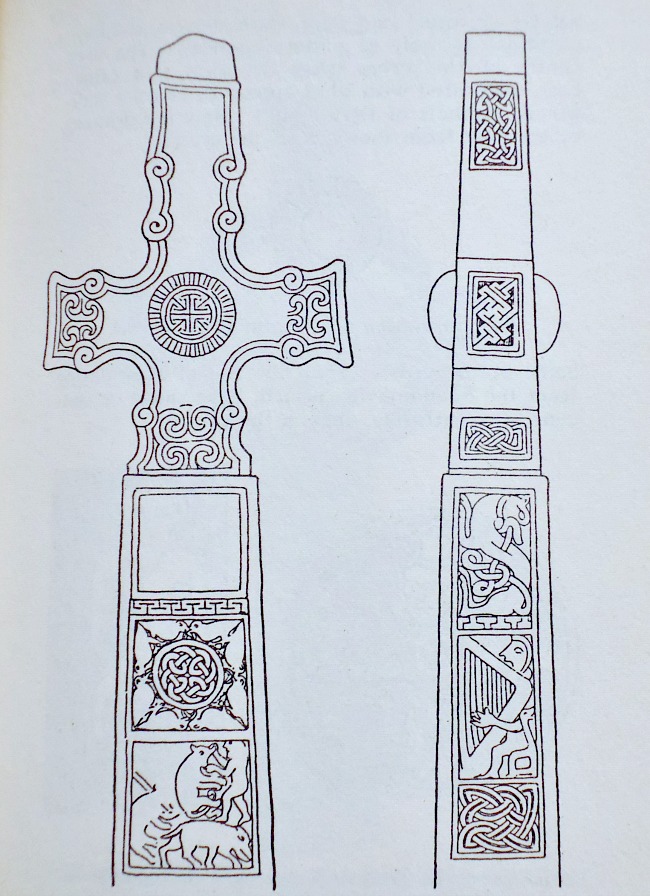
The cross is made of local hard sandstone and is 8 feet 6 inches high and 3 feet wide across its arms, and it is said to date from about 900 AD, so quite late for a Pictish stone. It is a Class III Pictish cross, but it does not have any symbols as such, although there are numerous warrior-like figures and also Biblical characters as well as ornate decoration described as being ‘Celtic’ in style. On the front face of the cross roll moulding and little spirals at intervals on the arms – with a raised circular boss at the centre which, according to the very detailed work ‘Symbolism Of The Celtic Cross’ by Derek Bryce, is “decorated with what appear to be solar radiations, symbols of Divine light”; the boss itself having a tiny cross on it. The shaft (front side) has three panels, one of which is now known to have a Latin inscription recalling the Pictish King Custantin, son of Wuirgust (Constantine Mac Fergus); the other two depict birds with crossed and interlinking beaks and legs surrounding a raised boss of interlacing, and David (from The Old Testament) tending the lion’s paw, with two more animals at the side.

The opposite cross-face has roll moulding, but the decoration in the boss is damaged, and the arms have scrollwork and key-patterning at the top. Both edges of the cross have interesting carvings – that at the left side has three panels (top) and three more on the shaft (lower) with a beast biting its tail, a man probably David seated playing a large harp, and cord-plait work. The right edge (top) has four panels of interlacing and three more on the shaft (lower) with two dogs sitting on their haunches with paws touching, two warriors on foot with sheilds and spears, and knotwork. The opposite shaft face has three panels showing a warrior on horseback, four warriors on foot holding shields and spears, a hound leaping on another animal, which is perhaps a hind, and key-patterning separating it all, according to Elizabeth Sutherland’s very thorough work ‘The Pictish Guide’.

Also in St Serf’s church is a Pictish Class III sandstone cross-slab of the 10th century? This has a broad-type Wheel or ring cross in high relief which is 3 foot 10 inches high. This slab was dug up from beneath the floor under the church tower about 1900. The cross at the top is, rather oddly, repeated lower down the slab, but only about half of it has been carved; the sides of the slab have typical Celtic interlacing, now rather worn. And a tombstone of the 10th or 11th century is thought to be a Viking hogback. This has a cross carved upon its front-side and cable moulding at its border.

St Serf or Servanus, patron of Dunning Church, founded a monastic school at Culross, Fife, in the early 6th century. Traditionally, he baptised and tutored St Kentigern (Mungo); and is perhaps wrongly accredited with the title: Apostle of Fife. He died in 560 or 580 and his feast-day is usually held on 1st July.

Sources:

Bryce, Derek., Symbolism Of The Celtic Cross, Llanerch Enterprises, Felinfach, Lampeter, Wales, 1989.

Jackson, Anthony., The Pictish Trail,  The Orkney Press Ltd., St Ola, Kirkwall, Orkney, 1989. 

Sutherland, Elizabeth., The Pictish Guide,   Birlinn Limited, Edinburgh, Scotland, 1997.

Copyright © Ray Spencer, The Journal of Antiquities, 2014.


1 Comment

The Sandbach Crosses, Cheshire

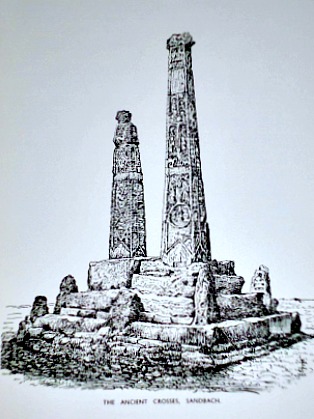
The Ancient Crosses, Sandbach (1886)

The Ancient Crosses, Sandbach (1886)

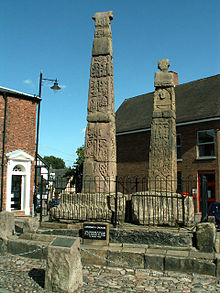
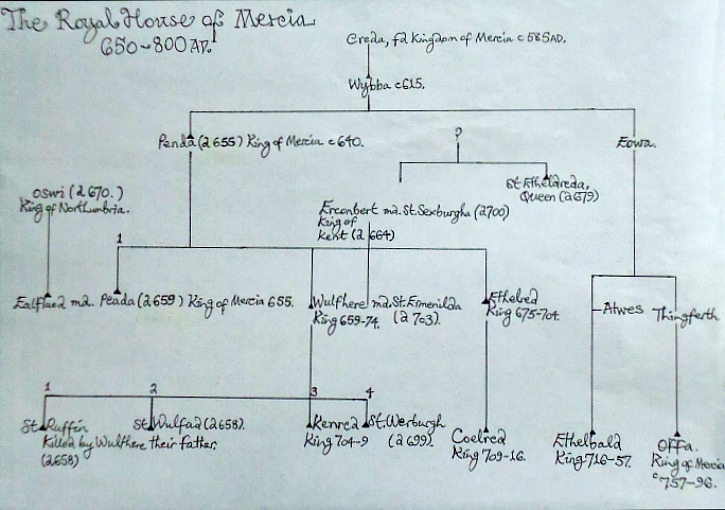
OS grid reference: SJ 7587 6082. In the cobbled market-place opposite the High Street at Sandbach, Cheshire, and at the back of St Mary’s church – are two tall Anglo-Saxon crosses known as The Sandbach Crosses, said to date from the 8th or 9th century, or maybe even earlier. They are in fact Mercian crosses because this area came under the jurisdiction of that kingdom during the 7th century AD, which was ruled by the pagan King Penda, and his son Paeda, who became a Christian; the crosses being ‘supposedly’ set up to commemorate the conversion to Christianity of Paeda following his business trip to the kingdom of Northumbria where he married a Christian princess called Alchfleda or Ealfleda, daughter of King Oswy. Four northern missionary priests: Adda, Betti, Cedd and Diuma accompanied the newly-married couple back to Mercia, and there the four ‘holy men’ set about spreading ‘the word of God’ in the kingdom of Mercia itself, perhaps even establishing a monastery at Sandbach, according to the Venerable Bede. They appear to have been succesful, especially when Paeda succeeded his father as king of Mercia in 655; Paeda died four years later in 659. The crosses ‘were’ said to have been set-up a few years earlier in 653 AD.

Both crosses were heavily restored after being virtually destroyed by Puritans in 1614 and then suffering the fate of being used as building material in various structures, in a well, and even as paving-stones in the town’s streets. The carved, sculptured stones that formed the two crosses were eventually very hurridly taken away to various places in Cheshire (by some eminent local notaries) – before being brought back and re-erected in the market-place at Sandbach in September 1816.

In the work of the antiquarian Miss E. Egerton ‘The Saxon Crosses – Sandbach, Cheshire – An Illustrated Description And History’, regarding the destruction of the crosses she says that: “Sir John Crewe took several pieces to Utkinton , and set them up as ornaments in his grounds. When he died they were taken to Tarporley, to the Rectory by Mr. Allen, where Mr. Cole, a distinguished Antiquarian, saw them, made drawings of them, and now they are to be seen in British Museum along with his other M.S.S. Later these stones were found to be deposited at Oulton Park, owned by Sir John Egerton. For a number of years the Crosses remained in a state of mutilation, but as Sandbach grew the inhabitants decided to have the Crosses restored and re-erected.”

But the two sculptured crosses, despite being battered about, are still “outstandingly” well-carved with scenes from the bible and notable moments from royal Mercia in the mid-7th century AD. It is thought highly likely that a third small cross once stood beside the two in the market-place, indeed the pieces of carved stone on the ground beneath St Mary’s church-tower, nearby, may have come from that ‘lost’ cross?

The taller of the two high crosses is almost 16 feet (4.8) metres high, while the smaller one is almost 11 feet (3.3) metres high, although they would originally have been taller if they had not lost their cross-heads. The carvings are in varying sized sections (panels) down each face and, although these carvings do not always quite match-up, generally they are pretty good considering what they had been through!
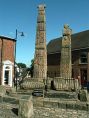
Sandbach Crosses (Photo Credit: Wikipedia)

Sandbach Crosses (Photo Credit: Wikipedia)

The taller cross is made-up of eight pieces of stone, some more recent, standing upon a large base and a stepped plinth, decorated with biblical scenes in sections (panels). At the top there is a broken, round-shaped  cross-head, now only a quarter of it remains. The east face is apparently the most interesting, maybe because it deals with Christ’s crucifixion, his baptism, and also “his” transfiguration in early Christian motifs. In the centre Christ on the cross with the two Mary’s at his side, and the emblems of the four evangelists formed by the limbs of his cross, while below that Jesus in the manger, with an angel above and an ox at each side. At the top, just below the head, two mutilated figures and, below that the intruments of the passion – a hamer and pair of pincers. Toward the bottom ‘The Annunciation of the Virgin Mary’ and above her the holy ghost in the form of a dove. Below that a circle with the Virgin Mary, St Elizabeth and St John.

The west face shows Christ’s passion: near the top four figures may be the evangelists, while further down Christ is bound with a cord, with a man in front dragging him (by the cord) towards Pilate. At the centre Simon of Cyrene carries the cross, and in front of him a figure carrying a club, or a lance, and just below the middle the Angel Gabriel visits Zacharias (seated) in the temple; the bottom panel shows two dragons. The north face has ‘The Descent of the Holy Ghost’ with a long-tailing dragon; the other panels going downwards have ten Apostles in two columns, each in his own compartment but on a different level, although ‘seemingly’ able to communicate with his neighbour! And the south face is adorned with interlacing, filigree work, and vine-scrolls, and a number of animals trapped inside the scrolls – representing John the Baptist in the Wilderness.

The smaller cross is largerly a 19th century reconstruction, its broken Maltese-style head may have come from a third small cross. It is made up of many panels in which there are numerous creatures and human figures. The north face depicts Paeda’s journey to the north. At the top two dragons with their tongues interlinked, below that two rows of compartments or rooms with a figure inside (walking), some carrying dagers in their hands. While the south face shows more figures, these ones quite well-carved and clear, in arched compartments and holding staves, while at the bottom two angels are looking upwards.

The Royal House Of Mercia.

The Royal House Of Mercia.

The east face consists of five diamond-shaped compartments. At the top a bull (meaning strength) with its head inclined backwards, while below that a human figure inside the diamond-shape with his hands ‘going’ into his sides, maybe representing King Penda, and above and below the king’s noblemen. In the centre of the cross Alchflaeda, princess of Northumbria, with her two attendants. At the bottom King Paeda of Mercia in a diamond-shape with two noblemen. The west face is damaged at the top, but the lower section is very good. Here we have the conversion to Christianity of Paeda with a dove coming to rest on his shoulder, while below him in arches are his many followers, and at the bottom two angels looking up.

Sources:

Anderton, Bill., Guide To Ancient Britain, Foulsham, Slough, Berkshire, 1991.

Burgess, Rodger., Cheshire – Secrets from the Past, Sigma Leisure, Wilmslow, Cheshire, 2000.

Egerton, E, Miss., The Saxon Crosses – Sandbach, Cheshire – An Illustrated Description And History (2nd Edition), Chester, 1934. (Reprinted by: The Rotary Club of Sandbach, December 1986).

English Heritage: https://www.english-heritage.org.uk/daysout/properties/sandbach-crosses/history-and-research/

Wikipedia: http://en.wikipedia.org/wiki/Sandbach_Cross

Copyright © Ray Spencer, The Journal of Antiquities, 2014.


2 Comments

St Tudclud’s Church, Penmachno, Conwy (Bwrdeistref Sirol), North Wales

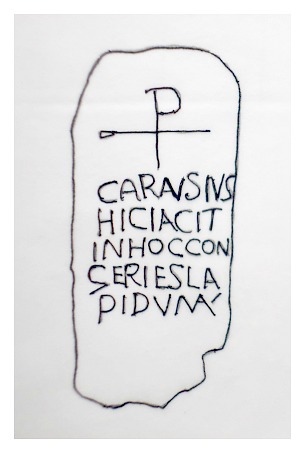
The Carausius Stone, Penmachno, Gwynedd

The Carausius Stone, Penmachno, Gwynedd

OS grid reference: SH 7899 5059. In the village of Penmachno, Conwy, stands St Tudclud’s Church, a rather unassuming Victorian building which houses a collection of Romano-British memorial stones. But these stones are now known to be of great historical importance with regard to Wales at the end of Roman occupation (the early 5th century AD). One of these stones recalls Carausius, a young Irishman who migrated to Wales and proclaimed himself emperor of the Celtic west, the other stone is in memory of the cousin of a magistrate, perhaps the first-known person with the title of a court official. The church is located on Llewelyn Street and is dedicated to the little-known Celtic saint, Tudclud, also known as Tyddud. A Roman camp stood close to where the church is – now alas little more than a few grassy earthworks in a field. The village lies 3 miles to the south-west of the A5 road, 4 miles south of the Conwy Valley and Bettws-y-Coed, 8 miles east of Pentrefoelas, and 12 miles north-east of Ffestiniog.

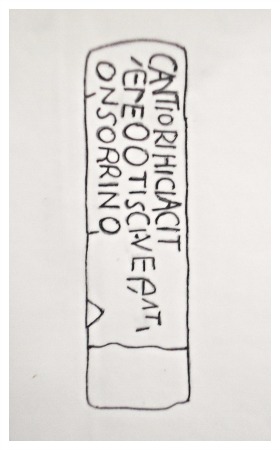
In the church of St Tudclud there are five very interesting inscribed memorial stones which date from the late 5th to early 6th century. In particular, two of these stones, one recalling Carausius, and the other in memory of Cantiorix are of very specific historic importance. The Carausius Stone is a flat-shaped grave cover inscribed in Latin to the memory of CARAUSIUS HICIACIT INHOCCON GERIESLA PIDUM or ‘Here lies Carausius in this heap of stones.’ Also inscribed on this stone are the Greek letters “X” and “P” the first two letters of the word Christ (Christos), which here form a four-rayed cross known as a Chi-Rho monogram. Legend tells us that Carausius, also known as Crair or Caron, was the hero of the Britons during the 3rd century AD. He proclaimed ‘himself’ King and Emperor of the Celtic West, and stood up to the might of the Roman army, who in turn, regarded him as ‘something of an annoyance.’ A church was dedicated to him at Tregaron, Gwynedd, because he was regarded as a saint in this part of the Celtic fringe.

The Cantiorix Stone, Penmachno, Gwynedd

The Cantiorix Stone, Penmachno, Gwynedd

Another interesting stone has a Latin inscription (on both faces) recalling Cantiorix the cousin of Maglos. It reads: CANTIORI HIC IACIT VENEDOTTI CIVES FUIT CONSOBRENAS MAGLI MAGISTRATI or ‘Cantiorix lies here, a citizen of Gwynedd, and cousin of Maglos the magistrate,’ The Magistrate Stone was found at Beddau Gwyr Ardudwy near Ffestiniog. It is thought to be the only known example of a person being linked to that of a court official and almost certainly dates from the 5th century. A third stone has the inscription ORIA HIC IACIT which simply means: ‘Oria lies here,’ while a fourth stone reads: FILI AVITORI INTEMPORE IUSTINI CONSULIS or ‘The son of Avitorus in the time of Justinus the Consul,’ which perhaps relates to a consul of Constantinople in the year 540? A large, square-shaped stone has two letters “L” and “R” carved onto it. A couple of these stones were found in the fabric of the church when it was being rebuilt in 1856, but they may originally have come from the nearby Roman camp. The font is thought to be 12th century.

A sixth gravestone is of the 13th century and commemorates Prince Iorwerth ab Owain Gwynedd (Iorwerth Drwyndwn), who died in 1174 and was the eldest son of Owain, King of Gwynedd. And another slightly more recent slab stone, maybe from the 8th century, has only an inscribed cross upon it. The patron saint of this church is Tudclud, or Tyddud, a 6th-century monk who was said to have been the son of Seithenyn, King of Cantref-y-Gwaelod (the Lowland Hundred), the drowned kingdom off the Cardigan coast. Not much is known about him other than he founded a monastery here at Penmachno and was the brother of St Arwystyl, who was a monk at Bangor Fawr, and St Collen of Llangollen. There is a legend that says King Seithenyn was so drunk one night that he forgot to close the sea gates and, by the morning his kingdom had been completely ‘lost to the sea,’ according to Nigel Pennick in his very interesting book ‘Lost Cities And Sunken Lands’ 1997.

Sources:

Barber, Chris., More Mysterious Wales, Paladin Books, London, 1987.

Gregory, Donald., Country Churchyards In Wales, Gwasg Carreg Gwalch, Llanrwst, Wales, 1991.

Gregory, Donald., Wales – Land Of Mystery And Magic, Gwasg Carreg Gwalch, Llanrwst, Wales, 1999.

Holder, Christopher., Wales: An Archaeological Guide, Faber & Faber, London. 1978.

Pennick, Nigel., Lost Cities And Sunken Lands, (Revised & Updated 2nd Edition), Capall Bann Publishing, Chieveley, Berks, 1997.

The Quest for Arthur’s Britain, edited by Geoffrey Ash, Paladin Books, St Albans, Herts, 1976.

http://www.megalithic.co.uk/article.php?sid=16831

Copyright © Ray Spencer, The Journal of Antiquities, 2014.

Caedmon’s Cross, Whitby, North Yorkshire

Caedmon's Cross at Whitby.

Caedmon’s Cross at Whitby (Front)

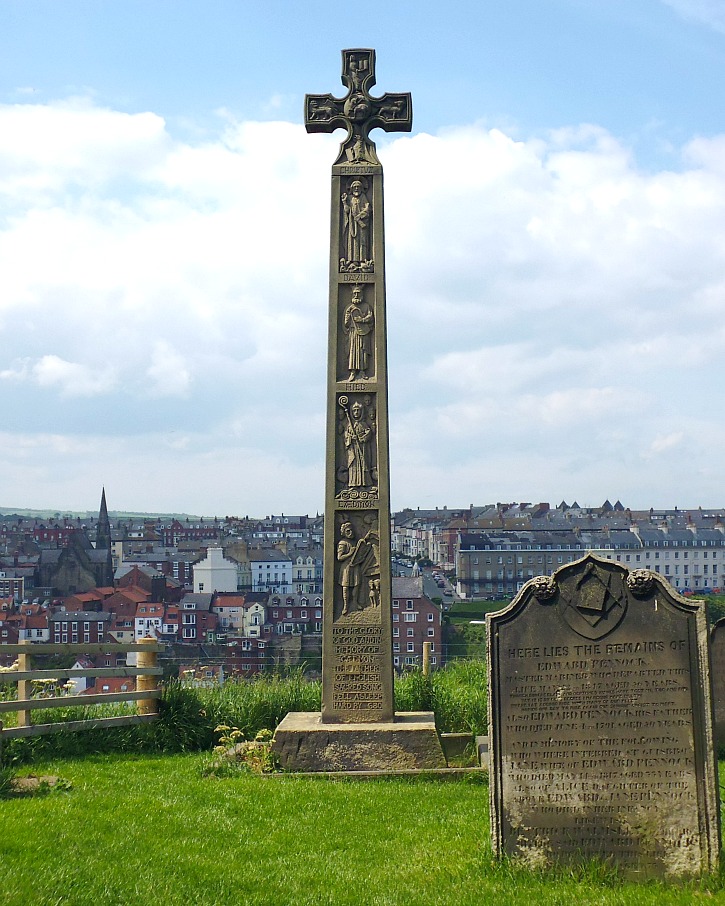
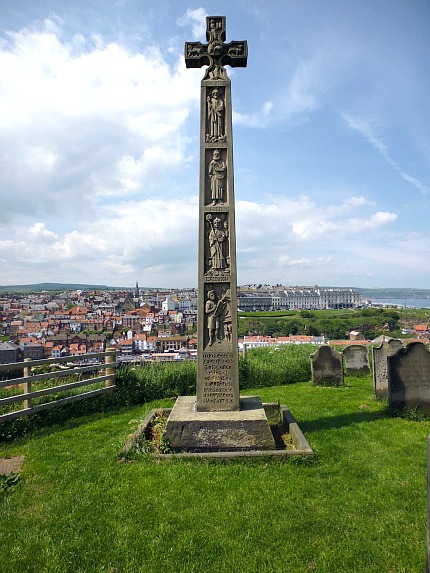
Os grid reference: NZ 9009 1126. From Church street it’s a fair-old climb to the top of the precarious flight of 199 steps up to the west side of St Mary’s churchyard, overlooking the river Esk where it meets the north sea; but at the very top we are compensated by the tall monument called Caedmon’s Cross, a late Victorian-style Celtic cross that commemorates the famous 7th century Anglo-Saxon poet, Caedmon. He lived for most of his life at St Hilda’s monastic community of Streonaeshalch (Whitby), the predecessor to the present-day abbey, as a laybrother and herdsman. But Caedmon was to become an outstanding religious poet, and we have St Hilda to thank for that! The cross is richly decorated on all four sides and, although it’s not an ‘ancient’ cross as such – it’s still a remarkably stunning monument. It’s well worth visiting.

Caedmon’s Cross is almost 20 feet high and stands upon a solid stone-base. It was made from a hard type of sandstone quarried close by Hadrian’s Wall; and was set-up in 1898 to commemorate the 7th century poet of Whitby Abbey, founded by the Northumbrian saint, Hilda. The monument is very reminicent of the Bewcastle, Ruthwell and Gosforth Crosses with its panels depicting various Saxon saints, kings and Biblical figures, and there is an inscription recalling Caedmon. On the front side (east face) in 4 panels: Christ in the act of blessing – his feet resting upon a dragon and a swine, King David playing a harp, the abbess Hilda  with her feet on tiny fossilised creatures (ammonites) with a gull by her side, and behind her her five best scholars. Also Caedmon in his stable being inspired to sing his hymn about ‘The Creation’ – below which an inscription: “To the glory of God, and in memory of Caedmon, Father of English sacred song. Fell asleep hard by AD 680.”

Caedmon's Cross, Whitby (East Face)

Caedmon’s Cross, Whitby (Front Face)

On the west face in panels: double vine stems symbolising Christ, loops with 4 scholars of Whitby at the time of Caedmon: Aetla, Bosa, John and Oftgar, below which are carved the first 9 lines of Caedmon’s hymn of Creation. The two sides of the cross show an English rose, birds, animals and an apple tree (Eden). Also, a harp at the foot of The Tree of Life (harmony with Christ). The cross-head is carved on one side with the Agnus Dei and the four Evangelists with their symbols, while the other side has knotwork, bosses, and a dove representing the Holy Ghost.

We know from what Venerable Bede tells us in his ‘Ecclesiastical History Of The English People’ that Caedmon was ignorant, at first, of words and song and, knew nothing much about ‘life and creation’, being teased and mocked by the other monks, but that his life literally changed overnight when he had a wonderful dream in which he was visited by an angel. He was told to compose a hymn about the Creation with our Lord at its ‘very core’. The following morning he rushed to inform abbess Hilda about this dream. Hilda was filled with joy at what she heard and encouraged him to write down what the heavenly angel had revealed. And so the great hymn to ‘God the Creator’ was composed; he even sang it in a angelic voice in front of his fellow monks.

Abbess Hilda invited scholars from the monastery to evaluate Caedmon’s work, and she asked him to take the tonsure of a monk – which he did. But he also set out to write about the Christian Church and compose other religious hymns and poems with the Bible at the heart of each one. Sadly the Creation hymn is Caedmon’s only surviving work and is said to be ‘the oldest recorded Old English poem.’ He is said to have died in the monastery hospice in AD 680 surrounded by his friends after having a premonition of his own death; St Hilda also passed away that year, aged 66. However some accounts claim that Caedmon died in AD 684? The 11th February is St Caedmon’s feast-day. Close by there is a rather battered medieval wayside cross on a circular stepped base.

Sources:

Bede, The Venerable., A History Of The English Church And People, Penguin Books Ltd., Harmondsworth, Middlesex, England, 1982.

Roberts, Andy., Ghosts & Legends of Yorkshire, Jarrold Publishing, Norwich, 1992.

Smith, William., Stories & Tales Of Old Yorkshire., (Ed by Dawn Robinson-Walsh), Printwise Publications, Bury, Lancashire, 1993. (Orig. ed by William Smith in 1883).

http://www.jstor.org/stable/25581386q=2

http://en.wikipedia.org/wiki/C%C3%A6dmon