The Journal Of Antiquities

Ancient Sites In Great Britain & Southern Ireland


Weyland The Smith – An Article by David McGrory

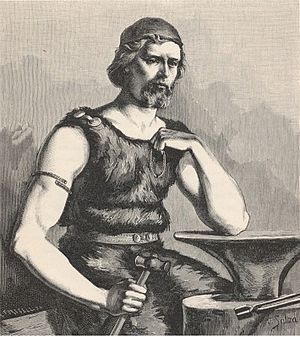
Volundr (Weyland the Smith) - an illustration. (Wikipedia)

Volundr (Weyland the Smith) – an illustration. (Wikipedia)

   Looking through some of my old ‘Prediction’ magazines I came across an excellent historical article by David McGrory. This article appeared in the June 1995 edition of the magazine and is all about the mythical Norse god Weyland the Smith, also known as Volundr. I thought that other people might like to read this, and so here it is “quoted” in full.  The author says:

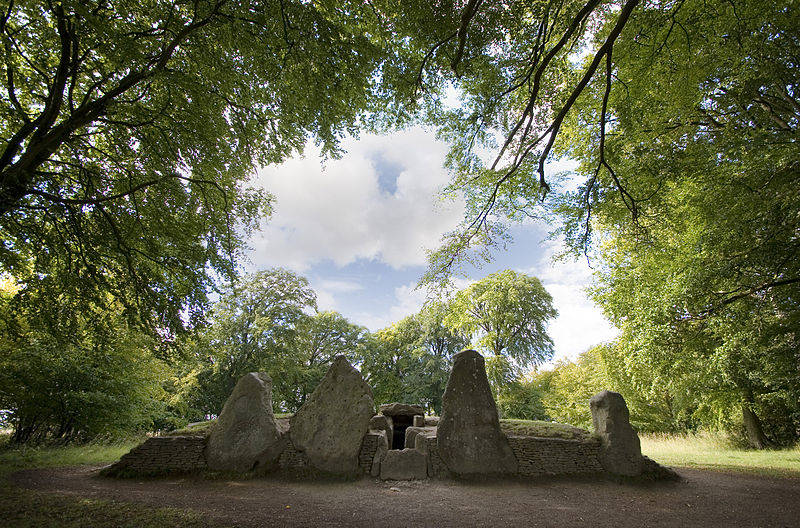
   “By an ancient ridgeway that passes through the Uffington White Horse, Oxfordshire, a Neolithic long barrow constructed at least 5,ooo years ago stands amid a circle of trees. The barrow with its large entry stones is known as Wayland’s Smithy, taking its name from the Teutonic demi-god, Weyland the Smith, also called Volund, for the first Saxons to see the mound thought it had been constructed by a god or giant”.

  “According to legend, anyone who passed this barrow with a horse that needed shoeing need only leave a silver coin then retreat; on his return, the coin would be gone and the horse shod. Similar tales are to be found in ancient Greek mythology concerning the classical smith god, Vulcan”.

Wayland Smith Long Barrow (photo credit: Msemmett for Wikipedia).

Wayland Smithy Long Barrow entrance (photo credit: Msemmett for Wikipedia).

   “Because the ‘smithy’ lay on the boundary of two Saxon estates it is the only ancient monument to be named on an Anglo-Saxon charter; dating to before the Norman Conquest, the conveyance charter referrs to the barrow as ‘Welandes Smiththan'”.

  “Teutonic beliefs brought here by the invading Saxons during the 5th century inform us that Weland was the youngest of three sons fathered by the demi-god Wade. As a child Weland was entrusted into the hands of dwarves who lived amid the metals in the mountains and taught him the magical art of the smith, thus he became skilled in forging, making weapons and jewellery”.

  “In his Iceland homeland Weyland spent much of his time out hunting with his two brothers. The three finally settled in a place called Ulfda where, one day, they saw three beautiful Valkyrier (nymphs) swimming naked in a lake, their ‘elf garments’ left lying on the shore. The brothers seized the magical clothes and the women who they took to be their wives”.

  “All lived contentedly together for eight years, then the Valkyrier became bored with domesticity and one day fled with the brothers were out hunting . Discovering their loss, two of the brothers went in pursuit, leaving Weland behind tending his forge. Anticipating the wives’ return, Weland wrought three golden rings which he strung on a willow wand”.

  “One day, while Weland was out hunting, King Niduth of Sweden who was searching for a smith entered Weland’s empty hut, saw the golden rings and took one for his daughter, Baudvild. Weland returned that night and, while roasting a piece of bear meat, noticed that one of the rings was missing. This caused him great joy as he imagined that his wife had returned, so sat awaiting her arrival and soon feel asleep”.

  “But instead of his wife, King Niduth returned, had Weland seized and carried to the palace. Then, by the Queen’s command, Weland was hamstrung, placed on a small island and compelled to work for his royal couple. Not surprisingly, Weland sought revenge and a suitable opportunity soon arose”.

  “King Niduth’s two greedy sons approached Weland demanding to see the tresure and were told it was kept at his forge (Wayland’s Smithy, Oxfordshire, was probably raided for treasure early in its history). Having seen the treasure, Weland told the brothers that if they returned the following morning he would give it to them”.

  “So they returned the next day and as they entered Weland slammed the door shut, decapitated them with one blow and buried their bodies. But the skulls he fashioned into silver-plated goblets for the King’s table; from their eyes he produced gems for the Queen; and the princess received a pearl necklace made from their teeth. Weland took further revenge on the princess who he raped when she came to him secretly to have repaired the golden ring given her by her father. As a result of this unwilling union a daughter was born who would herself become part of a later Teutonic mythology”.

  “Weland then escaped his island prison by taking flight, using a pair of magical wings he had wrought in metal. He landed on the palace wall, called the King and Queen forth and told them of the terrible fate of their two sons and the violation of their daughter. His revenge complete, Weland took to the air and was never seen on Earth again”.

  “His new role, apparently, was to act as armourer to the gods and our ancestors believed that Weland kept a doorway open into their world at Wayland’s Smithy; certainly there is some evidence of worship at this site”.

Source:

McGrory, David., ‘Weyland The Smith’ (article in Prediction magazine), June 1995 Volume 61 Number 6, Croydon, Surrey.

https://en.wikipedia.org/wiki/Wayland_the_Smith

https://en.wikipedia.org/wiki/Wayland%27s_Smithy

© Copyright, Ray Spencer, 2015.


1 Comment

London’s River 1- From The Cotswolds To Teddington – by J. R. L. Anderson

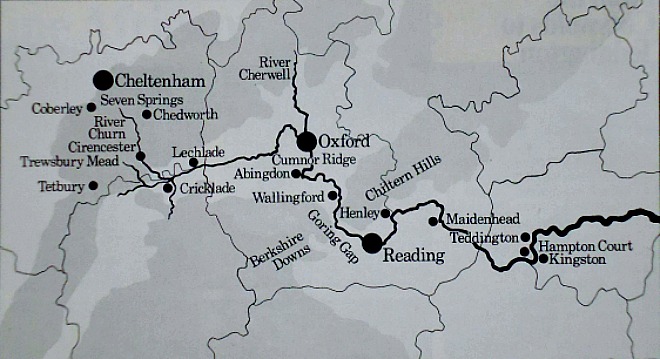
Map of the River Thames (Cotswolds to Teddington).

Map of the River Thames (Cotswolds to Teddington).

Here quoted “in full” is the brilliant and very comprehensive article from ‘The Illustrated LONDON NEWS’ magazine of July 1971, written by J.R.L.Anderson. In the forward to the article we are told that: “The Upper Thames no longer carries commercial traffic, though it remains a fine inland waterway for pleasure cruising. In the first of a two-part article the author, who lives in the Thames, describes the non-tidal stretch of the river and recalls some of its history and two of its enigmas – the continuing controversy over its source and the origin of its name.”

“The Thames is London’s river, but it would be more exact to say that London owes its existence to a geological freak, a little ridge of hard Corallian limestone near Oxford left by the Jurassic seas that covered most of southern England about 140 million years ago. This little ridge, noticeable enough in the days when people walked from Oxford to Cumnor, is taken by the motor car in its stride. You may, perhaps, have to change gear if you are held up by a lorry, but otherwise there is nothing to tell you that you are climbing a hill that changed the course of the Thames, and with it the course of English history.”

“The Thames rises in the Cotswolds and flows easterly towards the North Sea. But for the Cumnor ridge it would have gone on flowing eastwards, trending a little north to skirt the Chilterns, and forming its estuary somewhere between Aldeburgh and Clacton. But for the Cumnor ridge, Ipswich or Colchester would have been the capital of England.”

“The ridge checks the easterly flow of the Thames. To get round the ridge the river makes a great bend to the north and then turns south again, gathering the Cherwell at Oxford. Instead of flowing on east, it runs more nearly south – a little east of south – towards Reading. Just before its gets to Reading the Thames meets another barrier, the ridge of chalk forming the Berkshire Downs and the Chilterns. The river deals with this decisively, cutting a path for itself through what is called the Goring Gap. From here it returns to a generally easterly course to London and the sea.”

“London came into being as a settlement at about the sea-tide coming into the river up the estuary, a good place for crossing the river. There were shallows where, at low tide and when the Thames itself was low, the river might be fordable, though the crossing on foot or on horseback would always have been risky. But it would have been easy enough by boat, a good place for a ferrypoint before the river widens into its estuary. A good place, too, for beaching larger craft bringing cargoes from the Continent, a snug haven after those vicious, short, steep seas of the passage from Norway, Denmark or the Low Countries. So London came into being as the pulsing heart of England, with the Thames its artery.” 

“For a river with so much history so long studied, the Thames still presents a surprising number of enigmas. No one has yet satisfactorily determined what its name means, or where it comes from. The Romans found it called (phonetically) “Tems”, and  latinised this into “Tamesis”. The “h” in the modern spelling is a ludicrous intrusion. It occurs in no very early charters, although it is occasionally to be found in late medieval documents as “Thamisa”. The silly “h” became fashionable in the seventeenth century when it was considered the thing to go in for “antiquities” – it is a fake. It has remained with us ever since.”

“But what does “Tems” (or “Thames”) mean? It has no obvious root in the Celtic or Gallic tongues spoken in England before the Romans came. Dr Eilert Ekwall, author of the great Oxford Dictionary of English Place-Names, suggests that it may derive ultimately from the Sanskrit “Tamasa”, meaning “dark”, perhaps through the Old Irish “Temen”, also meaning “dark”.  Some early people speaking in Indo-European language certainly came to Britain and they may have called the Thames “dark water” in their tongue. It is a singularly inappropriate name for the Thames as it has been these past 2,000 years, for it is a silver stream rather than a dark, brooding one. But when our remote ancestors came, the Thames valley was thickly wooded, and the river under the trees may have seemed strikingly dark. No one knows. “Thames” may be a link with our first Indo-European forebears, or it may mean something completely different in some completely unknown tongue.”

“I should like here to denounce another affectation in the name “Isis” occasionally presented as an alternative name for the Thames above Oxford, and regrettably sanctioned as such by the Ordnance Survey. The “Isis” is a non-existent river, and the name was unheard of before the fourteenth century. Some unknown scribe seems to have conceived the idea that “Tamesis” was a compound of the names “Thame”, a tributary which joins the Thames just below Oxford, and an imaginary “Isis”. This is absurd. No one living by the Upper Thames has ever called the river anything but “Tems”, of which “Tamesis” is simply the Latin form.  “Isis” has gratified some uncritical literary fancies, but it is as bogus as the “h” in “Thames”. That “h”, I fear, is too long established in orthodox spelling to be shifted now, but the map-makers ought surely to abandon “Isis”.” 
   

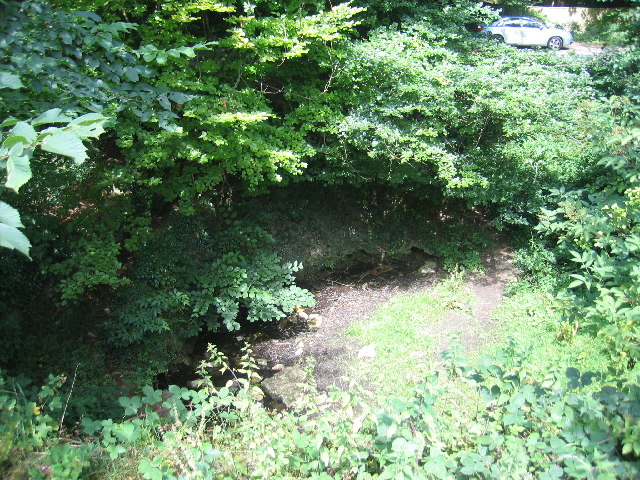
Seven Springs on the River Churcn (photo by David Stowell - for Geograph)

Seven Springs on the River Churn (photo by David Stowell – for Geograph)

“Another enigma of the Thames is that its source – in well-surveyed, civilised England! – remains in dispute. The Ordnance Survey accepts the source as a spring (commonly dry in summer) at Trewsbury Mead, about 3½ miles SW of Cirencester and just to the N of the old Roman road (Fosse Way) between Cirencester and Tetbury. This is accepted, too, by the Thames Conservators, the official body responsible for the river, and the site has been adorned by them with a statue of a river god (Old Father Thames?) that once lived in the old Crystal Palace. But there is a rival source, about 11 miles farther north at Seven Springs, near Coberley, on the outskirts of Cheltenham. Here, there is a better spring, in a dell with water in it, and a Latin inscription on a stone, recording:

            Hic Tuus,  O Tamesine Pater,  Septemgeminus Fons,  (Here, O Father Thames, is thy sevenfold source).

“The matter was even discussed in Parliament (in 1937), when the supporters of Seven Springs tried to get a ruling giving official recognition to their source. Mr Chamberlain’s Government was unmoved, sticking to Trewsbury Mead, and arguing that the river which rises at Seven Springs is not the Thames, but the Churn. The Churn, however, is a tributary of the Thames, which it joins at Cricklade. Its source is farther from the sea than Trewsbury Mead: should it be regarded as the main river down to Cricklade, and the stream from Trewsbury Mead as a tributary? This is like the arguments that go on about the Mississippi and the Missouri; it will never be settled.”

“The Thames has always been navigable, though not always easily, from the sea to Lechlade, and at times, when barge-traffic was important, as far as Cricklade. Until the coming of railways, the Thames was the main route for merchandise from London to Windsor, Maidenhead, Reading, Wallingford, Abingdon, Oxford, Lechlade and Cricklade, and for the products, mostly agricultural, of Oxfordshire and Berkshire sent to market in London. Cheeses from the Vale of the White Horse, shipped by river, helped to feed London before the Conquest. Until the Angevin kings stopped the trade (because they wanted revenue from the vineyards in France) there was a considerable river trade in wine from Abingdon and Reading. It was not the climate but politics that put an end to grape-growing in the Thames valley – an end, that is, commercially, for grapes can still be grown well by the Thames and I have drunk an excellent light wine from grapes grown near Pangbourne. Cotswold stone for building the first St Paul’s Cathedral was brought by the Thames to London, and Sir Christopher Wren turned again to Burford for stone and to the Thames for transport when he built the present St Paul’s. By Wren’s day, however, Portland stone  by sea was cheaper than Burford stone brought to London by river, so he used Burford stone only for parts of his cathedral, where he wanted its special qualities.”

“Had railways been invented a few decades later a splendid system of canals, based on the Thames, would have linked London to Bristol and the Midlands : there might even have been a ship canal from the Bristol Avon to the Thames. The canals exist but the railways killed them before they could be developed for modern traffic. It is no use crying over spilt canal water, but one can still be angry that so much of it remains spilt. Many people hold that these canals could – and should – be restored and modernised, to the great relief of overcrowded roads.”

“If commercial traffic has gone from the Upper Thames it remains one of the finest inland waterways in Europe for pleasure cruising. The Conservancy maintains a dredged channel for 124 miles of non-tidal river from Teddington to Lechlade, and the channel is being extended to take small cruisers well above Lechlade. All locks on the Thames are manned, and most of them now are power-operated. There are fleets of cruising craft for hire or charter, and good facilities for privately-owned boats. From the Thames, too, you can get on to the Oxford Canal, a beautiful eighteenth-century waterway, and thence to the canal network of the Midlands – wonderful territory for inland cruising. Many of the old canals are still navigable by small boats, though you may have to work the locks yourself. But this is good exercise for a crew of strong sons and daughters, while the skipper goes off to replenish stores. If you time your arrival rightly at the right places, stores replenishment can be indeed a congenial task.”
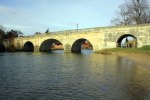
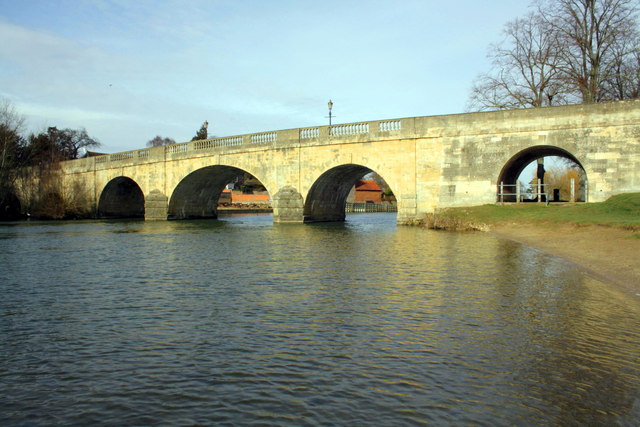
The River Thames at Wallingford Bridge (photo credit: Roger Templeman - for Geograph).

The Thames at Wallingford Bridge (photo credit: Roger Templeman – for Geograph).

“But you need a lifetime to properly explore the Thames itself, and its magic hinterland. It is good to travel by boat, but you need not, for all the Thames-side towns and villages can be reached by car, though you will want a good map, and will have to make considerable detours as the river winds. The centuries unfold with particular vividness as you make your way along the river, if you go with a map to a library beforehand and work out the meanings of the place-names on your route. The Thames is a boundary as well as a highway. It brought prehistoric man to the good upland country where he could flourish, and protected his little settlements. Later, it brought the early Saxons to the heart of their kingdom of Wessex – Hinksey, now part of modern Oxford and once an island in the river marshes, means “Hengist’s Island”, commemorating a very early Saxon name. The Thames bounded the ancient kingdom of Wessex, and when it was beset by enemies the river line held. King Alfred and his sons took particular care to guard the crossings at Cricklade, Oxford and Wallingford, and the invading Danes were checked by the Thames. Later, it was the dividing line in the south of England between the area where the old Saxon laws prevailed and the Danelaw, where Viking traditions were recognised.”

William the Conqueror secured his hold on England by holding the Thames. His great castles at London, Windsor, Wallingford and Oxford not only controlled the river but dominated the routes leading to and from places where it could be crossed. The wars between Stephen and Matilda were fundamentally struggles to control these castles, and it was Stephen’s final failure to take Wallingford Castle, which held out for Matilda, that ended the war in the treaty securing the succession of the throne of England to Matilda’s son, afterwards Henry II. It was through Henry II that the blood of the old Saxon Royal House was restored to the English throne, a link that has never since been wholly severed, save in the interregnum of the Cromwellian Commonwealth (1649-60). Thus it can be held with truth that it was the defense of the Thames at Wallingford in the twelfth century that not only gave England one of her greatest monarchs in Henry II but ensured that a descendant of Egbert, king of Wessex in the ninth century and the first ruler to style himself “King of the English”, occupies the throne of England still, in our present sovereign Queen Elizabeth II.”
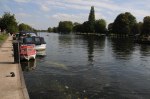
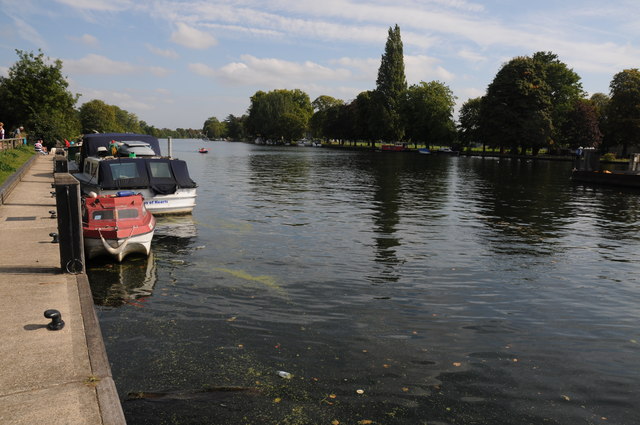
The River Thames above Teddington (photo credit: Philip Halling - for Geograph).

River Thames above Teddington (photo credit: Philip Halling – for Geograph).

“At Teddington, the Thames meets the tide from its estuary and begins to mingle with the sea. Above Teddington the Thames is an inland waterway; below, it starts to have an ocean feel about it. One of the lost hopes of the first post-war Labour government was a plan to establish a Thames-side Walk, all the way from London to the source. That went the way of many dreams of a brave new world. It would be nice to revive it, but such a riverside walk would be expensive to construct, for what was once the towpath has often vanished in the encroachments of houses and gardens, particularly near London. On the upper river there is still a good deal of towpath, but there are awkward gaps that would require long detours or expensive bridging to restore a walk along the river’s length. One day, perhaps……..”

Meanwhile, there is enough access to the Thames to give infinite pleasure in return for very little trouble. Below Henley the towns become more and more suburban, but the river remains beautiful, with magic reaches by Kingston and Hampton Court. The best sailing reach on the whole river is the stretch from Marlow to Bourne End. From Reading to Oxford towns and built-up areas are fewer. Abingdon is the most considerable town and still retains patches of medieval beauty in spite of some horrible commercial development. Wallingford is a gracious little place – its size does not match its history. Above Oxford there is next to nothing but water-meadows and peace. A week on a boat proceeding gently from Oxford to Lechlade is to be transported in time as well as space, to a world remote from motor roads, where the landscape has changed little since Parliament men and the Royalist troops fought over bridges in the Civil War, when Charles I made his capital at Oxford.”

“The centuries sit lightly on the Upper Thames. Yet it is always London’s river, feeling the force of social and technological change pulsing out of London in many subtle ways, some hurtful, some making for its betterment. I shall discuss these in the August issue of the ILN, and describe what I call the ocean-Thames, whose ships go out to the farthest seas of the world by that nursery of seamen the Thames Estuary,” so says the author of this magazine article J. R. L. Anderson back in 1971.

Sources:

Anderson, J. R. L., ‘London’s River 1 – From The Costwolds To Teddington,’ The Illustrated LONDON NEWS, Vol 259, No 6876, Holborn Hall, 100 Grays Inn Road, London WC1. July 1971.

http://www.geograph.org.uk/photo/2929575   © Copyright David Stowell and licensed for reuse under this Creative Commons Licence.

http://www.geograph.org.uk/photo/2813784   © Copyright Roger Templeman and licensed for reuse under this Creative Commons Licence.

http://www.geograph.org.uk/photo/2592231   © Copyright Philip Halling and licensed for reuse under this Creative Commons Licence.

© Copyright, Ray Spencer, 2015 (updated 2025).


2 Comments

The Old Frontier (Hadrian’s Wall), Scottish Borders, United Kingdom

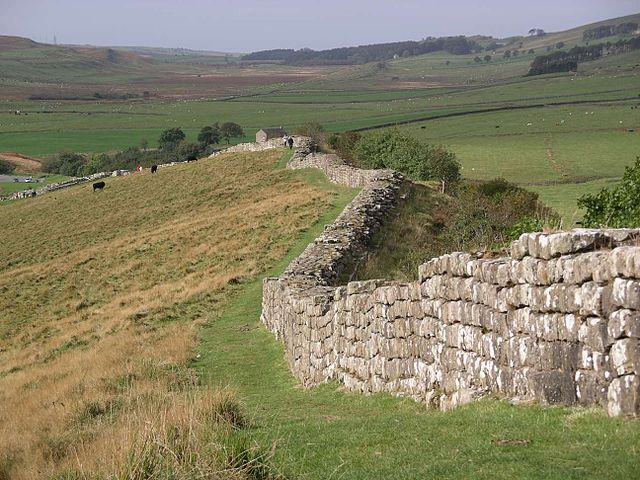
A section of Hadrian's Wall (photo by Moldovian1 for Wikipedia)

A section of Hadrian’s Wall (photo by Moldovian1 for Wikipedia)

In the Autumn 2008 edition of the magazine ‘Beautiful Britain’, there is an excellent article by the author Jock McKinnon called ‘The Old Frontier’. In this article, the author tours Hadrian’s Wall, the ancient Roman frontier that stretches from the Tyne in the east to the Solway Firth in the west, a distance of 80 Roman miles (73 normal British miles!), and he uncovers the history behind the Roman wall and its stones. Here I have “quoted” in full the article which appears in the magazine. Hadrian’s Wall (Latin: Vallum Aelium), also called the Roman Wall, Picts’ Wall, or Vallum Hadriani, was a defensive fortification in the Roman province of Britannia, according to Wikipedia.

“Standing on the stretch of Hadrian’s Wall west of the remains of Housesteads Roman fort, it is still possible to imagine a Roman sentry shivering in the cold. Squinting into the distant landscape, he must have wondered what on earth he was doing in such a ‘gods-forsaken’ place, so far from the centre of his ‘civilised’ world. It is an image that has been handed down to British schoolchildren for generations. But who really were the people who built and guarded the Wall? And why was it built? The answers, if they exist at all, lie buried in ancient records as well as in the stones and soil around the Wall.”

“The story begins with just one line of Hadrian’s biography, which describes the Emperor as ‘the first to build a wall, 80 [Roman] miles long, to separate the Romans from the barbarians’. In 117 AD, Hadrian succeeded Emperor Trajan, whose conquests had stretched the Roman Empire to its furthest reaches, from Mesopotamia (modern Iraq) in the south-east to Scotland in the north-west. It was clear to Hadrian, however, that the empire had just reached its limits. With military resources and communications stretched to their maximum, Hadrian decided to consolidate Roman hegemony by withdrawing wherever necessary to manageable borders. He knew it was more important to be able to control what the empire had conquered rather than attempt to stretch its frontiers further. And so he began a tour of the empire, including Britain, to see the problems for himself.”

McKinnon goes on to say: “Although much of Britain had been subjugated, and revolts by local tribes – such as Boudicca’s – had been brutally put down, it was clear that there was still trouble ‘up north’ caused by ‘insurgents’, to use a modern term, from the northern tribes. Although we do not know the nature of such warfare – no detailed accounts of the fighting exist – we do know that the building of the Wall began immediately after, or even during, Hadrian’s visit to the province, from 122 AD onwards.”

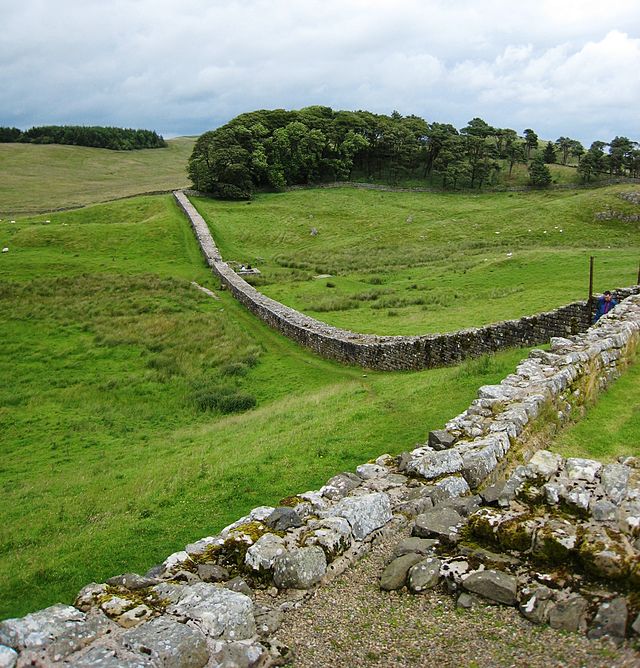
Section of Hadrian's Wall (photo by Velela - for Wikipedia)

Section of Hadrian’s Wall (photo by Velela – for Wikipedia)

“Stretching 73 miles from Wallsend on the Tyne in the east to Bowness-on-Solway in the west, the Wall and its forts were built from locally quarried stone and made good use of natural features such as Whin Sill, a lengthy rocky outcrop forming a north-facing cliff. A long line of forts also stretched west, down the coast of Cumbria. Wall inscriptions show that construction was mostly undertaken by troops from three legions, one of which – the Six Victrix – had come to Britain with Hadrian himself. The construction project may well have served the additional purposes of keeping the troops occupied and boosting competition and morale, as well as indicating to the locals that the Romans were deadly serious about imposing their will on the region.”

“Conceived as a wall up to 15 ft high and 10ft thick, with a forward ditch to make an attack more difficult, the design was changed before completion, with later sections adopting a much thinner width, in places only 7ft thick. It is not known why there was this change of plan; perhaps it was to make more efficient use of the materials, or simply to speed up construction. Either way, it suggests that the need for the barrier was pressing. Indeed, it is believed that territory to the south of the Wall was just as troublesome at the time.”

“The Wall was, therefore, more than a defensive barrier to keep out northern raiders. In certain spots along the route of the Wall, such as at Heddon alongside the B6318, you can still make out large earthworks. Known as the ‘vallum’, these works consisted of a flat-bottomed ditch south of the Wall, about 20ft wide and deep, flanked on either side by mounds 20ft wide and 10ft high. The vallum often diverts around the forts, showing that it was built around the same time. Crossings were built opposite the forts, through the ramparts and across the ditch, with a gate. This indicates that the system of earthworks was used to control the flow of traffic through the Wall.  So it seems that another purpose of the Wall was quite literally to divide and rule, and to control the cross-country movement of people and goods.”

The author asks: “So what do we know about the soldiers who manned the Wall? From inscriptions on the Wall and at nearby forts, it is clear that, although the legions – which consisted of men with Roman citizenship, helped with the construction of the Wall, and fought in the area, often manning forts to the north and south of the Wall, they did not form its main garrison. This was the job of auxiliaries – infantry and cavalry units of non-citizens recruited from all around the Roman Empire. Amongst the remains of the fort at Chesters is a stone reused as a step on which in inscribed the name of the First Cohort of Dalmations, infantrymen originally from the region which is now Croatia. Other inscriptions record the presence of troop units from France and Germany.”

“Chesters is a good place to begin to take in the skill of the military engineers. Because of the layout of the site, the fort is difficult to imagine, but the bath-house, with walls still reaching up to 10ft high, and the monumental foundations of the bridge that carried the Wall and traffic across the Tyne, are impressive. Also worth a visit is the small museum, which contains many of the most important inscriptions found along the Wall.”

“Chesters was one of a series of large forts that were constructed every six to eight miles along the Wall, sometimes after its construction, to house troops. These were in addition to the much smaller milecastles, which were built into the south side of the Wall once every Roman mile, and turrets. The purpose of the turrets and milecastles was to provide look-outs and to aid communication from fort to fort.”

“Housesteads was another large fort and its remains are imposing even today. It occupies a commanding position, on a south-facing slope, with its north side abutting the Wall and overlooking Whin Sill. Here it is possible to see the remains of gates, granaries, a headquarters building and the commanding officer’s house.”

Hadrian's Wall from Housesteads Fort (photo by Jamesflomonosoff - for Wikipedia)

Hadrian’s Wall from Housesteads Fort (photo by Jamesflomonosoff – for Wikipedia)

“There are still also visible remains of cultivation terraces outside the walls of Housesteads, and excavations have revealed the streets, workshops and shops that clustered around the forts of Chesters and Vindolanda. Local tradesmen would have supplied the armed forces and the expanding local civilian economy that would have gravitated towards the troops and military to serve their various needs.”

“Amongst the most remarkable finds from Hadrian’s Wall are the famous tablets of Vindolanda. Painstaking archaeology has pieced together fragments of military records and personal letters which were inscribed on the wooden tablets at the fort and then discarded, left to decay in wet, clay soil. Fortunately for us, they were miraculously preserved by the anaerobic conditions, and the retrieved texts now provide tantalising glimpses of  everyday life.”

The author, Jock McKinnon, in his article makes mention of the other Roman frontier, the Antonine Wall, about 100 miles to the north. He says of this: “Another frontier, this time of earth banks, ditches and wooden palisades, was built about 100 miles further north 20 years later, during the reign of the Emperor Antoninus. The purpose of this second barrier may have been to create a controllable ‘neutral zone’ to Hadrian’s Wall further south, indicating that there was still a threat from unrest, but it would have doubled the military forces needed to patrol both frontiers and the region and it was abandoned by about 170 AD.”

“Hadrian’s Wall itself was finally abandoned much later, not until the late fourth century, although finds at Birdoswald fort show that it continued to be used by a community, probably as a defensive enclosure, into the fifth or six centuries, long after the Romans and Hadrian had become a distant memory. Subsequently, much of the stonework was dismantled and reused for building work, and it’s only the remote stretches of the Wall and forts that can be seen today.”

“It is sobering today to stand on the Wall, where that imagined soldier once stood, knowing that although it was obviously important at the time to emperors, their troops and local people – whether they supported it, hated it, or earned money as a result of it – it really matters little now whether the Wall was successful or not. All the time, money and manpower spent to quell a distant province proved fruitless. Except, that is,  for what the Wall can still tell us about our distant past.”

Sources:

McKinnon, Jock., The Old Frontier, Beautiful Britain, Vol 3 Number 3 Autumn 2008, Cheltenham, Gloucestershire, 2008.

http://en.wikipedia.org/wiki/Hadrian’s_Wall

http://www.hadrians-wall.org

Copyright © Ray Spencer. The Journal of Antiquities, 2015.


The Mysterious Disappearing Boulders, Moeraki Beach, Otago, South Island, New Zealand

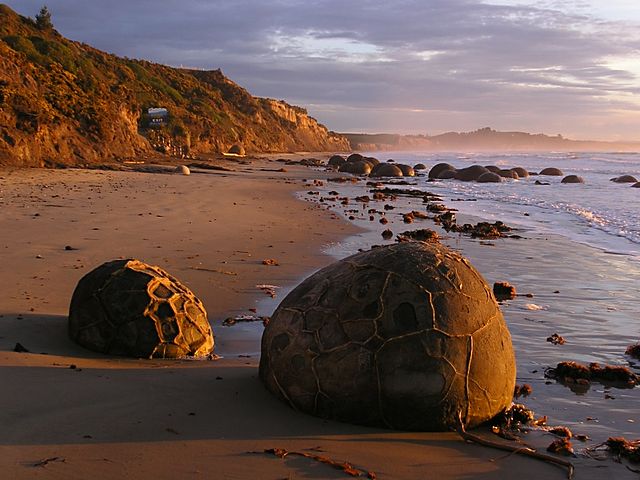
Moeraki Boulders, South Island, New Zealand (Photo credit: Karsten Sperling) (Wikipedia)

Moeraki Boulders, South Island, New Zealand (Photo credit: Karsten Sperling) (Wikipedia)

Latitude: -45.348199. Longitude: 170.827305. Strewn along the Moeraki beach, Koekohe Beach and Shag Point, in the Otago region, at the far south-eastern side of South Island, New Zealand, are many strange oval and spherical-shaped boulders – resembling, perhaps, giant potatoes – indeed the very name ‘Moeraki’ means “potatoes” in the Maori language of New Zealand. There is an interesting legend, to say the least, which attests to this strange curiosity. Many of these boulders are often half submerged in the sand and bed-rock, but when the tide comes in they mysteriously disappear, obviously, (or do they) and, after the tide goes back out they are seen to be not submerged ie ‘completely whole’ or fully uncovered of sand. These large boulders probably date back 60-65 million years. They are located in the south-eastern part of the South Island, in New Zealand, some 35 km (22 miles) south of Oamaru, between Moeraki and Hampden, and 80 km (67 miles) north of Dunedin. Access to the boulders is from highway 1 (Hampden-Palmerston road), just half a mile south of Hampden town, to the Moeraki Boulders Visitor Centre and car-park.

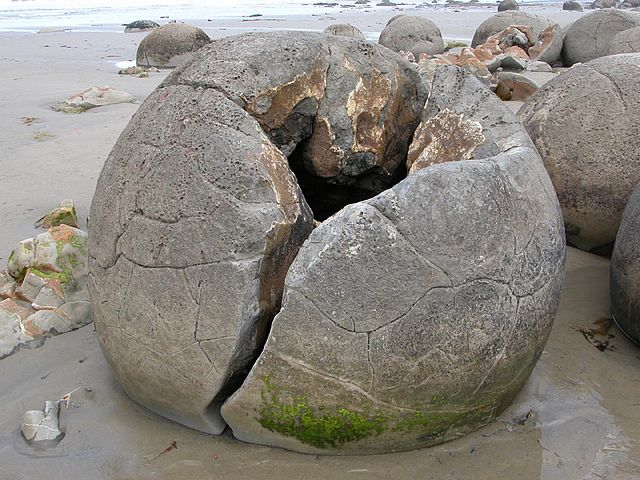
Broken boulder at Moeraki (Photo credit: William M. Connolley for Wikipedia)

Broken boulder at Moeraki (Photo credit: William M. Connolley for Wikipedia)

These curious grey boulders are literally strewn along the beach, often in clusters, and some in smaller groups of two or so. They vary in size but generally they are somewhere between 1 foot 7 inches and 7 foot 2 inches in circumference and in height between 2-8 feet; some are damaged and broken up due to constant erosion from the pounding waves, many others are wonderfully smooth-shaped and ‘naturally patterned’ with unusual circular, diamond and oblong shapes, said to be somewhat similar to ‘the eyes in potatoes’, but with connecting lines. The boulders are made of hardened mud, silt and clay, and they are cemented together with calcite which is often quite weak at the core and hard at the outer rim, which might account for some of the boulders cracking apart! Seamus P. Cahill writing in ‘Ireland’s Own’ magazine says that these “Huge stones appear on the sand at Otago, New Zealand, and then disappear – only to be replaced mysteriously by new ones!”.

In the colourful and informative book ‘The Beauty of New Zealand’ by Errol Brathwaite  we are informed that: “Moeraki Beach is named after the potato which ancient Polynesian voyagers brought with them in their double-hulled, ocean-going canoe. The canoe, so the olden legend goes, capsized near Shag Point, at the end of the beach, and the moeraki potatoes and some gourds which she was carrying were strewn by the tide along the beach, and were later transformed into boulders. Today, these septarian stones lie half buried in sand, a geological oddity, rusty-red or yellow inside, with crystalline cores”.

But we know that in geological terms they date back 60-65 million years and apparently lay on the sea bottom for much of that time, until the sea-levels began to fall some 15 million years ago. But the fact that “they” disappear and then reappear is simply an over-active (vivid) imagination from more recent times. The boulders are now something of a tourist attraction, and visitors (and geologists!) come here from all over the world to see these strange and curious rock formations. The boulders are sometimes called Araiteuru after the legendary Polynesian voyager sailing canoe which was said to have brought them here hundreds of years ago when they were apparently, and with much imagination – large potatoes! It is recorded that the Araiteuru also carried a cargo of calabashes, barracudas and eel baskets, and so I am minded to say that it must have been a very, very large canoe to carry such a large amount of items!

Sources:

Brathwaite, Errol., The Beauty of New Zealand, Golden Press Pty Ltd., Avondale, Auckland, New Zealand, 1982.

Cahill, Seamus P., (Just Imagine), Island’s Own, Wexford, Ireland, (various dates).

http://en.wikipedia.org/wiki/Moeraki_Boulders

http://www.kuriositas.com/2010/09/mysterious-moeraki-boulders.html

http://www.leeduguid.com.au/blog/new-zealand-south-island/


3 Comments

Grave of St Nicholas, Newtown Jerpoint, Co. Kilkenny, Southern Ireland

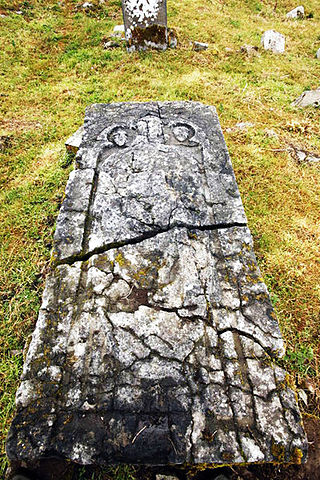
Tomb of St Nicholas (Santa Claus). Photo Credit: Wikipedia.

Tomb of St Nicholas (Santa Claus). Photo Credit: Wikipedia.

Irish grid reference: S 5679 4042. In the old churchyard at the west-side of the ruined medieval church of St Nicholas at Newtown Jerpoint, Co. Kilkenny, stands the medieval carved gravestone, reputed to be where the remains of St Nicholas of Myra (yes, the original Santy, St Nick, Santa Claus or Klaus), were laid to rest here back in the year 1300 and, a beautifully carved graveslab was placed over the saintly bishop’s remains. The legend says that St Nicholas’ remains were brought back to Ireland from Bari in Italy by two knight-crusaders of Irish/Norman birth, although [the] church dedicated to the saint was already established at Newtown Jerpoint at that time. There is also a holy well named after the saint. St Nicholas’ ruined church with its famous medieval gravestone is located (on private land), 2 miles south-west of Thomastown, just west of the Little Arrigle river and the N9 (R448) road, at Jerpoint Park. The monastic ruins of Jerpoint Abbey are about half a mile to the east; while sadly the village of Newtown Jerpoint was abandoned in the 1680s and the church left to fall into ruin and decay. Kilkenny town is 13 miles to the north-east.

The story goes that in the 13th century two Irish knights (both known as De Fraine) on their ‘retreat’ back from the crusades in the Holy Land stopped off at Bari in Italy and managed to secure some of St Nicholas’ holy remains; these remains were brought back to Ireland (by way of Normandy) and then buried in the churchyard adjoining the church of St Nicholas of Myra in Newtown Jerpoint; the two knights thought this to be a safe place for which to bury such a saintly personage. The family of De Fraine had a beautifully carved gravestone placed over the grave of the saint – the date being either 1200 or more likely in 1300 as the church had been established for some time already (1172), being built by William Marshall, earl of Pembroke and ancestor of the De Fraines’ family. Marshall, the son-in-law of Strongbow (Richard Fitzgilbert de Clare) also established the “new town” of Nova Villa Juxta Jeripons situated opposite the mid-12th-century Cistercian abbey of Jerpoint, in 1200, at which time he also built the little church dedicated to his favourite and esteemed patron saint, Nicholas of Myra.

The grave of St Nicholas and the adjoining church became a place of pilgrimage from the 13th/14th century onwards, as was the saint’s holy well close by the churchyard; however, in c1680 the village of Newtown was abandoned and the little church with its famous grave left to fall in to steady decay and ruin – its ruined tower, walls and gallery now almost obliterated by trees and foliage – the gravestone of St Nicholas cracked across the middle. But its beautiful carvings survive. The bishop or cleric on the large, cracked gravestone wears a robe that is shaped like a crusader shield, while at the top two carved heads at either side of the saint’s head are thought to be the knights who brought the remains from Italy to Ireland. At the upper left side a carving of a boat and at the opposite (upper right side) a sun carving; there is also a carved cross with more intricate stuff around it and what may be a French fleur de lis. A Latin inscription can also be seen on the stone.

The age-old legend of St Nicholas (Santa Claus) is known to most people. He was bishop of Myra (Mugla) in Lycia, Turkey, during the 4th century AD, and was well-known for his charitableness to the poor and the under-privileged, especially towards children; so much so that he came to be regarded as a “miracle-worker”. He is said to have died in 320, 342 or 350 AD, and his relics later (1084) translated to Bari on the Italian coast. According to the legend, Nicholas “reputedly gave three bags of gold to three girls for their marriage dowries” (Farmer, 2004). These dowries were tossed through an open window, or maybe down a chimney! and that is, perhaps, where the idea of Santa Claus putting gifts down a chimney comes into its own. Another legend says that he ‘raised to life’ three boys who had been drowned in a brine-tub by a butcher” (Farmer, 2004).

The author Colin Waters in his work ‘A Dictionary Of Saints Days, Fasts, Feasts And Festivals’ says of St Nicholas: “In early Europe it was traditional for people to leave gifts for others without saying who they were from on St Nicholas’ Eve (5th December). This was said to have been started by St Nicholas (also Klaus, Klass etc) when he was bishop of Myra in Lycia.” Waters goes on to say: “He is also patron saint of all prisoners and of all travellers, merchants and those overtaken by sudden distress or danger. His emblem is three balls, indicative of the gold he so freely gave away as a rich man. Panbrokers adopted his symbol. He is represented by three children in a tub.” St Nicholas is patron St of Russia and of Galway city. There are many churches dedicated to him in Ireland, including the medieval collegiate church of St Nicholas in Galway city, which dates from c1320 – said to be the largest parish church in Ireland.

The grave of St Nicholas at Newtown Jerpoint, Co. Kilkenny, has been mentioned by many Irish antiquarians and historians, including Canon Carrigan and Owen O’Kelly in his esteemed work ‘A History of County Kilkenny’. And interestingly, this tale has appeared regularly in the ‘Ireland’s Own’ magazine, being authored by Gerry Moran.

Sources:

Farmer, David., Oxford Dictionary Of Saints, Oxford University Press, New York, USA, 2004 

Moran, Gerry., ‘Santa Claus is buried in Kilkenny’, Ireland’s Own, Wexford, Ireland, (various dates).

http://omniumsanctorumhiberniae.blogspot.co.uk/2012/12/saint-nicholas-irish-connection.html

http://en.wikipedia.org/wiki/Newtown_Jerpoint

O’Kelly, Owen., A History of County Kilkenny, Kilkenny Archaeological Society, Kilkenny, Ireland, 1969-70.

Waters, Colin.,  A Dictionary Of Saints Days, Fasts, Feasts And Festivals, Countryside Books, Newbury, Berks, 2003.

Copyright © Ray Spencer, The Journal of Antiquities, 2014.


1 Comment

Bedd Branwen, Glanalaw, Treffynon, Anglesey

The site of Bedd Branwen by Eric Jones (Geograph).

The site of Bedd Branwen by Eric Jones (Geograph).

OS grid reference: SH 3611 8498. In a farmer’s field close to the west bank of Afan Alaw (river Alaw) near the hamlet of Glanalaw, Treffynon, Anglesey, stands the Bronze-Age ring-cairn known as Bedd Branwen, which is said to date back 4,000 years. It is named after the legendary princess Branwen or Bronwen, the daughter of King Llyr, and sister of Bran the Blessed (Bendigeidfran) from the Mabinogian. She was related to King Arthur. The cairn site is located on private farmland to the south-west of Bod Deiniol farm, close to the west bank of Afon Alaw – roughly half a mile south of Glanalaw, although a track/footpath runs past Hafan to Glanalaw hamlet and reasonable viewing looking south across the fields can be had from [here] with good zoom photography. However, you can probably walk across the fields to the cairn as long as the farmer doesn’t mind! The village of Treffynon is 1 mile to the east of Bedd Branwen, while Llanbabo and its ancient church are about one-and-a-half miles to the north-east.

Described as a ring-cairn or round barrow approx 24 metres by 28 metres – the kerb of which is still visible at the outer limit of the circle with a large, chunky standing stone (cist grave) at the centre which is now, sadly, cracked down the middle. The monument was apparently damaged back in 1813 by a local farmer who needed some stones for his house; at this time an urn was also dug up which was ‘said’ to have contained the ashes of a female – could these ashes have been those belonging to Branwen, the fairest and most beautiful woman in all Wales, if not the whole of Britain. Or, according to another account, she is one of the three most beautiful women in Wales!

But in reality the cairn pre-dates the legendary princess Branwen by a few thousand years or more, and other urns with grave-goods have been excavated here in more recent times – the early 1960s in fact. These urns almost certainly date from the Bronze-Age at around 2,000 BC. So, perhaps the discovery of the ashes of a female purporting to be those of the princess were ‘just a coincidence’. Today nothing is left of the earthern mound that once covered the cist grave, only the outline of this being still visible and some stones around the edge, though there are a few other curious stones in this field which ‘might’ well be associated with the monument. In the early 1960s excavation some more cremation urns were dug up along with pottery, grave-goods and also a necklace made of jet. These antiquities are housed in Bangor Museum in North Wales. In the work ‘The Ancient Stones of Wales’, author Chris Barber describes the monument as a “dolmen” and also refers to it by another name: Bod-Deiniol.

Branwen is a legendary and mythical character who figures strongly in the Mabinogian along with her father King Llyr (Lear) and her brother Bran the Blessed, who is known as Bendigeidfran in Wales, but it is a very sad tale. Princess Branwen is given in marriage by her brother to the Irish king, Matholwch, but after an insult to the Irishman by her half-brother, Efnisien, they soon begin to quarrel and then fall out, and poor Branwen is treated badly by being put to work as his cook. Bran then makes war on Matholwch but is killed in the battle (MacKillop, 1998). Later, she manages to escape back to the Isle of Anglesey where ‘she dies of a broken heart’, and is allegedly buried beneath the mound and cairn that now bears her name (Bedd Branwen).

According to The Mabinogian (second branch) Bran the Blessed is credited as going on a voyage across the Atlantic Ocean, but life ends badly for him; his severed head is buried on Tower Hill in London which then acts as a sort of talisman for the city against foreign invasion on the grounds that Britain should not rely on magic, according to the author Geoffrey Ashe in his work ‘The Quest for Arthur’s Britain’. Traditionally, Bran is recorded as being the son of Belinus (Gruffudd, 1980). If that is the case, then he and his sister Branwen are descended through Manogan, King of Britain, with the Blessed Virgin Mary? And Belinus or Beli has sometimes been identified with the Celtic sun god of that name. But as we know the Mabinogian gives the father of Branwen and Bran as King Llyr, who has sometimes been identified with the legendary King Lear of Shakespearean fame.

Sources:

Ashe, Geoffrey., The Quest for Arthur’s Britain,  Paladin, St Albans, Herts, 1976.

Barber, Chris., Mysterious Wales, Paladin, London W1X, 1987.

Barber, Chris & Williams, John Godfrey., The Ancient Stones of Wales, Blorenge Books, Abergavenny, Gwent, 1989.

Gruffudd, H., Enwau Cymraeg I Blant – Welsh Names For Children, Y Lolfa, Talybont, Dyfed, 1980. 

MacKillop, James., Dictionary Of Celtic Mythology, Oxford University Press, Oxford, 1998.

Photo Credit: http://www.geograph.org.uk/photo/1358949  © Copyright Eric Jones and licensed for reuse under this Creative Commons Licence.

Copyright © Ray Spencer, The Journal of Antiquities, 2014.


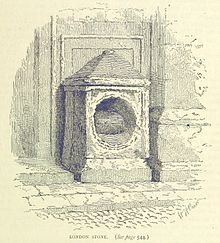
London Stone, Camden, Greater London

London Stone (Photo Credit: Wikipedia)

London Stone (Photo Credit: Wikipedia)

OS grid reference: TQ 3267 8090. Hidden away in a recess at the front of what was the Bank of China on Canning Street, Camden, London, close to the Cannon Street Underground Station, is the so-called London Stone, a relic perhaps of Roman Londinium. Sometimes also called ‘the Brutus Stone’ or ‘Britto Stone’ after the Celtic leader of the same name who was hailed as king of what would become London, according to The Legend. It is actually a squat round-shaped stone that is now much diminished in size and which may, in fact, have been a 15th-century boundary stone? The stone’s location is close to the corner of St Swithins Lane and nearly opposite Bush Lane. St Paul’s Cathedral is 1 mile to the west, while the River Thames and London Bridge are about a quarter of a mile to the south of Canning Street.

London Stone and its former stone surround (Photo Credit: Wikipedia)

London Stone and its former stone surround (Photo Credit: Wikipedia)

At the front of the W.H.Smith building at no.111 Canning Street in a specially designed stone recess stands the curious ‘London Stone’, a round-shaped stone that could be part of a Roman altar that was dedicated to the goddess, Diana, so says Geoffrey Ash in his great work ‘Mythology Of The British Isles’. It was apparently set up by Brutus, grandson of Aeneas of Troy, a self-styled king of what would become “London”. Brutus is said to have had a palace on the site of the present Guildhall about 1 mile to the southwest, beside the river Thames. The stone is 1 foot 5 inches high by 1 foot 9 inches wide and is made of Limestone that was quarried in Rutland, though it has been suggested that it is Bath stone? It sits securely behind a decorative iron grill, fronted by a very nicely carved outer recess made of Portland stone, at the top of which there is an information plaque; the inner recess is surrounded by thick glass for extra security.

The stone originally stood at the north side of Canning Street, where it was set into a niche in the south wall of St Swithin’s Church, close to the Mansion House, according to Janet & Colin Bord ‘Mysterious Britain’. St Swithin’s church was demolished after it suffered from being bombed during the 2nd World War; the stone was moved to the Guildhall Museum, then eventually to its present site in Canning Street.

According to documentary evidence, the stone was in existence in 1100 and 1188, and in the 16th century it was mentioned again by the antiquary John Stow, who was to describe it as: a great stone called London Stone, fixed in the ground very deep, fastened with bars of iron, and otherwise so stronglie set that if carts do runne against it through negligense the wheeles be broken, and the stone itself unshaken”. In the work ‘Mysterious Britain’ the Bords say that: “Although there is no tradition of it being used as a stone of initiation, the London Stone is of great intiquity and was held in veneration by the citizens who would make binding pacts across it and issue proclamations from it”.

It would appear, therefore, that over many hundreds of years folk, maybe travellers and pilgrims, have been chipping away and breaking pieces off the London Stone to take away as a relic in case it possessed some sort of magical healing power – it may well have done so – and if that be the case it would have originally been a much bigger block of stone, maybe even some sort of pagan altar in the time of the Romans, or maybe from ancient Britain, long before the Romans ever came to Britain but, Brutus who was a Celtic leader – had set his eyes on our shoreline! If he did ever come to Britain and reside at London, then it would have been roughly 1100 BC?

The author James MacKillop says in his ‘great tome’ ‘Dictionary Of Celtic Mythology’ says that Brutus was a progenitor of the British people. He was leader of the Trojans and had “dreams” of the Temple of Diana beyond the setting sun. After invading the island [Britain] he defeats the mythical giant Gogmagog and then establishes law upon the land named for him – Britain (Prydain). But actually Gogmagog was killed by being hurled over a cliff by another giant called Corineus of Cornwall who was a champion wrestler of great strength and valor – Reader’s Digest ‘Folklore Myths and Legends of Britain’. Very gruesome-looking stone effigies of Gogmagog and Corineus stand inside the Guildhall in King Street. Geoffrey of Monmouth mentions the legend of Brutus and the giants in his work ‘History of the Kings of Britain’ (1136). More likely than not London Stone was a ‘Milliarium’, a stone that was used to measure road distances in both Roman times, and long after that. And there is the famous saying: ‘So long as the Brutus Stone is safe, so long shall London flourish’.

Sources:

Ash, Geoffrey., Mythology Of The British Isles, Methuen, London, 1993. 

Bord, Janet & Colin., Mysterious Britain, Paladin (Granada Publishing), London, 1984.

MacKillop, James., Dictionary Of Celtic Britain, Oxford University Press, Oxford, 1998.

Photo Credits:  http://en.wikipedia.org/wiki/London_Stone

Reader’s Digest,  Folklore Myths and Legends of Britain, ( Second Edition), Reader’s Digest Association Limited, London, 1977.

The Megalithic Portal:  http://www.megalithic.co.uk/article.php?sid=8349

Copyright © Ray Spencer, The Journal of Antiquities, 2014.


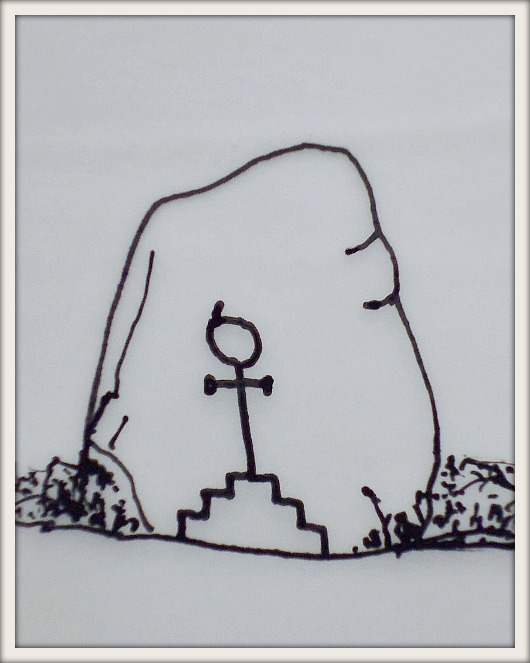
The God Stone, St Luke’s Churchyard, Formby, Merseyside

The God Stone, Formby, Merseyside.

The God Stone.

OS grid reference: SD 2800 0671. At the western side of the town of Formby, Merseyside, close to the seashore and just along St Luke’s Church Road, stands the parish church of St Luke and, almost hidden in the churchyard (west side) is The God Stone, a small oval-shaped stone that is inscribed with a thin cross standing upon some steps. It is also known as The Corpse Stone or The Cross Stone. The present 19th century church stands on a pagan site, but probably from about the early 10th century it was settled by Vikings from Ireland or perhaps the Isle of Man; the stone being placed there at that time, or maybe earlier? Also of interest in the churchyard is the wooden cross, and in the church porch the 15th century gravestone of a local giant! The seaside town of Southport is 6 miles to the north on the A565, while Crosby is 5 miles south on the same road. Liverpool city centre is 10 miles to the south.

The God Stone stands at the west side of the churchyard beneath some trees. It is 1 foot 6 inches high and is oval in shape, but below ground it becomes a short stumpy shaft which tapers away. It was apparently moved to its present position in 1879. In the early 10th century Formby (Fornebei) was a Viking settlement and a pagan one, but by about 960 the site was Christianised and, later in the 12th century a chapel was established, which would become St Luke’s. There were at least two churches on this site previous to the present-day church, which was built in 1855. It would, therefore, seem that the God Stone became a sort of marker or “rebus” to which the newly converted could ‘congregate around’ and be baptised “at” by Christian missionaries. At some stage, maybe a few centuries later, a Calvary cross was carved onto the stone by missionaries (as a representation of Christ). The curious little stone with its steps below a thin incised cross which has a circle or orb at the top (perhaps a Norse runic symbol) that ‘might’ signify commitment to Christ and ‘the climb up the steps to the cross’, and the nearness to heaven and then ‘eternal life’ (the afterlife).

In the Middle Ages and more recent times, and also to some extent in pre-Christian times, corpses were ceremononially carried around the stone three times, or maybe more in order to contain the spirit of the departed and prevent it from coming back to haunt the relatives, according to Kathleen Eyre in her book ‘Lancashire Legends’. She goes on to say that: “The practise of carrying the corpse three times around the churchyard was witnessed by an English traveller to Holland a few years ago”.  Though the author does not say who that traveller was!

Also in the churchyard there used to be an old wooden cross of uncertain age (encased in zinc) and standing upon tiered stone steps (there is now a more modern wooden cross in its place), and also the 18th century village stocks. In the church porch there is the cracked 15th century gravestone of a local giant. Actually he was none other than Richard Formby, a local man and one of the ancient family of Formby’s, who was the armour-bearer of King Henry IV (1399-1413) and who died in 1407. His tombstone was brought to St Luke’s from York Minster where it received its crack when a wooden beam fell onto it during a fire at the minster in 1829. Apparently, Richard was seven feet tall. An inscription on the gravestone reads: “Here lies Richard Formby formerly armour-bearer of our Lord and King, who died on the 22nd Day of the month of September in the year of our Lord 1407. Upon whose soul may God have mercy”- Kathleen Eyre ‘Lancashire Legends’. Housed inside the church is a crude 12th century font which came from the first building on this site. 

Sources:

Eyre, Kathleen., Lancashire Legends, The Dalesman Publishing Company Ltd., Clapham, North Yorks, 1979.

Fields, Kenneth., Lancashire Magic & Mystery, Sigma Leisure, Wilmslow, Cheshire, 1998.

http://stlukes.merseyside.org/history.html

Copyright © Ray Spencer, The Journal of Antiquities, 2014.


2 Comments

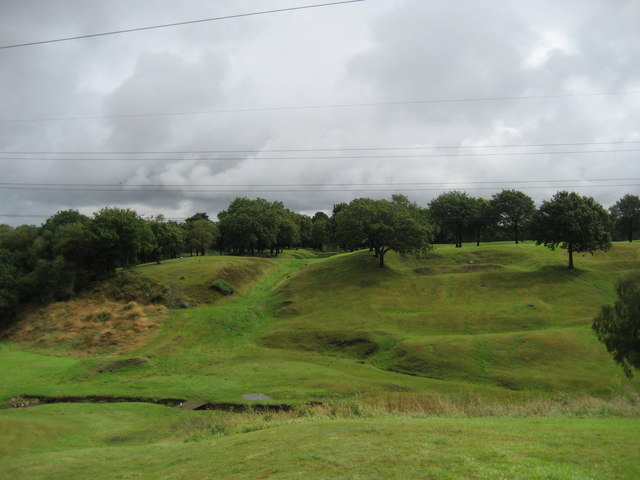
Rough Castle Roman Fort, Bonnybridge, Stirlingshire, Scotland

Rough Castle Roman Fort (Photo Credit: Wikipedia)

Rough Castle Roman Fort (Photo Credit: Wikipedia)

Os grid reference: NS 8435 7985. About halfway between Bonnybridge and Tamfourhill in the Falkirk region of Stirlingshire, in what “was” the ancient kingdom of Dumnonia, are the very well-defined earthworks of Rough Castle Roman Fort, a 2nd century Roman military site attached to the Antonine Wall (south side), which is ‘said’ to be one of the best preserved forts in Scotland, and certainly one of the most notable in Britain, according to the work ‘Ancient Monuments Scotland’, an HMSO guide. Although it was only a temporary fort it was well endowed with a number of military buildings and, at the east-side a bath-house, the foundations of which were discovered during a number of Archaeological excavations in the early 1900s. The fort was built upon a north-facing and very commanding escarpment, beside a ravine into which the Rowan Burn flows, which no-doubt aided the security of the fort somewhat. The town of Falkirk is 1 mile to the east and Larbert is 2 miles north.

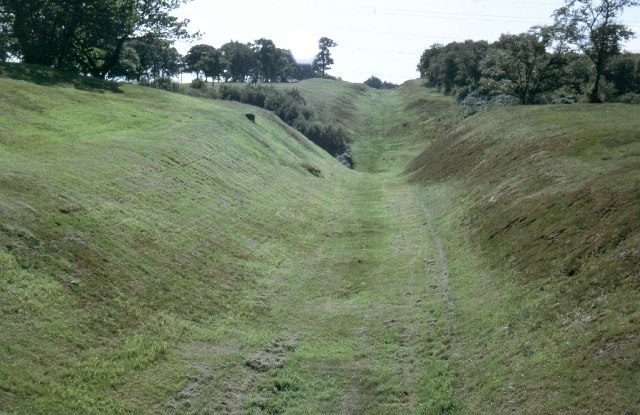
Antonine Wall near Rough Castle (Photo Credit: Wikipedia)

Antonine Wall near Rough Castle (Photo Credit: Wikipedia)

The fort stands at the south-side of the Antonine Wall (part of the north-west frontier) and, in particular, the section behind the fort (north and north-west side) with its deep-ditch and rampart is one of three that are extremely well-preserved, although the actual Roman wall itself, or what constituted as a wall at the time, has mostly disappeared leaving only the earthworks as a reminder. The Antonine Wall, built about AD 143, is actually a V-shaped ditch which was 15 Roman feet wide with a rampart of turf on a stone base, a military way that ran for 36 miles (40 Roman miles), linking the Firth of Clyde at Old Kilpatrick in the far west, to the Firth of Forth at Bo’ness in the east. It was built soon after AD 143 to a planned line, earlier set out by Julius Agricola (c 80 AD), by the legate Lollius Urbicus and named after the emporer at the time, Antoninus Pius; but militarily it was nothing like Hadrian’s Wall, although it was called ‘a permenent frontier’ at the time of building, and that’s what it was to remain – in the landscape at least.

Rough Castle For, a drawing by William Roy 1755 (Photo Credit: Wikipedia)

Rough Castle Fort, a drawing by William Roy 1755 (Photo Credit: Wikipedia)

The Rough Castle fort covered about 1 acre, so fairly small compared to some of the forts in England and Wales. It was called a ‘wall fort’ because it abutted up against a Roman wall, in this case the Antonine Wall. Typically it was square-shaped with curved corners but with no lookout towers, although there were the usual four side entrances at the N.S.E.W. Built around 142 AD as a temporary fort, spaced at a two mile interval with its near neighbours – Seabeg to the west and Watling Lodge to the east; at Watling Lodge there is another well-preserved section of the Antonine Wall. But Rough Castle only lasted for just over 20 years, and by 163-4 AD the wall and its 19 small forts and 14 temporary forts were abandoned, Hadrian’s Wall further to the south being occupied instead! However, for a short period around 210-11 AD Rough Castle was re-occupied. The double ditches and ramparts of the fort, and its annexe are well-preserved, especially at the east, south, and western sides, that at the north-side being the much deeper defensive ditch and steep rampart of the Roman wall.

During Archaeological excavations in 1902-3 the foundations of numerous buildings were discovered within the fort and, in the annexe a bath-house, including: an headquarters block, barrack block, commandant’s house and a granary; also a series of defensive pits (lilia) outside the Antonine ditch on the left front of the fort were found, according to the work ‘Ancient Monuments Scotland’, which goes on to say that: “Two inscriptions identify the garrison, the 6th Nervian cohort”, one of six infantry units of up to 500 men from north-eastern Gaul who were honoured with the title ‘Brittanica’, according to the very excellent work of I. A. Richmond ‘Roman Britain’. Further excavations took place at the fort in 1932, 1957 and 1961.

Sources:

Bedoyere, Guy de la., The Finds of Roman Britain, B.T. Batsford Ltd., London, 1989.

Breeze, David. J., Historic Scotland, Batsford Ltd., London SW6, 1998

Canmore/Rcahms Site Page  http://canmore.rcahms.gov.uk/en/site/46803/details/rough+castle/

H. M. Stationery Office, Ancient Monuments Scotland, Illustrated Guide, Volume VI, Edinburgh, 1959.

Photo Credits (nos 1&3)  http://en.wikipedia.org/wiki/Rough_Castle_Fort

Photo Credit (no 2)  http://commons.wikimedia.org/wiki/File:Antonine_Wall_near_Rough_Castle_Fort.jpg

Richmond, I. A., The Pelican History Of England 1 Roman Britain, second edition, Penguin Books, Harmondsworth, Middlesex, 1963.


The Rock Cones Of Urgup, Cappadocia, Turkey

Urgup in Cappadocia (Photo Credit: Wikipedia)

Urgup in Cappadocia (Photo Credit: Wikipedia)

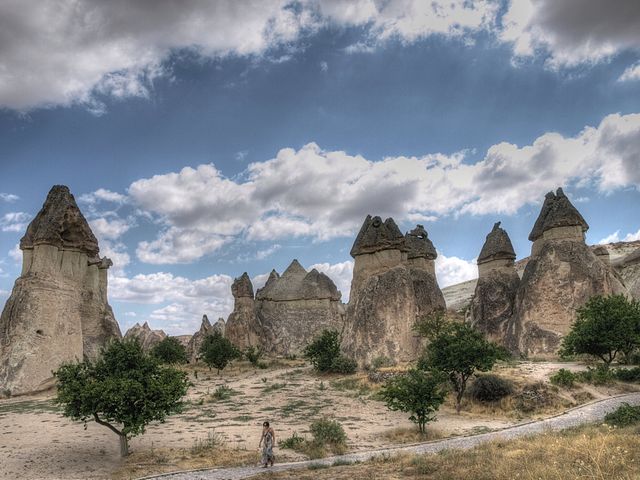
Latitude 38.660046 & Longitude 34.853611. On the Anatolian Plain in the Zelve region of Cappadocia, some 140 miles south-east of the capital city Ankara and 2 miles north-east of Goreme, stand the famous Rock Cones of Urgup, with hundreds of naturally-formed rock citadels: pinnacles, cones, domes, columns and pyramid-shapes, resembling giant mushrooms, which are known locally as Fairy Chimneys.

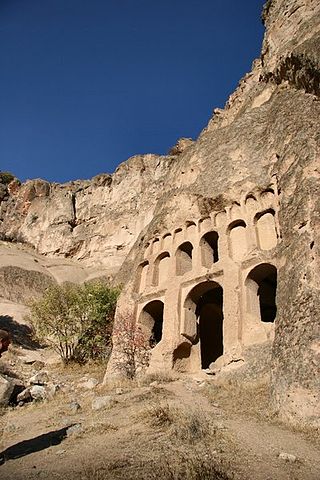
Since the 4th century Christian ascetics have sought sanctuary in some of the larger rocky structures and carved out churches and chapels from them, indeed some of the rock faces, nearby, have some quite astonishingly ‘beautifully’ hewn-out places of refuge and worship, while underground there are literally hundreds of subterranean cave-like dwellings, with passage-ways linking rock-cut rooms and buildings, many on different levels, with boulders that could be rolled into position across doorways in case of attack. But going further back – in the 1st century AD St Peter the Apostle is said to have brought Christianity to Anatolia, and then in the 4th century St Basil, bishop of Caesarea (now called Kayseri, 50 miles to the east), urged monks and hermits who were fleeing from persecution to follow an ascetic life on the Plain of Urgup and the Goreme Valley, nearby.

Fairy Chimneys of Cappadocia (Photo Credit: Wikipedia)

Fairy Chimneys of Cappadocia (Photo Credit: Wikipedia)

There are many hundreds of rock pinnacles, resembling lofty chimneys that seem to nearly touch the sky in places, which have been shaped by erosion and the softer rock around them gradually worn-away over millions of years to form the alien, moon-like landscape of today; many of the pinnacles being over 100 feet high (30-40 metres) and having windows and doorways, many even being joined together to form communities of people, with many more having churches and chapels built inside them. And below ground there are vast cavenous-like structures: tunnels, galleries, and passage-ways, with several different levels of underground buildings and rock-cut rooms. The main entrances have large boulders standing ready in position so that they could be rolled across in case of an attack from the outside, and if any would-be invader did get inside they would find the maze of passage-ways bewildering, if not down-right dangerous, and they would be dealt with in due course! A few of the larger, more interesting churches still retain their original medieval frescos, a lasting tribute to the monks and hermits who painted them many centuries ago.

A Rock Church in Cappadocia (Photo Credit: Wikipedia)

Rock Church,  Cappadocia (Photo Credit: Wikipedia)

These underground towns, cities, and communities of people would have been largely self-sufficient; they even had their own stables attached – both above and below ground, and also their own water supply through pools and large stone tanks. However, by the 13th century the rock chimneys of Urgup were being abandoned, and only a few solitary hermits and priests continued to live here in an equally solitary residence, but the man-made rock churches and chapels did continue to be ‘in use’ until more recent times, and today they are a tourist attraction, with some 600 or so churches surviving both at Urgup and at nearby Goreme – including the churches of St John the Baptist, St Barbara, St Basil, Church of the Apple and Tokali.

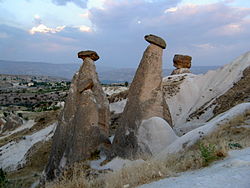
The geography of the Urgup and Goreme area is summed up as being: these strange rock formations were shaped over 8 million years or so to form what we see today. The cones or pinnacles have survived because they are formed from a much harder rock than the soft rock plateau that had originally surrounded them -which has worn away to leave the strange chimney-like shapes and, at the top of each cone a bulbous lump of basalt and small boulders has fused together, providing protection to the lower rock structure itself, looking like a sort of top-knot, perhaps, and giving each cone a chimney-like appearence – hence the local name ‘fairy chimneys.’

In the Reader’s Digest book ‘Strange Worlds Amazing Places’ the geography of this region is outlined in detail: “The process that shaped this unique landscape began when the volcanoes of Cappadocia erupted about 8 million years ago. They deposited countless layers of ash, lava, debris and mud, raising the altitude of the land by more than 1000 feet (300m) to form a prominent plateau.”

“Millions of years of compression turned the volcanic ash into a soft, pale rock called tufa. This was overlaid by a thinner layer of dark, hardened lava known as basalt. As the basalt cooled, it contracted and split, laying itself open to the erosive action of the weather. Streams and floods crisscrossed the plateau, cutting ever deeper, and earthquake shocks and winter frosts helped break up the layers of tufa and basalt.”

“Today the process of erosion continues, slowly wearing down the pinnacled landscape and exposing the multi-coloured layers of earth. These range from the palest tufa, through tones of ochre, russet and deep chestnut (caused by mineral impurities), to the black of the basalt.” Another Reader’s Digest publication ‘Book of Natural Wonders’, tells a similar story.

Sources:

Reader’s Digest, Strange Worlds Amazing Places, The Reader’s Digest Association Ltd., London W1X, 1994.          

Reader’s Digest Book Of Natural Wonders, The Reader’s Digest Association, Inc., New York, 1980.

Michael’s Guide Turkey, (series editor: Michael Shicor), Inbal Travel Information Ltd., Tel Aviv, Israel, 1990. 

Photo Credits:  http://en.wikipedia.org/wiki/Cappadocia

http://www.turkeytravelcentre.com/blog/cave-churches-cappadocia/

Copyright © Ray Spencer, The Journal of Antiquities, 2014.


The Calderstones, Allerton, Merseyside

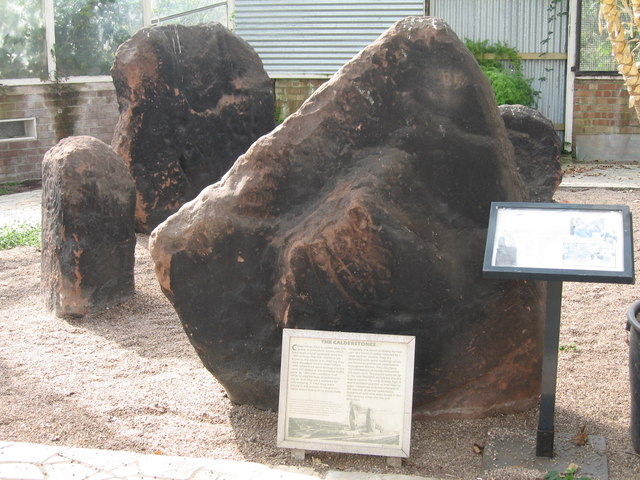
The Calderstones (Photo Credit: Sue Adair (Geograph)

The Calderstones  (Photo Credit: Sue Adair (Geograph)

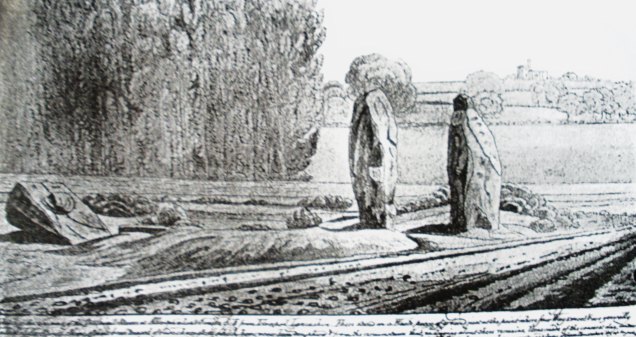
Os grid reference: SJ 4052 8757. Inside the palm house of the Calderstones Park Botanical Gardens at Allerton, Merseyside (originally in the county of Lancashire), stand 6 prehistoric megaliths known as The Calderstones, or the Caldwaye Stones, which are said to have come from a burial mound in the Allerton area back in the 1840s, although there is a record of them as far back as 1568 when they were being used as boundary markers and, at that time there were only three of them on view; the other three stones were excavated in the mid-19th century. These stones are thought to have ‘once circled’ the low mound which apparently had a burial chamber, or possibly a passage-grave at its centre. They are of interest, also, because they have carvings (rock-art) on them. The six standing stones, as they have always been referred to, were eventually brought to the Palm House in Calderstones Park, having stood near the entrance on Calderstones road (A562) and, opposite the aptly-named Druids Cross road. Liverpool city centre is 1 mile to the east.

The Calderstones, Allerton (1824)

The Calderstones, Allerton (1824)

The six stones range in height between 3-8 feet and probably date from the Bronze-Age. They are made of a hard sandstone. Of great interest are the carvings on them, there are a number of cup-and-ring marks on each one as well as spirals, and some other carvings that are more uncertain. When the mound at Allerton was excavated clay urns containing cremated bones and other artefacts were found, according to Mr W.A.Herdman in his work ‘A Contribution To The History of The Calder Stones near Liverpool’ (1896), adding credence to the probability that this was a burial chamber or passage-grave, but it could well have been a cairn circle due to the very fact that ‘these’ six megaliths had been discovered here; the stones would have almost certainly surrounded the chamber within the low burial mound (tumulus).

In 1845 the six Calder Stones were re-erected at the entrance to the park, and in 1864 they were examined by Sir James Simpson who declared them to be ‘part of a stone circle’; it was Sir James who identified the cup-marks and spirals and also wrote about them in 1865-7. In 1964 the stones were re-housed inside the Palm House (also called the Harthill Greenhouses), and here they stand as a fitting tribute to the antiquarians who discovered them back in the Victorian age. The stones have recently been re-sited in a special glass exhibition building in the Harthill Greenhouses buildings.

Sources:

Photo credit:  Sue Adair (Geograph) © Copyright Sue Adair and licensed for reuse under this Creative Commons Licence.

Geograph: http://www.geograph.org.uk/photo/401915

Fields, Kenneth., Lancashire Magic & Mystery, Sigma Leisure, Wilmslow, Cheshire, 1998.

Herdman, W.A., “A Contibution To The History of The Calderstones, near Liverpool”, Proceedings & Transactions of the Liverpool Biological Society, volume 11, 1896.

Simpson, James., “On the cup-cuttings and ring-cuttings on the Calderstones, near Liverpool”, Proceedings & Transactions of the Liverpool Biological Society, Volume 17, 1865.

Please see Paul Bennett’s very interesting, enthusiastic and in-depth site-page on The Northern Antiquarian: http://megalithix.wordpress.com/2014/07/08/calderstones/


Caedmon’s Cross, Whitby, North Yorkshire

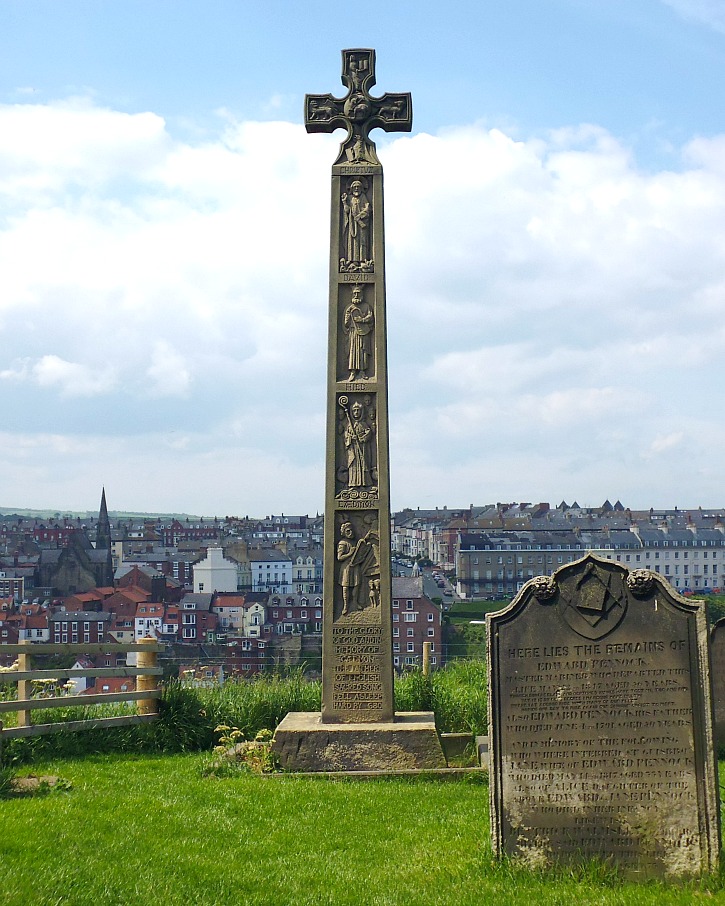
Caedmon's Cross at Whitby.

Caedmon’s Cross at Whitby (Front)

Os grid reference: NZ 9009 1126. From Church street it’s a fair-old climb to the top of the precarious flight of 199 steps up to the west side of St Mary’s churchyard, overlooking the river Esk where it meets the north sea; but at the very top we are compensated by the tall monument called Caedmon’s Cross, a late Victorian-style Celtic cross that commemorates the famous 7th century Anglo-Saxon poet, Caedmon. He lived for most of his life at St Hilda’s monastic community of Streonaeshalch (Whitby), the predecessor to the present-day abbey, as a laybrother and herdsman. But Caedmon was to become an outstanding religious poet, and we have St Hilda to thank for that! The cross is richly decorated on all four sides and, although it’s not an ‘ancient’ cross as such – it’s still a remarkably stunning monument. It’s well worth visiting.

Caedmon’s Cross is almost 20 feet high and stands upon a solid stone-base. It was made from a hard type of sandstone quarried close by Hadrian’s Wall; and was set-up in 1898 to commemorate the 7th century poet of Whitby Abbey, founded by the Northumbrian saint, Hilda. The monument is very reminicent of the Bewcastle, Ruthwell and Gosforth Crosses with its panels depicting various Saxon saints, kings and Biblical figures, and there is an inscription recalling Caedmon. On the front side (east face) in 4 panels: Christ in the act of blessing – his feet resting upon a dragon and a swine, King David playing a harp, the abbess Hilda  with her feet on tiny fossilised creatures (ammonites) with a gull by her side, and behind her her five best scholars. Also Caedmon in his stable being inspired to sing his hymn about ‘The Creation’ – below which an inscription: “To the glory of God, and in memory of Caedmon, Father of English sacred song. Fell asleep hard by AD 680.”

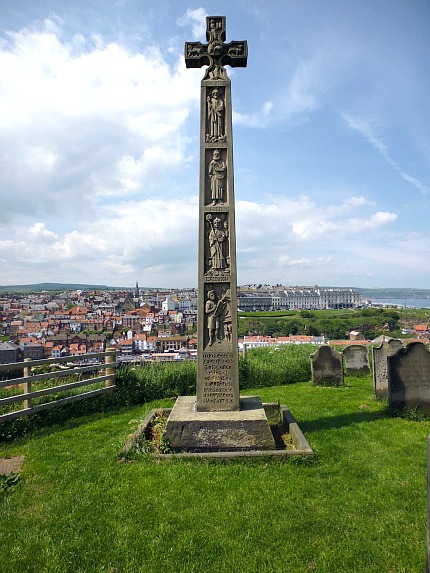
Caedmon's Cross, Whitby (East Face)

Caedmon’s Cross, Whitby (Front Face)

On the west face in panels: double vine stems symbolising Christ, loops with 4 scholars of Whitby at the time of Caedmon: Aetla, Bosa, John and Oftgar, below which are carved the first 9 lines of Caedmon’s hymn of Creation. The two sides of the cross show an English rose, birds, animals and an apple tree (Eden). Also, a harp at the foot of The Tree of Life (harmony with Christ). The cross-head is carved on one side with the Agnus Dei and the four Evangelists with their symbols, while the other side has knotwork, bosses, and a dove representing the Holy Ghost.

We know from what Venerable Bede tells us in his ‘Ecclesiastical History Of The English People’ that Caedmon was ignorant, at first, of words and song and, knew nothing much about ‘life and creation’, being teased and mocked by the other monks, but that his life literally changed overnight when he had a wonderful dream in which he was visited by an angel. He was told to compose a hymn about the Creation with our Lord at its ‘very core’. The following morning he rushed to inform abbess Hilda about this dream. Hilda was filled with joy at what she heard and encouraged him to write down what the heavenly angel had revealed. And so the great hymn to ‘God the Creator’ was composed; he even sang it in a angelic voice in front of his fellow monks.

Abbess Hilda invited scholars from the monastery to evaluate Caedmon’s work, and she asked him to take the tonsure of a monk – which he did. But he also set out to write about the Christian Church and compose other religious hymns and poems with the Bible at the heart of each one. Sadly the Creation hymn is Caedmon’s only surviving work and is said to be ‘the oldest recorded Old English poem.’ He is said to have died in the monastery hospice in AD 680 surrounded by his friends after having a premonition of his own death; St Hilda also passed away that year, aged 66. However some accounts claim that Caedmon died in AD 684? The 11th February is St Caedmon’s feast-day. Close by there is a rather battered medieval wayside cross on a circular stepped base.

Sources:

Bede, The Venerable., A History Of The English Church And People, Penguin Books Ltd., Harmondsworth, Middlesex, England, 1982.

Roberts, Andy., Ghosts & Legends of Yorkshire, Jarrold Publishing, Norwich, 1992.

Smith, William., Stories & Tales Of Old Yorkshire., (Ed by Dawn Robinson-Walsh), Printwise Publications, Bury, Lancashire, 1993. (Orig. ed by William Smith in 1883).

http://www.jstor.org/stable/25581386q=2

http://en.wikipedia.org/wiki/C%C3%A6dmon


Jennet’s Well, Calversyke, Keighley, West Yorkshire

Jennet's Well near Keighley.

Jennet’s Well near Keighley.

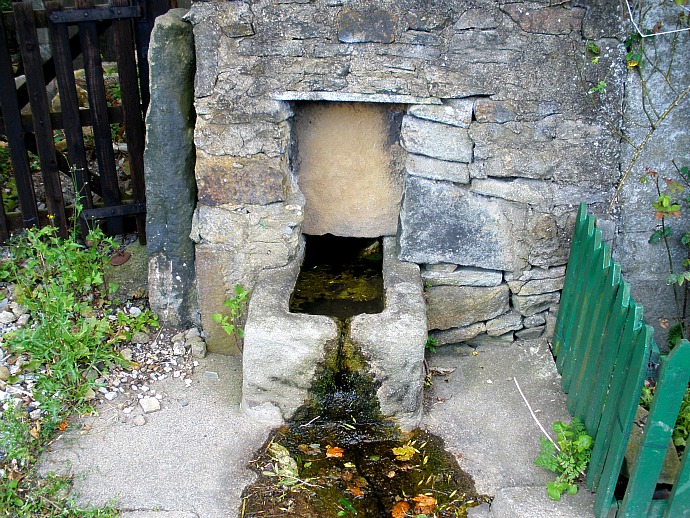
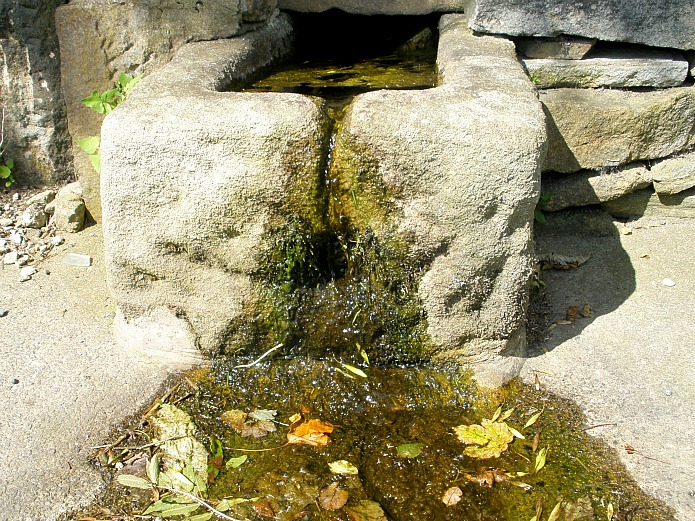
OS grid reference SE 0464 4185. Jennet’s Well stands beside a house at the west end of Shann Lane, almost opposite Calversyke reservoir, on Black Hill to the west of Keighley, West Yorkshire. It has variously been called St Jennet’s Well, Jannet’s Well and Jenny’s Well, but as to whom it was originally named for is now lost in the mists of time. Jennet was thought to have been a tutelary Saxon saint who was venerated at Keighley, perhaps at a church that no longer exists, but there is no record of a saint of this name here and so Jennet must be regarded as an obscure or unknown saint. Could it be the word “Jennet” meant something entirely different? Legend says the well at Black Hill stands at a Christianized place, maybe where people in Saxon times could congregate, worship and receive a miraculous cure by the waters of this little holy well, which had become a Christianized spring because a holy person had dwelt there; the spring then having the power to cure illnesses. The town of Keighley is about 1 mile away to the south-east and Braithwaite village roughly half a mile in the same direction.

Close-up of Jennet's Well.

Close-up of Jennet’s Well.

The spring of water flows out from a stone structure and into a square-shaped stone basin that looks to have some faint carvings on it which resemble those from the late Anglo Saxon period; it then runs along a stone gulley, afterwhich it apparently runs under the lane and then on into the Calversyke reservoir, close by. It obviously pre-dates the house by many hundreds of years, but may originally have been used as a source of water by the occupants and others close-by – indeed there are a few records saying the well used to supply the town of Keighley when it was brought to peoples’ homes in stone troughs from the never-failing spring at the west side of the town, according to Stephen Whatley’s ‘England’s Gazetteer’ of 1750. Local folklore says the well was the haunt of the fairy folk in times gone by. If you are going to look at the well or take photos there [please respect the privacy of the occupants of the house]. There are two other holy wells in this area: True Well and Goff Well.

Sources:

Dewhirst, Ian., A History of Keighley, Keighley Corporation, 1974.

Many thanks to The Northern Antiquarian:  http://megalithix.wordpress.com/2008/12/29/jennets-well-keighley/

The Megalithic Portal:  http://www.megalithic.co.uk/article.php?sid=26416

Whatley, Stephen., England’s Gazetteer,  J & P Knapton, London, 1750.

Copyright © Ray Spencer, The Journal of Antiquities, 2014.


Easter Island, South Pacific Ocean

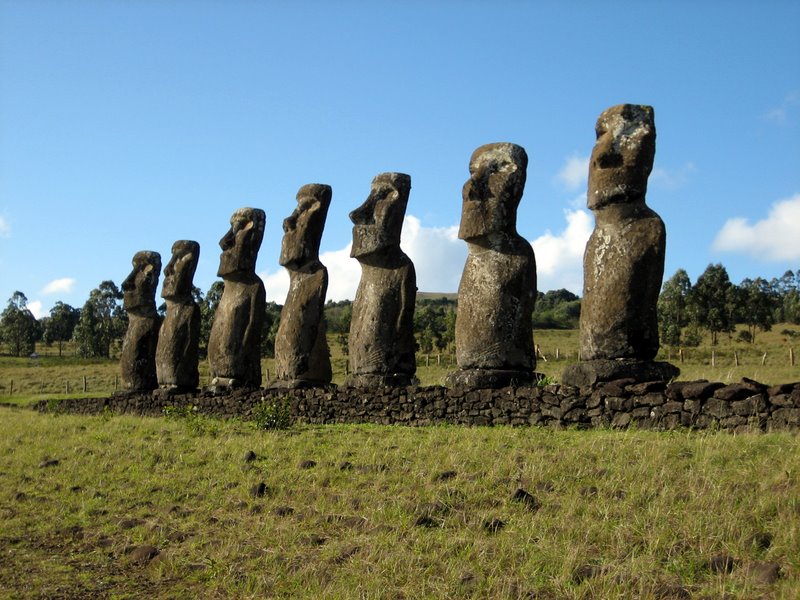
Easter Island (Ahu-Akivi) Photo Credit: Wikipedia.

Easter Island (Ahu-Akivi) Photo Credit: Wikipedia.

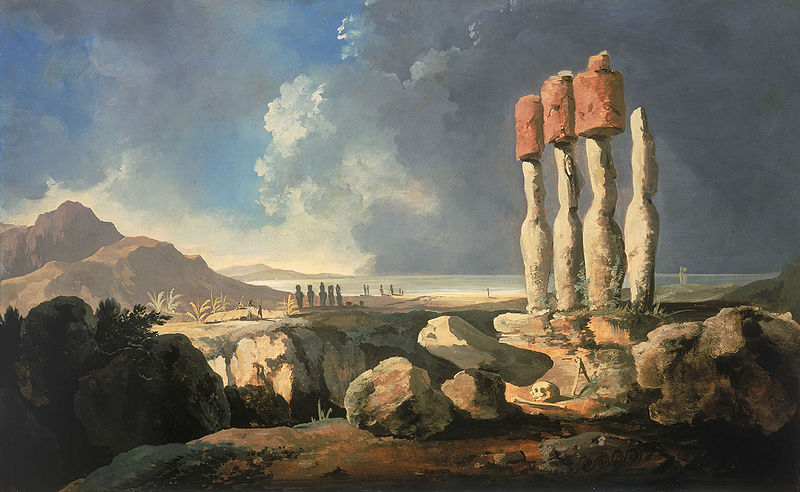
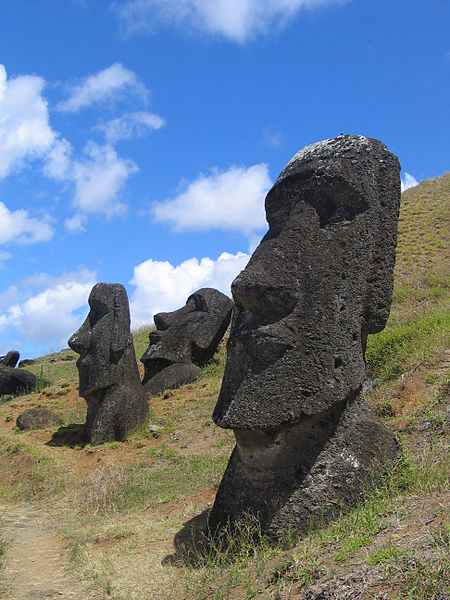
Latitude: -27.1211919. Longitude: -109.3664237. A small Polynesian island in the south Pacific Ocean far away from any major landmass is Easter Island, only discovered in the early 18th century, but it is a very extraordinary and mysterious island of giant stone statues and rock carvings, some perhaps dating back well-over 1,000 years. Also known as Rapa Nui, the “sacred” island of the mysterious tribe that are also called by the same name and who lived here, roughly, between 400-1700 AD.

There are said to be upto 1,000 small and large stone statues on the island, many are said to represent the gods or chiefs of the Rapa Nui tribes; and there are many superb petroglyphs or rock-carvings scattered about the island. The island is 10 miles across north to south and about 16 miles length-wise at the south side; also at the south side a line of three dormant volcanoes: Rano Kao, Punapau and Rano Raruku, while at the north another volcano called Rano Aroi; the island is made of sandstone and volcanic rock. Easter Island, sometimes called ‘the Navel of the World’ is 1,200 miles from any other island and roughly 2,360 miles from any major landmass – in this case the west coast of Peru. It is 1,290 miles east of Pitcairn Island.

Easter Island by Hodges Photo Credit: Wikipedia.

Easter Island by William Hodges 1775. Photo Credit: Wikipedia.

On Easter Sunday in 1722 Dutch sailors, lead by the enthusiastic seafaring admiral Jacob Roggeveen, discovered the barren, treeless island quite by chance and named it Easter Island; they were almost certainly very surprised to see huge stone heads lying on the ground. After that, in 1772 Spaniards re-discovered the island and, other interested parties (and some not so interested) came to the island in the late 19th century when archaeological excavations began. In more recent times (1956) the famous Norwegian explorer Thor Heyerdahl (1914-2002) sailed to the island on his balsa-log raft, Kon Tiki. Francis Hitching in his book ‘The World Atlas of Mysteries’ 1979, says of Heyerdahl’s expedition: “In 1956 the writer Thor Heyerdahl arranged an archaeological experiment with the mayor of Easter Island and six islanders. Using traditional methods, they carved out the contours of a new statue in three days using stone tools and gourds of water to soften the volcanic rock.”

Easter Island (Rano Raraku). Photo Credit: Wikipedia.

Easter Island (Rano Raraku). Photo Credit: Wikipedia.

The huge (colossal) statues carved from hardened volcanic ash are called ‘moai’ and they look stern-faced inwards away from the sea, seemingly to gaze towards the horizon for eternity, some stand on ceremonial rock platforms (ahu), especially those at Akivi on the island’s west coast and Nau Nau in Anakena Bay with between 7-15 figures, many having strange top-knots (pukao) on their heads, made from red tuff rock, their eye-sockets are made from coral and the irises from red scoria rock. In all there are nearly 900 statues (most having subtle differences in their appearances), including half-size ones and some that are unfinished, and some kneeling statues. They are said to represent the gods of the Rapa Nui. One of the statues, the ‘paro’ is 33 feet high (10 metres) and weighs in at 76 tonnes; another, an unfinished statue, is 69 feet high (21 metres), but there are some that are as tall as 24 metres, a staggering 78 feet! Many statues have fallen or been pushed over, maybe by the Rapa Nui tribes themselves as they knew that the end of their island culture was coming – due to a number of factors including abduction for the slave trade, war and disease – indeed by the 1870s only a hundred or so tribes-people remained, and in 1888 the island was finally annexed to Chile.

Author Justin Pollard in his excellent book ‘The Story of Archaeology In 50 Great Discoveries’ 2007, says that “By the 18th century Easter Island was almost devoid of trees and the destruction of the forest to provide wood for building and boats (and perhaps rollers for the moai) and to clear areas for agriculture led to a progressive impoverishment and erosion of the soil. These factors, together with the pressures caused by a growing population, meant that Easter Island society began to change rapidly.”

There are some amazing rock carvings on the island, in particular those in the Ana Kai Tangata cave at the south-west side of the island where there are depictions of the so-called ‘birdman’ (Tangata Manu) the supreme chief. The ‘birdman’ also features on a carved rock located above the Motu Nui islet; the cultus of the birdman was centred on the island village of Oronga where there are some well-preserved houses that were lived in by the Rapa Nui, from 1500 onwards. Thankfully, the famous statues of Easter Island have been re-erected and now stare, perhaps rather less stern-faced towards ‘a new horizon.’ Today tourists and archaeologists visit Easter Island to stare and to study the huge statues and rock carvings and, at the island that is slowly ‘being lived on’ once again!

Sources:

Hitching, Francis., The World Atlas Of Mysteries, Pan Books Ltd, London SW10, 1979.

Pollard, Justin., The Story Of Archaeology In 50 Great Discoveries, Quercus, London W1A, 2007.

Strange Worlds Amazing Places, The Reader’s Digest Association Limited, London W1X, 1994.

Photos Wikipedia:  http://en.wikipedia.org/wiki/Easter_Island

http://www.southamerica.cl/Chile/Easter_Island.htm

Copyright © Ray Spencer, The Journal of Antiquities, 2014.


2 Comments

Roman Bath, Westminster, London, WC2

Roman Bath, The Strand, London. (D. Mcleish)

Roman Bath, The Strand, London. (D. Mcleish)

OS grid reference TQ 3085 8087. In the stone-vaulted cellar of number 5 Strand Lane, off The Strand, Westminster, in a narrow alley-way close to King’s College, and next to Surrey Street, London WC2, can be found a very well-preserved Roman Bath, dating from the 2nd century AD, that is now regarded as a notable and historical reminder from the Roman city of Londinium (London), but now a curiosity of hidden-London. The bath is still in use and has been in one way or another since the late 16th or early 17th century, having been lost for hundreds of years after the Romans departed at the beginning of the 5th century AD. It seems the bath had belonged to a grand Roman villa which had stood on this site in the early days of the Roman occupation, probably the 2nd century AD, and which had stood on a raised area of land outside the city walls, overlooking the river Thames. The site is near to Charing Cross underground station and Covent Garden. The Victoria Embankment is just a short walk to the south.

The Roman Bath on the south side of the Strand is in a well-preserved condition considering its age, and is under 5 feet (1.5 metres) below street level, measuring 16 feet in length by over 6 feet in width and nearly 5 feet deep. The plunge bath as it is often called is still fed by a spring of cold water from St Clement’s Well just as it was in Roman times and, also more recently in the 17th century. Its stonework consists of bricks that are 10 inches long by 3 inches wide, all solidly packed together and water-tight. The stonework surrounding the Roman bath is very grand and it certainly looks ‘Roman’, but is it? However, the ugly iron grate-covers at the sides do not do it any justice, though they serve their modern-day purpose as inspection covers!

Roman Baths, The Strand, London (Photo Credit: Wikipedia)

Roman Baths, The Strand, London (Photo Credit: Wikipedia)

In 1612 King James I had the Roman bath fully restored from whence it had been the property of the Earls of Essex in the late 16th century; he then continued to patronise it – as did many other royals, including Anne of Denmark, his wife, and a number of royal courtiers. Then in the 18th century it was frequented by London’s wealthy and famous. In 1784 John Pinkerton the Scottish antiquarian described it as “a fine antique bath in the cellar of a house in Norfolk street in the Strand.” Norfolk Street no longer exists in name. At this time it belonged to the Earl of Arundel whose house and gardens were adjacent to the bath. In 1792 the antiquarian William Weddle Mp died suddenly after taking a plunge in the Roman bath. The famous author Charles Dickens visited the bath and then wrote about it in his book ‘David Copperfield’ recalling, perhaps, that master Copperfield had “many a cold plunge in the said bath.” The bath fell in to disuse in the late Victorian period but in the early part of the 20th century it was again restored to what we see today.

The bath is open to the general public one day a week (by appointment) and is today maintained by The City of Westminster on behalf of the National Trust. Roman artefacts have been discovered close by including: a sarcophagus and numerous items of pottery and coins, all dating from the Roman period. In September 2011 another Roman bath was found by railway workers on the south-side of the Thames at the corner of London Bridge street. A few historians have argued that the bath only dates from the 17th century, being built as a water feature or spa-bath by the Earl of Arundel, but this is now generally considered not to be the case – and so the thinking is that the bath is indeed Roman.

Sources:

Wikipedia:  http://en.wikipedia.org/wiki/Roman_Baths,_Strand_Lane

http://www.offtolondon.com/hiddenlondoncopy/romanbath.html

http://www.pasthorizonspr.com/index.php/archives/04/2013/archaeologists-find-10000-objects-from-roman-london

Romantic Britain, edt. by Tom Stephenson, Odhams Press Limited, London, WC2, 1939.

© Copyright, Ray Spencer, 2014.