The Journal Of Antiquities

Ancient Sites In Great Britain & Southern Ireland


Coal Bank Mill, Ashworth Valley, Norden, Greater Manchester

Washwheel Mill Ruins, Ashworth Valley, Rochdale

Coal Bank Mill Ruins, Ashworth Valley, Rochdale

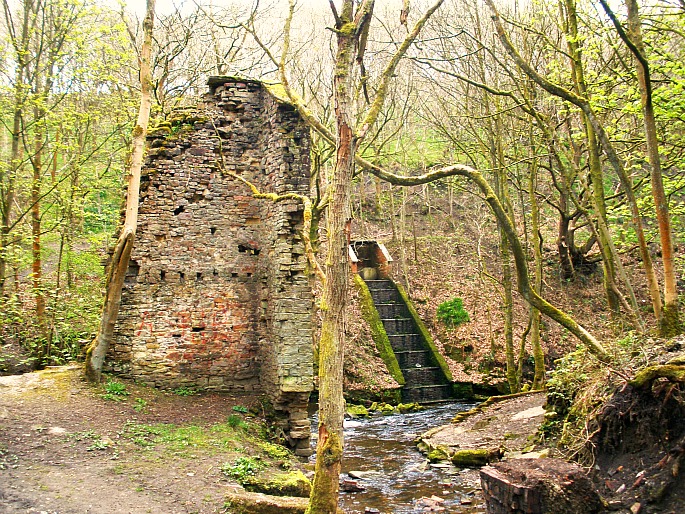
Os grid reference SD8559 1416. The site of what was once a thriving industrial place known as the Coal Bank Mill, in Ashworth Woods at Wolstenholme Fold – through which the Naden Brook flows, in what is now a very picturesque place hidden deep inside the Ashworth Valley, near Norden, Rochdale, where old industrial ruins merge in with the flora and fauna – as if in some way time has stood still, even though the industrial revolution and Coal Bank mill have been almost obliterated from what is now a “very” tranquil and secluded place. This is one of my favourite places from my days at school, a long time ago now, but still so many memories.

.
Coal Bank Mill (ruins)

Coal Bank Mill (ruins)

To reach the site go to the top of Norden road in the village of Bamford. Turn left onto Clay Lane for about half a mile, then at the electricity substation turn sharp left again. Go along Fairburn Lane keeping to the right and head down into the little valley where the bridge goes over the brook, then just up the hill after the bridge follow a footpath that heads off to the right. Walk along this track, the former tramway, through the woods beside the steep-sided bank, below which the Naden brook flows. Follow this fairly straight path for half a mile until you reach a modern curved, wooden bridge. You can also reach the site from Norden bus terminus, then following the brook south past the new housing devolpment and, past the tall Black Pits cotton-mill chimney, one of very few in this area still standing. Here the little stream from the hillside above called Mill Croft flows into the larger Naden brook in Ashworth Woods (actually part of Carr Wood) at a place known locally as Coal Bank, which is now a ‘landscaped’ area for walkers and picnickers alike, but which was once back in the industrial past a place of mills, chimneys, small coal pits (diggings), cotton-spinning, paperworks, dye and bleach works, all of which were ‘very’ reliant on the Naden brook. The town of Rochdale is just 2 miles from here on the A680 through Norden.
.
Coal Bank mill (ruins)

Coal Bank mill (ruins)

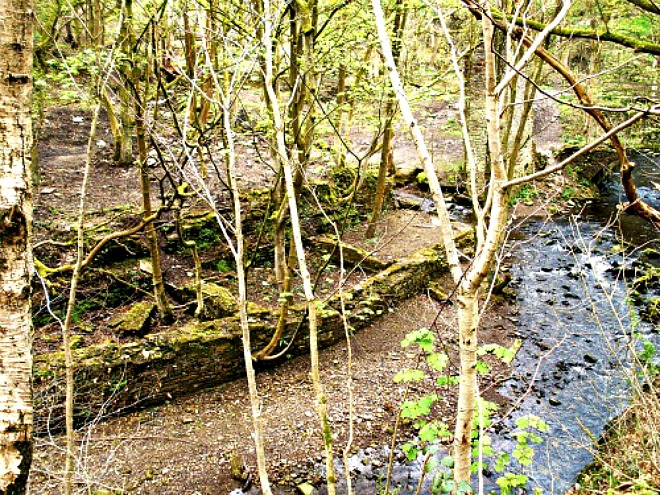
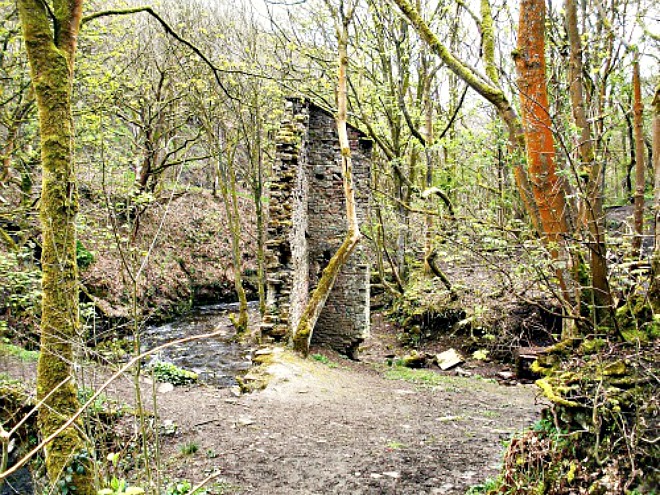
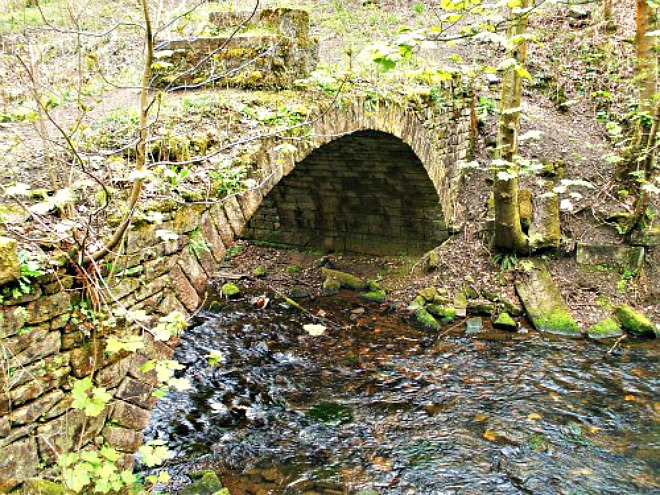
Here at Coal Bank we reach the site of what was Coal Bank Mill situated beside the Naden brook and, although the cotton-mill-cum-paper-mill has been almost obliterated – if you look closely you can still find the ruins of this one-time industrial enclave, a little bit of the Industrial Revolution hidden away in this wooded valley, near Rochdale, thanks in many ways to the great Ashworth family and, others, who owned the land around here. In the late 18th or early 19th centuries the place began life as a cotton-spinning mill (probably a fulling mill) but then in the 19th century the mill became a paper/printing works. In the early years of the 20th century the mill closed down for good. Much of the mill was then pulled down and great quantities of the stonework taken away. Part of a wall still stands as do the foundations of several buildings at either side of the walkway, including what was the lodge; there are also some nicely built stone bridges and lumps of old rusting ironwork! and also a few remnants of what looks like a water-wheel, or something similar? *In Grace’s Guide directory Coal Bank is described as a bleachers and dyers in the ownership of Richard Bell (1891).

.
Coal Bank Mill (ruins)

Coal Bank Mill (ruins)

The Coal Bank mill chimney with its “open” square-shaped flue was demolished in 2006 and the site levelled and landscaped in order to make new pathways and modern wooden bridges, making a nice place to stroll and enjoy one’s-self in this, now, peaceful place. But the ghosts of the many hundreds of workers, both adults and children, who toiled here in the past seem to be still present in this isolated, haunted valley; indeed it seems those workers, horses and loaded carts, are still treading the same cobbled pathways to the old mill; and if you’re very quiet you can still hear them…… well I think you can!
.
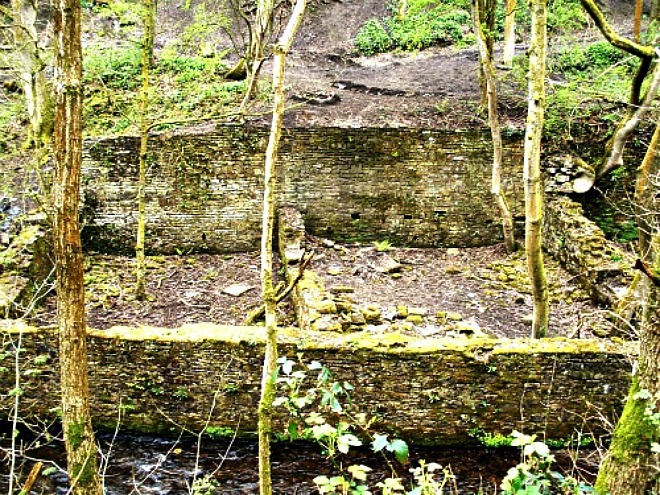
Coal Bank Mill (ruins)

Coal Bank Mill (ruins)

There are the ruins of other cotton-spinning mills (fulling mills) and Calico print mills further to the west near to Turn Village, beside the Cheesden brook, all quite evocative now and one might say, romantic looking. The ruins of Washwheel Lower Wheel mill, Deeply Vale mill, Deeply Hill; and also other spinning mills at Longlands, Cheesden Lumb mill, Cheesden Pasture mill, Croston Close mill, Four Acre mill and, further to the south Birtle Dene mill, New Birtle and Kershaw Bridge mills, are discussed at length along with a history of these cotton mills in the delightful book ‘The Forgotten Valley’ by A.V.Sandiford and T.E.Ashworth. The ruins at Cheesden Lumb mill were excavated by archaeologists from Manchester back in the 1990s, but nature is catching up and the ruins of these old mills are gradually giving way, sadly, to the rain and gales that frequently batter this part of north-west England. A way of life has now gone.

.
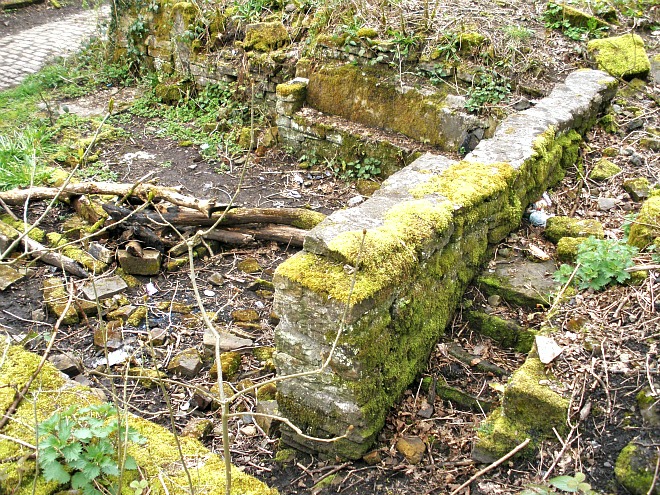
Coal Bank Mill (ruins)

Coal Bank Mill (ruins)

Sources:

.

Sandiford, A.V., & Ashworth, T.E., The Forgotten Valley, Bury and District Local History Society, 1981.
.
And, also my memory…….!


St John’s Church And Churchyard, Great Marsden, Nelson, Lancashire

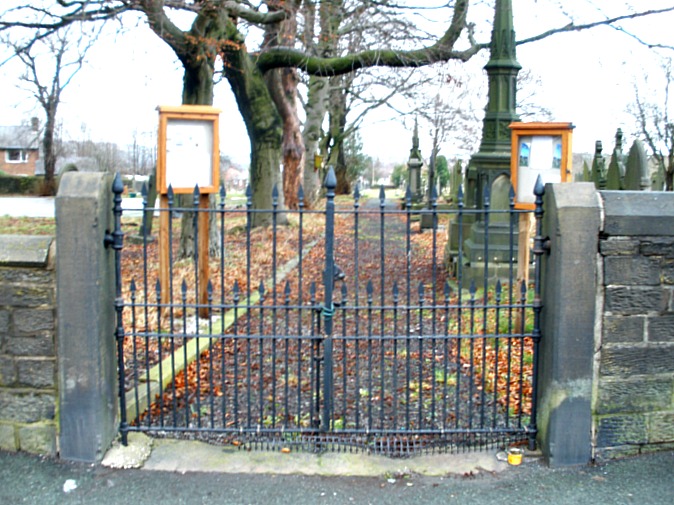
St John's churchyard entrance.

St John’s churchyard entrance.

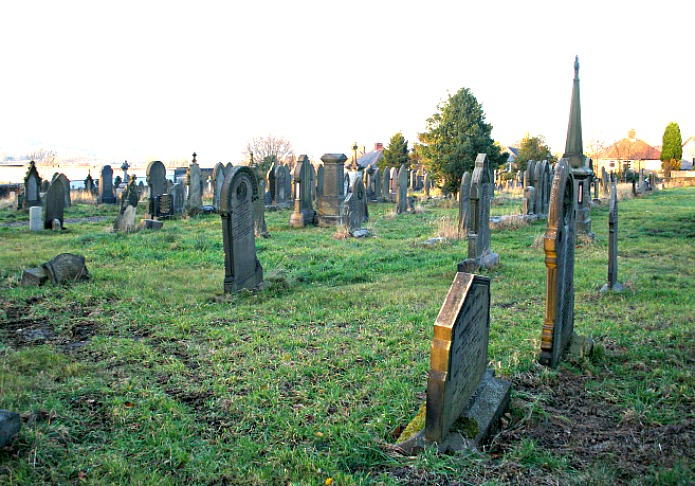
OS grid reference: SD 8700 3780. St John’s Church And Church-yard, Great Marsden, stands about ½ a mile to the north of Nelson town centre – up Barkerhouse road. Today, the modern church which is dedicated to St. John the Evangelist, has been amalgamated with that of the old St. Philip’s church on Leeds road, Nelson, and is much in use as a church centre for many local functions and social gatherings. The churchyard has many splendid old Victorian tombs and monuments, some quite tall and ornate ones, recalling the names of the many eminent local people that are of great interest to the area; and there are also many newer graves as well as a collection of interesting graveslabs from the 1st and 2nd world wars.

View inside St John's churchtard.

View inside St John’s churchtard.

In 1846 a Mrs Maw and a Miss Walton heirs to the Marsden Hall Estate gave land and money for the establishment of a church and burial ground at Great Marsden, adjoining Barkerhouse Road. The church was finished and consecrated in 1848. It was built in the ‘standard’ Victorian-Gothic style with nave, side and middle aisles; the stone used in it’s construction apparently coming from the local quarries at nearby Catlow. William Messenger was first vicar. The church was restored and extended in 1896 but problems with dry rot meant it had to be demolished in 1995. A new church was consecrated in 2000, but the graveyard had by then become much neglected. The site covers 6.5 acres, and some 17,000 burials have taken place over the past century and a half.

In 1848 the Town of Nelson did not exist. The area included two townships or villages – Great and Little Marsden. Little Marsden had it’s own church but most people in Great Marsden attended and were buried at St Bartholomew’s in Colne. The Townships only became Nelson after the East Lancashire Railway Company named it’s new station ‘Nelson’ after the Nelson Inn, which stood nearby. The Nelson Inn had been built in 1805 by my ancestors and given the name after the victory and death of Admiral Lord Nelson at Trafalgar that same year.

The population of the area had grown rapidly throughout the 19th century as handloom weaving in peoples’ houses was replaced by power loom weaving in local factories – the economics of scale allowing more cloth to be produced more rapidly to meet a growing demand for cotton garments and bedding. By the 1840’s there was clearly a need to have a new church in Great Marsden itself, and a mission was established to facilitate this.

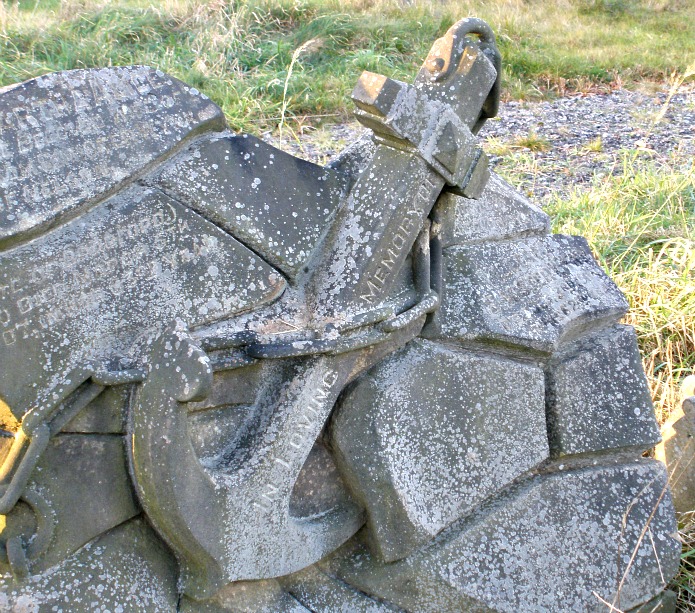
Anchor on tombstone at St John's churchyard.

Anchor on grave, St John’s churchyard.

In 1895 a new municipal burial site was established on Walton Lane as part of the new borough’s plans to emulate other boroughs with big projects like municipal buildings and parks high on the agendas of those who sought public office. Although people continued to be buried at St John’s the numbers declined in the 20th century, descendants themselves began to die off and the original occupants forgotten. The second half of the 20th century was a period of neglect. The burial ground was also affected by vandalism, subsidence and the encroachment of Japanese Knotweed, so that parts of the burial ground became inaccessible. My mother recalls successive vicars trying “desperately” to battle nature’s encroachment with little more than hedge trimmers and a garden lawn-mower!

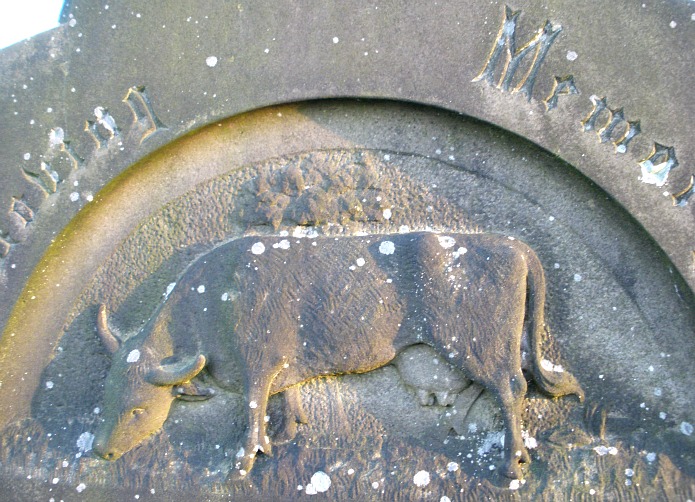
Cow on gravestone at St John's churchyard.

Cow on gravestone at St John’s churchyard.

In 2005 a group of concerned individuals many of whom had ancestors buried in the graveyard came together to establish a new group ‘The Friends of St Johns Churchyard’ and to establish a project to restore the churchyard and to make it accessible again. Over the past 8 years the churchyard has been transformed, the Japanese Knotweed eradicated, the subsidence dealt with, vandalism stopped and the grass regularly mown, seating established and, finally a memorial garden for quiet contemplation, set up. The many “often” spectacular monuments which can now be viewed – can be seen to reflect the new wealth of the area in the late 19th and 20th centuries with the more humble monuments often reflecting the interests, beliefs, and lives of the people buried there, with for example nautical (see photo above, left) and agricultural (see photo, right) carvings on some tombstones, and doves of peace etc on others.

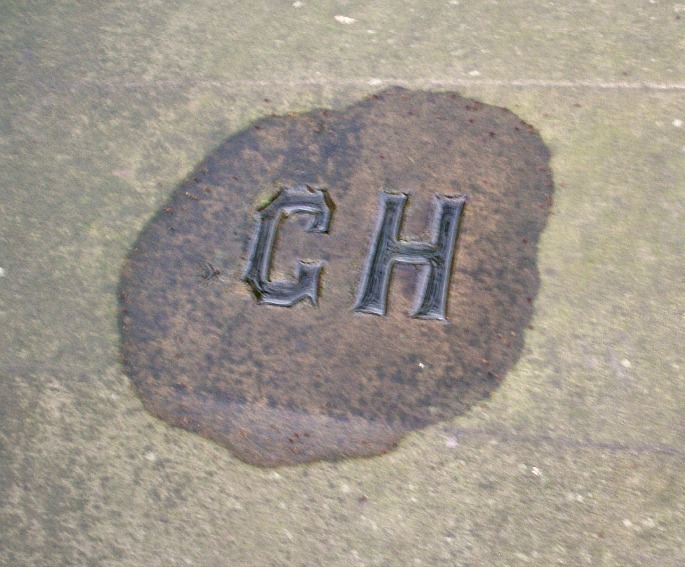
Letters GH on gravestone, St John's churchyard.

‘GH’ on grave, St John’s churchyard.

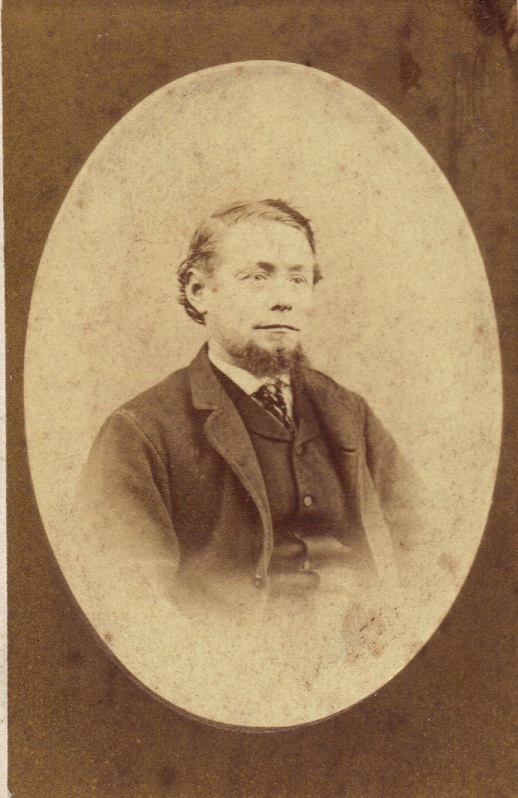
One of the more humble graves is that of my Great-Great-Grandfather, George Hillary 1837-69 (see photo below, right). The grave is marked with a simple inscription the letters ‘GH’ perhaps reflecting his view that there should be a lack of fuss over his funeral or that the family thought he would always be remembered by the local townsfolk. George was something of a local personality. People called him ‘George the Dandy’ on account of his liking for the most up-to-date fashions and his collection of waistcoats, a popular garment at the time with even children wearing them. As a youth George had travelled to the West Indies to work for a sugar company based in Liverpool, then as an adult he had worked for his father in law who had inherited the Nelson Inn as book-keeper and, later to learn the trade of Licensed Victualler. It was clear Matthew Manley had wanted him to take over on his retirement but fate was to intervene. George died aged 31 or perhaps 32 just one year before Matthew, of Tuberculosis, then called ‘consumption’ because of the way it appears to consume the body with feverish symptoms. It is said half the townsfolk turned out for the funeral. George’s prediction that the undertakers would fail to turn up came true when they got the date wrong! and men had to be found to carry the coffin from the Nelson Inn to the churchyard up the hill in Barkerhouse Road.

George Hillary.

George Hillary.

Also buried here are George’s wife, her second husband, George’s mother, and her parents, George’s brother and sister, his sister in law and brother in law, grandson and many cousins, too numerous to mention here.

By 2014 there has been a further renewal of interest in the graveyard, and for people seeking information about their ancestors as part of the ‘trend’ in Family History. The Friends now have requests for information from across the World. Some years ago the Pendle and Burnley Branch of ‘The Lancashire Family History and Heraldry Society’ recorded the information from ‘The Grave Books and Memorial Inscriptions’ and this is now available on CD (Details on The Friends of St John’s Churchyard Website).

There is a World War I Memorial Garden at the far side of the churchyard up against the north wall, and also two information boards.

Acknowledgements/Sources:-

Lancashire Family History and Heraldry Society: ‘Great Marsden (Nelson), St John the Evangelist Memorial Inscriptions and Grave Books’ CD.

Wilson, G.V., ‘Tales of the Nelson Inn’, Nelson and Colne Historical Society, 1966.

Bennett, W., ‘The History of Marsden and Nelson’, Nelson Corporation, 1957.

http://www.friendsofstjohns.co.uk/

© Ray Spencer, The Journal of Antiquities, 2014 (up-dated 2019).


The Burnley, Colne And Nelson Upland Archaeology Project

A new web-based archaeological project has been started by the Barrowford author and archaeologist John A.Clayton to map with ‘LIDAR’ Technology the east Lancashire towns of Burnley, Nelson and Colne – taking in the surrounding upland areas of Thursden, Extwistle, Worsthorne and Mereclough – with a view to uncovering the ancient past of these places and, to map their prehistoric past from the many Mesolithic camps, Bronze Age barrows, Roman enclosures to Medieval water-mills with LIDAR mapping. Please take a look at this new and very exciting website by clicking on the following link  http://www.barrowford.org/pendle-archaeology.html

Hi – the new books relating to the BNC Archaeology Survey are now in print. They can be purchased online at www.barrowfordpress.co.uk  or by cheque directly from me. They are also available at The Pendle Heritage Centre, Barrowford.

Best,

John Clayton

Barrowford.


John Dixon has Died

I have been told of the death of John Dixon of Aussteiger Publications, known to many as Lowergate. He was a truly great friend to me, always so kind and thoughtful. I enjoyed his company on the recent walks around Downham and Castercliff hillfort. He had a vast knowledge of prehistoric sites across the north-west of England, in particular the Pendle and Clitheroe areas. His many books are awesome to read with many, often unknown sites pointed out in the Brigantia series of walking books. John you WILL be so sadly missed by myself and many, many others in this field. Thank you John for all your help. When we walk upon the hills and moors of Pendle and Bowland, John you will be walking with us in spirit and guiding us along wherever we may walk. John, now you can find rest and peace. R.I.P John Dixon, a true gentleman.

Please click on the photo to enlarge it.

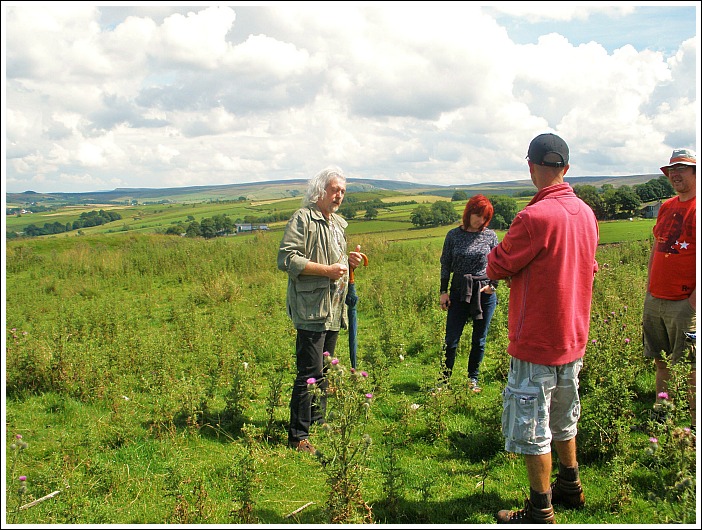
The late John Dixon, known to many as Lowergate, seen here on Castercliffe Iron-Age hill-fort, near Nelson, Lancashire, explaining the history of the site on 4th August 2012.


2 Comments

Brocklesby Park Mausoleum, Great Limber, Lincolnshire

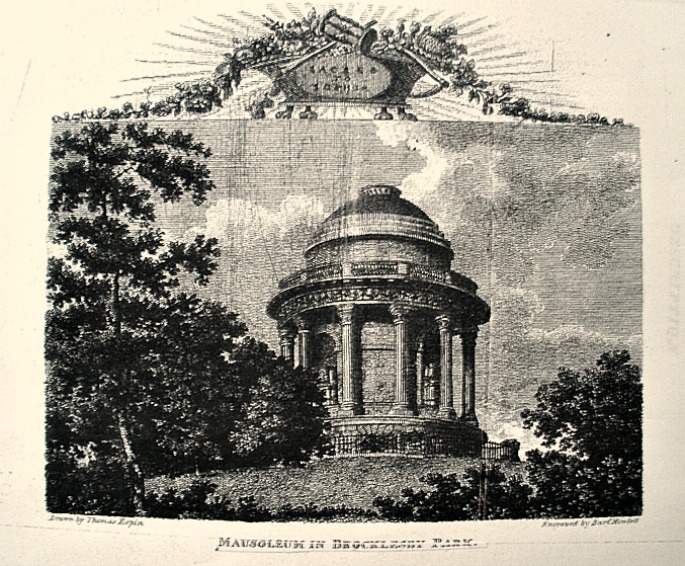
NGR: TA1332 0890. The mausoleum stands in the grounds and woodlands of Brocklesby Park (south side) close to Brigg road and high street at Great Limber. The following is from ‘A Description of The Mausoleum in Brocklesby Park, Lincolnshire, by T.Espin, Boston, 1808′.

Mausoleum in Brocklesby Park, Lincolnshire

“This sepulchral monument was erected by the present Lord Yarborough, to perpetuate the memory of his much lamented and amiable consort, who in the prime of life was separated from him and from the world, by a malignant fever of the brain”.

It is situate in his lordship’s park near the village of Limber* upon a commanding eminence the site of an ancient tumulus, evidently a place of Roman sepulture; the various urns full of burnt earth, bones and ashes, together with a variety of rings, combs, and perforated beads discovered on laying the foundations, fully justify such an opinion; it may therefore with great propriety be observed, that this elegant classic building stands majestically elevated on classic ground”.

*At Limber is a very good inn, near which Lord Yarborough has built a lodge where keys are kept to accommodate strangers who wish to see the building.

It was built from the designs of James Wyatt, esq. and completed under his direction in 1794. Its form is that of a Grecian temple of the peripteral kind; the colonnade consists of twelve fluted doric columns, which stand upon a rusticated basement about fifty-two feet diameter, these support a bold entablature, the frize of which is highly enriched with festoons of roses, sun-flowers and poppies, suspended from the horns of that appropriate doric ornament the bull’s skull over each column and tied upin two intervening places by bunches of ribbons; from the top of this entablature rises a very fine open balustrade. The external body of the temple is nearly forty feet diameter, is surrounded by four niches, in each of which stands a sarcophagus, this part rises to a small height above the balustrade, where it is covered with a dome, the commencement of which is stone, the upper part copper, with a circular curb of stone-work surrounding an aperture at the summit, through which descends the light necessary for the interior of the chapel”.

The basement part contains the cemetery, a most excellent piece of white brick-work, formed into compartments and recesses for depositing coffins: in the this apartment lie the remains of Mrs. Pelham, together with her father and mother the late Mr. and Mrs. Aufere, Mr. Pelham, great uncle to the present Lord Yarborough, and Francis Anderson, esq. his lordship’s father”.

Above this basement is the chapel ascended from the north by a spacious flight of steps. In a rectangular compartment above the door is the following inscription:   

                                                            TO THE MEMORY OF 

                                                                      SOPHIA

                                                    THE WIFE OF C. A. PELHAM,* 

                                                                   WHO DIED 

                                                       JAN. XXV. MDCCLXXXVI  

                                                                AGED XXXIII 

*Mrs. Pelham died previously to Mr. Pelham obtaining his peerage.  

   The first object  on opening the door, which cannot fail to affect the mind of sensibility, is the statue of Mrs. Pelham standing in the centre of the chapel on a cylindrical pedestal of whilte marble; the right hand supports a robe most exquisitely managed, the left arm resting on the trunk of a tree, sustains the head; the dress throughout is chaste and consistent, the drapery finely executed, the attitude strikingly graceful, the countenance placid and serene, and the whole may justly be considered a first rate production from the fascinating chissel of Nollekens”.

The chapel is divided into four compartments by eight fluted corinthian columns of Derbyshire marble; that on the north contains the door; in that opposite is an elegant cenotaph to the memory of Sir William Pelham of Brocklesby, who distinguished himself at the siege of Leith and in defence of Havre de grace; in 1579 he was appointed lord justice of Ireland with the authority of lord deputy; on his return to England, he was made lieutenant general of the ordinance, and accompanied the earl of Leicester as field marshal to the low countries in 1585; after performing signal service to his country, he died at Flushing in 1587. The tomb consists of a plain marble base sustaining a double pyramid, before which stands a large sarcophagus with a colossean female statue sitting thereon, holding a stork; the emblem of filial piety. The family arms are supported by a weeping Hymen with his torch inverted”.

In that recess on the east, stands a monument composed of a plain marble basement supporting a pyramidical slab and sarcophagus, on which lies a very large female figure resting on the left arm; in the other hand is a medallion on which is represented the bust of Charles Pelham, esq. of Brocklesby, who died in February, 1763, aged 84″.

The remaining compartment is occupied by the monument of Francis Anderson, esq.* of Manby, who died on October, 1758, aged 47. On a basement similar to the last, and in front of a like pyramid, stands a fluted sarcophagus, on which sit two naked boys supporting the family arms; that on the right thoughtful and pensive, that on the left cheerful, holding in his right hand the endless serpent with a butterfly walking around, an emblem of the soul traversing eternity”.

*Father to Lord Yarborough, but the estate came to his lordship from the above C. Pelham, esq., his uncle.

The fine proportioned columns which separate these recesses, support a bold entablature crowned with a highly decorative dome; the bottom part of stone is divided into enriched compartments, the upper part is stained glass executed by Eginton in a masterly style; the design exhibits numerous cherubim floating among clouds in seeming adoration to the supreme, allegorically represented by expanding rays from the centre: this happy and interesting finish, obstructs all glaring light from above, and diffuses a gloomy shade overy every part below, which inspires the mind with reverential awe”.

Throughout the whole of this beautiful fabric, Mr. Wyatt has displayed great skill in Grecian architecture, and has united solidity of workmanship with chastity of design; it is calculated to brave many a winter’s blast, and will long continue a fine memorial of that gentleman’s classic taste”.

From the colonnade the prospects are commanding and varied, but those towards the north, or north-east, the most picturesque; the middle ground is composed of a variety of forest scenery, and a sweep of the Humber forms the boundary of sight”.

The trees immediately encompassing this repository of mortality have been too recently planted to envelop it in solitude, and give that solemnity of appearance so necessary to be connected with places of this description; however the plantations have been judiciously laid out, and in the course of a few revolving years will unquestionably assume that character at present so devoutly to be wished”.

Copyright © Ray Spencer, The Journal of Antiquities, 2012 (updated 2024).


Please Visit The Aussteiger Publications Website

For all your local walking guide books in the north of England please visit the Aussteiger publications website:-http://www.aussteigerpublications.com/

or visit the Lancashire Diary at http://www.lancashirediary.com


Hello world!


Yes, hello World – well great Britain and southern Ireland. Welcome to the Home Page of my blog ‘The Journal of Antiquities’. Please do feel free to comment on any of the sites that appear on here. All comments will be carefully looked at, taken in to account, and then published, if they are okay. I for my part will try to make sure that all information and grid references are accurate.  Thank you for viewing my blog.

Comments are suspended at the moment due to the sheer volume, but I will reinstate this in due course. Please be aware any advertisements will be deleted, unless they are relevant to the site. I will be unable to answer every comment, but I will try to reply to those that I think are of interest to the blog site. Please do not post repeat comments on the site/site pages. All comments will have to await moderation. Thank you.