The Journal Of Antiquities

Ancient Sites In Great Britain & Southern Ireland


2 Comments

The Maiden Stone, Chapel Of Garioch, Aberdeenshire, Scotland

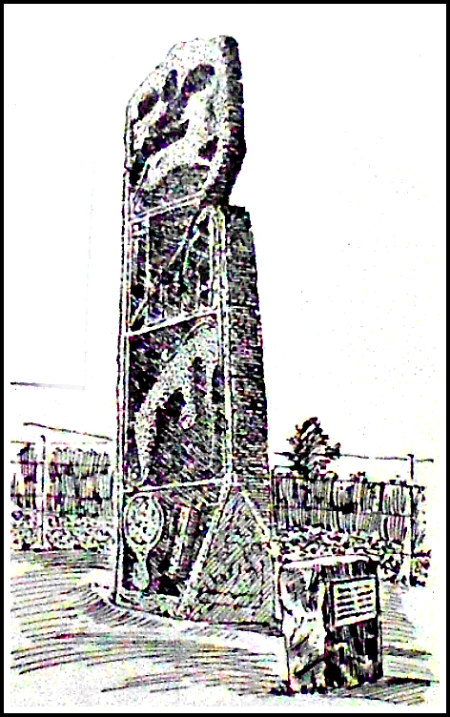
The Maiden Stone, Chapel of Garioch.

NGR:  NJ 70378 24714. About 1 mile to the northwest of the village called Chapel of Garioch, near Inverurie, Aberdeen-shire, there is a very tall carved stone slab known as The Maiden Stone or The Drumdurno Stone, which has Pictish symbols on one side and a Christian cross on the other. This carved stone, standing beside a country road, is thought to date from the 8th or 9th century AD, and was probably carved at the time when the Picts of eastern Scotland were being Christianized. There are one or two Legends about a confrontation that took place here between a local maiden and the devil and, this seems to be where the name ‘Maiden Stone’ originates. As it is located near Drumdurno farm the stone gets its other name from that local place-name. Chapel of Garioch is 4 miles northwest of Inverurie and just off the A96. To reach the monument head to Chapel of Garioch village and, at the old post office, follow the minor road northwest for ½ a mile. The stone stands beside the road on the opposite side of the woodland, just before the entrance to Crowmallie House.

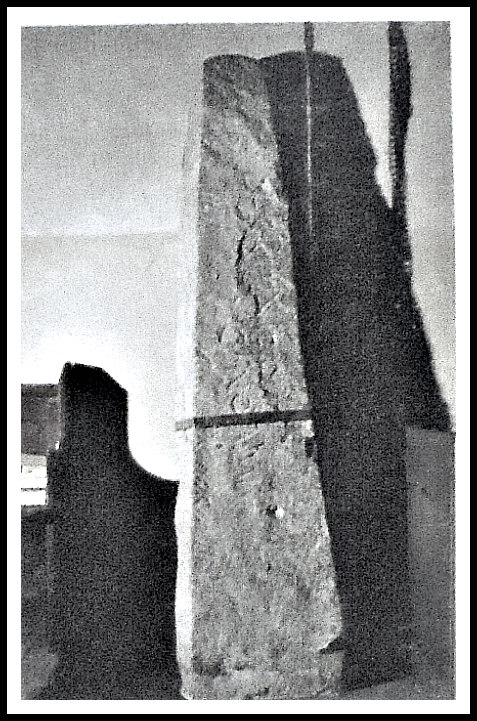
This tall Class II Pictish symbol stone and cross-slab is highly decorated although some of the carvings are now quite faint due to weathering. It is 10 feet high (3.2m) and is made of a pinkish-red granite. A triangular chunk or notch of stone is missing from the monument at one side about three-quarters of the way up and maybe some of the carvings too. The carving of a man with outstretched arms on the front of the stone may be a depiction of Christ; the carving of a ringed cross also on the front face would suggest that the Picts of eastern Scot-land were Christianized at the time that this carving was made – perhaps in the early 8th century AD?

The Maiden Stone by Alexander inkson-Mccon-nochie (1890).

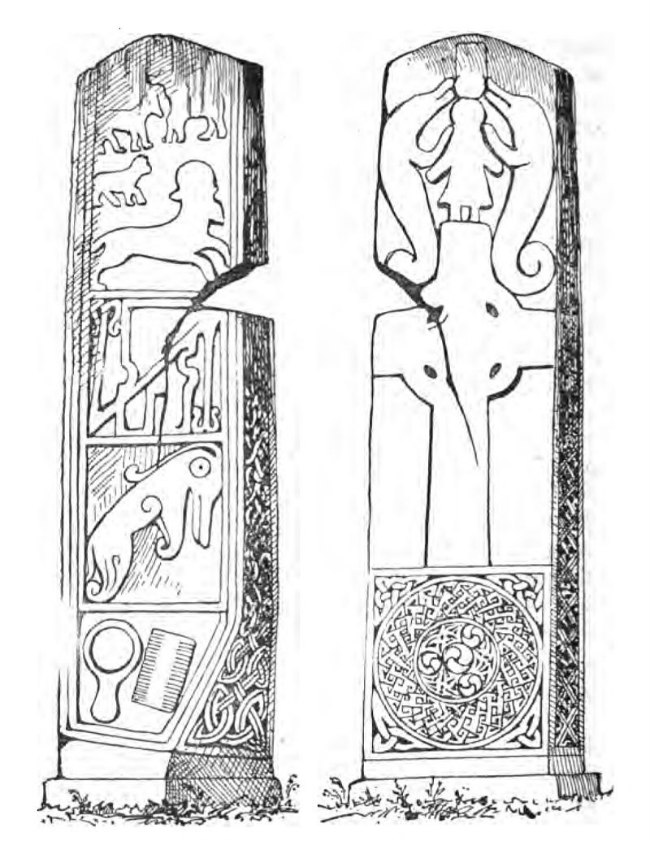
Elizabeth Sutherland (1997) gives her description of the stone and its carvings: “Front: divided into five panels: (1) above a cross find a man with arms outstretched and fish monsters with spiral tails on either side of him; (2) a ringed cross with round hollow armpits with all ornamentation defaced; in (3) and (4) no trace of sculpture remains; (5) spiral and knot-work decoration. Back: four panels reading from the top: (1) several defaced beasts; (2) a notched rectangle & Z-rod. A triangular section has been broken off the stone between these top two panels on the right following a natural crack in the granite; (3) a Pictish beast and (4) a mirror & double-edged comb. Both sides: decorated with very worn interlace. Comment: The Maiden Stone is one of the few Class II cross-slabs to be found in Aberdeenshire and may belong to the second half of the 9th century, thus post-dating the reign of Kenneth Mac Alpin. Political changes in the south may have had little immediate effect on the artistic traditions of the Picts here.”

Author Joyce Miller (2000) has a slightly different view of the stone carvings. She says that: “At the head of the front of the stone, a man stands with arms outstretched, holding a sea monster in each hand. Below this group is a ringed cross, with traces of interlaced decoration at either side. At the foot of the cross there appears to have been a large and intricately patterned disc, with triangular knots filling out the external corners. The back of the stone is less weathered and shows several beasts of various descriptions in the top panel; below is a large notched rectangle and z-rod; below that is a fine Pictish beast; and at the bottom is a mirror and double-sided comb.”

The site entry for Maiden Stone (HMSO 1959), says this is: “The most famous of the Early Christian monuments in Aberdeenshire, this stone is associated with several weird legends formerly current in the Garioch. On one side it displays a richly ornamented Celtic cross and other decoration in the same style, and on the other side are Pictish symbols.”

Miller (2000) also tells of a story about the stone. She says that: “One story concerning the origin of the stone is that a daughter of the Lord of Balquhain made a bet with the devil that she could bake bread before he could build a road to the summit of the high hill of Bennachie. The devil won the bet, of course, and when the woman fled she was turned into the stone, either by the devil or to prevent her going to hell.”  Another story or legend tells that the maiden married a stranger who turned out to be the devil and that he finished the road and claimed the forfeit. The maiden ran from the devil and prayed to be saved. The legend finishes by saying that God turned her to stone, and the notch in the stone is where the devil grasped her shoulder as she tried to run away, according to Wikipedia.

Sources and related websites:

 H. M. S. O.,  Ancient Monuments – Scotland, (Volume VI),  H. M. Stationary Office, Edinburgh, 1959.

Jackson, Anthony, The Pictish Trail, The Orkney Press Ltd., St Ola, Kirkwall, Orkney, 1989.

Miller, Joyce, Myth and Magic – Scotland’s Ancient Beliefs & Sacred Places, Goblinshead, Musselburgh, Scotland, 2000.

Sutherland, Elizabeth, The Pictish Guide, Birlinn Limited, Edinburgh, Scotland, 1997.

https://en.wikipedia.org/wiki/Maiden_Stone

http://wasleys.org.uk/eleanor/presocialhistory/prehistory/stonesandcircles/pictish/maiden/index.html

https://canmore.org.uk/site/18978/chapel-of-garioch-the-maiden-stone

https://www.historicenvironment.scot/visit-a-place/places/maiden-stone/

Copyright © Ray Spencer, The Journal Of Antiquities, 2018 (updated 2024),


1 Comment

The Sagranus Stone, St Dogmael’s, Pembrokeshire (Sir Benfro), Wales

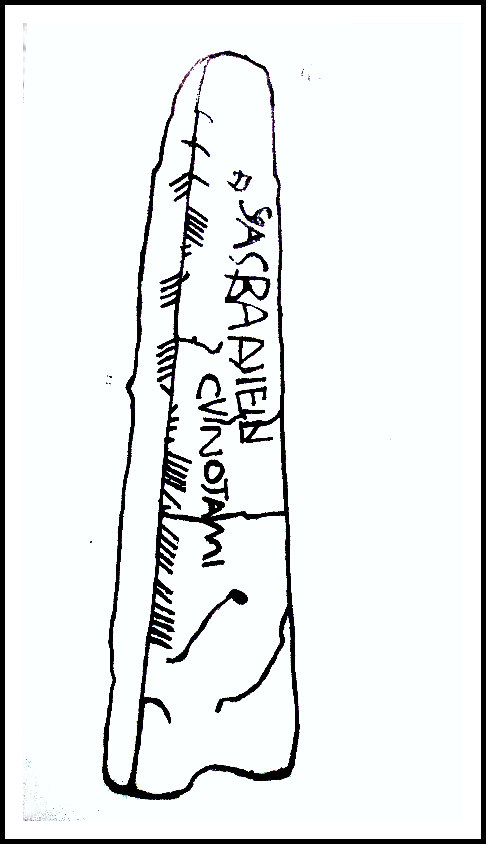
The Sagranus Stone at St Dogmael’s.

OS Grid Reference: SN 16404 45914. In the mid-19th century parish church of St Thomas the Apostle in the village of St Dogmael’s (Llandudoch), Pembrokeshire, is The Sagranus Stone, a 5th century pillar-stone which is inscribed with both Ogham and Latin inscriptions to the memory of Sagranus, son of Cunotamus. There are some other Early Medieval stones in this church though these would be called cross-slabs rather than inscribed stones. Close by the church are the ruins of the 12th century St Mary’s abbey of the French Tironesian religious order but, a long time before that, there was a Celtic ‘clas-type’ monastery here in the 5th century which had been established by St Dogmael, a Welsh monk who was born in the local area. This early Christian monastery was, however, destroyed by the invading Danes in 987 AD. The village of St Dogmael’s, also called Llandudoch, lies 1 mile southwest of Cardigan (over the river Teifi) and 3 miles northwest of Cilgerran. St Thomas’ parish church is located on Church Street and the abbey ruins are next to the church. 

Sagranus Stone.

The Sagranus Stone stands in the west end of the nave of St Thomas’ parish church and it has for some time now been recognized by scholars of Early Christian inscribed stones as being of great importance. It is a 7 feet high dolerite pillar-stone and is thought to date from the late 5th or early 6th century AD, that being the immediate years following the Roman retreat from Wales. This ancient stone probably came from the original cell (llan) of the Celtic monastery. There are two holes in the slab which means that in the past it was used as a gate post, and it may even have been in use as a sort of stepping stone over a stream; maybe this caused the stone to be broken into two pieces. But as a bilingual inscribed stone with its Ogham cipher inscription of notches or strokes on its edges and the Latin (Roman) inscription on its face – it’s safety is now assured. Back in 1848 the strokes on the ancient pillar-stone enabled scholars and historians to de-cipher (interpret) the Ogham alphabet. Ogham was the early Goidelic/Gaelic) language of Ireland. Both inscriptions, once they are translated, read as the same. 

HMSO/DoE (1975) says that: “1 Rough pillar stone of the early sixth century……. On the face is an inscription in two lines of Roman capitals, running downwards: SAGRANI FILI CVNOTAMI. On the dexter edge is an inscription in Ogham characters, which reads:  SAGRAGNI MAQI CVNATAMI. Both indicate that the stone was set up to mark the grave of the local chieftain, Sagranus, the son of Cunotamus. Ogham is a cipher, in which strokes arranged in relation to a vertical stem—in this case the angle of the stone—are used to represent the letters of the Latin alphabet. The system, which was evolved in Ireland, is found on a number of early inscriptions in Wales where it is generally employed, as here, with a Latin transliteration.” 

HMSO/DoE also give details of the other pre-Romanesque stones in the church: “2 Part of headstone now in the parish church near the south door. On the face is slightly incised Maltese cross in a circle. Small headstones of this type were in common use from the ninth to the eleventh century; this example is early in the series. 3 Base of a tall stone pillar now standing reversed near the pulpit in the parish church. On the face is incised the lower arm of a cross with a swollen foot enclosing spirals and a basal knob; the out-turned lines at the broken upper edge of the pillar indicate the beginning of the cross. Pillars of this type with incised crosses were set up for commemorative purposes in the cemetery and in other parts of Celtic monasteries. The elaborate cross is probably not earlier than the ninth century. 4 Part of the cover slab of a grave, originally some 6ft by 14in by 11in thick. On the upper surface is a Maltese cross in a circle with a long shaft and swollen foot enclosing spirals and a basal knob. Rather later than number 3; probably eleventh century.” There are several other Medieval stones but they are located in the abbey precinct outside. 

Donald Gregory (1991) adds that: “Between the south door of the church and the north entrance to the abbey ruins should be noted a very old yew, which is so large that it has had a three feet high brick wall built to contain it.” 

The abbey of St Mary was founded in 1115 by Robert Fitz Martin, Lord of Cemais, as a daughter house of the Abbey of Tiron in France, on the site of a Celtic (clas) monastery. However, the Celtic monastery was destroyed by the invading Vikings in 987 AD. The monks of St Mary’s were members of the Tironesian Order, founded at Tiron between Chartres and Le Mans (1114) by St Bernard of Abbeville (1046-1117). The order of Tiron followed closely the Benedictine Rule and, in accordance with that, the monks at St Mary’s led a simple and austere life much influenced by the self-disciplined austerity of St Benedict. St Mary’s had dependencies at Caldey and Pill in Wales. In 1536 the abbey was dissolved but the church and conventual buildings remained intact with some reconstruction taking place; and then it was put into parochial (parish) use, while the rest of the monastic buildings were allowed to fall into a ruinous state. The 14th century doorway of the abbey church retains its carved flower ornamentation. In the north transept there are Medieval carvings on corbels which depict Christ’s apostles, the eagle of St John the Evangelist and St Michael. Later, in 1848 a new church, dedicated to St Thomas the Apostle, was built from the stone of the old abbey. 

Not that much is actually known about St Dogmael, Dogfael, Dogwell or Toel, who has given his name to this Pembrokeshire village, apart from that he was a native of Ceredigion (Cardigan) just across the river Teifi. He was the son of King Ithel ab Ceredig ab Cunedda Wledig. Apparently he gained his monastic training in Ireland, but came back to settle on the Isle of Anglesey – where Llandogwel church is dedicated to him. Then, later he sailed down the Cardigan coast and established a monastery inland at what became St Dogmael’s (Llandudoch) near the river Teifi. Another church is named after him at St Dogwells, Pembrokeshire, but it seems he died in Brittany about 505 AD, where he goes under the name of St Toel. He is titular saint of the church of Pommerit Jaudy in the diocese of Trequier, Brittany. David Hugh Farmer (1982) says that: “It is likely, but not certain, that he moved to Brittany where a St. Dogmeel or Toel has had a considerable cultus, and is invoked to help children to learn to walk.” His feast day is celebrated on 14th June.

Sources and related websites:-

Bottomley, Frank, The Abbey Explorer’s Guide, Kaye & Ward Ltd., London, 1981. 

Farmer, David Hugh, The Oxford Dictionary of Saints, Oxford University Press, 1982.

Gregory, Donald, Country Churchyards In Wales, Gwasg Carreg Gwalch, Capel Garmon, Llanrwst, Gwynedd, Wales, 1991.

H.M.S.O./DoE, St Dogmael’s Abbey, C. A. Ralegh Radford, Her Majesty’s Stationery Office, London, 1975.

Spencer, Ray, A Guide to the Saints Of Wales and the West Country, Llanerch Enterprises, Felinfach, Lampeter, Dyfed, 1991.

Sagranus Commemorated at St Dogmaels

http://coflein.gov.uk/en/site/401267/details/sagranus-stone-st-thomas-the-apostle-church-st-dogmaels

https://en.wikipedia.org/wiki/St_Dogmaels

http://grandterrier.net/wiki/index.php?title=Sant_Dogvael

http://www.catholic.org/saints/saint.php?saint_id=2919

© Ray Spencer, The Journal Of Antiquities, 2018.

Donaghmore High Cross, Co. Down, Northern Ireland

The Donagh-more High Cross.

Irish Grid Reference: J 10443 34964. In an isolated and lonely spot beside Donaghmore Road, just east of the A1 (Dublin to Belfast Road), is the Early Christian Ecclesiastical site of Donaghmore (Domnach Mor) Moy Cova, and a churchyard beside the 19th century St Patrick’s Church, which belongs to the Church of Ireland. But here also stands the highly sculptured 10th century Donaghmore High Cross with its distinctive ringed cross-head. The place-name Donaghmore means ‘The Great Church’. Here in the 5th century AD St Patrick is thought to have established a church. This quite isolated little churchyard is located some 5 miles north of Newry and 6 miles south of Banbridge in Co. Down, Northern Ireland. To reach the site head north out of Newry for 5 miles on several country roads: Downshire, Belfast, Corcreechy and Aughnacavan, but keeping to the east of the A1 (Belfast road). On reaching a junction of four roads go right onto Donaghmore Road – where on your right you will soon see St Patrick’s Church and the Donaghmore Cross.

The Donaghmore High Cross or St Mac Erc’s Cross is a highly sculptured granite ring-head cross which is 10 feet high and is thought to date from the 9th or 10th century AD. It has a thick sturdy shaft and stands on a base of two steps. The ring-head probably came from another similar cross. It was re-erected at the S. side of St Patrick’s Church in 1891, but probably not in its original position. Depicted on the cross are several Biblical characters and scenes, and also panels with figures and decorative interlacing. Biblical characters and scenes on (W. Face) are: Noah’s Ark, Adam & Eve and Moses & David. The cross-head (W. Face) shows Christ’s crucifixion. He has long outstretched arms. At each side of Christ there are figures maybe of Stephaton and Longinus, two thieves and soldiers. An angel around Christ’s head. The (N. Face) depicts David & Goliath and interlacing. An angel on the cross-head. The (E. Face) has David or The Judgment of Solomon (David plays his lyre for Saul). Also figures, Moses smites water from the rock, David with the head of Goliath, David slaying the lion, The Last Judgment and St Paul with a bird or beast. S. Face has David and Solomon holding a child or other up-side down and St Paul or maybe St Anthony in the Desert.

St Patrick’s (Church of Ireland) church at Donaghmore is a 19th century building that replaced earlier Medieval churches and, before those, a church that was founded by St Patrick, patron saint of Ireland, in the 5th century. St Mac Erc, who was the brother of St Mochaoi (Mochua) and a disciple of St Patrick, probably became the first bishop of Donaghmore. His feast day is celebrated on 6th July. St Mochaoi founded the monastery of Nendrum on Mahee Island, Co. Down. He died in c497. Legend says that St Patrick converted the local chieftain to Christianity here at Donaghmore, and in thanks ‘he’ built his church beside the fort (rath) from where the chieftain ruled his people. There is a blocked-up souterrain (underground passage) in the churchyard; this may have originally been connected to the fort. The church itself stands on the mound which was part of the fort. There are also some faint earthworks in a field on the opposite side of the road over to the west of the churchyard at (J 1012 3496).

Sources and related websites:

Connolly, Greenwood, Hawkins & Wallis, Ireland – The Rough Guide, Rough Guides Ltd., London, 1999.

Fisher, Graham & Pennington, John, Historic Britain, Odhams Books, Feltham, Middlesex, 1953.

http://irishhighcrosses.com/down-crosses.html

http://irishantiquities.bravehost.com/down/donaghmoreHC/donaghmoreHC.html

http://lisburn.com/books/dromore-diocese/parish-donaghmore.html

http://archive.org/stream/ancientirishpari00cowarich/ancientirishpari00cowarich_djvu.txt

https://en.wikipedia.org/wiki/Donaghmore,_County_Down

© Ray Spencer, The Journal Of Antiquities, 2018.

1 Comment

Moone High Cross, Co. Kildare, Southern Ireland

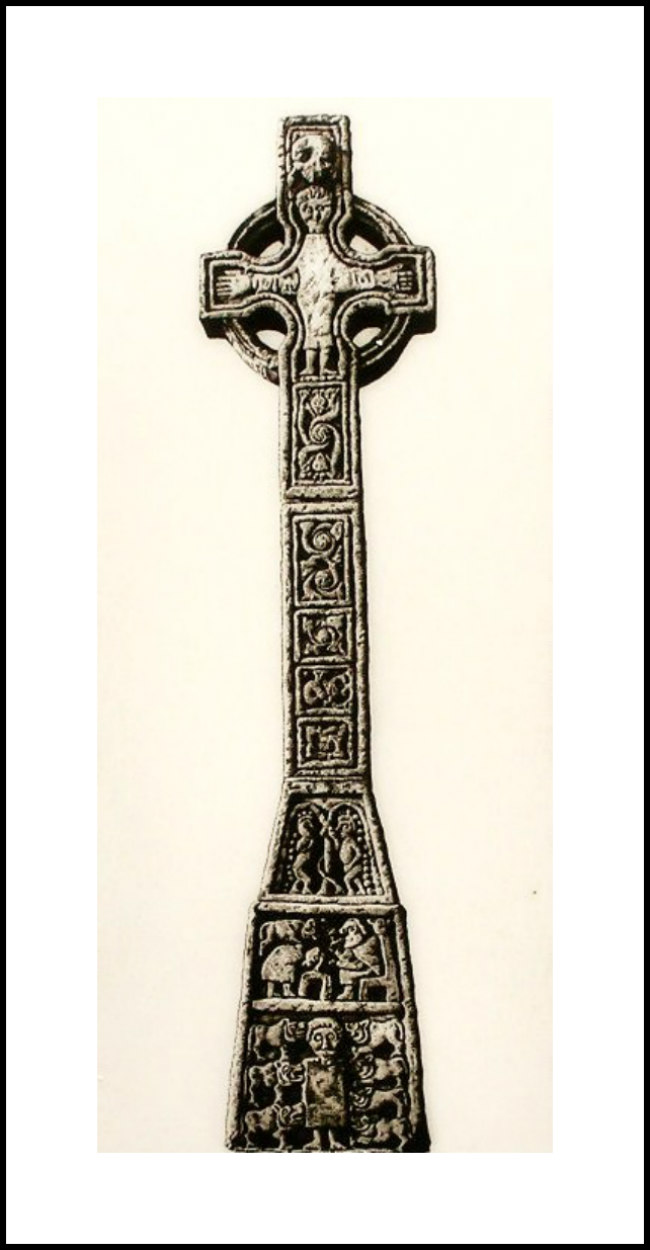
Moone High Cross (East Face)

Irish Grid Reference: S 78911 92693. About ½ a mile northwest of Moone village, on Belan Avenue, Co. Kildare, Southern Ireland, is a 5th century monastic site with the lavishly sculptured ‘Moone High Cross’, a 9th century richly carved granite monument with numerous scenes depicted from the Bible. It is said to be the second tallest high cross in Ireland. There is a second cross but this only survives in parts. Also here are the ruins of a 13th century abbey church (which now houses the cross). A monastery or abbey was probably founded here after 431 by St Palladius (d c460), and in the 6th century this was named after St Columba. The ruined church stands over the foundations of ‘this’ early Celtic monastery. The little village of Moon, in the Valley of the river Barrow, is 3 miles south of Ballitore and ½ a mile south of Timolin, close to the R558 road. At the post office in Moone take the road opposite going northwest crossing over the R448, then shortly after go onto Belan Avenue, crossing over the river Greese, and then follow the lane until you reach the farm and old mill: the high cross is on the opposite side of these buildings at the west side.

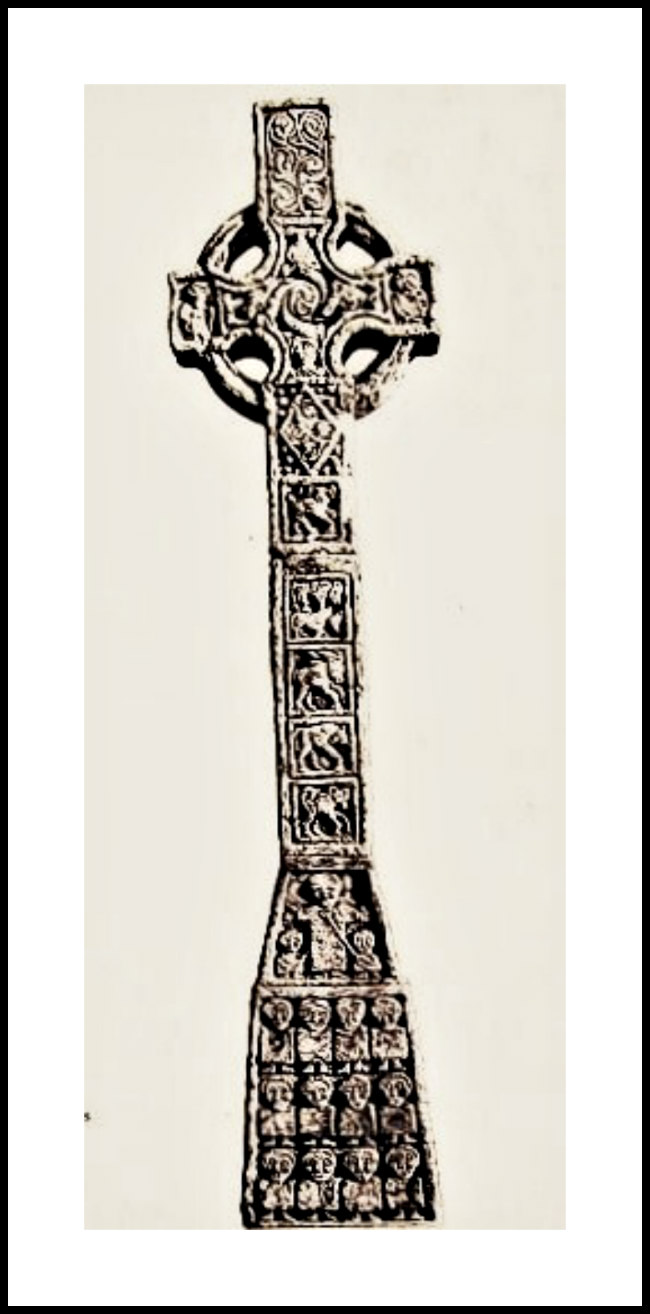
The high cross, also called St Columba’s Cross, stands inside the ruined 13th century abbey church which now has a glass roof over it. It is a 5.3 metre (over 17 foot) high granite cross of three sections with a long slender shaft that tapers away. The wheel-head, which might be of a later date, shows Christ crucified but this has suffered some damage. There are 51 sculptured panels on all four sides, each having richly carved decoration depicting numerous scenes and characters from the Bible, and also Celtic symbolism including animals, mythical and magical creatures and other figures, but also other decorative work. The cross is thought to date from the 8th or 9th century AD. In 1835 and 1893 sections of the cross were excavated from the church-yard and then re-erected, and more recently placed for protection against the elements in the ruined medieval church.

West Face

The S. face shows The Temptation of St Anthony while below that four mythical serpents (snakes) are fighting with two open-mouthed lions or horses. Above those: SS Anthony and Peter and a raven bringing food. The N. face shows: The Miracle of the Loaves and Fishes, The Flight into Egypt, SS Paul & Anthony in the Desert and The Three Children in the Fiery Furnace. The E. face has a large panel at its base showing the twelve Apostles, each having a square-shaped body, stubby legs and feet and pear-shaped heads; they all appear to have a slightly different facial expression! Above that: Christ being crucified (he has long outstretched arms), angels, a lozenge shape (diamond) and a whirligig (an object seen to be whirling or spinning around). The W. face shows: Daniel in the Lions’ Den (he is surrounded by seven hungry, open-mouthed lions), The Sacrifice of Isaac, Adam and Eve (with apple trees); also monsters interlinked with heads, and Christ and a Dolphin (above). 

There is also part of a holed cross in the church. This only has a short section of its shaft left and three sections of its wheel-head remaining; but the carvings on this cross are very similar and equally as good as those on the high cross. The carvings on this cross are: mythical and magical creatures, spirals, swirls, intertwining foliage, knotwork and interlacing. Although the 13th century church is ruined it still possesses ‘antae’ (projecting walls) at its gable ends, according to Nicholson’s Guide (1983).

Katharine Scherman (1981) says of the Moone High Cross that it is: “The most attractive of the Barrow crosses is the one at Moone, which, though the representations are no less naïve than those at Castledermot and other Barrow localities, has an entirely original and ingratiating charm. The cross is unusual in its shape, its tall slenderness accentuated by a long, tapered base. On the shaft are panels containing graceful, active and nearly recognizable quadrupeds. The Bible tales, scenes of spirited imagery, are on the four sides of the base. They include Adam and Eve—two small fat people framed by arches of apples; Daniel in the Lion’s Den—a figure in a square garment, like a paper doll, in a frame of seven openmouthed lions, four down one side from his ear to the hem of his dress, three down the other; the Twelve Apostles—twelve identical square men with pear-shaped heads and circle eyes, looking like three rows of cookies; the Miracle of the Loaves and the Fishes—five loaves, two fishes and two eels all by themselves in a pure and simple design.

“Homage is paid to those early anchorites St. Anthony and St. Paul, patrons of the monastic life. One panel shows their meeting in the desert: seated facing each other on straight-backed chairs, they break bread together. Another depicts St. Anthony—the rectangular saint beset by two rectangular visions , one with the head of an animal, the other of a bird. The panel below these two religious ones has an unscriptural scene of animals with the heads of horses and the bodies of serpents locked in an inextricable coil of combat; unlike the squared representations of humans, the artist carved his animals in sinuous curves. All the scenes are executed with a kind of childlike artfulness so that they fit exactly into their frames: the animals arch into the corners; the humans have round heads (the males’ are elongated by their short oval beards into teardrop shapes) and rectilinear torsos to fill the squares, and all their feet are turned side-ways, like those on Egyptian friezes. 

Scherman adds that: “In fact the art is clearly reminiscent of that of ancient Egypt: the artist was concerned with depicting what he saw intellectually with his mind’s eye rather than in reproducing in a naturalistic stylethe shapes seen by the visual eye alone. The stonework lacks the formalized skill of the Egyptians’ art, but it has an individualistic freshness deriving from the sculptor’s unregimented imagination, a luxury never permitted to the intensively trained Pharaonic artists.”

Sources and related websites:-

Nicholson’s Guides, Guide To Ireland, Robert Nicholson Publications Limited, London, 1983.

Reader’s Digest, Illustrated Guide To Ireland, The Reader’s Digest Association Limited, London, 1992. 

Scherman, Katharine, The Flowering of Ireland, Victor Gollancz Ltd., London, 1981.

http://highcrosses.org/moone/

http://www.thejournal.ie/heritage-ireland-coppingers-court-cork-moone-high-cross-kildare-2183701-Jun2015/

http://www.kildare.ie/Heritage/History/religious/crosses/moone-high-cross.htm

https://en.wikipedia.org/wiki/Moone

© Ray Spencer, The Journal Of Antiquities, 2018.

3 Comments

St Robert’s Cave-Chapel And Holy Well, Knaresborough, North Yorkshire

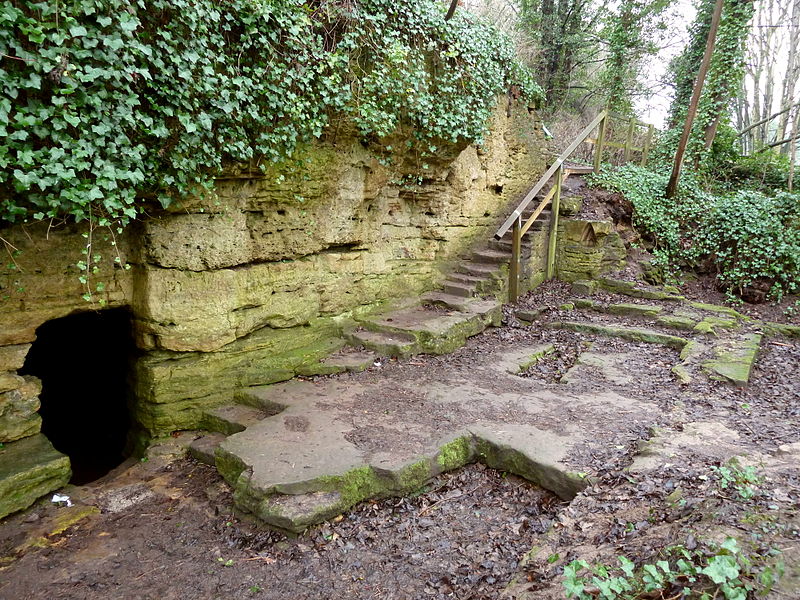
St Robert’s Cave by Storye book (Wikimedia Commons).

OS Grid Reference: SE 36083 56059. In a secluded wooded area near Grimbald Bridge between Abbey Road and the River Nidd at Knaresborough, North Yorkshire, is St Robert’s Cave & Holy Cross Chapel. Nearby, another chapel, but a 15th century wayside chapel and shrine, hewn out of the rock, which is today dedicated to Our Lady of The Crag. This particular chapel is not how-ever associated with St Robert. About 470m to the north is St Robert’s holy well, a healing spring resorted to by the faithful in times past. Robert Flower (1160-1218) was a hermit who spent many years here – more especially his latter years – but also at a number of other monastic sites across Yorkshire. He was said to have performed some miracles and devoted much of his time to the poor, though he was never canonised by the Church.  You can reach St Robert’s Cave from the newer bridge on Wetherby Road (B 6164). Go down the steps onto Abbey Road and a bit further south beside the river is the cave. The medieval Chapel of ‘Our Lady of the Crag’ is ½ a mile to the west at the other end of Abbey Road. St Robert’s Well was located on Monkswell Park Road about a ¼ of a mile north of town.

David Hugh Farmer (1982) says that St Robert was: “The son of an important townsman of York and became a cleric early in life. As a subdeacon he was a novice at the Cistercian abbey of Newminster, but stayed only a few months. He then chose to live as a herm at Knaresborough in a cave where another hermit, also in residence, was a knight in hiding from Richard I, on whose death (1199) he returned to his wife. Robert continued there for some years, until a wealthy widow offered him a cell and chapel at Rudfarlington, near by. A year later this hermitage was destroyed by bandits, so Robert lived at Spofforth under the church wall for a few months, then at Hedley near Tadcaster, where he found the monks to easy-going, before returning to Rudfarlington. Here he had four servants and kept livestock, but was soon in trouble with William de Stuteville, constable of Knaresborough Castle, for harbouring thieves and outlaws. The charge may have been true, for Robert was well known for charity to the destitute. The hermitage was destroyed by William; Robert returned to his cave at Knaresborough, where he lived for the rest of his life.

Farmer goes on to say of St Robert: “His benefactors included King John who gave him forty acres of land in 1216, which he eventually accepted for the poor  and so refused to pay tithes on it. William de Stuteville also gave him land and cows. Robert had a companion called Yves, who  remained with him for the rest of his life.

Farmer also adds that: “Robert’s death, like much of his life, was controversial. Cistercian monks from Fountains tried unsuccessfully to aggregate him to their Order on his death-bed and, after his death on 24th September, to bury his body in their church. But he refused the first and foiled the second by arranging for his burial at the chapel beside his cave. Later the Trinitarian house at Knaresborough acquired the hermitage: papal records for 1252 offered  an indulgence for ‘Building the monastery of St. Robert at Gnaresbur, where the saint’s body is buried’. This document followed his translation, but preceded any official process of canonization, for which a book of Lives and prayers was prepared. Official canonization never took place, but implicit approval was given to the cult. The chapel became a place of pilgri-mage, where oil flowed from the tomb. Matthew Paris regarded Edmund of Canterbury, Elizabeth of Hungary and Robert of Knaresborough as outstanding saints of the early 13th century.”

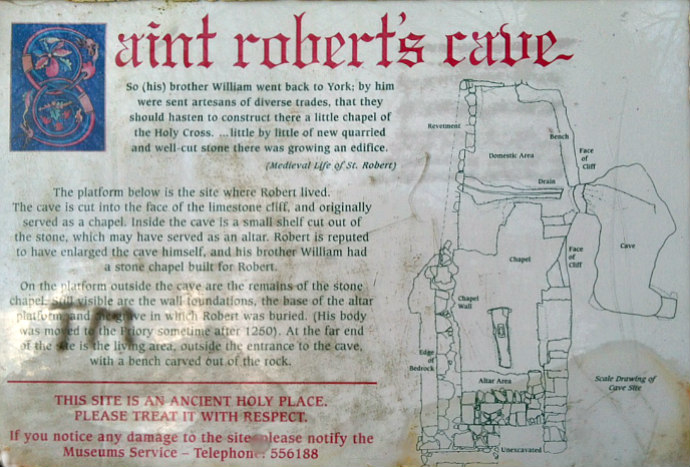
Sign at St Robert’s  Cave by Caruso 308 (Wikipedia)

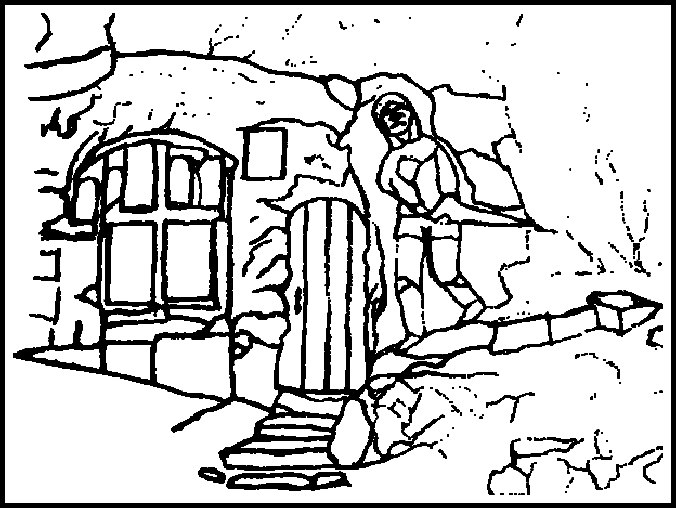
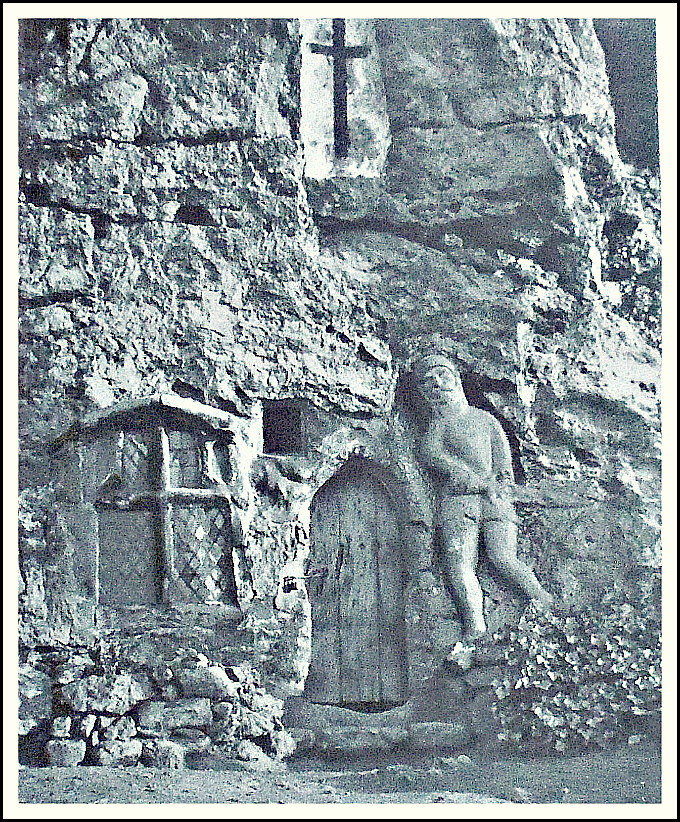
St Robert’s Cave on Abbey Road, with its connecting chambers and the grotto-like inner chapel, were carved out of the solid Limestone cliff beside the river Nidd. It’s thought the saint himself enlarged the chapel and hermitage which has a stone altar, stone seat, two alcoves, medieval carved cross and more recent graffiti; building this structure must have taken a considerable amount of both energy and time. The chapel was dedicated in honour of the Holy Cross and maybe also St Giles? Pilgrims visited the hermit-saint knowing him to be a miracle worker, and even some eminent local people were known to seek his good council. However, the cave and chapel were frequently flooded by the river Nidd and for long periods remained uninhabited and cut off – this more so in recent times. After the death of St Robert in 1218 his body lay in a tomb that was located in the cave-chapel. There is a church dedicated to him at Knaresborough and another at Pannall, north Yorkshire. Morley church, Derby-shire, has some very nice stained-glass windows depicting the Life of St Robert of Knaresborough. His feast-day is 24th September.

There used to be a holy well named for St Robert 470m to the north of the saint’s cave (at SE 3629 5650), but today that holy spot is the Monkswell Business Park, Manse Lane. However, the last vestiges of the said well/spring can still be seen although today it is a ‘wishing well’ into which locals throw coins! Robert Charles Hope (1893) said of this well that: “A short distance above Grimbald’s Bridge, in a field called Halykeld Sykes, on the north side of the river Nidd, is “”St Robert’s Well.”” There is also a chapel of St. Robert of Knaresborough, which was confirmed by charter to the Brethren of the Order of the Holy Trinity at Knaresborough by Richard, Earl of Cornwall.” Another holy well, said to be named after St Robert, can still be seen just to the southeast of Levisham, north Yorkshire.

Our Lady of The Crag, Knaresborough. (Drawing)

About ½ a mile to the west, at the other end of Abbey Road, is the medieval chapel of  ‘Our-Lady-of-the Crag’, which has sometimes mistakenly been called St Robert’s Chapel, but this folly-like structure was built 200 years after the saint. The chapel, with its tiny inner shrine, was carved out of the sandstone rock-face in c1408 by a local mason by the name of John, whose son was almost killed in a rock fall. John prayed to Our Lady for a miracle. His son survived, and to thank Our Lady for the miracle he built the Chapel in thanks. The inside of the chapel is very tiny but there is an altar and a lovely modern statue of Mary. It has a carved vaulted ceiling with bosses and gargoyles. Church services do still occasionally take place at the chapel and groups of pilgrims come on visits (see the St Mary of Knaresborough website, below, for more informa-tion). By the chapel’s entrance and ‘standing guard’ is an 18th century carved statue of a very life-like knight in armour holding his sword. The chapel is Grade I Listed.

Our Lady Of The Crag Chapel.

Headley & Meulenkamp (1999) add with regard to this chapel and saying that: “………it is a wayside shrine with beautiful Gothic decoration, immediately above it is Fort Montague, an 18th century folly.” They say of Knaresborough that: “it resembles parts of Derbyshire, not least because of the large number of hermits caves.” Fisher & Pennington (1953) say that: “It was originally a wayside chapel, founded at the beginning of the fifteenth century. It won its unenviable place in the annals of notoriety when Eugene Aram hid in it the body of his victim. Aram was convicted of murder and executed in 1759 many years after his crime, which was given a romantic interest quite undeser-ved by a novel of Bulwer Lytton. The figure is of a knight drawing his sword.”  

Sources and related websites:-

Farmer, David Hugh, The Oxford Dictionary of Saints, Oxford University Press, 1982.

Fisher, Graham & Pennington, John, Historic Britain, Odhams Books, Feltham, Middlesex, 1953.

Headley, Gwyn & Meulenkamp, Wim, Follies Grottoes And Garden Buildings, Aurum Press Ltd., London, 1999.

Hope, Robert Charles, The Legendary Lore Of The Holy Wells Of England, Forgotten Books, 2012 (originally published 1893)

https://commons.wikimedia.org/wiki/File:St_Roberts_Cave_008

https://en.wikipedia.org/wiki/Robert_of_Knaresborough

http://www.stmarysknaresborough.org/shrine.html

https://www.visitharrogate.co.uk/things-to-do/st-roberts-cave-p1203201

http://www.crsbi.ac.uk/site/1970/

http://www.halikeld.f9.co.uk/holywells/north/robert1.htm

http://www.megalithic.co.uk/article.php?sid=26391

© Ray Spencer, The Journal Of Antiquities, 2017.


2 Comments

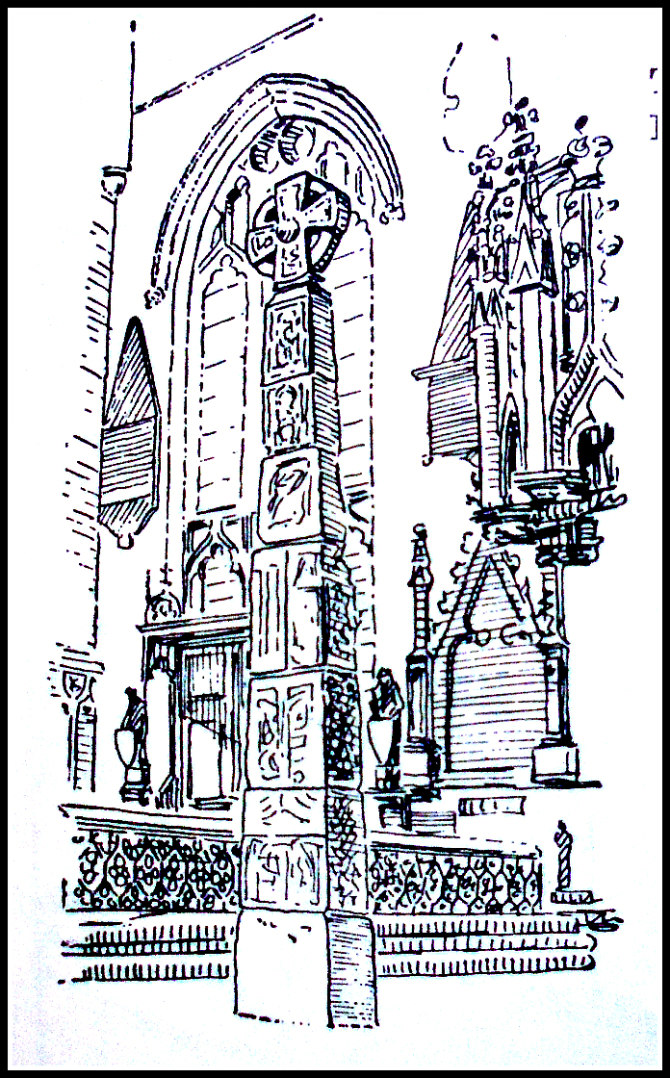
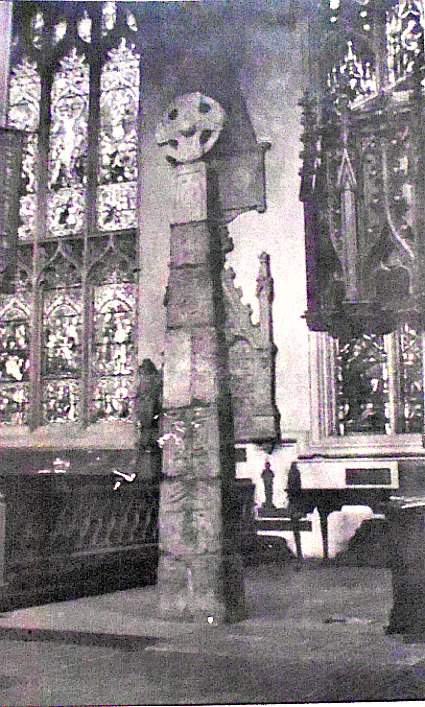
Saxon Cross in St Peter’s Minster Church, Leeds, West Yorkshire

The Anglo- Saxon Cross in St Peter’s.

OS Grid Reference: SE 30657 33295. In St Peter’s parish church on Kirkgate in Leeds, west Yorkshire, there is a very tall and slender 10th century Anglo-Saxon wheel-headed cross, which stands on the Altar Flat. This very large city centre church is nowadays called Leeds Minster or ‘The Minster and Parish Church of Saint Peter-at-Leeds’. The cross-shaft fragments were discovered in the late 1830s when the tower was being demolished, but much of the present cross is a Victorian reconstruction of the original one, or as near to that as possible. There are several carved (sculptured) panels on the tall cross-shaft whereas other sections have nothing at all; and though it looks to be somewhat “cobbled-together’, it is a fairly credible-looking piece of construction. The church “here” was first mentioned in the Domesday Book (1086) which stated that Leeds had a church, a priest and a mill; at this time the ruling overlord of Leeds was Ilbert de Lacy and the underlord, Ralph Paganel (Paynel). There may have been an earlier religious building on this site as far back as the early 7th century AD.

Joseph Sprittles writing in the parish guide book says of the Anglian Cross in St Peter’s that it is: “composed of sculptured stones found in the tower fabric of the old church when it was taken down. These were claimed by the architect who on retiring to Rottingdean caused the stones to be erected in his garden. After the death of Chantrell in 1876 the Vicar of Leeds, Dr John Gott, on learning the house was to be sold sought the purchaser and made him an offer for the Cross and, after much bargaining bought the ancient stones for £25 and  had them conveyed to Leeds where, four years later the cross was re-erected on the Altar Flat. The date of the Cross is thought to be c.925 A.D.” 

The restored cross shows Anglian and Scandinavian workmanship. It seems to be a platform for the Norse Legend of Weland the Smith, who features extensively on the monument. Weland or Weyland is depicted in a panel at the bottom of the cross in his flying machine with his tools of the trade. There are 10 carved sandstone panels but also some empty ones. Also, there is the usual interlacing, scrolls and end-knots, and a number of human figures both male and female as well as birds of prey. We see a cloaked figure holding a sword, a figure with a halo, a female figure held aloft by another figure, a female figure holding a horn, two hands grabbing hair; also Weland abducting the daughter of King Nidlad and Weland with a bird of prey. The wheel-head is considered not to be as old as the rest of the shaft and apparently comes from a different cross altogether. More information on this cross can be found on the Howard Williams (Archeodeath) website (see the link below).

Saxon Cross.

Author Frank Bottomley (1993) says regarding St Peter’s that it is a: “Medieval parish church replaced in 1841 with a significant building marking Anglian revival. Preserves spectacular A/S cross, fourteenth-century effigy, two fifteenth-century brasses and a large number of later monuments. Fifteenth-century font with seventeenth-century cover. ‘Brought in’ medieval glass (east window) and much of nineteenth-century.” Jones & Tricker (1992) add that Leeds is a: “A vast and overpowering town, but a great oasis for churches. The parish church of St Peter is unique because of its cathedral-type musical tradition – and what a place it is, rebuilt in 1841 for its famous vicar , W.F. Hook, to the designs of R.D. Chantrell. The exterior is massive, with a stately (144 ft ) tower. The interior is mighty and dignified, built to accom-modate 2,000 and full of seating and comm0dious galleries, but with the clear early Tractarian feel that it is not just a preaching house.”

Sources and related websites:-

Bottomley, Frank, Yorkshire Churches, Alan Sutton Publishing Limited, Stroud, Gloucestershire, 1993.

Jones, Lawrence E. & Tricker, Roy, County Guide To English Churches, Countryside Books, Newbury, Berkshire, 1992.

Sprittles, Joseph, Leeds Parish Church – History and Guide, Tower Publications, St. Marks, Cheltenham, Glos.,

The AA, The Illustrated Road Book Of England & Wales, The Automobile Association, London, 1961.

The Leeds Cross and Rethinking Weland the Smith

http://www.leodis.net/searchResults.aspx?LOCID=9999&DECADE=0&YEAR=&KEYWORDS=%20Saxon%20Cross&KEYWORDS2=&KEYWORDS3=&ANDOR2=&ANDOR3=&RECSPAGE=5&VIEW=1&CURRPAGE=1

https://en.wikipedia.org/wiki/Leeds_Minster

Weyland The Smith – An Article by David McGrory

© Ray Spencer, The Journal of Antiquities, 2017.


1 Comment

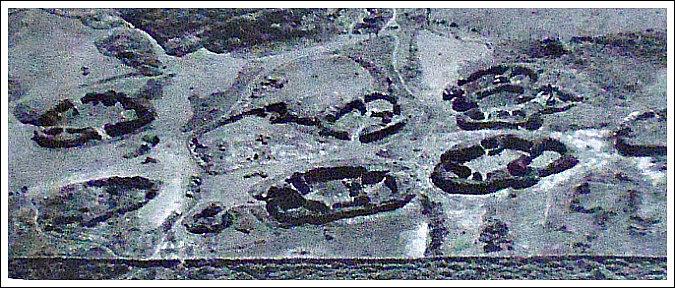
Chysauster Ancient Settlement, Near Gulval, Cornwall

Chysauster Ancient Settlement, Cornwall. B/W aerial photo.

OS Grid Reference: SW 4723 3497. A few miles to the northwest of Gulval, Cornwall, lie the quite remarkably intact and restored ruins of Chysauster Iron Age settlement/village at Newmill. It is 3 miles north of Penzance. There are several oval-shaped houses with courtyards, a street and also terraced garden plots, and at the south-side a ruined underground passageway known as a fogou or souterrain. This very significant archaeological site is thought to date back, perhaps, to the 1st century BC (the Late Iron Age) and was probably still inhabited until at least the 3rd century AD (the Romano-British period). Some of the granite walls of these round houses are ‘still’ quite high and very solid despite their great age. To reach this ancient site travel northwards from Gulval village onto the B3311, and then take Chysauster Road northwest for a mile or so – looking out for Chysauster cottage on the right-hand side and the Iron Age village. There is a car park beside the lane (northwest-side of the cottage) and, a ¼ mile further up hill where the roads bends to the left, is the English Heritage site shop. There is an entry charge. 

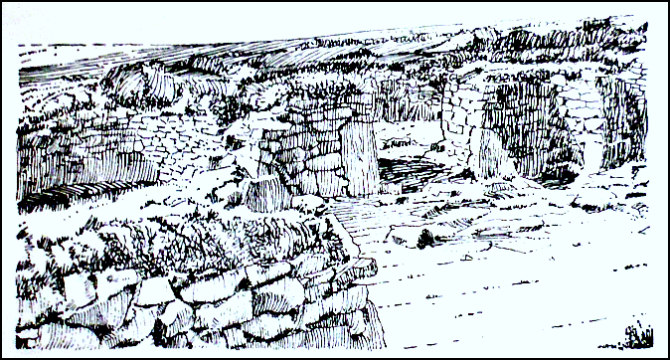
Author Jacquetta Hawkes (1975) gives us some interesting information on Chysauster. She says that: “on the west slopes of the hill [Castle-an-Dinas] is the Late Iron Age and Roman village of Chysauster, meticulously excavated and now carefully maintained. It is laid out in an orderly way with nine houses opening on a slightly curved lane in opposing pairs. The houses are of an unusual kind, known in Wales and further north but believed to be of Mediterranean origin. The principal of this domestic architecture is so utterly unlike our own that it is not easy to describe. The external outline is a rough oval, but the oval wall is immensely thick and contains within itself all the rooms, their doorways opening on to a central courtyard. In nearly all the houses the ‘best room’, oval or round in shape, is exactly opposite the narrow, roofed passage that leads into the courtyard from the lane. This larger room appears to have been thatched or turfed, but a few of the smaller cells were corbelled. Most of the floors were paved, and the larger rooms were usually furnished with hollow granite basins, presumably used as mortars; fragments of rotary querns or handmills were also found. There were serviceable drains, usually laid below the paving stones.

Chysauster Ancient Settlement, Cornwall. (Illustration).

Behind each house was a private garden, skilfully terraced and secured by an outer retaining wall of large blocks. A much-worn road led down from the village to the tin-deposits in the valley below as well as to the nearest stream. Where so much is preserved one longs to see it peopled; to know how many of them worked in the mines and how regularly; how much time they gave to their gardens: how far they were their own masters and how they marked their produce, getting the ore to the merchants who, as we are now fairly confident, shipped it from St. Michael’s Mount as the first step on the long route across France to their Mediter-ranean customers. At least it is not difficult on going into one of the Chysauster houses to see it in an Iron Age summer, the sun glaring in the courtyard where the dogs lie on the paving, the rooms dark as caves, a woman sweating as she pounds away with the heavy grindstone, small children kept safely in sight by the closed door of the passageway. All a little smelly and untidy, but not too uncomfortable and wonderfully companionable, with the eight neighbouring families, every detail known of their affairs—of expected births, betrothals, deaths; scandals, failures and achievements.”

Lord Harlech writing for H.M.S.O (1970) says of the site that: “Chysauster seems to have originated in the first century A.D., and it continued in occupation under the Roman Empire up to the third century A.D. The houses consist of oval enclosures of thick dry-built masonry, forming an open court from which various rooms open: the shape is common to other Cornish villages of this type. Chysauster and Carn Euny, like other such villages, contain a curious underground chamber known locally as a “fogou” and possibly  used for food-storage. Parallels to these are found in Scotland and Ireland.” 

Timothy Darvill (1988) says that Chysauster: “is an Iron Age settlement comprising a series of eight houses arranged in pairs along a street. Each house has an entrance facing east or north-east — away from the prevailing wind — thick outer walls, a courtyard immediately inside the entrance, and from three to six rooms opening from the courtyard. It is thought that animals were kept in the courtyard. The village also contains a fogou which is a long, narrow underground chamber possibly used for storing food and as a hide-out in times of unrest.” Janet & Colin Bord (1984) with regard to Chysauster say the site was occupied from the second century BC. They also say of the fogou or souterrain that “…..there is speculation regarding their purpose. Food storage or places of refuge are the most widely accepted answers; but we should not dismiss the possibility of there being some religious or spiritual reason for their construction.”

Sources and related websites:-

Bord, Janet & Colin, Mysterious Britain, Paladin Books, London, 1984.

Cunliffe, Barry, Roman Britain, The British Broadcasting Corporation, London, 1966.

Darvill, Timothy, Ancient Britain, (AA Glovebox Guide), Publishing Division of The Automobile Association, Basingstoke, Hampshire, 1988. 

Hawkes, Jacquetta, A Guide To The Prehistoric And Roman Monuments In England And Wales, Cardinal, London, 1975. 

Lord Harlech, Southern England, (H.M.S.O. Illustrated Regional Guide to Ancient Monuments No.2), London, 1970.

Michell, John, Prehistoric Sites in Cornwall, Wessex Books, Newton Toney, Salisbury, Wiltshire, 2003.

http://www.english-heritage.org.uk/visit/places/chysauster-ancient-village/

http://www.historic-cornwall.org.uk/a2m/rom_british/courtyard_house/chysauster/chysauster.htm

https://en.wikipedia.org/wiki/Chysauster_Ancient_Village

© Ray Spencer, The Journal Of Antiquities, 2017.


1 Comment

Gop Hill Cairn, Trelawnyd, Flintshire (Sir y Fflint), Wales

Gop Hill Cairn (from the Howard Williams website: Archeodeath).

OS Grid Reference: SJ 08675 80152. A huge oval-shaped prehistoric cairn (tumulus) surrounded by forestry on the south-side of Gop Hill (Y Gop), a ¼ of a mile to the north of Trelawnyd village, about halfway between Holywell and Rhuddlan, Flintshire, northeast Wales. Also known as Garn Gop Cairn or in Welsh – Gop’r Leni. It is thought to date from either the Neolithic or Bronze Age. Gop Cairn is almost certainly the largest cairn in Wales and the second largest man-made mound in the British Isles after Silbury Hill. However, no human burials were found when it was excavated in the late 19th century though there were many animal bones. Two caves below the hill (southwest-side) yielded finds that suggest communal burial grounds. To reach this site from High Street, Trelawnyd: head northwest on the track past the houses which becomes a footpath; follow this but then soon veer off northwards to climb up to Gop Hill, which is 820 feet high, and is now directly in front of you and sandwiched between the forested areas.

Author Richard V. Simcock (1986) gives some interesting information regarding Gop Cairn. He says: “This conspicuous monument on the summit of a hill to the north-west of Trelawnyd (formerly Newmarket) but just within the boundary of the parish of Gwaenysgor, and also with walking distance. It is the largest cairn in Wales, and measures about 335 yards in circumference at the base. It is constructed of limestone pebbles, and probably dates from the bronze age. The cairn has been the site of many explorations by eminent archaeologists, and whilst considerable historic relics and information has been acquired, there is still lack of evidence as to the purpose for which it was originally constructed. Excavations have resulted in the discovery of the bones of several Pleistocene animals, including those of bison, reindeer, Irish elk, hyaenas, woolly rhinoceroses and artic lemming, which probably date from BC 400 TO 3000. A cave on the south side of the hill has revealed evidence of communal Neolithic burial ground.”

Simcock goes on to say that: “Boudicca, the Queen of the Iceni, is often associated in legend with this area, and one writer connects the neighbourhood of the Gop with the battle fought between Sustonious Paulinus and Boudicca in AD 61. Generations of writers have also speculated where the great battle was fought, and where such immense slaughter and carnage was committed; also the site of Boudicca’s grave. The Queen’s restless ghost is often summoned up to reinforce the claims of many sites in England too. These stories may or may not be true, but it is not known where or when. Yet as one strolls high on this tumulus crest, it is not difficult picture this warrior Queen hurtling into battle, as so ably portrayed in the massive Victorian statue on the Thames embankment.”

From Howard Williams website: Archeodeath)

Author Christopher Houlder (1978) says of The Gop Cairn: “This is surely the most imposing mound in Wales, though its apparent size is partly due to its position. The overall height of 12 m and the maximum diameter of 100 m no doubt conceal a natural core formed by the hilltop. A vertical shaft in 1886 and two galleries failed to reveal any central features, disclosing only a few animal bones. The Gop Cairn’s size invites comparison with the Boyne chambered tombs, but it may be in reality the most important of the many Bronze Age burial mounds of the region, indicating wealth or status such as might accrue from participation in the metal trade with Ireland along the north coast.” 

Houlder adds that: “A startling example of such wealth came to light in 1815 in a small quarry at Bryn Sion (SJ 135 719), though it took the keen eye of a gipsy to recognize its value. Used for a while as a gate fastening, it proved in the end to be a gold torc, a twisted rectangular bar of metal bent into a hoop.”

Chris Barber writing in 1987 says of the Gop Hill cairn and nearby cave that: “Professor Boyd Dawkins carried out excavations here in 1886. He sank a central shaft right down to the bedrock, but his efforts were not rewarded with any significant finds. However, further down the hill below this cairn, he excavated a cave and discovered a small sealed chamber cut into the limestone. Inside were fourteen skeletons in crouched positions, with their arms and legs drawn together and folded. Of particular interest is the fact that the shape of their skulls showed two different periods of man, thought to be Neolithic and Early Bronze Age. Fragments of crude pottery and flint tools were also found here.”

Also, Barber (1987) adds more information regarding Gop Carn. He says: “Here is the largest carn [cairn] in Wales. It is 300 feet by 200 feet and 36 feet high. The hill on which it stands is known as Bryn-y-Saethau – The Hill of the Arrows. Many flint arrowheads have been found on its slopes and the massive carn is claimed to be the grave of Boudicca (otherwise known as Boadicea, the warrior Queen of the Iceni tribe in the first century AD). It is also said to be the grave of a Roman general. In 1938 a local man was walking from Dyserth to Trelogan when he saw a field full of Roman soldiers, and on Gop Hill he saw the ghost of the Roman general on a white horse with a sword in his hand. A cloud passed over the moon and the apparition vanished.”

Sources and related websites:- 

The two photos (above) are from Prof. Howard M. R. Williams website ‘Archeodeath’ and are displayed here under the terms of the Creative Commons Attribution-NonCommercial-ShareAlike 4.0 International License. https://howardwilliamsblog.wordpress.com/2015/11/14/the-largest-ancient-mound-in-wales-the-gop-cairn/

Barber, Chris, Mysterious Wales, Paladin, London, 1987.

Barber, Chris, More Mysterious Wales, Paladin, London, 1987. 

Houlder, Christopher, Wales: An Archaeological Guide, Faber And Faber, London, 1978.

Simcock, Richard V., North Clwyd At Random, Countryside Publications Limited, Brinscall, Chorley, Lancashire, 1986. 

http://www.coflein.gov.uk/en/site/306725/details/gop-cairn-y-gop-gop-hill-cairn

https://www.peoplescollection.wales/items/417521

https://en.wikipedia.org/wiki/The_Gop

© Ray Spencer, The Journal Of Antiquities, 2017.


3 Comments

Farnhill Moor Cup-Marked Rocks, Near Skipton, North Yorkshire

Cup-Marked Rock on Farnhill Moor, near Skipton, North Yorks

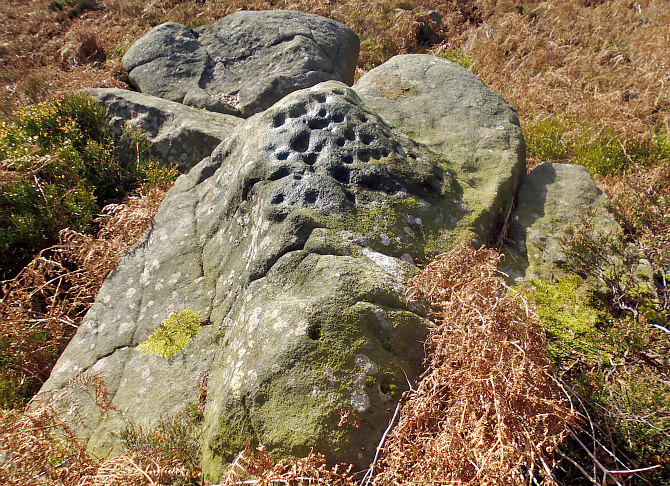
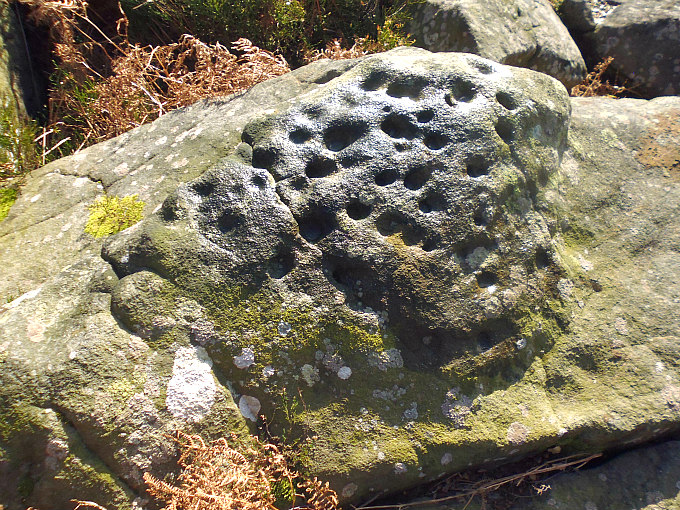
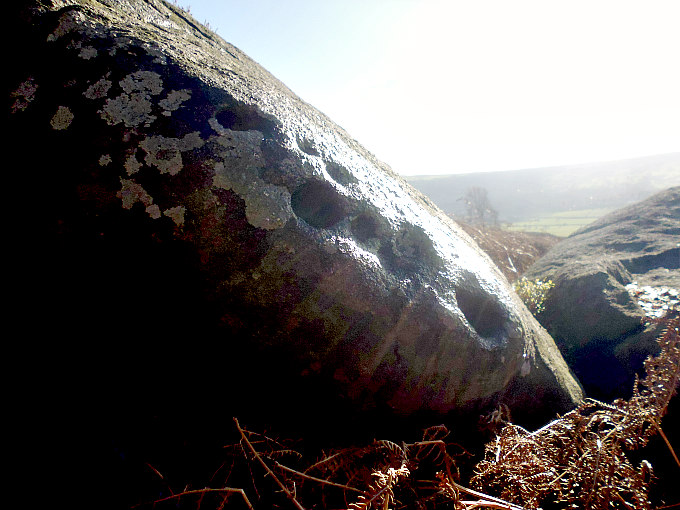
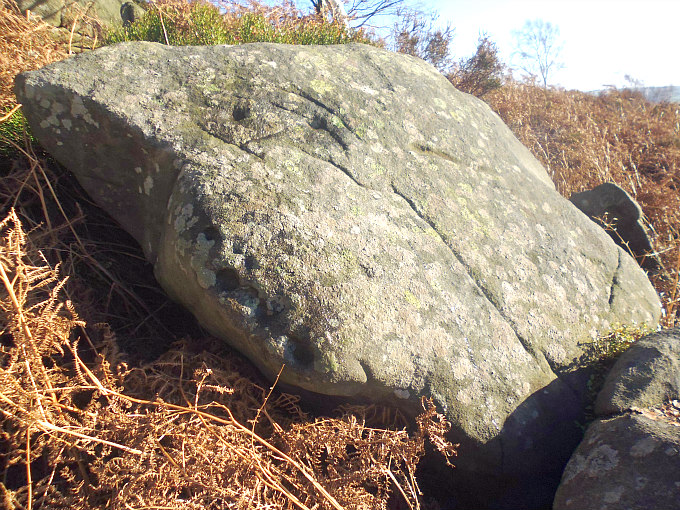
Cup-Marked Rock on Farnhill Moor with 40 cup-markings.

OS Grid Reference: approx. SE 0064 4710. On Farnhill Moor above the north Yorkshire villages of Farnhill and Kildwick, 3 miles to the southeast of Skipton, there is a little cluster of ancient cup-marked carvings on some gritstone rocks. These carvings or petroglyphs are rather hidden away by the undergrowth at the south side of Jubilee Memorial, a white monument with a stone cross. One of these large rocks has four large cup-marks while the rock above it on the craggy ridge has forty or so quite distinct cup-marks. From Main Street in Farnhill take the narrow Crag Lane uphill for a little while, then when reaching the wooded area on the right take the path going east. After a short distance veer off to the north to meet up with a well-defined footpath heading towards the Jubilee Monument. Just downhill from the monument walk east into the often dense undergrowth towards the craggy ridge. Here amongst these gritstone rocks you will have to search around to find the carvings, but it will be well worth it in the end!

Cup-Marked rock on Farnhill Moor, near Skipton, North Yorks.

Farnhill Moor Cup-Marked Rock showing 4 cups on the side and 2 more cups above.

On the edge of a large gritstone rock, just below the craggy ridge, are four large distinct cup-marks (petroglyphs) and above those possibly a couple of tiny cups. These cup-marks are very easily missed and not that easy to photograph, unless the sunlight is just right and not shining right at you. You will notice the gritstone rock has turned almost white which is due to rain over thousands of years. On the ridge above, another large rock jutting out from the crag has on its face forty or more very well-defined cup-marks, some small cups and some larger ones, which have ‘become larger’ maybe due to erosion over 4,000 thousand of years or more. There are a few small cup-marks away from the main panel. We don’t really know what these cup-marks mean, or why they were carved, and so they must remain something of an enigma. It’s very likely, however, Bronze Age people had their settlements on these very moors at a time when the climate was much milder in winter than it is nowadays. To the northwest on Low Bradley Moor lie the stone-strewn remains of two cairns where the Bronze Age people buried their chieftains.

Jubilee Monument.

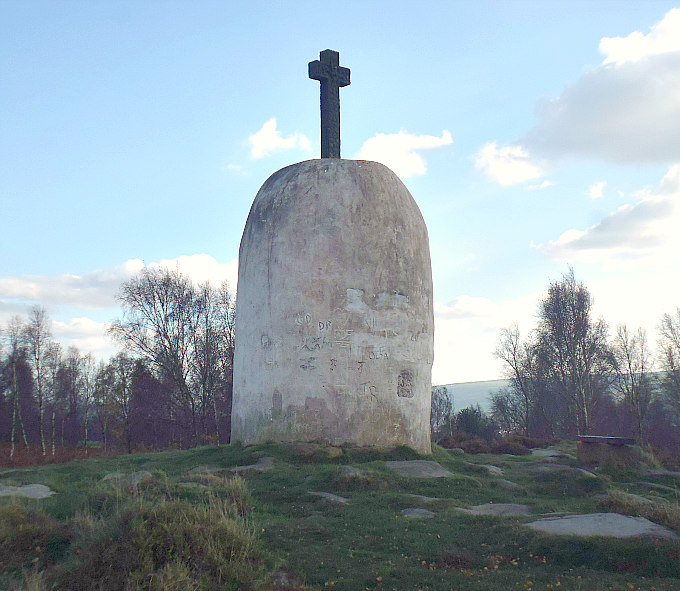
The Jubilee Monument also called Jubilee Tower or Pinnacle was erected in 1887 to celebrate Queen Victoria’s Golden Jubilee. This white painted, bottle-shaped monument is 12 foot high and atop the edifice there is a carved stone cross. The monument is covered with Victorian inscriptions, but there is also more recent graffiti. It is thought to have replaced an earlier cairn indeed some think this was a burial cairn, similar perhaps to those that date from the Bronze Age which can still be seen over to the northeast on Low Bradley Moor, although there are now only large piles of stones strewn around in a sort of circular fashion. (See below for further details).

Sources and related websites:- 

https://en.wikipedia.org/wiki/Farnhill

Bradley Long Cairn, Farnhill, North Yorkshire

http://www.farnhill.co.uk/farnhill-history.html

© Ray Spencer, The Journal of Antiquities, 2017.      


1 Comment

The Potteries Museum And Art Gallery, Hanley, Stoke-on-Trent, Staffordshire


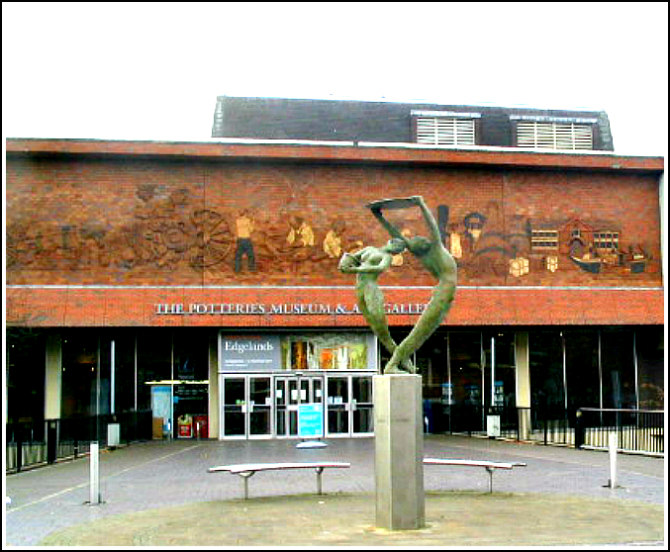
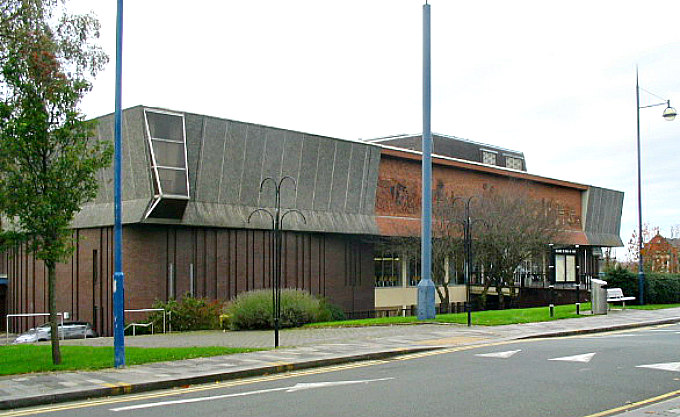
The Potteries Museum & Art Gallery, Hanley, Stoke-on-Trent, Staffs.

OS Grid Reference: SJ 88172 47323. The Potteries Museum And Art Gallery is a Local Authority Museum that is situated on Bethesda Street, Hanley, Stoke-on-Trent, Staffordshire. Inside the museum there are displays and collections of artefacts from prehistory including The Leekfrith Torcs, while from the Dark Ages: The Staffordshire Hoard; also Natural History, Geology and Landscape. From more recent times there are displays of local ceramics and decorative arts. But by far the most famous thing on display must be the World War II Spitfire. The museum and art gallery stands just 160 metres to the northwest of Hanley Bus Station and is close to the City Central Library and Police Station; the A5006 (Broad Street) runs a little to the west of the museum. There is free admission. Times of opening are from Monday to Saturday 10am to 5pm and on Sundays from 11am to 4pm. There is also an excellent café and shop.                                                                                                                                         

The Potteries Museum & Art Gallery, Hanley, Stoke-on-Trent.

The Potteries Museum at Hanley in North Staffordshire houses what are called ‘Designated Collections’. These range from ancient historical artefacts to a much more recent World War II Supermarine Spitfire, designed by Reginald J. Mitchell (1895-1937) from Talke, Stoke-on-Trent. As well as artefacts from the prehistory of Staffordshire, such as the 2,400-year-old ‘Leekfrith Torcs’ – the earliest known Iron-Age gold artefacts, there are more than 80 pieces from the famous ‘Staffordshire Hoard’ which found in 2009 and date back to the Anglo-Saxon Age. Also Local History, Geology and Landscapes of north Staffordshire, especially the Stoke-on-Trent area, with its rich history of industrial manufacturing sites ranging from coal mines to the famous pot-banks and canals that are so well-known to the area.

Apparently there are over 5,000 pieces of ceramic-ware much of which comes from the Potteries including Wedgewood and Minton. And from the 15th century to more recent times there is a fine collection of costumery and textiles. And a fine arts collection as well as Jade and Ivory pieces. Most pleasing must be the reconstructed, life-like street with shops and public house! A recent attraction for youngsters is the Secret (Sensory) Garden. The Art Gallery has paintings by the Classical artists including Picasso and Degas. The Potteries Museum has had a long association with two or three other local museums that also have collections and displays of pottery and industrial heritage. 

Sources and related websites:-

http://www.stokemuseums.org.uk/visit/pmag/

https://en.wikipedia.org/wiki/Potteries_Museum_%26_Art_Gallery

http://www.stokemuseums.org.uk/

http://www.thepotteries.org/spitfire/

© Ray Spencer, The Journal of Antiquities, 2017.


1 Comment

Panorama Stones, St Margaret’s Gardens, Ilkley, West Yorkshire

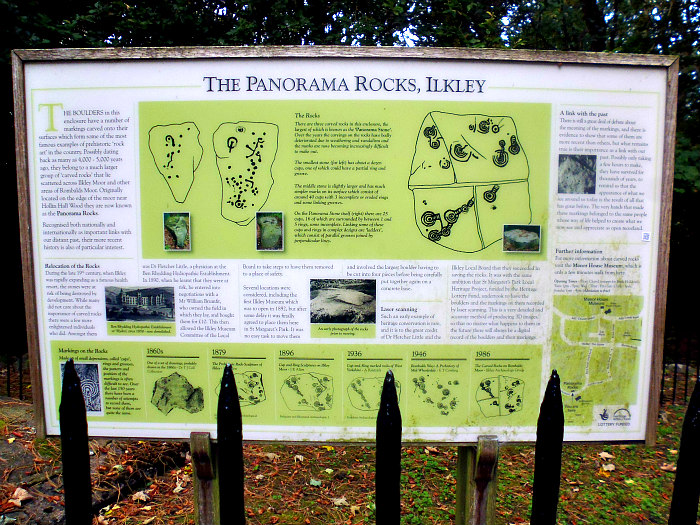
Panorama Rocks Information Board at St Margaret’s Gardens, Ilkley.

   OS Grid Reference: SE 11496 47298. In the woodland of  St Margaret’s Gardens also known as the Park opposite St Margaret’s Church on Queens Road in Ilkley, west Yorkshire, lie (behind iron railings) three large flat stones that were originally situated upon Ilkley Moor, ½ a mile to the southwest. These three stones or rocks were famous for their cup-and-ring carvings, but unfortunately the carvings are now very faint and not easy to make out; and two of the rocks were broken while being transported to their current location. There is a good information board here which gives details and illustrations of the 5,000 year old rock carvings. From the B6382 (The Grove) walk south up the steep Back Parish Ghyll Road and onto Albany Walk, then cross over the road and continue south up the steep lane to Queens Road and St Margaret’s Church. Walk onto Princess Road and there on the right-hand side are St Margaret’s Gardens and the railed off enclosure beneath the trees; the section with the stones in was locked when I last visited. 

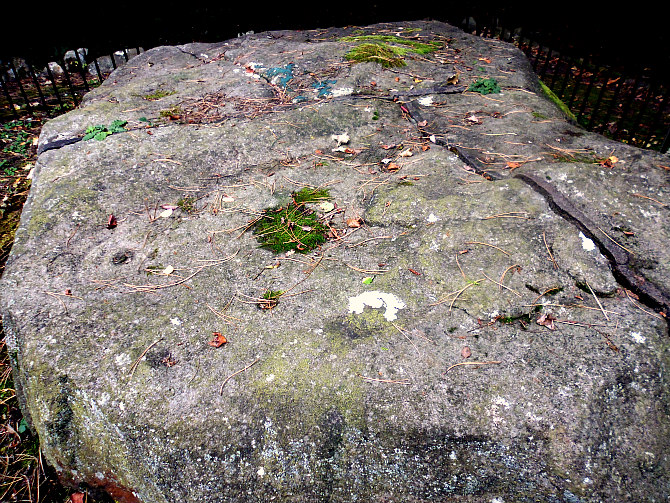
Panorama Stone in St Margaret’s Gardens at Ilkley, west Yorkshire.

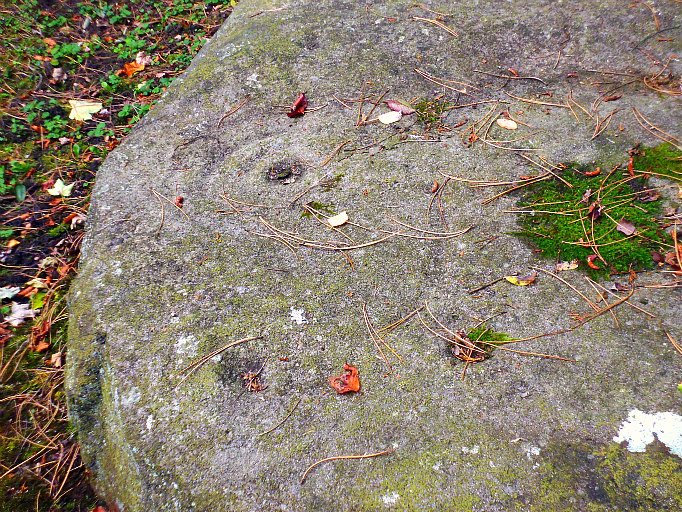
Panorama Stone and a close-up of the carvings.

   The three stones with their 5,000-year-old carvings are rather hidden behind the iron railings in the woodland at the edge of St Margaret’s Gardens, and the carvings (petroglyphs) are now quite faint and not easy to see, and they often have leaves covering them and moss growing in the cup-markings. The largest rock of the three is the actual Panorama Stone and, with the two smaller stones, was originally located behind the reservoir in Panorama Woods at about SE101470. They were brought to their current location in the late 19th century after ‘being’ found to be in the way of the town’s building extensions onto the edge of Ilkley Moor, also known as Rombald’s Moor; two of the rocks, one being the actual Panorama Stone itself, sadly, cracked as they were being lifted and this was made worse during transit. All three stones have cups with concentric ring carvings, or just cups on their own, but there are other curious designs too including lines or gulleys and ladder-like carvings linking or not linking cups, though most of these carvings are now only visible when the light is right!

    Author Paul Bennett (2001) while discussing ‘Barmishaw Stone’ on Ilkley Moor and its ladder-like carvings, says: “These ladder-like images, also found on the Panorama Stone opposite St Margaret’s Church in Ilkley, are unique in British rock art. While author J. C. Barringer (1982) while discussing the stone circles on Rombalds Moor, says that: “Perhaps better known and more intriguing than the stone circles are the carved ‘cup and ring’ stones which occur all along the north facing edge of Rombalds Moor on the exposed masses of millstone grit. He goes on to mention the clusters of cup-and-ring stones that can also be seen upon Snowdon Moor above Washburn Valley and the Chevin above the town of Otley, west Yorkshire. And Ian Longworth (1969) says that the carvings are: “circular hollows pecked into the rock’s surface sometimes surrounded by concentric rings.”                                                                                                                                                                          

Sources and related websites:-

Barringer, J. C., The Yorkshire Dales, Dalesman Publishing Company Ltd., 1982.                               

Bennett, Paul, The Old Stones of Elmet, Capall Bann Publishing, Milverton, Somerset, 2001.

Longworth, Ian, Regional Archaeologies – Yorkshire, Heineman Educational Books Ltd., London, 1969.

https://megalithix.wordpress.com/2010/10/18/panorama-stones-ilkley/

http://www.stone-circles.org.uk/stone/panoramastone.ht

© Ray Spencer, The Journal of Antiquities, 2017.


2 Comments

Haystack Rock, Ilkley Moor, West Yorkshire

Haystack Rock on Ilkley Moor, west Yorkshire.

Haystack Rock from a different angle.

   OS Grid Reference: SE 13027 46313. A large and squat-shaped gritstone rock known as Haystack or Haystacks Rock on Ilkley Moor, west Yorkshire, has many cup-and-ring carvings, but also some more recent graffiti. The rock is thought to resemble a haystack and so the name has stuck. It is just one of many rocks and boulders upon Ilkley Moor, also known as Rombald’s Moor, many of these often strange-shaped rocks having ancient cup-and-ring carvings that date from the Neolithic and Bronze Age periods of prehistory. However, these carvings are often almost ‘lost to the heather’ and not that easy to find – though there are said to be 400 of them on the moor. Best to park at Cow & Calf Rock Café on Hangingstone Lane, then walk up to Cow & Calf rocks and walk along the moorland footpath going southwest for a while, then head south and up onto the footpath along the ridge to Haystack Rock; while on the horizon further in front of you you will see the strange-shaped Pancake Stone perched on the edge of the ridge.

Haystack Rock, Ilkley Moor, with cup-and-ring carvings.

Haystack Rock. Close-up of the cup-and-rings

   Haystack Rock, also known as Rombald’s Moor 141, is a glacial erratic boulder that was deposited here thousands of years ago and then, during the Bronze Age the curious if strange rock-art known as cup-and-rings were carved onto the sloping face of the rock by ancient people who lived in hut circles and settlements on the moor, or they were simply traversing it from one side to the other, building their stone circles and erecting standing stones as they moved around.  The climate at this time would have been much milder in the Winter than what it is today. The millstone grit boulder is 2m high and over 5m in length, and resembles a haystack depending on what angle you are viewing it from. There are said to be 70 cup-and-ring carvings on the rock, some having channels linking and running away from them, as well as a few other curious carvings; but there is more recent graffiti too, some of which is obviously from the Victorian age. It is briefly mentioned by Paul Bennett on page 56 in ‘The Old Stones of Elmet’ (2001), and there is much more information on ‘The Northern Antiquarian’ website (see below).

   Author Brian Spencer writing in 1986 says that: “Visitors to Ilkley can hardly avoid seeing the distinctive mass of the Cow and Calf rocks. Behind them the moor is rich in the carved stones of our prehistoric ancestors who have left not only their cairns and circles but enigmatically carved ‘cup-and-ring’ and ‘swastika’ stones. A walk from the Cow and Calf along the edge of the moor will take in all these features.” 

Sources and related websites:-

Bennett, Paul, The Old Stones of Elmet, Capall Bann Publishing, Milverton, Somerset, 2001.

Spencer, Brian, The Visitor’s Guide To The Yorkshire Dales, Teesdale & Weardale, Hunter Publishing Inc., Edison, NJ USA, 1986.

Haystack Rock, Ilkley Moor, West Yorkshire

http://www.stone-circles.org.uk/stone/haystack.htm

                                                                                          © Ray Spencer, The Journal of Antiquities, 2017


1 Comment

St Nicholas’ Round Church, Orphir, Orkney Isles.

St Nicholas’ Round Church at Orphir, Orkney Isles. (Photo by T. Kent).

   OS Grid Reference: HY 33494 04429. On Gyre Road at Orphir Bay and a few hundred metres or so north of the shoreline of Scapa Flow, Orkney, are the remains of an early 12th century round church (kirk) of St Nicholas. It was probably originally dedicated to Saint Magnus. Beside the old church are a burial ground and the scant ruins of the Earls Bu, a Viking hall or palace, and also a farmstead and mill. The famous round church was built by Earl Hakon, who had a few years earlier (1111) murdered Earl Magnus (St Magnus). There is the Orkneyinga Saga Centre on the site; while in the burial ground there is an early medieval graveslab, and from the Dark Ages a Pictish symbol stone. The site is best reached from the A964 at the south-side of the island near Houton, then on Gyre Road for a short distance; the Orkneyinga Saga Centre entrance is on the right-hand side of the road.

   The author J. Gunn (1941) says of the round church: “At the churchyard near the shore we may stop to visit as pilgrims the pathetic little ruin at the east door of the church (now demolished). This is the semicircular apse and a fragment of the wall of a circular church, the remainder of which was unfortunately used as material for building the present church. This fragment is older than the cathedral of St. Magnus. It was built by Earl Hakon, the murderer of St. Magnus after his penitential pilgrimage to Jerusalem. 

   Mr Gunn goes on to say that after murdering Earl Magnus he: “……endeavoured to expiate his crime, as the manner then was, by going on a pilgrimage first to Rome and thereafter to Jerusalem. A small but deeply interesting fragment of masonry, still to be seen in Orphir churchyard, is regarded as a memorial of that penitential journey. At the east end of the present church (now demolished) is a vaulted semicircular apse of what was once the Round Church of Orphir, one of the very few churches in Britain built on the model of the Church of the Holy Sepulchre in Jerusalem. It seems certain that this was erected by Hakon on his return to Orkney, and it is therefore the oldest piece of ecclesiastical building in Orkney, except, perhaps, some of the ruins of little Celtic chapels. After his pilgrimage we read that Hakon proved a good ruler, made better laws, and became so popular that “”the Orkneymen desired no other ruler than Hakon and his issue.”” 

   The site entry for Orphir: St. Nicholas’ Church in ‘Ancient Monuments – Scotland’ adds that: “Only the chancel and a small part of the nave remain of this, the single example of a round church known to have been built in the Middle Ages in Scotland. The structure dates from the twelfth century, and appears to have been modeled on Scandinavian prototypes, derived ultimately from the Church of the Holy Sepulchre at Jerusalem.” Also we have Charles Tait writing in 1999. He adds some more information saying: “The Round Kirk is thought to be the church built by Earl Haakon Paulson, to the plan  of the Church of the Holy Sepulchre, on his return  from Jerusalem about 1120, in atonement for the murder of Earl Magnus. Previously known as the Girth House from the Norse grid for sanctuary, or peace, the church was largely demolished in the 18th century (about 1757) to build a new church, itself now gone.”

   Standing close by the round church are the foundation walls of some buildings, many now covered over by grass turf, of the Earl’s Bu or the drinking hall (palace or mansion), which was probably built by Earl Hakon Paulson between 1120-23. The place was mentioned in the famous Orkneyinga Saga. There are also some remains of a farmstead and watermill from the 10th century. The site was excavated three times in the 19th century, and continues today. At the entrance to the site is the Orkneyinga Saga Centre which is run by The Orkney Islands Council. This has displays celebrating the famous Viking Saga, and telling the story of the Norse Earls of Orkney through interpretation boards and audiovisual displays etc. In the burial ground there are stones from the early Medieval and Dark Age periods; one in particular being a 7th century Pictish symbol stone with crescent and V-rod, and an interesting carved graveslab from the 11th century. An inscribed runic stone was found here, but is now on display in the Orkney Museum, Tankerness House, Kirkwall. The Canmore ID number is: 1962. 

Sources and related websites:-

Gunn, J., Orkney – The Magnetic North, Thomas Nelson And Sons. Ltd., London, 1941.

H. M. S. O.,  Ancient Monuments – Scotland, (Volume VI),  H. M. Stationary Office, Edinburgh, 1959.

Tait, Charles, The Orkney Guide Book, (Edition 2.1), Charles Tait Photographic, Kelton, St Ola, Orkney, 1999. 

https://canmore.org.uk/site/1962/orphir-st-nicholass-church

https://en.wikipedia.org/wiki/Orphir_Round_Church

http://www.orkneyjar.com/history/or-chrch.htm

https://www.historicenvironment.scot/visit-a-place/places/earls-bu-and-church-orphir/

http://viking.archeurope.info/index.php?page=orphir-earl-s-bu-and-church

                                                                                  © Ray Spencer, The Journal of Antiquities, 2017.


The Mineral Well, Near Brinkies Brae, Stromness, Orkney

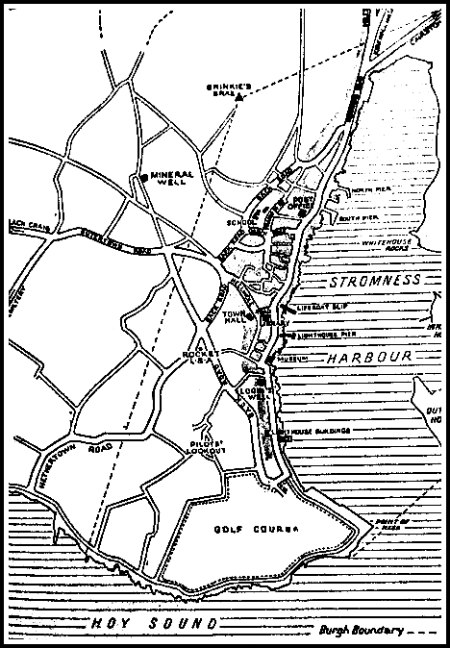
Road Plan of Stromness (from a drawing by J. R. Baikie, Burgh Surveyor)

   OS Grid Referance: HY 2477 0931. Beside the country lane about ½ a mile to the northwest of Strom-ness, Orkney, and in the valley a short distance to the southwest of Brinkies Brae Hill, can be found the now almost forgotten Mineral Well, which was actually a chalybeate well that had long been used by the good people of Stromness who had a need for its medicinal properties for their ailments; indeed so much so in past times that it was seen as the local “spa”. The well was locally called Haley Hole Well; it was regarded as sacred but probably never a holy well as such. The well is best reached from the south-side of the town of Stromness and, by travelling southwest then northwest along Guardhouse Park, Back Road, Croval Road and Brownstown Road for ½ a mile. Where the lane becomes narrower, and just after the turning called Grieveship Way, the little stone wellhouse can be seen on the right-hand side of the lane where there are open fields and excellent views northeast towards Brinkies Brae Hill and the Ordnance Survey trig column.

   Author J. Gunn in his excellent work ‘Orkney – The Magnetic North’ (1941) says of the well: “if not actually historic, was much used by former generations. It is known as the Mineral Well, and is to be found near the farm-steading in the valley to the south-west of Brinkie’s Brae. The water is strongly minl, and is credited with useful medicinal properties. If the approaches were improved and the qualities of the well made known more widely, this “spa” might be a distinct asset to the town as a health resort.”

   The ‘Stromness Community Garden’ website gives us some interesting information regarding the Mineral Well. It says: “As the ‘Haley Hole’ (hence the present road name ‘Hellihole Road’ leading from the town) it was visited by pilgrims from all over Orkney, who regarded it as a miracle well. The water was famed as a cure for scurvy and similar disorders. The name is undoubtedly from heilagr – Old Norse for holy – so it’s probably been considered sacred for some time.

   The website goes on to say: “Then, in the middle of the 19th century, it was advertised as “‘The Mineral Well’ and had a well house built over it to protect it from birds and animals. The stone built house had a wooden door and a ladle so visitors could drink their fill. By now the water was regarded as a more general tonic which visitors and townsfolk drank frequently.

   “Analysis of the water on Christmas Day 1862 by Dr Murray Thomson, who wrote a book ‘The Mineral Wells of Scotland’, showed it to contain a high percentage of sulphate of lime, chloride of magnesium and sulphate of iron, and a moderate percentage of chloride of sodium. The well was still considered to have health-giving properties in the early 2oth century.” Stromness Community Garden website is worth a visit and there are some photos of the well. See the following website/link: https://stromnesscommunitygarden.wordpress.com/

Sources and related websites:-

Gunn, J., Orkney – The Magnetic North, Thomas Nelson And Sons, Ltd., London, 1941.

http://www.orkneyjar.com/tradition/sacredwater/haleyhole.htm

https://en.wikipedia.org/wiki/Stromness

                                                                               © Ray Spencer, The Journal of Antiquities, 2017.


1 Comment

Castle Haugh, Paythorne Bridge, Newsholme, Lancashire

11th century Castle Haugh, Lancashire, (from the north).

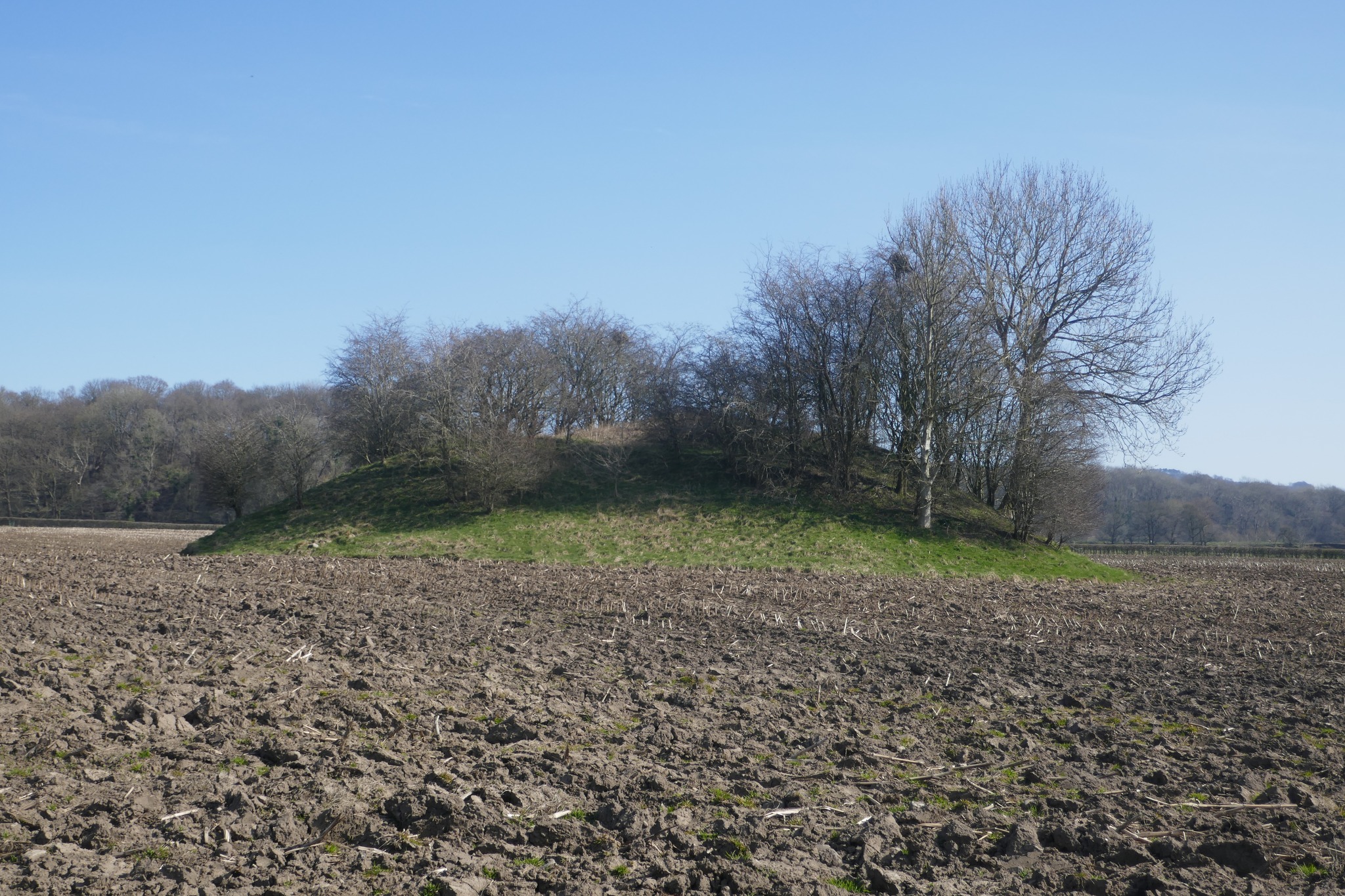
   OS Grid Reference: SD 82997 50775. High above a bend in the river Ribble, ¼ of a mile south of Paythorne Bridge, Newsholme, Lancashire, is a large tree covered mound with a deep ditch running part-way around it, which is known as Castle Haugh or Cromwell’s Basin. The site is 1 mile north of Gisburn and close to the A682 Hellifield road. It is about ¼ of a mile further along from Little Painley burial mound. Castle Haugh is actually a late 11th century Norman motte that is quite well preserved, although the ditch on the river-bank side has slid downwards. Often described as a medieval ringwork or earthwork. It was quite obviously a hastily constructed fortification built by a Norman baron; maybe William de Percy? There might have been a wooden structure on top of the mound in the early years, but that this was soon destroyed by Scottish raiders. The bailey, if it ever existed, has long since disappeared. It is best reached by way of a footpath heading south through the woods from Paythorne Bridge. Follow this path for about a ¼ of a mile until you see the mound of trees in the field just up ahead of you. As the mound is on private land it is best to ask the farmer for permission to view it more closely.

Castle Haugh Motte.

Castle Haugh Motte.

   Authors John & Phillip Dixon (1990) say of the site that: “Castle Haugh is sited on the edge of a high scar one hundred feet above the River Ribble south of Paythorne Bridge. It comprises a large mound and surrounding ditch. The central motte is small, twenty-five feet high, and it is evidently defensive, as it still retains the hearthen breast work round the top, silted down so as to convert the inner area into a shallow cup. The dry ditch round it, seven feet deep, is nearly perfect, except for a portion that has slipped down the scar. The situation is a commanding one, high above the Ribble, where Ribblesdale meets Craven and Blackburnshire.

   The authors go on to say that: “Some historians have suggested that Castle Haugh earthwork is what remains of an early castle of the Norman Baron, Roger the Poitevin, mentioned in the Domesday entry for Barnoldswick: “”In Bernulfeswic (including Ellenthorpe), Gamel (the English predecessor of Berenger de Todeni) had 12 carucates for geld. Berenger de Todeni held it, but now it is in the castellate of Roger the Poitevin.” This may be a reference to Castle Haugh, or to Clitheroe Castle, or to some other now lost castle in the West Craven District. 

   “Others suggest that the reference to a ‘castellate’ is not to an actual structure but a term used to indicate that a manor was in the honor of a lord. Many other words were used vaguely in the 10th and 11th centuries, before the establishment of an accepted terminology. The word ‘castelli’ is proven to have been used to refer to the whole of the lord’s estates, before the word ‘honor’ became the norm. This could well be the case with the Barnoldswick Domesday reference. However, the debate goes on.”

Castle Haugh. The deep  grassy ditch.

Castle Haugh. The ditch and motte.

   W. R. Mitchell (2004) says that: “When Norman rule began the valleys of Ribble and Hodder were already well settled, with evidence for the nuclei of many villages. William de Percy, who had arrived on the scene in 1067, was awarded a hundred Yorkshire manors, including Gisburn and Bolton-by-Bowland. Yorkshire territory was subsequently known as Great Bowland. Chipping — the Chipenden of Domesday Book — was not counted with Bowland until early in the 12th century, becoming part of the Lancashire share, otherwise called Little Bowland. The Bleasdale area, although not mentioned in the Domesday survey, was held by Tostig and included in the Forest of Lancaster. As such it was royal property.

   Jane Sterling (1974) says: “In the wholesale share-out of lands after the victory, William the Conqueror gave lands to Roger of Poitou, the third son of Roger de Montgomery, Earl of Arundel and Shrewsbury, a cousin of the Conqueror and who had fought with distinction at Hastings. Roger’s estates included the lands between the Ribble and the Mersey, Lonsdale and Furness. Amounderness (the Fylde) was added to these possessions in 1072. To this gift of land to Roger de Poitou we can trace the rather odd geographical distribution of the later county of Lancashire to include the southern part of the Lake District which would have more geographical affinity with Cumberland and Westmorland — an anomaly rectified by the new county boundaries. But military considerations took precedence over others and Roger de Poitou who became involved in a military campaign against the Scots was presumably given the land in the Cartmel and Furness areas so that he could defend the main route of the Scottish invasion — across the sands of the Leven and Kent estuaries.

   Sterling goes on to say that: “The Domesday Survey is a unique document. It was compiled mainly for the purpose of aquainting William I with the extent and tax potential of his new realm. Though by no means a comprehensive survey of the country it is an invaluable record of England in the early years of Norman domination. Lancashire at this time had still not emerged as an administrative county and the entries which cover the present day Lancashire are included partly in the survey of Cheshire and partly in “”the King’s lands in Eurvicshire (Yorkshire)””.

Castle Haugh. On the summit of the motte.

Castle Haugh. On the summit of the motte.

   I am informed by Nick Livsey that the large mound of Castle Haugh was built on top of a Bronze Age burial mound. This occurred because a site was quickly needed for a defensive castle (motte) to be situated close to the river Ribble. Nick says that: “Its a bronze age burial mound that was re-used as a motte and bailey castle (timber construction) around 1080; but its a shame that the river Ribble has eaten 1/3 of it away, and that a motte and bailey was constructed upon it and, as far as I know, it hasn’t been archeologically excavated, well not by professional archeaologists anyway.” Nick also adds that “the new Norman lord used the easiest available mound that offered good views down and up the Ribble and also the road system; the fact that there are so many burial mounds near here is because of the River Ribble was a watery liminal place between the living and the dead. You often find burial mounds on parish boundaries or next to lakes or rivers.”

Sources and related websites:-

Dixon, John & Phillip, Journeys Through Brigantia, (Volume One), Walks in Craven, Airedale and Wharfedale, Aussteiger Publications, Barnoldswick, 1990. 

Mitchell, W. R., Bowland And Pendle Hill, Phillimore & Co. Ltd., Chichester, West Sussex, England, 2004.

Sterling, Jane, Dark Age and Norman Lancashire, Dalesman Publishing Company Ltd., Clapham, North Yorkshire, 1974.

Thanks also to Nick Livsey for his input.

Little Painley Burial Mound, Gisburn, Lancashire

https://historicengland.org.uk/listing/the-list/list-entry/1012521

http://www.matthewpemmott.co.uk/2007/08/castle-haugh-gisburn.html

http://www.castleuk.net/castle_lists_north/103/gisburn.html

http://historicalbritain.yolasite.com/mottes.php

                                                                                          © Ray Spencer, The Journal Of Antiquities, 2017.