The Journal Of Antiquities

Ancient Sites In Great Britain & Southern Ireland


Winckley Lowes I, Near Hurst Green, Lancashire

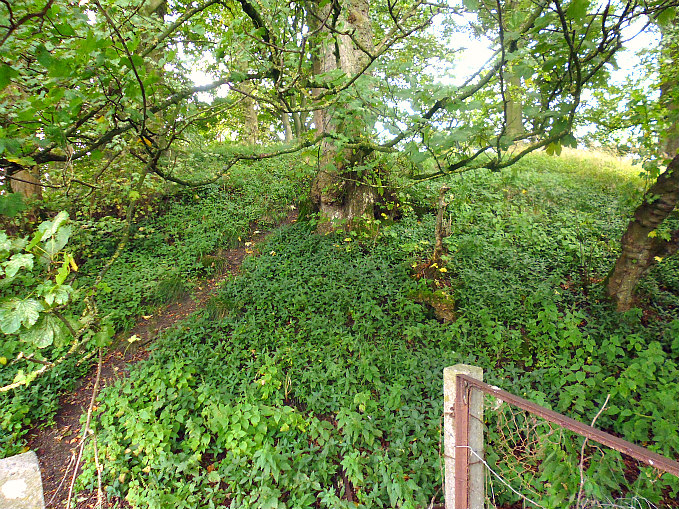
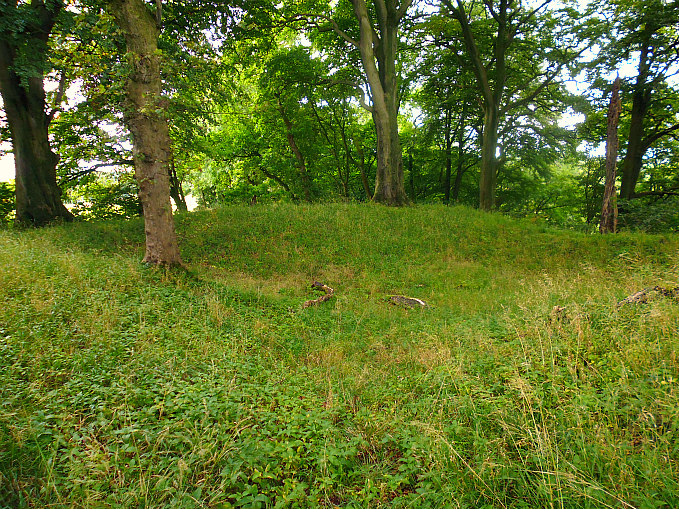
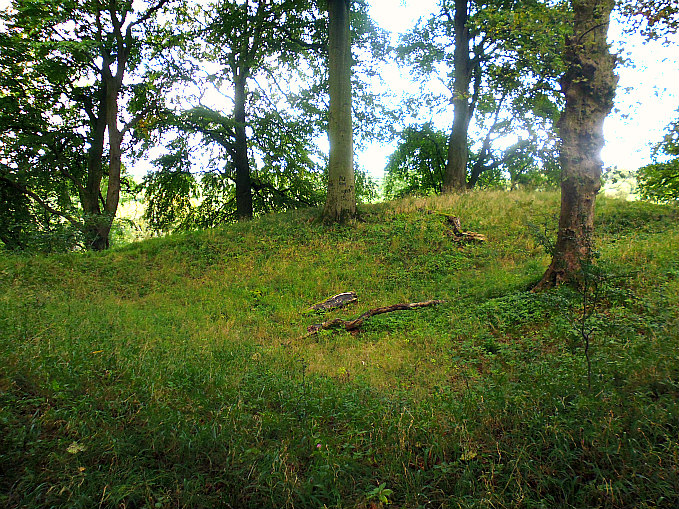
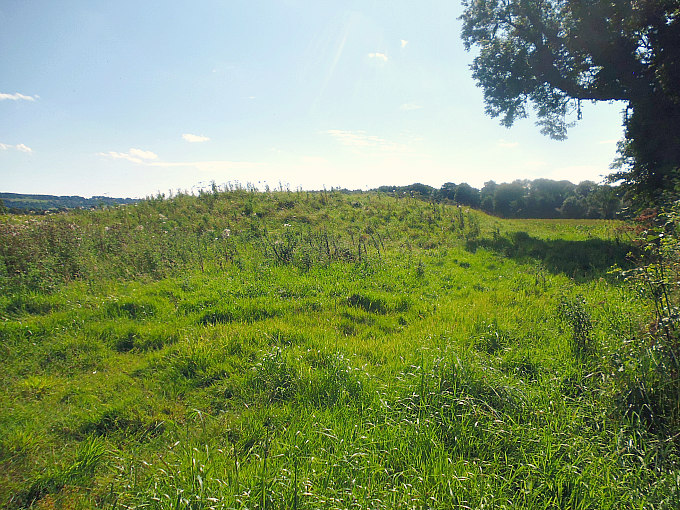
Winckley Lowes I Tumulus near the boathouse building.

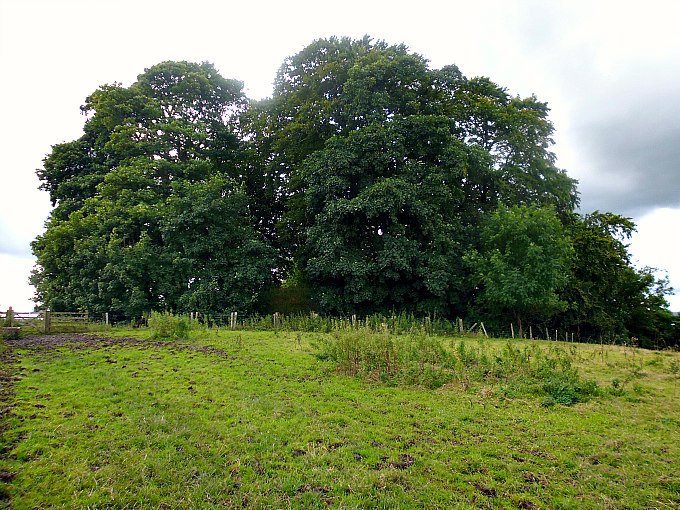
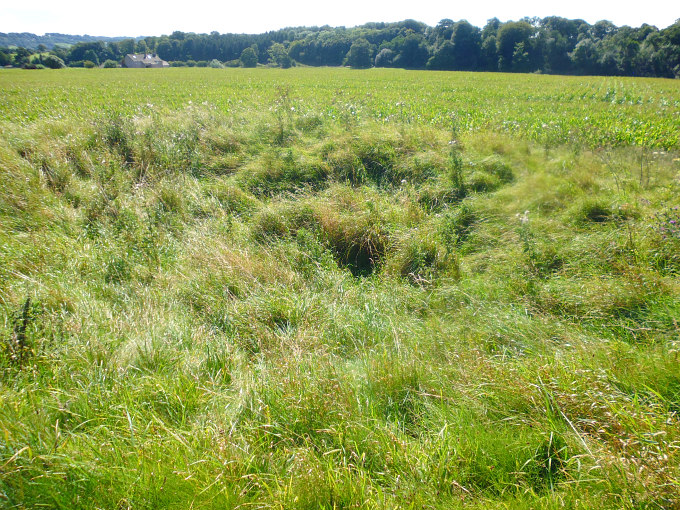
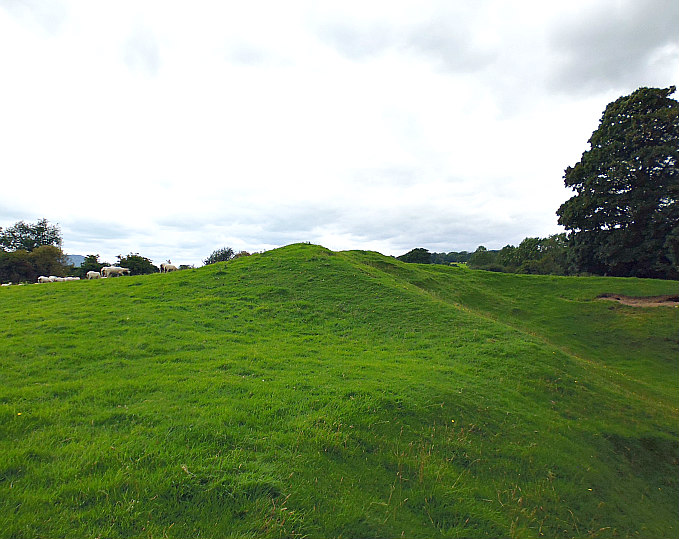
   OS Grid Reference: SD 70649 37461. Grass-covered Bronze Age burial mound (tumulus) in the corner of a farmer’s field, near the old boathouse (now a private house), 1 mile southeast of Hurst Green, Lancashire, which goes under the name Winckley Lowes I. The River Ribble is close by this site with a footpath running alongside it. There is a larger mound with trees growing on top of it a short distance away that is called Winckley Lowes II or Loe Hill.  At the time of my visit in late August the mound was surrounded by maze crops and so the site was difficult to get to and difficult to photo! There was a large hollow in the centre of the mound and what looked like a hole at the side of this, which was probably due to robbing-away in the past. At least two foot-paths heading south-eastwards, then south, from the B6243 road between Hurst Green and Great Mitton, near the bridges, are the best bet to reach the site; then follow the Ribble Way running beside the river to the former boathouse (now a private house); the two mounds lie in the farmer’s fields, just at the back.

   It’s not a good idea, however, to visit the mounds when the maze crops are growing tall. When the crops have been cut back in the Autumn it is possibly to see both mounds from the footpath beside the river Ribble, or from the two metal gates at either side of the boathouse, and if you do go further into the fields to get a closer view it is probably best to walk along the edges of the ploughed fields. 

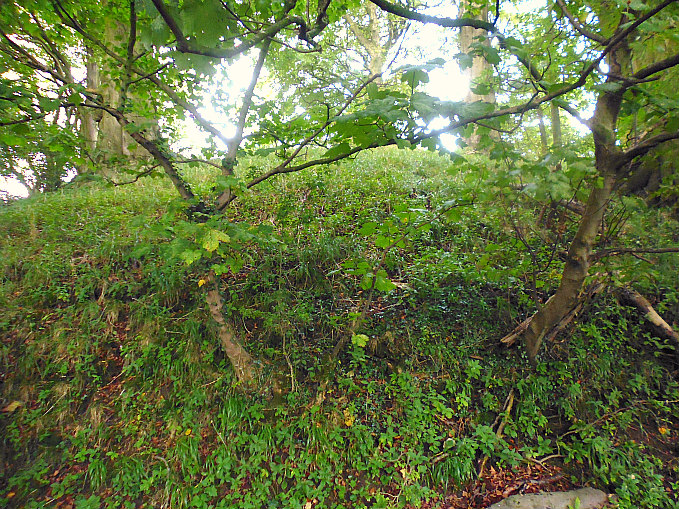
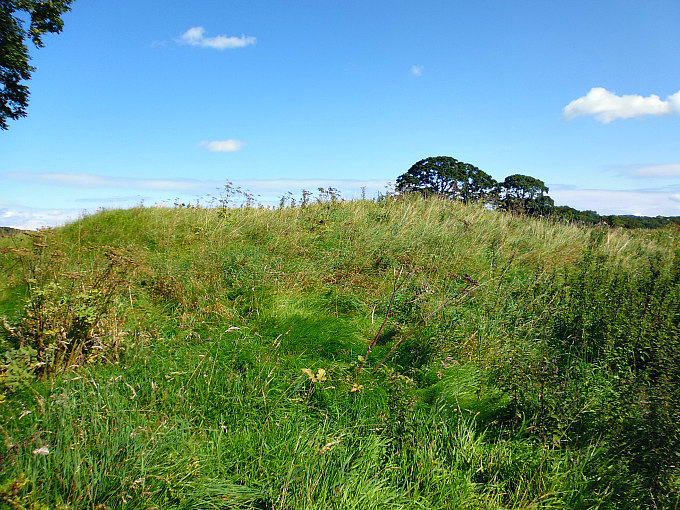
Winckley Lowes I.

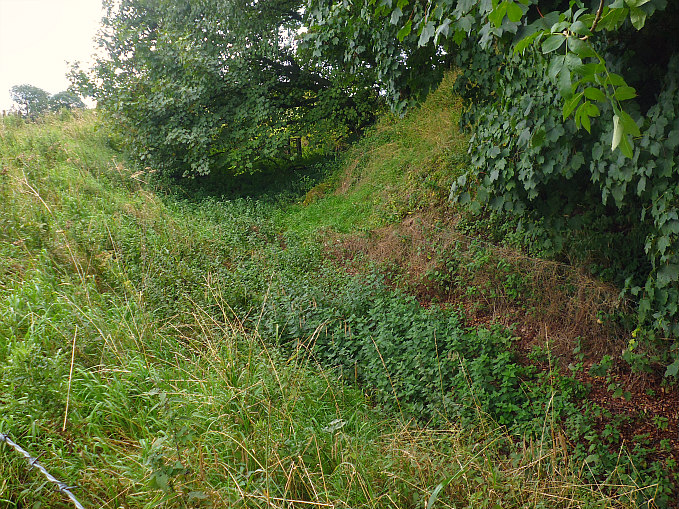
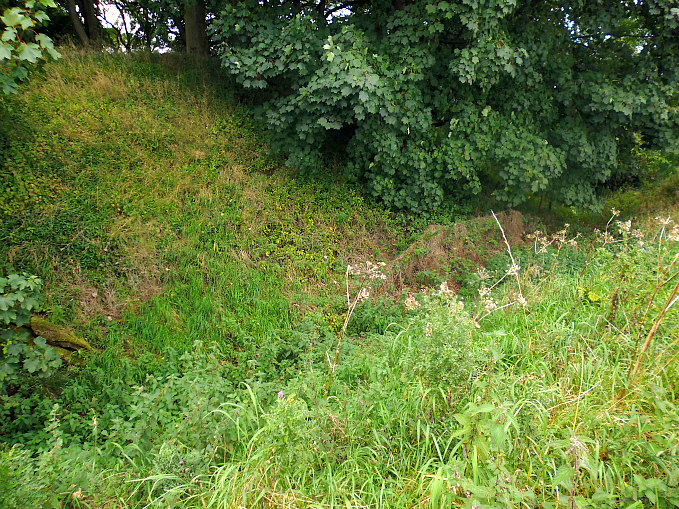
   The mound or barrow known as Winckley Lowes I stands in the corner of a  farmer’s field – some 220m north of the Hacking boathouse. It is 2.5m (8 ft 2′) high and roughly 34m (111 ft) by 45m (147 ft) and is built of earth and stones. It is described as being a bowl barrow or round barrow. At the centre there is a large hollow or depression with a small hole visible at one side. At the time of my visit in August the mound was covered in very thick grass and weeds. The barrow stands on what is the floodplain of the river Ribble.

   Authors John & Phillip Dixon say of Winckley Lowes I: “The one by the nearby barn was excavated by Rev. J. R. Luck of Stonyhurst College in 1894. The tumulus revealed a cinerary urn of c. 1250 B.C. which contained the cremated remains of a body. Also found were a young man’s skull and a flint knife; a boy’s skull and a child’s skull.

    “The burial is one of an important person — probably some local chieftain — buried near the ancient natural ford at Jumbles Rocks which must have been known and used by early man even in Neolithic times.”    

Winckley Lowes I.

   The site entry for Winckley Lowes (in the parish of Aighton, Bailey and Chaigley) in ‘Lancashire Archaeological Bulletin’ (1984) says:- “Two mounds. (a) Excavated by Fr. Luck in 1894. Found cremation  without urn, 3 inhumations, flint knife and pottery. These finds were all at Stonyhurst College in 1961 and 1967. The pottery was medieval or post-medieval, and, taken with the hollow in the top of the mound, suggests robbing. The flint is now at L. R. O.”

   Winckley Lowes II also known as ‘Loe Hill’ will be looked at in more detail in a separate site page.

Sources and related websites:-

John & Phillip Dixon, Journeys Through Brigantia (Volume Nine) The Ribble Valley, Aussteiger Publications, Barnoldswick, 1993.

Lancashire Archaeological Bulletin, Vol. 10 No. 2/3, May & July 1984.

http://www.megalithic.co.uk/article.php?sid=11088

http://www.themodernantiquarian.com/site/1697/winckley_lowes.html#images

                                                                                 © Ray Spencer, The Journal of Antiquities, 2017.


The Blarney Stone, Blarney Castle, Co. Cork, Southern Ireland

Blarney Castle, Co. Cork, Ireland, in 1791.

   Irish Grid Reference: W 60784 75334. A large lump of limestone that is set into the battlement of Blarney Castle, near Mangerton, Co. Cork, Southern Ireland, has been revered by Irish folk for hundreds of years due to its magical powers that give one ‘the gift of the gab’, or ‘the Blarney’, if you are able to kiss the said Blarney Stone (Cloch na Blarnan), which is not an easy thing to do as the famed antiquity is actually located a few feet or so below the top of the tower. As to where the stone came from know one seems to know with any great certainty, but it may have been brought here from the Holy Land, Egypt, or from Scotland. The stone was placed in its current position in the mid 15th century. Blarney Castle, a 12th century stronghold, is to be found about ½ a mile south of Mangerton to the east of the R617 road. Cork is 5 miles to the southeast. Access to the castle is usually from the Dromderrig side of Mangerton. From the ‘The Square’ follow the long, straight-road going southwards through the castle grounds. 

   Mary Penelope Hillyard (1958) in her excellent work ‘Blarney Castle and Rock Close’, goes into great detail regarding The Blarney Stone. She says: ‘The Blarney Stone itself is a block of limestone four feet one inch long, by one foot one inch wide and nine inches deep. There is a piece chipped out of the front, caused it is said by a cannon ball from one of Cromwell’s cannons. It is built into the battlement about two feet from the top…..The stone is said to give the gift of oratory in exchange for a kiss. According to one legend, it was once known as Jacob’s pillow and was brought to Ireland from the Holy Land during one of the crusades. The Blarney Stone is difficult to photograph to advantage.” 

   Hillyard goes on to say that: “A tale of a later date relates how one of the MacCarthys (the custodians of the castle) provided Robert Bruce with five thousand kerns to fight Edward II in Scotland. At the Battle of Bannockburn, in gratitude, Robert Bruce presented his Irish helper with a piece of the stone, that the owners had broken off the original, when the armies of Edward II, threatened the precious relic. The MacCarthy placed this stone of fame upon the battlement of his castle.

   “Yet another legend says that Cormac MacCarthy, walking beside the Martin river, rescued a woman from drowning. He thought that she was a peasant but she proved to be a witch. As a reward for saving her life, she told her rescuer of a magic stone in the castle which would give the gift of eloquence in return for a kiss.

   “Apart from all these legends, it is known that the MacCarthy who reigned in Munster during Queen Elizabeth’s time, was able to talk “”the noose of his head,”” and that the word “”blarney,”” meaning in conversation “”fair words in soft speech,”” dates back to that time. In his dealings with the Queen, while professing to be her loyal Baron of Blarney, MacCarthy never fulfilled any promise or condition he had made. Procrastination followed dalliance, delay and subterfuge followed device and evasion, until eventually in disgust the Queen cried out: “”Blarney, Blarney, what he says he does not mean. It is the usual blarney.””

   Hillyard also says of the Blarney Stone that: Once on the battlements the visitor must empty his pockets of valuables to prevent them cascading downwards through the branches of the yew trees, lie flat on his back, grasp two upright iron bars, have ankles held by a strong man, and inch his body through the opening, above which rests the Blarney Stone. The stone is set in the wall about two feet below the battlement. 

   “There is a fine view from the top of the Castle, over the wooded hills of Muskerry. To the south can be seen the turrets of the modern Blarney castle, and beyond that the lake. Beneath the castle to the east lies the lovely dell known as the Rock Close and under one of the walls of the keep is a cave.” 

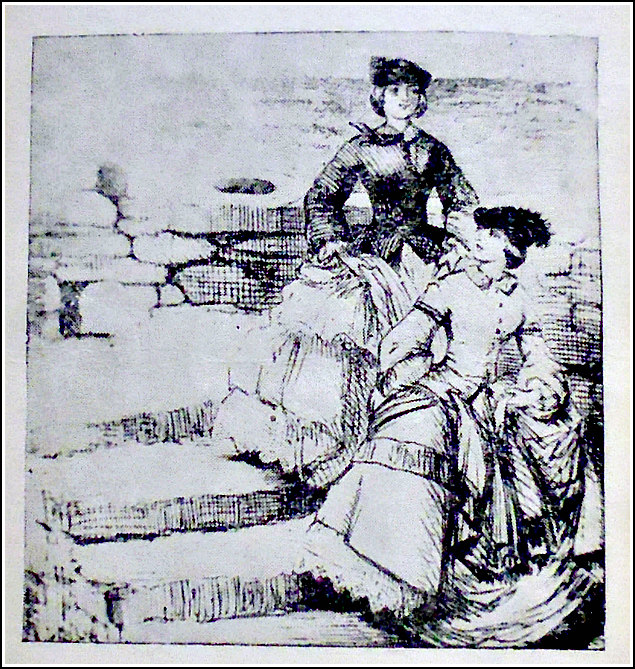
Sketch by John Leitch (1859). Two Victorian ladies having kissed the Blarney Stone.

   Reader’s Digest (1992) says of the Blarney Stone: “It is scrubbed with disinfectant four times a day to prevent any risk of transmitting disease”….and says: “Father Prout , the 19th century humorist and poet, wrote of it….. a stone that whoever kisses…. O he never misses…. To grow eloquent.” It goes on to say that: “The public ritual of kissing the Blarney Stone seems to date from the 18th century development of the Blarney Castle estate by the Jefferyes family. Some say the stone is  part of the Stone of Scone, the ancient crowning seat of Scotland’s kings, now in Westminster Abbey.” Also, Kevin Eyres & Michael Kerrigan (2008) add more information saying that: “Blarney Castle, built in 1446 by Dermot McCarthy, King of Munster, is one of Ireland’s oldest and most historic fortresses . The castle was the third to be built on the site by the McCarthys, whose stronghold it remained until Cromwell finally took it in the seventeenth century. Impressive as the castle is, it is the presence of the Blarney Stone, now rather prosaically referred to as the Stone of Eloquence, that makes Blarney Castle so internationally famous.”

   There are several theories as to where the Blarney Stone came from: it might have come from Israel where it was used as a pillow by the Hebrew Prophet Jacob (Yacob), or it came from Egypt and was the stone, or a part of it, that Moses struck “twice” in order to get water for his fellow travellers, while there is a legend that associates the stone with St Columba and it was maybe part of the Stone of Scone at which the kings of Scotland were crowned. More than likely the lump of stone is millions of years old and came from the local area.

   Mary Penelope Hillyard (1958) says of the Rock Close at the eastern front of the castle: “Here are a remarkable collection of massive boulders and rocks. Some of the rocks are arranged in circles. Others take on quaint shapes. A long, narrow rough stone staircase connects with a lower level in which a giant balanced stone, possibly a Druid tolmen stands.

   “The orderly arrangement of the various objects would indicate human planning rather than a haphazard setting by nature. Many of the Rock Close possessions have been by tradition and in folklore associated with witchcraft and magic. Among these are a wishing stairs, the Druidic circle, two caves (one known as the witch’s kitchen) and the fairy dancing green. Where the fancy ends and fact begins is difficult to ascertain. In the second half  of the 18th century James Jefferyes, then owner of Blarney Castle, found time to interest himself in the Rock Close, and its possible that he conceived the idea of setting out an ornamental garden here, on the lines of the Garzoni design often to be seen in the landscape gardens of Italy. There is evidence to show that Jefferyes made reconstructions. A large flat stone covering the wishing steps, with an inscription on it giving his name and the date 1759. Did Jefferyes, in fact, erect the wishing steps and arrange the other objects in the close—or did he merely renovate a far older construction?”

Sources and related websites:- 

Eyres, Kevin & Kerrigan, Michael, Ireland – Landmarks, Landscapes & Hidden Treasures, Flame Tree Publishing, Fulham, London, United Kingdom, 2008.

Hillyard, Mary Penelope, Blarney Castle and Rock Close, Woodlands Press, St Ann’s Hill, Blarney, Co. Cork, 1958. (The two images above are taken from this work).

Reader’s Digest, Reader’s Digest Illustrated Guide To Ireland, The Reader’s Digest Association Limited, London, 1992.

https://en.wikipedia.org/wiki/Blarney_Stone

https://blarneycastle.ie/pages/kiss-the-blarney-stone

https://sacredsites.com/europe/ireland/blarney_stone.html

http://www.theirishstore.com/blog/2016/05/18/guide-blarney-stone-people-kiss/

Blarney Castle Rock Close Gardens

                                                                                  © Ray Spencer, The Journal of Antiquities, 2017.


Dyffryn Ardudwy Burial Chamber, Gwynedd, North Wales

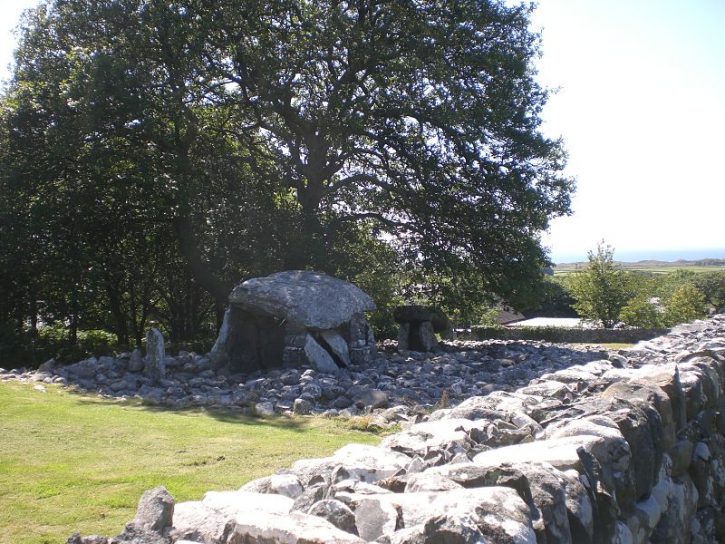
Dyffryn Burial Chamber outskirts. Pjposullivan (Creative Commons)

   OS Grid Reference: SH 5887 2284. Neolithic monument consisting of two independent burial chambers stands in a field, 200 feet above sea-level, at the east side of Dyffryn Ardudwy village, Gwynedd, on the western slopes of Moelfre Hill which rises to 1932 feet. Dyffryn Ardudwy is 5 miles north of Barmouth. The ancient monument from about 4000 BC is also known as a ‘chambered cairn’, ‘portal dolmen’ and ‘cromlech’; it goes by several other names including Arthur’s Quoit, Carreg Arthur and Coaten Arthur. These megalithic burial chambers or dolmens can be reached by way of a lane running east off the A496 (coast road to Harlech) just before, or after Bro Arthur, depending on which way you are walking, and then by a short footpath into the fields (passing close by the village school) for maybe 100 metres east of the village. It is marked by a large cairn of stones spread widely about and two burial chambers that are set-apart, each of them having upright slab-stones and huge sloping capstones.

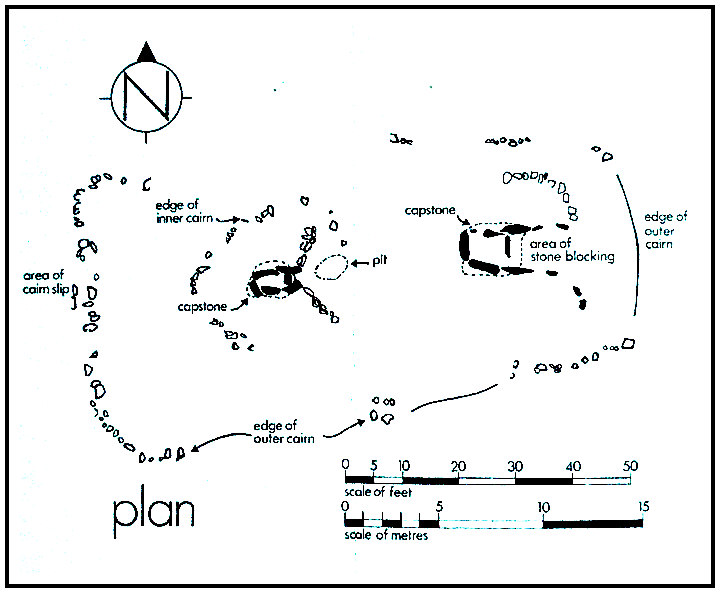
Dyffryn Ardudwy Burial Chamber, Gwynedd in North Wales. Plan.

   Some very good information is given in the following description by T. G. E. Powell, MA, FSA (Reader in Prehistoric Archaeology, University of Liverpool), and here quoted in full. He says: “It will be understood that the cairn  had been used over a long period as a quarry for stones to build the neighbouring walls and perhaps older structures no longer visible. Only the basal layers of cairn stones therefore survived, but sufficient to show that it had been roughly trapezoidal in plan, measuring  about 100ft in length, and in width some 35ft at the eastern end and 54ft at the western end. The cairn had a rough edge of small boulders. It’s bulk was made up of loose stones of kinds that could have been collected nearby. The megalithic slabs of which the chambers were built come from grits and slates of the Cambrian series and could have been obtained on the hillside. Excavation disclosed that there had been two periods of construction at the site. First, the smaller, western, chamber had been put up and surrounded by a small oval cairn. Later, but at perhaps no great lapse of time, the larger, eastern, chamber had been erected; then the trapezoidal cairn had been built to envelope everything. Whether this final cairn covered the capstones of both burial chambers cannot be proven, but it is likely that the cairn reached at least as high as their edges.

   “The construction of the western chamber shows it to be of a type often called for convenience a ‘Portal Dolmen’. At the higher, eastern end there is a pair of massive forward projecting stones with a high blocking stone between. These form a portal although one that is blind or non-functional. Access to the chamber was doubtless over the low slab forming the southern side. The floor of the chamber consists of a single large flat rock probably found here in its natural position by the original builders. The markedly sloped position of the capstone resting on the two portal stones and on the end stone of the chamber should be noted as characteristic of the Portal Dolmen type.

   “The eastern chamber was much more ambitious in construction, especially in the width to be spanned and in the weight of the capstone that was raised into position. It was found necessary in 1961-62 to provide additional support for this great roofing stone and a buttress was built on either side of the chamber for this purpose. This chamber stands some 28ft east of the other and is itself some 12ft long, splaying in width from 5 to 7ft. A low cross-slab with broken upper edge should be noted near the eastern end within the chamber. This may have stood to a greater height, thus acting as a partial closing stone. The gap between its free end and the southern side of the chamber was found to have been filled with blocks. A gap towards the rear in the walling of the north side of the chamber may have been intentional as it was spanned only by small flat slabs and no socket for a missing upright came to light. Eastwards of the cross-slab, the projecting walls of the chamber provided a kind of covered portico; then there was an open area bounded by small uprights of various heights, more or less continuing the shape of the portico. Finally, all this area the cross-slab outwards was sealed up with a massive blocking of sloped slabs and cairnstones. 

   “The original contents of the western chamber (Portal Dolmen) are unknown and had doubtless long been destroyed, but a pit under the cairn, just in front of the portal, produced a quantity of potsherds of a recognizable Neolithic ware. The original deposits in the eastern chamber had not been so much thrown out as thoroughly disturbed and mixed up with modern rubbish. Potsherds of several kinds were however found, as well as two polished stone pendants and some traces of cremation burials.”

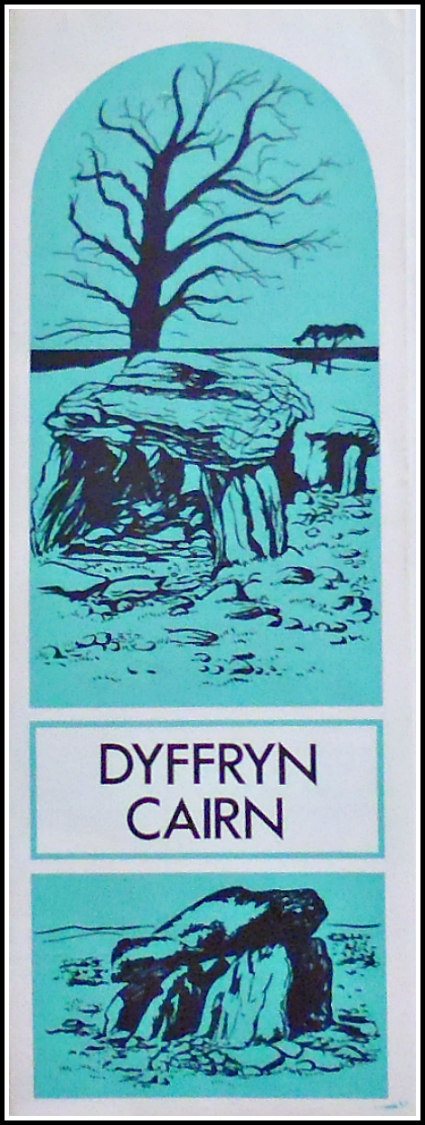
Dept of Environ-ment & H.M.S.O leaflet

   T. G. E. Powell in his conclusion of the site at Dyffryn Ardudwy says that: “This chambered cairn is a com-posite burial monument first having consisted of a small megalithic chamber of Portal Dolmen type surrounded by a small oval cairn. The  Portal Dolmen type is widely distributed in the coastlands of Wales, in Cornwall, and in Ireland. The Neolithic pottery found in the pit associated with this chamber at Dyffryn Ardudwy is related  to similar  wares known from Pembrokeshire and Cornwall. It was not possible to obtain any material during the excavation suitable for radio-carbon measurement so that only a suggestion based on other evidence can be given about date. On present information it seems likely that this Portal Dolmen was erected the middle of the third mill. BC. Subsequently, a larger megalithic tomb was built and the cairn proper to this chamber was extended so as to envelope the older monument to the west. The somewhat irregular shape of this cairn may be explained by this factor in conjunction with the slope of the ground. Pottery recovered from the eastern chamber belonged to various types and suggested a period of use beginning a little later than that of the Portal Dolmen, continuing perhaps to the opening of the second mill. BC. The general structural characteristics of the eastern  chamber, and its trapezoidal cairn, suggest a mixing of building practices owing something to the Portal Dolmen tradition, but more to influences coming by pastoral routes through the mountains from the Cotswolds and south-eastern Wales.”

   Chris Barber & John Godfrey Williams (1989) say of this site that: “On early Ordnance Survey maps they are marked as Cromlech and as Burial Chamber on later ones.” Bill Anderton (1991) says that: “As part of an outbreak of light phenomena, columns of light were seen issuing from the ground here in 1905. The site stands on the Morchras geological fault.” Christopher Houlder (1978) describes it as a “long cairn” and also adds that: “The cairn lies in an area of some of the finest Iron Age cultivation terraces in the country, visible on the hillside above.” And Jacquetta Hawkes (1975) informs us that: “The Dyffryn long barrow is approached through the iron gates of the village school and will be found alongside the playground not many yards from the highway. Hawkes goes on to say: “The barrow was excavated in the 1960’s revealing a long and complex history.”

Sources and related websites:-

Anderton, Bill, Guide To Ancient Britain, Foulsham, Slough, Berkshire, 1991. 

Barber, Chris & Williams, John Godfrey, The Ancient Stones of Wales, Blorenge Books, Abergavenny, Gwent, 1989.

Hawkes, Jacquetta, A Guide To The Prehistoric And Roman Monuments In England And Wales, Cardinal (Sphere Books Ltd.,) London, 1975. 

Houlder, Christopher, Wales: An Archaeological Guide, Faber & Faber, London, 1978.

Powell, T. G. E., Dyffryn Cairn – the megalithic chambered cairn at Dyffryn Ardudwy, Merionethshire, Dept of the Environment Ancient Monuments and Historic Buildings on behalf of the Welsh Office – for H. M. S. O, 1973.

https://en.wikipedia.org/wiki/Dyffryn_Ardudwy      The photo (above) from the Wikipedia website is displayed under the Creative Commons Attribution Share-Alike License.

http://cadw.gov.wales/daysout/dyffrynardudwyburialchamber/?lang=en

http://www.megalithics.com/wales/dyffryn/dyffmain.htm

http://www.megalithic.co.uk/article.php?sid=4449

                                                                                     © Ray Spencer, The Journal Of Antiquities, 2017.


Pinder Hill, Waddington, Near Clitheroe, Lancashire

Pinder Hill, Waddington, Lancs, site of a Bronze Age burial.

   OS Grid Reference: SD 7272 4368. Pinder Hill at Waddington in the Ribble Valley, 2 miles northwest of Clitheroe, Lancashire, was the site of a Bronze Age burial mound. Sadly the tumulus has been destroyed and there is no sign of it today. The hill is actually a series of hil-locks in the corner of a field to the west of the parish church of St Helen. These grassy hillocks look unassuming and ordinary today, but there used to be a small burial mound or barrow on the higher part of Pinder Hill and, in the late 19th century, a funery urn was excavated here. The artefacts from Pinder Hill were later deposited in Clitheroe Castle Museum. However, the site seems to be on ‘private land’ but it can be approached from the north-side along Belle View Lane via a field gate a bit further along, or from Twitter Lane! at the south-side where a metal gate beside the driveway of the house ‘might’ allow accesss?  There is parking on the opposite side of the lane in front of the playground.

Pinder Hill, Waddington, in the Ribble Valley, Lancashire.

Pinder Hill, Waddington. Looking along the ridge of the hill.

   Pinder Hill is a series of grassy hillocks at the western side of Waddington village. They were formed from glacial deposits consisting of smooth and rounded pebble-like stones worn-down many thousands of years ago by the movement of ice and water; these stones can clearly be seen where parts of the structure of the mounds have eroded and fallen away. It could be there was a settlement here in the Bronze Age? There was a small burial mound or round barrow on the summit of the hill but this was probably destroyed in the late 19th century when a gravel pit or quarry was being worked. But luckily the mound was seen to be of significant archaeological interest and its funery contents recognized as an ancient burial; the plain collared urn and pigmy vessel were later taken to the local museum for safe-keeping. What makes this site ‘so extra appealing’ is the babbling little brook that flows tranquilly at the very edge of the field, opposite the grassy hillocks of Pinder Hill.

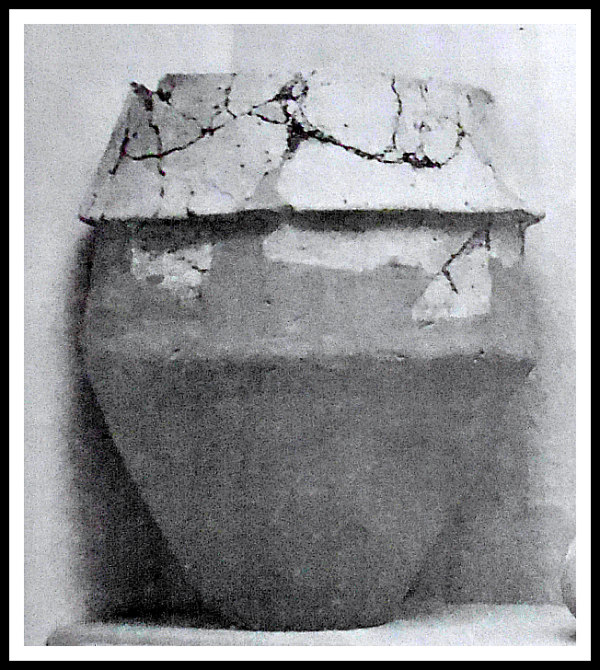
   John & Phillip Dixon (1993) say of this site: “To the south-west of the Buck Inn stands a hillock of glacial debris known as Pinder Hill. A small mound on the summit of the rise was excavated in 1887 and yielded a Bronze Age burial urn. Inside the urn, which was inverted, was a mass of broken and partly calcinated bones, more than half filling it.

   “Within this mass was found an ‘incense cup/pygmy urn’, two worked flints and a worked bone object. The presence of an ‘incense cup’ is thought by some to mark a female burial, the openwork pattern indicating basketry being particularly the work of women. Yet given the inverted position of the large urn the smaller may have been merely a stopper and may have no other significance.

   “The flints are of the type used for the preparation of skins and preparing thongs of hide. The bone object is a toddle used to fasten a coat or other. These finds are now on display in Clitheroe Castle Museum.”

    John Dixon goes on to say that: “Bronze Age axes have been found at Up-Brook Farm, Waddington, and the horn of a ‘auroch’, extinct during the Bronze Age, in the Ribble at Low Moor.”

Pinder Hill, Waddington. Drawing of the urn and pygmy cup/vessel.

Pinder Hill Bronze Age Collared Urn.

   The site entry for Pinder Hill in ‘Lancashire Archaeological Bulletin’ (1984) says:- “Plain collared urn inverted and containing A.V. found 22 June 1887 in, digging gravel pit. Contents included two flints and ? toggle of calcined bone (?).” The primary source is given as Y. A. J. 30;248. In the work  ‘Life In Bronze Age Times’ (Thomlinson & O’Donnell) some more information is given. It says that: Pinder Hill is a burial site dated as Middle Bronze Age, 1600-1500 B.C. On excavation in 1887 it revealed two vessels and many bone fragments. The urn…..was found to contain the cremated remains of a dead man. The use of the smaller vessel or incense cup is unknown.” The site is also mentioned by Ian H. Longworth in his (1984) work ‘Collared Urns: Of The Bronze Age in Great Britain and Ireland’. In this we find that the dimensions of the large urn were 15 inches in height, the small accessory vessel was 3 inches high.

Sources and related websites:-

Dixon, John & Phillip, Journeys Through Brigantia, Volume Nine: The Ribble Valley, Aussteiger Publications, Barnoldswick, 1993.

Lancashire Archaeological Bulletin, Vol. 10 No. 2/3, May & July 1984.

Longworth, Ian H.,  Collared Urns: Of the Bronze Age in Great Britain and Ireland, CUP Archive, 1984.

Thomlinson, Sarah & O’Donnell, John,  Life In Bronze Age Times, (A Resource Book for Teachers), Curriculum Development Centre, Burnley.

                                                                                 © Ray Spencer, The Journal Of Antiquities, 2017. 


High Wall Well, Bramley Meade, Whalley, Lancashire

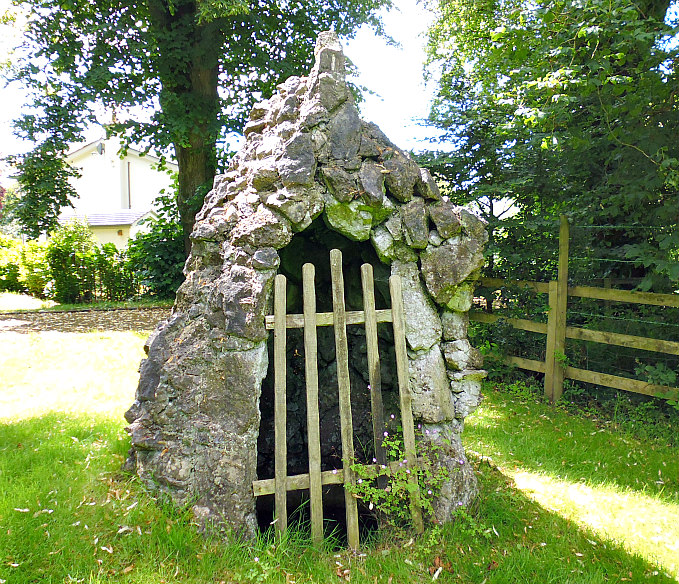
High Wall Well, Bramley Meade, near Whalley, Lancashire.

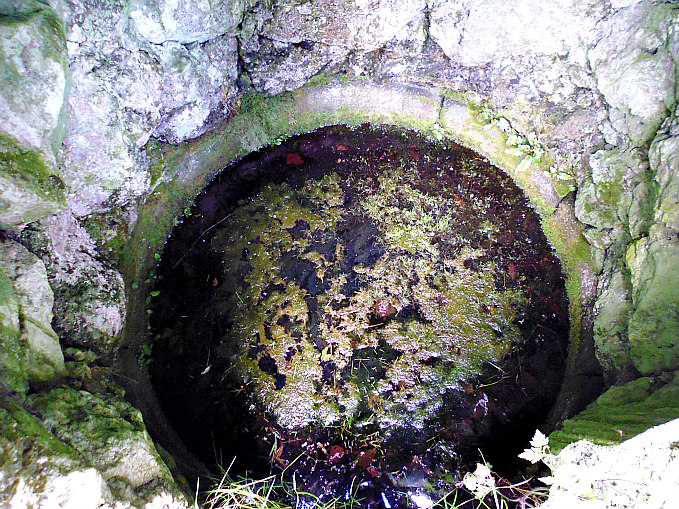
   OS Grid Reference: SD 73660 37014. Medieval well in the grounds of the former Bramley Meade Maternity Hospital, near Whalley, in the Ribble Valley, Lancashire. The structure is thought to date back to when Cistercian monks lived at the nearby abbey. It has, however, never been considered to be a holy or medicinal well as such though it was used by the monks and, in more recent times, maybe by the maternity hospital itself. This curious stone grotto-like structure surrounds what appears to be a fairly deep water-filled circular well basin, which may originally have been in use as a “plunge pool”, or in medieval times as a baptistery? A bit of a problem to reach though as its on private land, but you can maybe ask for permission to view the well from the lodge building on Clitheroe Road, or at the main entrance on Wisewell Lane walk up the driveway for a short distance, then turn sharp left and go through the wrought-iron gates (if open) passing the beautifully restored Neo-Classical style water-fountain with carved ladies around its wellhead, which stands in front of the former hospital building; the well is a little further along at the right-hand side on the grassy area. 

High Wall Well at Bramley Meade. Looking down into the well’s circular basin.

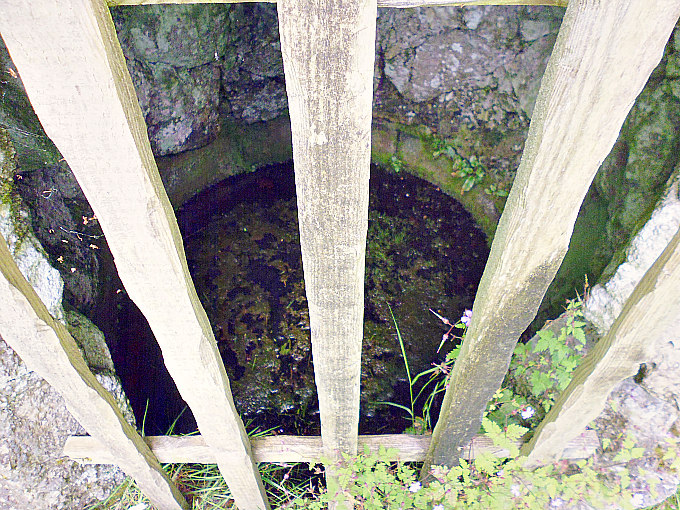
High Wall Well at Bramley Meade (the entrance).

   This curious looking well-house with its circular water-filled basin is now perhaps rather forgotten, although it is still of great interest to the town of Whalley in the Ribble Valley. The well-house stands at 8 feet in height and surrounds what looks to be a deep circular basin or plunge pool. It might have been used as a baptistery in late medieval times, but there is uncertainty about that. There are apparently three steps goings down into the water where the entrance is, but I could not see them when I looked down as the water was quite mucky and filled with grass cuttings. It’s an odd mixture of lumps of small and large stones cemented together in a crude sort of fashion to make it look grotto-like, but inside the stonework looks much stronger and more complete and, becoming more circular as the structure tapers downwards, forming the well basin which has the appearance of being more ancient perhaps. At the top of the well-house roof is a sort of crude stone pinnacle. Today, for safety reasons the well entrance has a sort of picket fence barring the way, which is very sensible given the possible deepness of the water.

    Apparently the well was originally called ‘Hey Well’ or ‘Hey Wall Well’ after the area in which it stands; more likely the name has just altered over the centuries and in more recent times become High Wall Well. There is an 18th century map showing the area where the well is situated in a book by Jimmy Fell (1979), who also says the well supplied the abbey. The well is briefly mentioned in History of the County Palatine and Duchy of Lancaster, Volume 3′. In this it is referred to as having no medicinal qualities but was used by the monks “as a cold bath.” And John & Phillip Dixon (1993) give us a few more interesting details about the well. They say that: “High Wall Well is sited inside the grounds of Bramley Mead Hospital. Covered by a grotto-type structure, the waters are reached by descending three steps. It is said to be the clearest and purest spring in the Whalley district, the only one that was never polluted.

   “Perhaps for this reason the Abbey monks laid leaden pipes from the well into their convent, sections of which have been located by the local History and Archaeological Society.”

Sources of information:-

Baines, Edward, History of the Palatine and Duchy of Lancaster (Volume 3), Fisher, son & Company, Lancashire, 1836.

Dixon, John & Phillip, Journeys Through Brigantia, Volume Nine: The Ribble Valley, Aussteiger Publications, Barnoldswick, 1993. 

Fell, Jimmy, Window on Whalley, Countryside Publications Limited, Brinscall, Chorley, Lancashire, 1979.

                                                                                  © Ray Spencer,  The Journal Of Antiquities, 2017.


St Peter’s Church, Prestbury, Cheshire

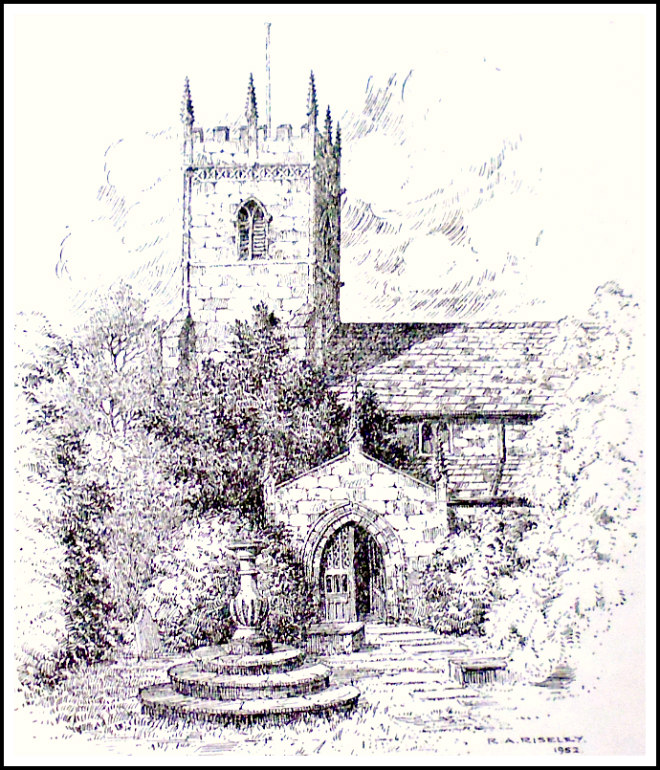
St Peter’s Church   (R. A. Riseley, 1952).

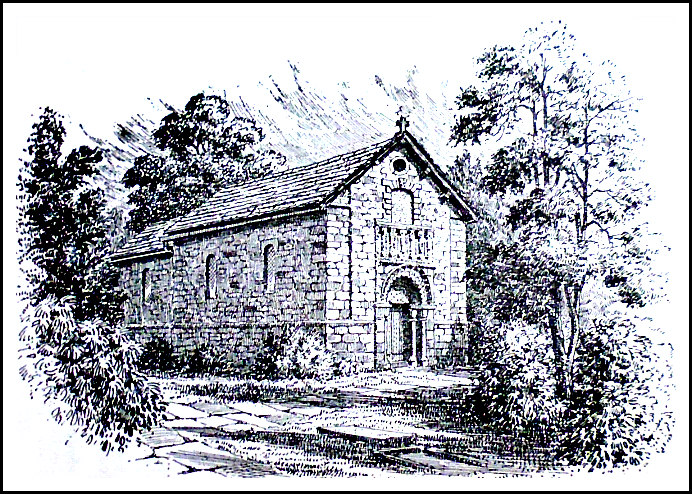
   OS Grid Reference: SJ 90082 76935. The 13th and 14th century grey sandstone parish church of St Peter at Prestbury, Cheshire, is located at the southwest side of the village, close by the A538 road (the village road), and just opposite The Bridge Hotel. The village is located some 4 miles to the southeast of Wilmslow. The River Bollin flows near the church. There was probably a late Saxon church on this site, or close by, in the 11th century. There is the obvious evidence with regard to that early church in the churchyard where there’s a very well-put-together monument made-up of two large fragments of Saxon crosses, which has some very nice, almost Celtic-like, carvings. Also in the churchyard a 12th century Norman chapel with a carved doorway that has some outstandingly beautiful sculptural work: above the doorway is a tympanum with “Christ in Majesty” and above that seven carved figures that are now sadly defaced.

   The parish church has some medieval features including an Early English three-light lancet window (1220-30) at the north side of the chancel and a 13th century piscina with carved head in the south aisle, while the 13th century font was recut in the 19th century and has carved heads of monks from St Werburgh’s Abbey. In the north aisle is a 14th century figure of St Nicholas. There is a nice oak rood-screen of 1787. The crenellated church tower is of 1480. Also of interest some late medieval carved (incised) coffin slabs. The earliest coffin slab is built onto the north wall of the chancel and has a foliated calvary cross and a Latin inscription to Reginald Legh, Esquire, son of Robert Legh, Knight, foremerly Lord of Adlington. He built the church tower and porch. Reginald died in 1482. Apparently there was a priory hereabouts in the 14th century and, in the century following, there was a monastic hospice (Spittal House), which in more recent times became a farm. After the Norman Conquest the manor and church came into the possession of the Earl of Chester and, by 1153 Hugh Kyvelioc, Earl of Chester, had given the same manor and church to the Abbey of St Werburgh at Chester. Another interesting slab in the north wall of the chancel shows Sir Edward Warren of Poynton, who is represented in full armour; around the border is a Latin inscription: “Here lyeth the body of Edward Warren of Poynton, Knight, which departed from this transitory life the 12th day of October, in the year of our Lord God, 1558. Whose soul God pardon. Amen.”

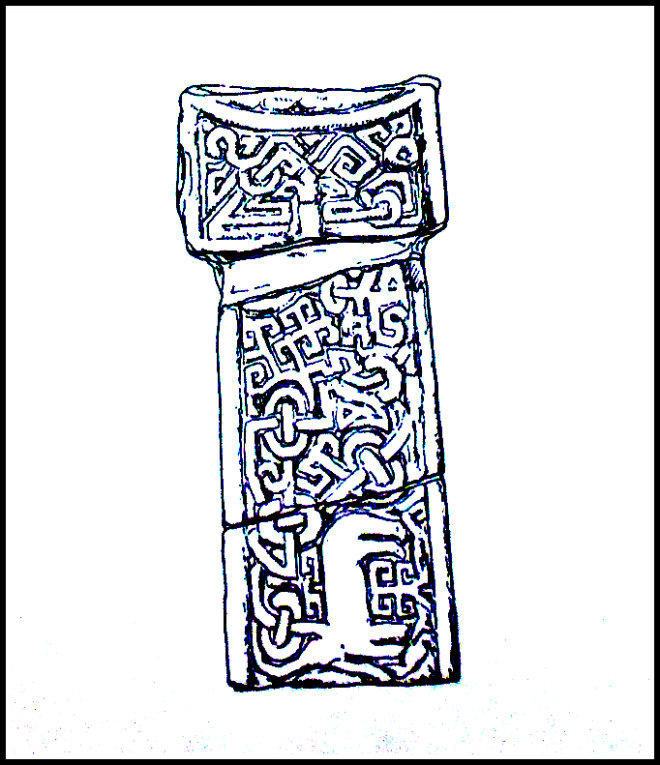
Saxon Cross in St Peter’s Churchyard by R. A. Riseley.

   The Anglo-Saxon cross in the churchyard is actually two sections of different crosses that have been delicately placed together to form a T-shaped ancient monument; the carvings looking much more Celtic in design than Saxon. This may be due to the close proximity of Prestbury to the Welsh border and, we know that that border was as far east as Chester and Warrington back in the so-called Dark Ages, and so the Celtic influence was stronger. The cross fragments were discovered about 1841 when restoration work on the chancel was taking place; the sandstone fragments were embedded in the masonry. Originally the carved fragments were presumed to date from the 8th century, but today they are considered to be from the 10th or 11th century. It is richly carved all over with interlacing, interlinking and key-pattern designs. At the bottom there is a strange creature with a large, open mouth and several tails and a possible human figure, while there is a second human figure in the centre of the top T-shaped section. All-in-all a very beautiful piece of sculptured stonework, be it Celtic or Anglo-Saxon? Also in the churchyard a Grade II listed sundial dating from 1672.

Norman Chapel at St Peter’s Church, Prestbury, by R. A. Riseley, 1955.

   At the southeast side of the parish church stands the 12th century Norman Chapel. According to the booklet ‘Prestbury and its Ancient Church’ (1952): “The building which stands close to the present Church and which is generally known as the “Norman Chapel”, was probably built on the site of the more ancient Saxon edifice. It has a beautiful Norman doorway, a fine specimen of its kind. Over the doors is a tympanum representing “Christ in Majesty,” a subject which occurs in 21 other Norman tympana in England. Above on the corbel table are seven figures, now much defaced, which are of great interest, being unique in Christendom. Their interpretation seems to be as follows: The central figure represents God the Father holding the law in His left hand typified by an open book, and the Gospel in the right hand as fore-shadowed by the cross; conjointly justice and mercy are portrayed. The figure to the right with the animal (the Norman method of drawing a lamb) seems to stand for Christ, the Lamb of God , seated at the right hand of the Father. The figure to the left, having a resemblance to a bird, typifies the Holy Ghost in form of a dove. Collectively these three figures stand for the Trinity. St Peter with the key is shown in the sixth figure. To this saint the church was dedicated as is its successor at the present day. Figure two represents the monarch who reigned when the oratory was built, and this is almost certainly Richard I, Coeur de Lion, he being the first of the Norman kings to bear the budded scepter surmounted by a plain cross as here shown. The brings the date of the oratory within the year of his coronation, 1190, and that of his death, 1199.

   “The warrior with battle axe, figure one, and priest with staff, figure seven, represent the military and ecclesiastical government of the county palatine. The figures then may be, when taken together, interpreted as follows: “”In the name of the Blessed Trinity, this church, dedicated to St. Peter, was built by the abbot and monks of St Werburgh in the reign of Richard I, when Randle Blundeville was Early of Chester.”” 

   The Parish church of St Peter is a Grade I listed building and the Norman chapel is a Grade II listed building.

Sources & Related Websites:-

Bottomley, Frank, The Church Explorer’s Guide, Kaye & Ward Ltd., London, 1978.

Rogers, Harold, W (forward by the vicar), Prestbury and its Ancient Church, Macclesfield Press Ltd., 1958? (Drawings by R. A. Riseley).

The AA, The Illustrated Road Book Of England & Wales, The Automobile Association, London, 1961.

Churchyard Cross, Prestbury, Cheshire

https://en.wikipedia.org/wiki/St_Peter%27s_Church,_Prestbury

https://historicengland.org.uk/listing/the-list/list-entry/1221919

http://www.crsbi.ac.uk/site/1197/

                                                    © Ray Spencer, The Journal Of Antiquities, 2017.


1 Comment

Churchyard Calvary Cross, Great Mitton, Lancashire

Medieval Calvary cross at Great Mitton, Lancs.

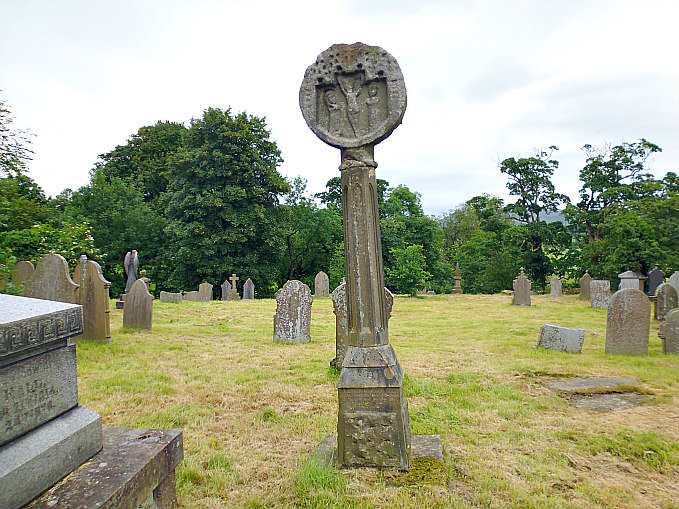
   OS Grid Reference: SD 71555 38958. In the churchyard of All Hallows parish church at Great Mitton in the Ribble Valley, Lancashire, stands a late Medieval round-headed calvary cross which is beautifully carved with scenes from the crucifixion of Christ. The long tapering shaft and base of this Grade II listed monument are, however, more recent in date, but the sculptured cross-head is ‘still’ a very wonderful sight to behold. It may have originated in one of the local abbeys that were destroyed at the Dissolution. And close by there is another monument: a very delightful late 17th century sundial with a curious inscription running around its shaft. The church of All Hallows can be reached from the B6246 – some 2 miles northwest of Whalley. A short distance after the Aspinall Arms public house and the River Ribble the church is almost on the corner of Church Lane where the entrance to the churchyard is just around the corner, hidden in the trees on the right-hand side.

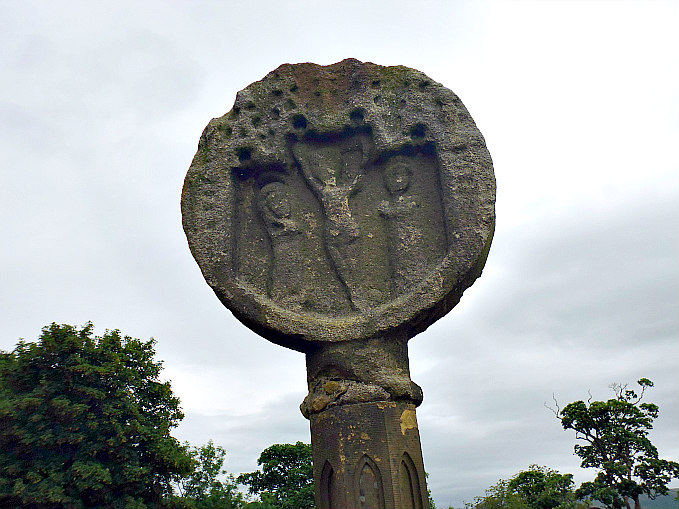
Churchyard ‘Calvary’ Cross, (West Face).

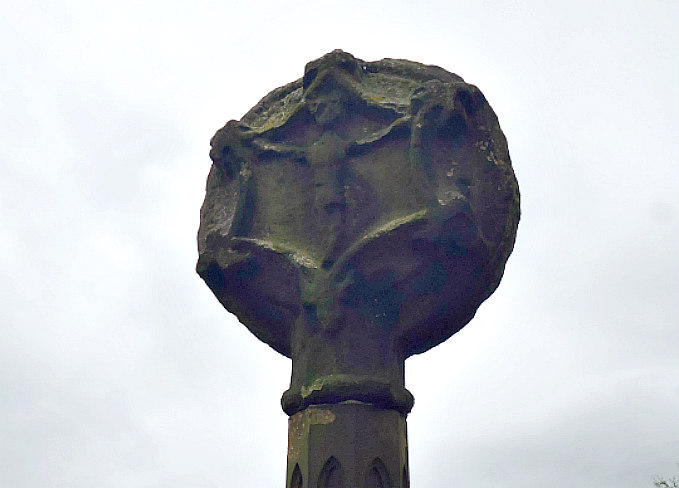
Churchyard ‘Calvary’ Cross, (East Face).

   This 14th century round-headed sandstone calvary cross is mounted on a long thin octagonal shaft that tapers away near the top and has a squared base bearing an inscription; both the shaft and base date from the mid-1800s. The original shaft has long since gone. It is often referred to as being of the Gothic period. On its W face there are three figures: Christ crucified in the centre with St Mary Magdalen and St John the Evangelist at either side of him, while the E face has a rather eroded figure of Christ on his own and crucified. Below that there is foliage. Both sides of the cross-head have tracery. All in all this is a very beautiful Christian monument and all credit to the mason who carved it. But I do think it should be placed inside the church in order to preserve it from the ravages of the weather.

   It is uncertain from where the cross-head originated but it could have come from either Whalley or Sawley Abbey. It would seem to be in this case, though, that it was actually brought from Cockersand Abbey, Lancashire; and in more recent times it was rescued from the bed of the nearby River Ribble, where it may have been hidden by the monks who from time-to-time resided at Mitton Hall, just opposite the church. Some of the wooden furnishings inside the 13-15th century church of All Hallows did indeed come from Sawley Abbey, near Clitheroe, after the dissolution of that religious house in 1536. Cockersand Abbey in north Lancashire was dissolved in 1539.

   The square base of the calvary cross-shaft has a Victorian inscription recalling the XIII hundredth year of the introduction of Christianity. The cross is now a Grade II listed monument. Also in the churchyard a sundial on a thin shaft, dating from 1683, which has a brass gnomon and plate, and an inscription in large ornate letters and numerals running around the bulbous middle section of the shaft.

Sundial in All Hallows Churchyard.

   The renowned authoress Jessica Lofthouse, writing in 1974, does not mention the churchyard cross but makes mention of Mitton Hall. She says that: “the buttressed gable end of Great Mitton Hall where the priests of Cockersand Abbey lived when they served the church in early days, make a happy composition with green slopes, trees and cattle, and industrious anglers knee-deep in the flowing river.” The highly respected local author, John Dixon, briefly mentions the churchyard cross. He also mentions The Three Fishes Inn at Great Mitton and says that: “Over the doorway……. are mounted a number of stones said to have come from Whalley Abbey.” 

Sources and related website:-

Bottomley, Frank, The Abbey Explorer’s Guide, Kaye & Ward Ltd., London, 1981.

Dixon, John & Phillip,  Journeys Through Brigantia (Volume Nine) The Ribble Valley, Aussteiger Publications, Barnoldswick, 1993.

Lofthouse, Jessica, Lancashire Countrygoer, Robert Hale And Company, London SW7, 1974, 

https://en.wikipedia.org/wiki/All_Hallows_Church,_Great_Mitton

http://www.megalithic.co.uk/article.php?sid=26292

http://www.daelnet.co.uk/features/churches/skptpend/gtmitton.htm

                                                    © Ray Spencer, The Journal Of Antiquities, 2017.


Watersheddles Cross, Near Scar Top, Lancashire-Yorkshire Border

Watersheddles Cross, near Scar Top, on the Lancs-Yorks border.

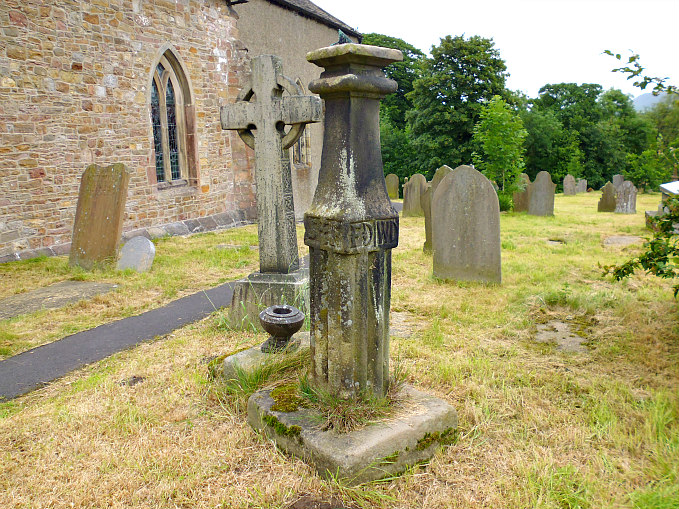
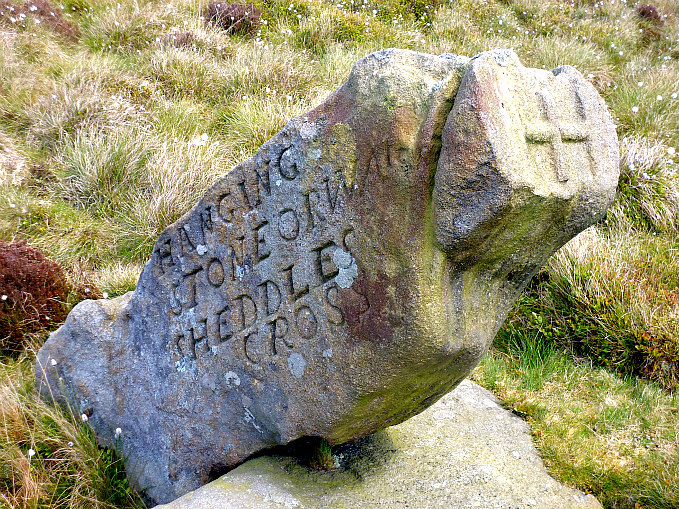
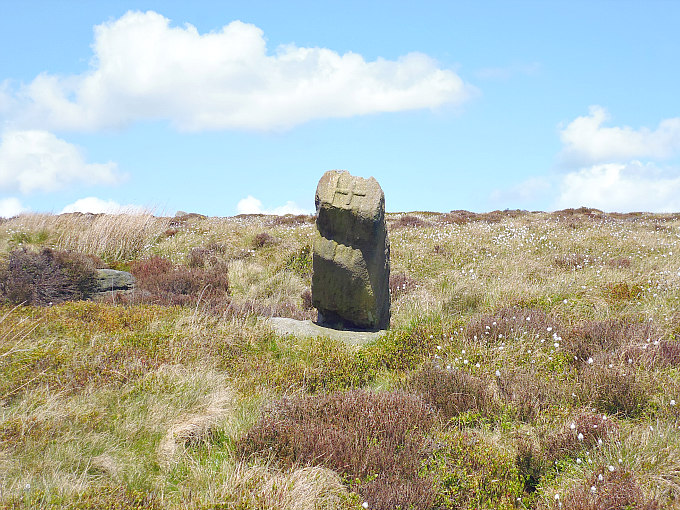
   OS Grid Reference: SD 97121 38282. On the southern flank of Kiln Hill and overlooking the northern end of Watersheddles Reservoir, near Scar Top, is the Medieval boundary stone called Watersheddles Cross or Hanging Stone which, even today, marks the boundary between Lancashire and Yorkshire. The old stone now leans over at a considerable angle but is still recognizable for what its original purpose was; and maybe it was an ancient standing stone from prehistory. It has a rather crude inscription on one side with the name in large letters. It is, though, uncertain why it also has the name ‘Hanging Stone’ and what that means with regard to the stone. The cross can be reached from the little boundary stone on Two Laws Road – just after the reservoir and going towards Scar Top. Follow the wall up the moor on an undefined path to a metal gate, then continue up beside the wall until that stops and veers off in the opposite direction. You will see the Watersheddles Cross more or less in front of you.

Watersheddles Cross (with recent carving)

Watersheddles Cross on Lancs-Yorks boundary

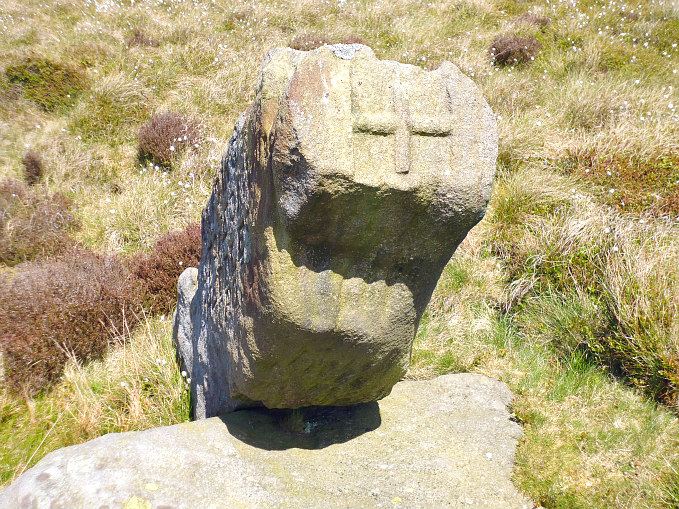
   The Watersheddles Cross or Hanging Stone is a rough-hewn length of stone some 6 feet long that leans at a 45° angle or maybe more and is held in position against another lump of stone, with yet more lumps of stone at its base and surrounding it. It used to stand upright. Maybe long ago in the mists of time there was a wooden cross here, but this rotted away and had to be replaced by a stone one. This rough pillar of stone may have originated from somewhere else on the moor, and perhaps it had been a standing stone from prehistory, though whether it was we don’t know with any certainty. However, the stone was apparently brought to its present location in the 14th century and, sometime after that, probably after 1618, the large lettering on its west side carved onto it. The nice little cross at the top of the stone has obviously been carved more recently, maybe the 19th century, and the top part of the stone cut-away to allow for this. So “why” is it also called ‘Hanging Stone’ – that we don’t know, but there are many other rocks and stones that have this name. There are other boundary stones further up the moor to the north towards Wolf Stones, an outcrop of gritstone rocks which are visible from here.

Sources and related websites:-

Water Sheddles Cross, Oakworth Moor, West Yorkshire

https://historicengland.org.uk/listing/the-list/list-entry/1009495

http://www.bradfordhistorical.org.uk/boundary.html

http://www.pastscape.org.uk/hob.aspx?hob_id=46131

                                                   © Ray Spencer, The Journal Of Antiquities, 2017.

1 Comment

Jacob’s Well, Near Littleborough, Lancashire-Yorkshire Border

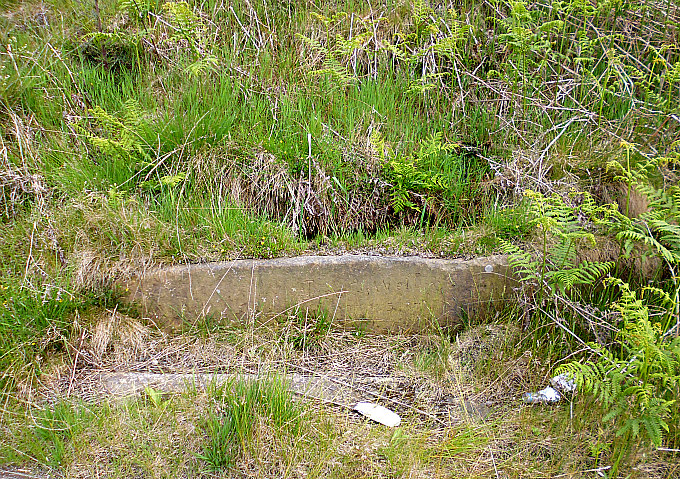
Jacob’s Well beside the A58 near Littleborough.

   OS Grid Reference: SD 96381 17068. At the side of the A58 (Halifax Road) close to Blackstone Edge Roman road, near Littleborough, and not far from the Lancashire-Yorkshire border is the now almost forgotten ‘Jacob’s Well’, a sacred spring that is hidden in the grass and fearns at the side of the busy, windswept moorland road that links the two counties. Some 280 metres east of the well is the so-called Roman road that climbs over Blackstone Edge and then heads to the fort at Ilkley. Presumably the Roman soldiers who marched along this Roman road knew of the presence of this ancient spring, which they may have even dedicated to one of their gods and, before that, the Celts would have also recognized it as a sacred spring. In more recent times it has acquired the dedication to Jacob, who might be the biblical prophet of the Old Testament, and is sometimes called St Jacob by Orthodox Churches. The well is to be found about halfway up the A58 road (right-hand side) and just 100m past where a wooden gate and footpath leads off to the east to meet up with the Roman road. At the top of the A58 road, on the opposite side, is the well-known landmark White House public house.

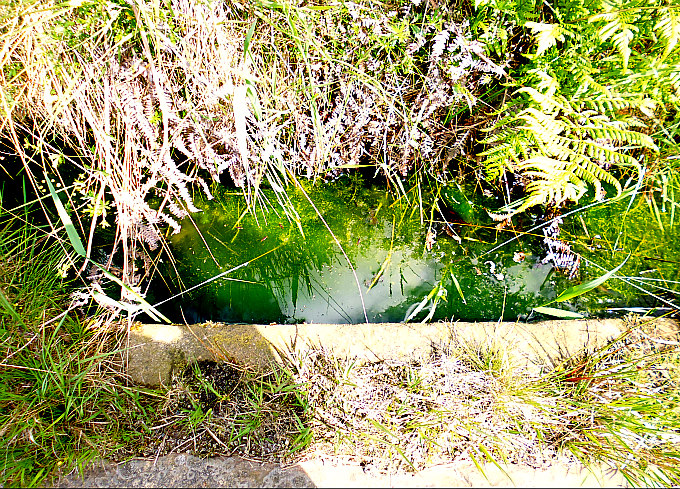
Jacob’s Well (close-up).

   At the front of the well there is a very long sandstone slab that has the inscription ‘Jacob’s Well’ carved onto it and some other letters just below that, but its difficult to tell what this says. It looks as though the inscription was carved in more recent times. The water is held in what looks to be a large and deep stone trough just behind the carved slab, but there is much foliage surrounding the well and so it is difficult to give any measurements. On the day of my visit the water was slimy green in colour and most certainly “not” drinkable.  There doesn’t appear to be any record of this well, whether it be holy or sacred, is not really known and the dedication to Jacob is uncertain. It could perhaps be named after the Biblical Jacob (Yacob) who was the Hebrew prophet and patriarch of the Old Testament. He is venerated as St Jacob by the Orthodox Churches. There are other wells named after Jacob, one at Bradford, west Yorkshire, and another at Matlock Bath, Derbyshire, but there are a few others in England. The name “Jacob” is also “James”, so these wells could be dedicated to a person with that name, perhaps even St James?

    According to tradition Jacob lived in the land called Canaan in Palestine, but died at Goshen in Egypt at a very great age. He was the son of Isaac and Rebecca, grandson of Abraham, twin brother of Esau, and nephew of Ishmael. He had twelve sons and one daughter, called Dinah. This therefore makes his sons (and maybe a grandson) the progenitors of ‘The Twelve Tribes of Israel’. The Bible tells us that God gave Jacob the name “Israel.” It is said [traditionally] that Jacob died in 1,711 BC at the great age of 147, his body brought back to Canaan by his sons or grandsons, and buried in the Cave of Machpelahphet where the Prophet Abraham lay, and also Rebecca, his mother, and Leah, his first wife; his second wife was Rachel. The famous ‘Jacob’s Ladder’ story is often told recalling a dream that he had about a ladder which reached from earth to heaven. Tell Balata 1½ miles southeast of Nablus, Palestine, is the site of the ancient Canaanite city of Shechem (Sichem) and Jacob’s Fountain (Bir Ya’qub). This is perhaps the well where Jesus spoke to a Samaritan women called Photini and drank water to quench his thirst (John’s Gospel). 

Sources and related websites:-

Aid to Bible Understanding, Watchtower Bible And Tract Society of New York, Inc & International Bible Students Association, Brooklyn, New York, U.S.A., 1971.

Rogerson, John, Atlas of the Bible, Time-Life Books, Amsterdam, 1993

Blackstone Edge Roman Road, Littleborough, Lancs-Yorks Border

https://en.wikipedia.org/wiki/Jacob

https://www.thoughtco.com/jacob-father-of-12-tribes-of-israel-70116

                                                   © Ray Spencer, The Journal Of Antiquities, 2017.

Affetside Cross, Near Bury, Greater Manchester

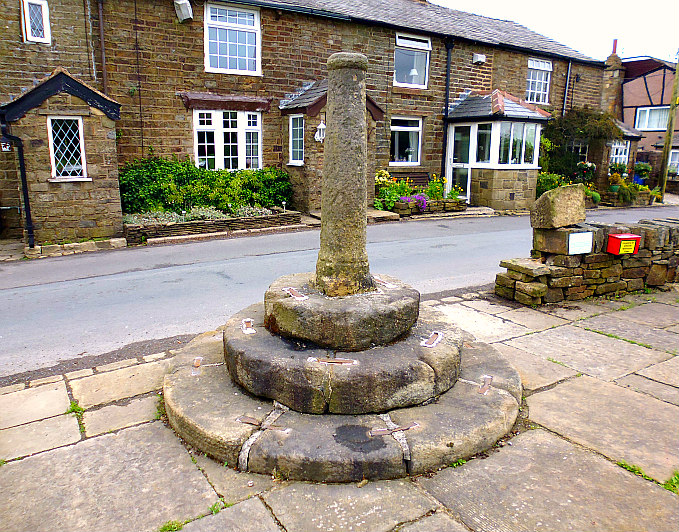
Affetside Medieval Cross, near Bury, in Greater Manchester.

   OS Grid Reference: SD 75471 13676. At the edge of Affetside village green, near Bury, Greater Manchester, stands an old cross of uncertain date. It is probably Medieval but, because it stands on the old Roman road (Watling Street), some historians have even considered it to be a Roman cross or milestone, or even a Roman column, but that seems unlikely. It is probably a pilgrims cross. Watling Street runs southeast from Affetside towards Manchester, and northwest in the opposite direction towards Ribchester. The village green has some modern standing stones and a large pond. Affetside Cross is best reached from the A 676 (Ramsbottom road) and then southeast for ½ a mile along the almost straight-running lane that is the Roman road, bringing you into the picturesque little village, where you’ll find the old cross beside the green – you can’t really miss it!

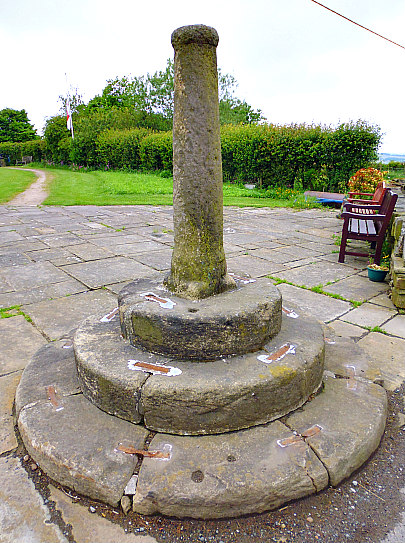
Affetside Cross.

   Affetside cross is about 4¼ feet high on its three steps, well actually two steps, as the top step is in effect the base which the gritstone shaft is socketed into, while the two lower circular, tiered steps are well worn with age. The shaft is formed from one complete length of local stone. At the top of the shaft there is a collar with a round or bun-shaped capital which may originally have held a stone cross, or maybe it never did? This is perhaps why the cross-shaft has taken on the appearance of a Roman column! There looks to be some faint carving on the shaft, or is this simply the mason’s tool marks. Thought to be Medieval in date and probably a pilgrims cross that was used ‘as a place to stop and pray for a safe journey’ by those weary but very religious travelers – making their way to Whalley Abbey by way of Bury, Ramsbottom, Helmshore, Holcombe Moor and Accrington – from the late 13th/early 14th century until the Dissolution of that holy place in 1537, when pilgrimages ceased. It would seem though the present monument is a market cross and more recent in age maybe 17th century, being re-erected about 1890, according to Pastscape.

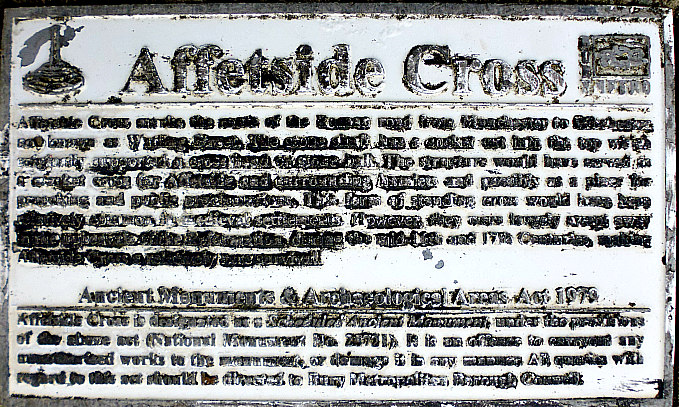
Information Plaque (now very hard to make out).

   The village of Affetside stands on the Roman road Watling Street which runs from here into Manchester (Mamucium) where there was a Roman fort and settlement, while in the opposite direction it runs to the fort at Ribchester (Bremetennacum). Is it possible that the pillar of the Affetside cross was a Roman milestone as the village is actually about halfway between the two forts; maybe it was re-fashioned by Medieval masons into what we see today. Or does the cross mark the site of a beacon – at which time an earlier monument or cross had stood here, apparently. These questions can never really be answered with certainty, we can only guess.

   Authoress Jessica Lofthouse (1964) does not say anything about Affetside cross but she mentions the village and Roman road, saying that: “Driving the civilizing power of Rome through the north-west came Julius Agricola and his road-builders in 79 A.D. Follow the line of the Manchester-Ribchester highway through Affetside and north by Blacksnape and Over Darwen.”

Sources and related websites:-

Lofthouse, Jessica, Lancashire Countrygoer, Robert Hale Limited, London, 1964.

Shotter, D. C. A., Romans in Lancashire, Dalesman Publishing Company Ltd., Clapham, Yorkshire, 1973.

http://affetside.org.uk/cross_history.htm

https://en.wikipedia.org/wiki/Affetside

http://www.pastscape.org.uk/hob.aspx?hob_id=44366&sort=4&search=all&criteria=affetside&rational=q&recordsperpage=10

http://www.bury.gov.uk/index.aspx?articleid=11677

                                                    © Ray Spencer, The Journal Of Antiquities, 2017.


St Patrick’s Chapel And Rock Graves, Heysham, Lancashire


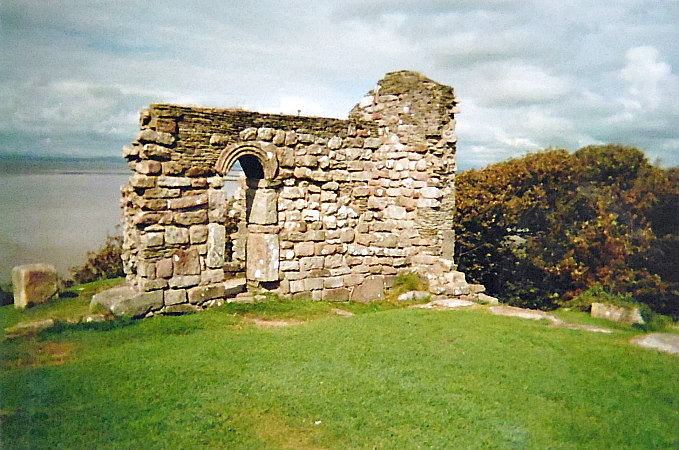
St Patrick’s Chapel on Chapel Hill, Heysham.

   OS Grid Reference: SD 40980 61628. On the headland above St Peter’s parish church at Heysham, in Lancashire, stand the ancient ruins of St Patrick’s Chapel, a Saxon building dating from either the 8th or 10th century AD. Also upon Chapel Hill, overlooking Heysham Sands, and just opposite the ruined chapel there are two sets of rock-hewn graves that are said to date from the 11th century AD. It is thought to be very unlikely that Ireland’s patron saint ever set foot on Heysham Head, as much as that makes for a very good story, although beneath the ruined chapel’s stonework there are the foundations of an earlier Celtic-style chapel – maybe dating back to the 6th century AD. To reach St Patrick’s Chapel: from Main Street take the rough track that heads west past St Peter’s churchyard entrance, and then slightly up hill for a while, then take the footpath that veers off the rough track for a few metres up to Chapel Hill and the ruined chapel with the curious rock-cut graves close by.

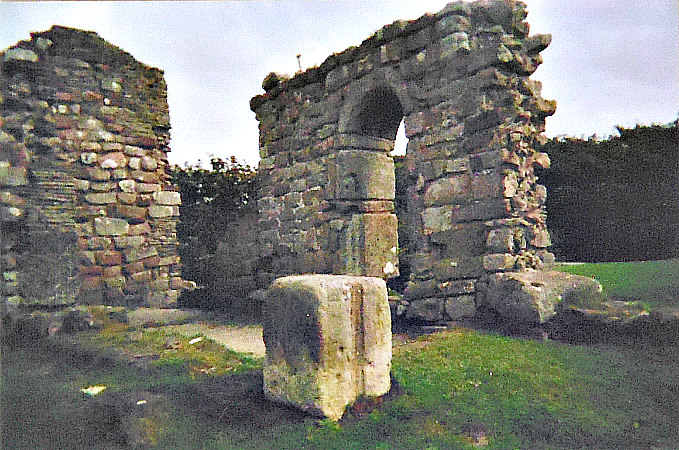
St Patrick’s Chapel, Heysham, from a different angle.

   The chapel measures 27 feet by 6 feet and is built from large, rough-hewn lumps of sandstone, with thinner rubble coursework sections between and at the top, but the curved Saxon doorway is by far the best part of the structure. According to Richard Peace (1997) the sandstone blocks that make up the chapel are: “fused together by molten shells.” However, a large part of the chapel has now gone through robbery of the stonework, or it has been used elsewhere in the vicinity, or maybe just lost to time. But beneath the ruin there are the foundations of an earlier Celtic-style chapel of the 5th or 6th century AD. It had been thought that the little building dated back to c750 AD, but in reality it probably dates from the 10th century AD, which would make it “contemporary with the earliest part of St Peter’s Church”, according to Eileen J. Dent (2003).

   The original Celtic chapel beneath the present ruin was most likely “due to the efforts of monks from Ireland, acting as missionaries to St Patrick”, says Eileen J. Dent. It’s almost certain that St Patrick of Ireland never set foot in Heysham, although traditionally he was shipwrecked off the Lancashire coast in the 5th century AD. More likely his followers came here. There are, however, a few holy wells named for him in the area. Nikolaus Pevsner (1979) says of the chapel that it is: “A plain rectangle, 27½ by 9 ft. The S doorway has an arch made of one with concentric grooves. Dating varies between the c8 and c9.”                                                                                              

   Author Eileen J. Dent says that: “In 1977-8 archaeologists found decorated plaster among the foundations of the earlier building. From discoveries, it would seem that the chapel was used only for worship and burial, and never used as a place of habitation. For example it could not have been a hermitage. There is no registration of the chapel as a chantry.

   “The chapel and the ground to the south were used as burial places. Some skeletons were found within the chapel and many more in the ground outside. The soil level is very shallow, and although the skeletons were in layers, none was buried deep.

   “G. Grainger, in an as yet unpublished paper [1977-8], says that the skeletons were generally in a poor condition, but there was probably a total of between 78 and 84 individuals, of various ages, and of both sexes. His tests showed that about one fifth of the population died before the age of 10 and that none survived beyond the age of about 45. After examination the bones were re-interred in the present churchyard.”

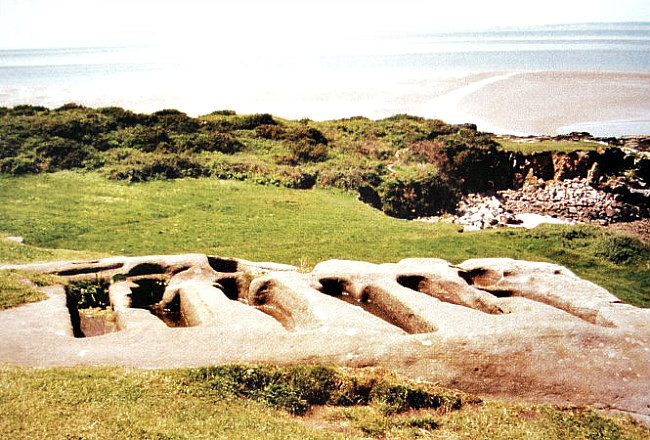
Rock-cut graves at Heysham, Lancashire

   Opposite St Patrick’s Chapel are six rock-hewn graves that are carved out of a large flat sandstone rock. Two of these are straight-sided and four body-shaped, each having a hole at the top, which might have been for a wooden cross. Close by there are another set of two graves but these look to be of a later, Medieval date, maybe from the 13th century? The set of six graves are thought to date from the 9th-11th centuries AD, but more likely to be of the latter century, which would make them Viking in origin. The question must be then, were the priests that served St Patrick’s chapel buried in these graves? That we don’t know but I would think they probably were. Today the rock graves are often filled with rainwater. The graves are Grade II listed and a Scheduled Ancient Monument.

   Author Eileen J. Dent says that: “The stone-cut graves were also examined in the 1977-8 dig. These are not unique. There are other rock-cut graves in the Isle of Man, and similar ones in Spain (Aragon). Archaeologists say that ‘a primary date is likely’, that is, contemporary with the first occupation of the site, but little is known about them, except that they were more likely to be reliquaries than containers for whole bodies.”

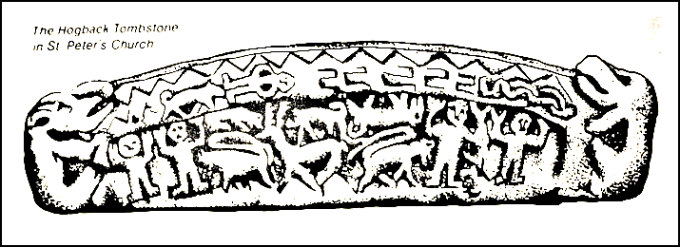
Illustration of the Hog-back tombstone in St Peter’s, Heysham.

   Below Chapel Hill stands the ancient parish church of St Peter parts of which date back to the Saxon period. Beside the pathway to the church there is the stump of an Anglo Saxon cross-shaft, which might be of the 9th century AD. It stands at just over 2½ feet high and is in the form of a house with windows and a door carved onto it – with faces and figures looking out. There is perhaps an association here with the visit of the three Marys to the sepulcher, or the raising of Lazarus, according to Nigel & Mary Kerr (1982). The upper three windows have faces looking out and a shrouded figure in the doorway below. There is also a round-headed panel (west face) with a saint holding a book, and below that and on the sides are foliage scrolls, say Nigel & Mary Kerr. Housed within the church (south aisle) is a hog-back tombstone of the 10th or 11th century AD. This used to stand out in the graveyard but was brought into the church (1961). It is richly decorated with scenes of stag-hunting from the Norse Legend of Sigurd. There is also zigzag carving, and at either end strange creatures cling to the stone, but whether they are hogs or bears is open to question. Almost certainly it was the gravestone of a wealthy Viking warrior.

Sources and related websites:-

Dent, Eileen, J., Heysham – a History, The Rector & Parochial Church Council of St Peter’s Church, Heysham, & Heysham Heritage Association, 2003.

Fields, Ken, The Mysterious North, Countryside Publications, 1987. 

Kerr, Nigel & Mary, A Guide To Anglo Saxon Sites, Paladin (Granada Publishing Limited), St Albans, Herts, 1982.

Peace, Richard, Lancashire Curiosities, The Dovecote Press Ltd., Stanbridge, Wimborne, Dorset, 1997.

Pevsner, Nikolaus, The Buildings of England – North Lancashire, Penguin Books Ltd., Harmondsworth, Middlesex, 1979. 

https://en.wikipedia.org/wiki/St_Patrick%27s_Chapel,_Heysham

https://historicengland.org.uk/listing/the-list/list-entry/1020535

http://www.sandhak.co.uk/html/history_of_heysham.html

https://en.wikipedia.org/wiki/St_Peter%27s_Church,_Heysham

                                                                                © Ray Spencer, The Journal Of Antiquities, 2017. 


Brownshill Dolmen, County Carlow, Southern Ireland

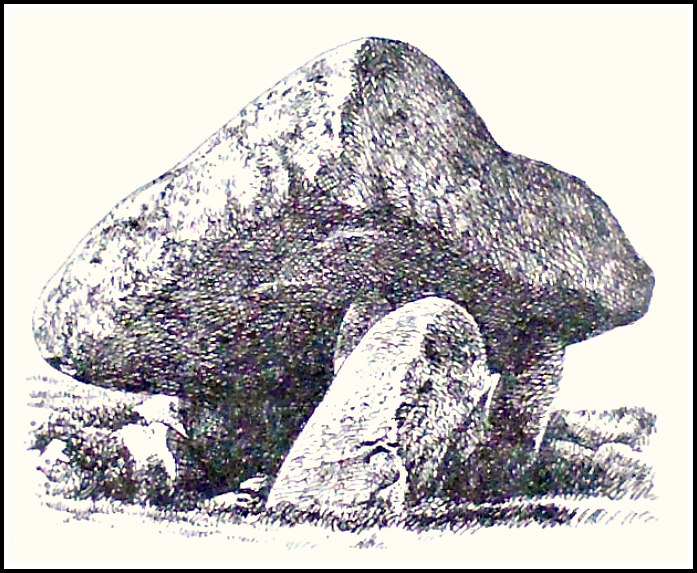
Brownshill Dolmen in Co Carlow, Southern Ireland

   Irish Grid Reference: S 75440 76846. In a field a little to the east of the village of Browneshill in County Carlow, Southern Ireland, is the Neolithic monument known as ‘Brownshill Dolmen’ or ‘Brownshill Portal Tomb’ and sometimes as Browne’s Hill Dolmen. But it also goes under the name of Kernanstown Cromlech. The monument has a huge capstone weighing over 100 tonnes, But sadly, however, it has lost its covering mound of earth and a few of its upright supports have collapsed under the enormous weight of the top-stone, although three uprights at the front are still supporting it – two of which form the portal (entrance) to the tomb. The dolmen is located almost 2 miles east of Carlow town near the R726 road. It is best reached to the east of Browneshill village: from the R726 (Hacketstown road) at Ballinakillbeg take the footpath for 550m that heads south from the road, then heads west for quite a distance, and then north to the ancient monument – which stands in the corner of the field.

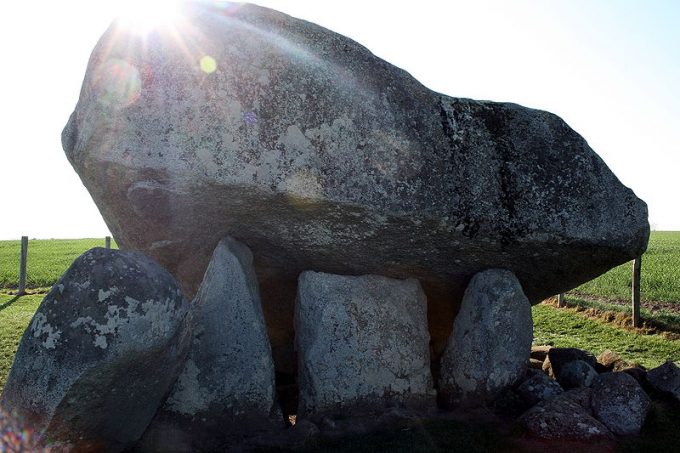
Brownshill Dolmen. Photo by Sarah777 (Creative Commons).

   The Brownshill Dolmen is really much like a ‘stone table’ or ‘tombstone on legs’ resting horizontally (vertically) on up-right stones’; but it is also called a cromlech and portal tomb (a tomb with an entrance). In the Nicholson ‘Guide To Ireland’, we are told that the: “Browne’s Hill Dolmen……with largest capstone in Ireland, if not Europe, 5 feet thick, 20 feet square and weighing over 100 ton. Two up-right portal stones (orthostats) support the huge granite capstone at the front, while the third supporting stone is a ‘gate-stone’ or ‘blocking stone’; these three entrance stones are between 5-6 feet high. There is a fourth stone at the front which may have been part of the forecourt, although this points at an angle away from the tomb. At the back of the monument two recumbent stones support the capstone near ground-level, but whether these two stones collapsed under the weight or were originally placed like this, is not known. I would think they were placed as such. Originally the tomb was covered by a mound of earth. The megalithic monument is said to be almost 4,000 years old and was the burial place of a Stone Age chieftain, according to Reader’s Digest ‘Illustrated Guide To Ireland’.

Sources of Information and related websites:-

Nicholson, Guide To Ireland, Robert Nicholson Publications Limited, London, 1983.

Reader’s Digest, Illustrated Guide To Ireland, The Reader’s Digest Association Limited, London, 1992. 

https://en.wikipedia.org/wiki/Brownshill_Dolmen                                                                                                                         https://en.wikipedia.org/wiki/Brownshill_Dolmen#/media/File:IMG_BrownshillDolmen.jpg

https://irisharchaeology.ie/2016/04/brownshill-portal-tomb-co-carlow/

http://www.megalithic.co.uk/article.php?sid=6333452

                                                                                       © Ray Spencer, The Journal Of Antiquities, 2017.


1 Comment

Saxon Sundial at St Gregory’s Minster, Kirkdale, North Yorkshire

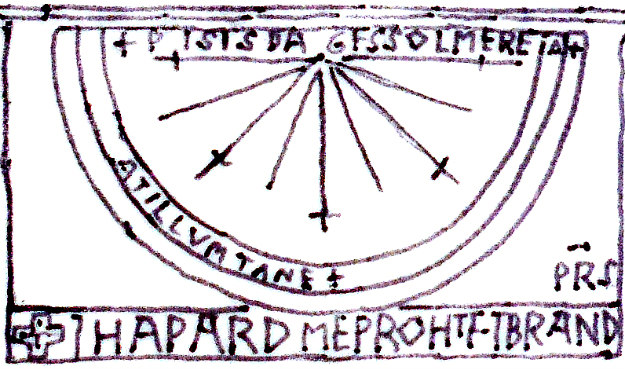
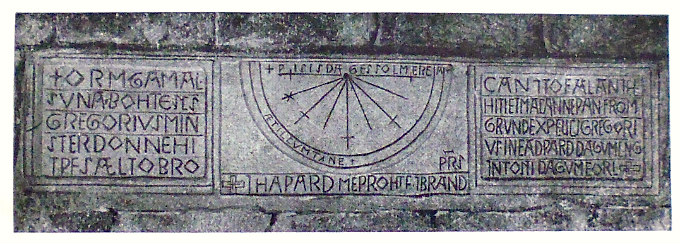
Anglo-Saxon Sundial at St Gregory’s Church, Kirkdale, north Yorks.

OS Grid Reference: SE 67688 85776. Above the inner south door of the ancient minster-church at Kirkdale near Kirkbymoorside, north Yorkshire, there is an Anglo-Saxon sundial of unique standing that is most beautifully carved and inscribed. It was reputedly carved in 1060 AD, just before the Norman Conquest of Britain. Also in the church which is dedicated to St Gregory are two carved Saxon grave-slabs and a number of fragments of Anglo Saxon cross-heads, and other antiquities most of which probably date from the late medieval period. The church of St Gregory is built on the site of an Anglo-Saxon church and monastery that was perhaps founded by St Cedd, or St Aiden, sometime after 650 AD. Though St Cedd was thought to have founded Lastingham church (659). This secluded church is 1½ miles to the west of Kirbymoorside village and just north of the A170 Helmsley to Kirkdale road. It can be reached on narrow country lanes – one of which is called Back Lane – the church being located at the northern end of ‘this’ country lane and in the opposite field above. 

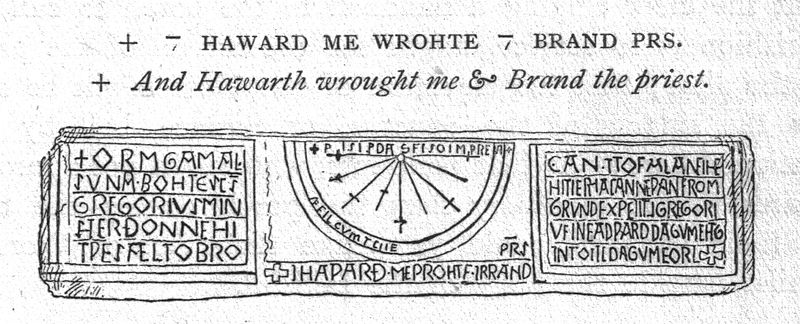
The church guidebook compiled by Mr Arthur Penn in 1970 is very helpful here. It says  that: “The dial seems to be in its original position, and consists of a stone slab, seven feet long, divided into three portions. The centre one is the dial, while the outer ones contain an inscription recording the rebuilding of the church, and giving a fairly exact date.

“The dial itself is divided into eight, which accords with the octaval system of time division, common among the Angles. The double cross on the first line denotes ‘daegmael’ or ‘day-time,’ and may be the time of the first service. The inscription above reads:- ‘This is day’s sun marker at every time.’

Kirkdale Sundial by:- Charles J. Wall (1912). Wikipedia.“The outer panels are curious in that the lettering on the first is even and well-spaced, while that on the third is compressed and yet it still was not able to hold the whole inscription, which was continued at the foot of the second panel. Clearly the work was never planned out. The inscription in modern language reads:- Orm Gamal’s son bought S. Gregory’s Minster when it was all broken down and fallen and he let it be made anew from the ground to Christ and to S. Gregory in the days of Edward the King and of Tosti the Earl. And Haward me wrought and Brand Priests. 

 “The inscription also tells us that the work was carried out in the days of King Edward (the Confessor) and of Earl Tosti. Tosti or Tostig, who became  Earl of Northumberland in 1055, was banished for a variety of crimes, including the murder of Orm’s father, Gamal, in 1065, but returned with Harold Hardrada, King of Norway, in the following year. The Norwegian army fought against Tostig’s brother, Harold  Godwinson, King of England, at Stamford Bridge, and there both Tostig and his Norwegian ally were killed. After the battle Harold Godwinson carried out his forced march to Hastings, where he was killed in battle by the Norman army of William the Conqueror. The sundial thus dates the building between 1055 and 1065. Its inscription in Northumbrian English has traces of runic characters, but is not difficult to decipher.”

Kirkdale Saxon Sundial (a close-up of the dial).

Nigel & Mary Kerr (1982) tell us more about the hours of the day shown on the sundial. They say that: “The lines with cross bars correspond with 6 a.m., noon , 3 pm., and 6 p.m., the uncrossed lines divide each tide into one-and-a-half-hour periods. The line with a cross on it on the left-hand side of the dial denotes 7.30 a.m., which marked the beginning of ‘day time'”. They also say with regard to the panels at either side of the dial: “that Orm rebuilt the church in the reign of Edward the Confessor, and the central inscription reads, in translation: ‘This is the day’s sun-marking at every hour. And Hawaro made me, and Brand, priest [?].'” 

St Gregory’s minster-church houses a number of antiquities from the Anglo Saxon period. There are two sculptured coffin lids in the north aisle one of which is called ‘The Ethelwald Stone’ which dates from the 10th century and recalls Aethelwald, King of Deira, while another called ‘The Cedd Stone’ has interlacing and is thought to date from the 10th century. This also has carvings on its side including V-shaped tassels with little ball-ends. This may be a representation of a pall, which was a cloth draped over a coffin. If it was, then the work was doubtless very fine, providing another outlet for the needleworking skills of Anglo-Saxon ladies, say Nigel & Mary Kerr (1982). In the north aisle there are a number of fragments of cross-heads from the 11th century  – one of which has been fashioned from pock-marks rather than the usual design of one continuous line. Also in the north aisle is ‘The Archer’s Stone’, while at the eastern end of the aisle a 14th century fragment with the Virgin and Child carved upon it. The octagonal font is Transitional and 13th century in date.

Ella Pontefract, writing in 1937, says of the minster that:- “Kirkdale is a satisfying church in a most beautiful situation, and it should not be missed.” Malcolm Boyes & Hazel Chester (1996) also reflect on the beauty of the place and its location in the peaceful valley beside Hodge Beck.

 Sources of information and related websites:-

Boyes, Malcolm & Chester, Hazel, Discovering The North York Moors, Smith Settle Ltd., Otley, West Yorkshire, 1996.

Jones, Lawrence E. & Tricker, Roy, County Guide To English Churches, Countryside Books, Newbury, Berkshire, 1992.

Kerr, Nigel & Mary,  A Guide to Anglo Saxon Sites, Paladin (Granada Publishing Limited), London, 1982.

Penn, Arthur (Compiler), St Gregory’s Minster Kirkdale, Parochial Church Council, 1970.

Pontefract, Ella, The Charm of Yorkshire Churches, The Yorkshire Weekly Post, Leeds, 1936-7.

https://en.wikipedia.org/wiki/Kirkdale_sundial

https://en.wikipedia.org/wiki/St_Gregory%27s_Minster,_Kirkdale

http://greatenglishchurches.co.uk/html/kirkdale.html

http://www.ling.upenn.edu/~kroch/scand/kirkdale.html

http://www.megalithic.co.uk/article.php?sid=13357

                                                                                       © Ray Spencer, The Journal Of Antiquities, 2017.

3 Comments

Din Lligwy Ancient Settlement, Near Moelfre, Anglesey, Wales

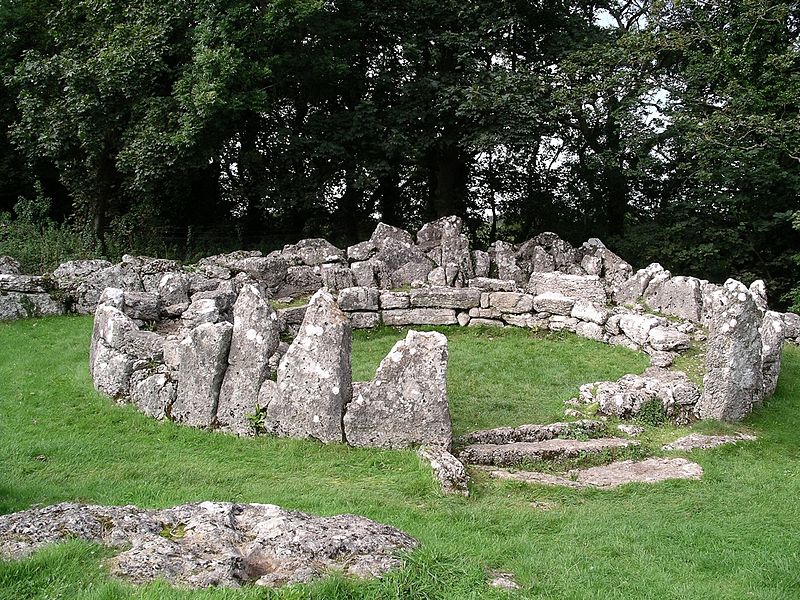
House foundations at   Din Lligwy by Velela (Wikimedia Commons).

   OS Grid Reference: SH 49717 86134. At the eastern edge of Coed cae’r-gaer woods near Rhos Lligwy, Anglesey, stands the well-preserved ancient settlement of Din Lligwy, dating for the most part from the 3rd and 4th centuries AD when it was occupied by a Romano-British tribe, though the first settlers here were people from the late Iron Age period. Set within a walled enclosure there are a couple of hut circles, rectangular structures, and a gatehouse-type building at the entrance. The site is located to the east of the A5025 road about 1 mile west of Moelfre, and not far from the east coast of Anglesey. A little to the northeast of Din Lligwy is Hen Capel Lligwy, a ruined medieval chapel while just over to the east stands the Lligwy Neolithic burial chamber. There is a car-parking area and information boards on the lane over to the east of the site, and a footpath run to the west for 300m, passing close to the ruined chapel, and then to Din Lligwy ancient settlement which nestles in a woodland clearing.

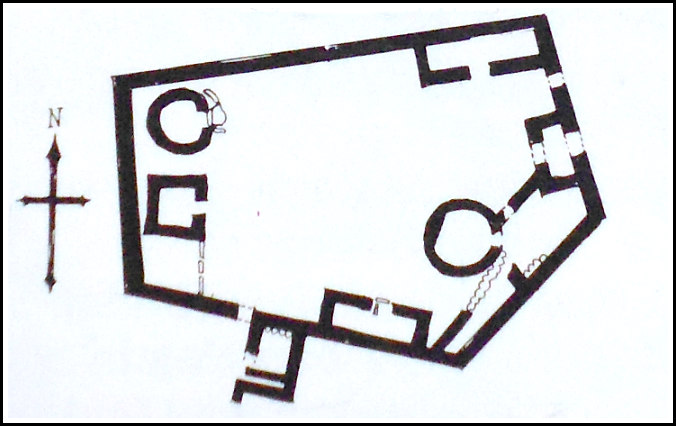
Plan of Din Lligwy Ancient Settlement, Anglesey.

   The ancient settlement or village of Din Lligwy covers about ½ an acre and measures roughly 56m x 53m and is pentagonal-shaped (with five-sides). It sits upon a limestone plateau at the edge of a low hill. Although its limestone walls were built for a partly defensive (fortified) purpose at the time, its more likely they were simply built to ‘enclose’ the buildings, but they obviously followed the standard pattern of earlier Iron Age construction. Inside the enclosure walls are two well-preserved hut circles, or round-houses, built from large limestone slabs around the sides, and also four rectangular-shaped buildings, one of which was perhaps the chieftain’s house, while beside the original entrance (NE side) another building that was probably a gate-house; the entrance (SW side) is later as is the little exterior building. The enclosure walls are a staggering 4-5 feet thick.

    Jacquetta Hawkes in her work ‘A Guide To The Prehistoric And Roman Monuments In England And Wales’, says of this site that: “Within a stout enclosure wall, there is a group of houses, two of them circular, but the rest rectangular in plan and all spacious, splendidly built and almost intact. Nearly all the walls show a massive construction with an inner and outer facing of large slabs and a packing of smaller stones. Din Lligwy shows signs of having buildings of more than one period, but it is known to have been inhabited during the Roman occupation down to the fourth century A.D.; it must surely have been the stronghold of some chieftain of unusual standing—one would like to think that the lord himself lived in the larger round house, a place quite worthy to rank as a Celtic palace.”

   The author Christopher Houlder writing in 1978 says of Din Lligwy: “The two round huts used as living quarters are likely to have been part of an open settlement of early Roman date, included in the strong pentagonal enclosure in the late IV century A.D. Six hearths in two of the rectangular buildings show that they were used for iron workshops, but one was a gatehouse.”

   We don’t know much about the people who lived at Din Lligwy apart from they were Romano-British, but they were probably subservient to the Romans and almost certainly supplied the army with iron weapons and tools made in their own smelting workshops. In this case, then, they were very useful to the Romans and so were more or less left in peace. To the people of Din Lligwy though this situation ‘served as a means to an end’. Then at some point between 385-400 AD they abandoned their settlement/homestead. The Roman army withdrew back to Gaul at about the same time. “There is no evidence that this outstanding site was lived in after about AD 400”, according to Harold Priestley (1976). The site was excavated between 1905-7 when “finds here have included Roman pottery and coins which may be an indication that the occupants were on friendly terms with the Romans”, says Chris Barber (1987).

   Hen Capel Lligwy (Old Lligwy Chapel) over to the northeast is a ruined 12th century chapel with some interesting Norman features. On the opposite side of the lane to the east (at OS grid ref: SH 50135 86039) is the Lligwy Neolithic burial chamber or cromlech. This has a huge capstone that is said to be 18 feet in length, and weighing 28 tons, according to Janet & Colin Bord (1994). “When excavated, the remains of 30 persons were discovered together with animal bones and pottery”, says Harold Priestley (1976).

Sources of information and related websites:-

Barber, Chris, More Mysterious Wales, Paladin, London, 1987.

Bord, Janet & Colin, Ancient Mysteries of Britain, Diamond Books, 1994.

Hawkes, Jacquetta,  A Guide To The Prehistoric And Roman Monuments In England And Wales, Cardinal (Sphere Books Ltd., London, 1975.

Houlder, Christopher, Wales: An Archaeological Guide, Faber & Faber, London, 1978. 

Priestley, Harold, The Observer’s Book of Ancient & Roman Britain, Warne & Co Ltd., London, 1976.

https://en.wikipedia.org/wiki/Din_Lligwy

http://www.megalithic.co.uk/article.php?sid=1494

http://www.anglesey-hidden-gem.com/din-lligwy.html

http://cadw.gov.wales/daysout/dinlligwyhutgroup/?lang=en

http://www.coflein.gov.uk/en/site/95541/details/din-lligwy-settlement-moelfre

                                                                                         © Ray Spencer, The Journal Of Antiquities, 2017.


1 Comment

The Craw Stane, Rhynie, Aberdeenshire, Scotland

The Craw Stane at Rhynie, Aberdeenshire.

   OS Grid Reference: NJ 49718 26343. In a field just to the south of the village of Rhynie, Aber-deenshire, beside the earthworks of the ancient settlement overlooking the Water of Bogie, stands The Craw Stane or Crow Stone, a granite slab with Pictish symbols that are thought to have been carved in the 5th century AD. Several more Pictish stones have been found in this area including one called ‘Rhynie Man’, which now stands in the Council HQ in Aberdeen. The Craw Stane stands at the south-side of what is probably a prehistoric mound or cairn.  It can be reached along Manse Road, south out of Rhynie for ¼ of a mile. After St Luag’s church and cemetery follow the footpath heading to the southwest; the stone can be seen in front of you. Or it can be viewed from the side of the road by going south for 100m out of the village on the A97 (Main Street) and from nearly opposite the entrance to Mains of Rhynie.

   The Craw Stane or Crow Stone (also called Rhynie No 1) stands on the south-facing slope of the hill above the Bogie Valley and at the E side of the ancient earthworks of a Settlement and Enclosure (where there have been a number of archaeological finds) – at the W and SW sides of which are a couple of burial mounds from a much earlier date – the southwestern mound is quite large and could be a long cairn; at the southern edge of this the stone is to be found. It is a granite slab measuring 5 feet 7 inches high by 3 feet wide and stands on a stone base. This Class I symbol stone has two quite distinct symbols: a fish and a beast. The fish is probably a salmon while beneath that the beast might be any large animal, but the suggestion is that it is an elephant, but it is more likely to be a mythical creature. These carvings were probably done in the 5th or early 6th century AD, long before the Picts were Christianized.

   Several more Pictish stones can be found in and around the village of Rhynie. One known as Rhynie Man or Rhynie No 7 has a carving of an ogre with a big nose, sharp teeth, and a rather fragile axe; this now stands in the Regional Council HQ at Aber-deen. Another, The Barflat Stone or Rhynie Barflat No 8, is another Class I symbol stone that was ploughed up at Barflat farm in 1978 and had a beast, curvilinear symbol and comb, but is now also at Regional Council HQ, says Elizabeth Sutherland. Two stones that are damaged can be found at the entrance to the graveyard of Rhynie Old Church which is dedicated to St Luag (OS grid ref: NJ 4994 2650). Both were removed from the foundations of the original church when it was demolished in 1878, so says Elizabeth Sutherland. No 5 has a beast’s head, double disc and Z rod beside a mirror and single-edged comb, while No 6 has part of a double-disc and Z rod above a crescent and V-rod with a mirror below. Two more stones Nos 2 & 3 stand on Rhynie village green (OS grid ref: NJ 4980 2715) but are damaged. No 2 has carvings of a double-disc and V-rod, now invisible, while No 3 shows a man’s back, spear and disc, again according to Elizabeth Sutherland in her excellent work “The Pictish Guide’. There is also further information in ‘The Pictish Trail’ by Anthony Jackson.

Sources of Information and related websites:-

Jackson, Anthony, The Pictish Trail, The Orkney Press Ltd., St Ola, Kirkwall, Orkney, 1989.  

Sutherland, Elizabeth, The Pictish Guide, Birlinn Limited, Edinburgh, 1997.
The AA, Illustrated Road Book Of Scotland, The Automobile Association, London, 1963.
https://en.wikipedia.org/wiki/Rhynie,_Aberdeenshire

http://www.megalithic.co.uk/article.php?sid=12063

https://canmore.org.uk/site/17199/rhynie-craw-stane

http://portal.historicenvironment.scot/designation/SM69

                                                                                    © Ray Spencer, The Journal Of Antiquities, 2017.