The Journal Of Antiquities

Ancient Sites In Great Britain & Southern Ireland


1 Comment

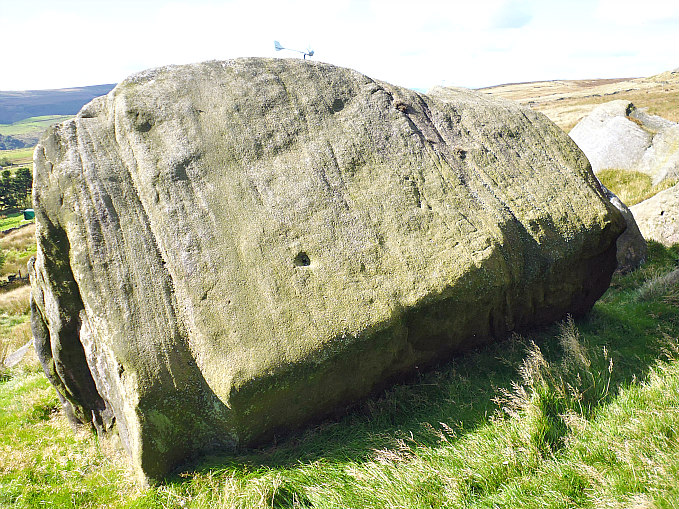
Kid Stone, Sutton Moor, West Yorkshire

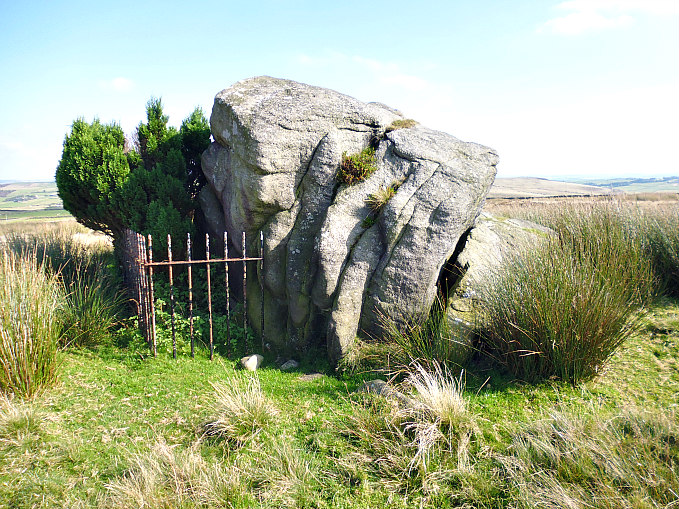
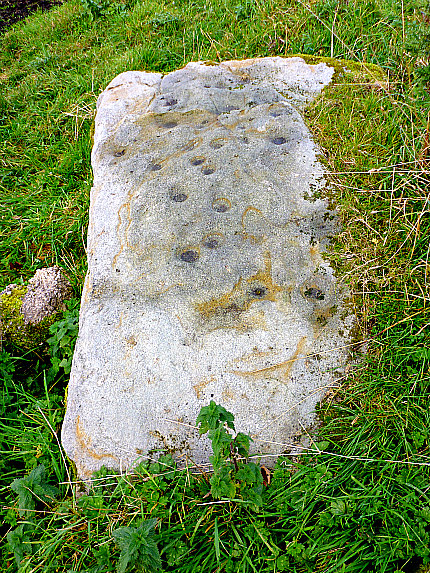
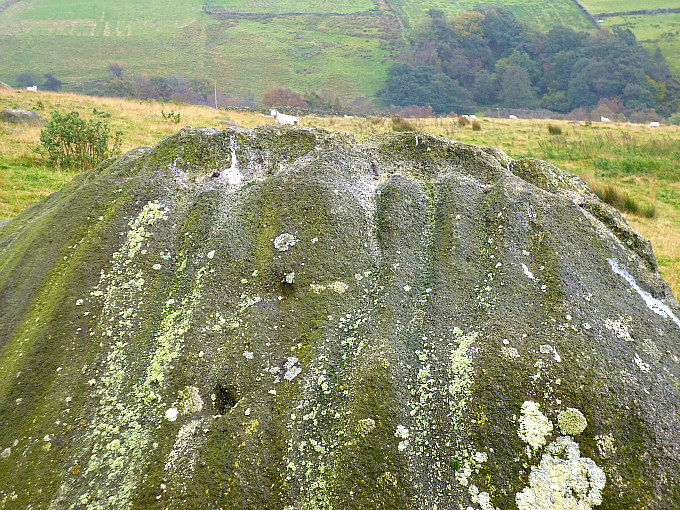
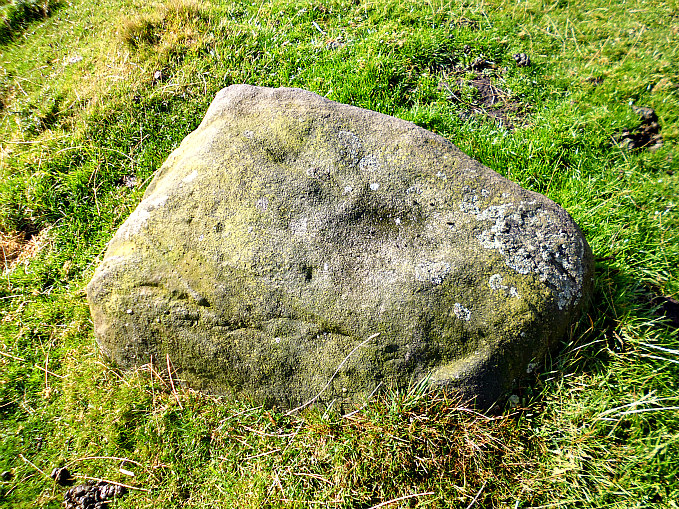
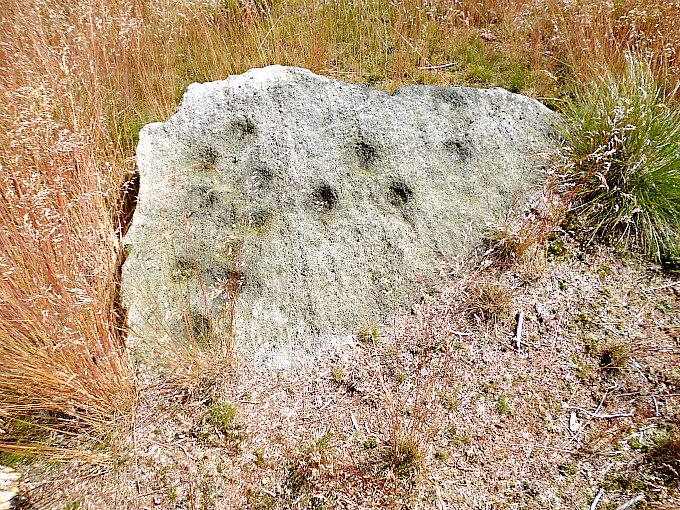
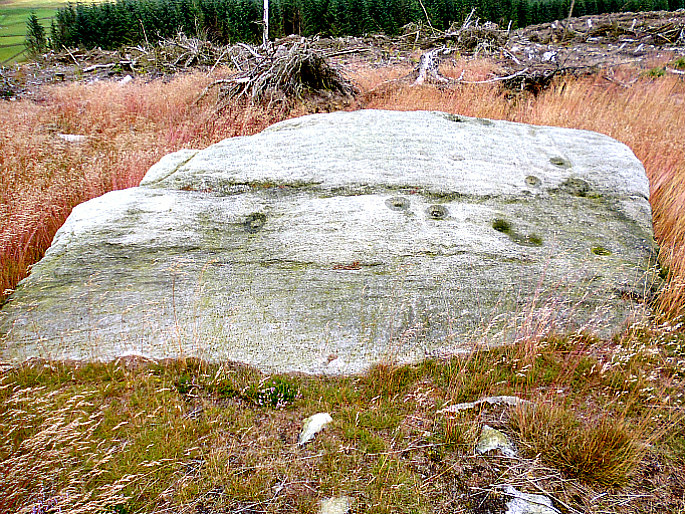
Kid Stone on Sutton Moor, West Yorkshire.

Kid Stone on Sutton Moor, West Yorkshire.

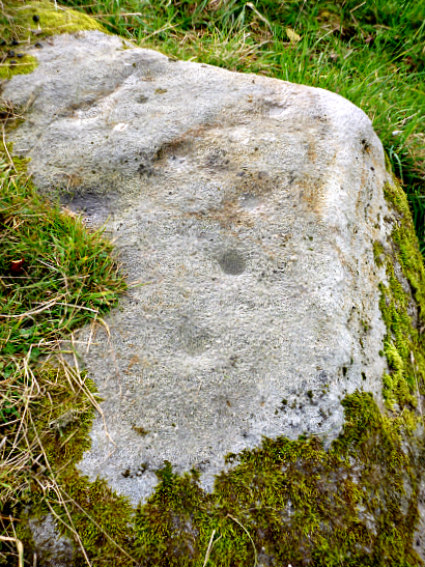
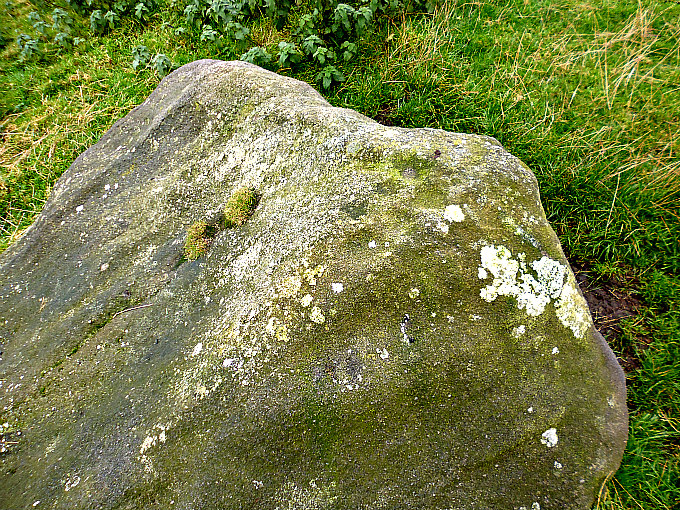
   OS grid reference: SD 99631 41759. A glacial erratic rock at the east side of Kid Stone Hill, above Long Gate, on Sutton Moor, West Yorkshire. It has been a parish boundary stone and way-marker for a long, long time, although the actual boundary is ‘now’ some distance away to the south. There are “possible” faint cup-markings on the flat side of the rock, and at the other side there is a curious granite memorial stone to a local sheep farmer and a yew tree within some iron railings. The ‘Kid Stone’ might get its name from ‘a young goat’, or maybe some other localised name – similar perhaps to ‘Buck Stone’, ‘Cat Stone’ and ‘Wolf Stones’ to name but a few on the moor. To reach the stone: follow the footpath from Buckstone Lane towards Hitchin Stone, then south-east towards Quicken Stone, and then via off east across the moor onto Kid Stone Hill – the stone is in front of you. Or take the footpaths going north-west from Long Gate just above Far Slippery Ford.

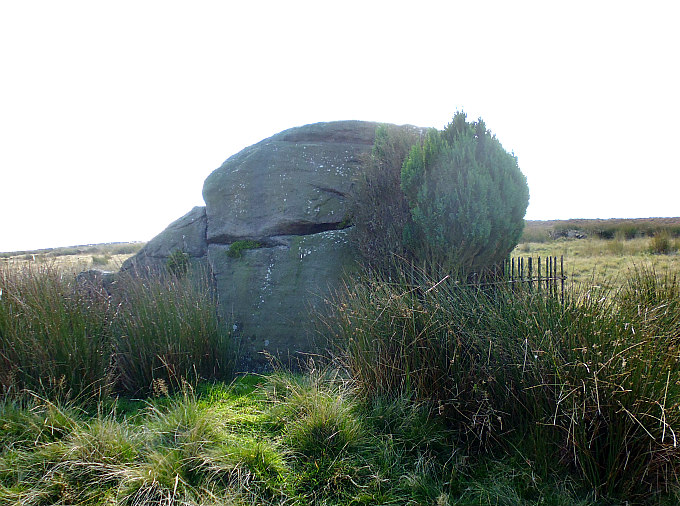
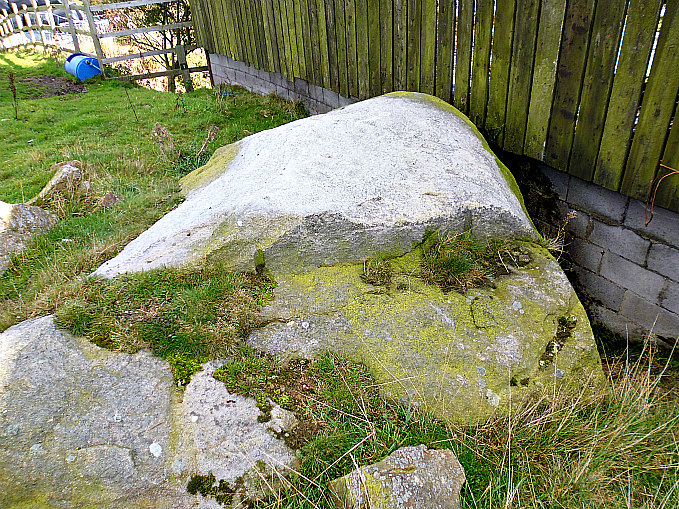
Kid Stone on Sutton Moor (with yew tree).

Kid Stone on Sutton Moor (with yew tree).

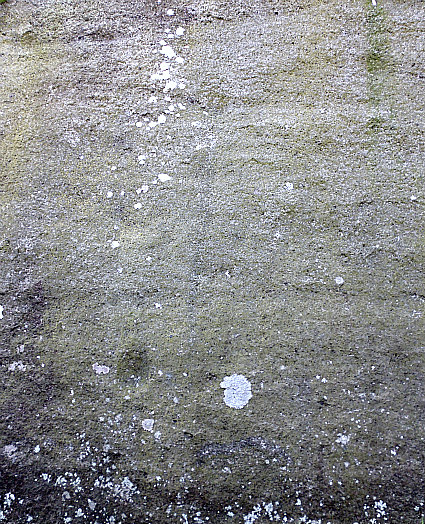
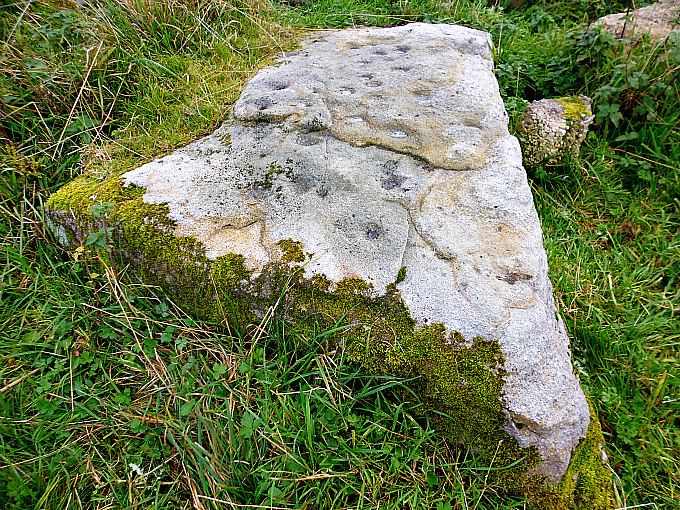
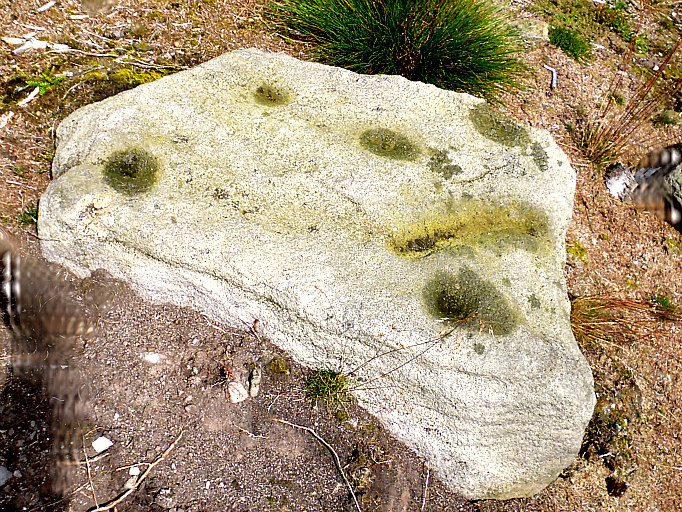
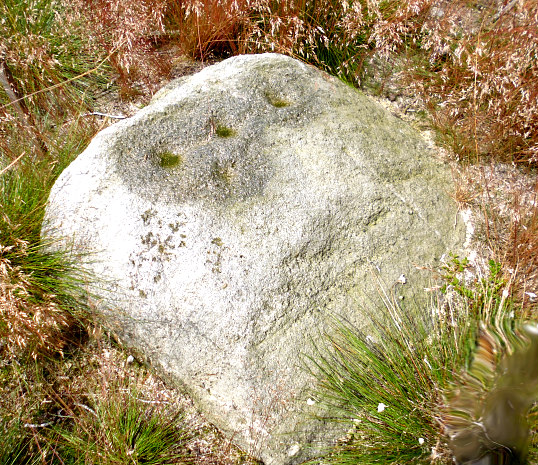
Kid Stone on Sutton Moor (possible faint cup-marks)

Kid Stone on Sutton Moor (possible faint cup-marks)

   The weather-beaten glacial erratic boulder known as ‘Kid Stone’ stands on the eastern side of Kid Stone Hill, on Sutton Moor. It stands upon the windswept moor at around 352 feet and is over 1,100 feet above sea level. Originally, this large gritstone rock marked the parish boundaries of Sutton and Newsholme, but today this boundary is a hundred yards or so further to the south. Geologically speaking the boulder was deposited here by a retreating glacier moving in a southward direction some 12,000 years ago; this glacier is sometimes referred to locally as ‘the Giant of Rombald’s Moor’ – to the north-east – as it came from there, although the boulder might have been scooped up from somewhere else along the way! The boulder is heavily worn, cracked, and has large grooves and channels running down its sides due to weather-related erosion (lots of rain). On its flat face there are a few “possible” faint cup-marks, or are these perhaps just more signs of erosion? 

   At one side of the boulder, inside some iron railings, there is a small yew tree growing and down at the base an odd/curious granite memorial stone to a local sheep farmer, Walter Rochester Airey, who died in 1994, but in what circumstances is not known. He lived at the farm back up the lane: New Bridge Farm on Buckstone Lane, Sutton-in-Craven. The memorial message on the stone says:- “In Loving Memory of Walter Rochester Airey, d 1994.”

Sources of information and related websites:-

https://www.sutton-in-craven.org.uk/historyDR.asp

https://en.wikipedia.org/wiki/Sutton-in-Craven

© Copyright, Ray Spencer, 2016.


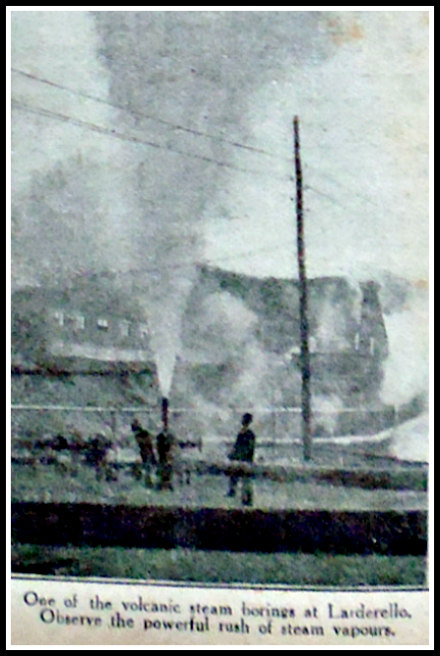
Harnessing a Volcano by Fabricio Sarti.

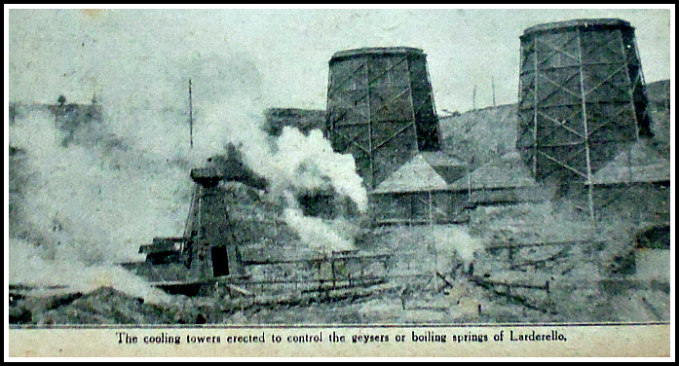
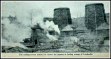
Larderello, Italy (volcanic geyers & cooling towers).

Larderello in Italy.

“The following is an account of the remarkable industrial and commercial uses to which Italian engineers have succeeded in putting the volcanic forces which exist in the sub-soil of certain parts of Italy, together with some of the grotesque mishaps which were brought about by the applica-tion of volcanic power to domestic purposes.

    “If you could be heated, laundried, lighted, bathed, and have your cooking done, without any trouble, and all for next door to nothing; if into the bargain you could raise spring cabbages for a mere trifle, and new potatoes all the year round, not to speak of obtaining all the motive and hydraulic power you required, you would probably wish to move into a neighbourhood where such desirable conditions prevailed.

    “As a matter of fact, there is a place where all this—and a great deal more exists, but it is situated in a somewhat inaccessible part of Italy, rather too far off, under existing conditions, to catch the Tube to the City, or the Elevated Railroad to Broadway.
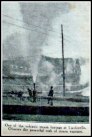
Larderello, Italy, (volcanic steam geyser).

Larderello, Italy, (volcanic steam geyser).

   “The district of Pisa, in Tuscany, is largerly of volcanic origins. In some parts of the province, and more especially in the neighbourhood of the little town of Larderello, the boiling  springs which exist in the subsoil issue to the surface in the form of numerous and powerful “gushers” or “geysers” of hot  vapour or steam. These gushers, or jets of steam, are known locally as “saffioni,” and the evaporated steam finds its way into a large number of small pools or “lagoni.” Though these jets of steam issuing through fissures in the granite, must have existed for many thousands of years, it was not  until about a hundred years ago that they were discovered to contain a substance of great commercial value. Some scientists visiting the pools, or “lagoni,” found out  that the waters contained, in a state of dissolution, a very considerable quantity of boracic acid. It was soon discovered that the boracic acid came from the jets of steam issuing from the soil near by, and, provided means could be invented to evaporate the waters of the “lagoni,” the boracic acid would fetch a good price.

   “Boracic acid was discovered in 1702, but as it has never been found possible to synthesize the product with a view to its artificial manufacture, chemists are dependent upon natural sources for its supply. Until comparatively recent times, boracic acid was in great request as an antiseptic, but has now been replaced by other and more powerful substances. Boracic acid continues, however, to be in great demand, both in its crude form and in the form of the various boraxes derived from it, for soldering, enameling, glazing, and dyeing purposes. It is likewise used in the manufacture of soap, and even as a substitute for that useful article.

   “Most of the boracic acid in use to-day comes from Italy, especially from the Pisa district. Recently, huge deposits have been located in Asia Minor, but the war has prevented the development of these deposits for industrial purposes.

   “The “saffioni” found around about Larderello are saturated with the acid, which, as the steam evaporates into the pools, settles at the bottom of the “lagoni.” It is supposed that the streams of hot steam passing at great pressure, and at a high temperature, through the underground fissures of the rock, act as a dissolvent upon the tourmaline in the granite, and separate the acid from the boron, carrying it automatically along to the surface.

   “The first attempts made to evaporate the waters of the “lagoni,” so as to secure the acid, were very primitive. Ovens were bored around the pools. These ovens were filled with wood, and kept alight until the waters had evaporated. This was a long and tedious process, and by the time the boracic acid was secured it proved so costly as scarcely to pay for production.
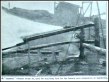
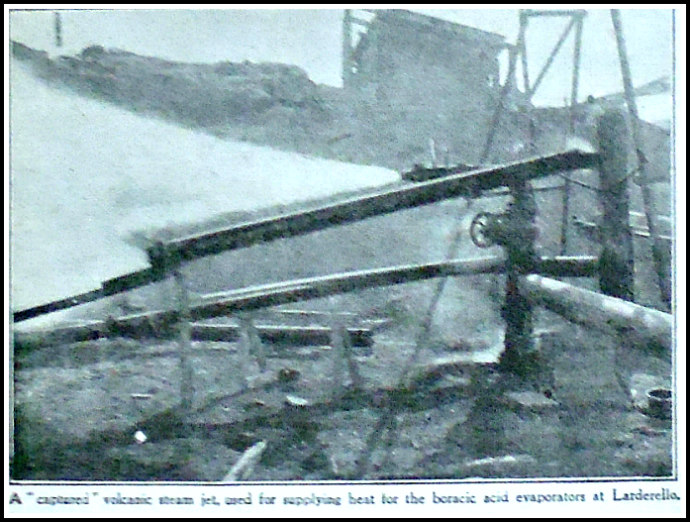
Larderello, Italy (a captured volcanic steam jet).

Larderello, Italy (a captured volcanic steam jet).

   “Other and more modern processes were afterwards tried, but none of them proved satisfactory until an Italian engineer hit upon the very simple idea of utilizing the “saffioni,” or steam jets themselves, as the heating power for the evaporization of the acid-laden waters. The natural pools into which the jets of steam projected the acid they contained were abandoned altogether, and around the aperture of each “saffioni” or jet of hot vapour, as it issued from the soil, there were built small reservoirs of rough masonry jointed with clay.These were filled with water from the pools, and the action of the hot vapour churning the water soon brought it almost to boiling-point. At the end of twenty-four hours it was found that the water contained about one and a half per cent. of acid. By means of a wooden pipe the water was conveyed into a second reservoir built round a second “saffioni,” where it was further enriched by acid. After being transferred into half-a-dozen different reservoirs built round different jets, the water was sent into a decanting tub or basin, where it deposited the earthy impurities held in suspense.

   “From the decanting basin the water is sent into special evaporators. These evaporators consist of long wide sheets of un-dulated lead, two hundred and fifty feet in length and eight feet wide, turned up at each side. These leaden sheets are placed on an incline, and the acid-charged waters trickle slowly over the wavy sheets of lead, which are heated by hot steampipes passing underneath. As the acid-charged water trickles over the hot, wavy, leaden plates it evaporates under the action of the heat, and deposits the boracic acid.
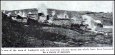
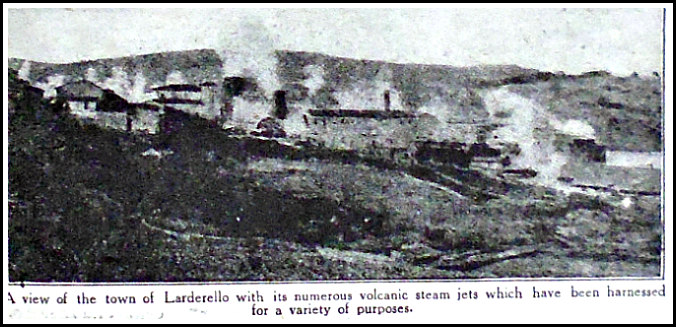
The Town of Larderello, Italy, with its volcanic steam geysers.

The Town of Larderello, Italy, with its volcanic steam geysers.

   “The hot steam is derived directly from the natural vapour underground, but instead of utilizing the ordinary “saffioni,” or vapour-jets, for the purposes, it was considered preferable to make separate artesian borings to a distance of one-hundred feet or so underground. The steam was tapped with such force, that unless special precautions had been taken beforehand the rush of subterranean vapour would have caused a serious accident. Indeed, the artesian borings brought up steam-jets with a pressure of no less than nine atmospheres at a speed of one-hundred and seventy-five yards to the second, and at the great heat, in some borings, of one-hundred and ninety degrees Centigrade or six-hundred and forty degrees Fahrenheit.

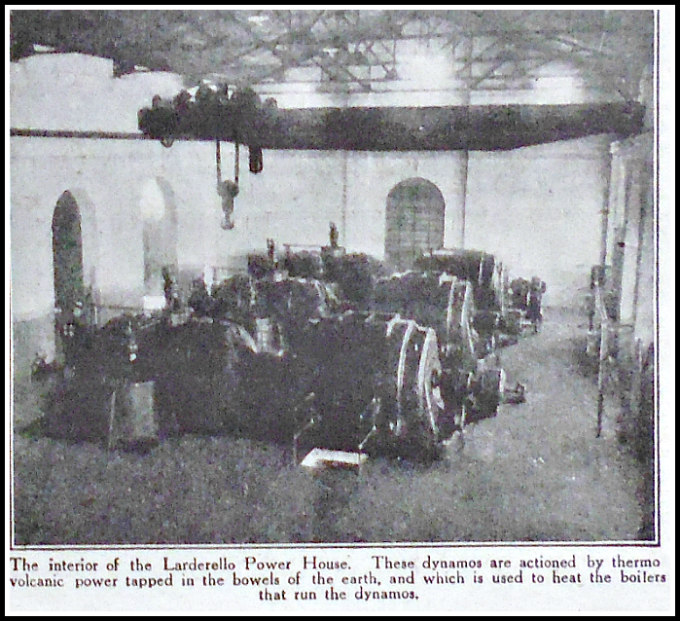
   “The discovery that such vast subterranean power lay at the disposal of the engineers soon led to the installation of powerful dynamos. It was first found necessary to purify the stream of its gaseous matters, for otherwise the machinery would have quickly become corroded.

   “Within a few years the engineers had tapped, by short artesian borings, quite a number of “hydro-volcanic” power-jets. A single one of these, the “Ponta Anna” bore, produces two-thousand three-hundred horse-power, whilst another, the “Venella” bore, produces one-thousand two-hundred and sixty horse-power. 
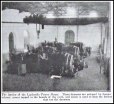
Interior of the Larderello power house.

Interior of the Larderello power house.

   “The power-houses were soon supplying hydro-volcanic energy to a considerable number of factories, and in what was formerly a deserted district there sprang up the town of Larderello. Not only so, but there ensued the natural desire to turn this volcanic power to domestic use, and some of the engineers and factory managers had their dwellings fitted up with piping, so as to get heat in winter and fuel for cooking, for the heat is sufficiently great to bake a joint in an oven in half an hour. It is, however, dangerous to “monkey about” with the subterranean forces of Nature, and early experiences were accompanied by a number of accidents and mishaps.

   “One of the factory engineers, whose house had been fitted with the hydro-volcanic heating apparatus, was aroused in the middle of a heavy sleep by a roaring sound like a locomotive blowing off steam. He turned on the electric light—which was also supplied by the dynamos worked by volcanic power—to discover a geyser of boiling water bubbling up in the middle of his bedroom and filling the room with steam. He had just time to jump out of bed and make his way out into the street in his dressing-gown, when the geyser assumed gigantic proportions and burst with a roar through the roof of the house, soon reducing the entire building to pulp. It seems that, in some way, the control cap of one of the main tubes, as the steam issued from the bore, had become partially unscrewed, with the result that the full force of the bore had found its way into the engineer’s house and burst the hot-water piping under the floor of his bedroom.

   “It took several hours before the geyser could be got under control.

   “On another occasion an Italian cook, on returning from market and entering her kitchen, was horrified and amazed to discover the whole of her pots and pans on the long kitchen range jumping about as though bewitched. The range was heated by steam radiators from one of the volcanic bores, and the metal of the radiators was of an undulating wavy form. Owing to a sudden increase in the subterranean velocity of the steam jet from the bore, the steam had ruptured the control cocks and had come throbbing through the heaters in jerks, imparting a gyratory movement to every one of the kitchen utensils on the range.

   “One morning, too, a stout factory manager had such a fright, whilst in his bath, that he resolved never again to take any baths the water of which was supplied by hydro-volcanic process. The bath was fitted with a hot and cold douche apparatus which, instead of descending from the roof over the bath, came from an aperture in the bottom of the bath-tub, in the form of an “ascending” douche, as it is called.

   “On that particular occasion the main geyser from one of the bores had suddenly taken on a “spurt” of two or three minutes, causing the hot water in the main pipe to rush with increased velocity, and rupturing the control tap. The water, in the form of a hot and cold mixed “douche,” suddenly shot up from below the bath with such tremendous force as to rupture the rivets and send the man taking his bath three or four feet into the air before he could recover himself. Happily the mixture of cold with hot water prevented what might have been a serious accident.

   “The municipal laundry, in which all the hot water is supplied from the bores, is another luxury due to the existence of hydro or thermo-volcanic power. Before the scientific system of controlling the steam at the output of the bores was brought to its present state of perfection, it not infrequently happened that a sudden wave  of “power” would play havoc with the machinery which supplied the hot water to the laundry. On one occasion all the “laundry” of the town of Larderello was sent flying in all directions, and there being a high wind blowing at the time – many of the articles were recovered in the plain several miles away. All these little mishaps no longer occur, so perfectly are the main thermic-power bores now under control. 

   “The Larderello “saffioni” are invaluable to the local market gardeners, who are so able to regulate the heat of their hot-houses as to produce fruit and vegetables in abundance all the year round.

   “The Larderello vapour jets and the intelligent industrial use to which they have been put by Italian engineers have attracted the attention  of scientists to the immense possibilities that lie in the systematic and rational utilization of the hidden subterranean forces of Nature.”

Source of information:-

Sarti, Fabricio, The article ‘Harnessing a Volcano’ was published in ‘The Wide World Magazine – An illustrated Monthly Of True Narrative’, Vol. XLII – October 1918 To March 1919. George Newnes Ltd., Southampton St., Strand, London.

                                                                  © Ray Spencer, The Journal Of Antiquities, 2016.


1 Comment

Doubler Stones, Addingham High Moor, West Yorkshire

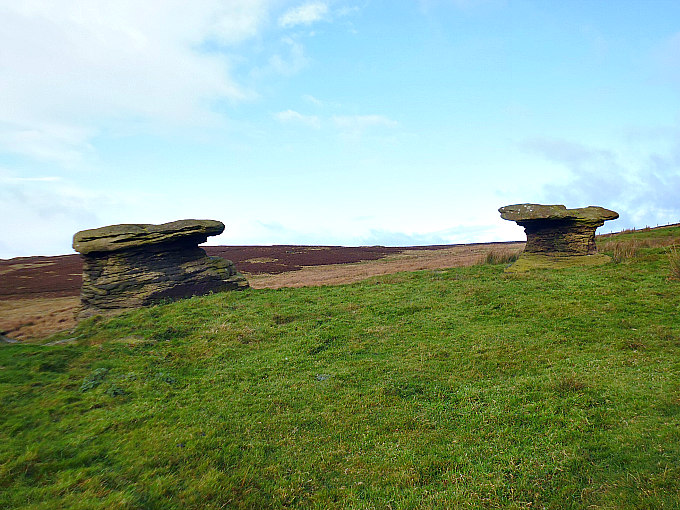
Doubler Stones on Addingham High Moor, west Yorkshire.

Doubler Stones on Addingham High Moor, west Yorkshire.

   OS Grid Reference: SE07230 46525. On the windswept Addingham High Moor, west Yorkshire, there stands the heavily weather-worn rocks known as ‘Doubler Stones’ – part of an outcrop of grit and sandstone rocks; their enigmatic rock-shapes being something of a great curiousity to moorland walkers down the years. These strange, weathered stones lie at the south-western edge of Rombald’s Moor. At least one of the Doubler Stones has cup-and-ring carvings, and a few other rocks here and further up the hill might have “possible” faint cup-marks. To reach the stones from the town of Silsden: take the Bolton Road going north-east, then east along Brown Bank Lane, then take Light Bank Lane over the moor to the south-east. Just after White Crag House: take the concrete track up to the gate, then walk along here to the house on the left. Take one of two footpaths north for a short while to Doubler Stones. 

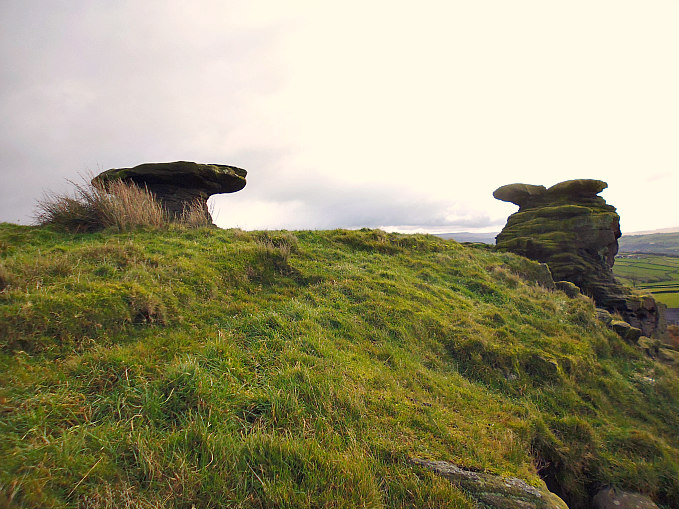
Ghostly shaped Doubler Stones in west Yorkshire.

Ghostly shaped Doubler Stones in west Yorkshire.

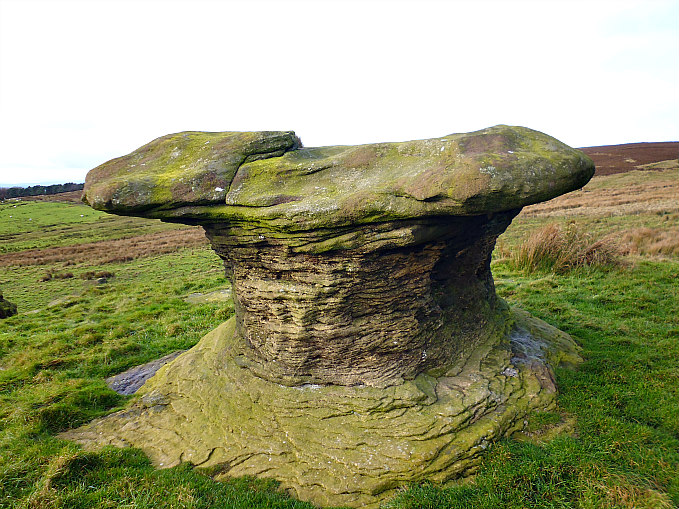
   These strange-shaped rocks are part of an outcrop of gritstone and sandstone rocks that stand like weather-worn sentinels watching over the moorland. They have taken on the shape of giant mushrooms or salt and pepper pots, but here they are locally called ‘Doubler Stones’ but whether this is because there are two of them – is not certain. It’s more likely that the name “Doubler” is derived from saucer or dish-shaped stones and this is indeed what they are; the tops of the stones are gritstone rocks that are now eroded and saucer-shaped, while the lower parts are made of very soft Sandstone, and this is why the middle sections have eroded down quite severly and become, over thousands of years, like ‘thin waistlines’ or bottle-neck shapes. One of the Doubler Stones has what looks to be a cluster of tiny cup-marks and a few other “possible” cups with rings and interlinking channels or grooves. A few other rocks here might have faint cup-marks – although these could be geological features. Another outcrop of rocks just up the moor to the east is also of interest as there are a few more “possible” cup-markings on the larger rocks.

One of the Doubler Stones on Addingham High Moor.

One of the Doubler Stones on Addingham High Moor.

   The author Paul Bennett in his renowned work ‘The Old Stones of Elmet’, gives his account of Doubler Stones: “One of the stones is a giant earth-fast mushroom, eight feet tall, whose upper surface is covered in a number of cup-markings. Ten yards away at the small crag we find the second Doubler Stone, atop of which are two large ‘bowls’ and perhaps some faint cup-markings, but these are debatable.” Bennett goes on to say that: “Nicholas Size (1934) described the stones to be haunted. It is very likely that this site would have possessed the spirits of some ancestral being, hero or other diety in ancient times. Ritual magickians have used the Doubler Stones to great effect. Amidst a decidedly yin landscape, the Doublers intrude with a potent yang quality. A brilliant site and well worth visiting!”

Sources and other related websites:-

Bennett, Paul, The Old Stones of Elmet, Capall Bann Publishing, Milverton, Somerset, 2001.

Doubler Stones, Ilkley Moor, West Yorkshire

http://www.stone-circles.org.uk/stone/doublerstones.htm

http://www.happyhiker.co.uk/MyWalks/WestYorkshire/SteetontoIlkleyviaDoublerStones/Hiking%20Pages%20-%20Steeton%20to%20Ilkley%20via%20the%20Doubler%20Stones.htm

                                                                          © Copyright, Ray Spencer, The Journal Of Antiquities, 2016.


The Lake of Soda by George Frederic Lees

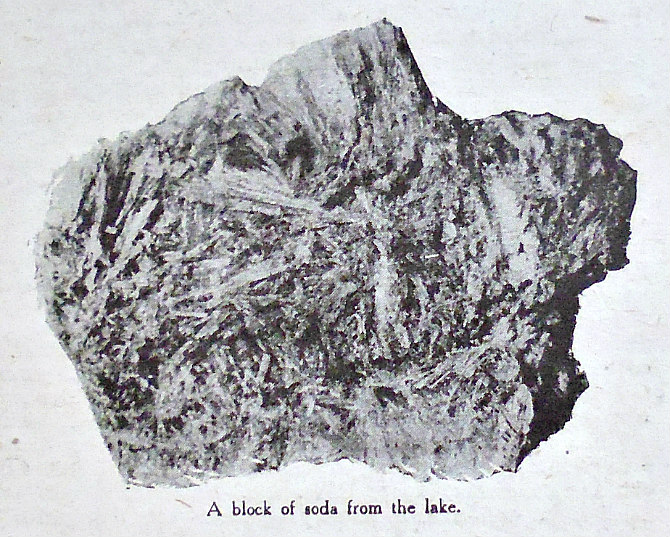
A block of Soda from the lake.

A block of Soda from the lake.

                               The Story of a Wonderful Natural Curiosity of British East Africa                                      “The following  article is a  striking instance of  the immense and  sometimes  inexhaustible wealth which is waiting to be exploited in British possessions in Africa. Much of that wealth is  still hidden, but in the case of Lake Magadi—a lake of solid natural soda covering an area of some thirty square miles—it was there for any enterprising explorer to discover and report to the right quarters. The story of the commercial development of this great Colonial asset adds a fresh chapter to the ever-enthralling romance of British industry.

   “In every quarter of the City of London, Romance is to be found by those who search for it dili-gently. Many an engrossing story of adventure or exploration, involving the lives of men, the overcoming of wellnigh insu-perable difficulties, and the expenditure of vast sums of money, which in itself  required no small amount of courage, lies hidden in office records, until the historian of the so-called minor events of the world happens upon it and forthwith disen-tangles it from a mass of commercial verbiage, always tedious of perusal and often covered with the dust of years. A romantic episode may lurk beneath the most innocent-looking phrase in the minute – book of a board of directors—some such common-place note as this:

    “”The attention of the board, at its meeting on such-and-such a date, was called to the commercial possibilities of this or that, in consequence of which they decided to dispatch a confidential agent to the spot mentioned to verify the statements made to them.”

   “Could there be a less promising starting-point for a story of discovery and adventure? So devoid of the slightest tinge of romance is such a bald statement that there is a risk of the searcher passing it over disdainfully. And yet, if he continues his investigations, he may indeed find that a very pretty tale of human endeavor, coupled with the unfolding of many curious said-issues, hangs thereon for his own and his readers’ delectation.

   “To take a concrete case, it happened that, some ten years ago, a certain explorer entered the office of a firm of City mer-chants, and made certain “”representations of the great importance and value”” of a curious lake in British East Africa. So it was set down in the minute-book, but what he actually said to the heads of the firm was somewhat as follows:—

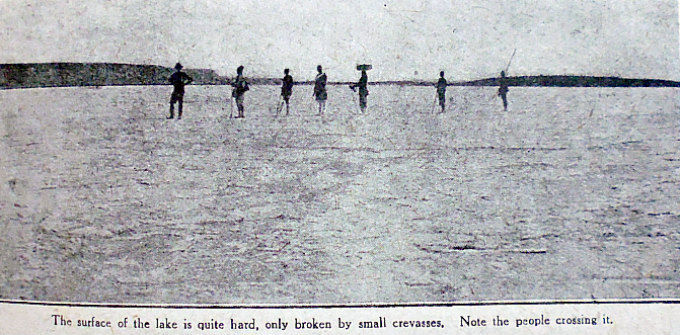
Lake Magidi in Uganda.

Lake Magadi in Uganda.

   “”The lake looks for all the world like an ice-field, and when the photographer showed us his  prints I might have imagine, but for the figures of the natives with their bare legs and scantily-clothed bodies, that we were a part of explorers in the Arctic regions. Mile upon mile of the great white expanse of soda and the hot springs of Magadi stretch around, with here and there a big block of alkaline deposit. A most remarkable sight. There must be millions upon millions of tons of the stuff. Of course, it opens up vast possibilities commercially. Only you will have to get the soda to the coast and so on to the ships, and that means building a branch to the Uganda Railway’s ocean port at Kilindini, or thereabouts.”

   “This declaration naturally aroused the greatest interest. It is not every day that a discovery with “vast possibilities commercially” is announced in the City, and if this lake of soda did really exist, was not a mere figment of the explorer’s imagination, his listeners had no need to be told that it might become a veritable gold-mine. The demand for soda is universal. Instinctively the partners began to pass the manifold users of soda in review.

   “Soda crystals are used in practically every household the world over for washing purposes. Carbonate of soda (otherwise known as soda ash) and caustic soda are largely used in numerous industries, as, for instance, by soap, glass, and paper makers, as well as by textile manufacturers for printing, bleaching, and dyeing, etc; whilst bicarbonate of soda is used for the manufacture of baking powder and mineral water.

   “The prospect was alluring. True, this commercial proposition  would mean the investment of a few hundred thousand pounds—probably up to half a million sterling—in addition to a good deal of hard work. But think of the return : a steady annual profit running into millions ! Unquestionably (the firm decided, after discussing the matter in all its bearings) they must institute an inquiry and, if the report they had heard were substantiated, see what could be done to secure the rights over these invaluable soda deposits.

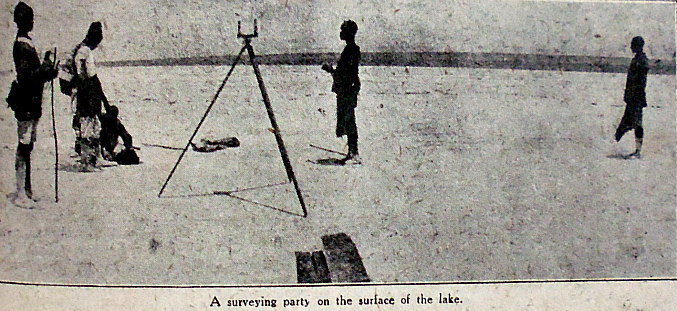
Surveying party on Lake Magadi in Uganda.

Surveying the lake.

   “Accordingly, Messrs. M. Samuel and Co. sent a confidential representative to British East Africa to verify the explorer’s statements. And this he did, many months later, by bringing back with him large samples taken from thirty-five different places over the whole area of Lake Magadi, which he described in even more glowing colours than his predecessor had done.

   “This conclusive evidence clinched the matter. The firm at once entered on protracted negotiations with the Colonial Office, and obtained from the Crown Agents for the Colonies, acting on behalf of the Government, an agreement, giving them the option of acquiring  direct from the Government about three hundred and twenty-four square miles of territory, including Lake Magadi, for a period of ninety-nine years, with the right of working the soda (subject to the rights of natives to take soda from the deposit for their own purposes), and of constructing a line of railway connecting the deposit with the main line of the Uganda Railway.

   “These preliminary steps having been taken, a fully-equipped surveying expedition was sent out in November, 1909, under Mr. Frederic Shelford, a well-known railway engineer who had done valuable survey work in Africa. The other leading members of the expedition were Mr. W. H. Levy and Mr. A. E. Herz, two directors of the company that had been formed to exploit the lake of soda; Mr. A. H. Endemann, who had studied on the spot the question of the most suitable mechanical appliances for dealing with the deposits; and Mr. Arthur Trobridge, who  had been engaged in the soda business for many years, and whose report was therefore looked forward to with considerable interest.

   “The expedition reached its destination, after an uneventful march from Magadi Junction, the nearest point on the Uganda Railway, on December 1st, and found , immediately prior to its arrival, that considerable rain had fallen. Consequently the whole of the lake, inclusive of some sand flats at its southern end, was covered with water, in depth from six inches to one foot. This was distinctly disappointing. However, it soon became evident that this was only a temporary inconvenience, and, indeed, by the time the explorers left the district ten days afterwards the water had considerably subsided, and a large area of the surface was already dry.

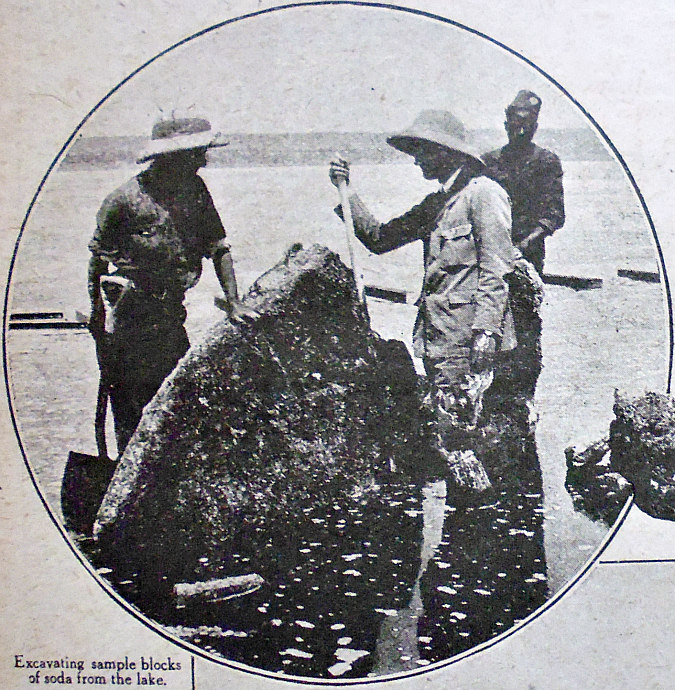
Excavating soda blocks from Lake Magadi.

Excavating soda blocks from Lake Magadi.

   “According to Mr. Trobridge, who drew up an exceedingly interesting report, the surface of the lake always become dry in this way shortly after the stoppage of the rains; and this conclusion was borne out by his former visit in October, 1904, “”when the whole of the surface was dry with the exception of a margin about thirty yards wide. The solid portion, which comprised practically the whole of the lake, was perfectly level and dry on the surface; but wherever the surface was broken up liquor rose to its level, and when the crystalline blocks were removed the liquor drained from the interstices of the crystals. The great purity of the crystalline soda is un-doubtedly due to the presence of this comparatively large quantity of soda in solution —technically known as ‘mother liquor’—distributed throughout the mass. Apart from the fact that the surface of the soda deposit becomes dry very soon after the rains have ceased. I also ascertained that during the rains the surface is never covered with so much water as to interfere in any way with the economic working of the deposit. For many years Indians have been removing soda from the lake, and they do so without paying any attention to the season.”

   “As to the chemical and physical character of the soda, they were found to be uniform over the whole surface of the deposit, as has been confirmed by the examination of numerous samples taken at widely-distant points both in 1909 and on the occasion of Mr. Trobridge’s previous visit in 1904. The crystalline deposit cleaved readily into blocks from which the “mother liquor” drained rapidly, leaving a friable mass of crystals.

   “The explorers also came to the noteworthy conclusion that there was good reason to assume that the deposit of soda extends to the full depth of the lake, the above-mentioned “mother liquor” only filling the interstices of the crystals. They sank a bore-hole in the lake through a continuous mass of crystalline soda to a depth of nine-feet, but with the primitive boring tools at their disposal they found it very difficult to proceed farther. Indeed, in view of the enormous bulk of soda thus disclosed they saw no practical object to be attained by boring to a greater depth.

   “Further, there were evidences, runs the report, that the quantity of soda already in the lake is being continually augmented. In addition to many surface springs and streams discharging considerable quantities of soda into the lake, there were evidences of large springs in the bed of the lake itself, which intrude saturated soda liquor. On the removal of the soda already crystallized the liquor which takes its place at once starts to reform the crust. The Indians engaged in this soda industry informed Mr. Trobridge that the crystalline mass is replaced so rapidly that they rework the same spots year after year. Of this he found full confirmation on examining several poles which they had been using to break up the soda and had left in the holes thus made. These poles were firmly set in a solid mass of crystals which had been formed around them, and Mr. Trobridge and his colleagues removed several large blocks of soda in which such poles were embedded. On examination they found this reformed soda of the same composition and purity as the permanent deposit.

   “In view of the fact that the crystalline soda is divided into several distinct horizontal layers, which are readily separated from each other, and for economy in working. Mr. Trobridge recommended that operations be confined to the upper layers, which he estimated contain about forty million tons in sight. As this vast quantity would be continually replaced, the lower layers would appear to have little more than theoretical interest. Should, however, it be deemed necessary to work these lower layers to the depth of nine feet, as disclosed by their bore-hole, he estimated that the total crystalline soda would be about two hundred million tons.

   “Two hundred million tons of soda capable of being converted, by very simple treatment, into a “soda ash” of great density, and equal in chemical purity to any soda ash on the market—a practically inexhaustible stock, since, as soon as part of the deposit is removed, it begins to form again. Think of the enormous profit to be drawn from such a source of wealth as that. Counting all expenses, the fortunate merchants who had got wind of this business deal came to the conclusion that a profit of at least twenty shillings per ton of soda products might be expected. Rarely does it fall to the lot of a City firm to see a profit of at least two hundred millions sterling in view.

   “Mr. Frederic Shelford’s report on the feasibility and cost of constructing the branch railway whereby the vast soda deposits of Lake Magadi could be rendered accessible was equally encouraging. He examined the country between the lake and the Uganda Railway, and eventually selected a route which was afterwards carefully surveyed in detail by the railway survey party.

   “No further evidence was required to prove that a great industrial future awaited the properly-organized exploration of this lake of soda of British East Africa. So work was started on the railway, which in due course was completed; wharves at the coastal terminus and oil tanks at Kilindini were constructed, and works, offices, etc., were erected at Magadi. Moreover, the company that had been formed erected extensive works at Irlam, near Manchester, and in Calcutta for the manufacture of soda crystals and bicarbonate of soda from Magadi soda ash. In brief, after 1911-12 the business was in full swing and quickly proved that those who had embarked on the enterprise were not mistaken in taking a sanguine view of the future prospects of this part of East Africa. But with the coming of war, work was naturally interfered with. Lake Magadi, lying within thirty miles of the frontier of German East Africa, came within the war zone, and what that means need not be unduly dwelt upon. Suffice it to say that the branch line from the lake to the Uganda Railway and vice versâ was found useful for the transport of other things than soda.”

Source of information:-

Lees, George Frederic, The article ‘The Lake of Soda’ was published in ‘The Wide World Magazine – An Illustrated Monthly Of True Narrative’, Vol. XLII – October 1918 To March 1919. George Newnes Ltd., Southampton St., Strand, London.

                                                 © Ray Spencer, The Journal Of Antiquities, 2016.


Dragon Stone, Near Steeton, West Yorkshire

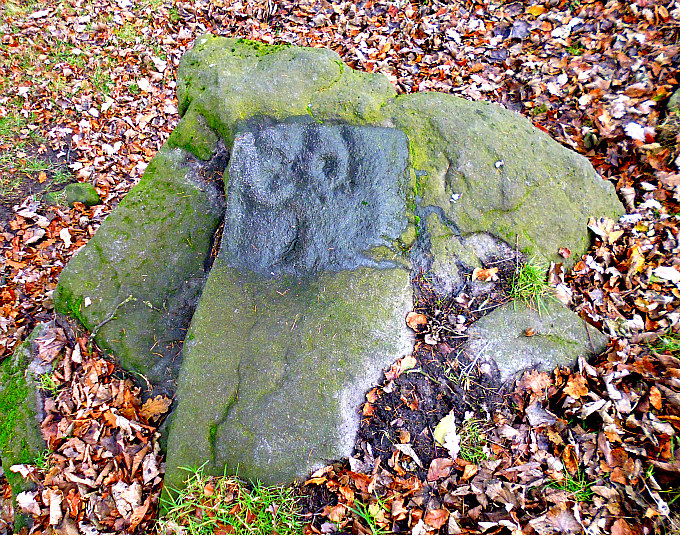
Dragon Stone - cup-marked rock near Steeton, west Yorkshire

Dragon Stone (cup-marked rock) near Steeton, West Yorkshire

    OS grid reference: SE 03604 03695. In a farmer’s field above Little Snowden Hill, near Steeton, west Yorkshire, there is a cluster of rocks in an area of rough ground which have prehistoric cup-marks, one of these rocks being locally known as ‘Dragon Stone’. And in the next field along there is another cluster of rocks which also look to have faint cup-marks. This so-called ‘Dragon Stone’ has several quite prominent little cups and there are also some grooves which may be part of the carvings here. However, these carved rocks are on private farm-land and there is no designated footpath. To reach the rocks you “might” be able to walk along the overgrown track leading off from Hollins Bank Lane, nearly opposite the entrance to Tower Farm, if the wooden gate opens? Walk along the track past the house and barn of Hollins Bank Farm, then soon after the wooded area you’ll need to via off across the field to the south for 90m beyond the first field wall. Otherwise, you’ll need to find another way of reaching the site from the lane, if that’s possible?

Dragon Stone, near Steeton, west Yorks.

Dragon Stone, near Steeton, west Yorks.

Cup-marked rock opposite Dragon Stone.

Cup-marked rock opposite Dragon Stone.

    In the corner of a farmer’s field above Little Snowden Hill there is an outcrop of gritstone rocks, or a cluster of rocks maybe. One of these known as ‘Dragon Stone’ bears many ancient cup-markings (rock-art). There are as many as 20 cup-marks on the this worn, flat rock, and around the sides and in the middle there are faint grooves running in a sort of circular fashion, but whether these were caused by erosion, or whether they are part of the carving, is not really known; and there is a crack in the rock which adds to the strange look of the stone. And why it is locally called ‘Dragon Stone’ is not known, although the rock might take on the look of a dragon at certain angles. On another rock, just opposite, and close by the wall there are a few more cup-marks, maybe up to 4 or more, although these can only be seen in a certain light and at an angle. This rock also has one or maybe two faint bowl-shapes made by erosion though these are often hidden away under a layer of lichen and grass. In the field beyond the wall (at SE 0354 4360) another cluster of rocks, one of which at least shows signs of a few faint cup-marks.

Sources and related websites:-

Dragon Stone, Steeton, West Yorkshire

Bowl Stone, Steeton, West Yorkshire

https://en.wikipedia.org/wiki/Steeton,_West_Yorkshire

© Copyright, Ray Spencer, 2016.


Cob Stone, Near Far Slippery Ford, Newsholme Dean, West Yorkshire

Cob Stone near Grey Stones Lane, Far Slippery Ford.

Cob Stone near Grey Stones Lane, Far Slippery Ford, west Yorkshire.

    OS grid reference: SE 00549 40890. In a field beside Grey Stones Lane and below an outcrop of rocks called Grey Stones Hill, near Far Slippery Ford, west Yorkshire, is a gritstone rock that is locally called Cob Stone. Whether it takes its name from a small round loaf of bread, or something else, I don’t know with any certainty, but I am also told that the word “Cob” means ‘Devil’ in this part of the country, so it could mean “Devil’s Stone”. The rock has a cluster of quite well-defined cup-marks on top and maybe a few fainter cups-marks lower down. To reach the stone you can take the footpath going east from Long Gate Lane at Far Slippery Ford. This will bring you to the bottom of the field. Other than that, you could see if the wooden gate opens on Grey Stones Lane next to the track going down to Grey Stones Farm. If it opens, then please make sure it is secured after entering, and on going back out again!

Cob Stone, beside Grey Stones Lane (cluster of cup-markings).

Cob Stone, beside Grey Stones Lane (cluster of cup-markings).

Large boulder near Cob Stone (with pos- sible cup-markings)

Large boulder near Cob Stone (with “possible” cup-markings).

    Cob Stone or Devil’s Stone is a glacial erratic gritstone rock that was deposited by a retreating glacier many thousands of years ago at the end of the last Ice Age. On top of the stone there is a cluster of 7 or 8 small cup-marks and further down a few fainter cups can just be made out. However, these faint cup-marks might have been caused by erosion – it’s often difficult to tell one way or the other, and the rock itself is now very smooth on its side due to thousands of years of weathering. Some 68m to the south-west there is an even larger boulder; maybe it’s another Cob Stone?, and this is indeed roughly shaped like a loaf of bread! This large boulder looks to have a few cup-marks on top and on its side, or are these due to erosion? And there are a few other rocks in the same field that have “possible” cup-markings; it’s just a case of walking around and looking closely at the many small and large rocks, and there are indeed “many” to look at. Cob Stone is recorded in Boughey & Vickerman’s  2003 survey.

    And of further interest to the lover of rock-art is another large rock some 80 metres to the south-east. This can be found at the north side of the large barn belonging to Greystones Farm. See the link below:-

Cup-Marked rock in the field near Cob Stone.

Cup-Marked rock in the field near Cob Stone, Grey Stones Lane near Far Slippery Ford.

Stone near Cob Stone (possible faint cup-marks)

Stone near Cob Stone at Grey Stones Lane, Far Slippery Ford (possible faint cup-marks)


Sources and related websites:-

Cob Stone Field, Keighley, West Yorkshire

Greystones Farm Cup-Marked Rocks, Near Newsholme Dean, West Yorkshire

                                                                            © Ray Spencer, The Journal Of Antiquities, 2016.


Greystones Farm Cup-Marked Rocks, Near Newsholme Dean, West Yorkshire

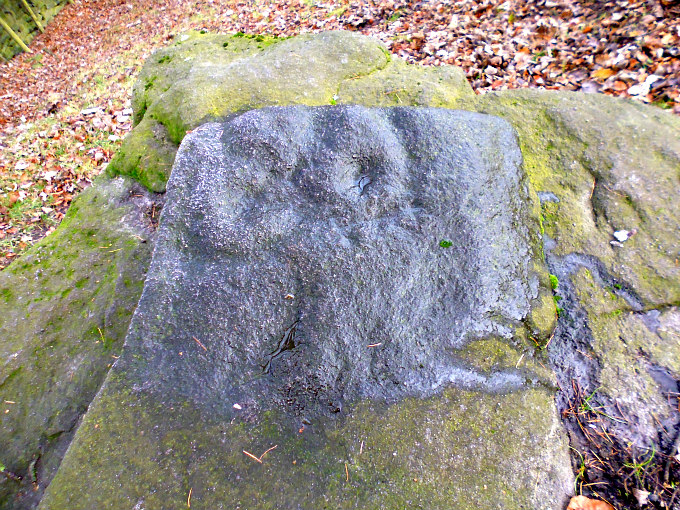
Greystones Farm Cup-Marked Rock (beside the large barn).

Greystones Farm Cup-Marked Rock (beside the large barn).

    OS Grid Reference: SE 00621 40844. Located beside the large barn of Greystones Farm, on Greystones Lane, is a gritstone rock which has several prehistoric cup-marks. A few other rocks is the same field also appear to have faint cup-marks, and one of these large rocks, locally called Cob Stone, also has “possible” cup-marks. Just above the farm there is an outcrop of gritstone rocks called Greystones Hill. The farm is a ¼ of a mile north of Far Slippery Ford, and the hamlet of Newsholme Dean is about 1 mile to the east on Todley Hall Road. To reach the site travel down Long Gate, then onto Coppy Lane and then Greystones Lane. Walk down the rough farm-track towards Greystones Farm, making sure the wooden gate is secured behind you. Via off the track to the large barn on the left – the cup-marked stone is beside this barn. You can also reach it via the footpath from Long Gate at Far Slippery Ford.

Greystones Farm Cup-Marked Rock (beside the large barn).

Greystones Farm Cup-Marked Rock (beside the large barn).

Greystones Farm Cup-Marked Rock (close up)

Greystones Farm Cup-Marked Rock (close up)

    Located at the north side of  Greystones Farm barn is a  large, weathered gritstone rock bearing several well-defined ancient cup-marks: as many as 15 tiny cups on the flat face of this soft rock. What these carvings represent we don’t really know: maybe they represent a sort of map of the stars, or they are just ancient graffiti or doodlings, or they are a map showing ancient springs, caves, or trackways.  Or do they perhaps represent something  else.  The whiteness, or greyness, of the rock is caused by weather related exposure over thousands of years – the exposed parts of the rock have been washed by rain to the colour that we see today, and so we have “greystones” which is sometimes spelt as “graystones”. A few of the larger rocks up the slope of the same field appear to also have cup-marks, although now very faint. One stone in particular called Cob Stone, near the top of the field at the other side of the track (SE 00553 40888) has eroded cup-marks on top. These cup-marked rocks were recorded and numbered by Boughey & Vickerman in their survey of 2003. (See The Northern Antiquarian link below).

Sources and related websites:-

Cob Stone Field, Keighley, West Yorkshire

http://www.pastscape.org.uk/hob.aspx?hob_id=1084602

                                                                   © Ray Spencer The Journal Of Antiquities.


1 Comment

Hawks Stones, Stansfield Moor, Near Todmorden, West Yorkshire

Hawks Stones (as seen from Kebs Road, near Todmorden).

Hawks Stones (as seen from Kebs Road, near Todmorden).

Hawks Stones, near Todmorden (strange shaped rocks).

Hawks Stones, near Todmorden (strange shaped rocks).

    OS grid reference: SD 9233 2735. A gritstone outcrop at the western edge of Stansfield Moor above Kebs Road, near Todmorden, in west Yorkshire. Like its near neighbour, Bride Stones, Hawks or Hawk Stones has many strange-shaped weather worn rocks and boulders that were first laid-down many millions of years ago, and then fashioned by a retreating glacier during the last Ice Age – some 13,000 to 15,000 years ago. There are the usual naturally-formed rock basins, and a few of the larger boulders appear to have ancient cup-marks, although it is often hard to differentiate between erosion-related holes and man-made rock-art. To reach Hawks Stones take the footpath from Kebs Road going east up the slope near the “old” Sportsman public house, then after 60m follow the ridge – going north-north-east to where you will soon reach the gritstone outcrop. However, the farmer has put up a lot of barbed-wire fencing, which makes it difficult, if impossible, to access some parts of the site.

Possible cup-marked rock at Hawk Stones, near Todmorden.

Possible cup-marked rock at Hawks Stones, near Todmorden.

Rock basin at Hawks Stones, near Todmorden, west Yorkshire.

Rock basin at Hawks Stones, near Todmorden, west Yorkshire.

    Hawks or Hawk Stones over to the east of Todmorden is an outcrop of millstone grit rocks and boulders that have taken on the form of some strange and odd shapes over many thousands of years; the erosion caused by weathering has added to the general eerie look of the place, which has, perhaps, been associated with the druids and their ritual and sacrificial worship back in the mists of time. The many rock pools and basins that are worn into the rocks maybe adding to that strange, mysterious feeling that one gets when visiting these lonely, moorland places. Some of the larger rocks and boulders look to have “possible” prehistoric cup-marks, some being more pronounced, while others are much more fainter. Or could these have been made by weather-related erosion over thousands of years? The place-name Hawks or Hawk Stones is thought ‘not’ to be associated with, or named after, the bird of prey!

    The Local author Geoff Boswell in his book ‘There and Back’, thinks that Hawk Stones are well-named: “because this area is the natural habitat of many moorland birds.”

Hawks Stones (naturally formed rock basins).

Hawks Stones (naturally formed rock basins).

Hawks Stones (possible cup-marks, or something else).

Hawks Stones (cup-marks, or something else).

    Author Paul Bennett in his outstanding work ‘The Old Stones of Elmet’, says that Hawk Stones are: “Illustrated on the 1717 Greenwood map, this huge outcrop of rocks was first described as “druidical” by Watson (1775), by inference to the local folklore of them being sites of ancient worship—which they may well have been. These sentiments were later echoed by Crabtree (1836). Then in 1864, the historian and folklorist, Thomas Wilkinson, gave a lecture to the Lancashire and Cheshire Historical Society, where he drew attention to the folklore of  these rocks. He was particularly interested in the “druidical rock basins” carved atop of some of them—or cup-and ring stones. The etymology of the site relates to “hollows” and not hawks as its name implies, which may be a description of such basins.”

Sources and related websites:-

Bennett, Paul, The Old Stones of Elmet, Capall Bann Publishing, Milverton, Somerset, 2001.

Boswell, Geoff, There and Back, Delta G, Todmorden, 2000.

http://www.walkingenglishman.com/westyorkshire02.htm

The Bridestones, Near Todmorden, West Yorkshire

                                                          © Ray Spencer, The Journal Of Antiquities.


1 Comment

Steeling Hill Earthwork, Near Coniston Cold, North Yorkshire

Steeling Hill Enclosure, near Coniston Cold, North Yorks.

Steeling Hill Enclosure, near Coniston Cold (north-side).

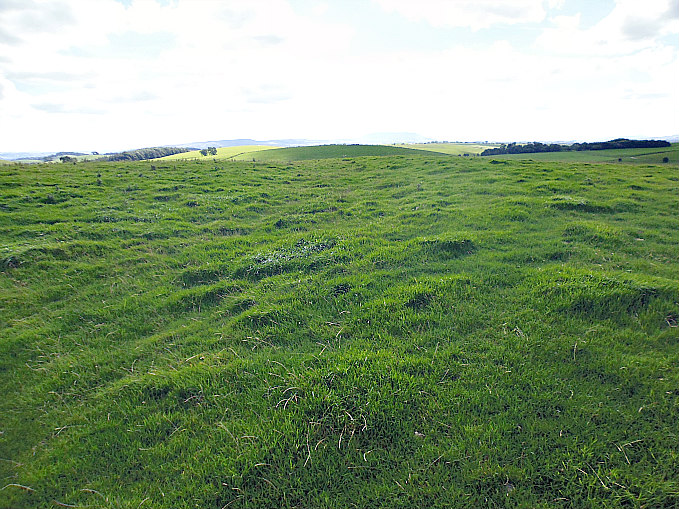
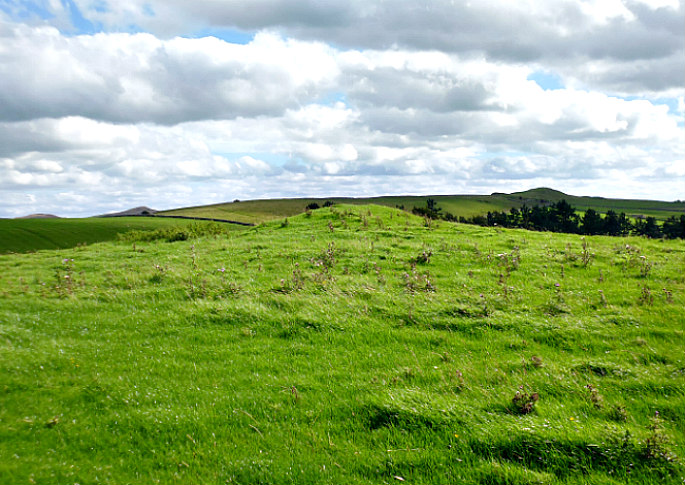
    OS grid reference: SD 8859 5515. A large earthwork or enclosure located on the crest of Steeling Hill above the A65 near Coniston Cold, North Yorkshire. This flat-topped hill on the opposite side of the lane from Kelber Farm was once the enclosure, settlement or camp of an ancient tribe, but unfortunately nothing much is known of its history. It was almost certainly a strategically placed encampment overlooking the valley below and in this sense it may have been a defensive site, although its low, almost non existent outer ditch, is barely visible today at ground level. At its centre there is a round-shaped feature but what this was is uncertain. It might actually be a more modern feature.

    To reach the earthwork from the A65 just to the south of Coniston Cold: go along the farm track/footpath nearly opposite The Coniston Hotel towards Kelber farm for 240m, then on the right-hand side go through the gate and head up the grassy hill-side for 220m to a second gate. You can reach the site from here. There is, however, no proper designated footpath up to the hill; and so please remember to ‘fasten the gates’ behind you.

Steeling Hill Earthwork (viewed from the south)

Steeling Hill Earthwork (viewed from the south)

Steeling Hill Earthwork (from the south-west).

Steeling Hill Earthwork (from the south-west).

    This very large rectangular earthwork on the top of Steeling Hill covers a large area of the summit and measures roughly 280m x 138m (918 ft x 452 ft), whilst the smaller, circular feature in the middle measures 74m x 60m (242 ft x 196 ft). The inner part of the earthwork/enclosure is raised by a few feet above the outer ditch, if it was ‘ever’ meant to be a ditch, but at the S and E sides this is much less noticeable. And as to the circular, slightly raised feature at the centre, and its distinct ditch – could this have been an inner enclosure, or maybe a living area with a hearth? Or could this be a more recent feature?

    So was this an Iron Age enclosure, or was it a Brigantian settlement?, or maybe something else; it looks to be an unlikely candidate for a Roman camp. Perhaps it was ‘a plain and simple animal enclosure’. But as ever there is a lack of any information regarding this earthwork, only the words ‘earthwork’ or ‘enclosure’ are mentioned on Ordnance Survey maps. There are though one or two other, similar, earthworks in this area, one in particular being near Cobers Laithe at Swinden, near Nappa.

Other related websites:-

http://www.kirkbymalham.info/KMI/malhamdale/speight.html

http://www.skiptoncastle.co.uk/history-of-craven.asp?page=17

https://en.wikipedia.org/wiki/Coniston_Cold

Kelber Farm

                                                             © Ray Spencer, The Journal Of Antiquities.


1 Comment

Lower Colgarth Hill Burial Mound, Near Bell Busk, North Yorkshire

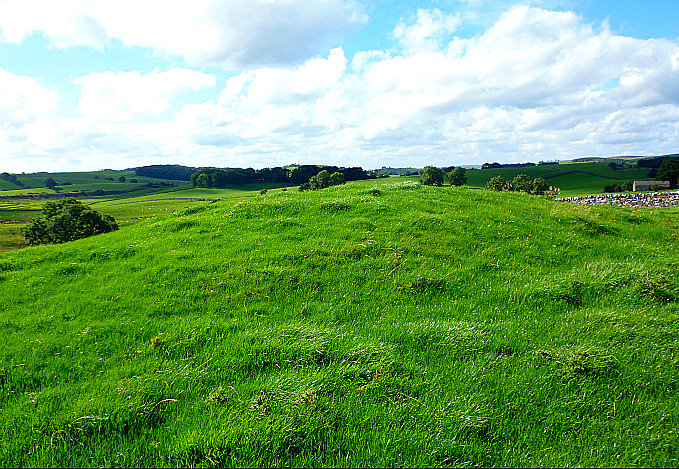
Lower Colgarth Hill, near Bell Busk (burial mound)

Lower Colgarth Hill, near Bell Busk (burial mound)

    OS grid reference:- SD 90489 57365.  At the foot of Lower Colgarth Hill beside Carseylands road about halfway between Bell Busk and Airton, north Yorkshire, there is a large and prominent Bronze Age burial mound (tumulus), which is close to a footpath and a ruined barn called Allamire Laithe. The burial mound is also called a bowl barrow or round barrow in archaeological terms, although this one is more like a long barrow, due to its size. You will also notice, although quite faint at ground level, that there are ancient cultivation terraces in this field and those close by. From here you get a good view over the River Aire. From Carseylands Hill road, at the south-side of the ruined barn, go 48m up the footpath to where there is a small boulder in the opening of the wall, then via off to the south for 35m – and you will soon see the grassy mound in the field just ahead of you.

Lower Colgarth Hill, near Bell Busk (a large grassy burial mound).

Lower Colgarth Hill, near Bell Busk (and the large, grassy burial mound).

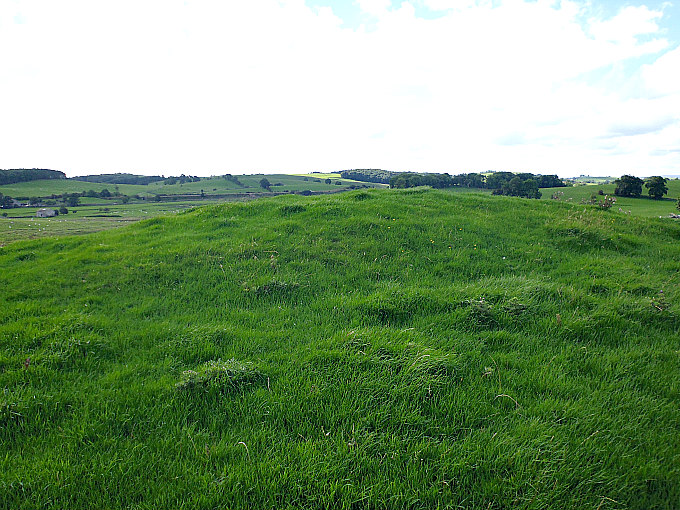
Lower Colgarth Hill near Bell Busk (the long-shaped burial mound)

Lower Colgarth Hill (and the long-shaped burial mound)

    The burial mound (tumulus) here at the foot of Lower Colgarth Hill is rather oddly-shaped, especially at its SW side, where it may have been dug into at some point in the past, although originally it was almost certainly bowl-shaped or bowl barrow-shaped; at a distance it has the look of a long barrow because of this. It measures roughly 11m (36 ft) long and 5.6m (18 ft) wide and is about 5 feet high. This was probably the place where a chieftain or a high-ranking individual of a local tribe was buried – either in the late Neolithic or the Bronze Age. Maybe more than one individual was buried in the mound and, or, quite possibly other members of the chieftain’s family.

Lower Colgarth Hill (and the grassy mound).

Lower Colgarth Hill (and the grassy mound).

    However, nothing more seems to be known about the burial mound on Lower Colgarth Hill – which seems to have been overlooked by antiquarians of the past few centuries, although Harry Speight does mention some other ancient sites in Craven; and I don’t know whether the tumulus ‘here’ has ever been excavated.  The cultivation terraces in the same field, and in other fields close by, are obviously very ancient. They are of a similar age, perhaps, to the ancient field systems in the Grassington area, which are considered to be Iron Age. Some cultivation terraces, however, are of a more recent age, probably Medieval?

Sources and related websites:-

http://www.kirkbymalham.info/KMI/malhamdale/speight.html

http://www.skiptoncastle.co.uk/history-of-craven.asp?page=17

http://www.docbrown.info/docspics/dales/dspage52.htm

                                                              © Ray Spencer, The Journal Of Antiquities.


1 Comment

Cobers Laithe Earthwork, Swinden, Near Nappa, North Yorkshire

Cobers Laithe Earthwork, near Nappa (looking north-west).

Cobers Laithe Earthwork, south-side (looking north-west).

Cobers Laithe Earthwork, near Nappa (looking north-east).

Cobers Laithe Earthwork, south-side (looking north-east).

    OS grid reference: SD 8669 5340. Sadly next-to-nothing is known about the oval-shaped earth-work or enclosure near to Cobers Laithe farm on  Swinden Moor, which is also known as Swinden Earthwork and Swinden Roman Camp, just 1 mile east of Nappa, North Yorkshire. Was it a Roman camp, as a few have suggested, or was it perhaps a Brigantian settlement – at the time of the Roman invasion? Or was it a more typical Iron Age settlement or enclosure? We don’t know with any certainty. And also it is a bit of an odd sort of earthwork-enclosure as it is intersected through the middle by a stream, and there are a numble of circular pits (bell pits), especially at the N side. The earthwork lies on private land. It is located in a field close to Mill Lane at Swinden – between Bank Newton and Nappa, just 380m to the west of Swinden Moor Head farm. On the earthwork side of the lane Ash Tree Farm is about 530m up the fields to the east.

Cobers Laithe Earthwork, south-side (looking north-west).

Cobers Laithe Earthwork, south-side (looking north-west).

Cobers Laithe Earthwork, south-side (looking east)

Cobers Laithe Earthwork, south-side (looking east)

    It is quite a large earthwork measuring roughly 107m x 87m and it used to have a smaller inner earthwork with a circular bank but this seems to have disappeared altogether, maybe due to farming and the stream. At the time of my visit the outer bank and ditch of the earthwork were deep in grass and reeds in several places, but despite that they are quite pronounced at the SE and SW sides. And at the N, NW and NE sides the bank and its associated ditch are still quite well-defined, and there is a possible entrance at the NW. But as to whether they were ramparts designed for warfare or security, we don’t know, but in my opinion I would think they were non-defensive.

Cobers Laithe Earthwork (the enclosure south-side). (the inner enclosure).

(The enclosure at the  southern-side).

Cobers Laithe Earthwork (grassy bank and ditch)

Cobers Laithe Earthwork (grassy bank and ditch)

    The oval-shaped layout of the earthwork or camp does ‘not’ look particularly Roman to me. We know the Romans always built square-shaped fortifications. Although it could have been a ‘temporary’ Romano-British camp. However, there does not appear to have been much, if any, Roman activity in the area; and the theory that there was a temporary Roman fort or camp at Long Preston, in the field near St Mary’s church, seems to have all but died a death. In all probability the earthwork here at Swinden was a Brigantian camp, settlement, or enclosure. But another distinct possibility being that this was a more typical Romano-British farmstead.

Cobers Laithe Earthwork (southern-side grassy earthworks.

Cobers Laithe Earthwork (southern-side grassy earthworks.

    The relatively flat part of the earthwork, nearest the lane and fence, is on the south-side of the little stream while the northern and, by far the largest part of the earthwork, lies just beyond the stream and up the slight slope of the field beyond. But unfortunately the stream in between the two sections has made for some very muddy and boggy conditions, and so it is not easy to reach that ‘northern’ section unless you have wellies! Its quite obvious that the steam is a ‘more recent’ feature, having gouged out the channel through the centre of the ancient earthwork. To put it another way: the stream was not here when the earthwork was constructed. It was formed from a spring further up the field over hundreds of years, but certainly ‘not’ thousands of years.

    The northern part of the earthwork is pock-marked by holes or depressions (bell pits) in the ground, which are probably the result of quarrying for coal a few hundred years or so back. This poor or cheap coal substitute being used by local farms. Some of the holes have now become ponds.

    The Pastscape website has the site of an alleged Roman camp (monument no. 45530) about a ¼ of a mile to the north-west at Swinden (OS grid ref: SD 8617 5440), though this is perhaps an error? See the website link below.

Sources and related websites:-

Click on this Geograph link for a good photo of the enclosure on Swinden Moor:-     http://www.geograph.org.uk/photo/2837370

http://www.pastscape.org.uk/hob.aspx?hob_id=45530

http://www.pastscape.org.uk/hob.aspx?hob_id=45517

http://www.megalithic.co.uk/article.php?sid=28080

https://en.wikipedia.org/wiki/Swinden

http://www.gisburn.org.uk/nappa/

http://www.longpreston.info/history/history.html

http://mapio.net/o/1975548/

                                                        © Ray Spencer, The Journal Of Antiquities.


1 Comment

The Bridestones, Near Todmorden, West Yorkshire

Bride Stones, west Yorks (Sphinx- like formation).

Bride Stones, west Yorks (Sphinx- like formation).

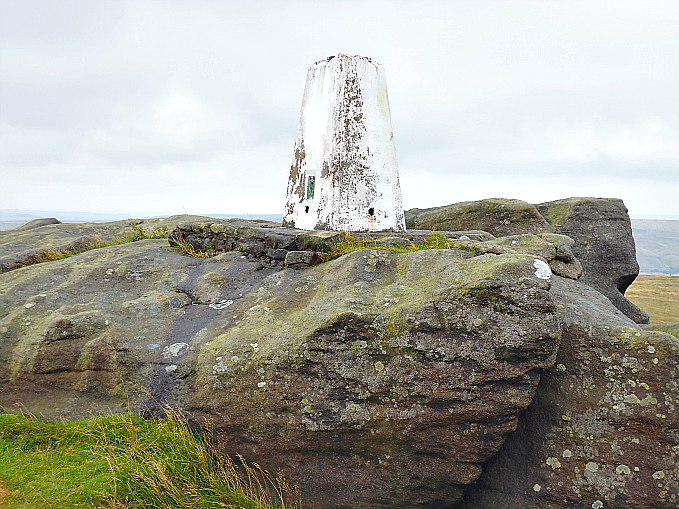
Bridestones, near Todmorden, west Yorks (OS trig point no: S4501)

Bridestones, near Todmorden, west Yorks (OS trig point no: S4501)

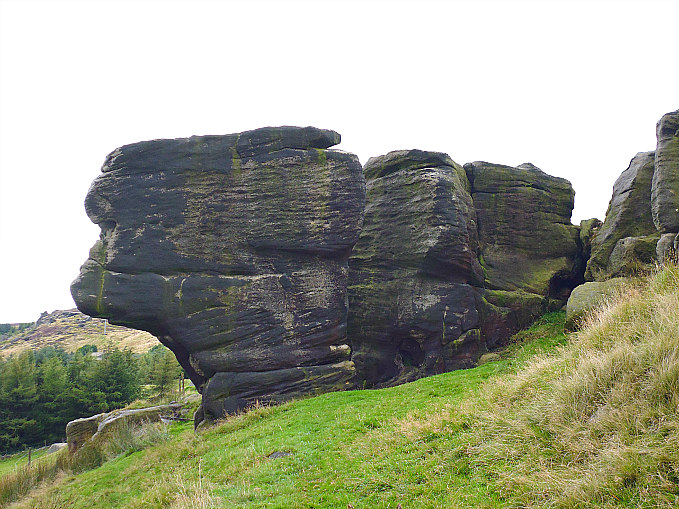
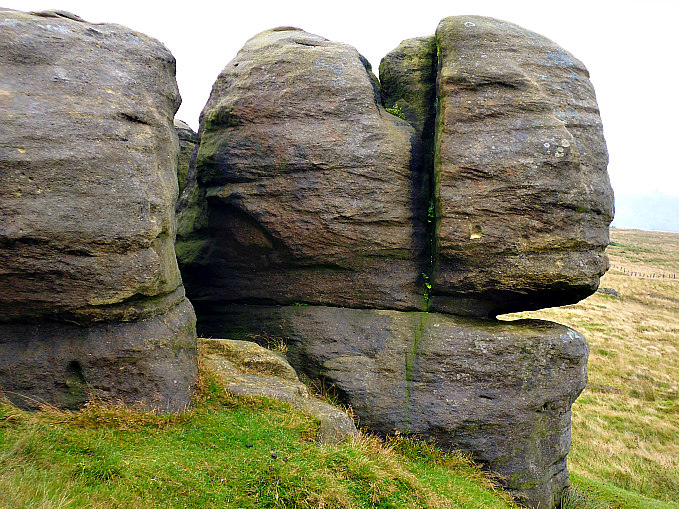
    OS grid reference: SD 9334 26750. Close to the Long Causeway and just east of Todmorden, West Yorkshire, are the Bridestones, outcrops of millstone grit rocks and boulders which are ½ a mile long. Amongst these rocky outcrops are a number of odd-shaped formations that have been caused by weather-related erosion over thousands, if not millions of years.  One huge boulder in particular, known as ‘The Great Bridestone’ is fantastically shaped at its base, looking like an up-turned bottle, as if it might topple over at any moment. There are a number of myths and legends associated with The Bridestones, many of these going back to the mists of time. More recently, perhaps, there are a number of local traditions that have become connected to the place and its many, strange-shaped rocks and boulders. The Bridestones are located about ½ a mile north-east of Eastwood Road – where a footpath runs across the often boggy moor to the outcrops. Another path connects the north-side of the outcrops from Kebs Road, and from just opposite Orchan House Farm at Fast Ends – it runs in a southerly direction across Bridestones Moor.

Bridestones (human face rock formation).

Bridestones (human face rock formation).

Bridestones, west Yorkshire (the anvil-shaped rock)

Bridestones, west Yorkshire (the anvil-shaped rock)

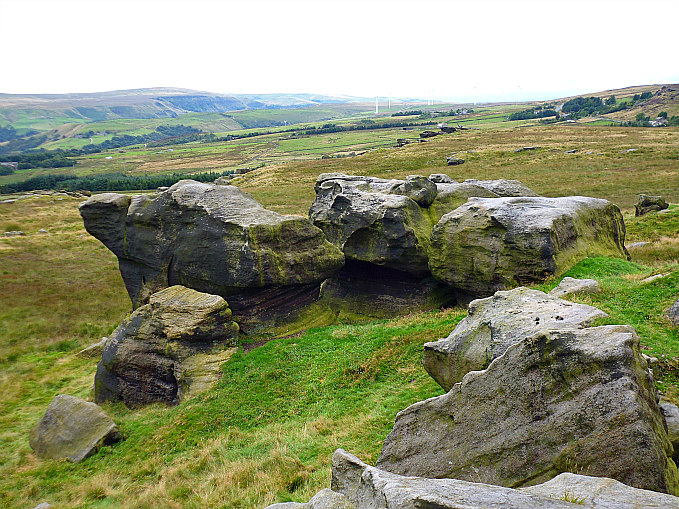
    At over 1,400 feet above sea-level the Bride-stones on the windswept moors to the east of Todmorden and the Calder Valley, there is a ½ mile long escarpment of Millstone Grit outcrops that stand like rocky sentinels keeping watch over the Pennine moorland. These rock forma-tions have been made by the ‘ravages of time’ – wind and rain over thousands of years weathering away the soft grit-stone into strange and curious shapes, and there are indeed some strange-shaped rocks – some looking like human heads and faces (the sphinx), while others look like prehistoric birds, a giant tortoise, and a bear, and there’s even a huge anvil-shaped rock.

Bridestones, west Yorkshire (the rock-house).

Bridestones, west Yorkshire (the rock-house).

Bridestones, (a "possible" cup-marked rock).

Bridestones, (a “possible” cup-marked rock).

    There is even a ‘rock-house’ at Fast Ends above Bridestones Farm at (OS grid ref: SD 9277 2690). Local legend says that Nan Moor and Jack Stone lived at the rock-house a few hundred years ago as ‘guardians of the stones’, and they were proba-bly married there, too. They are said to have lived in a wooden structure or homestead that was connected between the two large rocks; one of the oblong-shaped rocks having square-shaped openings in its side, which must have taken a great deal of time to carve out. This wooden structure was dismantled in recent times. Just above the rock-house there are some large, flat rocks which look to have ancient cup-marks but there are also larger, circular depressions that are naturally-formed by rainwater – although it’s sometimes difficult to tell which are natural and which are man-made! And there are many interesting rock basins to be seen.

Great Bride Stone stands like an up-turned bottle.

Great Bride Stone stands like an up-turned bottle.

Great Bride Stone (from a different sideways angle).

Great Bride Stone (from a different sideways angle).

    The name ‘Bridestones’ might be derived from Bridia, Brighid, or Briga, the pre-Roman (Iron Age) diety who is more often known from history as ‘Brigantia’, goddess of the Brigantes tribe of northern England – just prior to, and up to, the Roman Conquest. Or they “might” perhaps take their name from bride as in ‘bride and groom’ at a wedding ceremony, which harks back to times, long ago, when weddings supposedly took place on the moor where the outcrops of rocks now known as ‘Bridestones’ are located. Indeed there is a 15 foot high oval-shaped, weathered rock called ‘Great Bride Stone’ and beside it a smaller rounded rock called ‘the groom stone’. But undoubtedly the Bridestones was a sacred, magical place, and no-doubt a few thousand years ago it was the abode of druids who worshipped heathen gods and also officiated in ritualistic and sacrificial ceremonies, but aside from that they were also poets, historians, magicians, physicians and astronomers.

    Local author John Billingsley in his work ‘Folk Tales from Calderdale’ – Volume 1, says that: “The Bridestones are first mentioned in local documents in 1491, and Smith in his ‘Place-names of the West Riding’ does not quibble with the derivation from ‘bryd’, a bride….. John Stansfeld, however, in 1885, suggested that Danish ‘bred’ and Icelandic ‘bryddr’ married well with Gaelic ‘braidh’ and modern ‘bride’ in meaning ‘edge of the top of the hill’; whether today’s etymologists feel this explanation is defensible or not, the descriptive does fit this location rather well.”

    Billingsley goes on to point out that: “Taylor [Ian Taylor, 1993], has suggested an identification of Bride with ‘the Old Wife’ or Gaelic Cailleach, a traditional spiritual denizen of wild places more usually associated with the Irish goddess Danu; a local appearance of this hag figure may well be the Old Woman.

    “The Bride has also been locally known as the Bottle Neck. Other rocks have been given names, too, arising from one perception or another. Modern climbers have named rocks themselves, like the Indian’s Head and Spy Hole Pinnacle, as well as giving equally vivid names, like the Obscene Cleft, to specific routes. F.A Leyland cites names known in the nineteenth century, like Table Rock and Toad Rock.

    “John Watson knew of the Bride and Groom in 1789, but does not give details of the legend, other than saying the Groom had been “thrown down by the country people”. In keeping with the spirit of the time, however, he saw the rocks as the natural haunt of “a large settlement” of Druids – “a vast variety of rocks and stones so scattered about the common, that at first view the whole looked something like a temple of the serpentine kind”.

    And another local author, Geoff Boswell, in his book ‘On The Tops – around Todmorden’, says: “We know that the early Britons lived in Todmorden. We have the exhibition of objects dug from the bronze age barrow in the library. Perhaps the name Bride is very old and derives from the early British Breiad, the Gaelic Braidh, the Icelandic Bryddir and the Danish Bred. All of which have similar meanings of “the edge , or margin, at the top of a mountain”. It is a sobering thought that the names  of our prominent rocks can derive from very early times and are far older than any written records we have.”

    Author Paul Bennett in his work ‘The Old Stones of Elmet’, says of the Bridestones that it is: “A beautiful, remarkable and powerful site of obvious veneration. First described in local deeds as early as 1491, there are a great number of severely weathered boulders all round, many like frozen giants haunting a magickal landscape.

    “Dedicated to Bride, goddess of the Brigantine people, like her triple-aspect we find a triple-aspect to the outcrops here: to the west are the Bride Stones; to the east, the Little Bride Stones; with the Great Bride Stones as the central group, surveying everything around here. The goddess’ divine qualities were those of healing, smithcraft, poetry, and mother-hood. There is no attendant lore here that relates to any of these elements.

    “Although local history records are silent over the ritual nature of these outcrops, tradition and folklore tell them as a place of pagan worship. People were said to have married here, although whether such lore evolved from a misrepre-sentation of the title, Bride, is unsure. In the present day though there have been a number of people who have married here in recent years.

    “If the Brigantian goddess was venerated here, the date of the most active festivities would have been February 1-2, or Old Wive’s Feast day as it was known in the north.”

Sources and related websites:-

Bennett, Paul, The Old Stones of Elmet, Capall Bann Publishing, Milverton, Somerset, 2001.

Billingsley, John, Folk Tales From Calderdale, Volume 1, Northern Earth, Mytholmroyd, Hebden Bridge, West Yorkshire, 2008.

Boswell, Geoff, On The Tops – around Todmorden, (Revised Edition), Delta G, Hollinroyd Farm, Todmorden, 1988.

http://www.hebdenbridgehistory.org.uk/folklore/bridestones.html

Great Bride Stones, Todmorden, West Yorkshire

http://www.mypennines.co.uk/south-pennines/walks/301113.html#sthash.AKhGBLJg.dpbs

                                            © Ray Spencer, The Journal Of Antiquities.2016.

Les Causeurs Menhirs, I’le de Sein, Finistere, (Bretagne) Brittany

Les Causeurs Menhirs (photo credit: portalix - Wikimedia).

Les Causeurs (photo credit: portalix -Creative Commons).

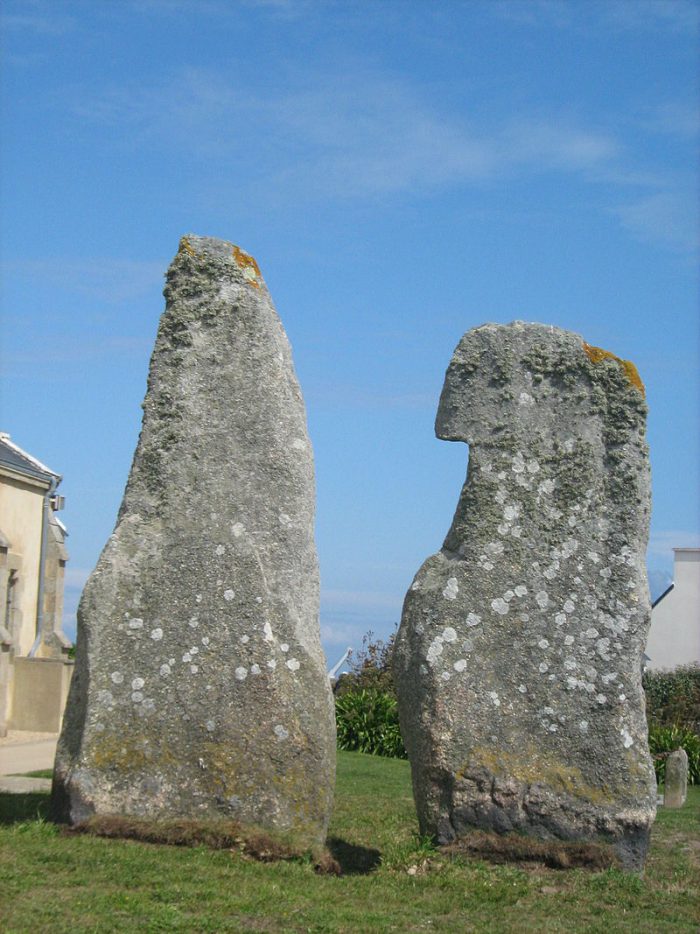
Latitude: 48.038149. Longitude: 4.851246. On a grassy mound at the south-west side of St Guénolé’s church on the I’le de Sein (Sein Island) – five miles off the Finistere coast at Pointe du Raz (Bretagne), Brittany, are two tall granite standing stones (menhirs) that are said to date from the Neolithic. These two standing stones may originally have been part of a stone circle. There are a number of myths and legends associated with these menhirs, and also the surrounding area in which they stand. The island, known as Enez Sun in Breton, is also steeped in pre-Christian myths and legends associated with druidic ritual. The standing stones can be seen on a low, grassy mound at the south-western side of St Guénolé’s Church (Eglise Saint-Guénolé) on the Place Francois-Le-Sud – just to the west of Port du Men-Briel.
The two menhirs (long stones) are also known in the Breton language as Ar Brigourien – the Talkers, and Ar Fistillerian – the Orators or Gossipers, and sometimes Ar Predicateurs – the preachers. The smaller stone seems to lean toward the taller one – hence the name “The Talkers”. They stand on a low grassy mound which long ago may have supported a circle of standing stones – these two are all that remain of that, but where the other stones went to is not known. Or maybe they originally formed part of a stone row or sacred way. It is thought they were erected here in the Neolithic period of prehistory (6,000-2,500 BC). Les Causeurs menhirs stand respectively at 2.8m (9 ft 3′) and 2.3m (7 ft 6′) in height. The church of Saint Guenole (alias St Winwaloe) was obviously built close to the stones to Christianise what was, long ago in the island’s dark past, a pagan ritualistic site associated with the druids and, mysterious pagan priestesses called “The Senes” – the island taking its name from them

The Breton author Henri Queffelec in his work ‘Un Recteur De L’ile De Sein’, tells us more about the island’s dark past. He says that: “In early times, the île de Sein was thought to be the haunt of supernatural beings. In the first recorded mention of the island in 43 A.D., in the work of the Roman geographer, Pomponius Mela, we are told that the Insula Sena possessed an oracle which was served by nine vestal virgins who had the capacity to control the elements and cure the apparently incurable. This tradition is later exploited by Chateaubriand in book IX of Les Martyrs (1809) in his description of the sacrificial activities of the Celtic druidess Velleda some of which take place on the “île de Sayne, île venerable et sacrée”. In the Middle Ages, the île de Sein is caught up in the Arthurian legends and according to some storytellers, is the birthplace of two of the most accom-plished magicians, the wizard Merlin, and Morgan La Fée.”

Queffelec goes on to inform us about the legendary ville d’ Ys, which was the kingdom of King Gradlon: “the ville d’ Ys, according to legend, was once the kingdom of King Gradlon in the sixth century A.D. situated somewhere between the Point du Raz and the île de Sein, and protected from the sea  by a system of dykes. King Gradlon’s daughter, Dahut or Ahès, was captivated by the charms of a handsome young man who was really the devil in disguise; as a proof of her love for him, he ordered her to get the keys of the dykes from Gradlon, her father. Once in possession of the keys, the devil opened the dykes and the town of Ys was submerged for ever. Gradlon managed to escape and went to Quimper where his statue can be seen on the cathedral; Ahès was changed into a siren, the Marie Morgane who lures unsuspecting sailors to their end. The story of the submerging of the ville d’ Ys is related by Queffelec in his novel, Tempête sur la ville d’ Ys, published in 1962.”

The Insight Guide ‘Brittany’, says of: “the fabled, drowned city of Is, [it was] the legendary capital of the kingdom of Cornouaille (echoes of Cornwall here).” It goes on to say that: I’le de Sein was the: “last refuge for the druids in Brittany.”

Sources and related websites:-

Insight Guide, Brittany, (First Edition), APA Publications (HK) Ltd., 1994.

Queffelec, Henri, Un Recteur De L’ile De Sein, George G. Harrap & Co. Ltd., London, 1972.

https://fr.wikipedia.org/wiki/Les_Causeurs

http://www.megalithic.co.uk/article.php?sid=8863

https://en.wikipedia.org/wiki/Winwaloe

http://www.lafermedekerscuntec.fr/peninsulas-islands-brittany.htm

http://www.brittanytourism.com/discover-our-destinations/quimper-cornouaille/unmissable-sites/sein

Check out more info here:  http://www.audierne-tourisme.com/en/discover/the-ile-de-sein/

Copyright © Ray Spencer, The Journal of Antiquities, 2016 (updated 2024)


Cup-And-Ring Marked Rocks on Rivock Edge, Near Riddlesden, West Yorkshire

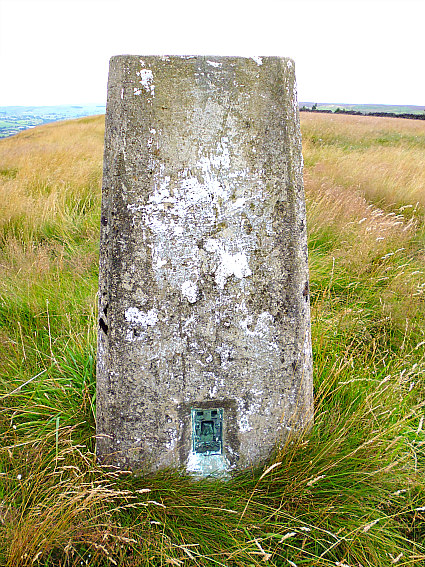
OS trig point no. S4563 on Rivock Edge.

OS trig point no. S4563 on Rivock Edge, West Yorks

    OS grid reference: SE 0742 4446. In close proximity to the Ordnance Survey triangulation pillar (no: S4563) at the north-western side of Rivock Edge, near Riddlesden, West Yorkshire, there are several prehistoric cup-and-ring marked rocks. However, some of these carved rocks are easily missed as they now lie amongst dead tree branches and stumps – the forest here having been cut down in the last couple of years. The trig point on Rivock Edge can be accessed from Silsden Road – to the north-west of Riddlesden. A footpath runs north-west across a field to a wall stile, then walk towards the television mast, but before that take the footpath (not the trackway) that heads north-east around the northern-side of Rivock Edge to Rivock Oven Cave. From here walk up-hill and head south-west across the wood-strewn moor, keeping sight of the wall and concrete trig pillar. It’s now just a case of looking out for the many large and small cup-marked stones and rocks, and they are widely scattered about.

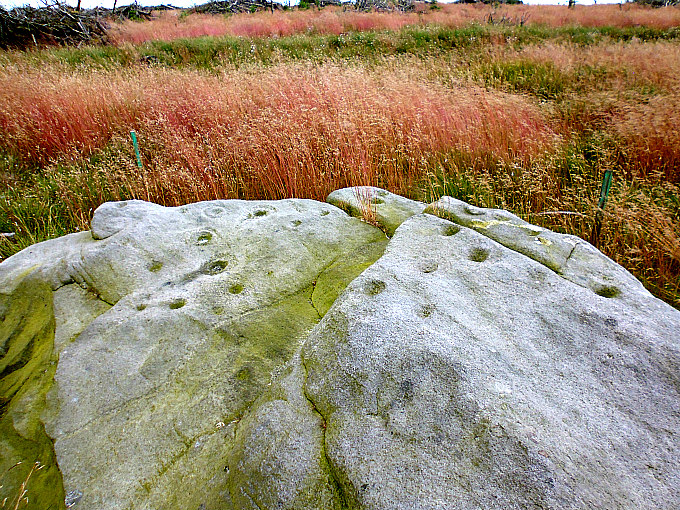
Cup-And-Ring Marked Rock at Rivock Edge.

Cup-And-Ring Marked Rock at Rivock Edge.

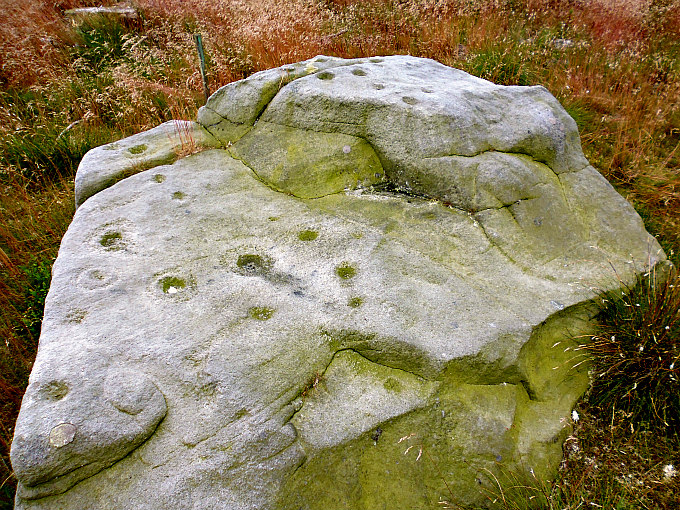
Cup-and-ring marked rock on Rivock Edge.

Cup-and-ring marked rock on Rivock Edge.

    One of the best cup-and-ring marked rocks on this part of the moor is undoubtedly,  in my opinion, the large gritstone rock located some 350m east of the trig point (SE 0743 4462). From the trig pillar follow the footpath east beyond the wall. This large, weather-worn rock has several well-defined cups and also a few that have faint concentric rings. Other carved rocks and stones can be found in the vicinity of the wall, while others are a bit further away. There may well be some that are hidden beneath the tree foliage, and a few that are still unrecorded.

Cup-marked rock on Rivock Edge, west Yorks.

Cup-marked rock on Rivock Edge, west Yorks.

Cup-marked stone on Rivock Edge, west Yorks

Cup-marked stone on Rivock Edge, west Yorks

    Cup-marks are circular depressions on rocks, usually on flat-sided gritstone and sandstone rocks, but not exclusively so, and often but not always these are surrounded by concentric circles. Sometimes these circular depressions and rings are joined or intersected with gulleys or lines running from other cup-marks; other patterns and designs can sometimes be seen on these rocks too. They are sometimes confused with larger, deeper depressions, or holes in the rock’s surface that are caused by natural water erosion; these are generally steep-sided.

Stone with cup-marks on Rivock Edge, west Yorks.

Stone with cup-marks on Rivock Edge, west Yorks.

Large rock with cup-marks, Rivock Edge.

Large rock with cup-marks, Rivock Edge.

    These ancient carvings (petroglyphs) or rock-art, have generally been dated to the Neolithic, but they are perhaps more likely to date from the early Bronze Age. But no-one seems to know, with any ‘real’ certainty, what they actually represent or signify, or why they were carved on rocks high-up on the bleak, windswept moors. Were these prehistoric cups-and-rings carved onto rocks to represent the stars or were they perhaps maps of the stars, or maybe maps showing where burials were located, or sacred places, springs, ancient pathways and caves that were, at that time, only known to our ancient ancestors? Or were they simply the doodlings and graffiti of ancient peoples?  So these carvings must remain, for the time being at least, something of an “ancient enigma”. Probably we will never really know their true meaning or symbolism.

    Author John Dixon in his work ‘Journeys Through Brigantia’, (Volume One), says of these mysterious carvings that: A comprehensive field study of the cup and ring stones of the moor has been published by the Yorkshire Archaeological Service. From that survey a few broad conclusions are possible.

    “The marked stones fall into three main types: cup and ring marked; cup marked only; and more complex designs. The marked boulders tend to be found in clusters on the flanks of the moor—both in Airedale and Wharfedale. Cup and ring marked stones are found in other parts of the British Isles—but Ilkley represents a unique concentration of carvings. It is clear that the stones were cut over a comparatively long period of time—and unfor-tunately some stones have been recut in modern times. Certain glacial markings may have been interpreted as the hand of man.”

    John goes on to say that: “We can be sure however that the stones themselves were sacred in ancient times. The kings of the Picts, the most ancient people we can identify by name in the Isles, were proclaimed upon a stone. The Stone of Scone  is now incorporated into the English Coronation Throne in Westminster Abbey. At Hexham and Beverly the thrones of the Anglo-Saxon bishoplords exist cut from a single stone.

    “Throughout history and throughout the world ancient places of assembly are often signified by stones or physical features—unchanging in a changing world. The signifi-cance of certain stones being stressed by the marking of the stone. Sacred marked stones can indeed be found worldwide, from Ilkley Moor to Ayers Rock.

    And the great Arthur Raistrick in his work ‘The Pennine Dales’, has an interesting theory regarding the climate in the Bronze Age. He says: “The wet period began to fall off about 3000 B.C. and the later Neolithic and Bronze Age people had a warm, dry period during which the forest cover of oak, alder, lime, and ash, with birch, spread over the fells to over 2,000 ft OD. The climate during the Bronze Age was better than that of today, and man could occupy many sites which now would be almost untenably cold and wet.”

Sources and related websites:-

Barringer, J. C., The Yorkshire Dales, The Dalesman Publishing Company Ltd., Clapham, 1982.

Dixon, John & Phillip, Journeys Through Brigantia, Volume One: Walks in Craven, Airedale and Wharfedale. Aussteiger Publications, Barnoldswick, 1990.

Raistrick, Arthur, The Pennine Dales, Arrow Books Ltd., London, 1972.

http://www.ancientmonuments.info/monuments/silsden-west-yorkshire

https://en.wikipedia.org/wiki/Neolithic_and_Bronze_Age_rock_art_in_the_British_Isles

http://www.stone-circles.org.uk/stone/rombaldsmoor.htm

http://www.yorkshirepost.co.uk/news/uncovered-secrets-of-ilkley-moor-s-rock-art-1-4925780

                                         © Ray Spencer, The Journal Of Antiquities.


1 Comment

Robin Hood’s Stone, Near Riddlesden, West Yorkshire

Robin Hood's Stone at Holden Gate, near East Riddlesden.

Robin Hood’s Stone at Holden Gate, near  Riddlesden.

    OS grid reference SE 0620 4446. A large pointed stone shaped like the head of a dinosaur, or maybe a dragon, stands below a rocky outcrop on Pinfold Hill, close to Holden Lane at Holden Gate, near Riddlesden, West Yorkshire. It is locally called ‘Robin Hood’s Stone’ but whether the legendary outlaw of Sherwood Forest ever visited it we don’t know, although there is also a Robin Hood’s Wood about ¼ a mile to the north-east of the stone. To make the stone look more interesting some bright-spark has painted eyes and teeth on it! It can be reached by travelling north along Holden Lane to the north-west of Riddlesden, and is about 450m further along the road from Holden Gate, and just after the footpath on the right. You can’t really miss it!

Robin Hood's Stone (with possible cup-marks).

Robin Hood’s Stone (with possible cup-marks).

    A curious stone this is mainly because of its strange shape. It looks as if it has, at some point, slid down the hillside from the rocky outcrop above on Pinfold Hill, when there was a perhaps a Geological earth movement here. Or could it be a glacial erratic boulder? But it doesn’t look like an erratic boulder to me because it seems to be very well embedded into the ground. It stands at a crazy, precarious angle and because of that it looks as if it could slither down the hillside at any moment! The large pointed stone has taken on the look of a dinosaur’s head, or could it be a dragon’s head, or a bird’s head! Some bright-spark has painted eyes and teeth on the stone to make it look like that maybe. On the flat, sloping side of the stone there are some “possible” prehistoric cup-marks, or were a few of these round holes made by climbers who often practice on the rock?

Robin Hood's Stone (looking up at the stone).

Robin Hood’s Stone (looking up at the stone).

    Legend says that Robin Hood the outlaw of Sherwood Forest came here and took shelter beneath the stone; well he wouldn’t have had too far to travel from Kirkless, near Leeds. And Robin was maybe born in Wakefield! And just up the hill to the north-east of the stone we have a Robin Hood Wood. Paul Bennett of ‘The Northern Antiquarian’ has suggested that the stone was moved here in the Victorian period from near Barden Tower (Bolton Abbey way), and he goes on to say that Robin Hood’s Stone was once nearly broken up and taken away for building material – had it not been for local people who objected to its removal. He also thinks the stone “was” a meeting place at the pagan festival of Beltane (1st May). Check out TNA website (below).

Sources and related websites:-

Robin Hood’s Stone, Riddlesden, West Yorkshire

http://www.bbc.co.uk/bradford/content/articles/2006/09/20/robin_hood_wakefield_feature.shtml

© Copyright, Ray Spencer, 2016.