The Journal Of Antiquities

Ancient Sites In Great Britain & Southern Ireland


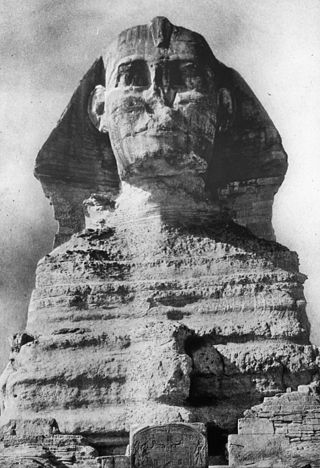
Great Sphinx, Giza, Egypt

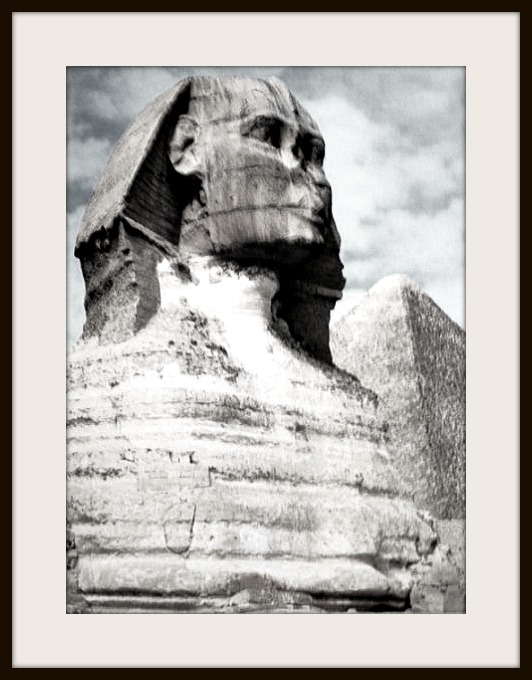
Great Sphinx at Giza, Lower Egypt.

Great Sphinx at Giza, Lower Egypt.

Latitude 29.975350. Longitude 31.137500. Ancient site at Giza in Lower Egypt, 12 miles south-west of Cairo. The ‘Great Sphinx’, also known as ‘the Sphinx of Hamaldis’, whilst during the time of the ‘New Kingdom’ it was called ‘Horus of the Horizon’ and, in modern Egyptian Arabic ‘the Terrifying One’ – (Wikipedia). It stands just 200 metres from the Pyramid of Khafra, and is known to the local inhabitants as ‘the guardian of the Giza necropolis’. The nose of the sphinx was apparently chopped off back in the 7th century AD, and not as many historians had once thought by the cannons of Napoleon Bonaparte’s army in 1798, but I suppose that made for a good story!

Giza Image 9627 (photo by Thebrookelynway for Wikipedia)

Giza Image 9627 (photo by Thebrookelyn-way   for Wikipedia)

The great sphinx dates from the 4th dynasty of the pharaohs (2,575-2,467 BC) and is thought to represent Khafra, who ruled between 2,558-2,532 BC). However, some historians now think the statue might date from the New Kingdom (1,570-1,070 BC), according to author Cathal Coyle in his “very concise” article ‘Famous Landmarks’ in the magazine ‘Ireland’s Own’.  This gigantic crouching limestone monument, located on the western bank of the River Nile, is 66 feet high, 63 feet wide and 220 feet in length; and has the body of a lion and the head of a human, possibly Khafra, but there is no certainty about that.

Author Cathal Coyle in his magazine article says that: “When Khafre came to power during the 4th Dynasty, he constructed the Great Sphinx by using limestone core blocks weighing hundreds of tons in his temples. His craftsmen also created more than 200 statues; 22 of these were at least three times life size.”

Coyle goes on to say: “Representative of two Egyptian gods – the pharaoh god and the lion god, the sphinx combines the body of a crouching lion with the head of a human. In ancient times, it is thought that the face and body were painted dark red and the head cloth was yellow with blue stripes.” There are said “still” to be traces of this red paint on the head of the sphinx, especially ‘it is said’ near one of the ears.

   “Although there has been great speculation about the nose of the Great Sphinx, it is not actually known what happened to it. The drawings made by European travellers of the 16th and 17th centuries to Giza show the sphinx’s face complete with a nose.”

   “By the time of Napoleon’s expedition to Egypt in the early 19th century, the nose was missing. One possible suggestion is that the face of the sphinx was the victim of target practice by the French army! Some scholars also believe that the sphinx originally had a beard. Pieces of the beard discovered by excavation are in the British Museum in London.”

   “Much controversy has surrounded the Great Sphinx, including whether or not it was actually carved as late as the 4th Dynasty. An accumulating body of evidence, both archaeological and geological, indicates that the Sphinx is far older than this – and was only restored by Khafre during his reign.”

   Cathal Coyle goes on to add that: “Some archaeologists have also suggested that it was a memorial to a Pharaoh, but other scholars believe the Sphinx functioned as an astronomical observation device that marked the position of the rising sun on the day of the spring equinox. Later Egyptian rulers worshipped it as an aspect of the sun god, calling it Hors-Em-Akhet or ‘Horus of the Horizon.”

   “What saved the Great Sphinx from complete destruction is the fact that it had been submerged beneath the desert sand for most of its existence.”

   “Between 1816 and 1858, a series of adventurers, including Giovanni Caviglia and Gaston Maspero, attempted to clear the sand from around the body of the Sphinx but were each forced to abandon the project due to the enormous amount of sand. Finally, between 1925 and 1936, the French engineer Emil Baraize was successful in clearing the sand to reveal the base of the Sphinx.”

   “Repairs to the Sphinx have been made over the centuries by the Pharaohs Tuthmosis IV and Ramesses II, and also during the Roman era. In the 1980’s, during a six-year period, more than 2000 limestone blocks were added to the body of the Sphinx and various chemicals were injected in the hopes of preventing the deterioration. This treatment was not successful and sadly contributed to further deterioration. The Great Sphinx at Giza continues to deteriorate because of the humidity and the ever-increasing smog from nearby Cairo.”

   Author Cathal Coyle concludes his article by saying that: “The focus appears to be on preservation rather than further explorations; but towards the end of 2010 during routine excavation work in the area of the monument, Egyptian archaeologists discovered large sections of mudbrick walls which were part of a larger wall which stretched for 132 metres around the Great Sphinx.”

Sources:

Coyle, Cathal., Famous Landmarks, Ireland’s Own, (various dates), Wexford, Ireland.

https://en.wikipedia.org/wiki/Great_Sphinx_of_Giza

Copyright © Ray Spencer, The Journal of Antiquities, 2015.


2 Comments

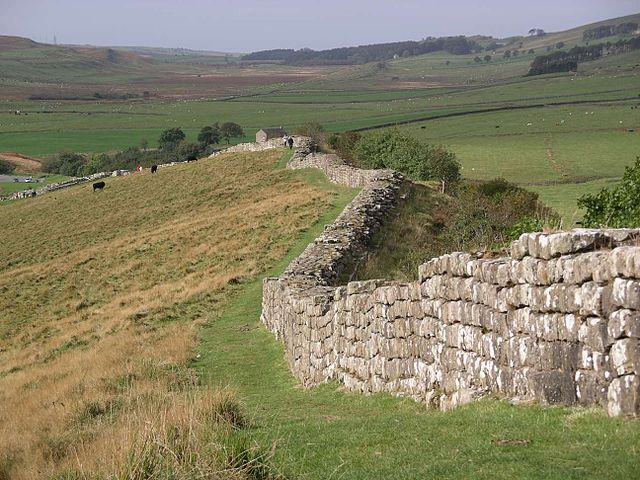
The Old Frontier (Hadrian’s Wall), Scottish Borders, United Kingdom

A section of Hadrian's Wall (photo by Moldovian1 for Wikipedia)

A section of Hadrian’s Wall (photo by Moldovian1 for Wikipedia)

In the Autumn 2008 edition of the magazine ‘Beautiful Britain’, there is an excellent article by the author Jock McKinnon called ‘The Old Frontier’. In this article, the author tours Hadrian’s Wall, the ancient Roman frontier that stretches from the Tyne in the east to the Solway Firth in the west, a distance of 80 Roman miles (73 normal British miles!), and he uncovers the history behind the Roman wall and its stones. Here I have “quoted” in full the article which appears in the magazine. Hadrian’s Wall (Latin: Vallum Aelium), also called the Roman Wall, Picts’ Wall, or Vallum Hadriani, was a defensive fortification in the Roman province of Britannia, according to Wikipedia.

“Standing on the stretch of Hadrian’s Wall west of the remains of Housesteads Roman fort, it is still possible to imagine a Roman sentry shivering in the cold. Squinting into the distant landscape, he must have wondered what on earth he was doing in such a ‘gods-forsaken’ place, so far from the centre of his ‘civilised’ world. It is an image that has been handed down to British schoolchildren for generations. But who really were the people who built and guarded the Wall? And why was it built? The answers, if they exist at all, lie buried in ancient records as well as in the stones and soil around the Wall.”

“The story begins with just one line of Hadrian’s biography, which describes the Emperor as ‘the first to build a wall, 80 [Roman] miles long, to separate the Romans from the barbarians’. In 117 AD, Hadrian succeeded Emperor Trajan, whose conquests had stretched the Roman Empire to its furthest reaches, from Mesopotamia (modern Iraq) in the south-east to Scotland in the north-west. It was clear to Hadrian, however, that the empire had just reached its limits. With military resources and communications stretched to their maximum, Hadrian decided to consolidate Roman hegemony by withdrawing wherever necessary to manageable borders. He knew it was more important to be able to control what the empire had conquered rather than attempt to stretch its frontiers further. And so he began a tour of the empire, including Britain, to see the problems for himself.”

McKinnon goes on to say: “Although much of Britain had been subjugated, and revolts by local tribes – such as Boudicca’s – had been brutally put down, it was clear that there was still trouble ‘up north’ caused by ‘insurgents’, to use a modern term, from the northern tribes. Although we do not know the nature of such warfare – no detailed accounts of the fighting exist – we do know that the building of the Wall began immediately after, or even during, Hadrian’s visit to the province, from 122 AD onwards.”

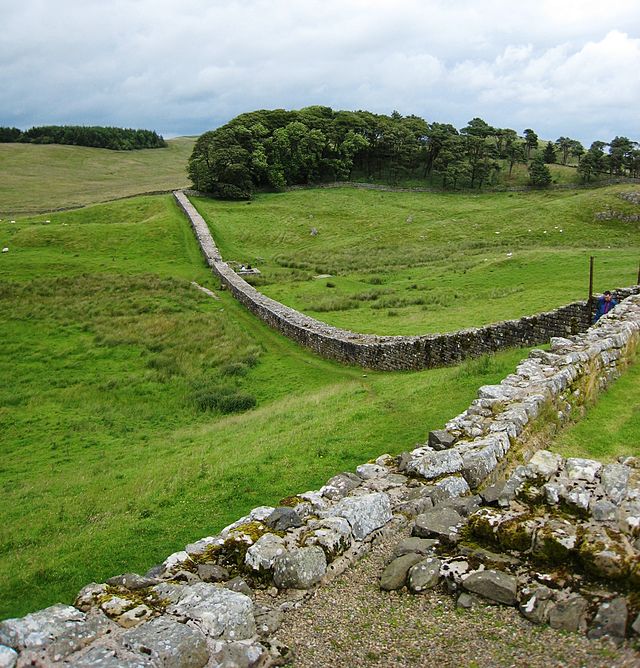
Section of Hadrian's Wall (photo by Velela - for Wikipedia)

Section of Hadrian’s Wall (photo by Velela – for Wikipedia)

“Stretching 73 miles from Wallsend on the Tyne in the east to Bowness-on-Solway in the west, the Wall and its forts were built from locally quarried stone and made good use of natural features such as Whin Sill, a lengthy rocky outcrop forming a north-facing cliff. A long line of forts also stretched west, down the coast of Cumbria. Wall inscriptions show that construction was mostly undertaken by troops from three legions, one of which – the Six Victrix – had come to Britain with Hadrian himself. The construction project may well have served the additional purposes of keeping the troops occupied and boosting competition and morale, as well as indicating to the locals that the Romans were deadly serious about imposing their will on the region.”

“Conceived as a wall up to 15 ft high and 10ft thick, with a forward ditch to make an attack more difficult, the design was changed before completion, with later sections adopting a much thinner width, in places only 7ft thick. It is not known why there was this change of plan; perhaps it was to make more efficient use of the materials, or simply to speed up construction. Either way, it suggests that the need for the barrier was pressing. Indeed, it is believed that territory to the south of the Wall was just as troublesome at the time.”

“The Wall was, therefore, more than a defensive barrier to keep out northern raiders. In certain spots along the route of the Wall, such as at Heddon alongside the B6318, you can still make out large earthworks. Known as the ‘vallum’, these works consisted of a flat-bottomed ditch south of the Wall, about 20ft wide and deep, flanked on either side by mounds 20ft wide and 10ft high. The vallum often diverts around the forts, showing that it was built around the same time. Crossings were built opposite the forts, through the ramparts and across the ditch, with a gate. This indicates that the system of earthworks was used to control the flow of traffic through the Wall.  So it seems that another purpose of the Wall was quite literally to divide and rule, and to control the cross-country movement of people and goods.”

The author asks: “So what do we know about the soldiers who manned the Wall? From inscriptions on the Wall and at nearby forts, it is clear that, although the legions – which consisted of men with Roman citizenship, helped with the construction of the Wall, and fought in the area, often manning forts to the north and south of the Wall, they did not form its main garrison. This was the job of auxiliaries – infantry and cavalry units of non-citizens recruited from all around the Roman Empire. Amongst the remains of the fort at Chesters is a stone reused as a step on which in inscribed the name of the First Cohort of Dalmations, infantrymen originally from the region which is now Croatia. Other inscriptions record the presence of troop units from France and Germany.”

“Chesters is a good place to begin to take in the skill of the military engineers. Because of the layout of the site, the fort is difficult to imagine, but the bath-house, with walls still reaching up to 10ft high, and the monumental foundations of the bridge that carried the Wall and traffic across the Tyne, are impressive. Also worth a visit is the small museum, which contains many of the most important inscriptions found along the Wall.”

“Chesters was one of a series of large forts that were constructed every six to eight miles along the Wall, sometimes after its construction, to house troops. These were in addition to the much smaller milecastles, which were built into the south side of the Wall once every Roman mile, and turrets. The purpose of the turrets and milecastles was to provide look-outs and to aid communication from fort to fort.”

“Housesteads was another large fort and its remains are imposing even today. It occupies a commanding position, on a south-facing slope, with its north side abutting the Wall and overlooking Whin Sill. Here it is possible to see the remains of gates, granaries, a headquarters building and the commanding officer’s house.”

Hadrian's Wall from Housesteads Fort (photo by Jamesflomonosoff - for Wikipedia)

Hadrian’s Wall from Housesteads Fort (photo by Jamesflomonosoff – for Wikipedia)

“There are still also visible remains of cultivation terraces outside the walls of Housesteads, and excavations have revealed the streets, workshops and shops that clustered around the forts of Chesters and Vindolanda. Local tradesmen would have supplied the armed forces and the expanding local civilian economy that would have gravitated towards the troops and military to serve their various needs.”

“Amongst the most remarkable finds from Hadrian’s Wall are the famous tablets of Vindolanda. Painstaking archaeology has pieced together fragments of military records and personal letters which were inscribed on the wooden tablets at the fort and then discarded, left to decay in wet, clay soil. Fortunately for us, they were miraculously preserved by the anaerobic conditions, and the retrieved texts now provide tantalising glimpses of  everyday life.”

The author, Jock McKinnon, in his article makes mention of the other Roman frontier, the Antonine Wall, about 100 miles to the north. He says of this: “Another frontier, this time of earth banks, ditches and wooden palisades, was built about 100 miles further north 20 years later, during the reign of the Emperor Antoninus. The purpose of this second barrier may have been to create a controllable ‘neutral zone’ to Hadrian’s Wall further south, indicating that there was still a threat from unrest, but it would have doubled the military forces needed to patrol both frontiers and the region and it was abandoned by about 170 AD.”

“Hadrian’s Wall itself was finally abandoned much later, not until the late fourth century, although finds at Birdoswald fort show that it continued to be used by a community, probably as a defensive enclosure, into the fifth or six centuries, long after the Romans and Hadrian had become a distant memory. Subsequently, much of the stonework was dismantled and reused for building work, and it’s only the remote stretches of the Wall and forts that can be seen today.”

“It is sobering today to stand on the Wall, where that imagined soldier once stood, knowing that although it was obviously important at the time to emperors, their troops and local people – whether they supported it, hated it, or earned money as a result of it – it really matters little now whether the Wall was successful or not. All the time, money and manpower spent to quell a distant province proved fruitless. Except, that is,  for what the Wall can still tell us about our distant past.”

Sources:

McKinnon, Jock., The Old Frontier, Beautiful Britain, Vol 3 Number 3 Autumn 2008, Cheltenham, Gloucestershire, 2008.

http://en.wikipedia.org/wiki/Hadrian’s_Wall

http://www.hadrians-wall.org

Copyright © Ray Spencer. The Journal of Antiquities, 2015.


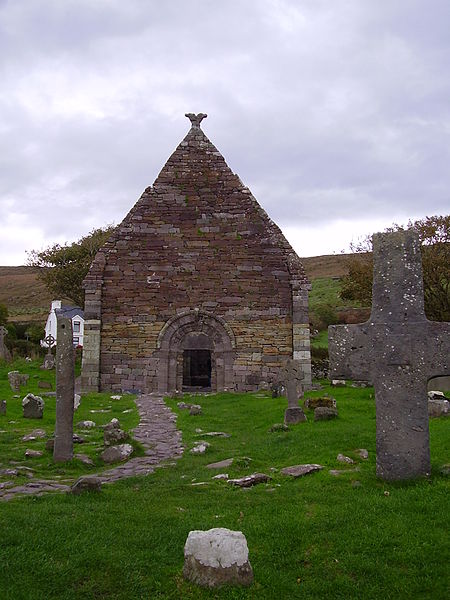
Kilmalkedar Monastic Site, Dingle Peninsula, Co Kerry, Southern Ireland

Kilmalkedar Church, Co Kerry (Photo credit: Wikipedia)

Kilmalkedar Church, Co Kerry (Photo credit: Wikipedia)

Irish grid reference: Q 4030 0620. Just off the R559 Cois Farraige (or the Carrig) road to the east of Murreagh on the Dingle Peninsula, Co Kerry, stands the 7th-century Kilmalkedar Monastic Site, also known as Cill Malcheadair. Here we find a small 12th-century roofless Romanesque church, a rare Dark Age sundial, an Ogham and Latin inscribed stone and some cross-inscribed slabs, one of which is called ‘the Alphabet Stone’ and, there are some pre-Christian holed ‘balaun’ stones, holy wells and early medieval grave-markers – in what is a ‘very’ beautiful and holy setting in the far southwest of County Kerry, 5 miles north-west of Dingle on the R559 road.

The first church and a monastery were established here at Kilmalkedar in c 600 AD by St Maol-cethair (Maolcedar), the son of an Irish king (of Ulster). A building called ‘St Brendan’s House’, actually an oratory, can also be found here and, close by the pilgrims’ road (Cosan na Naomh) leads on to Mount Brandon from where St Brendan departed for foreign lands in the mid-6th century. About 1 mile to the southwest of Kilmalkedar is the famous boat-shaped building known as ‘the Gallarus Oratory’, which dates maybe from the 8th century. The Celtic monastery of Kilmalkedar is known from history to have been a renowned school of learning during the early medieval period.

The ancient roofless Romanesque chapel dates from the mid-12th century, though there was obviously an earlier religious building on this site, maybe dating back to the Dark Ages when both St Brendan and, later St Maolcethair were in residence here. There are a number of very beautiful architectural features in the church. It consists of a chancel and nave – the chancel measures roughly 6 metres by 5 metres – while the nave is roughly 8 metres by 9 metres. The church is said to resemble the more famous Cormac’s Chapel at Cashel, County Tipperary.

In the excellent article ‘Marking The Passage Of Time’ by Patrick O’Sullivan for the Ireland’s Own magazine we are informed that the church was: “built in the Romanesque style of the twelfth century, typical features being the round-headed doorway and the high pitched gables”. But there are a number of other features too including the barrel-vaulting and a lower section of the corbelled stone roof, and some carved window surrounds have survived. The chancel dates from 1200; and the west doorway has a ‘tympanum’ with carved stone head. O’Sullivan in his article goes on to say: “The original roof of the church has long since given way but the East Window, known locally as Cno na Snaithaide, the eye of the needle, still remains. It has long been the tradition for pilgrims to pass through the window nine times, especially at Eastertime, when it was believed that doing so would grant them the promise of eternal life”.

Standing in the chancel is the famous ‘Alphabet Stone’, dating probably from the 6th century AD, which is 4 feet high, but is broken at the top. On its west face the Latin alphabet and an earlier inscription DNI which is probably ‘domini’. The north face has a thin, damaged cross while the south face has an equally thin Latin cross with scrolled ends. And outside in the graveyard a 6-foot-high slender Ogham stone with a little round hole at the top. The Latin inscription on this is: ANM MAILE INBIR MACI BROCANN which is translated as: ‘In the name of Mael Unbir, son of Brocan’, and on the opposite side (along the edge) is the Ogham notch inscription reading the same. This stone is thought to date from the 5th or 6th century AD.

Kilmalkedar Sundial Co Kerry (Photo credit: Wikipedia)

Kilmalkedar Sundial Co Kerry (Photo credit: Wikipedia)

Also in the churchyard is a 4-foot high rectangular-shaped stone with sundial markings beautifully carved onto it. O’Sullivan says of this: “The beautiful sundial is marked with segments which correspond to the divisions of the monastic day”. He goes on to say: “The northwest face meanwhile is decorated with a cross of arcs, the later now thought to be a symbol of pilgrimage, as it appears on many stones associated with early pilgrimage routes”. And further he says: “While the lines on the Kilmalkedar sundial end in half moons, or semi circles, other examples have lines that end in three-pronged forks. There are two decorative fret motifs at the top of the shaft of the Kilmalkedar sundial, everything about it evocative of an age when the pilgrims made their way to the holy mountain. It is the easiest thing in the world to picture some of them stopping by the sundial, telling the time of day from the way in which its face was shadowed by the sun”, he says.

There are a number of interesting early Medieval grave markers set among the more modern gravestones, these may indicate where monks from the monastery were buried between the 8th-12th centuries. Also, there are two holy wells – one for St Maolcedir, founder of the monastery here, and the other belongs to St Brendan whose ruined, roofless oratory (St Brendan’s House) stands 50 metres to the north. St Brendan’s holy well is located at the south-east side of his two-roomed oratory.

Also in the churchyard, a hefty and tall slab cross with a thin (unfinished) cross carved onto it, and a number of early medieval grave markers in the form of crosses, including a small T-shaped tau cross. These probably mark the graves of the monks who lived at the monastery between the 8th-12th centuries AD.

Some 50 metres to the north, near St Brendans House, there are two pre-Christian balaun stones with several depressions or bowl-like holes in them – though what these were originally used for is uncertain, maybe milk, or some other substance was placed in the holes as a kind of fertility aid, or for healing purposes? During the early Christian period these holes may have been used by missionaries for holy water and, subsequently baptism of the local people. Close by is the pilgrims road (Saint’s Road) which leads from Kilmalkedar to Brandon Mountain from where legend says St Brendan the Navigator sailed across the Atlantic Ocean on his long journey to other lands back in the mid-6th century AD, according to Katharine Scherman in her delightful book ‘The Flowering of Ireland’.

Sources:

Bord, Janet & Colin., Mysterious Britain, Paladin Books, London, 1974.

The Antiquities of Kilmalkedar: Dingle Peninsula, Co Kerry

http://irishantiquities.bravehost.com/kerry/kilmalkedar/kilmalkedar.html

http://de.wikipedia.org/wiki/Kilmalkedar

O’Sullivan, Patrick., ‘Marking The Passage Of Time’, Ireland’s Own, (Various Dates), Wexford, Ireland.

Scherman, Katharine., The Flowering of Ireland, Victor Gollancz Ltd., London, 1981.

Copyright © Ray Spencer, The Journal of Antiquities, 2012 (updated 2023).


1 Comment

Heston Brake Long Barrow, Portskewett, Monmouthshire, Wales

Heston Brake Puddingstones (Photo credt: Grashoofd - Wikipedia)

Heston Brake Puddingstones (Photo credt: Grashoofd – Wikipedia)

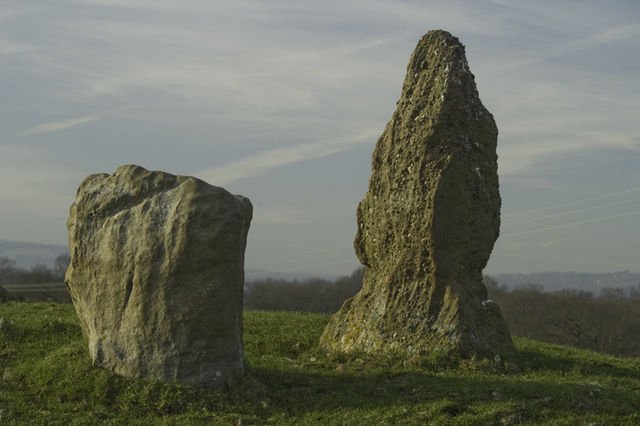
Os grid reference: ST 5052 8867. Located in a field and on the brow of a hill overlooking the Severn Estuary, south Monmouthshire, stands the more than 4,000 year old prehistoric barrow or cairn called Heston Brake Long Barrow, sometimes also referred to as a “chambered tomb”or “dolmen”. The barrow still has nine of its stones positioned (maybe in situ) on top, but has obviously suffered over time from damage caused by vandals digging into it, although in the late 19th century it was excavated by archaeologists. It is located in a field at Black Rock – about half a mile to the north-east of Portskewett, and just 100 metres to the west of Leechpool Lane. This ‘now’ partly destroyed barrow stands (on private land) about 150 metres south of a footpath heading in a westerly direction from Lower Leechpool Farm on Leechpool Lane. The village of Mathern is some 2 miles to the north-east.

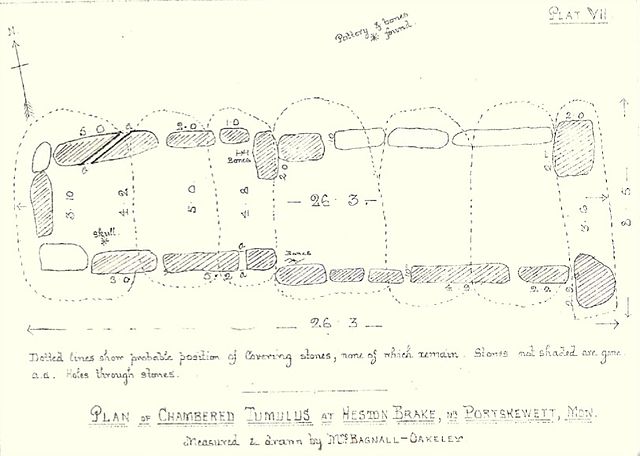
Plan of chambered tumulus at Heston Brake by Mary Ellen Bagnall Oakeley (1888)

Plan of chambered tumulus at Heston Brake by Mary Ellen Bagnall Oakeley (1888)

The remains of the barrow’s two inner chambers (internally connected E and W sides) apparently measured 26 feet long by 5 feet across, according to Fred Hando (in the much acclaimed work ‘Hando’s Gwent’); however the middle section of the monument was destroyed in more recent times. However the 9 standing and recumbent pudding-stones on the 1 metre high mound still look very impressive. It would seem that there were originally 13 upright stones here but 4 of these have now gone – probably being robbed-away to the local area for walls. At the east side (the probable entrance to the chamber) an impressive-shaped stone is 5 foot in height and shaped like a knife or axe-head, while beside it a 2 foot high square-shaped stone (called the chopping block) by local author Fred Hando in the work ‘Hando’s Gwent’, where there is a drawing of  ‘Heston Brake Tumulus by moonlight’ on page 159.  So could this ancient monument have been used for sacrificial/ceremonial purposes back in the Neolithic Age?

All the other stones here are somewhere between 1-2 feet in height; but obviously the low mound on which they now stand would originally have been much higher and would have covered the standing stones by several feet. The mound contained two interconnecting chambers for burials – which revealed various antiquities when it was excavated back in 1888, although at this time it became known that, very unfortunately, earlier vandalism and, or robberies had taken place here, according to Chris Barber and John Godfrey Williams in their excellent book ‘The Ancient Stones of Wales’ (1989). The authors also say that: “It is marked as Long Barrow on the Ordnance Survey maps of  1953 and 1981”.

In the work ‘Wales: An Archaeological Guide’ (1978) by Christopher Holder we are told that: “The present condition of the stone structure and the mound of this chambered long barrow is misleading. Excavations in 1888 showed it to consist of a gallery 8 m long by 1.5 m wide, in the E. end of a barrow 18 m long by 9 m wide”. And it would seem, according to Christopher Holder, that in spite of its position by the Severn, virtually in sight of the Cotswolds, “it seems to belong with Gaerllwyd….. to a tradition of more western origin, distinct from that of the Black Mountains and….. Parc Cwm”.

At the excavations of 1888 a number of human bones were dug up from the earliest period and, some pottery sherds from slightly more recent times. The late author Fred Hando in the work ‘Hando’s Gwent’ adds that: “if you would like to feel cold shivers down your spine, choose a moonlit midnight next summer and visit this long barrow alone”. Okay, thanks Fred, will do that next time!

The late and renowned author Roy Palmer in his epic tome ‘The Folklore of (Old) Monmouthshire’ speculates as to Heston Brake, among a couple of other sites nearby, being the place where the British (Celtic) chieftain Caractacus or Caradoc lived for a time with the ancient Silures tribe in the early part of the 1st century AD, but eventually he went to Rome and died there after being pardoned by the emperor Claudius – sometime after 51 AD.

Sources:

Barber, Chris & Williams, John Godfrey., The Ancient Stones of Wales, Blorenge Books, Abergavenny, Gwent, 1989.

Hando, Fred., Hando’s Gwent, (Ed. by Chris Barber), Blorenge Books, Abergavenny, Gwent, 1987.

Holder, Christopher., Wales: An Archaeological Guide, Faber & Faber, London, 1978.

http://en.wikipedia.org/wiki/Portskewett

Palmer, Roy., The Folklore of (Old) Monmouthshire, Logaston Press, Almeley, Herefordshire, 1998.

Plan of Heston Brake chambered tumulus, Monmouthshire, by Mary Ellen Bagnall Oakeley, 1888, can be found in Volume 2 ‘Proceedings of The Clifton Antiquarian Club’.


1 Comment

Mary Hoyle Well, Hyndburn Moor, Lancashire

Mary Holy Well near Huncoat, Lancs. (Photo Donald Jay).

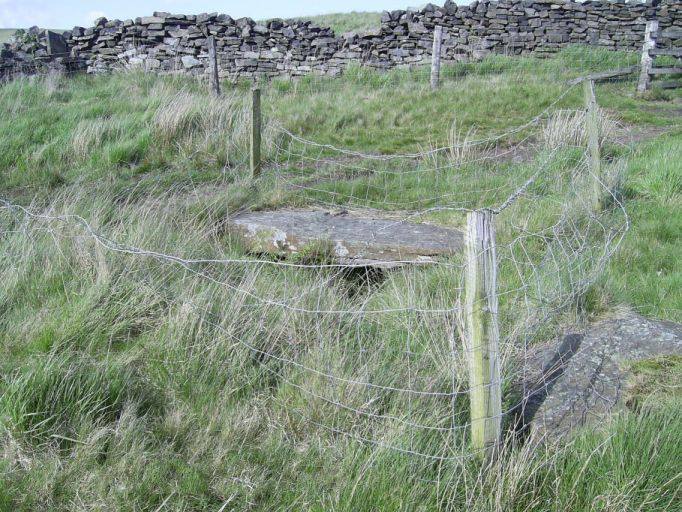
OS grid reference: approx. SD 792 283. On Hyndburn Moor between Huncoat and Dunnockshaw, Lancashire, is the now rather forgotten Mary Hoyle Well, a natural spring and former healing well named for St Mary the Virgin. It is also called ‘May Road Well’ on the Ordnance Survey map and ‘May Hole Well’ and, perhaps more locally ‘Mere Royde Well’. Today, there is not much to see, apart from a thick stone slab which has an inscription carved onto it that by all accounts is probably a recent addition. In the past pilgrimages and fairs took place here, usually on the first Sunday of May, but were also associated with the feast days of the Blessed Virgin Mary in February, March, May, July and September, which the local Roman Catholic community held in great reverence. The well is located at the south-western side of Hameldon Hill, some 400 metres east of the King’s Highway, an ancient moorland road that links Huncoat with Haslingden; it stands beside a junction of moorland tracks, one of which leads to the east in the direction of Dunnockshaw, Clowbridge, Goodshaw and Loveclough. Mitchell’s Reservoir is just a little to the north-west of the well.

Back in the 17th and 18th centuries the well was visited by pilgrims on the ‘feast-days’ associated with the Blessed Virgin Mary – at which time fairs were “also” held here at the beginning of May, but by the 19th century the fairs had stopped and veneration of the well was in decline. There were numerous reports of healings caused by the well water, which was quite deep down in the ground beneath the slab and was never known to dry up, even in times of drought. At some point in the 1970s, the large stone slab, recorded as being over 90 inches long, 50 inches wide, and 7 inches thick, was badly damaged and cracked in two; today this slab is only half its original size. The faint carved inscription on the stone says ‘Mary Hoyle Well’ and a cross has been carved onto it by some devotee, but these inscriptions are from fairly recent times – again probably the 1970s.

The Accrington author Rowland Joynson in his book ‘Join Joynson’ published in conjunction with ‘Accrington Observer & Times’ tells us quite a bit about Mary Hoyle’s Well. Mr Joynson say that: “The water cannot be seen. It is piped from somewhere down beneath the erstwhile flagstone and emerges somewhere near the dam of Mitchell’s Reservoir. It is reputed never to run dry”. “Certainly around 1957 there was a great drought and much worry about reserves at Mitchell’s, but Mary Hoyle’s kept on trickling”. “There are all sorts of speculations about the origin of the name. It is generally assumed to have been the Mere Royd Well, but many ancient wells are associated with the Virgin, and Mary Hoyle does leave you thinking”. The author also speculates that the well is the original source of the Hyndburn “as the spring rising at the greatest altitude”. At one time, long ago, the well was the ‘most important’ source of the drinking water for the higher part of Accrington, according to Joynson.  It now, apparently, flows underground into the nearby Mitchell’s Reservoir.

Mary Hoyle Well is one of the places included in the book ‘The Holy Wells and Mineral Springs of N.E. Lancashire’ by Clifford Byrne, where he mentions similar customs happening at Calf Hey Well at Cockden, Briercliffe, near Burnley, but there are many other wells and springs dotted about the area, many of them now largely forgotten. Henry Taylor in his great antiquarian work of 1902‘The Ancient Crosses of Lancashire’ also mentions Mary Hoyle Well.

Sources:

Byrne, Clifford., The Holy Wells and Mineral Springs of N.E. Lancashire, Marsden Antiquarians, Nelson, 1982.

Joynson, Rowland., Join Joynson, Clough & Son, Great Harwood, Lancs, England, 1975.

Taylor, Henry., The Ancient Crosses of Lancashire, Richard Gill, Manchester, 1902.

Many thanks to the late Donald Jay for the photo (top).

Copyright © Ray Spencer, The Journal of Antiquities, 2015.


The Mysterious Disappearing Boulders, Moeraki Beach, Otago, South Island, New Zealand

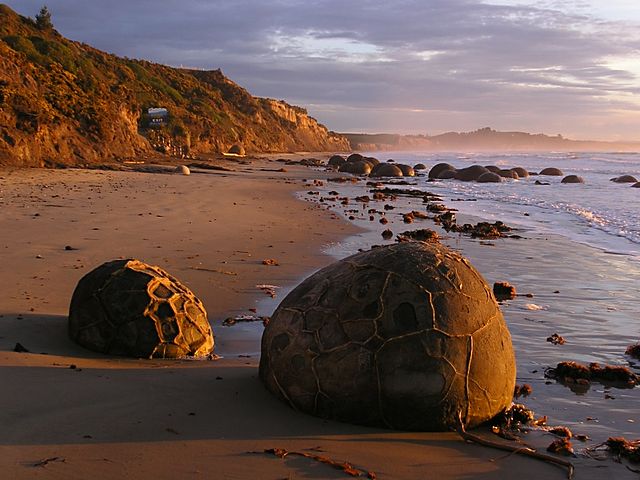
Moeraki Boulders, South Island, New Zealand (Photo credit: Karsten Sperling) (Wikipedia)

Moeraki Boulders, South Island, New Zealand (Photo credit: Karsten Sperling) (Wikipedia)

Latitude: -45.348199. Longitude: 170.827305. Strewn along the Moeraki beach, Koekohe Beach and Shag Point, in the Otago region, at the far south-eastern side of South Island, New Zealand, are many strange oval and spherical-shaped boulders – resembling, perhaps, giant potatoes – indeed the very name ‘Moeraki’ means “potatoes” in the Maori language of New Zealand. There is an interesting legend, to say the least, which attests to this strange curiosity. Many of these boulders are often half submerged in the sand and bed-rock, but when the tide comes in they mysteriously disappear, obviously, (or do they) and, after the tide goes back out they are seen to be not submerged ie ‘completely whole’ or fully uncovered of sand. These large boulders probably date back 60-65 million years. They are located in the south-eastern part of the South Island, in New Zealand, some 35 km (22 miles) south of Oamaru, between Moeraki and Hampden, and 80 km (67 miles) north of Dunedin. Access to the boulders is from highway 1 (Hampden-Palmerston road), just half a mile south of Hampden town, to the Moeraki Boulders Visitor Centre and car-park.

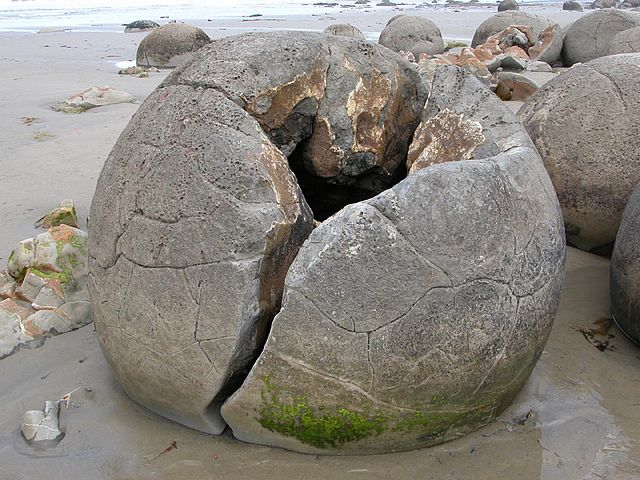
Broken boulder at Moeraki (Photo credit: William M. Connolley for Wikipedia)

Broken boulder at Moeraki (Photo credit: William M. Connolley for Wikipedia)

These curious grey boulders are literally strewn along the beach, often in clusters, and some in smaller groups of two or so. They vary in size but generally they are somewhere between 1 foot 7 inches and 7 foot 2 inches in circumference and in height between 2-8 feet; some are damaged and broken up due to constant erosion from the pounding waves, many others are wonderfully smooth-shaped and ‘naturally patterned’ with unusual circular, diamond and oblong shapes, said to be somewhat similar to ‘the eyes in potatoes’, but with connecting lines. The boulders are made of hardened mud, silt and clay, and they are cemented together with calcite which is often quite weak at the core and hard at the outer rim, which might account for some of the boulders cracking apart! Seamus P. Cahill writing in ‘Ireland’s Own’ magazine says that these “Huge stones appear on the sand at Otago, New Zealand, and then disappear – only to be replaced mysteriously by new ones!”.

In the colourful and informative book ‘The Beauty of New Zealand’ by Errol Brathwaite  we are informed that: “Moeraki Beach is named after the potato which ancient Polynesian voyagers brought with them in their double-hulled, ocean-going canoe. The canoe, so the olden legend goes, capsized near Shag Point, at the end of the beach, and the moeraki potatoes and some gourds which she was carrying were strewn by the tide along the beach, and were later transformed into boulders. Today, these septarian stones lie half buried in sand, a geological oddity, rusty-red or yellow inside, with crystalline cores”.

But we know that in geological terms they date back 60-65 million years and apparently lay on the sea bottom for much of that time, until the sea-levels began to fall some 15 million years ago. But the fact that “they” disappear and then reappear is simply an over-active (vivid) imagination from more recent times. The boulders are now something of a tourist attraction, and visitors (and geologists!) come here from all over the world to see these strange and curious rock formations. The boulders are sometimes called Araiteuru after the legendary Polynesian voyager sailing canoe which was said to have brought them here hundreds of years ago when they were apparently, and with much imagination – large potatoes! It is recorded that the Araiteuru also carried a cargo of calabashes, barracudas and eel baskets, and so I am minded to say that it must have been a very, very large canoe to carry such a large amount of items!

Sources:

Brathwaite, Errol., The Beauty of New Zealand, Golden Press Pty Ltd., Avondale, Auckland, New Zealand, 1982.

Cahill, Seamus P., (Just Imagine), Island’s Own, Wexford, Ireland, (various dates).

http://en.wikipedia.org/wiki/Moeraki_Boulders

http://www.kuriositas.com/2010/09/mysterious-moeraki-boulders.html

http://www.leeduguid.com.au/blog/new-zealand-south-island/


1 Comment

St Candida’s Church, Whitchurch Canonicorum, Dorset

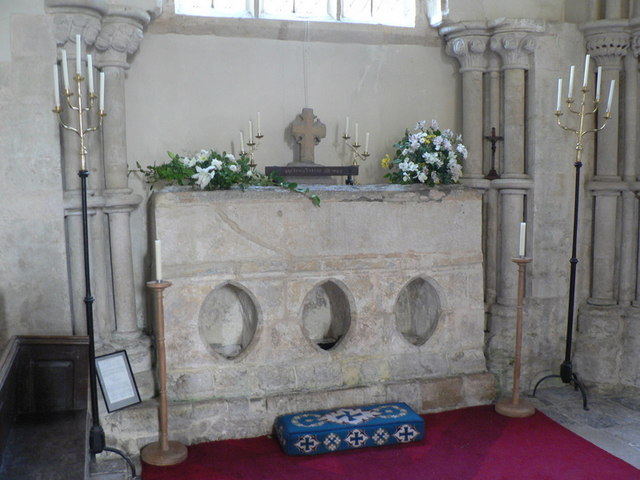
Shrine of St Candida at Whitchurch Canonicorum. (Photo credit: Wikipedia)

Shrine of St Candida at Whitchurch Canonicorum. (Photo credit: Wikipedia)

OS grid reference: SY 3967 5432. At the north side of Whitchurch Canonicorum village, in Marshwood Vale, along Lower Street stands St Candida’s Church (St Candida and Holy Cross), an ancient parish church on an equally ancient site, probably Saxon. The building houses the quite rare 13th-century shrine of a Saxon saint who was apparently martyred hereabouts by Vikings; the church then became a place of pilgrimage during the Middle Ages. St Candida is also known as St Whyte, St Wite, St Wita and St Gwen, though very little is actually known about her, and the date of her death is not known with any real certainty – although it was, according to legend, somewhere between the 7th and 9th centuries AD. The church tower of St Candida’s has some carved stones built into it which depict the martyrdom of the saint. The village of Whitchurch Canonicorum lies in the far south-west of Dorset – a few miles north of the A35 on country lanes – some 6 miles north-east of Lyme Regis and 2 miles north-east of Charmouth.

Within the parish church stands a rare 13th century stone shrine with three large oval-shaped apertures and, inside this there is a lead reliquary which is said to contain the bones of a local Saxon saint called Candida or Wite who was martyred at nearby Charmouth, probably at the beginning of the 8th century AD or, possibly in the 9th century? Some historians ‘consider’ her to be a saint from south Wales called Gwen Tebrion, but this seems most unlikely as St Gwen lived at an earlier date, the 6th century, but she shares the same feast-day 1st June.  Gwen means ‘White’ in the Welsh language form. The assumption was that King Athelstan gave the ‘so-called’ relics of St Gwen to the church at Whitchurch Canonicorum back in the 10th century AD.

A reference in the Reader’s Digest book ‘Folklore Myths and Legends of Britain’ says of the apertures in the medieval shrine “pilgrims thrust diseased limbs or bandages in the hope of miraculous cures”. Indeed numerous miracles of healing the sick and infirm have been recorded here over the centuries. An early miracle recorded at the shrine was the restoration of sight (Rodney Castleden, 1986).

In an article by Rodney Castleden ‘Saints, Shrines & Miracles’ for ‘Exploring The Supernatural’ magazine in 1986 we are given some interesting information about St Candida’s tomb [shrine]. The author says: “At the turn of the century a crack appeared in the stonework of St Candida’s tomb. It was then possible to examine the leaden reliquary inside… which carried the inscription HIC REQUEST RELIQE SCE WITE (Here lie the remains of Saint Wita? Wita was an alternative name for Candida. The lead box was opened up and inside were found the bones of a small woman who was about forty years old at the time of her death”. Castleden goes on to say that: “Very little is known about St Candida. Indeed, it may be her obscurity that ensured that she attracted no attention at the time of the Dissolution. All that we know about her, apart from the evidence of her shrine, rests on local tradition, which may or may not be reliable. The local tradition says that St Wita, or Candida, was a Saxon woman killed by the Danes on one of their raids when they landed at Charmouth. Part of this tradition is preserved in carvings on the church tower; they show a Viking axe and a Viking longship, the agencies of Candida’s death”.

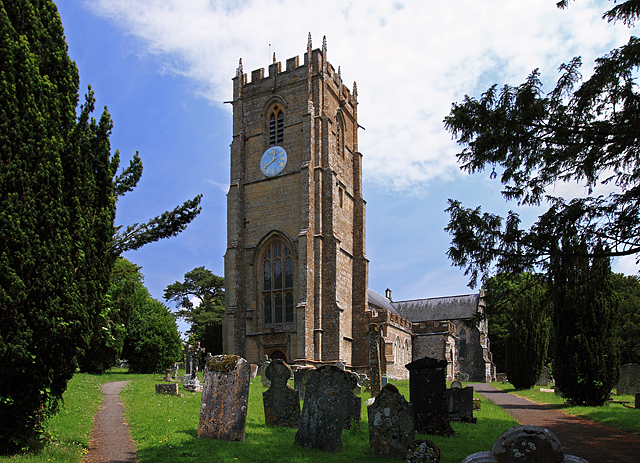
Parish Church of St Candida at Whitchurch Canonicorum (Photo credit: Wikipedia)

Parish Church of St Candida at Whitchurch Canonicorum (Photo credit: Wikipedia)

The parish church of St Candida and Holy Cross stands on a Saxon foundation, but the present-day building is architecturally Early English (late Norman) to Perpendicular – 12th to 14th century. The font is Norman and the pulpit Jacobean, and it is noted for its nave arcades and tombs, according to The Illustrated AA Road Book of England & Wales. Authors Jones & Tricker ‘County Guide To English Churches’ say that: St Candida’s is “nearly all EE. The south doorway is, however, Norman and the S porch Perp. The arcades are EE with stiff-leaf foliage and trumpet-scallop capitals. The fine tower has eight pinnacles and is Perp. Norman font with intersecting arches, 16th C stalls (French) and Jac pulpit”.

It is of interest here to mention that just 1 mile to the south of Whitchurch is the village of Morecombelake and a healing well dedicated to St Candida (Wite). The well has long been able to cure eye troubles. Indeed, author Rodney Castleden says: “Dorset children still call the pale blue flowers of the periwinkle ‘St Candida’s Eyes’, which again links the saint with eyesight. The well and its magic properties seem likely to form part of a much older tradition, from long before the Christian era”.

Sources

Castleden, Rodney., Saints, Shrines & Miracles, The Supernatural Magazine, November 1986.

http://en.wikipedia.org/wiki/Church_of_St_Candida_and_Holy_Cross

Jones, Lawrence E. & Tricker, Roy., County Guide To English Churches, Countryside Books, Newbury, Berks, 1992.

Pepin, David., Discovering Shrines And Holy Places, Shire Publications Ltd., Princes Risborough, Aylesbury, Bucks, 1980.

Reader’s Digest., Folklore Myths & Legends of Britain, (Second Edition), The Reader’s Digest Association Limited, London, 1977.

The AA, The Illustrated Road Book of England & Wales, (Second Post-War Edition), The Automobile Association, London WC2, 1962. 

Copyright © Ray Spencer, The Journal of Antiquities, 2015.


Mossy Well, Muswell Hill, Haringey, London

Os grid reference:  TQ 288 899. A few miles to the north of the city of London, in Haringey district, is the London suburb of Muswell Hill (NW10), which takes its name from an ancient healing well (long ago) called Mossy Well or Moss Well and, later in the 12th century it was “perhaps” re-named by some local Augustinian nuns who built their chapel there – calling it St Mary’s Well at Muswell. Or could the name actually be derived from the river Moselle, locally called  ‘the Mose’, which ‘springs to life’ in Hornsey (on Moss Hill), just to the south-east of Muswell Hill, and which was long known for its medicinal qualities, though it is in fact a brook. But are the two actually one and the same, probably not. The healing well (known as St Mary’s Well) has long since been capped under the ground, with only the place-name still there to remind us of this once holy, pilgrimage site. Today a private house (no 10 Muswell road) stands on the ‘presumed’ site halfway along the road. Muswell road is located just west of Alexandra Park and the famous Alexandra Palace, while to the north is Muswell Hill Golf Course, and a mile to the south Highgate Cemetery.

Mossy Well is described as being a natural spring, but undoubtedly in early Christian times it was used by the local community which would, at that time, have been just a settlement, though it must have had healing and beneficial qualities, maybe this was attributed to the ‘moss that grew in it’ or around it? Then, later in Saxon times it would have become a proper healing spring with people coming to visit it from farther afield. And in the 12th century some nuns came to the area and built a dairy farm; they saw the holy well, built a chapel beside it, and re-named both after St Mary the Virgin. After this time, in the medieval period, the well became a place of pilgrimage with healing occurring at the well, and votive offerings being made in the chapel, to Our Lady.

There is a legend that was told back in Tudor times which stated that: A Scottish king came to the Mossy Well and was cured of a disease there by drinking of the water, but there is no date given. The only other more recent record comes from a book called ‘Old London, Spas, Baths and Wells’, by Septimus Sunderland. What is known is that the Bishop of London gave some land to the Augustinian nuns of St Mary’s priory at Clerkenwell on which to found a chapel beside a healing well at Muswell – the place then became a Roman Catholic pilgrimage site with numerous cures being wrought there. The chapel was destroyed in the 16th century under the orders of King Henry VIII.

Sources:

http://www.londonslostrivers.com/muswell-stream.html

http://en.wikipedia.org/wiki/Muswell_Hill

http://en.wikipedia.org/wiki/River_Moselle_(London)

http://www.muswell-hill.com/n10biz/info/history.html

Sunderland, Septimus., Old London, Spas, Baths and Wells, John Bale, sons & Danielsson, London, 1915.


3 Comments

Grave of St Nicholas, Newtown Jerpoint, Co. Kilkenny, Southern Ireland

Tomb of St Nicholas (Santa Claus). Photo Credit: Wikipedia.

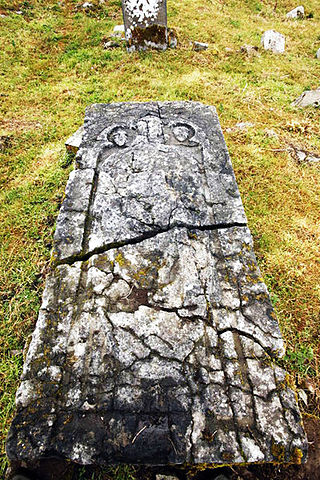
Tomb of St Nicholas (Santa Claus). Photo Credit: Wikipedia.

Irish grid reference: S 5679 4042. In the old churchyard at the west-side of the ruined medieval church of St Nicholas at Newtown Jerpoint, Co. Kilkenny, stands the medieval carved gravestone, reputed to be where the remains of St Nicholas of Myra (yes, the original Santy, St Nick, Santa Claus or Klaus), were laid to rest here back in the year 1300 and, a beautifully carved graveslab was placed over the saintly bishop’s remains. The legend says that St Nicholas’ remains were brought back to Ireland from Bari in Italy by two knight-crusaders of Irish/Norman birth, although [the] church dedicated to the saint was already established at Newtown Jerpoint at that time. There is also a holy well named after the saint. St Nicholas’ ruined church with its famous medieval gravestone is located (on private land), 2 miles south-west of Thomastown, just west of the Little Arrigle river and the N9 (R448) road, at Jerpoint Park. The monastic ruins of Jerpoint Abbey are about half a mile to the east; while sadly the village of Newtown Jerpoint was abandoned in the 1680s and the church left to fall into ruin and decay. Kilkenny town is 13 miles to the north-east.

The story goes that in the 13th century two Irish knights (both known as De Fraine) on their ‘retreat’ back from the crusades in the Holy Land stopped off at Bari in Italy and managed to secure some of St Nicholas’ holy remains; these remains were brought back to Ireland (by way of Normandy) and then buried in the churchyard adjoining the church of St Nicholas of Myra in Newtown Jerpoint; the two knights thought this to be a safe place for which to bury such a saintly personage. The family of De Fraine had a beautifully carved gravestone placed over the grave of the saint – the date being either 1200 or more likely in 1300 as the church had been established for some time already (1172), being built by William Marshall, earl of Pembroke and ancestor of the De Fraines’ family. Marshall, the son-in-law of Strongbow (Richard Fitzgilbert de Clare) also established the “new town” of Nova Villa Juxta Jeripons situated opposite the mid-12th-century Cistercian abbey of Jerpoint, in 1200, at which time he also built the little church dedicated to his favourite and esteemed patron saint, Nicholas of Myra.

The grave of St Nicholas and the adjoining church became a place of pilgrimage from the 13th/14th century onwards, as was the saint’s holy well close by the churchyard; however, in c1680 the village of Newtown was abandoned and the little church with its famous grave left to fall in to steady decay and ruin – its ruined tower, walls and gallery now almost obliterated by trees and foliage – the gravestone of St Nicholas cracked across the middle. But its beautiful carvings survive. The bishop or cleric on the large, cracked gravestone wears a robe that is shaped like a crusader shield, while at the top two carved heads at either side of the saint’s head are thought to be the knights who brought the remains from Italy to Ireland. At the upper left side a carving of a boat and at the opposite (upper right side) a sun carving; there is also a carved cross with more intricate stuff around it and what may be a French fleur de lis. A Latin inscription can also be seen on the stone.

The age-old legend of St Nicholas (Santa Claus) is known to most people. He was bishop of Myra (Mugla) in Lycia, Turkey, during the 4th century AD, and was well-known for his charitableness to the poor and the under-privileged, especially towards children; so much so that he came to be regarded as a “miracle-worker”. He is said to have died in 320, 342 or 350 AD, and his relics later (1084) translated to Bari on the Italian coast. According to the legend, Nicholas “reputedly gave three bags of gold to three girls for their marriage dowries” (Farmer, 2004). These dowries were tossed through an open window, or maybe down a chimney! and that is, perhaps, where the idea of Santa Claus putting gifts down a chimney comes into its own. Another legend says that he ‘raised to life’ three boys who had been drowned in a brine-tub by a butcher” (Farmer, 2004).

The author Colin Waters in his work ‘A Dictionary Of Saints Days, Fasts, Feasts And Festivals’ says of St Nicholas: “In early Europe it was traditional for people to leave gifts for others without saying who they were from on St Nicholas’ Eve (5th December). This was said to have been started by St Nicholas (also Klaus, Klass etc) when he was bishop of Myra in Lycia.” Waters goes on to say: “He is also patron saint of all prisoners and of all travellers, merchants and those overtaken by sudden distress or danger. His emblem is three balls, indicative of the gold he so freely gave away as a rich man. Panbrokers adopted his symbol. He is represented by three children in a tub.” St Nicholas is patron St of Russia and of Galway city. There are many churches dedicated to him in Ireland, including the medieval collegiate church of St Nicholas in Galway city, which dates from c1320 – said to be the largest parish church in Ireland.

The grave of St Nicholas at Newtown Jerpoint, Co. Kilkenny, has been mentioned by many Irish antiquarians and historians, including Canon Carrigan and Owen O’Kelly in his esteemed work ‘A History of County Kilkenny’. And interestingly, this tale has appeared regularly in the ‘Ireland’s Own’ magazine, being authored by Gerry Moran.

Sources:

Farmer, David., Oxford Dictionary Of Saints, Oxford University Press, New York, USA, 2004 

Moran, Gerry., ‘Santa Claus is buried in Kilkenny’, Ireland’s Own, Wexford, Ireland, (various dates).

http://omniumsanctorumhiberniae.blogspot.co.uk/2012/12/saint-nicholas-irish-connection.html

http://en.wikipedia.org/wiki/Newtown_Jerpoint

O’Kelly, Owen., A History of County Kilkenny, Kilkenny Archaeological Society, Kilkenny, Ireland, 1969-70.

Waters, Colin.,  A Dictionary Of Saints Days, Fasts, Feasts And Festivals, Countryside Books, Newbury, Berks, 2003.

Copyright © Ray Spencer, The Journal of Antiquities, 2014.


Blackstone Edge Roman Road, Littleborough, Lancs-Yorks Border

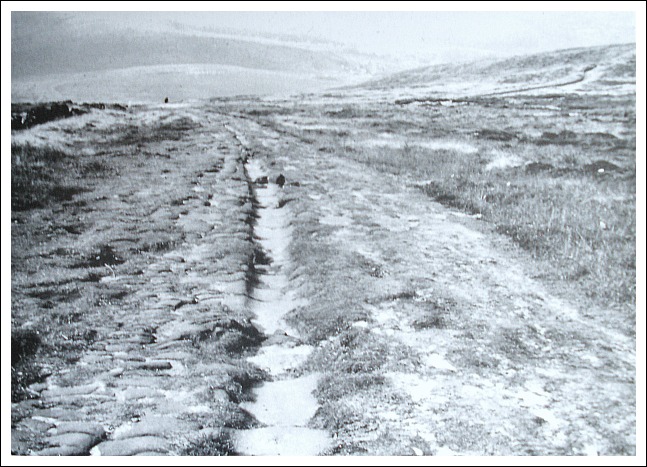
Blackstone Edge Roman Road.

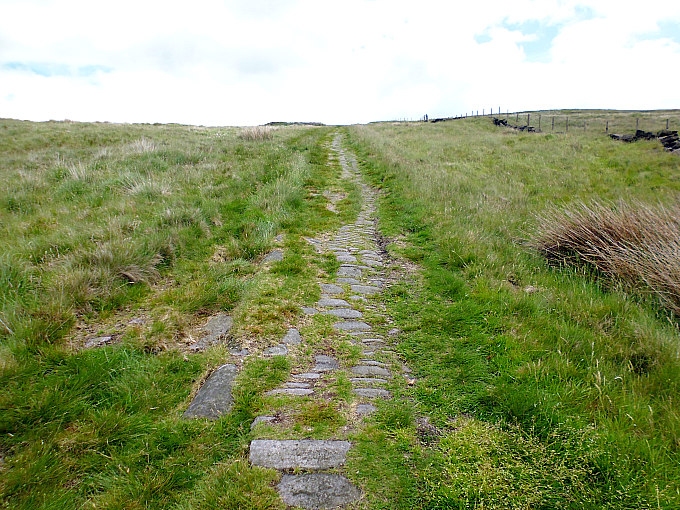
Blackstone Edge Roman Road.

OS Grid Reference: SD 9617 1680. Blackstone Edge Roman Road is located 2 miles east of the town of Littleborough – running almost parallel to the A58 Littleborough to Halifax road. Blackstone Edge ‘Roman Road’ is a cobbled ‘road’ surface traversing the bleak moorland for about 2 miles or so along Blackstone Edge on the Lancashire-West Yorkshire border. The road has a deep groove running down the centre. It is a scheduled monument initially thought to be of Roman Origin. This road is still marked on Ordnance Survey maps as a Roman Road but nowadays the most widely accepted theory is that it is an early turnpike road from circa 1735.

Until recently popular opinion had it that before the Romans there were no roads in the British Isles. This is not a correct interpretation of the situation. Ancient routes such as the Ickneld Way existed long before AD43. The Romans did build roads and this was one of the reasons for their great success. Roads aided administration as the Empire became ever larger. Roads aided the quick movement of troops to deal with insurgencies and incursions, and they helped to facilitate trade. However the evidence shows that similar structures usually of timber existed from Neolithic Times. More sophisticated structures existed in the Bronze Age using stone and Timber. The Iron Age saw the introduction of gravelled streets as at Danbury and Silchester.

Roman Roads typically consist of a consolidated embanked and cambered core of earth, chalk or stones (the agger), which was then surfaced with compacted stone or gravel. The wider zone was then often defined by boundary ditches, and sometimes further drainage ditches, or trenches from which material for the agger was dug.

Blackstone Edge ‘Roman Road’ (at almost 6 metres in width) does not conform strictly to this approach and the other problem with Blackstone Edge ‘Roman Road’ is that the groove running down the centre is unusual, and has therefore led to other theories about its origin, though similar grooved drainage ditches are known from Roman sites around the country.

It has been suggested that this channel may once have accommodated a cable that was used to winch vehicles up the incline. In keeping with this theory a circular foundation block can still be seen at the top of the incline this solution to the problem being hinted at in the Turnpike Act of 1734. On the other hand, some experts believe that the central channel was used to help vehicles brake as they descended the steep incline down towards Littleborough and others propose that it was merely a drainage duct.

Blackstone Edge Roman Road, today.

Excavations first took place in 1923/24 under Ian Richmond. In 1965 James L Maxim ‘A Lancashire Lion’ proposed that it was a turnpike road dating from 1735 – immediately following the Turnpike Act of 1734. Possibly built on or next to an earlier, probably Medieval Packhorse Route. Maxim proposed that the central groove was for cables assisting cables to negotiate the steep incline with the circular “foundation” acting as a pulley. However, a further survey in 2012, which involved fieldwork and reviewing the evidence, questioned some of these assumptions. Why was work undertaken to create deep and wide cuttings, and what appears to be a terrace on one side? Further, the packhorse way closely follows the road using one of the cuttings. The survey came to the conclusion that it might have to be reconsidered as a Roman Road. Another possibility is that none of these apply and it is, in fact, a more modern, perhaps 19th century moorland track that has long been associated with the quarrying of stone.

The Roman road that runs over Blackstone Edge linked the large Roman legionary fortress of MAMVCIVM (Manchester) to the smaller fort of VERBEIA (Ilkley) and is some 36 miles long. Some historians have, perhaps, wrongly called the fort at Ilkley (OLICANA).

About a mile up the moorland path from the A58 (where the Roman road officially begins) stands Aiggin Stone, a boundary stone that is inscribed with some Latin letters and a cross; the name is perhaps a derivation of “agger” the material from which the Roman road was constructed.

                                                         © Ray Spencer, The Journal Of Antiquities, 2017.


1 Comment

Bedd Branwen, Glanalaw, Treffynon, Anglesey

The site of Bedd Branwen by Eric Jones (Geograph).

The site of Bedd Branwen by Eric Jones (Geograph).

OS grid reference: SH 3611 8498. In a farmer’s field close to the west bank of Afan Alaw (river Alaw) near the hamlet of Glanalaw, Treffynon, Anglesey, stands the Bronze-Age ring-cairn known as Bedd Branwen, which is said to date back 4,000 years. It is named after the legendary princess Branwen or Bronwen, the daughter of King Llyr, and sister of Bran the Blessed (Bendigeidfran) from the Mabinogian. She was related to King Arthur. The cairn site is located on private farmland to the south-west of Bod Deiniol farm, close to the west bank of Afon Alaw – roughly half a mile south of Glanalaw, although a track/footpath runs past Hafan to Glanalaw hamlet and reasonable viewing looking south across the fields can be had from [here] with good zoom photography. However, you can probably walk across the fields to the cairn as long as the farmer doesn’t mind! The village of Treffynon is 1 mile to the east of Bedd Branwen, while Llanbabo and its ancient church are about one-and-a-half miles to the north-east.

Described as a ring-cairn or round barrow approx 24 metres by 28 metres – the kerb of which is still visible at the outer limit of the circle with a large, chunky standing stone (cist grave) at the centre which is now, sadly, cracked down the middle. The monument was apparently damaged back in 1813 by a local farmer who needed some stones for his house; at this time an urn was also dug up which was ‘said’ to have contained the ashes of a female – could these ashes have been those belonging to Branwen, the fairest and most beautiful woman in all Wales, if not the whole of Britain. Or, according to another account, she is one of the three most beautiful women in Wales!

But in reality the cairn pre-dates the legendary princess Branwen by a few thousand years or more, and other urns with grave-goods have been excavated here in more recent times – the early 1960s in fact. These urns almost certainly date from the Bronze-Age at around 2,000 BC. So, perhaps the discovery of the ashes of a female purporting to be those of the princess were ‘just a coincidence’. Today nothing is left of the earthern mound that once covered the cist grave, only the outline of this being still visible and some stones around the edge, though there are a few other curious stones in this field which ‘might’ well be associated with the monument. In the early 1960s excavation some more cremation urns were dug up along with pottery, grave-goods and also a necklace made of jet. These antiquities are housed in Bangor Museum in North Wales. In the work ‘The Ancient Stones of Wales’, author Chris Barber describes the monument as a “dolmen” and also refers to it by another name: Bod-Deiniol.

Branwen is a legendary and mythical character who figures strongly in the Mabinogian along with her father King Llyr (Lear) and her brother Bran the Blessed, who is known as Bendigeidfran in Wales, but it is a very sad tale. Princess Branwen is given in marriage by her brother to the Irish king, Matholwch, but after an insult to the Irishman by her half-brother, Efnisien, they soon begin to quarrel and then fall out, and poor Branwen is treated badly by being put to work as his cook. Bran then makes war on Matholwch but is killed in the battle (MacKillop, 1998). Later, she manages to escape back to the Isle of Anglesey where ‘she dies of a broken heart’, and is allegedly buried beneath the mound and cairn that now bears her name (Bedd Branwen).

According to The Mabinogian (second branch) Bran the Blessed is credited as going on a voyage across the Atlantic Ocean, but life ends badly for him; his severed head is buried on Tower Hill in London which then acts as a sort of talisman for the city against foreign invasion on the grounds that Britain should not rely on magic, according to the author Geoffrey Ashe in his work ‘The Quest for Arthur’s Britain’. Traditionally, Bran is recorded as being the son of Belinus (Gruffudd, 1980). If that is the case, then he and his sister Branwen are descended through Manogan, King of Britain, with the Blessed Virgin Mary? And Belinus or Beli has sometimes been identified with the Celtic sun god of that name. But as we know the Mabinogian gives the father of Branwen and Bran as King Llyr, who has sometimes been identified with the legendary King Lear of Shakespearean fame.

Sources:

Ashe, Geoffrey., The Quest for Arthur’s Britain,  Paladin, St Albans, Herts, 1976.

Barber, Chris., Mysterious Wales, Paladin, London W1X, 1987.

Barber, Chris & Williams, John Godfrey., The Ancient Stones of Wales, Blorenge Books, Abergavenny, Gwent, 1989.

Gruffudd, H., Enwau Cymraeg I Blant – Welsh Names For Children, Y Lolfa, Talybont, Dyfed, 1980. 

MacKillop, James., Dictionary Of Celtic Mythology, Oxford University Press, Oxford, 1998.

Photo Credit: http://www.geograph.org.uk/photo/1358949  © Copyright Eric Jones and licensed for reuse under this Creative Commons Licence.

Copyright © Ray Spencer, The Journal of Antiquities, 2014.


Sudbrook Iron Age Camp, Portskewett, Monmouthshire

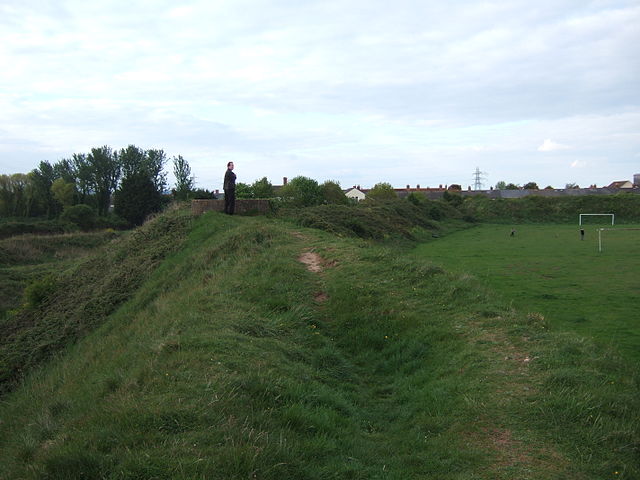
Iron Age hillfort, Sudbrook. (Photo Credit: Wikipedia)

Iron Age hillfort, Sudbrook. (Photo Credit: Wikipedia)

OS grid reference: ST 5053 8732. About half a mile south of Portskewett, Monmouthshire, on the cliffs overlooking the Severn Estuary, is the Iron-Age Sudbrook Camp, a promontory fort with its well-defined earthworks still largely intact, although suffering somewhat at its south side due to coastal erosion. It is known to have been inhabited from roughly the mid-2nd century BC up to at least the 1st or perhaps mid-2nd century AD – at which time it may well have been in use as a Roman trading post. The earthworks are located by going along Sudbrook road and, at the end of Camp road, they are some 50 metres to the south-west, close by the ruins of a 13th century church, some railway buildings, and the Severn Railway Tunnel (Gwent Levels). A coastal path traverses the camp. Caldicot village is 1 mile to the west, while the M4 motorway and the Severn Bridge, are half a mile to the east; the town of Chepstow is roughly 4 miles to the north.

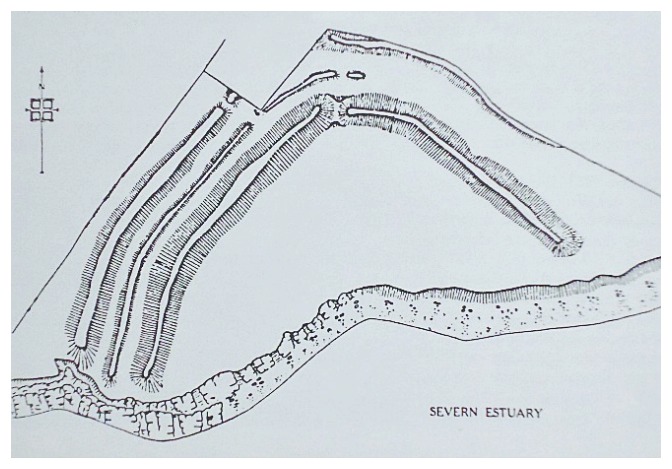
Plan of Sudbrook Camp (After V.E.Nash-Williams) 1936.

Plan of Sudbrook Camp (After V.E.Nash-Williams) 1936.

Sudbrook Camp is made up of triangular-shaped earthworks. The whole site is 1.4 hectares: the inner section is approx 78 metres between the cliff and the first ditch, 109 metres across south to north and 280 metres in width west to east, but a section at the south-side has eroded away due to cliff falls, and so the camp would have been larger. A section at the north side ‘may’ have been destroyed due the houses and also Sudbrook and Camp lanes. However, the rest is still resonably well-preserved, in particular the fairly deep ditches, three ramparts at the west and two ramparts at the east – indeed the defensive ramparts still stand up to 5.2 metres high, according to the work ‘Prehistoric Sites of Monmouthshire’ by Children & Nash. At the far south-western side of the camp stands a World War II concrete lookout post. Rather oddly the interior of the camp is sometimes used as a football pitch!

Camp road to the north-west cuts off the earthworks, as do the ruins of Holy Trinity Church at the far south-eastern side. The entrance to the camp can clearly be made out at the north side between the ditches and ramparts; this connected up to an ancient trackway which was used by the Silures tribe, and later by the Romans, linking the site to their newly established town at Caerwent ( Venta Silurum) ‘market town of the Silures’, which later became Caer Guent (Fortress Venta), some 5 miles to the west.

Sudbrook Camp would have been inhabited by an ancient Celtic tribe in the Iron Age (150 BC) and, later in 30 or 31 AD, by the Silures, a fierce tribe who worshipped a cat-like diety. The Silures ruled the south-eastern part of Wales. But at this time they were being put under pressure by the Roman legions making their way up the Severn estuary – led by one Julius Frontinus – who set out to invade Siluria, and at which time the Celtic chieftain Caradoc (Caractacus) had fled from north Wales to Sudbrook Camp, or maybe Llanmelin hill-fort, one-and-a-half miles north-west of Caerwent. Caractacus eventually ended up in Rome where he was pardoned by the emperor Claudius (after 51 AD). The Silures were ‘allowed’ to remain at Llanmelin hill-fort until about 70 AD. However, Frontinus did not make much of an inpact, and it was not until 51 AD that the Silures tribe had their so-called ‘last stand’ when attacked and routed by Ostorius Scapula and the XX legion, according to Roy Palmer in his book ‘The Folklore of (Old) Monmouthshire’.

There is evidence to think that after the routing of the Silures tribe from the camp the Romans used the place as a trading-post and, 17 metres below the cliffs in the estuary, there was a natural harbour facility that was used by the newly conquering Roman legions as ‘a possible docking facility’ and naval base (beach-head) for their sailing vessels – up until at least the late 1st century AD, or even the mid-2nd century AD – Bryan Walker’s work ‘The Archaeology And History Of Ancient Dean And The Wye Valley’.

Archaeological excavations were carried out at Sudbrook Camp between 1934-36 at which time many artefacts were found including: bones of oxen, pigs, sheep and goats and, also fragments of iron, glass, Roman bricks and coins. During the excavations, the remains of two V-shaped ditches were discovered between the ramparts (north-west side) of the main bank which, would have been done in four stages. Two steep-sloping revetments of uncoursed drystone walling were uncovered on the inner scarp – ‘Prehistoric Sites of Monmouthshire’ by Children & Nash.

The sad-looking grey ruins of the 12th or 13th century Holy Trinity Church stand at the far south-eastern side of the earthworks, now alas almost hidden by ivy, bushes and trees, with only the front bell-tower gable-wall and a few ruined rear walls still standing; its graveyard has nearly gone over the cliffs. But the main part of the ruin dates from the 17th century, other earlier parts being from the 13th-14th centuries, notably the chancel, while the nave walls may be 12th century. Sadly the church was abandoned and left to the elements in the 1790s, due probably to the erosion of the nearby cliffs – Fred Hando ‘Hando’s Gwent – A Centenary Tribute’.

Fred Hando says of the ruin: “There is no great charm in the grey ruins of Holy Trinity, Sudbrook. It is difficult to account for its erection here, unless it was a private chapel for John Southbrook, who is mentioned in the Wentwood Survey of 1276”. He goes on to say that: “Holy Trinity at Sudbrook was in use, it seems, to the end of the Eighteenth Century. Bradney tells us that one of the last to be buried there was Captain Blethin Smith of Sudbrook, who left instructions that his corpse was to be borne to the grave by six seafaring men”. Captain Smith’s will was dated 1755.

Sources:

Barber, Chris., Exploring Gwent,  Regional Publications (Bristol) Limited, Clifton, Bristol, 1984.

Children, George & Nash, George., Prehistoric Sites of Monmouthshire, Logaston Press, Little Logaston Woonton Almeley, Herefordshire, 1996.

Hando, Fred., Hando’s Gwent – A Centenary Tribute, (Ed by Chris Barber), Blorenge Books, Abergavenny, 1987.

Houlder, Christopher., Wales: An Archaeological Guide, Faber And Faber, London, 1978.

http://www.sudbrook.info/

http://en.wikipedia.org/wiki/Sudbrook,_Monmouthshire

Palmer, Roy., The Folklore of (old) Monmouthshire, Logaston Press, Little Logaston Woonton Almeley, Herefordshire, 1998.

Walters, Bryan., The Archaeology And History Of Ancient Dean And The Wye Valley, Thornhill Press, Cheltenham, Gloucestershire, 1992.

Copyright © Ray Spencer, The Journal of Antiquities, 2014.


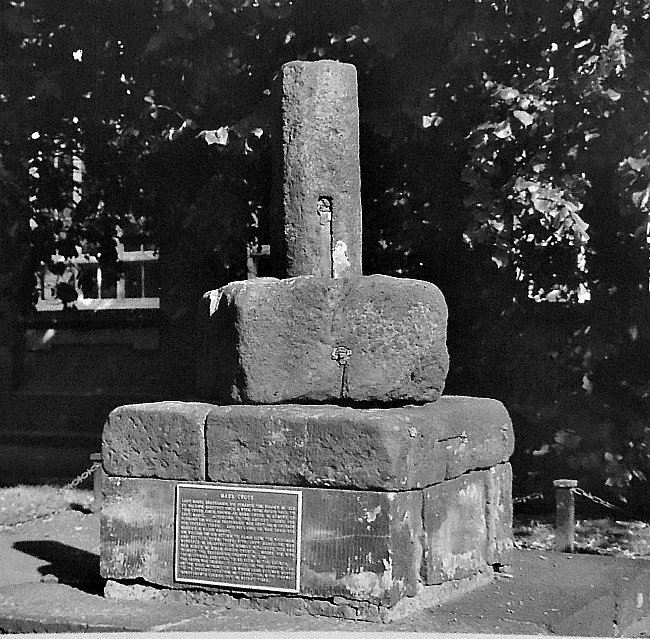
Mab’s Cross, Standishgate, Wigan, Lancashire

Mab’s Cross, Standish-gate, Wigan, Lancashire

OS grid reference: SD 5853 0628. At the east-side of Standishgate, just off Wigan Lane, Wigan, Lancashire, stands the rather weather beaten monument known as Mab’s Cross, Mabel’s Cross, or Wigan Cross, which dates probably from the 14th century. It is named after Mabel de Bradshaw, wife of Sir William de Bradshaw, of Haigh Hall in Wigan. But there is an interesting, though an also somewhat sad and painful story to tell that has long been associated with the old Wigan Cross, a tale of deep remorse and, at the same time, unrequited love. In All Saints parish church in Wallgate, Wigan, stands the altar-tomb of Mabel and her husband William de Bradshaw, a now rather forlorn and sorrowful monument with effigies of the two – whose legend has continued down through the ages since they both rested here in the 14th century. The cross is located by a footpath in a garden at the front of Wigan Girls’ High School, just to the north of Wigan town centre, and a little to the west of the A49 (Central Park Way).

Mab’s Cross or Wigan Cross is very battered and worn from centuries of wear and tear, weather, and other damage. It stands at 2.3 metres (6 foot 5 inches) high; its stump could be a remnant from the Saxon age, though more likely it is medieval – mid 13th century. Its large step is more modern, probably not the original step(s), but the plinth is well-worn and is made up of a large slab on top of gritstone blocks with a plaque attached to this, while the worn and broken stump is socketed into a large, rough base. The monument was moved to its present position in 1922 from the opposite side of the road. It is surrounded by railings and is grade II listed.

The often-told and very sad story, with minor variations, about the life of Lady Mabel de Bradshaw (Bradshaigh) of Haigh Hall, Wigan, is this: Mabel’s husband Sir William became involved in a local rebellion against the powerful Earl of Lancaster, known as the Banastre Rising, but this proved unsuccessful so he was forced to flee abroad to escape his enemies, according to author Kenneth Fields in his work ‘Lancashire Magic & Mystery’. Almost certainly Sir William goes off to fight in the crusades (c1314), but 10 years pass by with no sign of him returning – Mabel believing him to be dead – she decides to marry a Welsh knight, Sir Osmund Neville. Then, eventually Sir William turns up in Wigan market-place dressed as a beggar; Mabel recognises him and they finally return to Haigh Hall. But upon finding out what has transpired in the intervening years, he confronts Sir Osmund on horseback, and in the deadly combat Sir Osmund is killed at the place called Newton Park (Newton le Willows). The two are then ‘said’ to have lived happily together at Haigh Hall – at least that is the theory!

Mabel’s confessor now orders her to do penance for what she has done. She is told to walk barefooted and barelegged on pilgrimage once every week from Haigh Hall to Wigan Cross [Mab’s Cross], a distance of 2 miles, which she does do for the rest of her life, but now Mabel is re-united with Sir William and is happy once again? Sir William de Bradshaw dies in 1333 and the almost saintly Mabel builds a chapel for him (1338) in Wigan parish church (the Bradshaw Chapel) also The called Crawford Chapel; she then has effigies carved on his tomb, one of her husband cross-legged and wearing armour, with sheild at his shoulder – his sword almost drawn from the scabbard and, one of herself in a long robe next to his; and on the sides of this the whole ‘sorry story’ is told in detail with various sculptures, including one of Lady Mabel with candle in hand praying at the foot of her cross. Mabel died in 1348 at the age of 30.

Of other interest in All Saints church is a Roman stone, part of an altar dedicated to their god Mithras, built into the splay of one of the windows of the tower, a relic from when the Romans had a fort or settlement (Coccium), possibly on the outskirts of the town at Castle Hill, Hindley, and where legend says: King Arthur fought one of his many battles. Author Joseph P. Pearce in his work  ‘Lancashire Legends’ says: “The Roman road leading from Warrington to Preston and Walton-le-Dale, passed through the very centre of the town of Wigan, bearing the traffic of the Legions and the Guilds and Traders of old.” The present church is 19th Century, but it stands on the site of the Roman station of Coccium and a Saxon church. Close to the church stands the medieval Haigh Hall – where the famous Bradshaw family lived and which is still haunted by the ghost of Lady Mabel.

Sources:

Fields, Kenneth., Lancashire Magic & Mystery, Sigma Leisure, Wilmslow, Cheshire, 1998.

Howarth, Ken., Ghosts, Traditions & Legends Of Old Lancashire, Sigma Leisure, Wilmslow, Cheshire, 1993.

http://www.prestonhistoricalsociety.org.uk/gallery-image?id=fd1a0be60126e19506ac2d9e488c65f8

http://www.wiganarchsoc.co.uk/content/History/Mabs_Cross.htm

Pearce, Joseph P., Lancashire Legends, The Ormskirk Advertiser, 1928.

© Ray Spencer, The Journal of Antiquities, 2014. Up-dated (2019).


4 Comments

St Barnabas Churchyard Cross, Bromborough, Wirral, Cheshire

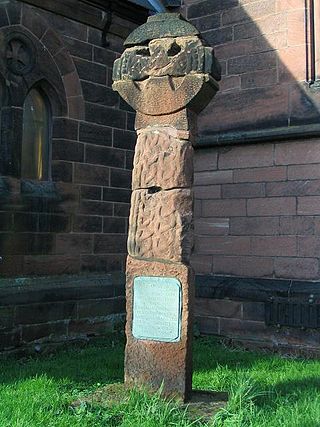
Cross at St Barnabas Church, Bromborough (Photo credit: Peter Craine - Geograph)

Cross at St Barnabas Church, Bromborough (Photo credit: Peter Craine – Geograph)

OS grid reference: SJ 3490 8221. On Church Lane in Bromborough, Wirrral, stands the 10th century St Barnabas Churchyard Cross, where at the south-side beside the church porch stands this heavily re-constructed Anglo-Saxon wheel-head cross. There are apparently some other carved stones, possibly of Saxon origin, in the garden of the nearby parsonage; and in the churchyard there is an interesting 18th century sundial and, close-by stands the 19th century market cross. St Barnabas’ church is located in the centre of the village on Church Lane to the west of the river Mersey – at the east-side of the Wirral Peninsula. Birkenhead lies 3 miles to the north on the A41 road while Ellesmere Port is 3 miles south-east on the M53. Bromborough is thought to be one of the many contenders for the Battle of Brunanburh (937 AD), though there is ‘much’ debate about that.

The first church ‘may’ have been established here in 928 or 934 AD, but there may have already been a monastery here, and then a Norman foundation which stood for several hundred years, though the present red Sandstone parish church is of 1862-4. There may have been Viking incursions into the area during the 9th and 10th centuries, which is why it is sometimes assumed the cross shows some ‘tenuous signs’ of Scandinavian influence, though it is generally regarded as being Saxon carving. Early chronicles suggest that the first church, and quite possibly [the monastery] were founded by Aelfthryth, or Ethelfleda, Lady of the Mercians, sometime around 912 AD. Lady Ethelfleda was the daughter of King Alfred the Great.

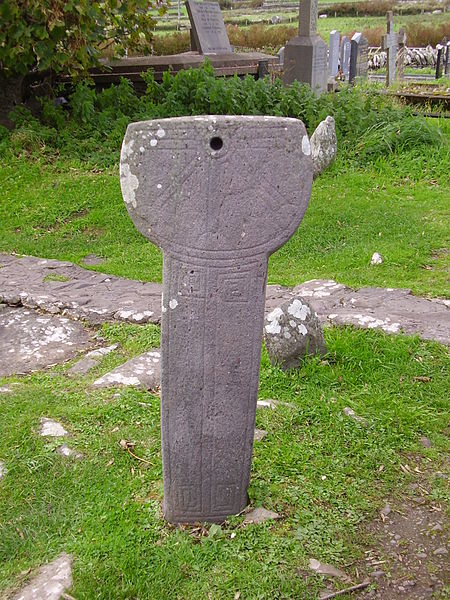
The Saxon preaching cross was put together from three fragments of Saxon stones that originally resided inside the church, and was re-erected beside the porch in the churchyard in 1958. It looks to be quite a crude monument and something of a mish-mash of the three seperate carved stones ‘haphazardly put together’ that are thought to date from the 9th-10th centuries. These pieces of carved stone originally stood in the present church and, indeed in the earlier Norman foundation before that. The sculptured wheel-head is quite basic really, with only faint carvings across its middle; the only other bit of carving is a long panel of worn interlacing on the shaft, below which a plaque* is attached recalling its history and which, rather sadly spoils the monument. The two parts of the wheel-head above and below the middle (carved) section look to be of a later date, possibly the 12th-16th century?

Also of interest in the churchyard is a 18th century sundial. This may originally have been part of the market cross. It stands upon two square-shaped steps on a base, and has a thin tapering shaft with a square top and dial. The date is recorded as being 1730.

In front of the churchyard stands the very tall market cross with square-shaped pillar standing on an eight-stepped plinth, supporting a fine ornamental top. Author Derek Bryce in his book ‘Symbolism Of The Celtic Cross’ says of this monument: “The cross at Bromboro in Cheshire stands on a stepped pyramid base, the steps of which are clearly not intended for treading…..the cross is surmounted by a sphere and sundial, which have since been replaced by a cross ecclesiastical.” The steps (plinth) of the cross are clearly medieval, maybe 13th century, the rest is from 1874.

Sources:

Bryce, Derek., Symbolism Of The Celtic Cross, Llanerch Enterprises, Felinfach, Lampeter, Wales, 1989.

* http://www.geograph.org.uk/photo/2257157

http://list.english-heritage.org.uk/resultsingle.aspx?uid=1015600

Photo Credit: http://en.wikipedia.org/wiki/St_Barnabas’_Church,_Bromborough

Copyright © Ray Spencer, The Journal of Antiquities 2014 (Updated 2023)


1 Comment

Meir ny Foawr, Knocksharry, Isle of Man

OS grid reference: SC 2758 8495. The prehistoric site of Meir ny Foawr, near Knocksharry, at the far western side of the Isle of Man, is a former Bronze-Age stone circle; however, not much of it has survived, and some of its quartz boulders may have been robbed away over the centuries. This collection of boulders in a sort of part circle is located on the side of the hill called Lhergy Dhoo Uplands and is nearly half a mile southeast of Lhergydhoo house, in Kirk German parish. It can be reached on footpaths to the east from Switchback road, and the stones can be seen for many miles around. However, there is a dearth of information regarding the site. The little village of Knocksharry is 1 mile to the north on the A4 road, while the town of Peel is 2 miles to the southwest along the same A4 coastal road, overlooking the beautiful Doon Bay.

Meir ny Foawr stone circle is also known locally as ‘the Devil’s Fingers’ or ‘the Giant’s Fingers’ indeed many Megalithic monuments in the Isle of Man are in some way associated with the devil, or some mythical giant. The structure covers an area of around 30 feet (9.4 metres) and is formed by five large white quartz boulders in a sort of horseshoe shape, rather than a circle, though it may originally have been a circle? Three of the stones lean over at the north side, while that in the centre is 7 feet high and may represent the altar; the three leaning stones are considered to be part of the original burial chamber. When the site was excavated some Bronze-Age urns were dug up. On the periphery, there are a couple of smaller stones known as outliers. So, in fact, we might consider calling this a ring cairn or cairn circle? We must assume, therefore, that there was at one time an earthen mound covering the stones here at Meir ny Foawr?

The area around Knocksharry is rich in ancient remains. There is the prehistoric site of Crosh Mooar about 1 mile to the northeast of Meir ny Foawr – this was a Bronze-Age burial mound – but sadly it was almost destroyed in the early 1900s. And there are several cairns and tumuli dotted around the immediate area; at Knocksharry there is a Bronze-Age cemetery which is located close to the ruins of an early Christian chapel. Here three badly damaged funerary urns were excavated.

Sources:

Hulme, Peter J., More Rambling In The Isle Of Man, The Manx Experience, Douglas, Isle of Man, 1993.

The Ancient And Historic Monuments Of The Isle Of Man, The Manx Museum And National Trust, Fourth (Revised) Edition, Douglas, 1973.

http://www.isle-of-man.com/manxnotebook/iomnhas/v035p446.htm

http://www.isle-of-man.com/manxnotebook/fulltext/pn1925/gn.htm

Copyright © Ray Spencer, The Journal of Antiquities, 2014 (updated 2023).