The Journal Of Antiquities

Ancient Sites In Great Britain & Southern Ireland


Easter Island, South Pacific Ocean

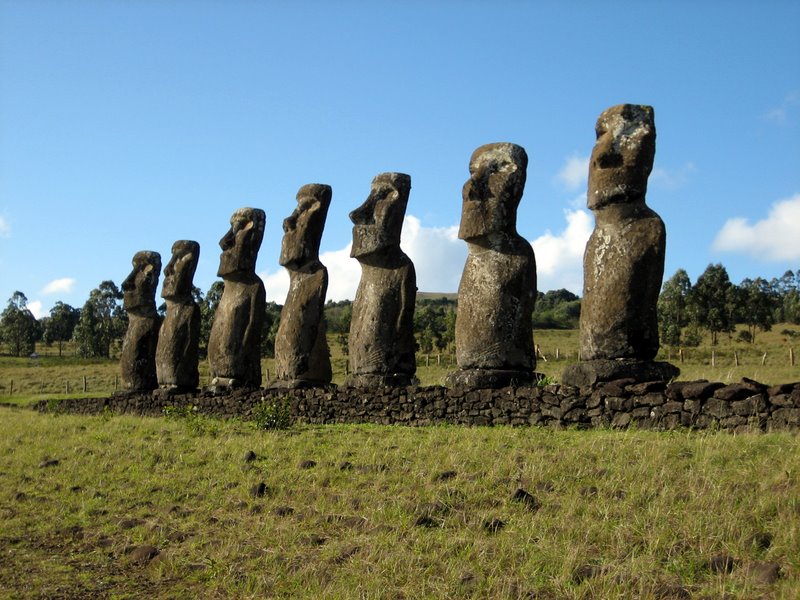
Easter Island (Ahu-Akivi) Photo Credit: Wikipedia.

Easter Island (Ahu-Akivi) Photo Credit: Wikipedia.

Latitude: -27.1211919. Longitude: -109.3664237. A small Polynesian island in the south Pacific Ocean far away from any major landmass is Easter Island, only discovered in the early 18th century, but it is a very extraordinary and mysterious island of giant stone statues and rock carvings, some perhaps dating back well-over 1,000 years. Also known as Rapa Nui, the “sacred” island of the mysterious tribe that are also called by the same name and who lived here, roughly, between 400-1700 AD.

There are said to be upto 1,000 small and large stone statues on the island, many are said to represent the gods or chiefs of the Rapa Nui tribes; and there are many superb petroglyphs or rock-carvings scattered about the island. The island is 10 miles across north to south and about 16 miles length-wise at the south side; also at the south side a line of three dormant volcanoes: Rano Kao, Punapau and Rano Raruku, while at the north another volcano called Rano Aroi; the island is made of sandstone and volcanic rock. Easter Island, sometimes called ‘the Navel of the World’ is 1,200 miles from any other island and roughly 2,360 miles from any major landmass – in this case the west coast of Peru. It is 1,290 miles east of Pitcairn Island.
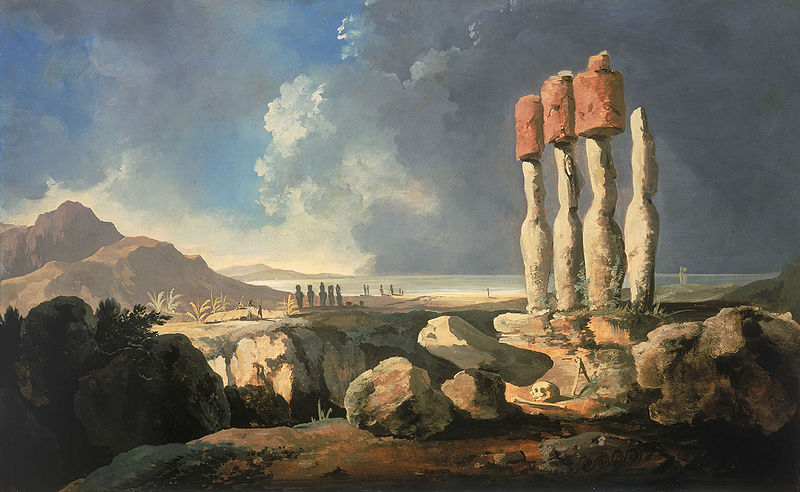
Easter Island by Hodges Photo Credit: Wikipedia.

Easter Island by William Hodges 1775. Photo Credit: Wikipedia.

On Easter Sunday in 1722 Dutch sailors, lead by the enthusiastic seafaring admiral Jacob Roggeveen, discovered the barren, treeless island quite by chance and named it Easter Island; they were almost certainly very surprised to see huge stone heads lying on the ground. After that, in 1772 Spaniards re-discovered the island and, other interested parties (and some not so interested) came to the island in the late 19th century when archaeological excavations began. In more recent times (1956) the famous Norwegian explorer Thor Heyerdahl (1914-2002) sailed to the island on his balsa-log raft, Kon Tiki. Francis Hitching in his book ‘The World Atlas of Mysteries’ 1979, says of Heyerdahl’s expedition: “In 1956 the writer Thor Heyerdahl arranged an archaeological experiment with the mayor of Easter Island and six islanders. Using traditional methods, they carved out the contours of a new statue in three days using stone tools and gourds of water to soften the volcanic rock.”
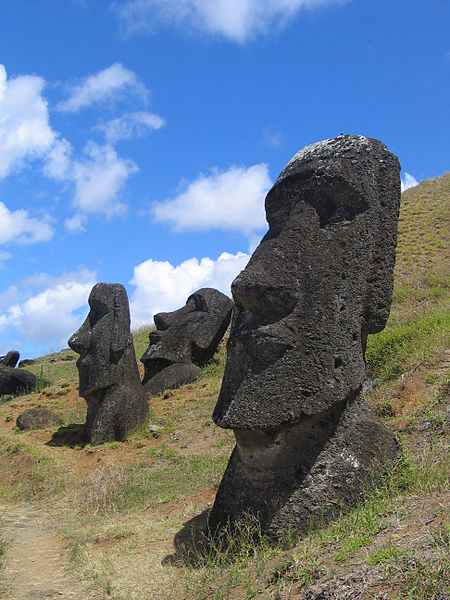
Easter Island (Rano Raraku). Photo Credit: Wikipedia.

Easter Island (Rano Raraku). Photo Credit: Wikipedia.

The huge (colossal) statues carved from hardened volcanic ash are called ‘moai’ and they look stern-faced inwards away from the sea, seemingly to gaze towards the horizon for eternity, some stand on ceremonial rock platforms (ahu), especially those at Akivi on the island’s west coast and Nau Nau in Anakena Bay with between 7-15 figures, many having strange top-knots (pukao) on their heads, made from red tuff rock, their eye-sockets are made from coral and the irises from red scoria rock. In all there are nearly 900 statues (most having subtle differences in their appearances), including half-size ones and some that are unfinished, and some kneeling statues. They are said to represent the gods of the Rapa Nui. One of the statues, the ‘paro’ is 33 feet high (10 metres) and weighs in at 76 tonnes; another, an unfinished statue, is 69 feet high (21 metres), but there are some that are as tall as 24 metres, a staggering 78 feet! Many statues have fallen or been pushed over, maybe by the Rapa Nui tribes themselves as they knew that the end of their island culture was coming – due to a number of factors including abduction for the slave trade, war and disease – indeed by the 1870s only a hundred or so tribes-people remained, and in 1888 the island was finally annexed to Chile.

Author Justin Pollard in his excellent book ‘The Story of Archaeology In 50 Great Discoveries’ 2007, says that “By the 18th century Easter Island was almost devoid of trees and the destruction of the forest to provide wood for building and boats (and perhaps rollers for the moai) and to clear areas for agriculture led to a progressive impoverishment and erosion of the soil. These factors, together with the pressures caused by a growing population, meant that Easter Island society began to change rapidly.”

There are some amazing rock carvings on the island, in particular those in the Ana Kai Tangata cave at the south-west side of the island where there are depictions of the so-called ‘birdman’ (Tangata Manu) the supreme chief. The ‘birdman’ also features on a carved rock located above the Motu Nui islet; the cultus of the birdman was centred on the island village of Oronga where there are some well-preserved houses that were lived in by the Rapa Nui, from 1500 onwards. Thankfully, the famous statues of Easter Island have been re-erected and now stare, perhaps rather less stern-faced towards ‘a new horizon.’ Today tourists and archaeologists visit Easter Island to stare and to study the huge statues and rock carvings and, at the island that is slowly ‘being lived on’ once again!

Sources:

Hitching, Francis., The World Atlas Of Mysteries, Pan Books Ltd, London SW10, 1979.

Pollard, Justin., The Story Of Archaeology In 50 Great Discoveries, Quercus, London W1A, 2007.

Strange Worlds Amazing Places, The Reader’s Digest Association Limited, London W1X, 1994.

Photos Wikipedia:  http://en.wikipedia.org/wiki/Easter_Island

http://www.southamerica.cl/Chile/Easter_Island.htm

Copyright © Ray Spencer, The Journal of Antiquities, 2014.
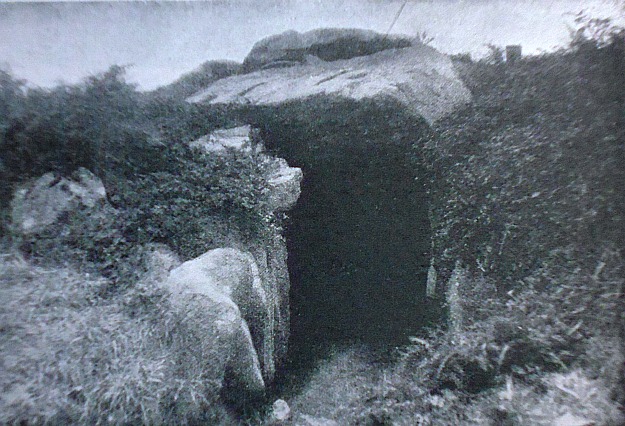


Le Creux Es Faies, St Peter Du Bois, Guernsey, Channel Islands

Le Creux Es Faies, Guernsey, Channel Islands (J.Dixon-Scott)

Le Creux Es Faies, Guernsey, Channel Islands (J.Dixon-Scott)

Latitude: 49.456047. Longitude: -2.653499. At the south-western side of the island of Guernsey and just to the north of L’Eree Bay, stands the well-preserved prehistoric monument of Le Creux Es Faies, a huge grassed-over mound which covers an ancient burial tomb, said to date back to between 3,500-2,500 BC. The burial chamber or dolmen is located on the Houmet Nicolle headland a little to the north of L’Eree Bay opposite the island of Lihou, in the parish of St Peter Du Bois, on Les Sablons road. Close by there is a concrete watchtower that was used by German troops during the occupation of the Channel Islands (1940-45). St Peter Port lies on the east coast about 7 miles from here. On Lihou Island, there are some ruins belonging to a Benedictine priory.

Le Crueux Es Faies (Mound of the Fairies) is very similar to the La Varde Dolman, also in Guernsey, and to Gavrinis Tumulus, Brittany. The bottle-shaped passageway is said to be between 8-9 metres long and unusually has a chamber that leads off from the main burial chamber (which is round-shaped), while the long gradually narrowing passage has hefty-looking supporting stones along it sides running the whole length into the tomb and, on top of these at one end, two large capstones. The mound at the north-eastern side has been damaged, possibly during the 2nd world war, the sides of the mound are strengthened by flat upright slabs placed at intervals with a stonework course between each of the slabs, much like at Gavrinis Tumulus. Originally, the mound here at Le Creux would have been much higher, erosion having decreased its overall size. The entrance has a huge slab jutting out over it and the approach has large, almost recumbent stones at either side as you descend down into the darkness of the tomb. Le Creux was probably used for burial purposes from the Neolithic through to the late Bronze-Age.

In local myth and folklore, we are told that the (portal) entrance to the mound is the ‘gateway to the fairy kingdom,’ the inner part of the monument being referred to as a ‘fairy grotto.’ Here the little people would go about their daily duties, making bread and keeping house in their own fairy realm, being largely undisturbed by the world outside! They would only venture out to play when darkness had descended and be back inside by sunrise.

During archaeological excavations in 1840 a number of flint arrowheads were discovered, but little else of interest was found, due quite probably to the tomb being robbed away by locals or antiquity hunters wanting to make easy money.

Sources:

Newnes Pictorial Knowledge, Volume Seven, George Newnes Limited, London WC2.

The Megalithic Portal:  http://www.megalithic.co.uk/article.php?sid=2076070978

http://www.topicguernsey.com/history

Copyright © Ray Spencer, The Journal of Antiquities, 2014.
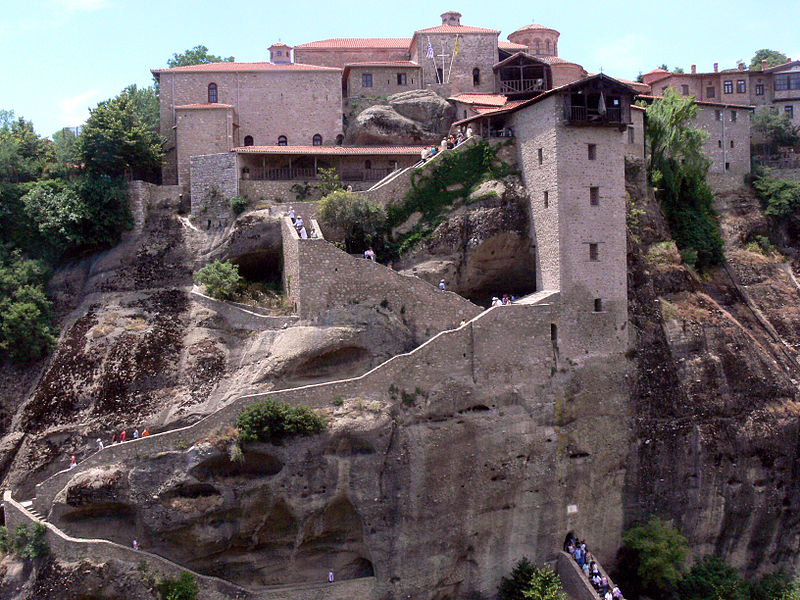

Meteora, Plain Of Thessaly, Greece

The Monastery of Meteoran, Greece (Photo Credit: Wikipedia)

The Monastery of Meteoron, Greece (Photo Credit: Wikipedia)

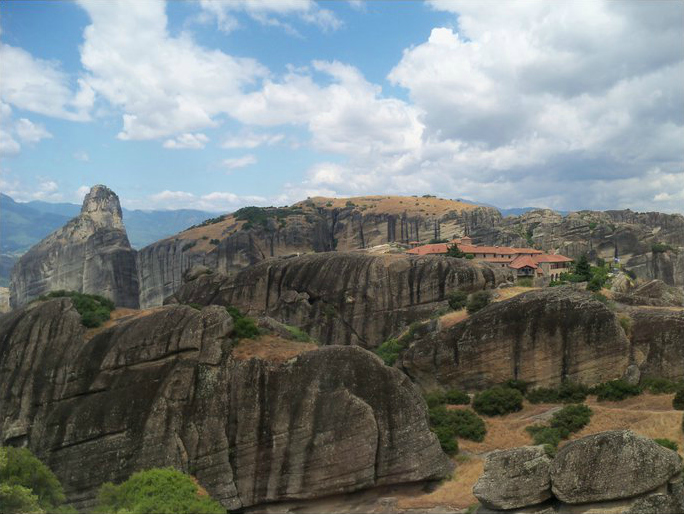
Latitude: 39.726457. Longitude: 21.626565. At the north-eastern side of the Plain of Thessaly, central Greece, to the north of Kalambaka lie the monasteries of Meteora, a Christian enclave where in 950 AD Barnabas and his fellow hermits came to live in inaccessible rock-hewn caves and, later, in 1350 the first hermitage was established on Dupiani Rock by the monk, Nilos. At about the same time Greek Orthodox monks sought sanctuary here by building monasteries on top of high, rocky pinnacles over 1,000 feet up. These Christian monasteries lie to the north of the Pineios river on the edge of the Pindhos Mountain, along bending roads and winding tracks that seem to go on forever into a strange land of towering outcrops of red sandstone and conglomerate rock that have been fused together over thousands/millions of years, forming ‘strange geological formations.’ There are twenty-four lofty pinnacles, many having monasteries and churches on top that seem to mingle in with the very rocks that they sit on. The largest of the monasteries is Moni Meteoron on Platys-Lithos (The Broad Rock) at an altitude of 1,752 feet; and the name Meteora is said to mean ‘In the heavens above’ or ‘floating in the air.’ Kalambaka in the Pineios Valley is 1.5kms to the south of Meteoron and the village of Kastraki is 1km south.

There were twenty-four monasteries in all between the 14th and 16th centuries but today only six are still inhabited, two of which are convents of Orthodox nuns. The most famous and largest of these monasteries ‘The Great Meteoran’ or Theotoko Meteoritis on Broard Rock was founded sometime after 1350 by St Athanasios Koinovitis (1305-83) who had earlier travelled here from Mount Athos, in Greece. Athanasios is a Greek Orthodox saint who is honoured on 6th March as St Athanasios Meteoritis. The monastery is dedicated to the ‘Metamoposis’ or Transfiguration, and it’s church of 1388 is cross-in-square shaped, being enlarged in 1550 by the Serbian monk, Josaph. On the East Rock stands Moni-Varlaam founded in 1517 by the two brothers Theophanes and Nectarios of Ioannina on the site of a hermitage established in 1350 by the monk Barlaam. The monastery had to be restored after it suffered bomb damage in World War II. Its monastic church ‘Agion Panton’ or All Saints is a typical cross-in-square building. A couple of interesting relics were ‘reputedly’ housed here, namely the finger of St John and the shoulder blade of St Andrew, and there are lovely frescos depicting scenes from the lives of Jesus and the Virgin Mary.

The Moni-Rossanis or Russanu monastery (Russian monastery) stands on top of an inaccesible rock. It was founded in 1639 on the site of a hermitage of 1388. Now a convent, its church dedicated to St Barbara is richly decorated with well-preserved frescos that are said to date from 1566. Agios-Nikolaos Monastery (St Nicholas) opposite Dupiani Rock was founded in 1588 and enlarged (1628). A basilica-like church has lovely frescos that date from 1527. The Agia-Triada Monastery (Moni-Triada) was founded in 1438 and is dedicated to the Holy Trinity; its church was built in 1476. The monastery is quite exeptional in beauty. There are damaged frescos dating from 1692, while the Chapel of Agios-Ioannis (St John) dates from 1682 and is hewn out of the rock. It is reached by way of a narrow stone stairway which leads up from the valley below.

The rocky cliffs of Meteora (Photo Credit: Wikipedia)

The rocky cliffs of Meteora (Photo Credit: Wikipedia)

One of the best monasteries is probably Agios-Stefanos Nunnery. This was founded in 1312 by the Emperor Andronicus III (Palaiologus) 1328-1341. It used to have a small basilica, but the main church Agios-Charalampos (St Charalambos) was built in 1798 and has wood carvings, the Iconostasis, abbots throne, choir stalls, lecterns and Epirus carvings etc. The Chapel of St Stephan has frescos (1500), while the treasury (monastery museum) houses old icons, manuscripts, reliquaries and a skull set in silver that is said to be that of St Charalambos, an early Christian martyr (AD 198). Two other monasteries: Ypapanti and Pantokrator (Christ) are now ruined. There are several churches hidden-away on the rocky pinnacles, while others can be found in the valley below Meteora. These churches that are linked to the monasteries include: Ayia-Trias, Ayia-Pro Ilias, Ayia Analipsis and Panagia.

In the great tome ‘Strange Worlds Amazing Places,’ 1994, one passage sums up the demise of Meteora: “The eerie fascination of Meteora’s geology and the spiritual pull which the place exerts are largely responsible for its current demise as a religious centre. As Meteora increasingly becomes a museum piece which attracts thousands of tourists each year, aspiring young monks and nuns are unwilling to join the monasteries, while older devotees flee from them, to seek solitude elsewhere.”

Up until last century anyone wishing to visit the monasteries of Meteora had to endure climbing up a precarious rope-ladder, but nowadays it is somewhat easier as there is a pulley system (a net-and-rope device) with a sort of seat to sit on while a monk operating a windless from a gantry above, hauls you up over a thousand feet!

Sources:

Photos Wikipedia: http://en.wikipedia.org/wiki/Meteora

Strange Worlds Amazing Places, The Reader’s Digest Association Limited, London W1, 1994.

Book of Natural Wonders, The Reader’s Digest Association, Inc, New York & Montreal, 1980.

Gouvoussis C., Greece, Editions K. Gouvoussis, Athens, Greece, 1970.

http://www.great-adventures.com/destinations/greece/meteora.html

Copyright © Ray Spencer, The Journal of Antiquities, 2014.

Mary’s House, Mount Koressos, Turkey

House of Virgin Mary. (Photo Credit: Wikipedia)

House of Virgin Mary (Photo Credit: Wikipedia)

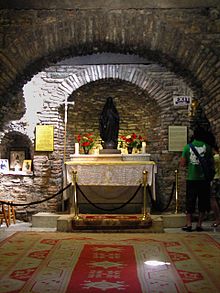
Latitude: 37.912344. Longitude: 27.332818. On the eastern slopes of Mount Koressos (Bulbul Dagi) four and a half miles south of Selcuk and the ancient, classical ruins of Efes (Ephesus) is Mary’s House, the place where the Blessed Virgin Mary came to live after the crucifixion of her son, Jesus. Today there is a Marian shrine here at Meryen Ana Evi and it is a place of ‘devout’ pilgrimage. About half a mile to the north on Meryen Ane Kilisesi road are the Byzantine ruins of The Church of the Virgin Mary (The Council Church), where it’s possible Mary also lived for a short time. The site is reached from the D550 heading south out of Selcuk from the Magnesia Gate, then by turning west onto the Meryem Ane Yolu road for another 4 miles up onto the wooded slopes of Mount Koressos and, the Church of the Virgin Mary and a little further on stands the much venerated Christian site called the House of the Virgin Mary. Here also is St Mary’s Well which is said to have healing properties. According to ‘the Legend’ and documentary evidence: Mary lived a ‘secluded’ life here for several years after accompanying St John from Jerusalem to Ephesus; she is said to have died at Meryen Ane, aged 64? St Paul also lived for a time in Ephesus. The Turkish coast lies 6 miles further to the west.

The foundations of this building [Mary’s House] were discovered in the late 19th century after much painstaking work after the recordings (revelations) of a German nun, Blessed Catherine Emmerich (1774-1824), were revealed. She apparently had a vision of the Virgin Mary who informed her of the whereabouts of her home near Ephesus. Catherine recorded what Our Lady had told her in a book called ‘The Life of the Virgin Mary,’ which had been written in French. In 1891 a Lazarist priest and president of Izmir college decided to see if the location and validity of Mary’s house (as given in the nun’s revelations) held any real, accurate credence. Archaeologists searched the mountainside south of Ephesus for many years, but eventually, they discovered foundations at Panayir Dagi on the slopes of Mount Bulbul, also called Mount Koressos. They first discovered a round-shaped cistern, an arched wall, and what may have been a pool but better still two clay sarcophagi were found, each containing a skeleton and burial gifts as well as two Roman coins, one of Constantine and the other of Justinian.

Later, other foundations including some walls were excavated close by, and it was these that lead to the final discovery, Mary’s House. A date was arrived at somewhere between the 6th-7th centuries AD, but the discovery of pieces of coal and stonework gave a date of 1st century AD. A church-like building with a dome and cross-shaped plan was eventually built over these scant foundations, the old and new walls were marked with a red line so as to show which were the old 1st century walls.

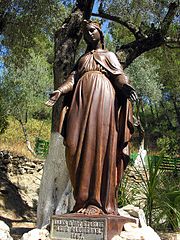
Statue of Virgin Mary (Photo Copyright: Wikipedia)

Statue of Virgin Mary (Photo Copyright: Wikipedia)

The author Selahattin Erdemgil in his book ‘Ephesus’ says: “An entrance with door-like niches on both sides, leads into a vaulted vestibule whence one enters the hall with an open apse. The statue of the Virgin Mary found in the apse, had been placed there about one hundred years ago. Since the grey area in front of the apse is different from the rest of the marble paved floor, it must have been the location of the hearth”. Erdemgil goes on to say “The small room in the south is known as the bedroom and there is an apsidal niche in its eastern wall.” Inscriptions on the wall are interpretations from the Koran relating to the Virgin Mary; Muslim people revere her and often come to pray in the little room. Outside, to the west a holy water fountain and St Mary’s Well which has long been able to cure the sick. A beautiful statue of the Virgin Mary stands on a rock base in the garden, and there is a Wall of Supplication. In recent times two popes have visited the shrine and proclaimed it as a place of Catholic pilgrimage. On The Feast of the Assumption 15th August pilgrims from all over the world visit the House of Mary in coach loads.

Sources:

Photos Wikipedia:  http://en.wikipedia.org/wiki/House_of_the_Virgin_Mary

Erdemgil, Selahattin., Ephesus, Net Tourist Yayinlar A.S, Istanbul, Turkey, 1986.

Gumus, Dogan., Ancient Ephesus, DO-GU Yayinlari, Istanbul, 1996.

Michael’s Guide, Turkey, Series ed. Michael Shicor, Inbal Travel Information Ltd., Tel Aviv, Israel, 1990.

http://www.toursofephesus.com/house-of-mary-history-information-kusadasi-turkey-selcuk-ephesus.php

Copyright © Ray Spencer, The Journal of Antiquities, 2014.

Ayres Rock, Northern Territory, Australia

Ayres Rock, Australia

Ayres Rock, Australia

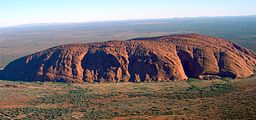
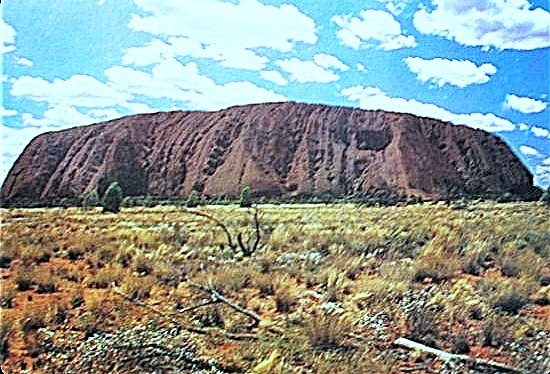
Latitude: 25.344683. Longitude: 130.037370. Ayres Rock is a ‘world famous’ natural rock formation (which includes Kata Tjuta) in the Australian outback – the southern part of the Northern Territory, central Australia, some 208 miles (in a straight line) south of Alice Springs; by road it is more like 280 miles! This sacred sandstone rock is located close to State Route Highway 4 (Lesseter Highway) but more often called Uluru Road, a few miles south-east of Yulara.

The Aboriginal people of Australia regard Ayres Rock, also called Uluru, as a sacred place. There are many deep springs and watering holes (billabongs) located on and around the rock that are known to have sacred healing qualities, and there are caves with rock art. Ayres Rock Campground and Uluru-Kata Tjuta Cultural Centre at Yulara are in a rocky area to the north, spread out over several miles, just east of State Route 4 in The Kata Tjuta National Park. Ayres Rock is now a World Heritage Site. The 19th-century explorer Sir William Gosse named the Great Rock after Sir Henry Ayres, Premier of South Australia.

At an elevation of 2,830 feet, 860 metres above sea level, a height of 1,142 feet (348 metres) and a length of 3.6 km (2.2 miles) Ayres Rock monolith is a massive natural rock formation that can be seen a very long way away, sixty miles or more due to the terrain of the Northern Territory. It is ‘said’ to be up to 450 million years old, with a circumference of 9.4km (over 5 miles) and estimated to be 6kms below ground level.

The make-up of the rock, geologically speaking, is very interesting in that it is made of reddish ‘arkose’ sandstone, although seperately Kata (the Olgas) is a conglomerate mix of small stones and boulders fused together with mud etc. Uluru is distinctly reddish at certain times of the day due to the high iron, red oxide content of the rock, but at other times it is grey. The rock also has a rich feldspar content, which adds to the rock’s distinctly reddish hue, although the colours change at different times of the day. Over millions of years, there has been much erosion due to weathering and it is ‘this’ that has caused the strange formations of gulleys, ridges and furrows that we see today. The rock is virtually bare with no vegitation whatsoever.

Uluru (Helicopter View) Photo Copyright: Wikipedia

Uluru (Helicopter View) Photo Copyright: Wikipedia

There are many deep honeycomb hollows and, also a number of deep caves in Ayres Rock which have been made over millions of years, especially near the base where some contain fantastic rock paintings made by the ancestors of today’s Aboriginal people, namely the Yankunytjatjara (carpet-snake people) and the Pitjantjatjara (hair-wallaby people) who lived in what was at that time called the ‘Dreamtime’ (Tjukurpa); their paintings depicting scenes from life. These pictographs and paintings are “…..Mute testimony to primitive man’s reverence to Ayres Rock, these archaeological relics add to the majestic beauty of the colossus of the Australian outback” according to the ‘Book of Natural Wonders,’ 1980. And there are, apparently, many sacred springs that seep out from deep in the rock’s surface; these are sacred springs to which the powers of healing have been attributed, and around the great rock there are watering holes (billabongs) for the thirsty – man or beast – for this place is a very hot, unrelenting desert. Water is a matter of ‘life and death.’

The book ‘Strange Worlds Amazing Places,’ 1994, informs us that: ….“As the sun spreads its dawn rays across the sky, Uluru begins to lighten. Shifting from black to deep mauve, the giant monolith gradually becomes more distinct. When the first rays of the sun strike, the stone bursts into a riot of reds and pinks that chase each other across the surface with startling speed. Shadows flee the hollows until the whole rock is bathed in desert daylight. The colour changes continue throughout the day, and by evening have run the spectrum from golden and pinky reds through ruby to crimson red and purples.”

Sources:

Book of Natural Wonders, The Reader’s Digest Association, Inc, New York & Montreal, 1980.

Strange Worlds Amazing Places, The Reader’s Digest Association Limited, London W1, 1994.

Wikipedia:  http://en.wikipedia.org/wiki/Uluru

The Megalithic Portal:  http://www.megalithic.co.uk/article.php?sid=11621

Wikipedia:  http://en.wikipedia.org/wiki/Billabong

Copyright © Ray Spencer, The Journal of Antiquities, 2014.

1 Comment

Drumtroddan Carved Rocks, Port William, Dumfries and Galloway, Scotland

Drumtroddan Cup and Ring Marked Rocks (Photo credit: Roger W. Haworth - Geograph)

Drumtroddan Cup and Ring Marked Rocks. Photo credit: Roger W. Haworth (Geograph)

OS grid reference: NX 3626 4474. Some 2 miles to the north-east of Port William, Dumfries and Galloway, are three outcrops of rocks known as Drumtroddan Carved Rocks, which are said to have been carved in the Bronze Age. These prehistoric carvings are located 200 metres south of Drumtroddan farm to the east of the B7085. White Loch of Myrton is just to the south; one of the carved rocks is located in a wooden area close by. And a further 400 metres south-east of Drumtrodden rock carvings there’s an alignment of three prehistoric stones, one of which lies on the ground. The town of Whithorn is 6 miles east on the B7021 and Glenluce is 12 miles west on the A747.

There are said to be between 80-90 well-defined cup-and-ring carvings spread out on the three natural rock faces, the majority being tiny or small, well-pronounced cups with medium and larger concentric rings, with some linear lines (grooves) linking one to another; and there are spiral deigns and other curious (unknown) symbols. The cups have either two, three, five or six rings. Although simple in their design, these carvings are very ingenious. But some might see the carvings as graffiti, or scribblings, though they were, in fact, very carefully and accurately carved at the time, some 4,000 years ago. They remind us, perhaps, of when a stone is dropped into a pool of still water and then we get the ripple effect with circles getting bigger as they move outwards. Another rock with cups and rings can be seen 1.4km to the east at GR: NX 3776 4438.

The authors Janet and Colin Bord in their book Mysterious Britain,1984, look to the author John Foster Forbes writing in 1939 with regard to Drumtroddan. He believed that “There is an affinity between these cups and the nature of the stars. A star is a generator and transmitter of Cosmic Energy in spiral form. These cups could be used as micro-cosmic examples of spiral-staral energies.”

400 metres to the east (Gr NX3645 4429) an alignment of three stones (fenced off), two are upright but one, the central stone, has fallen down. These stones were probably placed here at an earlier date than the rock carvings, but no doubt they are in some way connected. The two standing stones are around 10 feet high and there is a space of 40 feet between each stone. It is thought that a fourth stone stood on the alignment which is orientated NE to SW. The southwest stone now leans at an angle out of true vertical.

Sources:

Photo copyright: Roger W. Haworth (Geograph). This file is licensed under the Creative Commons Attribution-Share Alike 2.0 Generic license

Bord, Janet & Colin., Mysterious Britain, Paladin (Granada Publishing Ltd), London W1, 1984.

Ancient Monuments – Scotland – Illustrated Guide, Vol VI, H.M.S.O, Edinburgh, 1959.

http://www.undiscoveredscotland.co.uk/portwilliam/drumtroddanstones/index.html

http://www.megalithic.co.uk/article.php?sid=1522

Copyright © Ray Spencer, The Journal of Antiquities, 2014.

Hope Churchyard Cross, Derbyshire

Churchyard Cross, Hope, Derbyshire (Photo credit: Geograph)

Churchyard Cross, Hope, Derbyshire (Photo credit: Ashley Dace (Geograph).

OS grid reference: SK1721 8347. At the southeast side of the Derbyshire village of Hope stands the 14th-century church of St Peter and the Hope Churchyard Cross, a late 9th-century Saxon cross-shaft. There is also a medieval cross in the churchyard. The church is located on Station road at the east side of the village close to Pinder Road, and, just a short distance to the east, the river Noe flows into Peakshole Water. And 1 mile further east in The Hope Valley at Brough the scant earthworks of a Roman fort can be seen. The village of Castleton is 2 miles west on the A6187, Bamford is 3 miles to the northeast, and Buxton is 6 miles to the southwest on the A6 road.

This 6-foot 6-inch sandstone cross-slab stands at the south side of the church and is now set into a more modern square base. Said to date from the time of King Alfred, it was found in two pieces after being hidden away in the wall of a nearby schoolhouse until 1858, having lain there for safety since the Civil War. It is richly carved albeit a little weather-worn. All four sides have carvings in separate panels, the best side being the east which has three panels; at the top there is knotwork, while in the middle two figures are holding up a large staff (or a cross), the lower panel having two interlaced rings surrounded by foliage. The west face is also excellent. Again there are three panels, the top shows a figure holding the cross above his shoulders, the central segmental-headed panel has two saints embracing, while the bottom one has three double concentric rings with double cords crossing ‘diagonally’ and inter-linking over the rings. The north face has just two panels with snakes biting each other (top) and the bottom having four-cord plait design with interlacing; there is interlacing composed of figure of eight knots on the south face. Sadly the cross-head is long gone. Close to this is The Eccles Cross, dating from the Middle Ages.

Near the north door there is a medieval calvary on five octagonal steps with a pillar sundial on top of an eight-sided base. This base has a square-shaped hole which could have accommodated an earlier, Saxon cross, although the whole thing is more akin to a market or wayside cross? Inside the church there are two nicely carved medieval grave slabs (in the chancel) with crosses and various symbols of outdoor life, namely hunting horns and arrows suggesting that these belonged to two officials of the Royal Forest of the Peak. These grave slabs were made in the 13th century and came from the building prior to the present church. On the north wall there are a number of “ugly” gargoyles, reflecting our pagan past, two of which may be the horned god of the Celts, Cernunos. According to the author David Clarke in his book ‘Ghosts & Legends of the Peak District, 1991, St Peters “is the oldest recorded Christian place of worship in the northern Peak District, and in Saxon times it was the focus of one of the largest parishes in England, stretching from the Derwent woodlands in the north to Buxton, Tideswell and the Padley gorge.”

About a mile to the east at Brough, near Bradwell, in the Hope Valley are the earthworks of the Roman fort of ANAVIO. But there is little to see now apart from some low, grassy banks. Two Roman roads ran from the fort, one going to Buxton, the other to Melandra Castle near Glossop and Templeborough, near Rotherham.

Sources:

Geograph:  http://www.geograph.org.uk/photo/2368735

Photo:  © Copyright Ashley Dace and licensed for reuse under this Creative Commons Licence.

Sharpe, Neville. T., Crosses Of The Peak District, Landmark Publishing Limited, Ashbourne, Derbyshire, 2002.

Clarke, David., Ghosts & Legends of the Peak District, Jarrold Publishing, Norwich, 1991.

Bunting, Richard., Anglo-Saxon and Viking Derbyshire, J. H. Hall & Sons Limited, Derby.

Copyright © Ray Spencer, The Journal of Antiquities, 2014 (updated 2023).


The Devil’s Den, Marlborough, Wiltshire

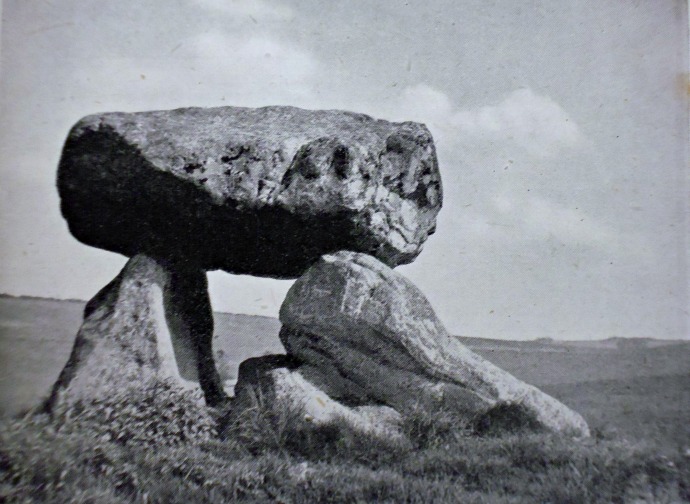
The Devil's Den, Wiltshire (Dixon-Scott)

The Devil’s Den, Wiltshire (Dixon-Scott)

OS grid reference: SU 1521 6965. In a field on Fyfield Down, 1 mile east of Marlborough, Wiltshire, stands the prehistoric burial chamber known as The Devil’s Den or Clatford Bottom Stone, a Neolithic monument from 5,000 years ago that is also known as a Dolmen (stone table). To reach the site head north on the footpath from the A4 (Bath Road) opposite Clatford village and near the “private” entrance to Manton House Estate, then after about 950 metres head west to the monument on Fyfield Hill, which is in a little valley. They own much of the land on this side of the road, so keep to the footpath if possible. The town of Marlborough is 1 mile east on the A4, while Avebury is 2 miles to the west. Nearby, to the east stands an ancient mound which has given its name to the town of Marlborough. You may well come across some crop circles in the fields around The Devil’s Den! Don’t be surprised!

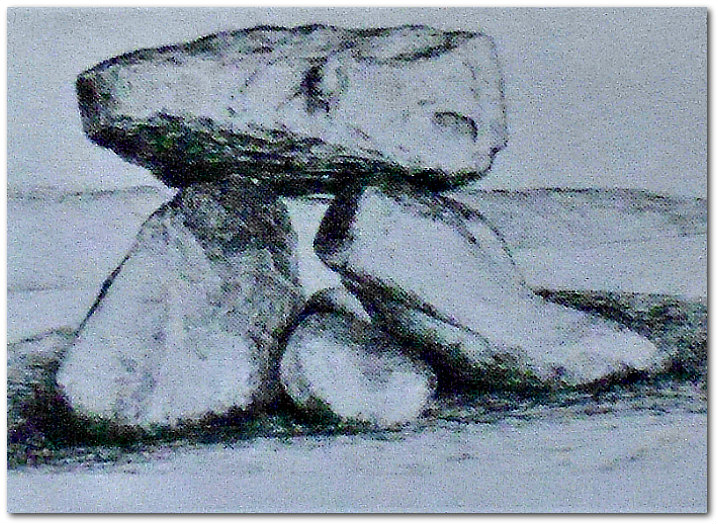
The Devil’s Den, near Marlborough (drawing)

The Devil’s Den burial chamber stands upon a low mound that was originally part of a long barrow – which is still visible near the south-east edge of the field in the form of a recumbant “outlier” stone; the barrow would have been 230 feet in length. So what we see here today is almost certainly a reconstruction from the early 1920s – the stones having fallen down. The large capstone now only stands on two supporting stones, the other upright lies recumbant, though there might have been another two or three stones here long ago. Originally this burial chamber would have been covered over by an earthen mound but, over time this has been either ploughed away, or eroded away by the weather. Recent evidence ‘suggests’ it might never have had an earthen covering? The large, chunky capstone is said to weigh 17 tons or more and to have at least two cup markings on it. And there is a legend concerning these cup-marks. A number of well-respected antiquarians have visited the site including the great William Stukeley in the early 1740s; he called this ancient monument a kist-vaen (cist).

According to local tradition “if water is poured into the hollows on the capstone, a demon will come along in the night and drink it.” But there are many legends and myths associated with the devil around these ancient sites, most of them should be taken with a pinch of salt over the left shoulder! It might be that the devil was considered the only one who could build such a monument, but we know different. In the grounds of Marlborough College (SU1836 6867) at the north-east side of the town – a stepped grassy mound is thought to be where Merlin the Magician lies buried, but infact, it is Maerl’s Mound and the town’s name is derived from this. One or two places in Wales migh also claim to have Merlin buried in their neck of the woods! It was probably, originally, a prehistoric burial mound or barrow pre-dating Merlin which in the Middle Ages had a small castle built over it. Though Maerl or Maerla could well be ‘one and the same’ as Merlin?

Sources:

Romantic Britain, ed. by Tom Stephenson, Odhams Press Limited, Long Acre, London WC2, 1939.

AA Illustrated Guide To Britain, Drive Publications (Reprint), London WC1, 1982.

The Northern Antiquarian:  http://megalithix.wordpress.com/2010/06/30/devils-den-clatford/

http://en.wikipedia.org/wiki/The_Devil’s_Den

http://www.francisfrith.com/fyfield,marlborough,wiltshire/photos/the-devils-den-1901_47674/

Copyright © Ray Spencer, The Journal of Antiquities, 2014 (Up-dated 2021).


2 Comments

Roman Bath, Westminster, London, WC2

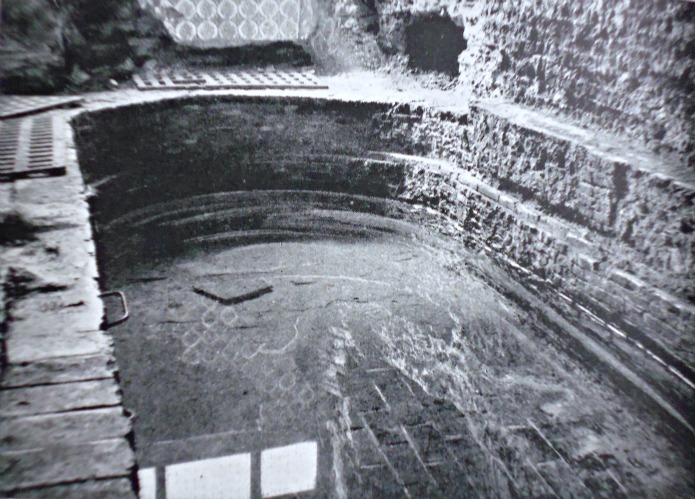
Roman Bath, The Strand, London. (D. Mcleish)

Roman Bath, The Strand, London. (D. Mcleish)

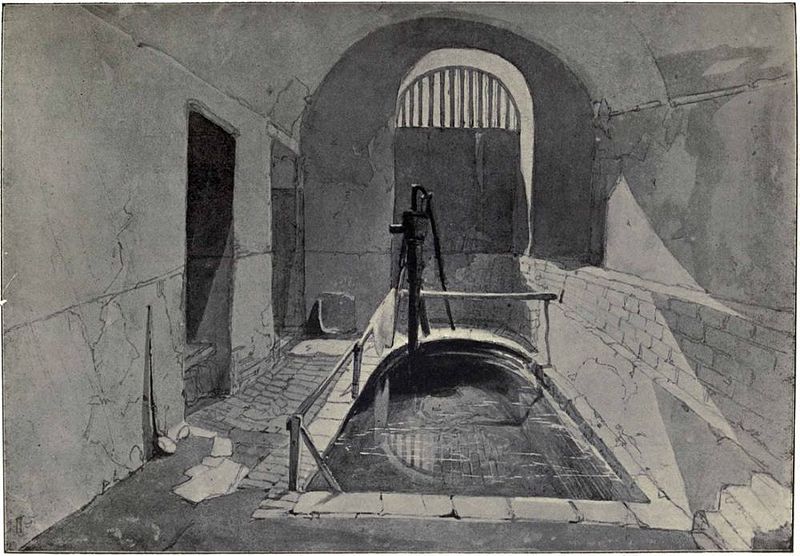
OS grid reference TQ 3085 8087. In the stone-vaulted cellar of number 5 Strand Lane, off The Strand, Westminster, in a narrow alley-way close to King’s College, and next to Surrey Street, London WC2, can be found a very well-preserved Roman Bath, dating from the 2nd century AD, that is now regarded as a notable and historical reminder from the Roman city of Londinium (London), but now a curiosity of hidden-London. The bath is still in use and has been in one way or another since the late 16th or early 17th century, having been lost for hundreds of years after the Romans departed at the beginning of the 5th century AD. It seems the bath had belonged to a grand Roman villa which had stood on this site in the early days of the Roman occupation, probably the 2nd century AD, and which had stood on a raised area of land outside the city walls, overlooking the river Thames. The site is near to Charing Cross underground station and Covent Garden. The Victoria Embankment is just a short walk to the south.

The Roman Bath on the south side of the Strand is in a well-preserved condition considering its age, and is under 5 feet (1.5 metres) below street level, measuring 16 feet in length by over 6 feet in width and nearly 5 feet deep. The plunge bath as it is often called is still fed by a spring of cold water from St Clement’s Well just as it was in Roman times and, also more recently in the 17th century. Its stonework consists of bricks that are 10 inches long by 3 inches wide, all solidly packed together and water-tight. The stonework surrounding the Roman bath is very grand and it certainly looks ‘Roman’, but is it? However, the ugly iron grate-covers at the sides do not do it any justice, though they serve their modern-day purpose as inspection covers!

Roman Baths, The Strand, London (Photo Credit: Wikipedia)

Roman Baths, The Strand, London (Photo Credit: Wikipedia)

In 1612 King James I had the Roman bath fully restored from whence it had been the property of the Earls of Essex in the late 16th century; he then continued to patronise it – as did many other royals, including Anne of Denmark, his wife, and a number of royal courtiers. Then in the 18th century it was frequented by London’s wealthy and famous. In 1784 John Pinkerton the Scottish antiquarian described it as “a fine antique bath in the cellar of a house in Norfolk street in the Strand.” Norfolk Street no longer exists in name. At this time it belonged to the Earl of Arundel whose house and gardens were adjacent to the bath. In 1792 the antiquarian William Weddle Mp died suddenly after taking a plunge in the Roman bath. The famous author Charles Dickens visited the bath and then wrote about it in his book ‘David Copperfield’ recalling, perhaps, that master Copperfield had “many a cold plunge in the said bath.” The bath fell in to disuse in the late Victorian period but in the early part of the 20th century it was again restored to what we see today.

The bath is open to the general public one day a week (by appointment) and is today maintained by The City of Westminster on behalf of the National Trust. Roman artefacts have been discovered close by including: a sarcophagus and numerous items of pottery and coins, all dating from the Roman period. In September 2011 another Roman bath was found by railway workers on the south-side of the Thames at the corner of London Bridge street. A few historians have argued that the bath only dates from the 17th century, being built as a water feature or spa-bath by the Earl of Arundel, but this is now generally considered not to be the case – and so the thinking is that the bath is indeed Roman.

Sources:

Wikipedia:  http://en.wikipedia.org/wiki/Roman_Baths,_Strand_Lane

http://www.offtolondon.com/hiddenlondoncopy/romanbath.html

http://www.pasthorizonspr.com/index.php/archives/04/2013/archaeologists-find-10000-objects-from-roman-london

Romantic Britain, edt. by Tom Stephenson, Odhams Press Limited, London, WC2, 1939.

© Copyright, Ray Spencer, 2014.


3 Comments

Ysbyty Cynfyn Stone Circle, Powys, Wales

St John's Church, Ysbyty Cynfyn (Photo credit: Geograph)

St John’s Church, Ysbyty Cynfyn (Photo credit: Geograph)

OS grid reference: SN 7520 7910. The little hamlet of Ysbyty Cynfyn is located in the Valley of Afon Rheidol between Devil’s Bridge and Ponterwyd in the parish of Llanbadarn Fawr, and in the shadow of the Rheidol and Plynlimon Ranges, western Powys. It is a 19th century church, but its sacred churchyard stands inside a prehistoric stone circle; the actual churchyard itself is partly circular which strongly suggests this is, and has been, a sacred site for thousands of years, and is often referred to by historians and antiquarians alike as Ysbyty Cynfyn Stone Circle. In the Middle Ages a monastic hospice run by the Knights Hospitallers of St John of Jerusalem stood on the site of the present-day church, which is dedicated to St John the Baptist, though there isn’t much to see of that today – but hence we still have the place-name “Ysbyty” meaning ‘hospittum’ (hospice). The hospice cared for pilgrims making their way to St David’s. This must undoubtedly be seen as a something of a compromise between the Christian Church and the pagan world of standing stones, temples, ritual and magic – something the church had wanted to banish, but here the two ‘quietly’ came together and so, we have a church within an actual pagan stone circle, even if there’s not a great deal to see, only five stones remaining, today. Or could it be that the stones were just too big to move so the churchyard wall was built around them! Aberystwyth is 12 miles to the west on the A44 and Devil’s Bridge is 2 miles south on the A4120 road.

Churchyard at Ysbyty Cynfyn (Photo Credit Penny Mayes, Geograph)

Churchyard at Ysbyty Cynfyn, Powys.  (Photo Credit: Geograph)

Ysbyty Cynfyn church is located about 80 metres west of the A4120 road, beside Temple farm. Today only five stones remain of the former circle set on a low earthen bank that is said to date from the Bronze-Age, around 1,500 BC; however the remaining stones seem to blend in well with the churchyard wall, indeed two thin slab-stones now act as gateposts at the eastern entrance and, there is at least one recorded account that says there is a faint ‘Christianised’ carving on one of these? A large lump of quartz-stone on the top of the wall next to the gateposts looks interesting! The other two stones, also at the eastern-side, are very big in many ways both in height and girth, but whether they are in their originals positions is open to question? Two large, quite bulky standing stones fit ‘nicely’ into the wall surrounding the churchyard, while a third one stands at the back of the church (north-side) adjoining the wall and gravestones and is 3.4 metres (11 feet) high and about half as much in width; this particular stone would seem to be in its original position. Almost without a doubt there were other standing stones here long-ago, forming a proper circle, the site of what may have been, perhaps, a pagan temple used by druids for the purposes of ritual and magic. There are apparently a few ‘lost’ recumbant stones in the nearby fields – maybe these came from the stone circle?

In the little church of St John, there’s a curious carved wooden font (1850) and on the wall a brass plaque in memory of local men who fell in the 2nd world war. The church dates from 1827. Over by the carpark there is a round-shaped well with a ‘warning notice’ saying: “this water is not for drinking.” Could this well have been used by the knights of St John and did it once have healing properties? To the north of the church upon the Rheidol, opposite Bryn Bras, are the remains of an old lead mine that was called Temple Mine and 1 mile to the west, close to Parson’s Bridge, at Dolgamfa, a Bronze-Age cairn circle can be seen.

Sources:

Gregory, Donald., Country Churchyards In Wales, Gwasg Carreg Gwalch, Capel Garmon, Llanrwst, Gwynedd, Wales, 1991. 

Gregory, Donald., Wales Before 1066 – A Guide, Gwasg Carreg Gwalch, Llanrwst, Gwynedd, 1992.

Houlder, Christopher., Wales: An Archaeological Guide, Faber & Faber, London, 1978.

Barber, Chris., Mysterious Wales, Paladin (Grafton Books), London, 1987.

http://www.megalithic.co.uk/article.php?sid=1375

Photo Credit: © Copyright Penny Mayes and licensed for reuse under this Creative Commons Licence.

Photo Credit:© Copyright Penny Mayes and licensed for reuse under this Creative Commons Licence.

© Copyright, Ray Spencer, 2014.


St James’ Church, Avebury, Wiltshire

OS grid reference: SU 0991 6990. In the village of Avebury, close to the manor house and just 100 metres west of the famous stone circle, stands St James’ Church, a building that is of Anglo-Saxons origins. Located on Church Walk, just north of High Street, in the centre of this charming village, but outside of the pagan stone circle. Christianity came late to Avebury – due, perhaps, to the allure of the 3 pagan stone circles standing within a sizable circular enclosure, covering 24 acres, 1,400 feet across, and nearly 1 mile in circumference which virtually surrounds the village, its grassy bank being upto 5 metres high and the ditch about 25 metres wide. The stone circles date from the late Neolithic between 2,900 to 2,500 BC. When Christianity did finally arrive here in about 1000 AD the people were ‘still very slow’ in adapting from their heathen ways to something much more profound, fulfilling and everlasting. The church houses a beautiful medieval tub font which is carved with a superb dragon, a depiction of paganism (the Devil) being stamped on and a new religion, Christianity, being heralded in. There is also a fragment of an Anglo-Saxon cross and a number of other ‘quite delightful’ architectural things to see inside the church. Avebury is 6 miles east of Marlborough on the A4 (Bath Road) and 8 miles from the town of Chippenham in the west, again on the A4 road. Stonehenge is 17 miles south, close to the A303 road, near Amesbury.

St James’ parish church is largely Norman, although there are some earlier, Saxon features, in particular the two round-headed windows in the Saxon nave wall, while the three rather odd-looking circular, porthole windows at a higher level, are late Anglo-Saxon or perhaps early Norman? There’s also a very interesting squint hole. The church was probably added to in the 12th century. Also, there is a partly restored 15th century rood loft, but sadly the rood itself was destroyed during the atrocities of the Reformation. At the north-west corner embedded in the wall part of an Anglo-Saxon cross-shaft with carvings. The tower with its stair-turret is 15th century Perpendicular. At the south-side a superb Norman doorway which, according to the author Simon Jenkins in his delightful book ‘England’s Thousand Best Churches’, 2000, “offers a lovely composition of foliated capitals and a zigzag arch beneath an empty saint’s plinth.” But the best antiquity here is undoubtedly the 12th century tub font with its beautiful early Norman carvings. Restoration to St James’ was carried out in the 19th century.

The font dates from the early 12th century and is exquisitly carved with a Christian figure that appears to be ‘stamping out paganism’ and heralding in the new religion with “one” eternal God. A bishop or ecclesiastic wearing a “short skirt” is depicted with his crozier in one of the intersecting arches stamping on a winged serpent (dragon) with a long never-ending curling tail which, at the same time is biting his foot or cloak; this is an obvious reference to the battle between the established ‘serpent-power’ worship of the pre-Christian temple at Avebury, and the new Christianity, according to Janet & Colin Bord in their book Mysterious Britain, 1984. Quite clearly it can be seen as ‘the Devil’ getting his final comeuppance and Christianity securing its position as the true and everlasting faith. There is a second serpent with a long, curling tail. The font is also adorned around the bottom with columns that have bands or cords shooting out from their tops to form the intersecting ‘domed’ arches.

Sources:

Janet & Colin Bord, Mysterious Britain, Paladin (Granada Publishing Ltd)., London, 1984.

Jones, Lawrence E. & Tricker, Roy., County Guide To English Churches, Countryside Books, Newbury, Berkshire, 1992.

Darvil, Timothy., Ancient Britain, AA Publishing Division, Basingstoke, Hampshire, 1988.

Anderton, Bill., Guide To Ancient Britain, W. Foulsham & Co Ltd., London, 1991.

Ashe, Geoffrey., Mythology Of The British Isles, Methuen, London, 1993.

Click on for images of the church  http://greatenglishchurches.co.uk/html/avebury.html

Click on for images of the church  http://www.anglo-saxon-churches.co.uk/images/avebury.pdf

© Copyright, Ray Spencer, 2014.


Gavrinis Tumulus, Gulf of Morbihan, Brittany, France

Entrance to Gavrinus Cairn (Photo Copyright: Wikipedia)

Entrance to Gavrinus Cairn (Photo Credit: Myrabella, Wikipedia)

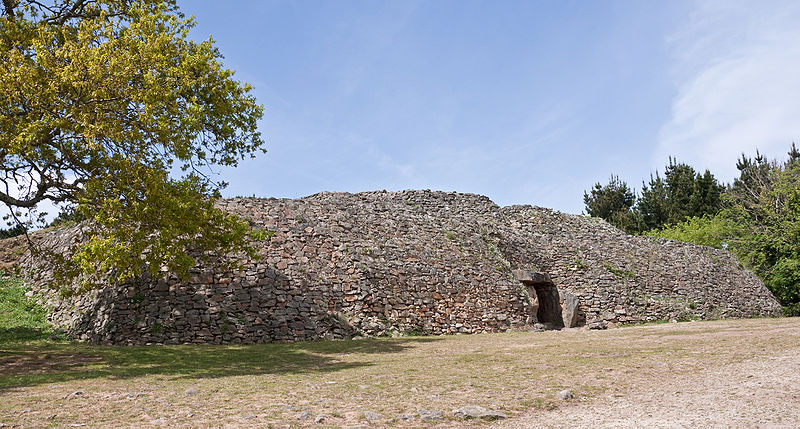
Latitude 47, 571835 Longitude -2,898588. In the Gulf of Morbihan, 1 mile south of Larmor-Baden in the Bretagne-Morbihan region of Brittany, is Gavrinus Island (Ile de Gavrinis) with what is considered a world-famous prehistoric burial mound called Gavrinis Tumulus. The burial chamber at the south side of the island is ‘variously’ referred to as a tumulus or cairn, dating back to the Neolithic 5,000 to 6,000 years. It is said by those historians that are proficient in this type of ancient monument to be the best-preserved passage grave in Brittany, and maybe Europe, if not the world, though there are other “equally good” burial mounds in Europe, one in particular being Newgrange in Southern Ireland. Gavrinis means Isle of Goats. To reach the island of Gavrinis you need to get a boat from the embarking point in the port of Larmor-Baden, but it’s only a short trip of 10 minutes! The town of Vannes is some 12 miles to the north-east on the D136 and D101 roads.

Gavrinis Decorated Stones (Photo Credit: Wikipedia)

Gavrinis Decorated Stones (Photo Credit: Wikipedia)

The great mound of Gavrinis measures 23 feet in height (7 metres) and is 328 feet in circumference (100 metres). The diameter of the mound is between 50 and 60 metres (164 feet to 196 feet). It was built around 3,500 BC and was made of earth and large stones that are piled on to the top of the burial mound. Deep inside the mound a gallery (passage) 43 feet long is covered over by stones – with 50 slabs, 23 of these are supporting slabs on top of which there are 9 capstones or tables, leading to a square-shaped burial chamber. The stone supports are richly adorned with beautiful carvings, including pattern-work, symbolism, animals and what could be a human figure – also zigzag decoration, lozenge shapes, abstract circles, axes, arcs, and snake-lines. Undoutedly, this was a funery tomb for some high-ranking person, maybe a chieftain or a king; the ceiling above is made of a large (single) stone-slab measuring 12 feet (4 metres) long by 9 feet (3 metres) wide and weighing upto 17 tons, which rests upon 8 more stone supports standing in a rectangle. The entrance (portal) is built with large slabs, two at the sides and one at the top, while the sides (faces) of the mound are stepped or tiered with thousands of large lumps of stone, not to disimilar perhaps to the pyramids at Giza in Egypt! There are some ‘spectacular’ panoramic views to be had from the tumulus of Gavrinis of the Gulf of Morbihan and the surrounding areas for many miles around, in every direction!

Gavrinis was discovered back in 1832 and excavations began in 1835. In more recent years, the 1960s through to the 1980s there have been further excavations and, in recent years (2011) the decorated stone slabs from inside the chamber have been ‘thoroughly’ researched. A few miles to the south is the tiny island of Er Lanic and two stone circles (together) in the form of a figure-eight – half of the circle now being submerged in the sea. To the north of Gavrinis Island, near Auray, stands the burial chamber or tumulus of Er Grah and, near that close to Locmariquer is Les Table des Marchand. The renowned archaeologist and writer, Aubrey Burl, visited Gavrinis and ‘seems’ to have been “very enthusiastic” about what he had seen of the cairn. Burl was later to describe this and other ancient monuments in his book ‘Megalithic Brittany,’ 1988. Burl said of Gavrinis “It is for its art that Gavrinis is famous.”

Sources:

Michelin Tourist Guide ‘Brittany’, Michelin Tyres Plc, London, 1983.

Insight Guides ‘Brittany’, Ed: Brian Bell, (First Edition) APA Publications (HK) Limited, 1994.

Burl, Aubrey., Megaliths of Brittany, Thames & Hudson, London, 1985.

http://en.wikipedia.org/wiki/Gavrinis

http://www.knowth.com/gavrinis.htm

http://www.academia.edu/5015454/Gavrinis._The_raising_of_digital_stones

Copyright © Ray Spencer, The Journal of Antiquities, 2014 (updated 2023).


Ballygowan Rocks, Argyll and Bute, Scotland

Ballygowan Cup-and Rings (Photo Credit: Wikimedia*)

Ballygowan Cup-and Rings (Photo Credit: Wikimedia*)

OS grid reference: NR8162 9778. In Kilmartin Glen, Strathclyde region, Argyll and Bute, near to the village of Slockavullin there is a fenced-off area with an outcrop of rocks called Ballygowan Rocks, which are covered in prehistoric rock-art, dating back thousands of years to the Bronze-Age. The site is located beside a path and close to woodland about half a mile north of Tayness Cottage, Ballygowan, half a mile south-west of Slockavullin village and, to the north-west of the B8025 and A816 roads and Kilmartin burn. Ballygowan is a solitary little hamlet with no more than a few cottages. Kilmartin is one-and-a-half miles to the north-east and the town of Lochgilphead 10 miles south on the A816. This area is particularly rich in prehistoric rock-art, so you don’t have to go far before you come across rocks covered in cup-and-ring markings. It is well-worth the long trek, in the end at any rate!

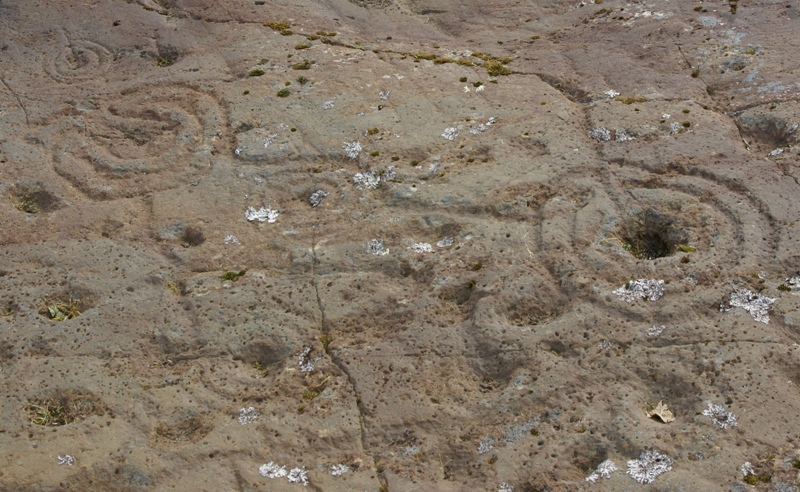
The Ballygowan cup-and-ring markings are carved onto the flat face of an outcrop measuring 2.5 metres. There are said to be at least 70 small, medium and large cup-and-rings here, some having radial grooves that link up with the cups, while other enlarged cups seeming to go into the natural cracks in the rock, and many having slightly deeper rounded centres than their counterparts. One cup-marking in particular resembles a horseshoe with several rings that stop at a ‘junction’ and then go outwards from the cup itself, while larger cups (some oval-shaped) go off into the naturaly-formed cracks in the rock’s surface; also there are ‘radial’ grooves or gulleys which link-up with other cups-and-rings. This type of rock-art is said to date from the Bronze-Age, around 2,500 BC.

But why were these strange cup-markings and other patterns designed like this, and for what reason were they carved? Were they used for aligning the stars and constellations, or perhaps the setting of the moon. Maybe they were to ‘align’ features on the horizon, such as hills, mountains and valleys? Maybe we will never know for certain, we can only guess. But they must have mean’t something to our ancient ancestors as they wouldn’t have spent so much time carving these strange shapes.

There are other cup-marked rocks in Kilmartin Glen at Achnabreck, Cairnbaan, Kilmichael Glassary and, further to the north at Buluachraig, all well-worth visiting.

Sources:

Darvil, Timothy., Glovebox Guide – Ancient Britain, The Publishing Division Of The Automobile Association (AA), Basingstoke, Hampshire, 1988.

Canmore Site No: NR89NW 99 & ID 76384 http://canmore.rcahms.gov.uk/en/site/76384/textcontribution/ballygowan/

*Photo Credit: http://commons.wikimedia.org/wiki/File:Ballygowan_Cup_And_Ring_Marks_20120414_detail.jpg

The Megalithic Portal: http://www.megalithic.co.uk/article.php?sid=1863884826

© Copyright, Ray Spencer, 2014.


Castleberg Hillfort, Addingham, West Yorkshire

Castleberg Hillfort (Photo Credit) Geolocations David Spencer.

Castleberg Hillfort (Photo Credit: Geolocations David Spencer)

OS grid reference: SE 0912 4943. Just half a mile to the north-east of Addingham at Nesfield, West Yorkshire, is Castleberg Hillfort, said to date from the Iron Age although the site has never been properly excavated by archaeologists and therefore it could be earlier, maybe late Bronze Age, which would then make it an enclosure or settlement, and quite probably the Roman legions came this way on their way to the fort at Ilkley (Olenacum or Olicana?) and maybe ‘made camp’ here on the hill at some point; the name Castleberg is distinctly a Roman one. The hillfort stands at the top of a naturally-formed hill that has a Limestone scar at its southern side. Much of the western side of the site is covered in woodland which stretches down to the river Wharfe, while a little further to the south, opposite Low Mill village, and hidden in trees beside the river lies the famous Castleberg scar, which is actually a Limestone crag. The town of Ilkley is 3 miles to the east on the A65 and Bolton Abbey is 9 miles north-west along Bolton Road and then the A59.

The shape of the hillfort is quite odd, really, mainly because it follows the contours and curve of the hill. It measures, roughly, 140 metres in width, 130 metres lengthwise and 130 metres in diameter; the earthworks being more visible at the eastern side and at the western and north-western sides where earthworks run off from the fort itself; the south-side of the hillfort follows the natural curve of the hill above the river Wharfe. A few well-known Victorian antiquarians and historians have visited this site and more or less they all agree with each other with regard to Castleberg, though there is still much uncertainty about its true age – the Stone Age through to the more recent, Roman period? There have been a couple of finds dating from the Bronze-Age, but nothing particularly substantial. This man-made defensive hillfort would have provided its occupants with a panoramic view of the surrounding area for miles around and would ‘certainly’ have given them prior warning of any signs of hostility advancing up the Wharfe valley.

On Addingham Low Moor, just east of the village, near Woofa Bank, there are several more ancient sites including tumuli, enclosures and round dikes, making this a very rich area of prehistory, while to the south-east, there is Ilkley Moor with many, many more ancient antiquities. St Peter’s Church at Addingham (SE0851 4969) is said to have been built on a pagan site though the present building is 15th century; it houses a very nice carved section of an Anglo-Saxon cross, dating from the 10th century.

Sources:

The Northern Antiquarian  http://megalithix.wordpress.com/2008/09/28/castleberg-nesfield/

Photo Credit  http://www.geolocation.ws/v/W/File:Castleberg%20Fort,%20Nesfield%20-%20geograph.org.uk%20-%2060792.jpg/-/en

Bell, Richard., Village Walks in West Yorkshire, Countryside Books, Newbury, Berkshire, 1998.

© Copyright, Ray Spencer, 2014.


1 Comment

St Gregory’s Well, Clooncree, Co. Galway, Southern Ireland

Holy Well (Photo credit: Fr John Musther.

Holy Well (Photo credit: Fr John Musther)*

Irish grid ref: L6537 5807. Close to the eastern shoreline of Lough Ballynakill (Loch Bhaile na Cille) at Doonen, near Clooncree, in Connemara, Co.Galway, is St Gregory’s Well, a pre-Christian healing spring that is dedicated to St Gregory (Ceannanach), a follower of St Patrick, who died about 500 AD. The well is a roughly half a mile to the southeast of a ruined 15th century chapel (on Cartron road), which is also named for this saint. The chapel stands at the top end of the large graveyard, now almost submerged in foliage and in a rather sorry state of repair; originally it would have been a fairly large, ornate building. Close to the ruined chapel there is a small, carved pillar-stone with an incised cross. St Ceannanach (Cononagh) was a native of Iararna at the southeastern side of the Aran Islands and is said to be buried at Inishmaan where Tempull Canannagh was founded by him in the 5th century AD. According to legend, the saint was martyred for his faith on the eastern shoreline of Lough Ballynakill where a stone, said to have blood stains on it, used to stand at the place where the saint died. The little village of Cartron (Moyard) is 1 mile to the north-west of Clooncree on the Tooreen road, while Cleggan is 2 miles to the west on the coast. Ballynakill means ‘The Lake of Church Town.’

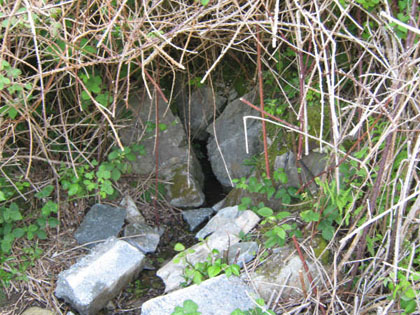
There isn’t a great deal to see of the ancient well close to the Doonen road, to the east of the lough, just an opening down amongst some rocks but, almost certainly in the past it would have been regarded as a place of pilgrimage and the water no doubt having healing properties due to the very fact that an early Christian saint was murdered here, indeed, according to the well-told legend St Ceannanach the son of an Irish king was set upon by a pagan chieftain from Bundowlish who was ‘greatly’ annoyed at the holy man’s fervent desire to spread the Christian message in his territory; where the saint was beheaded there was a stone which forever afterwards was stained with blood. However in recent times the bloodstone, as it was called, has been lost although local children used to try and find it! Legend also says that: after being martyred the saint picked up his severed head, washed it in the well, and then miraculously re-attached it to his body. The well is 2 feet wide and surrounding it a stone-wall some 4 feet high, while the well enclosure is 12 feet in diameter; its spring issues from deep between some rocks and, when it is flowing properly it forms a little stream or rivulet. In days gone by pilgrims performed the Stations of the Cross round the well on sundays, but more especially on the saint’s feast-day 10th March.

Cross-Slab (Photo credit: Fr

Cross-Slab (Photo credit: Fr John Musther)*

St Ceannanach’s 15th century church at Cartron (Irish grid reference: L 6479 5828) is now in a very ruinous state, with only two gables left and fragmentary walls in between, nature having almost taken over with trees and bushes growing where the congregation once sat. However in this state it looks quite romantic and even evocative. There were churches on this site before the present one, one of which was said to have been built by the saint himself, or maybe by his followers? The church was 60 feet in length and 20 feet in width, its wall being 8 feet high; the east gable is 15th century, while the west gable retains its twin-light windows and a circular feature above. Close to the ruins (12 metres northeast) there is an early Christian pillar-stone with a thin incised cross, dating perhaps from the 6th century? But the centre of Ceannanach’s missionary work was on the Aran Islands, especially at Inishmaan where he founded an oratory called Tempull Cannanagh (Cononagh), which is now a ruin, and, at Iararna (southeast point) of the Aran Islands, his gravestone can still seen. He is probably to be identified with ‘Gregory the Fairheaded,’ while ‘Gregory Sound’ beyond Cleggan is ‘thought’ to be named after him – alluding to another, or the same legend concerning the saint’s martyrdom.

Sources:

Previte, Anthony., A Guide to Connemara’s Early Christian Sites, Old Chapel Press, 2008.

*Photo Copyright: This work is licensed under a Creative Commons Attribution-NonCommercial-ShareAlike 4.0 International License

*http://www.earlychristianireland.org/Counties/galway/ballinakill/

http://www.megalithicireland.com/Ballinakill%20Medieval%20Church,%20Galway.html

http://oughterardheritage.org/static.aspx?idtxt=terms

Copyright © Ray Spencer, The Journal of Antiquities, 2014 (up-dated 2021).