The Journal Of Antiquities

Ancient Sites In Great Britain & Southern Ireland


Ring Stones Hill, Catlow, Nelson, Lancashire

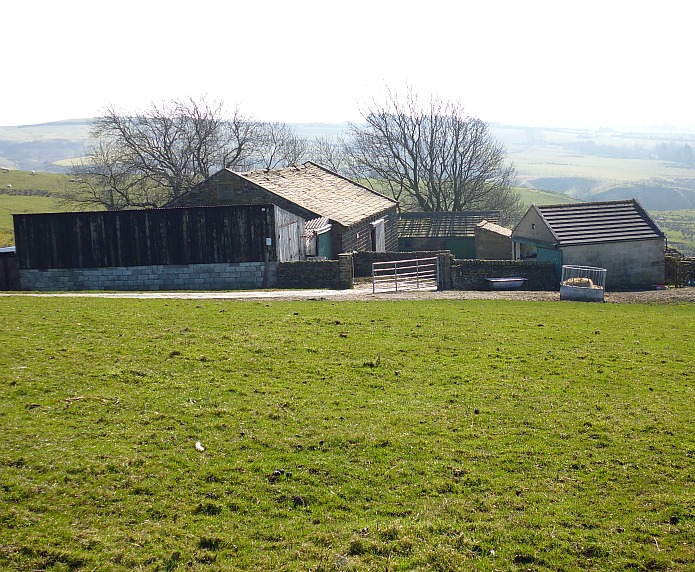
Ring Stones Hill Farm, near Catlow.

Ring Stones Hill Farm, near Catlow.

OS grid reference: SD 8933 3670. On the tops above Nelson, Lancashire, to the east and about halfway between Delves Lane and the hamlet of Catlow there is a farm called Ring Stones Hill, where up until about 1856 there stood a large stone circle, or maybe a cairn circle, but sadly there is no trace of this ancient monument today – the stones having been robbed-away to build walls and some perhaps incorporated into the out buildings of the farm. Nothing much has been recorded about this prehistoric stone circle, only the name survives. However, there may be stones belonging to this ‘now lost’ Bronze-Age monument in nearby walls, and one or two having being put into use as gateposts! Ring Stones Hill Farm, whose barn is ‘thought’ to be built over the stone circle, is situated roughly between Delves lane and Crawshaw lane to the south-west of Knave Hill. There is nothing to see, only fields, although on closer inspection there is a scattering of stones buried in the ground in a sort of circular fashion in the field just to the east, close to Pathole beck. Catlow is about half a mile from here along Crawshaw Lane, Walton Spire (Walton’s Monument), which is partly a Dark Age monolith, dating perhaps from the 10th century, stands just to the north, while the town of Nelson is 1 mile to the west.
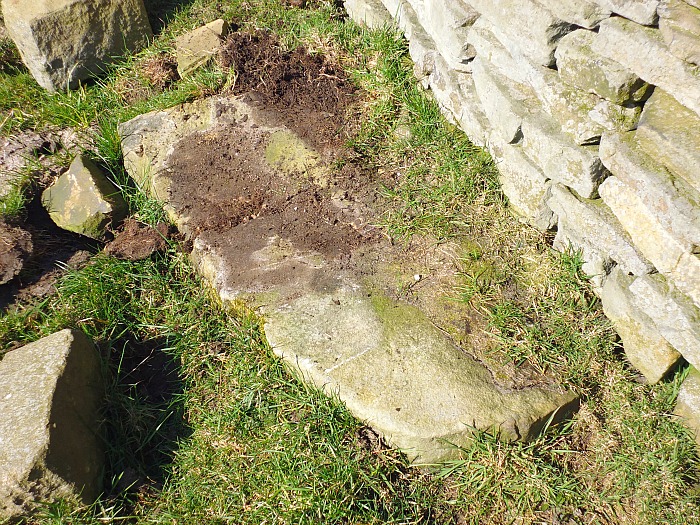
Recumbant Stone, near Ring Stones Hill.

Recumbant Stone, near Ring Stones Hill.

In the book ‘Historic Walks Around The Pendle Way,’ 1990, local authors John Dixon and Bob Mann give an interesting insight into Ring Stones Hill saying: “Nestled above Pathole Beck is the whitewashed farmstead of Ringstones Hill, a 17th century building displaying many fine mullioned windows. Up to around 1850 a large circle of stones stood next to the house, sadly the circle was dismantled when the present barn was built with only the name to give memory to the former monoliths.” A large stone on the ground below the wall-stile which gives access to the field from Delves lane is of interest. Could this be one of the stones that formed the stone circle? Maybe. Just to the right of this path on the shoulder of the hill there is a very faint earthwork of what is possibly an ancient burial mound. Authors John Dixon and Bob Mann mention this in their book ‘Historic Walks Around The Pendle Way’. They go on to say: “What could be a burial mound is sited in a field above the farm at SD 89263693. This is in the form of a small mound, 3m. in diameter.”
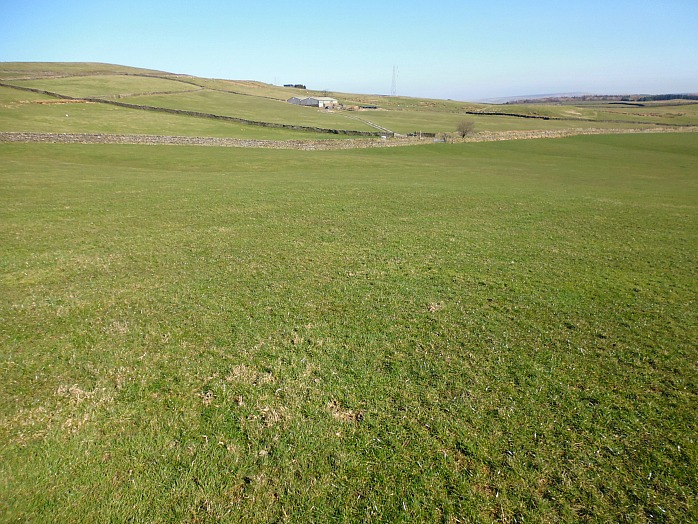
Site of burial mound near Ringstones Hill Farm.

Site of burial mound near Ringstones Hill Farm.

The origins of the name Catlow are somewhat confused. Cat could be an Old British word ‘catu’ meaning ‘war’ or ‘battle’, and similarly the Celtic word ‘catt’ also means ‘battle’, whereas ‘low’ is usually taken to mean mound or henge; so here we have ‘battle at or near the henge’. And ‘cat’ might also refer to ‘feral cats,’ oddly enough! Over the years there have been a number of archaeological finds in and around Catlow Quarries and also in the vicinity of the ancient hamlet. In 1854 two decorated cremation urns were dug up by quarry workmen, and in 1845, a Bronze-Age tanged spear or dagger was excavated in Catlow, and in 1954 a third cremation urn was discovered to the south of the quarries; these were of the Pennine type that are called ‘collared’ urns, dating from the middle to late Bronze-Age. There have also been a few finds of Roman coins in this area and also at Castercliffe, about 1 mile north of Catlow.

Sources:

Dixon, John & Mann, Bob., Historic Walks Around The Pendle Way, Aussteiger Publications, Barnoldswick, 1990.

The Northern Antiquarian:  http://megalithix.wordpress.com/2013/12/14/ring-stones-hill/

Copyright © Ray Spencer, 2014.
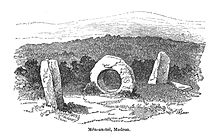

Men-an-Tol, Madron, Cornwall

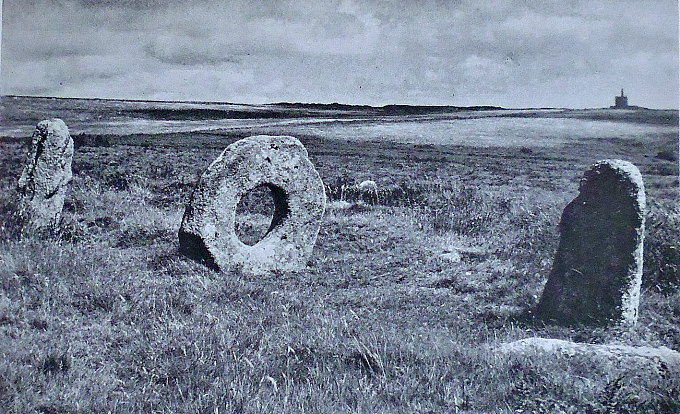
Men-an-Tol, Cornwall, by J.T.Blight, 1874. (Photo courtesy of Wikipedia)

Men-an-Tol, Cornwall, by J.T.Blight, 1864. (Photo courtesy of Wikipedia)

OS grid reference: SW 4264 3494. On the moors about halfway between Morvah and Madron, in Cornwall, stands the late Neolithic monument known as Men-an-Tol (the holed stone), with three standing stones and one now lying down, dating back to between 2,000-3,000 BC the late Neolithic to early Bronze-Age. This alignment of stones lies on a moorland footpath which branches off a track just to the west of the site. Here there is an alignment of three standing stones, the central stone (the Crick Stone) has a very large hole, while the fourth stone is recumbant; there may have been others here when the site was much bigger – quite a bit of the monument having been robbed-away over the centuries, prior to which it may have formed a circle of stones. Nearby, there are other prehistoric sites of interest. Madron village is 3 miles to the south-east, the town of Penzance is 3 miles to the south, and St Just is 4 miles to the south-west.

The three standing stones are all roughly 1.0 to 1.2 metres (3 foot 5 inches to 4 feet) high, the large ‘perforated’ hole in the central, round-shaped stone being 0.5 metres (1 foot 6 inches) in diameter (though Borlase, in 1749, says it is 1 foot 2 inches), and each stone is about the same distance apart (8-9 feet); the western-most stone was moved to its present position in the early 19th century and aligned with the others – along with the recumbant stone there are five or maybe six other outliers buried in the ground close-by, which make-up this circular ancient site, covering upto 18 metres (59 feet). To the south-east there are the faint earthworks of a cairn, its low mound just visible. Over the last two hundred years or so antiquarians have often ‘pondered,’ and been ‘rather puzzled’ as to whether these standing stones once formed a much larger stone circle and, some go even further, in thinking there was once a burial chamber or mound here, though today there are no signs of either of these, very sadly.

Men-an-Tol Standing Stones in Cornwall.

The holed-stone was obviously used for fertility rituals and, maybe even magic, and the pointed stones next to it being ‘phallic in shape’; this being borne-out through the folklore and customs of the locality and its people in ‘days gone by’. The well-known authors Janet and Colin Board in their book ‘Mysterious Britain’, 1984, say that: Many of these stones are supposed to be helpful in curing certain illnesses, and children were once passed through the Men-an-Tol when they were suffering from rickets. Stones with holes big enough to crawl through, and with similar beliefs attached to them, can be found all over the world. There may once have been some benefits to be gained from such customs, …….certain stones can hold powerful currents passing through the earth, could not the hole serve as a focus for this power, which would pass into the body of, and give renewed vitality to, anyone climbing through the hole?” Young people would come to the holed-stone in order to consult the stone (oracle) with regard to their future love life, and two pins would be placed like a ‘cross’ on top of the stone and then they would, hopefully, move in a certain way. “This was interpreted in answer to a question put to the stone,” according to Bill Anderton in his book ‘Guide To Ancient Britain,’ 1991. Young children with tuberculosis, rickets and spinal problems were passed through the holed-stone three times, while a ‘childless’ women would have to crawl through the hole nine times to receive a cure. After that, hopefully they were cured!

There are several other important prehistoric monuments close by, the closest to Men-an-Tol being Men Scryfa Standing Stone, half a mile to the north, and The Nine Maidens Stone Circle, 1 mile to the north-east. And 2 miles to the southwest is Lanyon Quoit.

Sources:

Bord, Janet & Colin., Mysterious Britain, Paladin Books (Granada Publishing Ltd)., London, 1984.

Anderton, Bill., Guide To Ancient Britain, Foulsham & Co. Ltd., London, 1991.

Darvil, Timothy., Ancient Britain (Glovebox Guide), The Automobile Association (The Publishing Division), Basingstoke, 1988.

http://www.megalithics.com/england/menantol/mentmp.htm

http://sacredsites.com/europe/england/men-an-tol_cornwall.html

Wikipedia  http://en.wikipedia.org/wiki/Mên-an-Tol

https://en.wikipedia.org/wiki/M%C3%AAn-an-Tol

© Ray Spencer, The Journal of Antiquities, 2014 (up-dated 2019).


The Bowder Stone, Rosthwaite, Cumbria

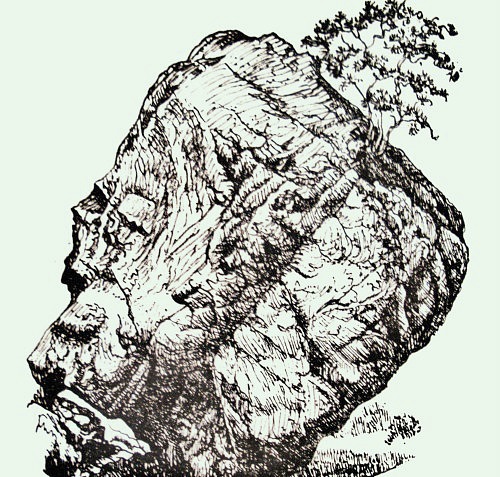
The Bowder Stone, Cumbria

The Bowder Stone, Cumbria

OS grid reference: NY 2540 1641. In the valley of the river Derwent, in Borrowdale, just north of Rosthwaite in a woodland clearing on the opposite side of the road from the river, stands a huge glacial boulder shaped like a human head that is one of several Cumbrian curiosities and, which has locally been called The Bowder Stone or Balder’s Stone, after the son of the Norse god, Odin (Woden). This ice-borne rock was carried down the valley by a glacier many thousands of years ago and deposited, having been trapped and then dislodged between the two side-slopes of the river valley. Today, the massive rock has become a tourist attraction and a photographer’s delight! And many antiquarian writers have travelled here to see the stone and maybe “try”and measure its height and girth, and to be amazed at this wonderous geological curiosity. The village of Rosthwaite is 1 mile south on the B5289 road and Grange is roughly one and a half miles north-west, while the town of Keswick is 5 miles in the same direction from here.

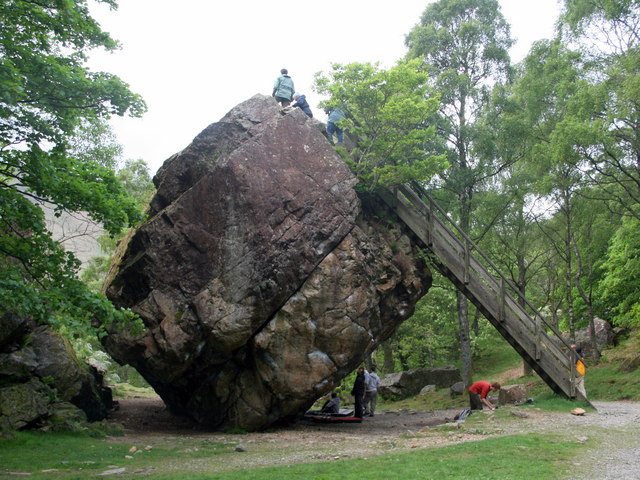
The Bowder Stone (Geograph)

The Bowder Stone (Geograph)

The Bowder Stone is 36 feet high (10.9 metres), 62 feet long (18.8 metres) and 90 feet (27.4 metres) in circumference, though ‘a few’ might, perhaps, argue with these approximate measurements! It is said to weigh somewhere between 1,970 to 2,000 tons, give or take a few! Geologically speaking the huge rock was brought to its present position by a ‘retreating glacier’ moving south from Scotland during one of a number of Ice Ages 12,00-15,000 years ago; this being a well-known fact because the rock is not from the local area, which is largely volcanic in its geological make-up. It is a free-standing erratic in that it does not touch the surrounding rocks, but simply balances and pivots deep in the ground beneath it. The rock is shaped like a human head, or several heads with faces – you can easily see a nose, eyes and mouth on at least three different parts of the stone if you look closely at it, indeed you might see more than three! A step-ladder allows access to the top of the stone where a good panoramic view can be had of the Derwent Valley and Upper Borrowdale; the various marks and holes in the stone have been made by climbers. There are other glacial erratic rocks close by, but none of them quite as big as The Bowder Stone.

The Ward Lock Red Guide (Lake District) 1975 sums up the rock quite nicely: “A mile from Grange Bridge and immediately beyond a large slate quarry is the famous Bowder Stone, a remarkable rock of prodigous bulk, which lies like a ship upon its keel.” And author Maxwell Fraser in his book ‘Companion Into Lakeland’, 1939, says: “The chief tourist site of Borrowdale is the curious geological feature, the Bowder Stone, a poised block of stone 36 feet high which is reckoned to weigh 1,970 tons.” In the great Arthur Mee’s book ‘Lakeland Counties’ we are told about one ancient curiosity of Borrowdale, Castle Crag, a nearby Iron-Age hillfort, and then the author goes on to say: “Another is the curious Bowder Stone, an immense boulder of about 2,000 tons……, which after rolling down the fell-side, has remained balanced on an edge so narrow that through a hole in it two people can shake hands”. According to tradition, two people holding hands through the opening at the bottom of the rock and then making a wish, shall have that wish come true.

Sources:-

Fraser, Maxwell., Companion Into Lakeland (Second Edition), Methuen & Co. Ltd., London, 1939. 

Mee, Arthur., Lake Counties, (Seventh Impression), Hodder And Stoughton Ltd., London, 1961.

‘Lake District’  Ward Lock Red Guide, (edt by Reginald J.W. Hammond), Ward Lock Limited, London, 1975.

The Illustrated Road Map Of England & Wales, The Automobile Association (AA), London, 1962.

Geograph  © Copyright Graham Hogg and licensed for reuse under this Creative Commons Licence.

Copyright © Ray Spencer, The Journal of Antiquities, 2014.


4 Comments

St Maughold’s Well, Maughold, Isle of Man

Click Photo  OS grid reference: SC 4961 9193. On the top of the headland overlooking the Irish Sea beside a footpath, 350 metres to the north-east of St Maughold’s churchyard, is the place of medieval pilgrimage called St Maughold’s Well or Chibbyr Vaghal, a pre-Christian spring that was adopted by a 5th century Celtic saint called Macaille, Maccald or Maughold, who was an Irish prince. To reach the well head east along the track to the lighthouse, but after 100 metres via off along the footpath in a northerly direction; keep on this path for 320 metres towards the headland (north side) and, on reaching a gate take the footpath in a south-easterly direction for a short distance to the well which, flows into an oblong pool beneath some rocks that jut out forming the surround at one side of the well, on the gorse-covered Maughold Headland overlooking the Irish Sea. The town of Ramsey is 2 miles north-west on the A2 road and Laxey village is roughly 6 miles south, also on the A2 road.

The sacred healing spring flows into a little pool beneath ancient rocks and, although it is said to be ‘a never failing-spring’, it does sometimes seem to stop flowing at certain times. This source of water issuing from deep in the ground once served a Celtic monastery, founded in the 5th century by the Irish saint, Maughold, who had come here in the footsteps of two of St Patrick’s disciples St Conindrus and St Romulus, to live on the headland after apparently trying to deceive St Patrick by placing a live man in a shroud, then asking St Patrick to come and revive him with a miracle, but the ‘evil deed’ did not work on the great Irish saint and so Maccald, a well-known outlaw and robber, became a Christian and was sent, as a penence, to live out his humble life as a hermit on the remote and rather windswept headland of the island. Legend says the well was formed (sprang forth) where his horse came ashore after it carried the saint over the sea from Ireland! There is a long flat stone beside the well which is shaped like a ‘chair’ and in more recent times it was indeed called St Maughold’s Chair, but whether this is the original stone chair is another matter because it was recorded recently that the stone had disappeared from the side of the well.

In the book ‘More Rambling In The Isle of Man’ the author Peter J.Hulme, 1993, informs us, interestingly, “That the spring may have been the work of men since among the unique collection of Christian monuments (housed at St Maughold’s church in the village) of the period is one reading “Bramhui led off water to this place.” So although the spring was already there, could it be that the monastic community here somehow managed to divert the spring – Bramhui perhaps being the monk whose idea it was?

The water used to have healing qualities according to the authors Janet & Colin Bord in their brilliant book ‘Sacred Waters’, 1986. They go on to say that: “women wishing for offspring would drink the water of St Maughold’s Well and sit on the saint’s chair close by”, and the well had its full virtue “only when visited on the first Sunday of harvest, and then only during the hour the books were open at church (ie when the priest was saying Mass)”. They also say: “Its water was believed to cure many ailments, including sore eyes and infertility. Barren women would sit in the ‘saint’s chair’ nearby and drink a glass of the well water. Pilgrims would drop a pin, bead or button into the well before leaving”.

And the author William Bennet in his work ‘Sketches of the Isle of Man,’ 1829, says of the well: “most celebrated in modern times for its medicinal virtues is the spring which issues from the rocks of the bold promotory called Maughold Head, and which is dedicated to the saint of the same name, who, it appears, had come upon the well and endowed it with certain healing virtues. On this account is is yet resorted to, as was the pool of Siloam of old, by every invalid who believes in its efficary. On the first Sunday in August, the natives, according to ancient custom, still make a pilgrimage to drinks its waters; and it is held to be of the greatest importance to certain females to enjoy the beverage when seated in a place called the Saint’s Chair, which the saint, for the accommodation of succeeding generations obligingly placed immediately contagious persons”.

St Maughold became bishop of the island, succeeding St Conindri and St Romulus. He died in 488 or 498 AD. He was also, apparently, a missionary in Scotland and Wales – indeed in Wales he goes under the name St Mawgan – if that’s correct then it would appear that the penence afforded to him by St Patrick did not come to complete fruition!

Sources:

Bord, Janet & Colin., Sacred Waters, Paladin (Grafton Books), London, 1986.

Hulme, Peter. J., More Rambling In The Isle Of Man, The Manx Experience, Douglas, Isle of Man, 1993.

Bennet, William., Sketches of the Isle of Man, London, 1829, p.65.

The Ancient And Histotric Monuments of the Isle of Man, The Manx Museum And National Trust, (Fourth (Revised) Edition, Dublin, 1973.

Photo courtesy of Pinterest  http://www.pinterest.com/pin/531635930983947437/

https://www.gov.im/mnh/heritage/story/Image.gov?id=3959


The Bull’s Stone, Ballymacnab, Co. Armagh, Northern Ireland

Irish grid reference: H8903 3855. Close to the junction of the Ballymacnab road leading off the B31 Newtownhamilton road there is a small standing stone, or perhaps what could be a carved stone or part of a cross-head, locally called The Bull’s Stone. This odd-shaped stone was once much bigger, but sadly it has been damaged and pieces of it robbed away over the centuries. Today a monument has been erected with a bull (guardian of the stone) sleeping contently! Legend associates the stone with St Patrick, patron saint of Ireland, and his pet bull that had frequently annoyed him whilst he was trying to build his church. The place where the stone now stands, in a little garden area, is referred to from “legend” as ‘The Bull’s Track’, a local landmark. The small round-shaped stone still has the imprint of a bull’s hoof on it, if that’s what it really is? Ballymacnab is in the parish of Collene (Cill Chluna), and Armagh city is 7 miles to the north on the B31 road. The Seagahan Dam which harnesses the power of the river Callan is 900 metres to the south.

Unfortunately, nothing much is known about the age of the stone or its history, apart that is, from what we know of the myth and legend associated with it and St Patrick’s involvement back in the mid 5th century AD – in particular from the renowned Irish poet and author Thomas George Farquhar Paterson (1888- 1971) in his book ‘Notes’, Vol 1, 1940 and again in his more recent work ‘Harvest Home’, ‘The Last Sheaf’, 1975. Obviously these folktales are from an earlier time. The Bull Stone may and I “stress” may have been a prehistoric standing stone, or perhaps a stone deposited by glaciers thousands of years ago? Unfortunately we don’t know.

The “legend” is related that St Patrick on his way north to Armagh decided to build a church at a place today called Armagh-Breague. However, every time he began work to build it he was thwarted by his bull, and had to leave quite quickly! On the third occasion it once again stopped him from doing any building work, but the saint was also now very angry and had made his mind up to deal with the creature. We are told that he hurled or tossed the bull from Armagh-breague Mountain which is near to Newtownhamilton; the unfortunate creature landed several miles to the north where it struck or collided with a large stone, the marks left by its hooves clearly plain to see, even today. After that the bull did not trouble St Patrick and he was able to build his church, though not in the place where he had intended. There is a more modern Roman Catholic church dedicated to him just a few hundred yards up the road from the stone at Ballymacnab, which now stands upon the site chosen by the saint’s bull!

What we do know with certainty is St Patrick came to Armagh in 445 AD and here built his most famous church, today Armagh Cathedral stands on the site of that foundation, afterwhich the saint was made Archbishop of Armagh. For the next 20 years until his death in 465 St Patrick continued to build churches and monasteries and evangelise throughout much of Ireland, spreading the ‘word of God’ wherever he went.

Sources:

Paterson, T.G.F., ‘Notes’, Vol 1, PSAMI, 1940, 71.

Paterson, T.G.F., ‘Harvest Home’, ‘The Last Sheaf’., (ed. E.E.Evans), 1975.

Google Map (please adjust)  http://irish.gridreferencefinder.com/gmap.php?lt=54.288115&lg=-6.6334539


St Brynach’s Church, Nevern, Pembrokeshire, Wales

 Nevern Cross (After Westwood)

Nevern Cross
(After Westwood)

OS grid reference: SN 0834 4002. Situated in the very pretty and largerly unspolt village of Nevern (Nanhyfer), between Cardigan and Fishquard, is the cruciform-shaped St Brynach’s Church, standing proudly in front of a large tree-covered mound where, long ago, early Welsh chieftains and, later possibly Norman barons, lived in a fortifified stronghold, or castle, from the mid 6th century to the early 12th century; and where beside the Caman brook the Celtic monk, Brynach, came to build his monastery at the beginning of this period which, historians often call the Dark Ages. St Brynach, an Irishman, became a friend of St David. Here we see the beautifully carved Celtic churchyard cross and an inscribed memorial stone and, there are two other ancient stones, indeed inscribed stones from the the 5th or 6th century AD housed inside that are well worth a look at because of what they can tell us about this sacred and holy site, all making for a fascinating little collection of Dark Age antiquities. The churchyard has an avenue of ancient yew trees, and just a short walk south from here we can see the famous Pilgrims’ Cross and stone at the side of the River Nyfer. The A467 is 1 mile south of Nevern, while the village of Newport is 2 miles to the south-west and Fishguard is a further 5 miles in the same direction. Cardigan is 9 miles to the north-east.

Maglocunus Stone (After Macalister), 1945.

Maglocunus Stone (After Macalister), 1945.

There was quite probably a monastery here c 540 AD, and maybe even some sort of ecclesiastical centre, but then in the 12th century a Norman church was built on the site, today only the tower of that building remains, the rest being from the 14th and 15th centuries onwards through to 1864 when restoration took place. The nave has a stone vaulted roof. Two flat stones acting as windowsills in the south wall of the nave are quite interesting, one in particular, from the 10th century, is quite unusual. It is 62 inches long and has an intertwining cord carved onto it (in relief) that forms a Celtic-style cross – though there is no inscription on this. The other stone has a Latin inscription in memory of Maglocunus (Clechre) who has been identified with St Clether, son of king Clydwyn of Carmarthen – who lived in the fortification behind the church in the early part of the 6th century and was a relative of St Brynach, who died in 580 AD and was also the founder of a church at Braunton, in Devon. Legend says that St Brynach used to climb to the top of Carn Ingli, an Iron Age hillfort 2 miles to the south-west, in order to converse with angels.

The Latin inscription is MAGLOCVNI FILI CLVTOR – ‘The Stone of Maglocunus son of Clutorius. Some historians think Maglocunus was the famous Maelgwyn (Maelgeoun), king of Gwynedd, though this is very uncertain. There are also Ogham notches on the front edge of this stone – giving a similar pronouncement, so no doubt there is an Irish (Goidelic) connection here; these two stones are thought to have come from the churchyard – they are now preserved from the elements of wind and rain, something quite common in this part of south-west Wales! In the Chancel there is a photo of an old stone that went missing. It was 10 feet long by 3 feet wide and had a Greek cross inscribed on it, “an early relic of British Christianity”, according to the church guidebook of 1980.

The Vitalianus Stone, Nevern.

The Vitalianus Stone, Nevern.

Outside the church at the east side of the porch stands the 5 foot (1.5 metre) high Vitalianus Stone, a Romano-British gravestone from the 5th century AD that has a faint Latin inscription in memory of VITALIANI EMERETO – ‘The stone of Vitalianus discharged with honour.’ Again, there are Ogham-script notches on the edge, making this a bilingual inscription. According to the author Chris Barber in his book ‘More Mysterious Wales’ Vitalianus is Vortimer, the son of King Vortigern and, says Barber: “and it is feasible that it is his memorial stone that can be seen here at the church of St Brynach”.

St Brynach's Cross, Nevern.

St Brynach’s Cross.

At the south side of the church stands the famous Great Cross of St Brynach. This lovely carved cross is 13 feet tall (3.9 metres) and 2 feet (0.9 metres) wide, and is thought to date from the 10th or 11th century AD. It is from the top of this cross that, according to ‘tradition,’ the first cuckoo of the Spring perches and sings its heart out on the saint’s feast day 7th April, and no doubt it does without failure every year! The cross is “superbly” decorated with all manner of Celtic pattern-work inside sections of various sizes; there is “a differently arranged ribbon, the endless interlacing symbol of eternity”, according to the church guide book. There is knotwork, cord-plaitwork, fretwork, ring-work and Greek swastika and diagonal key-patterning, with geometric designs on all four sides, possibly Scandinavian, rather than Celtic. Both faces E.W. have a small panel with alphabetical-type inscriptions, which are recorded as: dns (dominus) and haneh (halleluiah), and also on the east face two primitive-style crosses with long, angular arms. The cross-head is a ‘separate’ part to the rest and is a typical five-holed wheel-head, quite common in Wales. On the outside north wall of the church a fragment of stone, acting as a windowsill, has a broken Latin inscription TVMIM in memory of someone called Tumin or Tuminius? while a faint consecration cross can be seen on the east wall of the Glasdir Chapel.

An avenue of ancient yew trees forms the pathway up to the church. One of these bleeds red sap from a broken branch; this apparently signifies ‘unrequited love‘. Local legend says the red sap (resin) will continue to ooze from this tree until ‘the castle on the hill is once again occupied by a Welshman’. Another legend says that a monk from the early Celtic monastery was hanged from the yew tree, which may mean these trees were here before the present-day church! About 1oo yards to the south-west of the church, along a footpath beside the river Nyfer leading off the Frongoch road, in the direction of Glandwr is the famous Pilgrims’ Cross built into a rock face and, below that a ‘very’ well-worn stone bearing a small incised cross. These mark the pilgrimage route between Holywell and St David’s – Nevern being one of the places where medieval pilgrims would stop, and kneel down to say prayers, before continuing on their long, arduous journey to where St David, patron saint of Wales, lay buried.

Sources:

Barber, Chris., Mysterious Wales, Paladin (Grafton Books), London, 1987.

Gregory, Donald., Country Churchyards in Wales, Gwasg Carreg Gwalch, Capel Garmon, Llanrwst, Gwynedd, 1991.

Allen, J. Romilly., Early Christian Art In Wales, Archaeologia Cambrensis, 5th series, vol xvi, 1899.

Bryce, Derek., Symbolism Of The Celtic Cross, Llanerch Enterprises, Felinfach, Lampeter, Dyfed, Wales, 1989.

Macalister, R.A.S., Corpus Inscriptonum Insularum Celticorum, Vol 1, Dublin, Ireland, 1945.

http://sitesandstones.blogspot.co.uk/2009/02/church-of-st-brynach-nevern.html

Spencer, Ray., Historic Places in Wales – An Exploration of the Fascinating and Mysterious, (Unpublished Manuscript), Nelson, Lancashire, 1991.

Copyright © Ray Spencer, The Journal of Antiquities, 2014 (updated 2025).


Bleasdale Circle, Bleasdale, Lancashire

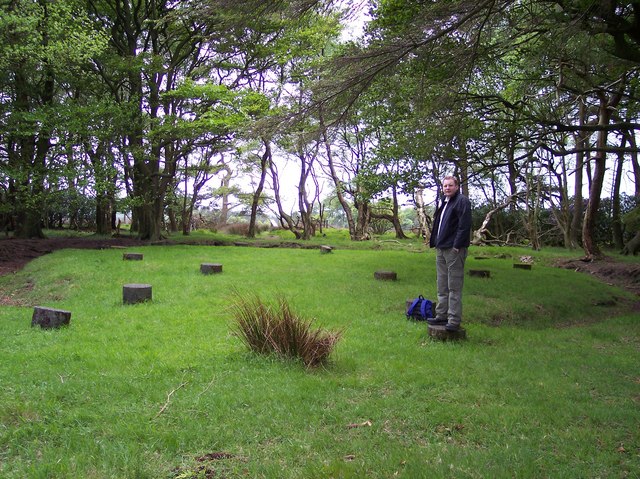
Bleasdale Circle (Geograph)

Bleasdale Circle (Geograph)

Os grid reference: SD5770 4600. High up on the peat and moss-covered Bleasdale Fells in north Lancashire, in an enclosure of trees (at Edmarsh) stands the famous Bleasdale Circle, or in fact, a circle of 11 concrete posts marking out where a circle of timber posts used to be and, which is also referred to as a ‘henge monument’, at the centre of which was a mound with a burial inside. Located about half a mile north of the tiny village of Bleasdale, this prehistoric monument requires a good climb up onto the fells from the nearest country lane at Vicarage farm to the west, or from near Church wood, a mile or so to the south.

Although there isn’t much to see here today it’s well worth checking out the place to look at the circular earthworks of bank, ditch and the squat concrete posts that tell us where the ‘ceremonial’ wood-henge once stood; some more recent wooden posts rotted away in the early part of the last century. The circle was first discovered back in 1898 and excavated within the next year and, re-excavated in the early 1930s by a more localised archaeological team; and so the site has been dated at somewhere between 2,200 to 1,500 BC – the early Bronze Age. We now know that an “early” tribal community settled, lived, and died here on the bleak and isolated fells of Bleasdale, a name which is derived from the Old Norse for ‘blesa’ meaning blaze or light spot, according to W.R.Mitchell in his book ‘Bowland And Pendle Hill’. Garstang is roughly 5 miles to the west, while the village of Chipping is 4 miles to the south-east following Chipping Brook for the last few miles.

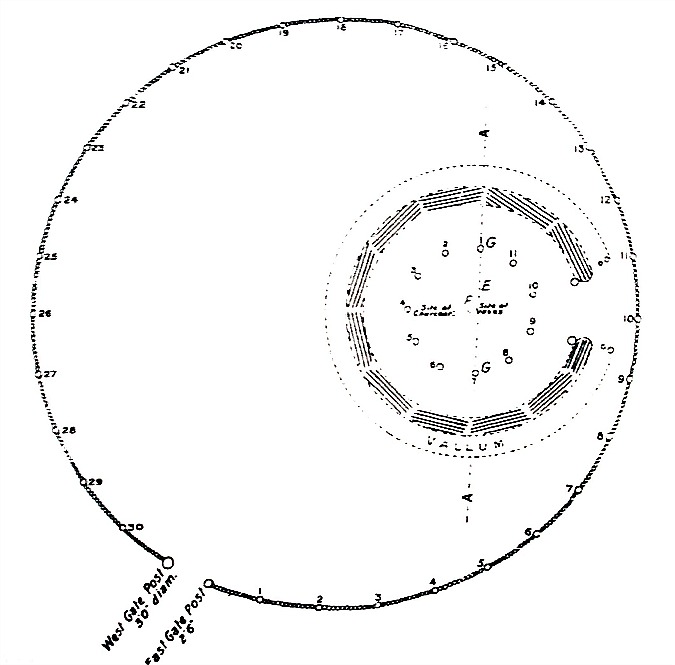
The henge site covers an area of 50 metres by 40 metres (south to north) with the much small inner circle roughly 17 metres by 20 metres (36 ft diam) at the eastern side, with funery mound 3 feet high, which was surrounded by a single-causewayed ditch (3-5 ft) floored with birch poles 10-20 cm in width, according to the authors John & Phillip Dixon in their book ‘Journeys Through Brigantia’ (The Forest of Bowland), Volume 8. Here 11 concrete pillars mark out where originally large oak posts would have formed a circle upon the mound, with an avenue of three poles on each side across the east-facing causeway, according to John & Phillip Dixon.

Inside this mound (at the centre) a stone-lined chamber (cist) was discovered containing two 21 cm high decorated collared pottery urns, of the Pennine type, which would have once held the ashes of those buried here; one of the urns having a little pottery pigmy cup inside it!  These urns could, therefore, be amongst the oldest collared urns found in Britain. John & Phillip Dixon go on to say: “the above circular feature was  surrounded by a palisade consisting of 22 large oak poles 8m. apart, between which were smaller diameter posts”. The larger, outer circle had a double entrance at the east-side some 7 metres across, with a smaller entrance at the south-side 5 metres across. Within the large outer circle there were a number of small dwelling places or huts 3-4 metres across, although these were at some point destroyed by fire, leaving only the burnt patches in the soil. These roofed-over dwelling huts with central posts would have been earthen constructions made, probably, of dung and clay.

Bleasdale Circle (plan)

Bleasdale Circle Plan (Syd Wilson, 1900)

In his book The Buildings of England – North Lancashire, Nikolaus Pevsner, sums the place up quite smartly: “The site consisted of a small barrow beneath which was a grave containing two cremations in collared urns and an incense cup. The structure was surrounded by a ring of eleven posts (now marked by concrete pillars) with outliers forming an entrance on the E, and these in turn were bounded by a ditch. This group was surrounded by a timber palisade (not visible on the ground) 150 ft in diameter, with an entrance on the SW”.

Some of the artefacts from the excavation at Bleasdale were later displayed at the Harris Museum in Preston. Please make your own mind up about the display, once you have seen it!

Kathleen Eyre (1979) writes about the Bleasdale Circle. She says: “The spectacular discovery of the Bleasdale Circle was made during excavations on land belonging to Fairsnape Farm at the end of last century. Cinerary urns, containing human ashes, were discovered two feet below ground. The pottery was identified by archaeologists as belonging to the Middle Bronze Age (2,500-750 B.C.). The Circle was probably connected with some primitive form of worship in which the rising sun was part of the ritual.”

Sources:

Dixon, John & Phillip., Journeys Through Brigantia – The Forest of Bowland, Aussteiger Publications, Barnoldswick, 1992.

Mitchell, W.R., Bowland And Pendle Hill, Phillimore & Co Ltd., Chichester, West Sussex, England, 2004.

Pevsner, Nikolaus., The Buildings of England – North Lancashire, Penguin Books, Harmondsworth, Middlesex, England, 1979.

Eyre, Kathleen, Lancashire Legends, Dalesman Books, Clapham, North Yorkshire, 1979.

Top Photo of Bleasdale Circle  © Copyright Raymond Knapman and licensed for reuse under this Creative Commons Licence.


Coal Bank Mill, Ashworth Valley, Norden, Greater Manchester

Washwheel Mill Ruins, Ashworth Valley, Rochdale

Coal Bank Mill Ruins, Ashworth Valley, Rochdale

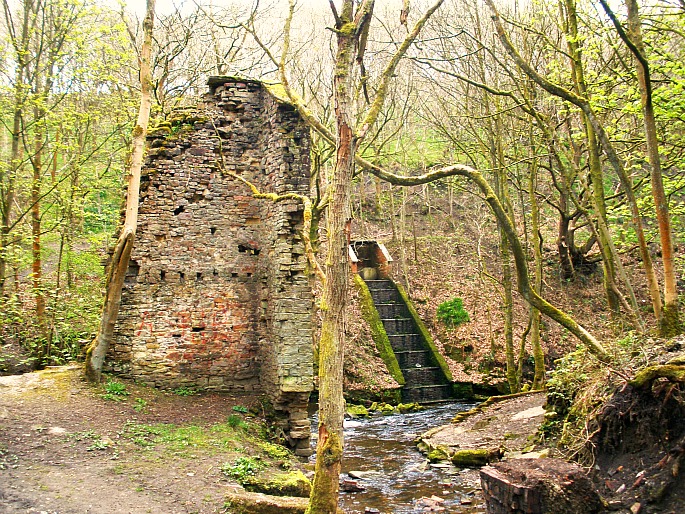
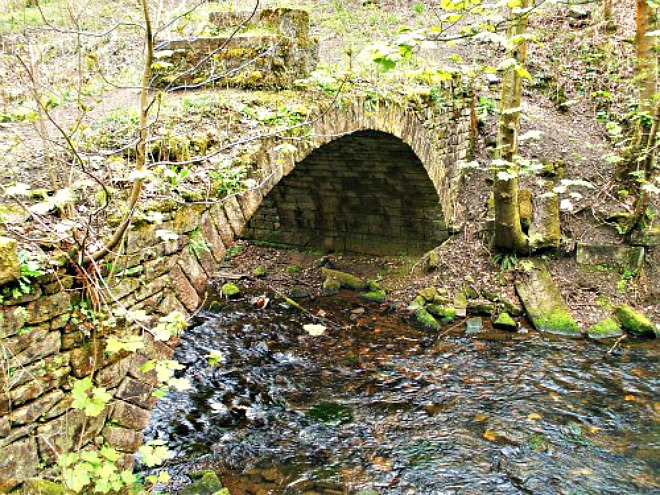
Os grid reference SD8559 1416. The site of what was once a thriving industrial place known as the Coal Bank Mill, in Ashworth Woods at Wolstenholme Fold – through which the Naden Brook flows, in what is now a very picturesque place hidden deep inside the Ashworth Valley, near Norden, Rochdale, where old industrial ruins merge in with the flora and fauna – as if in some way time has stood still, even though the industrial revolution and Coal Bank mill have been almost obliterated from what is now a “very” tranquil and secluded place. This is one of my favourite places from my days at school, a long time ago now, but still so many memories.

.

Coal Bank Mill (ruins)

Coal Bank Mill (ruins)

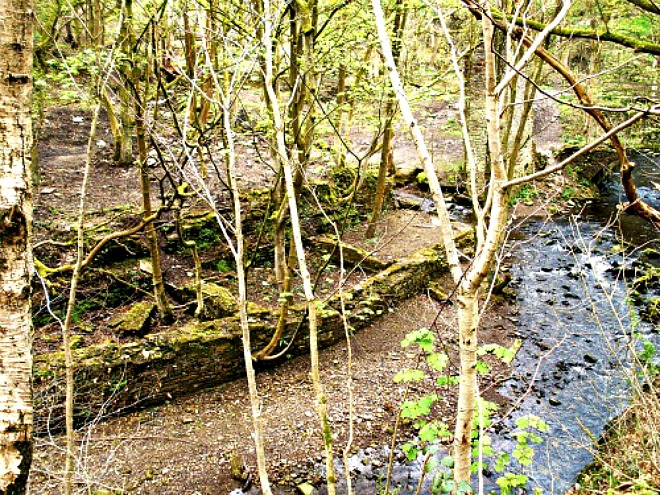
To reach the site go to the top of Norden road in the village of Bamford. Turn left onto Clay Lane for about half a mile, then at the electricity substation turn sharp left again. Go along Fairburn Lane keeping to the right and head down into the little valley where the bridge goes over the brook, then just up the hill after the bridge follow a footpath that heads off to the right. Walk along this track, the former tramway, through the woods beside the steep-sided bank, below which the Naden brook flows. Follow this fairly straight path for half a mile until you reach a modern curved, wooden bridge. You can also reach the site from Norden bus terminus, then following the brook south past the new housing devolpment and, past the tall Black Pits cotton-mill chimney, one of very few in this area still standing. Here the little stream from the hillside above called Mill Croft flows into the larger Naden brook in Ashworth Woods (actually part of Carr Wood) at a place known locally as Coal Bank, which is now a ‘landscaped’ area for walkers and picnickers alike, but which was once back in the industrial past a place of mills, chimneys, small coal pits (diggings), cotton-spinning, paperworks, dye and bleach works, all of which were ‘very’ reliant on the Naden brook. The town of Rochdale is just 2 miles from here on the A680 through Norden.

.
Coal Bank mill (ruins)

Coal Bank mill (ruins)

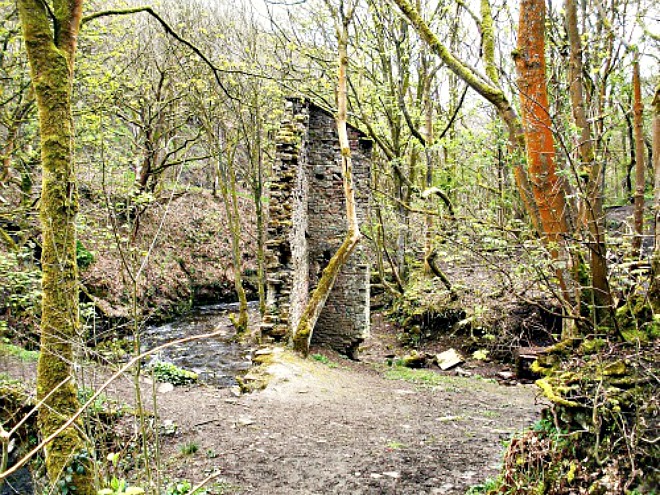
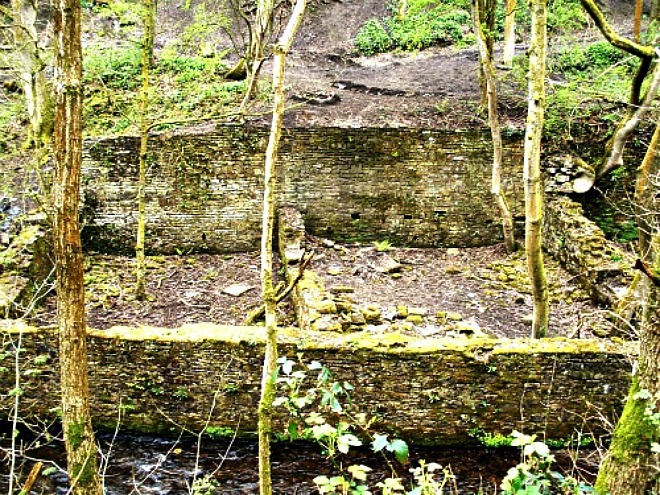
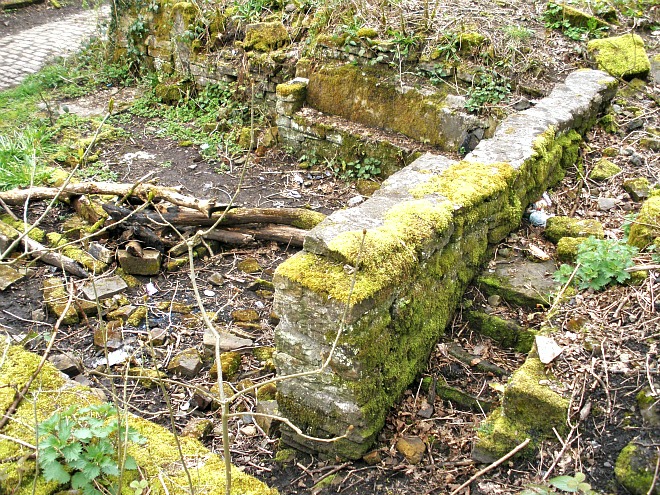
Here at Coal Bank we reach the site of what was Coal Bank Mill situated beside the Naden brook and, although the cotton-mill-cum-paper-mill has been almost obliterated – if you look closely you can still find the ruins of this one-time industrial enclave, a little bit of the Industrial Revolution hidden away in this wooded valley, near Rochdale, thanks in many ways to the great Ashworth family and, others, who owned the land around here. In the late 18th or early 19th centuries the place began life as a cotton-spinning mill (probably a fulling mill) but then in the 19th century the mill became a paper/printing works. In the early years of the 20th century the mill closed down for good. Much of the mill was then pulled down and great quantities of the stonework taken away. Part of a wall still stands as do the foundations of several buildings at either side of the walkway, including what was the lodge; there are also some nicely built stone bridges and lumps of old rusting ironwork! and also a few remnants of what looks like a water-wheel, or something similar? *In Grace’s Guide directory Coal Bank is described as a bleachers and dyers in the ownership of Richard Bell (1891).

.

Coal Bank Mill (ruins)

Coal Bank Mill (ruins)

The Coal Bank mill chimney with its “open” square-shaped flue was demolished in 2006 and the site levelled and landscaped in order to make new pathways and modern wooden bridges, making a nice place to stroll and enjoy one’s-self in this, now, peaceful place. But the ghosts of the many hundreds of workers, both adults and children, who toiled here in the past seem to be still present in this isolated, haunted valley; indeed it seems those workers, horses and loaded carts, are still treading the same cobbled pathways to the old mill; and if you’re very quiet you can still hear them…… well I think you can!
.

Coal Bank Mill (ruins)

Coal Bank Mill (ruins)

There are the ruins of other cotton-spinning mills (fulling mills) and Calico print mills further to the west near to Turn Village, beside the Cheesden brook, all quite evocative now and one might say, romantic looking. The ruins of Washwheel Lower Wheel mill, Deeply Vale mill, Deeply Hill; and also other spinning mills at Longlands, Cheesden Lumb mill, Cheesden Pasture mill, Croston Close mill, Four Acre mill and, further to the south Birtle Dene mill, New Birtle and Kershaw Bridge mills, are discussed at length along with a history of these cotton mills in the delightful book ‘The Forgotten Valley’ by A.V.Sandiford and T.E.Ashworth. The ruins at Cheesden Lumb mill were excavated by archaeologists from Manchester back in the 1990s, but nature is catching up and the ruins of these old mills are gradually giving way, sadly, to the rain and gales that frequently batter this part of north-west England. A way of life has now gone.

.

Coal Bank Mill (ruins)

Coal Bank Mill (ruins)

Sources:

.

Sandiford, A.V., & Ashworth, T.E., The Forgotten Valley, Bury and District Local History Society, 1981.

.
And, also my memory…….!


Inveryne Standing Stones, Argyll And Bute, Western Isles, Scotland

OS grid reference: NR 9156 7496. In a field some 200 metres from the shoreline of Auchalick Bay in the west Cowal region and the parish of Kilfinan, Argyll and Bute, are three prehistoric standing stones known as the Inveryne Standing Stones or Auchalick Standing Stones, which are in fact a stone row, an alignment of shaped and jagged stones placed here 4,000 years ago. To reach these stones you need to come off the B8000 road about halfway between Kilfinan and Portavadie and ‘trek’ up a steep track passing Corr Mheall and then towards Inveryne farm – there are a number of other footpaths that lead in the same westerly direction but, be prepared for a long, arduous walk. The standing stones are approx 800 metres south-west of the farm, just to the north of Tigna Cladaich house. You can also reach the site from Melldalloch further to the east. Lochgilphead, the nearest town, is 8 miles to the northwest across Loch Fyne.

In the corner of a field near the footpath and a wooded area are three standing stones in a row looking rather forgotten and lonely in this rugged windswept landscape overlooking Loch Fyne and, in the distance the town of Tarbert. According to Canmore RCAHMS site no 39914 (1988) the three slabs vary in height and shape. The first stone at the north-east side stands at 0.75m (2ft 5) high and is straight-sided with a rounded top; the central stone is 0.95m (3ft 1) high, mainly rounded in shape with a natural depression, and the third south-westerly most stone is 1.05m (3ft 6) high and has a jagged top with slanting sides. A fourth stone, which is rarely mentioned, lies recumbent and abandoned on the ground close by. There may have been other stones forming this alignment and, if that’s the case, these must have been robbed away?

I don’t know why these ancient stones are standing in this windswept location, unless they are in some way connected to a cup-marked rock to the northeast, at OS grid reference NR9217 7578, which can be found beside the footpath to Inveryne farm, southwest of Corr Mheall and the B5000 road. There are other standing stones and ancient burial sites in the Cowal region, and, also over on the Isle of Bute.

Sources: Canmore RCAHMS  http://canmore.rcahms.gov.uk/en/site/39914/details/inveryne/

Cowal and Bute Essential guide 2012, E & R Inglis Ltd., Dunnon, Argyll and Bute, 2012.

The Megalithic Portal  http://www.megalithic.co.uk/article.php?sid=1984&m_distance=0.0

Copyright © Ray Spencer, The Journal of Antiquities, 2014.


2 Comments

Gokewell Priory, Broughton, North Lincolnshire

Gokewell Priory Farm (

Gokewell Priory Farm (*Copyright, see below)

OS grid reference: SE 9402 1028. Roughly ½ a mile east of the Appleby Frodingham steelworks (Scunthorpe) and about halfway between Broughton and Santon, in north Lincolnshire, is the ‘lost’ hamlet of Gokewell with the scant remains and earthworks that are all that is left of the small religious house of Gokewell Priory, covering up to 1 acre of land. Standing just a little to the north “was” Gokewell Priory Farm (now demolished*) around which there are some very scant stone foundations, earthworks, ditches and ponds, all that is left of the medieval priory that housed Cistercian nuns between the late 12th and the early 16th centuries. The site now lies in the parish of Broughton, and an area of bushes marks the site where the farm used to stand.

The hamlet of Gokewell is virtually gone. Of the site itself there is little remaining today, while all around it there are ploughed fields that are usually covered in crops during the summer months but, there are footpaths around the periphery of the earthworks and, Santon Wood is just a short distance to the north – otherwise the priory earthworks are for the ‘most part’ on private land. The village of Broughton is 1 mile to the south-east on the B1207 (Appleby Lane) which is, in fact, the course of the Roman road Ermine Street; the Roman road itself runs straight through the village centre. There was a holy well at Gokewell called Nun’s Well, but the site could date back to the Dark Ages or to pre-Christian times?

The small priory with a school-room for poor children was ‘probably’ founded in 1185 by William de Alta Ripa but, it’s possible that it was founded a little earlier in 1148; there were three other local benefactors who also gave ‘money’ for the establishment of the religious house, which was run by Cistercian nuns, with the first recorded prioress being a noblewoman called Avice (1234). From what we know, and its not very much, the priory never had much money (for its up-keep) and at any one time there was never more than ten or eleven religious sisters here and, even less on some occasions; at the Dissolution in 1536, only seven sisters remained! The sisters would have lived a “very” spartan life, with a life of prayer and penance, and besides that very little in the way of food, apart from fish from their ponds (still to be seen today), and foodstuffs given to them by local people, their clothes were bought by their own families. However, they did take in ‘poor’ children, mainly boys under the age of eight and girls under ten years. The rector of Flixborough was their steward but they were always much in debt to him; however a number of northern bishops found the house to be ‘in good order’ and offered their protection against local thieves and troublemakers. We know that the yearly revenue of Gokewell priory never exceeded £10!

In 1536 the priory of Gokewell was abandoned, seemingly without any fuss, and the sisters dispersed to the locality, while the last prioress Anne (of) Castleford was given an annual pension of £4 and was still living in 1553. But it seems the prioress was not highly thought of by the younger nuns, in deed they took no notice of her and even apparently referred to her as ‘a simpleton’; she also failed in her ability to discipline the nuns. Eventually the stonework from the priory was re-used in the building of the nearby Priory Farm; much of this carved and dressed stonework ‘could’ still be seen in the farm’s walls and its out-buildings (*the farm has long since been demolished). The land where the priory stood was flattened for farming purposes; however one large round-shaped fish-pond remains and a few smaller ponds can be made out, along with ditches, earthworks and ‘lumps and bumps’ beneath which, scant stone foundations remain.

The place name ‘Gokewell’ is derived from “Gawk” or the Anglo-Saxon name gawkr meaning cuckoo or fool! which refers to a holy well Gawkr’s Well (Cuckoo Well), probably a pre-Christian spring that was eventually renamed ‘Nun’s Well’ after the religious sisters who came to live here at the end of the 12th century, but whether it ever had any curative properties, we don’t really know, though I suspect it did. A bit of searching around and you may still be able to find the well, though it could now be dried up? Abraham de la Pryme (1671-1704) the Yorkshire antiquarian writing in the 17th century calls it Nun’s Well and remarks: “And this day I went to Gokewell, formerly called Goykewell, which was a nunnery. It seems to have been a most stately place. The walls has compassed in betwixt twenty and thirty akers of ground. They shew’d me a little well, which by tradition, was once very great and famous; this they called Num’s Well. It has run straight through the midst of this ground, being a great spring, and it fed the all house with water, and several statues or water fountains in the courts and gardens.”

Footnote:- My Great-Great-Great-Great Grandparents Thomas and Rebecca Spencer lived at Gokewell Priory Farm from 1815-25, after which they moved to Messingham. Thomas died in 1863 and is buried in the cemetery there.

Sources:

British History Online  http://www.british-history.ac.uk/report.aspx?compid=38014

Page, William., A History Of The County Of Lincoln, Volume 2, pages 156-7, 1906.

Pryme, Abraham de la., Ephemeris Vitae: A Diary of My Own Life, Vol 54, Surtees Society, 1870.

*Photo: © Copyright Robert Reynolds and licensed for reuse under this Creative Commons Licence.

My sincere thanks go to Ross Parish for his very valuable information on Gokewell, the place name, and the holy well. Please take a look at his web blog for more holy wells in Lincolnshire  http://insearchofholywellsandhealingsprings.wordpress.com/tag/lincolnshire/

Copyright © Ray Spencer, The Journal of Antiquities, 2014.


Carew Cross, Pembrokeshire, Wales

Carew Cross (After J. Romilly Allen)

(After J. Romilly Allen)

OS grid reference: SN 0467 0370. At the east side of Carew’s ‘mighty’ medieval castle, close to Bird’s Lane, in the little village of Carew, near Sageston, stands the 4 metre-high Carew Cross, a truly magnificent Celtic ‘high’ cross that dates from the 11th century, which is carved with some quite stunning patterns and designs that are similar to those found on crosses in southern Ireland and the Isle of Man and, there is a memorial inscription in memory of a Welsh prince. The Carew cross is very similar in many respects to the churchyard cross at Nevern, also in Pembrokeshire. Carew is 6 miles west of Tenby on the A4075, not far from the Milford Haven estuary and Pembroke Dock. The nearest parish church to the cross is, St Mary’s, 1 mile south at Carew Cheriton.

The wheel-headed cross stands at about 4 metres (13 feet 2 inches) in height and is made, for the most part, out of local sandstone, and is in two sections, which is rather odd, although this was presumably done due to the sheer height of the monument. It is probably the tallest cross in Wales. There are panels on its two sides with elaborate decoration and pattern-work. We also see a Latin inscription to the memory of an 11th-century Welsh prince on the front face; in fact there could have been two inscriptions if the empty panel next to it had been used! And, it is thought the Carew Cross is ‘not’ in it’s original position because it has been moved around at least a couple of times, once in the Middle Ages, and again in more recent times; and today it is surrounded by iron railings. It dates from AD 1035 when the inscription was carved onto the cross, making it a memorial stone as well; so the actual stone-carved cross could be earlier in date, perhaps the 6th-9th centuries?

There is the usual Celtic-style decoration, such as: plait work patterning, and knot-work (varying in types), but we also have intricate key-patterning, cord-plaiting (four and fourteen cord) to be precise; patterns with circular and oval rings – plain and looped, and also Greek-style key-patterning, fretwork, and square key-patterns that look similar to “swastikas; and diagonal key-patterning – again looking like the swastika symbol. The edges of the cross have an interlinking knotwork design. The Latin inscription reads: MARGIT EUT REX ETG FILIUS or King Mariteut, Margiteut (Maredudd) son of Etguin (Edwin) lies here. According to legend, Mariteut was king of Dheubarth (south-west Wales), but he was murdered in battle by Cynan ap Seisyllt in AD 1035 after only a two-year reign. The Edwin mentioned in the inscription could be Edwyn ap Einion, father of Hywel? We know Hywel as Prince of Wales and the famous law-giver from Welsh history, who introduced and gave us’ the so-called codified ‘Laws of Dyfed’ after he held a famous parliament at Whitland (Hendy-gwyn-ar-Daf), in Carmarthenshire (AD 930). Prince Hywel Dda (Hywel ap Catell) died in AD 950. The cross-head is quite ordinary, and could be a bit more recent in date, but the cross-base is thick and stocky, being some 4 feet in width, though this part is undecorated.

Carew’s medieval, moated castle looks out from its rocky outcrop over an inlet of the river Carew, one of the tidal rivers flowing out from the Milford Haven estuary. Now ruined but still very attractive it was built in c 1270 by Nicholas de Carew on the site of an earthen and timber fortification from the 1100s, and enlarged in the 15th century, but destroyed in the Civil War (1640s). There are two churches nearby, one St John the Baptist, is the local church, whereas the parish church of St Mary is 1 mile south of the castle, at Carew Cheriton. This cruciform-shaped building dates from the 14th century – being built for Bishop Gower of St David’s. The tower is 15th-century Perpendicular. Inside, there are some interesting tombs and effigies, while out in the churchyard, there’s a 16th-century charnel house/chantry chapel.

Sources:

Allen, Romilly J., Early Christian Art In Wales, Archaeologia Cambrensis, 5th series, vol xvi, 1899.

Barber, Chris., Mysterious Wales, Paladin (Grafton Books), London, 1987.

Barber, Chris., More Mysterious Wales, Paladin (Grafton Books), London, 1987.

Gregory, Donald., Country Churchyards In Wales, Gwasg Carreg Gwalch, Capel Garmon, Llanrwst, Gwynedd, 1991.

Bryce, Derek., Symbolism Of The Celtic Cross, Llanerch Enterprises, Felinfach, Lampeter, Wales, 1989.

Spencer, Ray., Historic Places In Wales – An Exploration of the Fascinating and Mysterious, (unpublished manuscript), Nelson, Lancashire, 1991.

Copyright © Ray Spencer, The Journal of Antiquities, 2014 (updated 2023).


St John’s Church And Churchyard, Great Marsden, Nelson, Lancashire

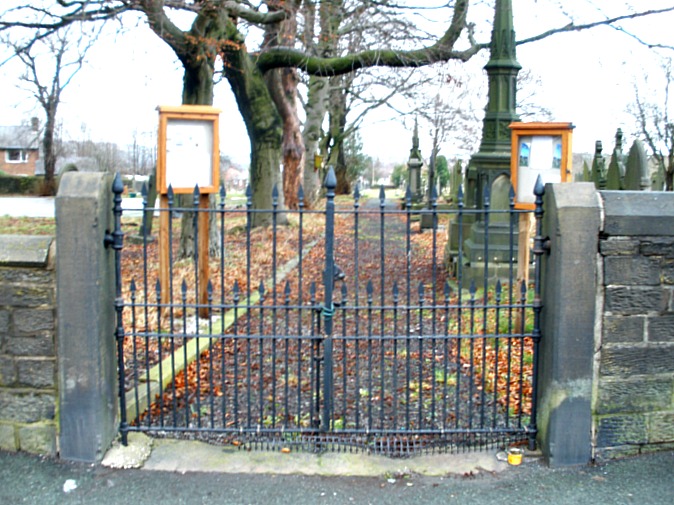
St John's churchyard entrance.

St John’s churchyard entrance.

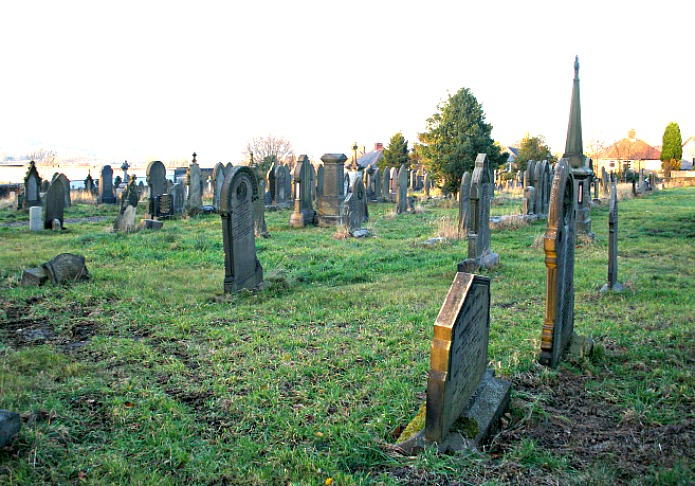
OS grid reference: SD 8700 3780. St John’s Church And Church-yard, Great Marsden, stands about ½ a mile to the north of Nelson town centre – up Barkerhouse road. Today, the modern church which is dedicated to St. John the Evangelist, has been amalgamated with that of the old St. Philip’s church on Leeds road, Nelson, and is much in use as a church centre for many local functions and social gatherings. The churchyard has many splendid old Victorian tombs and monuments, some quite tall and ornate ones, recalling the names of the many eminent local people that are of great interest to the area; and there are also many newer graves as well as a collection of interesting graveslabs from the 1st and 2nd world wars.

View inside St John's churchtard.

View inside St John’s churchtard.

In 1846 a Mrs Maw and a Miss Walton heirs to the Marsden Hall Estate gave land and money for the establishment of a church and burial ground at Great Marsden, adjoining Barkerhouse Road. The church was finished and consecrated in 1848. It was built in the ‘standard’ Victorian-Gothic style with nave, side and middle aisles; the stone used in it’s construction apparently coming from the local quarries at nearby Catlow. William Messenger was first vicar. The church was restored and extended in 1896 but problems with dry rot meant it had to be demolished in 1995. A new church was consecrated in 2000, but the graveyard had by then become much neglected. The site covers 6.5 acres, and some 17,000 burials have taken place over the past century and a half.

In 1848 the Town of Nelson did not exist. The area included two townships or villages – Great and Little Marsden. Little Marsden had it’s own church but most people in Great Marsden attended and were buried at St Bartholomew’s in Colne. The Townships only became Nelson after the East Lancashire Railway Company named it’s new station ‘Nelson’ after the Nelson Inn, which stood nearby. The Nelson Inn had been built in 1805 by my ancestors and given the name after the victory and death of Admiral Lord Nelson at Trafalgar that same year.

The population of the area had grown rapidly throughout the 19th century as handloom weaving in peoples’ houses was replaced by power loom weaving in local factories – the economics of scale allowing more cloth to be produced more rapidly to meet a growing demand for cotton garments and bedding. By the 1840’s there was clearly a need to have a new church in Great Marsden itself, and a mission was established to facilitate this.

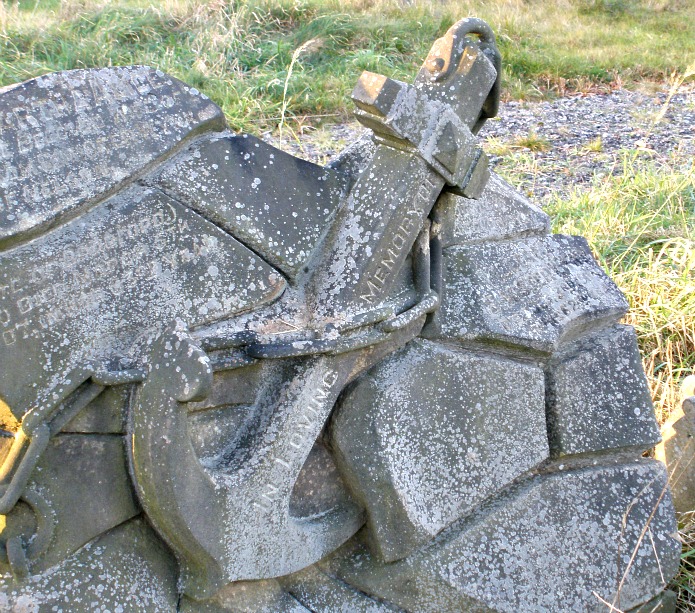
Anchor on tombstone at St John's churchyard.

Anchor on grave, St John’s churchyard.

In 1895 a new municipal burial site was established on Walton Lane as part of the new borough’s plans to emulate other boroughs with big projects like municipal buildings and parks high on the agendas of those who sought public office. Although people continued to be buried at St John’s the numbers declined in the 20th century, descendants themselves began to die off and the original occupants forgotten. The second half of the 20th century was a period of neglect. The burial ground was also affected by vandalism, subsidence and the encroachment of Japanese Knotweed, so that parts of the burial ground became inaccessible. My mother recalls successive vicars trying “desperately” to battle nature’s encroachment with little more than hedge trimmers and a garden lawn-mower!

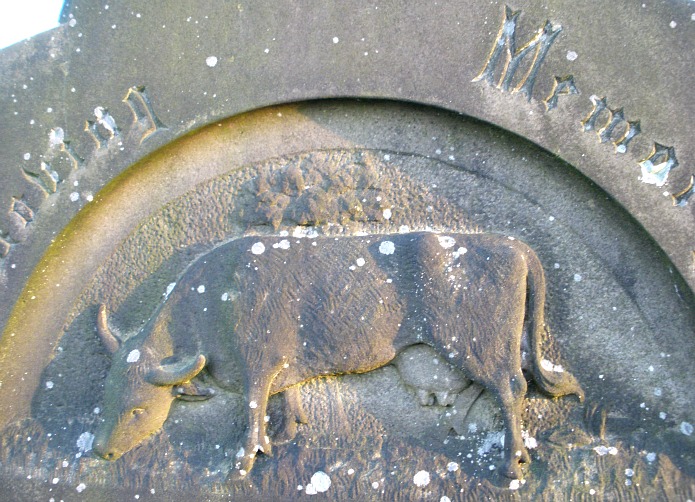
Cow on gravestone at St John's churchyard.

Cow on gravestone at St John’s churchyard.

In 2005 a group of concerned individuals many of whom had ancestors buried in the graveyard came together to establish a new group ‘The Friends of St Johns Churchyard’ and to establish a project to restore the churchyard and to make it accessible again. Over the past 8 years the churchyard has been transformed, the Japanese Knotweed eradicated, the subsidence dealt with, vandalism stopped and the grass regularly mown, seating established and, finally a memorial garden for quiet contemplation, set up. The many “often” spectacular monuments which can now be viewed – can be seen to reflect the new wealth of the area in the late 19th and 20th centuries with the more humble monuments often reflecting the interests, beliefs, and lives of the people buried there, with for example nautical (see photo above, left) and agricultural (see photo, right) carvings on some tombstones, and doves of peace etc on others.

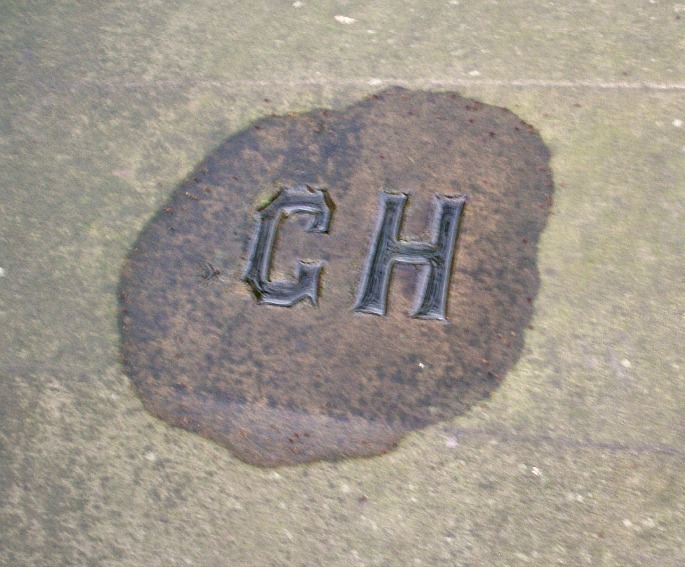
Letters GH on gravestone, St John's churchyard.

‘GH’ on grave, St John’s churchyard.

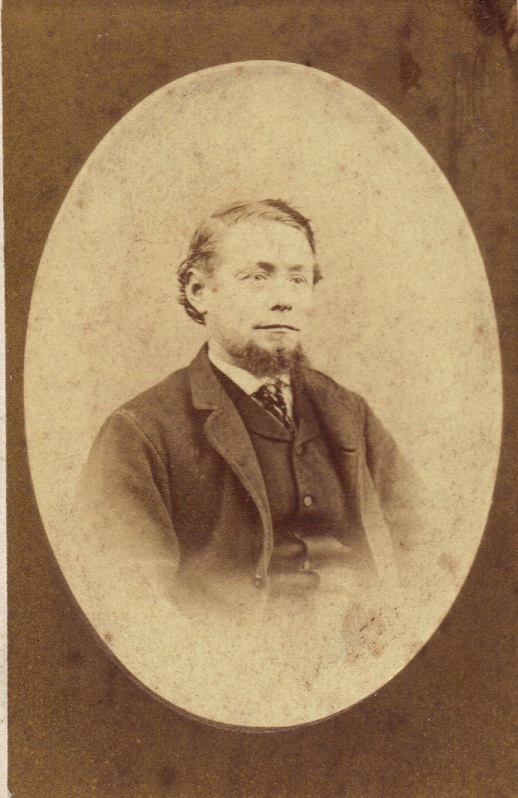
One of the more humble graves is that of my Great-Great-Grandfather, George Hillary 1837-69 (see photo below, right). The grave is marked with a simple inscription the letters ‘GH’ perhaps reflecting his view that there should be a lack of fuss over his funeral or that the family thought he would always be remembered by the local townsfolk. George was something of a local personality. People called him ‘George the Dandy’ on account of his liking for the most up-to-date fashions and his collection of waistcoats, a popular garment at the time with even children wearing them. As a youth George had travelled to the West Indies to work for a sugar company based in Liverpool, then as an adult he had worked for his father in law who had inherited the Nelson Inn as book-keeper and, later to learn the trade of Licensed Victualler. It was clear Matthew Manley had wanted him to take over on his retirement but fate was to intervene. George died aged 31 or perhaps 32 just one year before Matthew, of Tuberculosis, then called ‘consumption’ because of the way it appears to consume the body with feverish symptoms. It is said half the townsfolk turned out for the funeral. George’s prediction that the undertakers would fail to turn up came true when they got the date wrong! and men had to be found to carry the coffin from the Nelson Inn to the churchyard up the hill in Barkerhouse Road.

George Hillary.

George Hillary.

Also buried here are George’s wife, her second husband, George’s mother, and her parents, George’s brother and sister, his sister in law and brother in law, grandson and many cousins, too numerous to mention here.

By 2014 there has been a further renewal of interest in the graveyard, and for people seeking information about their ancestors as part of the ‘trend’ in Family History. The Friends now have requests for information from across the World. Some years ago the Pendle and Burnley Branch of ‘The Lancashire Family History and Heraldry Society’ recorded the information from ‘The Grave Books and Memorial Inscriptions’ and this is now available on CD (Details on The Friends of St John’s Churchyard Website).

There is a World War I Memorial Garden at the far side of the churchyard up against the north wall, and also two information boards.

Acknowledgements/Sources:-

Lancashire Family History and Heraldry Society: ‘Great Marsden (Nelson), St John the Evangelist Memorial Inscriptions and Grave Books’ CD.

Wilson, G.V., ‘Tales of the Nelson Inn’, Nelson and Colne Historical Society, 1966.

Bennett, W., ‘The History of Marsden and Nelson’, Nelson Corporation, 1957.

http://www.friendsofstjohns.co.uk/

© Ray Spencer, The Journal of Antiquities, 2014 (up-dated 2019).


Jinny Well, Newchurch-in-Pendle, Lancashire

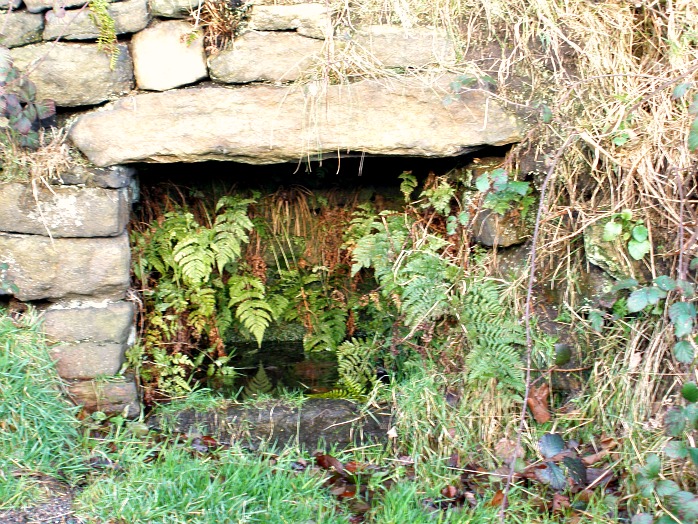
Jinny Well, Newchurch-in-Pendle.

Jinny Well, Newchurch-in-Pendle.

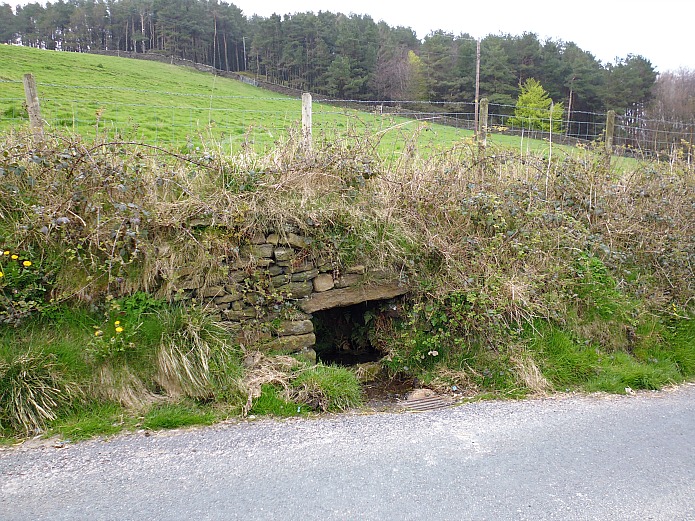
OS grid reference: SD 8238 3946. A few hundred yards down the hill from the Pendleside village of Newchurch-in-Pendle along Jinny Lane, and set into the grassy bank is Jinny Well or Jennet’s Well, a sacred spring that has been here for some considerable time, from when the land was first formed in geological terms. Not a great deal is known about it today, perhaps because in our modern times with clean drinking water on tap, it has been largerly forgotten, sadly. At the time of my visit the well was looking a bit overgrown. From the top of the village Pendle Hill can be seen, 2 or 3 miles to the north-west, while the village of Sabden is 4 miles further to the west and Barrowford is roughly 3 miles to the east.

The well is built into the grassy bank at the side of Jinny Lane – it’s roof is formed from a thick stone-slab and a large stone basin collects the water, which is nowadays a dirty-brown colour and “certainly not” suitable for drinking, while at the other side and also above, the structure is made out of drystone walling; the spring comes out of a small grassy hillock in the field above the well. At the front there is a horrid iron grid to collect any overflowing, cascading water. Undoubtedly, at one time long ago the well water was used by local people because of its purity and, maybe it had some health-giving qualities of which we know little about today.

Jinny Well, Newchurch-In-Pendle

Jinny Well, Newchurch-In-Pendle

According to local legend, the lane is haunted by the headless ghost of a woman called Jinny, Jinnet or Jennet; and she has given her name to the well and the lane, but as to when she lived around here, again, we do not know, only the legend and name remain. Maybe Jennet still uses the well for her needs in the realm where ghosts and spirits (water spirits) preside. Jennet does not appear to have been accorded the title of ‘saint’ in this case, even though she lost her head! There are a few other wells and springs in the pretty village of Newchurch-in-Pendle, in particular there is said to be a well in the garden of St Mary’s vicarage/parsonage.

Source:

Bennett, Paul., The Northern Antiquarian, 2009. http://megalithix.wordpress.com/2009/11/08/jinny-well-pendle/

Copyright © Ray Spencer, The Journal of Antiquities, 2013.


Stydd Chapel, Ribchester, Lancashire

St Saviour's Chapel at Stydd, Ribchester.

St Saviour’s Chapel at Stydd, Ribchester.

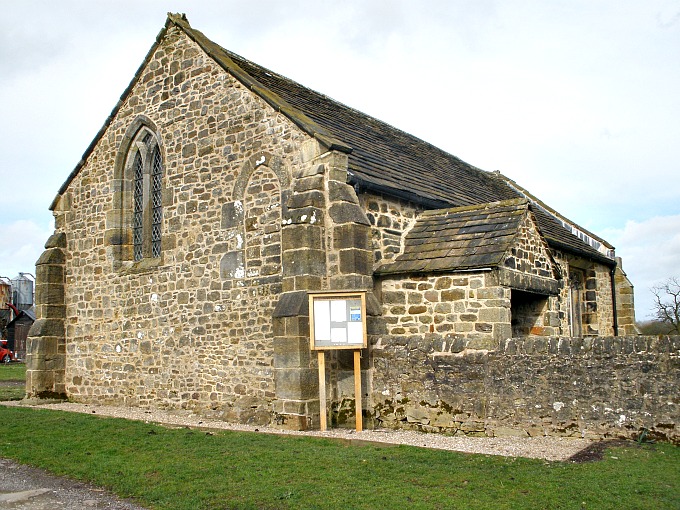
OS grid reference: SD 6538 3597. About ½ a mile to the east of Ribchester village, just after the Ribchester Arms Inn, turn off the B6245 (Blackburn road) and head up Stydd Lane (past the 18th century Stydd Almshouses) which eventually becomes a dirt track, and where soon you reach the isolated and ancient little Stydd Chapel, a simple rectangular-shaped building looking a bit like a barn, dating back to the mid 12th century and dedicated to St Saviour. And how pleasant the building is, surrounded on one side by a tiny grassy enclosure which was in use as a graveyard until 1879; and some old and new farm buildings scattered around it at the back. There are a number of interesting architectural features in the building and, equally some interesting old grave-slabs. The river Ribble runs close by and Dutton is bit further along the Blackburn road, while Longridge is 2 miles to the north-west and Whalley is 4 miles due east on the A59 road via Copster Green and Billington.

In her book Lancashire Countrygoer, 1964, authoress Jessica Lofthouse says of Stydd Chapel: “Six centuries ago the Knights Hospitallers of St. John of Jerusalem owned an estate at The Stede, a small “monastery” complete with chapel, dormitory, refectory and cloisters. They were crusading monks, rarely at home until the last fighting men had returned from the Holy Places. In 1338 — when it was considered it no longer served any useful purpose — it was dissolved.” The earliest documented evidence is probably the deeds (undated) of the mid 12th century, then later in 1292 another, clearer more acceptable document saying that “the Knights Hospitallers of St John aquired the land from one Adam of St Saviour at Dutton”. Author Ron Freethy in his book Exploring Villages, 1985, refers to St Saviours as a “Crusader church” and goes on to say that these Hospitallers whom took a major part in the crusades over in the Holy Land also brought back ‘healing’ herbal plants and says: “for the Knights of St John were not only good fighters but skilful healers and herbalists. Many of the plants they cultivated still grow well near Styd, and a careful look around the church yard will reveal plants such as toothwort, used to cure toothache, and willow trees from which they stripped the bark to cure headache”.

It was either in 1136 or 1150 when the Knights Hospitallers arrived at Ribchester to establish their chapel and monastic hospice for pilgrims, though it seems there had already been some kind of religious building on the site at the back where Stydd Manor farm now stands, perhaps an early Christian church or, more likely a Roman temple dedicated to the god Mithras, because Archaeological excavations here in 1912 came upon another building that ‘appeared’ to pre-date the present chapel, and could well be of a 4th century date, according to local authors John & Phillip Dixon in their book Journeys Through Brigantia (Volume 9) The Ribble Valley, 1993. A stone dedicated to Mithras was discovered inside the Roman fort at Ribchester – being used as a floor tile in a Romano-British building there. Stydd Manor farm still has some stones from the hospice or monastic farm incorporated into its walls.

The Early English porch (south door) was added to the chapel in the 13th century and has an oak door studded with nails and covered in old graffiti, while inside the building is rather “primitive” or bare to say the least with its stone-flagged floor, but there are also some interesting antiquities to be seen, despite that. Inside, the south door is quite beautiful with some exceptional carvings including concave keel mouldings and capitals with Corinthian floriated designs, dating from around 1200. But best of all are the north doorway and windows. On the exterior of the late Norman north doorway (now blocked up) there is what is called dog-toothed zig-zag carving (from between 1160-1190) and two round-headed windows. The octagonal font is made of gritstone and dates from the early 1500s and is interesting because it has carvings of sheilds and sacred heraldic symbols on all it’s sides, while the oak screen is of the late 17th century; and the piscina or water stoup built into the south wall of the chancel is medieval – maybe even late Norman, and has a trefoil stone head but it’s water bowl has gone. High up in the west wall there is another blocked-up doorway – this probably once lead to a wooden gallery and linked up with another building, now long gone.

Gravestone of St Margaret Clitheroe at Stydd Chapel.

Gravestone of St Margaret Clitheroe at Stydd Chapel.

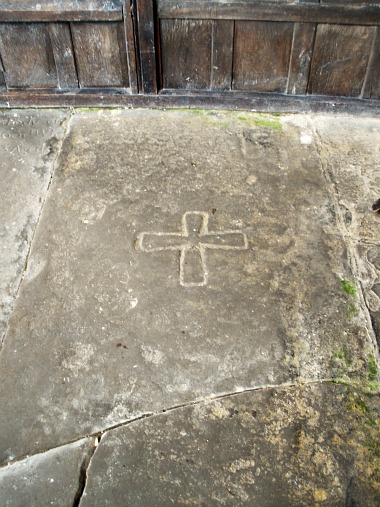
In the sanctuary at the back of the chapel we have some large recumbant grave-slabs. The one that is badly broken at the bottom with the plain incised cross is “said” to be that of the Roman Catholic martyr St Margaret Clitheroe (1556-86) who suffered for her faith at York and was canonised as one of the English Martyrs in 1970. She could, perhaps, have been related to the Clitheroe family who lived in these parts during the 14th century, though we don’t know this with any “real” certainty, but why would the gravestone of a Yorkshire martyr be here at Stydd? At the side of this stands a coffin tomb of unknown date. The other interesting gravestone which is now broken across the middle has a lovely floriated design. Buried here beneath this stone are the Knight Sir Adam de Cliderow and his wife Lady Alice Cliderow (1350). Outside in the old graveyard there is a medieval cross-base – its stump having disappeared. This is said to have come from Duddel Hill on the moors a few miles to the north of Stydd. Church services are still held ‘occassionaly’ at the Stydd Chapel and visitors, rather than pilgrims, come here now to look at the building.

Sources:

Lofthouse, Jessica., Lancashire Countrygoer, Robert Hale Limited, London, 1964.

Dixon, John & Phillip., Journeys Through Brigantia (Volume Nine) The Ribble Valley, Aussteiger Publications, Barnoldswick, 1993.

Freethy, Ron., Exploring Villages with Ron Freethy, Countryside Publications, Brinscall, Chorley, Lancashire, 1985.

Church Guide (Booklet), The Church of St. Saviour, Stydd. 2004. (In conjunction with St Wilfrid’s Church, Ribchester).

© Copyright, Ray Spencer, 2013.


Sueno’s Stone, Forres, Moray, Scotland

OS grid reference NJ 0465 5953. At the east side of the village of Forres, before reaching the B9011 road, turn left into Findhorn road and, on the opposite side of the road in a field, stands the famous Sueno’s Stone, a very tall class III Pictish stone/cross-slab, which since the 1990s has rather unfortunately been housed within a horrid glass, protective cage – although it is now stopping any further erosion to the beautiful Pictish carvings, so that has to be a good thing. It used to stand inside iron railings. The stone is said to weigh over 7 tonnes. According to the author, Elizabeth Sutherland, in her delightful book The Pictish Guide, 1997, of the stone she says: “It is undoubtedly one of the finest examples of Dark Age sculpture in Europe and should not be missed”. The town of Nairn is 10 miles to the west on the A96 and the town of Elgin is 11 miles to the east, also on the A96.

Sueno’s Stone (Swein’s Stone) is a ‘highly sculptured’ Old Red Sandstone pillar standing on a low, stepped base at between 21-23 feet high (6-7 meters) that is thought to commemorate a battle or battles that took place in the mid 9th century AD, according to the legend. Many of the decorative scenes depict Dark Age battles which took place in Scotland, but there are is also a strong Christian theme running through much of the ornamentation, and very beautiful it all is too. There are, however, no Pictish symbols on class III stones. The general thinking is that the battle scenes depict King Kenneth MacAlpin and his victories over the Picts circa AD 842, or could they in fact be earlier in date or, indeed, slightly more recent? We don’t even know for certain who “Sueno” was. The authors Janet & Colin Bord in their book Ancient Mysteries of Britain, 1991, suggest that “Sueno for whom it is named, may have been a Norse king defeated near this spot by the Picts”. It seems ‘quite’ likely that the stone was moved to its current position from somewhere nearby, having apparently lain buried in the ground for some considerable time; the very first reference to this stone came in the early 18th century.

English: Sueno's Stone. This is a historic sho...

Sueno’s Stone. Photo by Anne Burgess (Geograph).

On the front side of the pillar there are 11 panels with ‘many’ horsemen riding into battle and numerous human characters, probably Pictish warriors, but also characters not involved in any battle but, which could possibly recall the coronation of Kenneth MacAlpin, in particular the two tall figures bending over a seated figure – now echoed by a few leading experts in the field. The best part is quite obviously the very large wheel-headed cross with it’s long shaft on a rectangular base in the centre of this face; this being the part that seems to draw our full attention and, was probably meant to do just that because it takes up most of the face; there is also the more familiar knotwork interlacing both on the shaft and on the sides.

The opposite side (back) is quite literally covered in upto 100 figures, elite warriors and horsemen all in 4 panels. The general concensus by historians on Pictish history with regard to this side of the stone is that the carvings say out loudly: ‘the Pictish kingdom is finished and the Scots are “victorious” and here to stay – make no mistake about that’. King Kenneth MacAlpin is now in charge. In panel 1 there is a row of figures holding swords and standing above eight warriors on horseback (in three rows facing left); another row of warriors in panel 2 – the middle figure wearing a kilt could be King Kenneth MacAlpin? Another row has eight figures with the two in the centre, fighting and, a third row has six severed heads with a bell and next to that six corpses without their heads, while a warrior is about to behead a seventh figure; beneath that two couples are fighting with their hands. The fourth row has more mounted warriors fighting (in three columns) and making their escape from warriors on foot.

In the third panel there are yet more warriors in pairs and, in the centre what is perhaps a bridge, tent or a broch with corpses and severed heads beneath it, while below that two pairs of figures orating the battle scene. Panel 4 shows two rows of warriors facing left with the four front figures unharmed and chained and their victors with sheilds and swords following them. The edge of the stone (right) is carved with leaves and plants and the heads of beasts linked and intertwining, while below that two human heads; the left edge shows more beasts, interlacing and men with fish tails interlaced to form figures of eight; three more heads can be seen beneath this. It is thought the stone was actually set up by the victorious Kenneth MacAlpin who had now become king of the Scots, thus ending the rule of the Picts in Scotland. The Picts now had to accept the ‘inevitable outcome’. MacAlpin died in AD 858 or 859 – having ruled as king of the Picts and, later of the Scots, from circa 834 AD. He died at Forteviot in Perthshire and was buried on the Isle of Iona.

Sources:

Sutherland, Elizabeth., The Pictish Guide, Birrlin Limited, Edinburgh, 1997.

Bord, Janet & Colin., Ancient Mysteries of Britain, Diamond Books (Harper Collins Publishers Ltd), 1991.

Jackson, Anthony., The Pictish Trail, The Orkney Press Ltd., St Ola, Kirkwall, Orkney, 1989.

https://en.wikipedia.org/wiki/Sueno%27s_Stone

http://www.britroyals.com/scots.asp?id=kenneth1

http://www.ancient-scotland.co.uk/site.php?a=141

Copyright © Ray Spencer, The Journal of Antiquities, 2013.