The Journal Of Antiquities

Ancient Sites In Great Britain & Southern Ireland


San Miguel de Arrechinaga, Markina-Xemein, Biscay, Northern Spain.

Latitude 43.267458. Longitude 2.49396. The little Basque town of Markina-Xemein in the Pais Vasco, province of Bicay, north-eastern Spain is much like any other town in the Basque Country, but here we have a very curious site. The little church and hermitage of San Miguel de Arrechinaga stands just across the bridge at the western side of the town on the Xemein Etorbidea road. It is built around three huge megaliths or, a dolmen? The town is situated on the main B1 633 road running north-east to south-west. Bilbao is some 26 miles to the west, while the town of San Sebastian is about the same distance to the east.
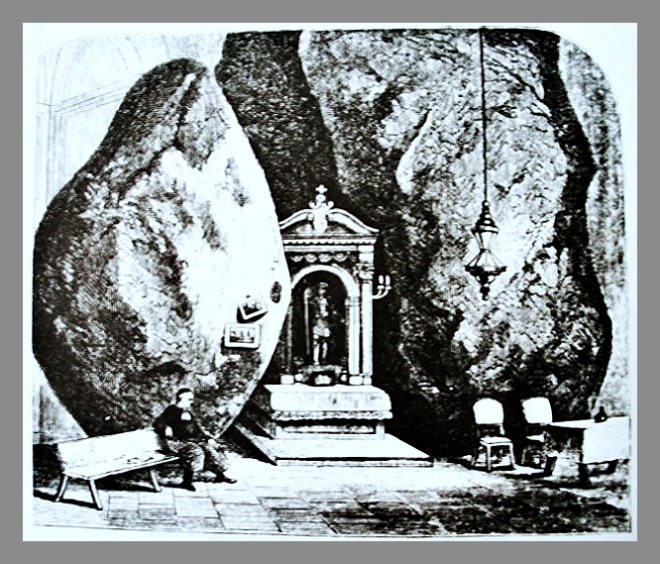
San Miguel de Arrechinaga, Markina-Xemein, Spain

Although the huge stones within the sanctuary of San Miguel’s church have often been referred to as a prehistoric dolmen, it is almost certain they are not. In fact, they owe more to geographical history. The three odd-shaped, gnarled and distorted boulders are probably the eroded remains of a huge rock outcrop from the hillside that was formed in the Tertiary period many hundreds of millions of years ago, perhaps 40 million years ago? At least that is the general consensus. So, in other words, they are a natural feature, and nothing to do with prehistory.

In the Middle Ages, according to legend, a local hermit came to live here and built his cell beneath the huge stones. His name was perhaps St Pollonio. Later, a church was built around the three stones and the hermitage, a site that was by that time revered as a place sacred to St Michael the Archangel, patron saint of high places. In the 18th century a new church was built around the curious stones. The three stones support each other in an interlocking sort of way; the largest of the three at the back lies over the top of the front two stones, supporting the whole structure. At the front and between the stones stands the main altar and a shrine inside which stands a very nice statue of St Michael (San Miguel) and a reliquary of St Pollonio – the whole thing looking as though it were made to be this way. A 14th century altar-piece can be seen in the church – though this is often locked away for security reasons. The floor of the church is hexagonal, while the roof is pyramid-shaped with a cupola in the centre of the ceiling and a rather large, radiating key-lock boss. St Miguel’s entrance door has an upper axis over which stands a belltower.

Legend says that a young man must pass three times underneath the huge stones if wishing to be married the following year; this is said to still take place even today. One rather far-fetched local legend claims that St Michael killed and then buried the devil beneath the boulders long ago before the church was built on the site – something that is said of other churches with a dedication to this saint located upon high places or rocky outcrops.

Sources:-

Fergusson, James., Rude Stone Monuments In All Countries, London, 1872.

Click on the following link  http://www.blogseitb.us/basquetourism/2010/11/28/san-miguel-de-arretxinaga-a-very-peculiar-church/

Click on the following link  http://hispanismo.org/senorios-vascongados/5613-curiosidades-san-miguel-de-arrechinaga-marquina-vizcaya.htm

© Copyright, Ray Spencer, 2012.


Kerloas Menhir, Plouarzel, Finistere, Brittany

Français : Le menhir Kerloas à Plouarzel en Br...

Kerloas Menhir (Photo credit: China_Crisis Wikipedia)

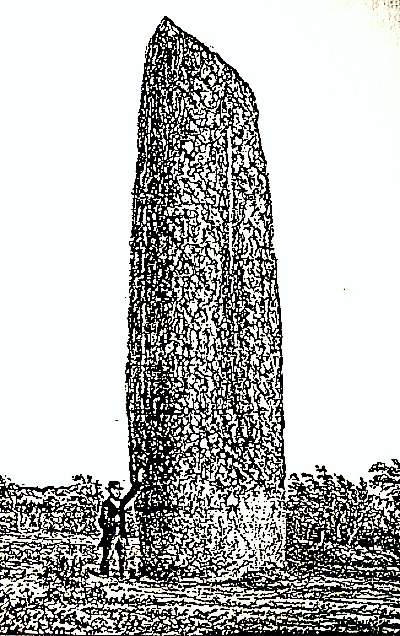
Longitude 48.426638 Latitude 4.679393. The Kerloas Menhir or Menhir de Kerloas stands on a low mound in open countryside, 2 miles east of the village of Plouarzel in northern Finistere. The nearest town is Ploudalmezeau 7 miles to the north. A footpath takes you 200 metres south from the D5 Kerloas road to the giant standing stone that dates from the Bronze-Age around 3,000-4,000 BC and, to a prehistoric monument that can be seen for many, many miles around – although today it is missing its top section after lightning apparently struck it at some point in the distant past. The menhir stands at the southern edge of the Bois de Kervealouz Forest. This is probably the tallest standing stone in Europe.

At 9.5 metres or 31 feet high this smooth granite standing stone which was quarried at L’Aber Ildut a couple of miles to the north-west is quite a remarkable sight. But originally it was approx 40 feet high before it lost the top 2 metres or so during a severe thunderstorm 200 years ago. The top part was blasted away by a lightning strike, some of the large pieces being sent over a large area landing in the nearby forest and on a farmhouse. It has a huge girth with a “quadrangular” tapering base; the shaft also gradually tapering away near the top where the breakage has occured. It’s estimated weight is 150 tonnes. Beneath the small round-shaped mound on which it stands there are said to be a several more metres of stone. About three feet up from ground-level on two sides there are two strange feminine-like humps or protuberances in the menhir – giving it the appearance of a hunchback person, but nobody seems to know why, or what, they are for. They are, however, probably associated with fertility? The mound beneath the stone is probably the remains of a tumulus where there was a burial of a chieftain, or maybe more than one chieftain – indeed the area around the site is called Kerglass ‘field of grief’.

Kerloas Menhir, Finistere, Brittany.

According to local legend, up to 100 years ago young, newly married couples would visit the Kerloas menhir on their wedding night in order to improve their family prospects. The woman would rub her naked body against one of the humps in the stone, while her husband would do the same to the other hump. These strange occurrences were performed in order that the man would receive a male child, while the woman would become the dominant one in the house. It also seems probable that the woman would help her childbearing on by climbing the menhir to the top naked and then sliding back down it again, but whether all this clambering all over the stone helped we don’t know, it probably would have caused the woman much bruising and friction burn in the meantime! Other legends claim there was buried treasure beneath the stone (grave goods), while a very far-fetched legend claims the big stone wanders off every night to take a drink from a river, or even the sea! Now that is indeed far-fetched.

Source:-

Briard, Jacques., The Megaliths of Brittany (Giseserot Edition), Rennes, 2001.

https://en.wikipedia.org/wiki/Menhir

Copyright © Ray Spencer, The Journal of Antiquities (updated 2024).


2 Comments

La Grand Menhir Brise, Locmariquer, Morbihan, Brittany

the Great Menhir of Er Grah, the largest known...

The Grand Menhir (Photo credit: S.Moller, Wikipedia)

Latitude 47.571647 Longitude 2.949593. The site of the massive monolith or menhir is at the northern side of the village of Locmariquer, Morbihan region, and just west of the cemetery on the D781 (Route d’Auray). The nearest town, Auray, is 10 miles to the north. Its name means ‘great broken standing stone’ because that is what it is today. But a more romantic name for the broken standing stone is ‘the fairy stone’ (Menhir Hroeg or Er Grah) because it was thought to have been erected by the little people, or the fairy folk who lived there and, maybe still do. But, in actual fact it was set up by Neolithic tribesmen in 4,500 BC – the huge stone being brought here from an outcrop of rocks near the estuary of the river Auray, some 7 miles to the north of Locmariquer.

Today, sadly the grand menhir lies on the ground having been broken into four sections by a lightning strike, or some think by an earthquake, but originally there were five sections – probably a small fragment has been lost. It is now thought that the menhir was broken by human involvement in two distinct stages. When it stood upright, if it ever did, then it would have been over 20 metres or between 64-66 feet high and its weight calculated to be around 300 tonnes or more, perhaps making it the largest monolith in Europe – or one of the largest in western Europe? However, the menhir would have been placed several feet into a round-shaped pit which has now been partially filled in. The girth of the stone at its base being approx 4 metres. The four remaining lumps of stone are carved and shaped smoothly around their narrower edges and also on the broad faces, and there is a carving of what is perhaps an axe in it’s wooden haft on one of the stones.

Near the top of the menhir the stone narrows to form a roughly pointed shape, something that might cause it to be seen as phallic in appearance, but more than likely the stone was, or would have been used, for astronomical purposes. There were probably other standing stones here because a number of socket holes have been excavated running in a straight northerly direction for 180 feet, but of these only small stones remain. The grand menhir and its accompanying stone row were no doubt aligned with the winter and summer solstices and, quite probably a lunar happening such as an eclipse at the time of construction.

The 'Table des Marchand' dolmen in Locmariaque...

Table-de-Marchand (Photo credit: Myrabella, Wikimedia Commons)

Behind the grand menhir is another prehistoric site that is linked. This is La Table des Marchand also known as The Merchants’ Table, a Neolithic passage-grave that has now been reconstructed. Actually, it is a dolmen that stands within the remains of a burial mound (tumulus) that measures over 36 metres or nearly 120 feet across. As the name suggests the monument is very like a stone table albeit three tables or capstones that are supported by 17 curved and slightly pointed upright stones. Below the largest stone table there is a gallery with stone-built walls around the chamber; the large stone table resting at one end on one of these curved supports, this one in particular has carvings of sun-ripened wheat ears. And the underside of the large table or capstone has an interesting carving depicting what is thought to be a plough in the form of an axe that connects up by a shaft that has slight traces of a harness and oxen (long-horned cattle), the back legs of one of these animals can be just made out, although it is rather faint now.

There are two more dolmens in the village. At the northern side stands The Dolmen of Mane Lud and in the centre The Dolmen of Mane Rethual – both of which are worth looking at if time is not too tight.

Sources:-

https://en.wikipedia.org/wiki/Locmariaquer_megaliths

Michelin, Brittany Tourist Guide, Michelin Tyre Limited, London, 1983.

Scarre, Chris (edited)., The Seventy Wonders Of The Ancient World – The Great Monuments And How They Were Built, Thames & Hudson, London, 1999.

Copyright © Ray Spencer, The Journal of Antiquities, 2012 (updated 2024).


Carnac Stone Rows, Morbihan, Brittany

Carnac Stone Rows, the Morbihan Region, in Brittany.

Latitude 47.595977 Longitude 3.066988. The countryside around Carnac in the Morbihan region of southern Brittany abounds with standing stones that stride across the fields like ancient warriors – forming alignments or stone rows – perhaps the most famous being ‘Alignments de Kermario’ about 1 mile north-east of the village of Carnac, beside the D196 road (Route de Kerlescan). The nearest town is Auray 10 miles to the north-east. You can’t really miss these rows or avenues of prehistoric menhirs as they can be seen from three other country lanes running off the D196, or you can walk beside the stones if you wish. The stone rows start just a little to the north of the village of Kermario and fan out in the form of geometric patterns in a north-easterly direction for over half a mile (1,300 metres) standing like ageless sentinels in the landscape, often oblivious to the lanes that cut through the sides of them, and even then the stones have not lost out.

There are 10 stone rows or avenues at Kermario and upto 1,030 standing stones, seven of the rows being very well preserved. They are thought to date back to the Neolithic age between 3,300-4,500 BC and to have probably been placed here for astronomical purposes, perhaps in relation to the stars, but also to align with the summer and winter solstices, and also being used to predict lunar eclipses. One local legend says the stones are actually Roman soldiers turned to stone by St Cornely (Cornelius), the local healing saint of Carnac, who is patron saint of cattle and whose (pardon) is still held on the second sunday of September – the nearest sunday to his feast-day 16th September. St Cornelius should probably be identified with the pope and martyr of that name who died in 253 AD?

The stones were locally quarried and rolled along on shaped timbers by thousands of workers always ensuring a straight line was kept to. Some of the menhirs are now recumbant, while others tilt at various odd angles, but most of them remain in a relatively up-right position considering how long it is since they were placed there. The stones vary in size, but some are 20 foot high. At the north-eastern end of the alignment, near the Kerloquet road, a stone circle has been identified, and here the smaller scale Alignment de Kerlescan made up of over 500 stones takes over.

Sources:-

https://en.wikipedia.org/wiki/Carnac_stones

https://en.wikipedia.org/wiki/Stone_row

Thom, A & Thom, A.S., ‘The Carnac Alignmenents’, Journal for the History of Astronomy, 1972.

Copyright © Ray Spencer, The Journal of Antiquities, 2012 (up-dated 2021).


The Fairies Rock, La-Roche, Illet-et-Vilaine, Brittany

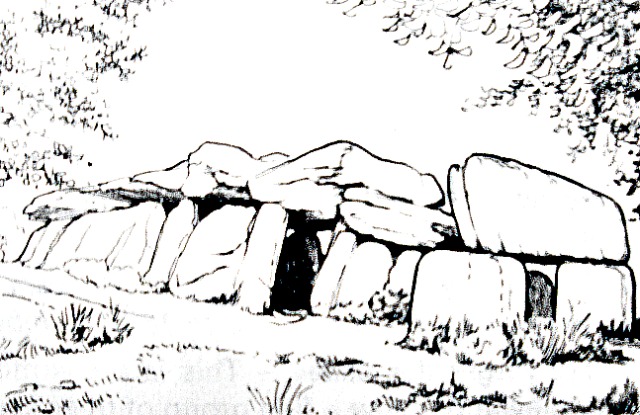
Longitude 47.936515 Latiude 1.404866. The Fairies Rock or ‘Rock of the Fairies’ (Roche-aux-Fees) prehistoric monument is located in a wooded area with oak trees and a small lake about half a mile northeast of La Roche village, Illet-et-Vilaine Dept, central Brittany, near the D341 La Motte road. There is a small car park. The site is two-and-a-half miles south of Esse and some 3 miles northwest of Retiers. This famous passage grave is said to be the largest dolmen in France, and it is quite probably the best preserved of any of the dolmens in Europe. In the Breton language the word “dolmen” means table of stones or simply ‘a stone table’.

Fairies Rocks, Brittany (After P.Mesney).

There are 40 huge stone slabs here, some reckon on there being 42, but it is difficult to reach a proper total. The dolmen or passage-grave dates from the late Neolithic period sometime between 3,000-5,000 years BC, and was said to have been built by fairies, but in reality this sacred long tomb was constructed by ancient tribesmen for the burial of chieftains, but because it forms an alignment it was probably also used by them to view the Winter solstice on 21st December. The huge slabs of stone have a slight purple colour, but in fact, the stones are made of a reddish basaltic schist that was quarried some 3 miles from here.

The passage grave or corridor tomb is 20 metres (65 feet) long, 4 metres (13 feet) wide and 2 metres (6-7 feet) high. Some of the larger slabs and boulders weight up to 40 tonnes, while the smaller ones weigh several tonnes, rather to heavy for the fairies to attempt to lift but hundreds of tribesmen would no doubt have ways of dealing with them. The entrance to the dolmen or passage grave is 3 metres long and is in the form of a porchway (portico) with two uprights and a huge top lintel stone that fits exactly into position. This capstone has some markings at its edges, possibly caused by ropes or something ritualistic. Further inside the monument there is a low roofed passageway or corridor and then a large chamber divided into four compartments with uprights around the sides supporting the rest of the monument and more huge top stones forming the roof. In the central chamber a lump of stone has fallen to the ground. Originally this wonderful grave (tumulus) aligned south to east would have been covered over with earth to a length of 20 metres, but the earth has gone leaving the massive supporting stones.

According to legend, young couples would come here to consult with the fairy folk. They were then informed by the little people to do as instructed. The man would have to walk around the stones in a clockwise direction, while the woman went in an anti-clockwise direction, and by the time that both had returned to their starting position each would have to have counted the same number of stones – all would then go well for them in their marriage, but if one had counted a couple of extra or lesser stones they might not find things went their way; and if they each counted by more than two stones then the marriage would not go ahead and they must go their own separate ways. Well its a good story, and if you believe in the fairy folk, and many people do, then you will almost certainly be captivated by the little tale.

Please click on the following link to see a photo of the site  http://www.flickr.com/photos/cris_gmp/498506060/

Copyright © Ray Spencer, The Journal of Antiquities, 2012 (updated 2024).


Rey Cross Roman Camp, Stainmore, Cumbria

OS grid reference: NY 9004 1241. This is a difficult one to reach. You will need to park in one of the east-bound lay-bys beside the A66 Stainmore Pass dual carriageway on the summit and then find a stile allowing access to the earthworks of this 1st century AD Roman marching camp at Buzzard Hill. [A word of caution here please do be very careful as the road can be quite dangerous]. The almost rectangular-shaped earthworks are much more prominent once you get close up to the site. Most of the camp lies on the north side of the road, but a section (south-side) can be found on the opposite side of the A66, near the river Greta, although it is probably not worth crossing over the road for.

The camp was probably built sometime between 70-72 AD when the 6,000 strong IX legion under the Roman governor Quintus Petillius Cerialis came to the north of England to subdue the Brigantes and Venutius, husband of the warrior Queen, Cartamandua, then forming a rather tenuous alliance. Petilius later defeated and murdered Venutius at Stanwick c72 AD. The A66 follows the course of the Roman road between York (Eboracum) and Carlisle (Luguualium), but it seems the road was constructed slightly later than the marching camp in the early 1st century AD? eventually linking many camps, forts and fortlets along the way, including those nearby at Bowes Moor, Bowes (Lavatris), Maiden Castle and Brough (Verteris). It is, however, believed Rey Cross marching camp was only occupied for a temporary period, perhaps a few weeks, months or a year? The camp appears to have been re-occupied during the 3rd-4th centuries AD because some pottery has been excavated from that period.

The earthworks are spread over 20 acres or 296 metres from east to west and 144 metres north to south with fairly strong ramparts of stone and earth and, an external ditch. At the south side these ramparts still stand to a height of approx 6 feet in the centre and approx 20 feet wide at its base. But the northern ramparts are much more intermittent and less strong due to boggy ground conditions, indeed part of the northern section has sunk into the ground. There are traces of an external ditch at the north side measuring just 0.4 metres and, at the north-west just under 1 metre. During excavations in 1990-1 before the road was widdened into a dual carriageway, an external ditch at the eastern and western sides was found. This was some 2 metres wide and just under 1 metre deep with a berm of 1 metre in width. Near the north-east corner of the camp there is what is probably a Bronze-Age stone circle, something the Romans had clearly taken in to account.

There were at least 9 gateways (tituli) each being about 10 metres in width at the north, south, east and western sides of the camp; however, at the south-western side a couple of the south-eastern gateways have been obliterated by the A66 which bisects through this lower part of the earthworks, and recent limestone quarrying has not helped the situation. Three gateways at the north-side are still visible today. Close to the south-western side there is a small mound which sits where the quarrying occured, although this feature has, luckily, survived. This may well have been a small signal station? – there were others in an alignment sited at intervals along the Roman road, now the A66.

Rey Cross, Stainmore, Cumbria

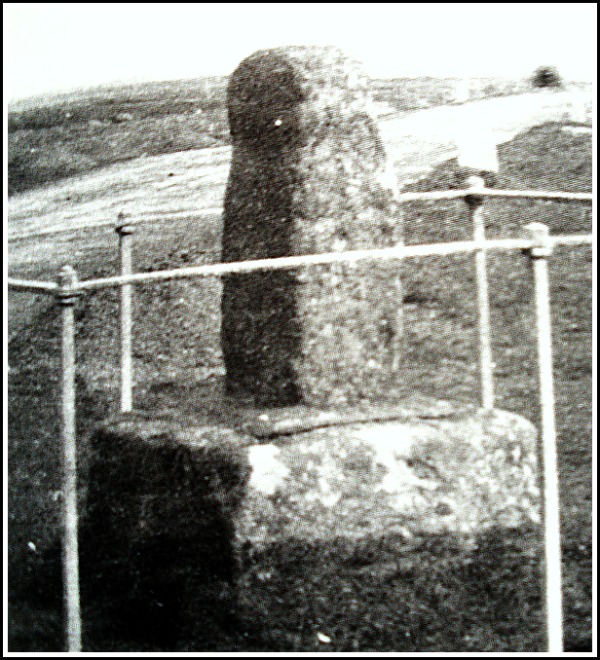
In a lay by at the side of the A66 to the east of the Roman camp stands the stump and base of an Anglo-Saxon cross (Rey Cross), dating from c946 AD when it was set up by King Edmund of Northumbria to mark the boundaries between his own territory and Cumbria (Strathclyde). However, legend says that in c954 the Viking ruler of York, Eric Bloodaxe, fled from York into Cumbria, being murdered and buried here at that time. There is no evidence for that. The cross originally stood within the Roman camp, but in 1992 it was re-located to its present position when the A66 was widened. Sadly the wheel-head and the upper section of the shaft have long since disappeared, leaving just the worn stump socketed into a more modern lump of stone or concrete. The cross would originally have been 3 metres high. Today there are no signs of any Saxon carvings, the inclement weather conditions upon Stainmore having put paid to that.

Sources:-

Wilson, Roger J.A., – A Guide to the Roman Remains In Britain (Fourth Edition), Constable, London, 2002.

Transactions of the Cumberland and Westmorland Antiquarian and Archaeological Society (TCWASS), (2nd Series) xxxiv (1934) pages 50-61.


Finn’s Well, Haggate, Lancashire

Finn’s Well, Haggate, Lancashire

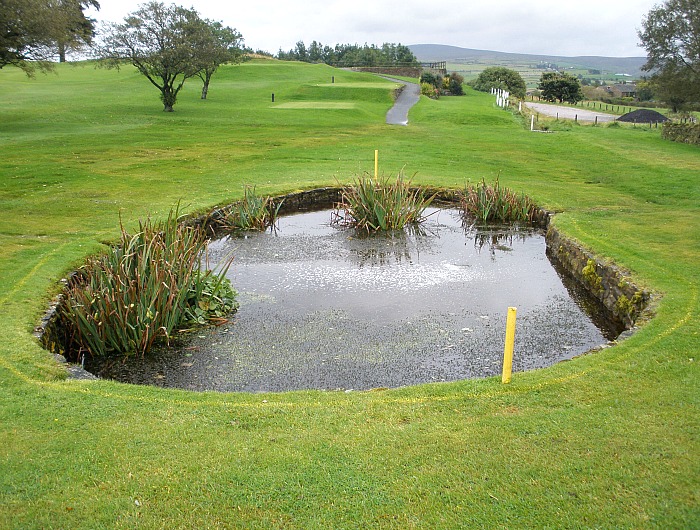
OS grid reference: SD 8671 3582. Finn’s Well or Finsley Well is now rather forgotten, but it is still flowing. It can be found 1 mile to the southeast of Nelson town centre on Higher Causeway (at Marsden Heights) just before the village of Haggate. Walk along a track that goes along the eastern edge of Nelson Golf Course. The well is just at the edge of the golf links close by a wall. A farmhouse called Finsley used to stand where the rough trackway is, but this was demolished in the 1980s. The golf course was opened back in 1921 and is a privately run course. The well or spring, because that’s what it originally was, now mingles in quite well with the green links and bunkers of the golf course, having been recently restored to look like it is part of the place, or rather a delightful little pond at the edge of the fairway, perhaps!

The well is roughly oval in shape and edged all around with stonework. It measures about 70 feet in circumference and 20 feet across. There are two inlets, one, the main inlet issues with a steady, constant flow of water, while another inlet is largerly dry. At the opposite side there is an outlet which keeps the water level the same all the time, even during very wet spells of weather and dry spells of weather. The depth of the water is not more than 6 inches at any time. Obviously the spring was used by the inhabitants of Finsley farm and other farms close by, but that no longer applies today because many of these buildings have gone. But I have no doubt the spring has been here for many hundreds, if not, thousands of years. It was probably the abode of a Norse chieftain or landowner by the name of Finn – the place-name Finsley probably means ‘Finns Hill’ or ‘the hill where Finn dwelt’. Many villages around here have Scandinavian names: Harle Syke means ‘Defensive ditch of Jarl’. Jarl being a Norse earl. Scholefield just north-east of the well is yet another Scandinavian name: Skali-feld meaning ‘Summer pasture or dwelling’. Haggate is thought not to be a Scandinavian place-name; it simply means: ‘hawthorne trees by the gateway’ (Hack Gaeta).

Finn’s Well, Haggate, Lancashire

The well has on more than one occasion been referred to as St Helena’s Well due to the fact that a farm or house called ‘St Helena’ stood close by a stone trig point that is in a somewhat sorry state. The trig point is number 54621. However, that building stood about a quarter of a mile to the west and was probably not connected with “this” well, despite the saint’s name often being associated with holy wells, and the building originally called St Helena was demolished in recent times. There is no Roman site in this area, although there have been some Roman coin finds at nearby Catlow and Castercliff Hillfort.

Copyright © Ray Spencer, The Journal of Antiquities, 2012 (updated 2024).


St Boniface Church, Papa Westray, Orkney Isles

English: St Boniface Kirk, looking towards Westray

St Boniface Kirk, Papa Westray (Photo credit: Wikipedia)

OS grid reference: HY 4882 5270. At the far north-west corner of Papa Westray overlooking the cliffs of Runnapitten, about half a mile north of the hamlet of Holland and a little to the west of Kirk house, stands the tiny medieval church of St Boniface. This was the site of a 7th or 8th century monastery and the probable site of a Pictish settlement. But the area around the church also has some Bronze-Age and Iron-Age antiquities – there was a 10-foot-high prehistoric roundhouse, or broch, just east of the church where an Iron-Age settlement existed, though nothing much remains of that now, apart from the earthworks. In the churchyard of St Boniface’s there is a Viking hog-back gravestone, which would also mean there was a Viking settlement here, and part of an early Pictish cross-slab – originally there were two stones with crosses carved onto them, excavated in the churchyard. These were removed for safety to nearby museums.

The little church (kirk) dates from the 12th century but there was probably a monastery on the site back in the 7th or 8th century AD, founded by St Boniface, bishop of Ross in Scotland; indeed the place is sometimes called Munkerhouse (monks’ house). St Boniface and his Celtic monks would have served the Pictish community here and converted this dark age tribe to Christianity at the beginning of the 7th century. Historians place the death of St Boniface at c. 630 AD, though some have placed his death in the early 8th century. He founded over one hundred churches in the north of Scotland, including the one on Papa Westray, Orkney. His feast day is given as 14th March. In 1700 the little church was enlarged, but by 1930 it had been abandoned and left to become ruinous. However, in 1993 it was fully restored both inside and out, and is now in use once again for services.

Close to the churchyard wall, amongst more modern gravestones, there is a Viking hog-back tomb stone from the 11th or 12th century? although this is now very worn and it is difficult to see any of the carving. According to legend, this marked the grave of Earl Rognavald Brusison who was the nephew of St Magnus the martyr of Kirkwall. Close by, part of a Pictish cross-slab; the main part of the stone being removed for safety to the National Museum of Scotland at Edinburgh. This slab was carved with a circular cross and also an incised cross. In 1966 a second Pictish cross-slab was excavated from the north-east corner of the churchyard. This had a Pictish-style cross and a circle with a small decorative cross inside, but for safety reasons is now housed in the Tankerness House Museum in Kirkwall.

Sources:-

Tait, Charles., The Orkney Guide Book (Edition 2.1), Charles Tait Photographic, Kelton, St.Ola, Orkney, 1999.

Armit, Ian., Celtic Scotland, B T Batsford, London, 2005.

Click on the link for a photo of the hog-back tombstone at St Boniface. http://www.google.com/imgres?num=10&hl=en&biw=1093&bih=503&tbm=isch&tbnid=hdKQOtI930kZnM:&imgrefurl=http://globetrotter-games.com/travel/Photo2002Orkney/OrkneyIndex.htm&docid=c-A3Oe3fBHqsfM&imgurl=http://globetrotter-games.com/travel/Photo2002Orkney/020912_051_Papa_Westray_-_Hogback_at_St_Boniface.jpg&w=400&h=267&ei=k6tgUOzmHuK-0QWvmYCICQ&zoom=1&iact=hc&vpx=637&vpy=166&dur=6330&hovh=183&hovw=275&tx=169&ty=129&sig=116874016552324944431&page=4&tbnh=138&tbnw=173&start=40&ndsp=15&ved=1t:429,r:8,s:40,i:236

Copyright © Ray Spencer, The Journal of Antiquities, 2012.


John Dixon has Died

I have been told of the death of John Dixon of Aussteiger Publications, known to many as Lowergate. He was a truly great friend to me, always so kind and thoughtful. I enjoyed his company on the recent walks around Downham and Castercliff hillfort. He had a vast knowledge of prehistoric sites across the north-west of England, in particular the Pendle and Clitheroe areas. His many books are awesome to read with many, often unknown sites pointed out in the Brigantia series of walking books. John you WILL be so sadly missed by myself and many, many others in this field. Thank you John for all your help. When we walk upon the hills and moors of Pendle and Bowland, John you will be walking with us in spirit and guiding us along wherever we may walk. John, now you can find rest and peace. R.I.P John Dixon, a true gentleman.

Please click on the photo to enlarge it.

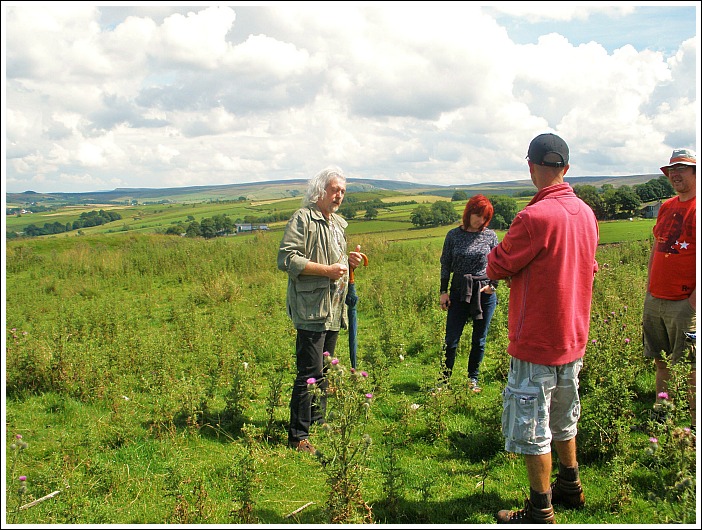
The late John Dixon, known to many as Lowergate, seen here on Castercliffe Iron-Age hill-fort, near Nelson, Lancashire, explaining the history of the site on 4th August 2012.


1 Comment

St Doolagh’s Holy Well, Balgriffin, Co Dublin, Southern Ireland

Irish grid reference: O 2112 4208. The holy well is located behind the church of St Doolagh to the north of Dublin and just off the R107 Malahide road at Balgriffin. The area known as Balgriffin is a small part of Malahide, one and half miles to the north – Malahide itself being a suburb of Dublin city. St Doolagh’s parish church dates in part from the 12th century when it was an Augustinian abbey, but there was a church on the site back in the early 7th century AD – at which time it is thought that St Doolagh or Doulagh lived as a hermit here. He is, however, a largely forgotten saint and nothing much is known about him. He may have been a disciple of St Finian and in later life became a bishop. His feast day 17th November is still celebrated here at Balgriffin where his holy well can be found in a sunken area behind the church, surrounded by trees; and a rather nice well it is too. In fact, there are two holy wells here.

St. Doulagh's Church, Malahide

St. Doulagh’s Church, (Photo credit: Wikipedia)

The main holy well, St Doulagh’s is located inside a small hexagonal-shaped well-house that has a pointed roof and two narrow windows at the back, one shaped like a cross, while at the front above the entrance door another narrow window. The building actually taking on the look of a small chapel or baptistry. Here the spring of water issues from what may originally have been a font, and then outside into a square-shaped baptismal pool or bath that has some steps ascending downwards. The well-house stands in a sunken area that is surrounded by low walls and, at the poolside end, there are stone seats running around these walls for the benefit of pilgrims. On the saint’s feast day 17th November pilgrims still come here hoping for a miraculous cure through the healing waters. At certain times the sunken area around the well-house is submerged in water forming a much larger bathing pool.

A short distance from the main well-house down some steps is yet another well. Yes there are two wells here. This building is octagonal-shaped and has an arched doorway with a narrow window above that. The spring called St Catherine’s well (St Catherine’s Pond) is located inside the little building. This well-house, like St Doulagh’s, is similar in design, and has also been a place of pilgrimage since at least the middle-ages, if not before that.

Inside the small, partly restored church, there is a hermit’s cell where the low window is located and, also a penitent’s cell (not sure what the difference is). Also, what is considered by some authorities to be the actual tomb of St Doulagh. Just down the lane stands a small cross on a modern, stepped base. This is shaped like a letter “T” and is probably one of only a very few tau crosses in Southern Ireland, dating from the early medieval period.

Click on the following links for a photo pf St Doolagh’s Holy Well http://www.google.com/imgres?num=10&hl=en&biw=1093&bih=503&tbm=isch&tbnid=u35Uk414Ln1N6M:&imgrefurl=http://www.flickriver.com/places/Ireland/Dublin/Balgriffin/&docid=pQNZORmhxt4iRM&imgurl=http://farm8.static.flickr.com/7186/6848457907_cefb0f6d2a.jpg&w=500&h=394&ei=76lYUMD3F-fI0AXEk4GoDQ&zoom=1&iact=hc&vpx=608&vpy=81&dur=911&hovh=199&hovw=253&tx=134&ty=120&sig=114173254659168981823&page=1&tbnh=149&tbnw=193&start=0&ndsp=10&ved=1t:429,r:8,s:0,i:101

https://en.wikipedia.org/wiki/St_Doulagh%27s_Church

Copyright © Ray Spencer, The Journal of Antiquities, 2012.


Turnaspidogy Stone Row, Co Cork, Southern Ireland

English: Cults Stone Row Row of three standing...

Turnaspidogy Stone Row, Co Cork. Photo credit Wikipedia.

Irish grid reference: W 1876 6696. Three prehistoric stones together in a field just to the east of the Currahy road near the hamlet of Turnaspidogy (Tir Na Spideoga). The stones are a bit difficult to find at the best of times, but they can be found a little to the east of a farm building on a flat area of land where the land slopes gently away. A few miles to the south is Lough Allua, while the nearest town is Dunmanway, 9 miles to the south-east. Another name for this ancient site is sometimes given as ‘the Cult Stones’.

The three stones stand on a low mound and are roughly aligned north to south. Originally, they would have formed a stone row though any other stones, if there were any, have been robbed away to the locality to be used as gate-posts, perhaps? Farming has more or less destroyed the site. One of the stones has sadly now fallen over, but this would have been the tallest of the three at 2.4 metres in length. The other two stones stand between just under 1 metre to 1.7 metres in height. Neolithic people would have erected these stones on an alignment to mark a lunar event on the horizon, but probably not a solar event, as is sometimes the case.

Copyright © Ray Spencer, The Journal of Antiquities, 2012.


1 Comment

Kit’s Coty, Walderslade, Kent

OS grid reference: TQ 7451 6083. The prehistoric burial chamber called Kit’s Coty or Kit’s Coty House stands in a field to the west of the Chatham road in the Medway Valley and the A229, 1 mile south-west of Walderslade. The famous Pilgrims Way is just to the south as is the Rochester road. The nearest town, Chatham, is 2 miles to the north. The ancient monument can be reached by a trackway running alongside the site from the south at Blue Bell Hill. At first glance, the monument looks like a large stone shelter or a tiny house, but it soon takes on the form of a burial chamber, which is also referred to in other terms as being a cromlech, dolmen or quoit. Although it dates back to the Neolithic age, it apparently takes its name from a 5th-century Welsh prince called Catigern – hence we get “the house of Cati”.

Kit’s Coty Burial Chamber, Kent.

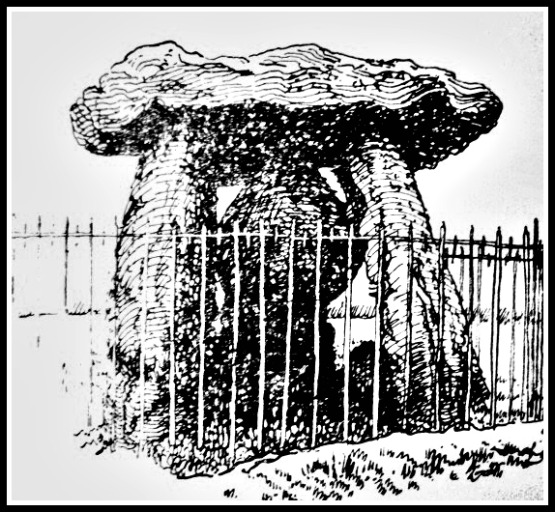
Originally, the burial chamber was at the eastern end of a long barrow that was completely covered over by a mound that has now gone, while at the western end there used to be a large standing stone and another stone (a peristalith) that was known locally as “the General’s Tombstone”. Sadly, this large stone was blown up in 1867 because it got in the way of ploughing the field. The burial chamber consists of three huge upright slabs or sarsens 2.5 metres high with an equally large, overlapping capstone 4 metres long standing upon a small mound 1 metre high; originally this mound was 15 metres wide. The whole site of the burial chamber and long barrow is roughly 70 metres in length. Today, the monument is surrounded by ugly railings for security reasons.

Although the monument dates back more than 4,000 years to the Neolithic age, the name is derived from a Dark Age prince called Catigern, son of Vortigern, who, according to legend, died in a battle against the Saxons under Hengest and Horsa at or near Aylesford in 455 AD. 400 metres to the south, beside the Aylesford road, can be found another ancient monument called Little Kit’s Coty or “the Countless Stones” where there are a number of recumbent stones which once formed a second burial chamber. No burials have been found at either of these sites.

Copyright © Ray Spencer, The Journal of Antiquities, 2012 (updated 2025).


The Ringing Stone, Balephetrish, Tiree, Scotland

OS grid reference: NL 9988 4678. At the north side of the island and just south of the B8068 coast road to the west of Balephetrish village in Vaul parish stands a large glacial erratic boulder called ‘The Ringing Stone’, which has many prehistoric cup-markings on its surface. It is known in the Gaelic language as ‘Clach a’ Choire’ and, also ‘The Gong Stone’ due to the ringing, metallic noise that emanates from it when struck. There are a number of legends associated with the stone, most of them being a bit far-fetched.

English: The Ringing stone of Tiree

The Ringing stone (Photo credit: Wikipedia)

The Ringing stone (Clach a’ Choire) is a large round-shaped granite, glacial erratic boulder that sits on top of a plateau of rocks just to the south of the B8068 coast road, near Balephetrish. It was brought here from the island of Rum at the last Ice Age some 11,000 to 13,000 years ago. In the Neolithic period 4,000 to 6,000 years ago it was carved with literally dozens of cup-marks, too numerous to even try to count. But obviously the ancient people from the Neolithic, and later the Bronze Age, also found it to be “a mystically symbolic stone”. The boulder is perched on tiny little pedestal-like rocks that themselves sit on top of rocky surfaces. Apparently, when the rock is struck a ringing sound emanates from it, or, a metallic sound as if it contained a crock of gold coins maybe!

According to legend – and there are quite a few, if the stone is ever split asunder the island of Tiree will disappear beneath the waves. Another says that if the boulder were to shatter and fall from its pedestal of stones which it rests upon, then Tiree will sink beneath the waves. And, lastly there is a tall tale often told on the island that there is a crock of gold coins inside the stone – hence the ringing sound when the stone is struck!

Sources:-

Kennedy, Donneil., The Land below the waves: Tiree past and present, Tiree Publishing Company, 1994.

https://en.wikipedia.org/wiki/Tiree

Copyright © Ray Spencer, The Journal of Antiquities, 2012 (updated 2023).


Dolaucothi Roman Gold Mines, Pumsaint, Carmarthenshire

NGR: SN 6629 4031. Dolaucothi (Ogofau) Roman gold mines are located near the village of Pumsaint (five saints), close to the A482 road, 8 miles south-east of Lampeter and 7 miles north-west of Llanwrda. The mines are at the east side of the village beneath the slopes of Allt Gwmhenog – on the eastern bank of the river Cothi. The ancient site is on the Dolaucothi Estate and is owned by the National Trust. The first activity here was probably in the Bronze Age, but the Romans exploited the gold here from the late 1st century AD, and mining was still going on in Medieval times and, even more recently!

Dolaucothi Gold Mines: entrance

Dolaucothi Gold Mines: entrance (Photo credit: Pete Reed)

The Romans started mining gold here when they conquered Wales in the late 1st century AD and probably built a fort close by in 78-80 AD to protect what they saw as a vital asset. The new governor of Britain, Sextus Julius Frontinus, moved to build a number of strategically positioned forts across southern Wales – Coelbren, Pumsaint and Llanio (Bremia) being just three of them – others soon stretched out across the length and breadth of Wales from Caerleon in the south-east to Segontium in the north-west, which in the west were later served by the Roman road, Sarn Helen. The gold was shipped overseas to the mint at Lyons in Gaul and made into coinage that quickly saw its way to the heart of the Roman Empire, Rome, and beyond.

To begin with opencast surface trenches were dug, but then later deep tunnels were dug down into the solid rock of the hillside of Allt Gwmhenog, some of which were 50 foot deep and up to 300 feet long, allowing for better access to the gold seams. But this meant sheer brute strength was needed because the workers were only using simple picks and chisels, which would take many days to excavate just small areas. On the hillside to the north the Romans built aqueducts, one of these being 7 miles long running along a gorge by the river Cothi, while another ran up the valley of the Annell for 4 miles. At intervals there were stone tanks or reservoirs for holding the water – these are still visible along the hillside as are the channels and stone ledges from the foundations of the aqueduct. Evidence suggests that the Romans abandoned the gold mines in the late 3rd century AD, but some form of mining continued in post-Roman times and even into the Medieval period. In the 1930s a Roman water-wheel was excavated from deep down in the mine, and back in the 18th century a hoard of gold artefacts was found, including brooches and snake bracelets. These treasures are now in the British Museum in London.

Carreg Pumsaint - geograph.org.uk - 396874

Carreg Pumsaint. Photo by  Nigel Davies –  (Geograph – Creative Commons)

Near the entrance to the Roman mine on a low mound there is a small standing stone (Carreg Pumsaint) which, according to legend, is associated with five Celtic saints who lived as hermits here in the 6C AD. Their names were Ceitho, Celynin, Gwyn, Gwynaro and Gwynog. They were the sons of Cynyr Farfdrwch, a prince of Pembrokeshire, at the time of St David. Legend says the brothers fell asleep in the mine, vowing only to awaken when a truly virtuous bishop is once again seated on the throne of Menevia. Yet another legend claimed they would only awaken when King Arthur returns to Wales. There are said to be five hollows in the stone where the saints lay their heads – although today there only seem to be four hollows in the stone. Long ago, there were five healing wells located in the Cothi river at Cwm Cerwyni half a mile south-west of Pumsaint church, each well being dedicated to one of the saints. The wells were at one time a place of pilgrimage.

Source:-

Houlder, Christopher., Wales: An Archaeological Guide – the prehistoric, Roman and early medieval field monuments, Faber, London, 1978.

https://en.wikipedia.org/wiki/Dolaucothi_Gold_Mines

More info here: https://www.geograph.org.uk/photo/396874

Copyright © Ray Spencer, The Journal of Antiquities, 2012 (updated 2025).


La Gran’ Mere Du Chimquiere, St Martin, Guernsey, Channel Islands

La Gran'mère du Chimquière, Statue menhir, St ...

La Gran’mère du Chimquière, St Martin, Guernsey (Photo credit: Wikipedia)

Latitude 49.437841 Longitude 2.554598. Located about 2 miles south-west of St Peter Port on the island of Guernsey is the parish of St Martin with it’s medieval church. The church stands beside Le Grande Rue, a site that was originally a pagan one but was Christianised in the 6th century AD by Celtic missionaries from Wales and the west of England. In the churchyard there is a large granite standing stone menhir that was carved into a female form some four thousand years ago and is said to represent an earth goddess or earth mother figure, hence the name La Gran’ Mere – the grand-mother.

The granite statue menhir stands guarding the entrance to the churchyard of St Martin’s parish church and is between 5-6 feet high. Dating from around 2,000 BC when it was probably a square-shaped standing stone or “long stone”, it was fashioned into a female figure with head and shoulders in either the Celtic or Roman period. The carvings are of a typical female figure, an earth mother form that depicts a pagan fertility goddess which, rather strangely, guards and protects a Christian church. Perhaps the old pagan goddesses still have their uses!

Newly married couples would, and still do, place coins or flowers on the statue’s head and shoulders to bring them luck, seeing it as a fertility symbol perhaps. In the 16th century a disgruntled churchwarden decided to split the stone in two, regarding it as a pagan relic, but the local people rallied round and restored the statue. The split in the stone can still be seen today. There is another similar standing stone figure in St Marie’s churchyard at Castel on the west coast of the island, although that one is much more defaced.

Photo Credit Wikipedia: https://commons.wikimedia.org/wiki/File:Guernsey_2011_078,_Statue_menhir_at_St._Martin_church.jpg

Copyright © Ray Spencer, 2012 (updated 2026)