NGR: TL 2373 2368. Sandwiched between several roads on a grassy area of land (Six Hills Common) are six ancient barrows, but they are not Bronze Age in origin as most people might have assumed, they are, in fact, Roman barrows! The six mounds stand close by the London Road, the busy traffic of the Great North Road (the Old A1), Six Hills Way and Kings Road, just outside of Stevenage New Town, Hertfordshire. These monuments would normally, I suppose, be referred to as “tumuli”, and as such they form a Roman barrow cemetery. However, no burials were found when Antiquarians carried out excavations way back in the 18th century; only some bits of wood and iron were excavated, and at least one barrow escaped being dug into. The six barrows are all around 10 feet high but would have originally been higher than that. They are steep-sided and, when built, would have been flat on top, but less so after being dug into in the early 1740s. But who would likely be buried in these Roman barrows? Maybe some wealthy and powerful Romans from Londinium. London is about 32 miles to the south. Or maybe the wealthy occupants of a nearby Roman villa, perhaps – who knows – but as we already know, it seems no one was ever interred in at least five of the barrows, we don’t, however, know about the sixth. The nearest Roman villa (Wymondley) at Nine Springs is 6 miles to the northwest, just to the east of Hitchin, and there are two more villas, although they are several more miles to the southwest.
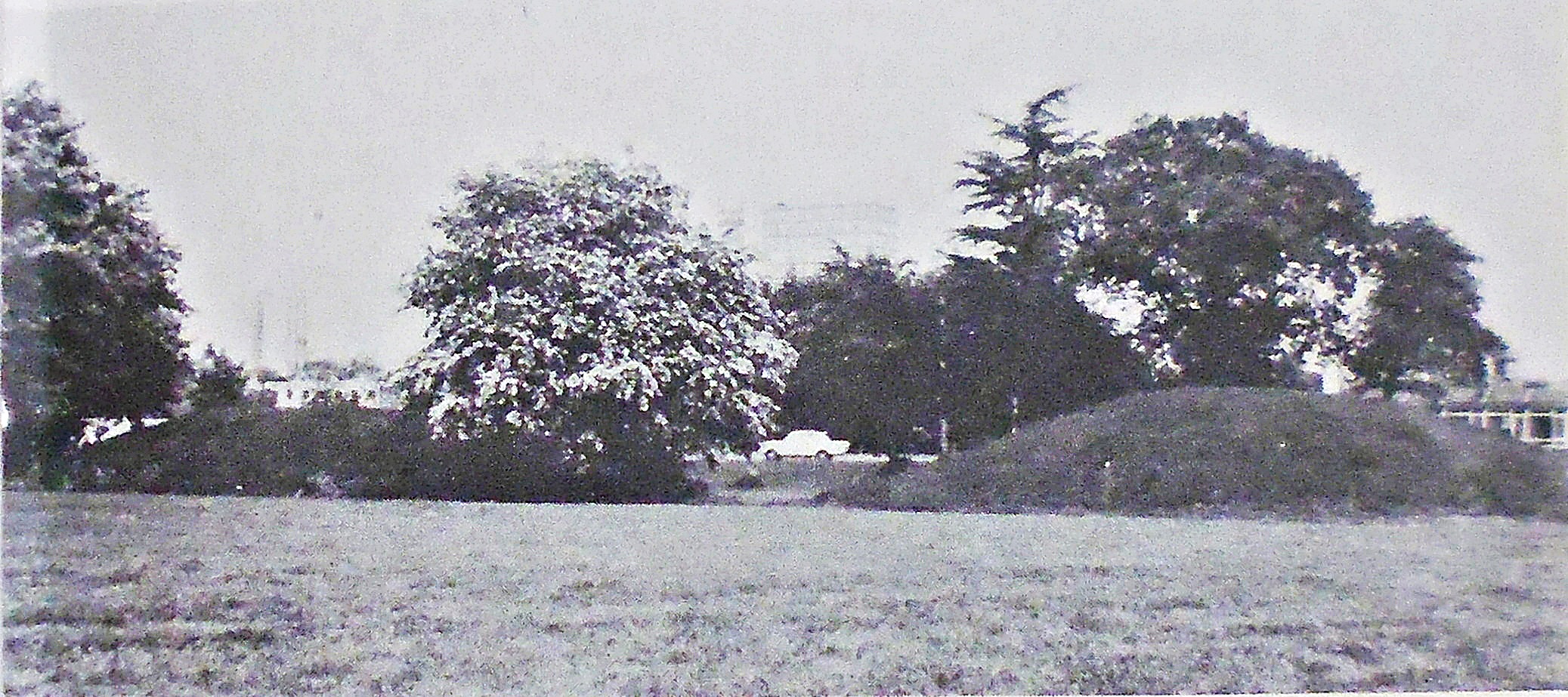
The Six Hill (Roman Barrows), Stevenage in Hertfordshire.
Peter Clayton, writing in 1976, says: “One does not generally expect to find ancient sites in the middle of a new town like Stevenage but, curiously enough, there beside the Roman road to the north (now the A1(M)) are six barrows. They are known as the Six Hills, and have an average diameter of 60 ft and are around 10 ft high. Of Roman date, it is known that some of them at least were opened in 1741 by Dr Ducarel, who only found some wood and pieces of iron. Their interest really lies in their strange juxtaposition with modern blocks of glass and concrete: they form an oasis of calm in the centre of heavy traffic.”
James Dyer, writing in 1977, tells us more about the site, saying: “Dr Ducarel and his friends who opened the Six Hills (or Six Boroughs) in September 1741 would have been amazed to find them as they are today, isolated by the rushing traffic to the north. The barrows average 3.1 m high and 18.3 m in diameter, and all except one appear to have been opened at some time in the past. Dr Ducarel ‘found only wood and a piece of iron’. ‘An old man in the town’, he recorded, ‘remembers opening the fourth and finding nothing.”
Jacquetta Hawkes (1975) says of the site that: “By the roadside at Stevenage are the Six Hills, a line of neat round barrows which have lent their name to a famous nursery garden. As their position and steep-sided form might suggest to the wary, these barrows are not prehistoric in age, but mark Roman burials.”
Eric S. Wood’s Field Archaeology work of 1975 adds to the above, saying: “Roman barrows are conical, with steep sides and often flat tops, perhaps to take a memorial stone or post. Only about 100 are known or suspected, the best being in Kent (Holborough Knob), Essex (The Mount, Lexden; the Bartlow Hills, Ashdon), Cambs. and Herts (Six Hills, Stevenage); others occur to the west and north of this area, as far north as Hovingham near Malton (Yorks. NR). Alignments are common along Roman roads. A Roman barrow on Mersea Island, Essex, covered a brick tomb. But look round Roman towns.”
Sources / References and Related Websites:-
Clayton, Peter, Archaeological Sites of Britain, Weidenfeld And Nicolson, London, 1976.
Dyer, James, Southern England: An Archaeological Guide, Faber and Faber Limited, London, 1977.
Hawkes, Jacquetta, A Guide To The Prehistoric And Roman Monuments In England And Wales, Cardinal, London, 1975.
Wood, Eric, S., Field Guide To Archaeology, (Fourth Edition), Collins, London, 1975.
https://en.wikipedia.org/wiki/Six_Hills
https://historicengland.org.uk/listing/the-list/list-entry/1015579
https://www.ourstevenage.org.uk/content/places/the-six-hills/the-six-hills
https://www.aubreyresearch.com/uk/roman-britain/sites/the-six-hills-roman-barrows
© Copyright, Ray Spencer, 2026.


