The Journal Of Antiquities

Ancient Sites In Great Britain & Southern Ireland


Clegyr Boia Hillfort, Near St David’s, Pembrokeshire (Sir Benfro), Wales

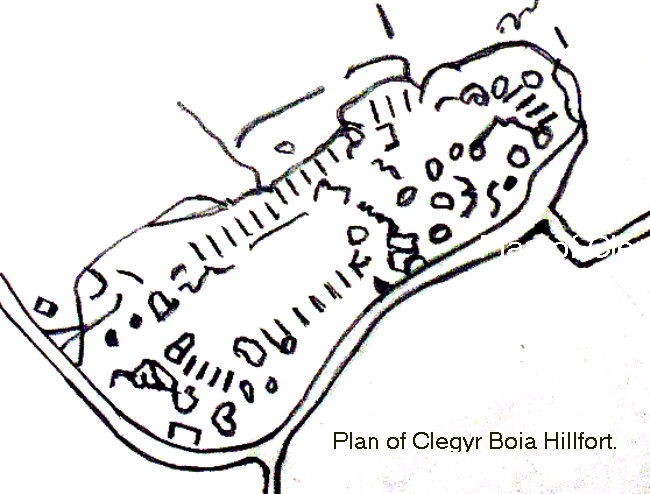
Plan of Clegyr Boia Hillfort, Pembrokeshire.

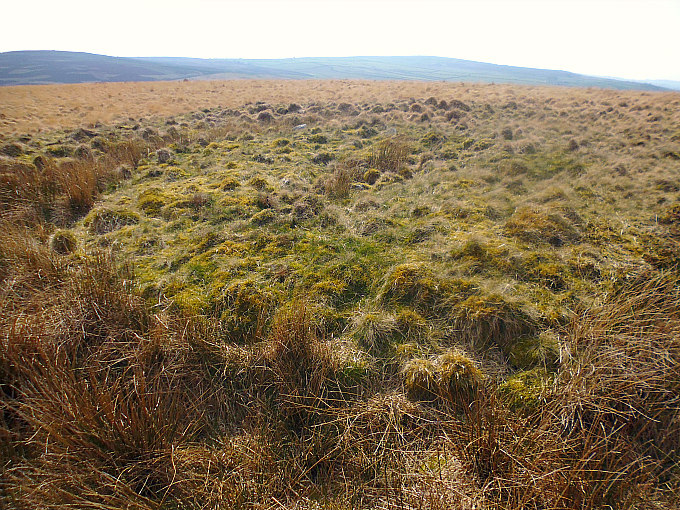
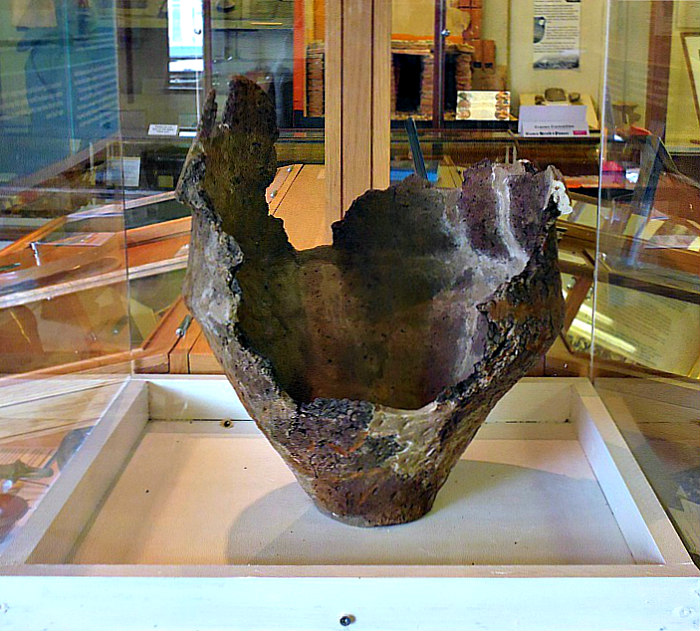
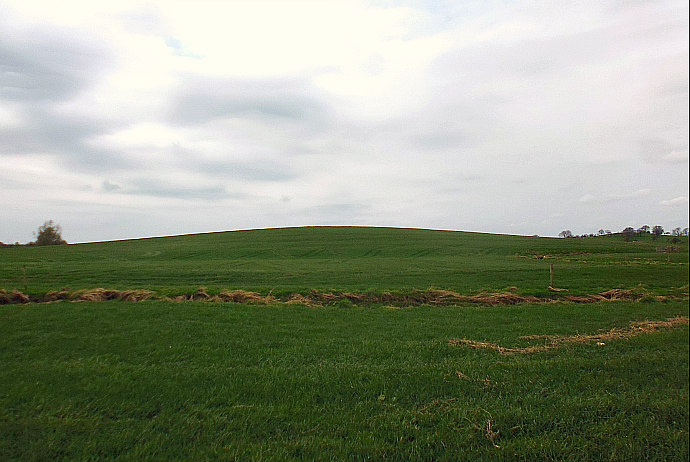
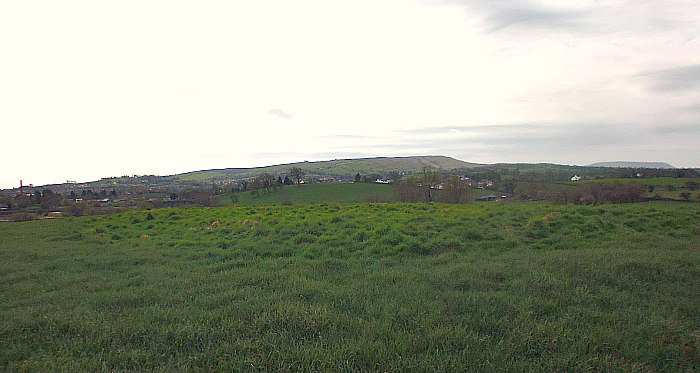
OS Grid Reference: SM 73719 25062. About 1 mile to the west of St David’s, at Nant-Y-Felin, in Pembrokeshire (Sir Benfro), Wales, is the prehistoric hill-top settlement site and hillfort of Clegyr Boia, which derives its name from a 6th Century pirate; however, the place was settled long before that in the Neolithic Age, and continued to be settled, in one way or another, up until the Dark Ages. The rectangular-shaped hillfort and earlier Neolithic settlement occupy the summit of this small rocky hill (named after an Irish pirate leader called Boia) and are enclosed by ramparts that join up with the existing rock outcrops – forming a secure, defensive site. Legend tells that the fort was destroyed by fire. Archaeological excavations took place on Clegyr Boia in the early 1900s and, more recently in the 1970s. There are two holy wells: one being Ffynnon Dunawd and, at the southwest side, there is Ffynnon Llygaid. From the western side of St David’s: take Pit Street and then Feidr Treginnis road until you see the hillfort in front of you. At least two footpaths lead up to the hillfort from the lane.

Timothy Darvill (1988) tells us that: “The rocky summit of this steep-sided hill on the coastal plain of south-west Dyfed was first occupied in early Neolithic times, and is one of the largest settlements of the period in Wales.

“About 3800BC, at least two rectangular houses stood on the hilltop. Their occupants were probably cattle farmers, and in addition to the large quantity of pottery recovered there were flint tools and polished stone axeheads made from locally outcropping rocks. Whether this settlement was defended is not known, but in Iron Age times a substantial rampart, which still stands 1m high, encircled most of the hilltop. The entrance, fortified with a long entrance tunnel, lay at the south-west corner of the site.”

Darvill adds that: “Legend attributes the site to Boia, an Irish pirate of the 6th century AD. Boia’s wife apparently sacrificed her stepdaughter Dunawd to heathen gods but on the same night Boia himself was slain by a second pirate, named Lisci, and his castle was consumed by fire from heaven.”  

Chris Barber (1987) says that: “This small fort is situated on the summit of a large mass of igneous rock which rises about 45 feet above the surrounding farmland and is roughly 320 feet long by 100 feet wide. ……the summit has been fortified by a bank of stones mingled with earth. Originally, the bank would have been faced on both sides with large slabs set on end, in a similar fashion to the camp of Bwrdd Arthur on Anglesey. Most of the facing stones at Clegyr Boia have been removed for building purposes, but some still remain in place.

“The camp is roughly a rectangular parallelogram with an outpost on the north-eastern extremity. The interior of the main camp and the annexe have been hollowed out, and these excavations have, of course, provided the stone and earth to build the ramparts. In the sixth century the site was occupied by Boia, a Gwyddel chief who gave St David considerable problems, although the latter eventually dealt with him by causing fire to fall from heaven and consume the fortress. There is reputed to be a well here that is a small hollow in the rock, just large enough for a fist to be inserted. It is claimed that the water is good for soothing sore eyes.” 

Children & Nash (2002) tell us more, saying that: “Clegyr Boia is set within rectangular ramparts, measuring 100m by 25m, that may be of Iron Age date. The settlement, excavated in 1943, consists of two Neolithic house structures, a fire pit and a midden (Williams, 1953, 24-9). An earlier excavation revealed a possible third hut, located centrally within the rampart area (Baring-Gould, 1903). Outside the settlement area, a large number of Mesolithic flint scatters suggest continuous occupation of the peninsula for well over 4,000 years.

“One of the houses is oval, the other rectangular. The rectangular structure (7m by 3m) comprised two rows of posts, which may have supported a timber roof. An “unused pit” investigated inside this structure by Audrey Williams was compared by the excavator to similar pits discovered under the Pentre Ifan monument. She also suggested a link between the two sites on the basis of pottery evidence.

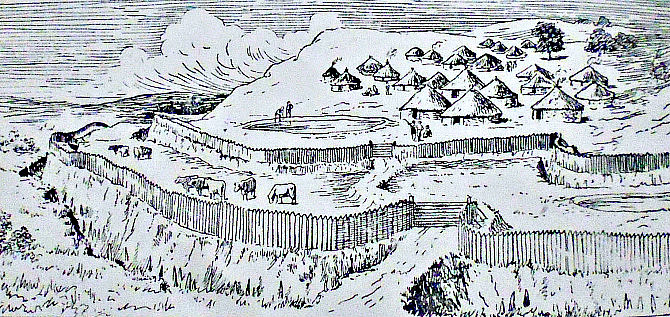
* Drawing of a typical Neolithic hill settlement.

Children & Nash go on to tell that: “The oval hut yielded evidence of extensive burning. Barker (1992) has suggested that the burning, plus the deposition of pottery in each of the contexts, indicates possible ritual abandonment. We would argue that the settlement and the two nearby monuments are contemporary, and that the former may have suffered natural abandonment towards the end of the Neolithic, only being re-occupied in the Iron Age. Pottery from the oval hut appears to be identical to examples found in the rectangular structure and in the midden to the west. Three different Neolithic pottery styles have been identified in all, and are similar to wares found in Cornwall, Southern Ireland and the Wessex region. The evidence suggests that a possible exchange network linked these areas. Barker (1992) proposes a Middle Neolithic (4,300 to 3,300 BC) date for the pottery from Clegyr Boia. Recovered from the floors of two huts were shouldered bowls, a number of animal bones, mainly of wild cattle, and limpet shells. 

“A series of hearths to the west of the oval hut yielded a flint arrow-head and a partly-polished stone axe of gritty volcanic tuff (Houlder, 1988). Limpet shells, pottery, and oak and birch charcoal were recovered from the midden. Cattle bone was found in both huts. The bone, together with the shells, suggest that the people of Clegyr Boia existed on a mixed economy of hunting/gathering/fishing with an element of domesticated herding. The settlement may have supported only two or three small family units at any one time.”  

Christopher Houlder (1978) adds to the above saying that: “The rocky summit of a small hill has been enclosed by ramparts joining outcrops to form a secure Iron Age dwelling site, for which precise dating evidence was lacking in excavation. Important Neolithic remains included the substantial rectangular house of a group of cattle farmers, whose pottery indicates an Irish connection in the third millennium B.C.”

Sources / References & Related websites:-

*Airne, C. W, M.A. (Cantab.), The Story of Prehistoric & Roman Britain — Told in Pictures, Sankey, Hudson & Co. Ltd., Manchester.

Barber, Chris, More Mysterious Wales, Paladin, London, 1987. 

Children, George & Nash, George, Monuments In The Landscape . Volume 5 — Neolithic Sites of Cardiganshire Carmarthenshire & Pembrokeshire, Logaston Press, Little Logaston Woonton Almeley, Herefordshire, 2002.

Darvill, Timothy, AA Glovebox Guide — Ancient Britain, Publishing Division of the Automobile Association, Basingstoke, Hampshire, 1988.

Houlder, Christopher, Wales: An Archaeological Guide, Faber & Faber, London, 1978. 

https://en.wikipedia.org/wiki/Clegyr_Boia

https://ancientmonuments.uk/128978-clegyr-boia-camp-st-davids-and-the-cathedral-close#.XT4mhlLsZjo

https://www.megalithic.co.uk/article.php?sid=5988

https://getoutside.ordnancesurvey.co.uk/local/clegyr-boia-pembrokeshire-sir-benfro

https://coflein.gov.uk/en/site/305389/details/clegyr-boia

© Ray Spencer, The Journal of Antiquities, 2019.

Greenberfield Lane Cup-Marked Stones, near Barnoldswick, Lancashire

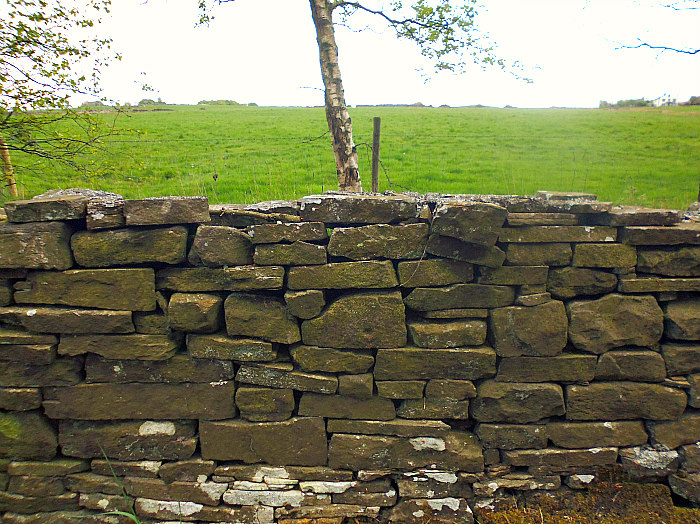
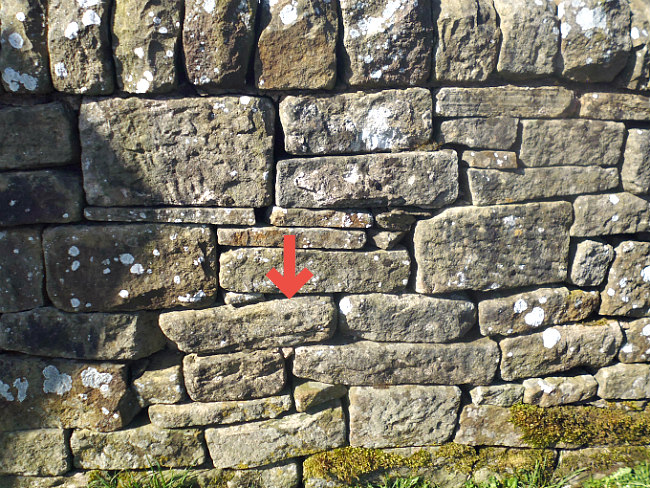
Cup-marked stone on Greenberfield Lane. Red arrow marks the spot.

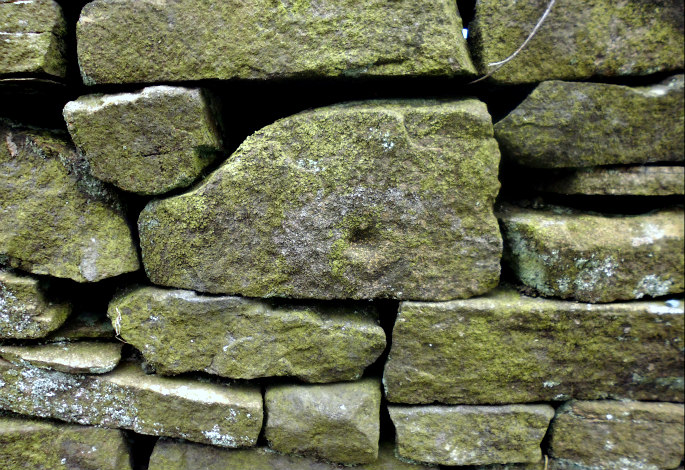
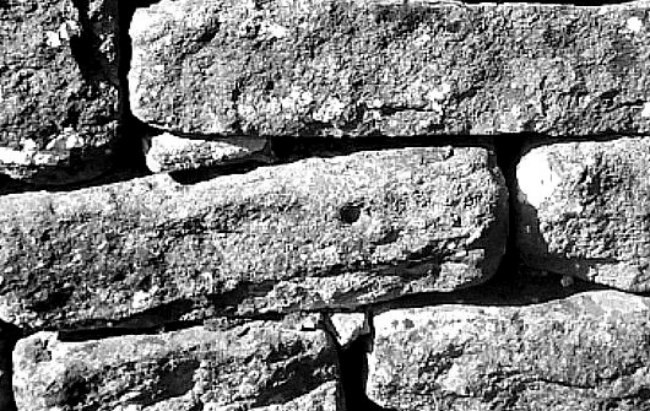
Cup-marked stone beside Greenberfield Lane, Barnoldswick.

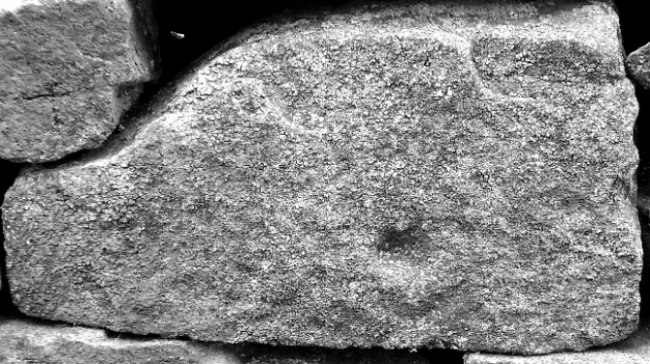
NGR: SD 8852 4806. A “new find” and “an unrecorded carving” in the wall at the side of Greenberfield Lane, near Barnoldswick, Lancashire. It is a tiny cup-mark, but it is very easily missed; and there is another “possible” cup-marked stone in the wall further along the lane on the opposite side. There is a carpark at Green-berfield Locks on the Leeds & Liverpool Canal. So where did these carved stones come from? The tiny cup-marked stone is located just past Greenberfield farm (with the large glacial erratic boulder by the side of the entrance) and the nice farmhouse (with a smaller boulder in front of it). There doesn’t appear to be a ring carving around this tiny cup-mark but, if there is it’s very, very faint, though the more I look at the photo the more I think there might be!

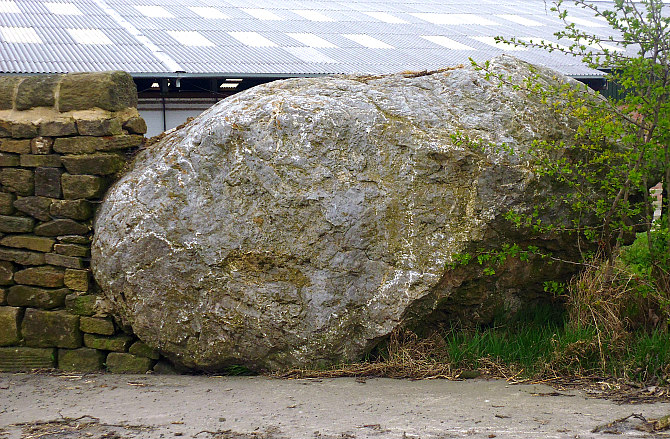
Glacial boulder beside the entrance to Greenberfield farm.

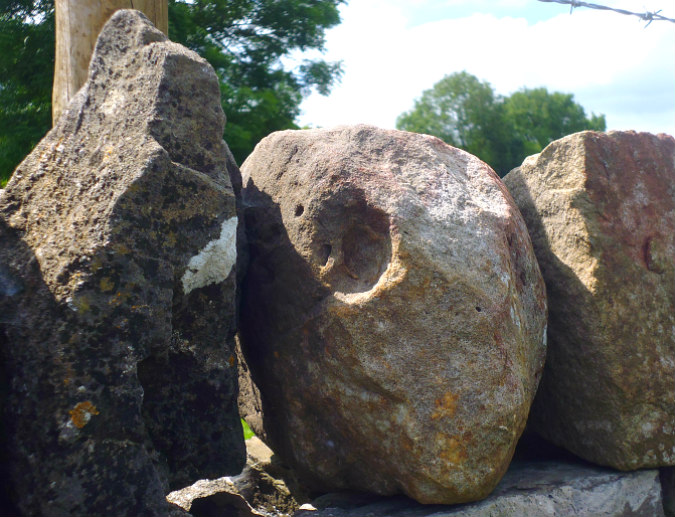
“Possible” cup-marked stone beside Greenberfield Lane,

The second stone is located a little to the southwest at (NGR: SD 8847 4802) and is on the top of the wall further along on the op-posite side of the lane. This is a smooth round-shaped stone with   a well-pronounced circular hole, but whether it is a cup-mark carving is uncertain. It could be a hole left by a fossil that has dropped out, or it could be some Geological feature? At certain angles though it does look like a prehistoric cup-mark. Whatever it is, it is a very interesting stone. There are other round-shaped stones along the top of the wall. The large glacial erratic boulder (mentioned earlier, above) is between 4 and 5 foot high, and was dug out of the boulder-clay (10 foot deep) by a 13 ton digger when the new farm building (where the cows are milked) was under construction, and had not seen the light of day since the last Ice Age. The smaller boulder (in front of the farmhouse) was probably dug out of the ground around the same time. Greenberfield lies within ‘the Craven lowland drumlin field’, according to Nick Livsey.

Thanks to Nick Livsey for the above information.

https://www.visitlancashire.com/things-to-do/greenberfield-picnic-site-p561340

© Ray Spencer, The Journal of Antiquities, 2019.


Roman Altar-Stone in All Saints Church, Wigan, Lancashire

Roman-Altar Stone in All Saints Church, Wigan, Lancashire.

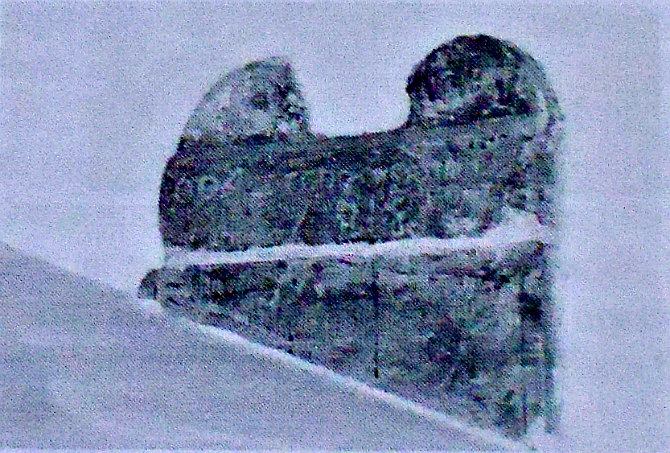
NGR: SD 58168 05667. All Saints parish church on Bishopgate, Wigan, Lancashire, houses part    of a Roman altar-stone that is said to have come from the Roman station of COCCIUM (COCCIO) – Wigan, which was probably built in 70 AD, and was located on the hill where the parish church now stands. There is no trace of this roman fort or camp today – the parish church of All Saints taking its place. The altar-stone, which has curved, scroll-like features at each end, has a 17th century inscription on its visible side whereas a Latin inscription on the opposite side is ‘not visible’. It was probably dedicated to the Roman god Mithras. A “presumed” Roman road runs west from MAMVCIVM (Manchester), converging in the centre of the town and then running northwest to Walton-le-Dale, while another Roman road runs south from Wigan towards Warrington, Wilderspool and on to Northwich (CONDATE). A Roman bath-house has recently been excavated where the Shopping Arcade now stands in the town centre. All Saints church, a mid 19th Century building, is easy to find at the southeast corner of Bishopgate, just off Market Street, in Wallgate, and opposite the War Memorial. 

The Church guide book says of the Roman altar, that: “Of special interest under the Tower are the window in the west wall which, though much restored, dates from the 13th century, and part of a pagan Roman Altar which is built into the splay of the east side of the modern window in the north wall. It was found in the rebuilding of 1845-1850 buried beneath the High Altar and was placed in its present position then. It is unfortunately only partly visible, so that it is impossible to tell whether it has a Roman inscription on the hidden side. On the exposed face is a half obliterated modern inscription, dated 1604. It was probably used in the Roman station of Coccium, which can almost certainly be identified with modern Wigan, and which probably stood on the hill now occupied by the parish church.” 

D. C. A. Shotter (1973) tells about the Roman site of Coccium, saying: “The next site northwards in probably Wigan, although no structural remains of Roman occupation have been found there. The chief evidence for the existence of a Roman site under the present town comes from Route 10 of the Antonine Itinerary, which gives distances on a route from Ravenglass (Cumberland) to Whitchurch (Shropshire). The middle section of this route is given as GALACUM (probably Burrow in Lonsdale). BREMETENNACUM (certainly Ribchester), COCCIUM and MAMUCIUM (almost certainly Manchester). The distances given are too great to refer to any settlement between Ribchester and Manchester on the direct route, but they will fit a route that runs from Ribchester to the Coastal road at its junction in Ribblesdale, then south to Wigan, and thence to Manchester on the road attested by the 19th Century observers. Thus Wigan would provide an identification for the elusive site of COCCIUM, and in Roman times it will have been entered from the South, the East and the North respectively by Wallgate, Millgate and Standishgate.

“Further evidence comes from the finds made in and around Wigan. To judge from cinerary urns recovered from the area of the gas works, a cemetery appears to have lain on the South side; the Church has a Roman altar built into it; further, various coins have been found in the area, including a hoard of some 200 coins recovered in Standish in the late 17th Century; this hoard contained coins from the late 1st to the mid-3rd Century A.D. Another important find, this time from Dalton (five miles north-west of Wigan) is the headless statue of Cautopates………, one of the attendants of the god, Mithras.” 

Joseph P. Pearce (2005) says that: “Here, on the rising land within a loop of the river Douglas, the Roman Conquerors of Britain have founded their camp and castlefield. The Roman road leading from Warrington to Preston and Walton-le-Dale, passed through the very centre of the town of Wigan, bearing the traffic of the Legions and the Guilds and Trades of old. Four streets radiate from the Market Place—Standishgate, Wallgate, Millgate, and Hallgate; all bearing a Roman stamp. A stone from a Roman altar has been found, embedded within the walls of Wigan Church. Here the Romans ruled until that day when Rome, herself, was beset by barbarian hordes. Then the Roman soldiers were withdrawn from Britain and the ancient British race was left to the cruel mercy of the Norsemen.”

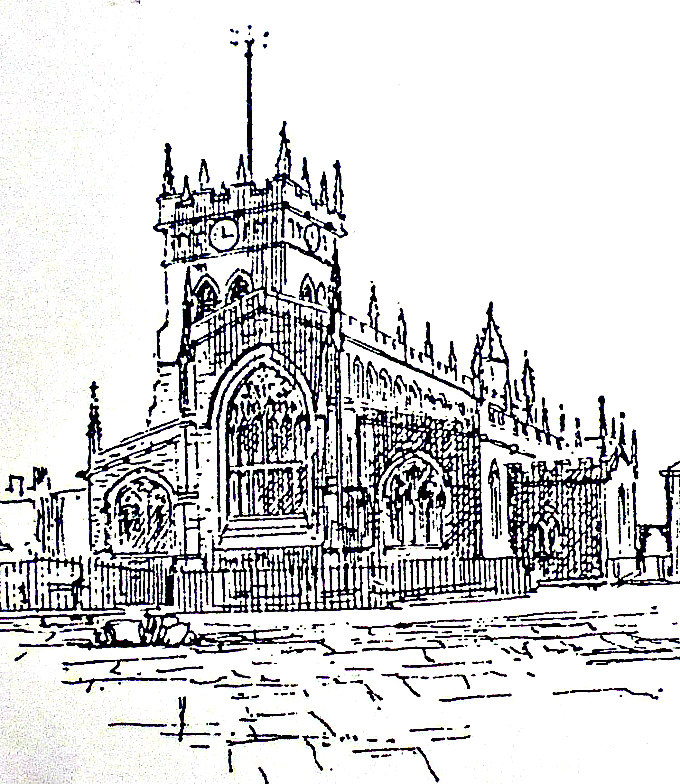
All Saints Church, Wallgate, Wigan, Lancashire.

Besides the Roman stone there are other interesting features in All Saints. In the Crawford Chapel   is a tomb with recumbent and battered effigies of Lady Mabel de Bradshaw of Haigh Hall and her husband William, a now rather forlorn and somber monument that has stood here since the 14th century. Lady Mabel is the heroine of the famous Wigan Cross or Mab’s Cross in Standishgate, which dates back to 1338 when it was set up by Mabel, a saintly and charitable lady…… who endowed her chapel with property in Haigh and Wigan to enable a priest to celebrate divine service at the Altar of the Blessed Virgin Mary in Wigan Church, remembering especially the souls of herself after death, King Edward II, her husband, Sir William, her parents and all her ancestors, Roger, then Bishop of Coventry and Lichfield, and all the faithful departed, says the Church guide book. The very ornate font in the south aisle is 14th-15th Century and its large gritstone bowl can be seen close-by. It has a band of quarter foils run-ning around its outer surface; apparently this was in use as a water butt in the gardens of the hall before being being restored   to the church.

And finally, there was at one time in the past a school of thought indicating perhaps that the Roman station of Coccium was located on Castle Hill, 3 miles east of Wigan, at Hindley, in Lancashire (NGR: SD 62460485). However, this thought, account, or suggestion now seems to have been ‘completely discounted’, and is not the case with Coccium, which is nowadays considered to have been where the parish church of All Saints is now to be found in Wigan town centre. There was, however, a Medieval structure on Castle Hill, at Hindley, which was probably a timber castle.

The Historic England List Entry No. is:- 1384556.

Sources / References and related websites:-

Church guide book, The Parish Church of All Saints, Wigan — A Short History and Guide, 2003. The two images (above) are from this guide.

Pearce, Joseph P., Lancashire Legends, Book Clearence Centre, Wigan, 2005. (Originally published by The Ormskirk Advertiser, 1928. This edition is re-published with the kind permission of the Liverpool Daily Post & Echo Group).

Shotter, D. C. A., Romans in Lancashire, Dalesman Publishing Company Ltd, Clapham, Yorkshire, 1973. 

Mab’s Cross, Standishgate, Wigan, Lancashire

https://en.wikipedia.org/wiki/All_Saints%27_Church,_Wigan

https://historicengland.org.uk/listing/the-list/list-entry/1384556

https://www.british-history.ac.uk/vch/lancs/vol4/pp57-68

http://www.wiganarchsoc.co.uk/content/Projects/Millgate/wbe1.html

http://www.wiganarchsoc.co.uk/blog/?page_id=420

© Ray Spencer, The Journal of Antiquities, 2019.

2 Comments

St Peter’s Churchyard Cross, Stoke-on-Trent, Staffordshire

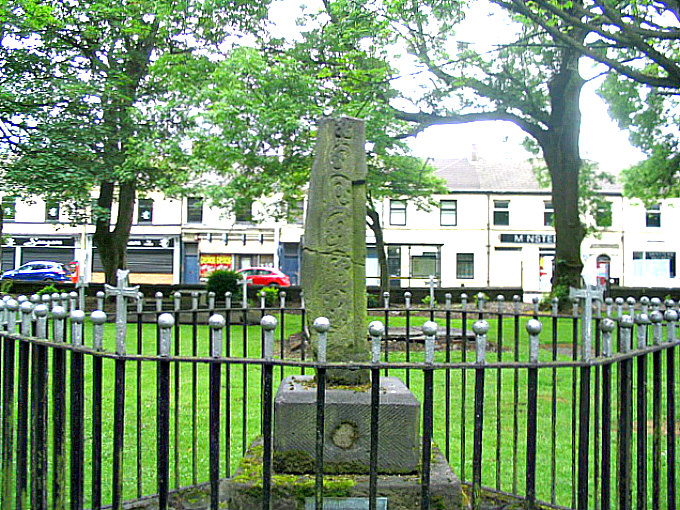
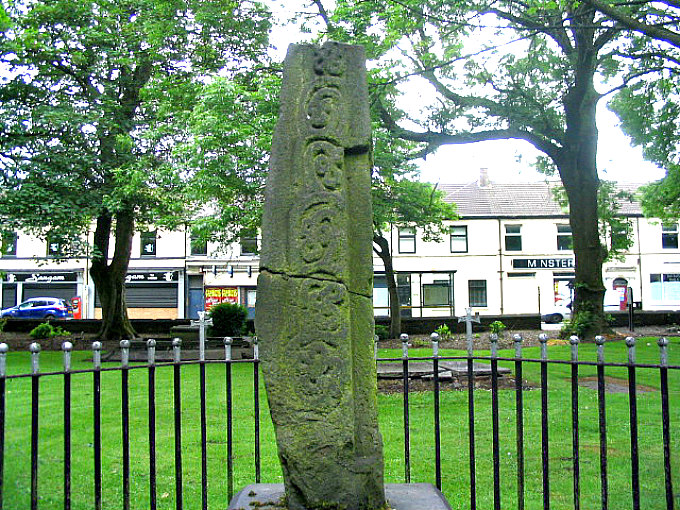
Cross in the churchyard of St Peter’s Minster, Stoke-on-Trent. Front.

Saxon Cross, Stoke-on- Trent.

NGR: SJ 87931 45213. In the grassy graveyard of St Peter’s Minster on Glebe Street, Stoke-on-Trent, Staffordshire, are the remains of a Mercian cross-shaft on a stepped base, dating from the 10th century AD, although some historians think it might date from the 8th-9th century? The actual name and dedication of the Minster church is St Peter’s Ad Vincular (St Peter in Chains). There is visible decoration on the shaft of this preaching cross although it is now rather worn and weather-beaten, and there are cracks from previous damage. It is a Saxon cross, that is a certainty, the area itself being part of the Old Saxon Kingdom of Mercia; and the first church here (and indeed the cross) were of wood. This 7th Century church was probably associated with St Chad, bishop of Lichfield. The building that is now the minster was built in the 19th Century. The site can be reached from the centre of Stoke. Head west onto Glebe Street and a few hundred yards south of the town hall is St Peter’s Minster and its large graveyard; the cross stands on a stepped base behind modern iron railings.

Mercian cross-shaft in St Peter’s churchyard, Stoke. Front face.

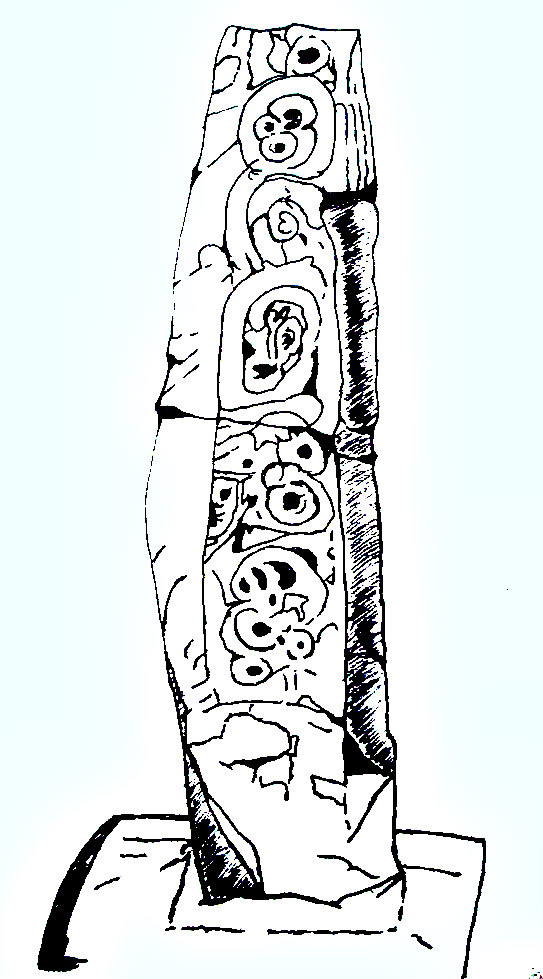
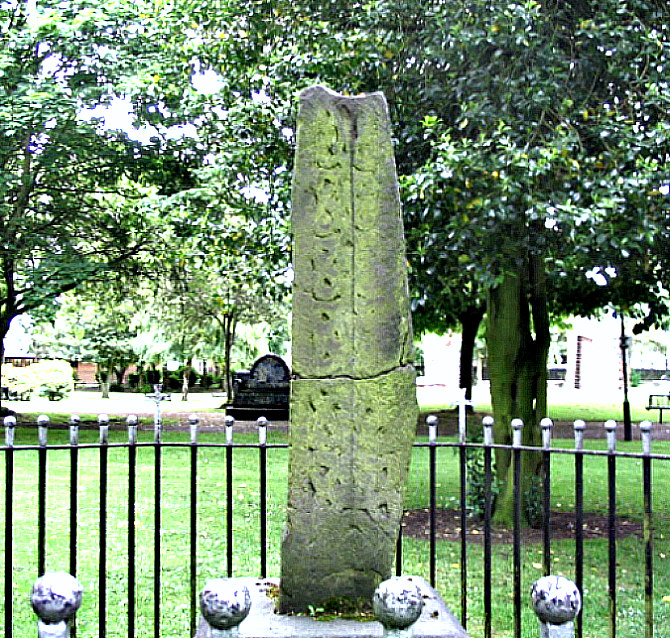
The cross-shaft, without its cross-head if it ever had one, stands 4 feet high (1.3m) in a socketed stone upon a base of two chunky steps, which are probably of a 19th Century date, though the cross itself is probably 10th Century or a few hundred years before that. The monument is set within a paved surround. It is said to stand on, or near, the site of a wooden cross from which St Chad is said to have preached in the 7th Century. Sadly the shaft is quite worn with the carvings on one side being difficult to make out, but the front face has long vine scrolls and interlacing and, on the sides there looks to be some key-patterning, while the reverse side has a lot of knotwork and interlacing and, a series of holes that might have been done in recent times? The break across the middle of the shaft can clearly be seen but this does not detract from its great antiquity; the monument being carefully restored. At the base an inscription reads: ‘This fragment of a pre-Norman cross identified by Chas Lynam F.S.A. was re-erected near to its original position in the 25th year of the reign of H.M. King George V by P.W.L. Adams F.S.A.’ The cross-shaft is a Grade II listed monument.

There is a story or tale coming from St Peter’s Church that says the cross-shaft was discovered in 1876 by a gravedigger who spotted it being used as a door lintel inside the old church, which was being demolished to make way for a newer church building. During its recovery the shaft broke in two so it was placed in storage, but in 1935 it was formally identified by Mr Charles Lynam who had it restored and re-erected in the churchyard.

Doug Pickford (1994) tells us more about the site, saying: “At Stoke itself, meaning a fortified stockade, and the collective name so often (wrongly) given to this area there is the Church of St Peter and nearby is the base and trunk of an ancient preaching cross. Was this cross, I wonder, a stone monolith before it was used for preaching. Perhaps in earlier times it was used for praying to, not preaching from. Stoke was most probably a fortified place holding out from the old Britons who took refuge in the high Staffordshire moorlands.”

The very large Minster churchyard also has some re-erected stone arches from an earlier church; and amongst the many in-teresting graves there is the one of Josiah Wedgwood of Burslem and Etruria (1730-1795) the famous master potter; another of Josiah Spode of Stoke-on-Trent (1733-1797) who was also a famous pottery manufacturer, and the grave of Charles Bourne (1775-1836) the pottery manufacturer of Fenton. There is also a commemorative ceramic (mosaic) seat in the churchyard, which was installed in 2000.

Mercian cross at Stoke- on-Trent (reverse side).

The earliest origins of Stoke-upon-Trent go back to at least 800 AD, but probably further back to the 7th Century. It would seem the Saxon name was Stoiche or Stoche – a stockade, but there was no mention of the Church of Stoke in Domesday, though there was a brief mention of it in ‘The description of Caverswall’. The name and its probable meaning have been considered to be: ‘the place of the church’, ‘place by or next to a church’, or ‘settlement beside a church’; the latter name being the most likely. In St Peter’s Minster can be seen a baptismal font that was in use as a garden ornament. It is thought to be of Saxon origins. In 1932 it was restored and put back into use in the church. Also in St Peter’s there are a number of monuments and marble memorial tablets to the ‘great-and-the-good’ of Stoke-on-Trent’s pottery manufacturing history, which brought about, and shaped the Industrial Revolution in the Potteries of North Staffordshire.

Adrian Room (1993) adds more, saying: “This well-known city has a basic name derived from the Old English stoc (place), as considered for STOKE-BY- NAYLAND. It is more likely that the meaning here is ‘dependent settlement’, as there is no evi-dence for the latter sense. The addition of the river name distinguishes this Stoke from the hundreds of others. The name of this city, perhaps the best known example, was recorded as Stoche in the Domesday Book.” 

The PastScape monument no is: 75813.

Sources & References:-

Pickford, Doug, Staffordshire — Its Magic & Mystery, Sigma Leisure, Wilmslow, Cheshire, 1994.

Room, Adrian, Dictionary Of Place-Names In The British Isles, Blitz Editions (Bookmart Limited), Enderby, Leicester, 1993.

https://en.wikipedia.org/wiki/Stoke_Minster

St. Peter’s Cross, Stoke-on-Trent, Staffordshire

https://historicengland.org.uk/services-skills/education/educational-images/cross-fragment-in-st-peters-churchyard-6467

https://www.pastscape.org.uk/hob.aspx?hob_id=75813

http://www.thepotteries.org/listed/124a.html

https://stokeminster.org/heritage

© Ray Spencer, The Journal of Antiquities, 2019.


The Major Oak, Sherwood Forest, Nottinghamshire

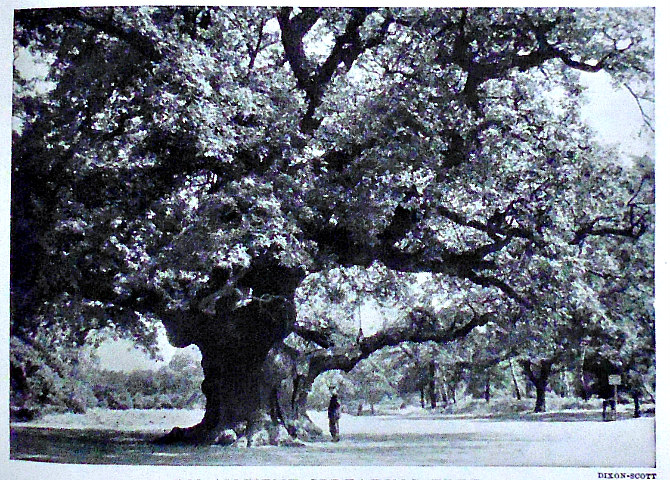
The Major Oak in Sherwood Forest, Nottinghamshire.*

NGR:- SK 62048 67908. In Sherwood Forest Country Park, beside Robin Hood’s Way, ½ a mile north of Edwinstowe, in Nottinghamshire, is the much-photographed ‘Major Oak’, an ancient English oak tree that has stood here for many hundreds of years and, according to legend, it gave shelter to the outlaw Robin Hood, the much talked about legendary figure of Sherwood Forest and Nottingham.  According to legend Robin and Maid Marian were married in Edwinstowe Church. This giant English oak tree was originally called ‘The Great Oak’ and ‘Queen’s Oak’, but in 1806 it was renamed after a well-known military man of local repute. It has a huge girth and an equally great height though it has often proved difficult to measure exactly. The Major Oak has over the centuries been a place to meet and gather for local people, and in more recent times a place to ‘sit beneath’ and be photographed! At the northeastern side of Edwinstowe: take either of two footpaths running northwest (through Sherwood Forest) for a ¼ of a mile or so from the B6034. The tree stands on Broad Drive which is also called Robin Hood’s Way.

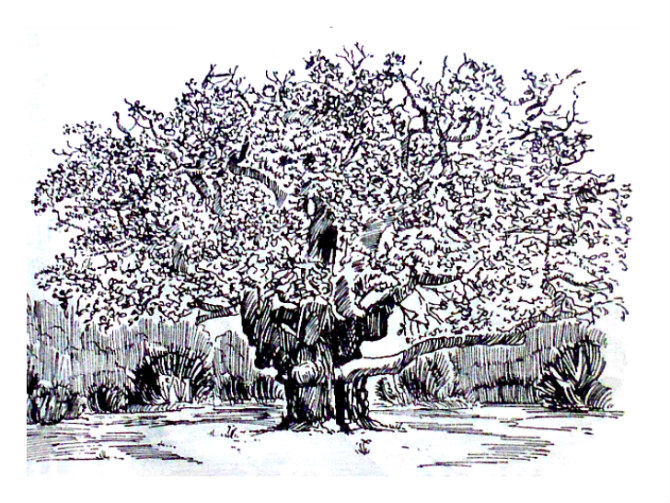
The Major Oak in Sherwood Forest (Drawing).+

The Major Oak, Great Oak, Queen’s Oak or Cockpen Tree has probably stood here in Sherwood Forest for 1,000 years. This Pedunculate oak is a native English oak tree with the Latin name ‘Quercus Robur’; the peduncles being its longish stalks carrying the acorns. It is distinguished from sessile oak by its spreading rather than ascending branches, leaves with rounded bases on short stalks and acorns on long stalks or peduncles, according to The Woodland Trust (2007). Measuring the tree has always proved to be difficult.  Its circumference (girth) is said to be somewhere between 30-33 feet (9-10.5m) and its height in the region of 52 feet (16m), and it weighs in at 23 tons (how did they manage to work that one out). Its canopy is said to extend outwards by 92 feet (28m); many of its large branches are now supported by wooden stakes. Down the years many local people have sheltered, and had their photo taken, beneath this famous oak tree, but back in the mists of time the legendary outlaw Robin Hood and his Merry Men hid beneath its bows – no doubt hiding from the Sheriff of Nottingham’s soldiers, or the infamous Sir Guy of Gisborne! 

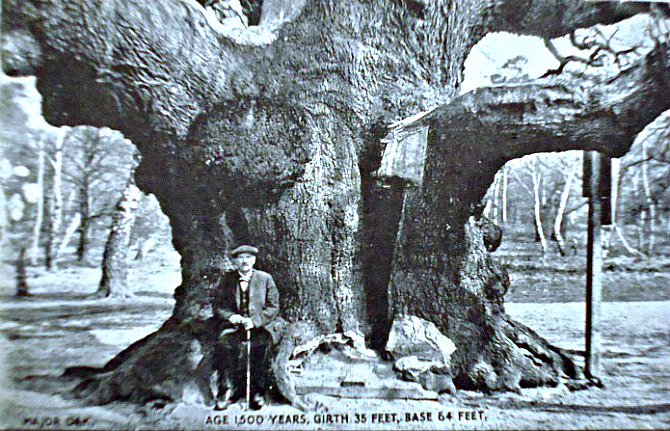
Garry Hogg (1968) says of the site that it is: “off B6034, half a mile north of Edwinstowe. A five-minute walk through Sher-wood Forest leads you to this extraordinary survivor. It is the largest, if not the tallest, tree in the country. It is a Samson among oaks, forty to fifty feet in girth at breast height, half as much again at ground level, its lower boughs as massive as many an oak-tree bole. A dozen and more people can be accommodated at once within its lightning-blasted shell. It is claimed to be at least six centuries old; certainly it exudes an aura of antiquity that seems to date it back well beyond the age of the baronial castle and the pele towers of the Border.”  

Old B/w Postcard: The Major Oak, and its guardian (seated).

Pat Mayfield (1976) tells of Sherwood Forest, saying: “Many people looked upon the trees within the forest of Sherwood as being immortal, and indeed they must have seemed so, for where our lives might be expected to be counted in tens of years the trees’ lives could be counted in hundreds. More especially was this so because the majority of the trees in Sherwood were in fact oaks and grew to an enormous size and age. I have heard many visitors express their disappointment at the present size of Sherwood Forest, and this must seem to them a very little forest when compared with the days of the legendary Robin Hood. What most people forget to take into account is the fact England is now much more highly populated than it was in those days, and that we have also had the industrial revolution and coal mining brought onto the scene, for which both labour and houses were required. For these reasons trees were cut down fairly extensively, and the forests which once covered the whole of central England have now dwindled to a few hundred acres. Fire, too, has played its part in the destruction of the forest, but nevertheless we do have at least some of it left to remind us of days gone by.”  

Mayfield adds that: “The Major Oak, as it is now called, is reached by the footpath which starts at the Edwinstowe corner of the forest. It was once known as the Queen’s Oak, but it was re-named in 1806 after a Major Rooke. The tree is 30 feet in circumference, although many of its heavier boughs now have to be supported by chains.” 

Tom Stephenson (1946) says that the Oak tree has: “Pride of place among British indigenous trees must certainly be given to the oak. Its roots are deeply buried in our history, and it is one of the few undoubted native trees of this island of ours.

“Among the early inhabitants of Britain the oak was always the object of special veneration, and druidical religious rites and primitive courts of justice used to be held under its branches. Later, the oak acquired great importance for the construction of ships. The “wooden walls of England” or “hearts of oak,” as they have been called, were all made from the tough timber of this tree, the angular branches of which were especially conveniently shaped for the frames of wooden ships. 

“The oak is a magnificent, sturdy tree, and develops a huge strong trunk, firmly rooted in the ground, and massive spreading limbs. It is a very long-lived tree and some oaks seem to be almost eternal, century after century having passed over their heads and left them unchanged. Some rugged old veterans are estimated to have lived for over 2,000 years.”  

Sources / References & related websites:-  

Hogg, Garry, Odd Aspects of England, David & Charles (Publishers) Limited, Newton Abbot, Devon, 1968.

Mayfield, Pat, Legends of Nottinghamshire, The Dalesman Publishing Company Ltd., Clapham, North Yorkshire, 1976.

*Stephenson, Tom (Edt.), The Countryside Companion, Odhams Press Limited, London, 1946.

+The AA, The Illustrated Road Book Of England & Wales, The Automobile Association, London, 1961.

The Woodland Trust, Woodland Trees, Autumn Park, Grantham, Lincolnshire, 2007.

https://en.wikipedia.org/wiki/Major_Oak

https://www.nottinghamshire.gov.uk/culture-leisure/country-parks/sherwood-forest/history-of-sherwood-forest-robin-hood-and-major-oak

https://www.visit-nottinghamshire.co.uk/things-to-do/the-major-oak-p586841

https://www.atlasobscura.com/places/major-oak

https://www.treeoftheyear.org/Letosni-rocnik/Velky-dub.aspx

© Ray Spencer, The Journal of Antiquities, 2019.


Coldrum Stones (Long Barrow), Near Trottiscliffe, Kent

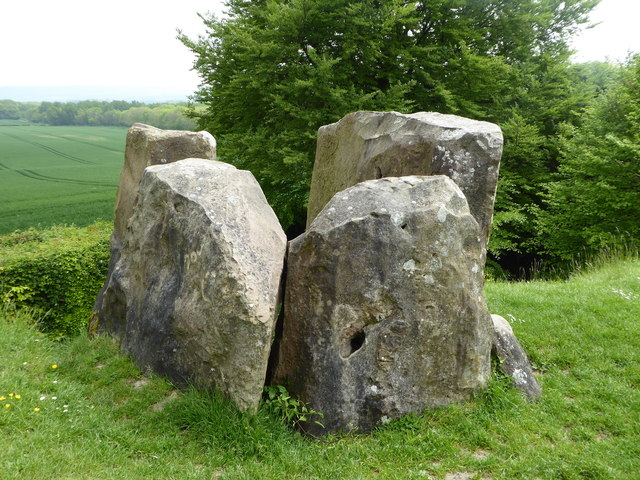
Coldrum Long Barrow, Kent. Photo: pam fray (Creative Commons).

NGR:-TQ 65438 60726. About a ¼ of a mile to the east of St Peter’s & St Paul’s Church, Trottis-cliffe, Kent, stands the megalithic monument known as ‘Coldrum Stones’ or ‘Coldrum Long Barrow’, which dates from the late Neolithic. In the ownership of the National Trust this ancient burial chamber lies at the side of a field, ½ a mile to the south of The Pilgrim’s Way, and over-looking the Medway Gap. The little village of Trottiscliffe which one must go through is known ‘very fondly’ to local people as “Trosley”. The four very large and impressive stones are all that remains of the burial chamber, which would have had a mound over it. In 1910 the structure was excavated and more than 20 individuals were found along with the bones of many animals from around 2,000 BC. At the east side of Trottiscliffe village: drive or walk along Church Lane for ¼ of a mile past the church, then soon turn north on narrow lane to the carpark. Or from the church continue east along Coldrum Lane, then north to the monument. From carpark take footpath east, then south, for a short while to reach Coldrum Stones Ancient Monument, which lies in front of you – more or less.

Christopher John Wright (1981) tells in great detail about: “The Coldrum Stones, or more properly the Coldrum Long Barrow, are the remains of a Neolithic burial chamber. They are today the property of the National Trust, given in 1926 as a memo-rial to the Kentish archaeologist and antiquary Benjamin Harrison (1837-1921), and a bronze plaque mounted on one of the stones near the path records this presentation.

“Once the circle with the dolmen stood complete upon its raised knoll overlooking the Medway Gap—a circle of towering columns 160ft/80m in circumference. Now the eastern half of the knoll is gone, probably when chalk was being excavated or cut away when the road, now no more than a bridlepath, was made. Half the circle has fallen down as a result, but four massive sarsens about 12ft x 10ft/3.6m x 3m stand poised on the brink. The remainder of the circle lie prone in a more or less regular arrangement on top of the knoll—fallen giants of almost equal size strewn across the slope. Even now in its ruined state the monument is impressive and its site, facing the wide river valley, striking.”

Wright goes on to say that: “The remains of 22 Neolithic people, together with some bones of the ox, deer, rabbit, and fox ascribed to the period about 2000 BC were discovered here in 1910, and they were displayed in Trottiscliffe church.

“The Coldrum Stones is a complex megalithic tomb and one of a remarkable group of dolmens found in this part of the Medway valley, between Wrotham and Boxley, described as the ‘Kentish Stonehenge’. These structures were all of Neolithic origin and were, without exception, burial places. The great stones are all sarsens, and are comprised of sand hardened into masses by silica infiltration, the presence of iron often resulting in a yellow-brown staining. The stones are not of any composition quarried locally, and it is possible that they were strewn about during the ice age and collected together to be erected for this purpose.” 

Timothy Darvill (1988) says of the site, that: “Starting west of the River Medway the first site to see is the Coldrum Long Barrow……, probably the best preserved of all the Medway sites. It sits on a low ridge in the shadow of the North Downs and faces east towards the Medway. The mound is slightly wedge shaped, about 20m long, and edged with a ring of rounded sarsen boulders known as peristalith. The chamber at the east end, partly restored, survives as four upright stones forming three sides of a simple box-like structure. Excavations revealed that at least 20 individuals had been buried in it. As visible today, however, the east end of the site has been truncated; originally the ground would have sloped away from the tomb more gently than it does now.”

Darvill (1988) tells of some more nearby megaliths, saying that: “Just over a mile south of Coldrum are a pair of long barrows at Addington. The larger of the two, the Addington Long Barrow [NGR: TQ 654592], lies west of the village and is crossed by the minor road leading to Wrotham Heath. The mound is 60.3m long by 14m wide. Traces of a peristalith and the re-mains of a collapsed chamber at the eastern end can still be seen. About 100m north-west of the Addington Long Barrow is the Chestnuts Long Barrow [NGR: TQ 652592], accessible by asking permission at the house in whose grounds it stands.”

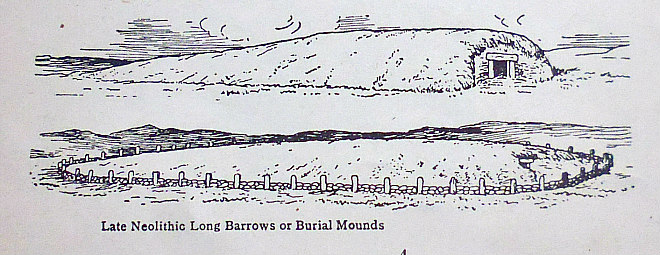
Two examples of Neolithic Long Barrows.

Jacquetta Hawkes (1973) says of the site: “This is a good monument to visit first, for it at once makes clear the general character of all the rest. Coldrum plainly consists of a closed burial-chamber towards the eastern end of a rectangular setting of stones which once enclosed a long mound, now much reduced in size. Unfortunately the huge capstone which should roof the chamber has been lost—but at Kit’s Coty we shall be able to see another example still in position. This chamber was re-excavated in 1910, and the bones found in it were for a time almost the only surviving relics from any of these Kentish graves; in 1940 the museum of the Royal College of Surgeons in which most of them lay was completely destroyed by a bomb. The remains of many individuals, including babies, were identified; one skull, belonging either to the most important or the most recently buried corpse, was found resting on a stone shelf supported by two blocks of ironstone. The skeletons were recognized as belonging to a small, long-haired people of the kind which in the past it was permissible to call Mediterranean. Nowadays one has to be more cautious.”   

Janet & Colin Bord (1994) say: “A ley 4½ miles length was surveyed in Kent by Paul Devereux, editor of The Ley Hunter magazine, and he found that there was a legend of a tunnel connecting Coldrum barrow with Trottiscliffe church, following the line of the ley. The legend also said that there was hidden treasure in the tunnel, a feature also found in other similar tales, which could refer to the power or energy flowing along the ley.”

Sources / References & Related Websites:-

Airne, C. W, M.A. (Cantab.), The Story Of Prehistoric & Roman Britain — Told In Pictures, Sankey, Hudson & Co. Ltd., Manchester,

Bord, Janet & Colin, Ancient Mysteries of Britain, Diamond Books, Birkenhead, 1994.

Darvill, Timothy, GloveBox Guide — Ancient Britain, The Automobile Association (Publishing Division), Basingstoke, Hampshire, 1988.

Hawkes, Jacquetta, A Guide To The Prehistoric And Roman Monuments In England And Wales, Cardinal (Sphere Books Ltd.,) London, 1975. 

Wright, Christopher John, A guide to The Pilgrims’ Way and North Downs Way, Constable & Company Ltd., London, 1981.

Photo (top) by pam fray:   https://www.geograph.org.uk/photo/4956966

https://en.wikipedia.org/wiki/Coldrum_Long_Barrow

Kit’s Coty, Walderslade, Kent

https://www.nationaltrust.org.uk/coldrum-long-barrow

https://www.megalithic.co.uk/article.php?sid=359

https://www.atlasobscura.com/places/coldrum-long-barrow

https://www.cantab.net/users/michael.behrend/repubs/j_geomancy/v1n3/pages/bullion_kent.html

© Ray Spencer, The Journal of Antiquities, 2019.

2 Comments

Uncra Roman Fort, near Keighley, West Yorkshire

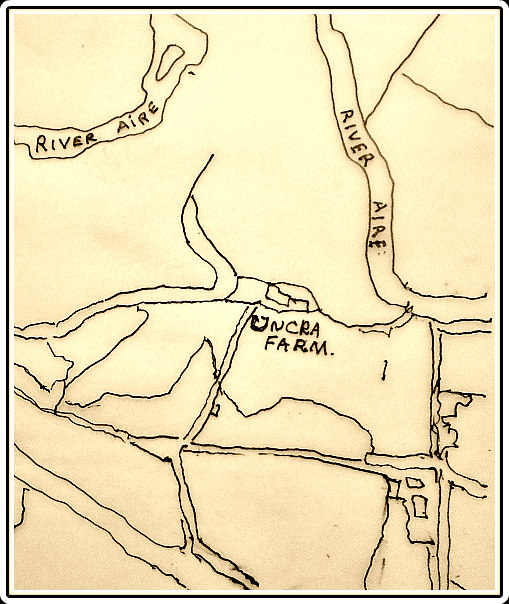
Old Map of Uncra Farm, near Keighley.

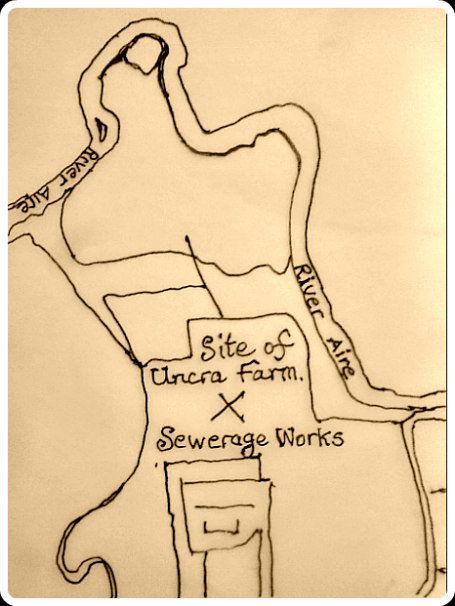
The site of Uncra Farm (today).

NGR:- SE 0858 4142. The lost (forgotten) Roman fort of Uncra was located where the farmstead of that name used to be – close to the bank of the River Aire, and roughly halfway between East Riddlesden Hall and Marley – at the northeastern side of Keighley, West Yorkshire. Uncra farm was said to have been built on the site of the Roman fort or camp. The location of this “lost fort” was in the field at the north side of the present A650, which used to be called Marley Road. However, on the site ‘today’ there is the Marley Sewerage Works, which seems a great shame to me, though the field at the north side might still have slight traces; other than that there are no visible remains. Sadly, it is lost to the Mists of Time. The Roman road from Manchester to Ilkley, or maybe a medieval track, ran through this area and crossed the River Aire by way of a wooden bridge. Fragmentary sections of this, or a later bridge, were excavated in 1929, and a number of Roman coins and, some fragments of a Saxon cross, were found close to East Riddlesden Hall. There is a display of Roman coins in the hall.

Marie Campbell (1999) tells us about this site, saying that: “Long before the River Aire changed its course in about AD 78, a Roman fort is believed to have existed between East Riddlesden and Marley Hall, near Keighley. The road to the fort is thought to have stretched along Hog Holes Lane, Long Lee, cutting along Parkwood Top before its decent to Uncra and Marley. Here it passed over the ford at the River Aire to climb the steep slopes of Morton Banks and beyond. The farmstead of Uncra was supposed to have been erected over the fort’s foundations. From the August pages of the Keighley News 1883 a clue to the site of Uncra Farmstad may be gleaned. Mr F. Morgan, a tenant of Uncra farm, reported smoke rising from a haystack, the property of Mr Wallbank of High Shann Farm. The haystack was in a field by the River Aire, close to his farmstead and bordered by Keighley Corporation tip and local gasworks.”

Campbell goes on to say: “A severe drought in the 1850s at Uncra near Marley revealed an ancient oak and sycamore bridge, 120cms wide and 18 metres across. It rested ‘upon uprights fixed into three blocks of masonry with large-headed nails and wood pegs’. During the 1920s antiquarians digging at the site recovered a large block of stone with a hole in the centre. Masonry dispersed on the water’s edge was thought to be ‘the central pier, the river having changed its course since the bridge was erected’. Horsfall Turner in his History of Ancient Bingley said of Marloe/Marley Bridge. ‘”I have no memo-randum to show this bridge was destroyed”‘. The Sessions Rolls of 1650 to 1700 reveal that, ‘the ford through the water where carts and carriages with wyne and oil and iron pass from the city of York to the market town of Keighley is worn with pitts so as to be very dangerous to passengers’. In January 1687 the wooden bridge was restored at a cost of £230. In 1929 Mr C. Bailey of East Riddlesden Hall granted permission to dig part of the Aire and its banks in this location during a drought. A number of faced stones were found in the mud, about 60cms higher than the course of the river running between Marley and Riddlesden Hall. This was close by the present course of the river near How Beck. Excavations on the North bank uncovered the sycamore central trestle sighted by antiquarians way back in the 1850s. The trestle was removed from the site and presented to Keighley Museum by its finders. It was transferred to Cliffe Castle but has since disappeared, perhaps disintegrating after being dredged from the riverbed. With only obscure references to the existence of the ancient cart ways and bridge to Uncra, had it not been for two very dry spells all may have lain hidden forever from sight.”     

Marie Campbell (1999) adds that: “The dreaded Ninth Roman Legion, a body of 5000 men, was stationed somewhere near Uncra in AD117 according to two local amateur archaeologists in the 1980s. They said they believed the whole legion to have been massacred within a two-mile radius of Crossflatts. Two coffers, one containing gold and the other bronze coins, are supposed to have been hurriedly secreted near the banks of the River Aire by Roman paymasters. The Yorkshire Archaeological Society is sceptical about this theory although the archeologists have found, with the aid of a metal detector, several fragments of metal which had once been part of a spear, a metal skirt tailpiece and a medallion. They were dug from the ground close to Druid’s Altar, a plateau high above Uncra and Marley.

“In the summer of 1917, a Mr Bennet discovered a small bronze eagle in almost perfect condition in a newly ploughed field to the north of Parkwood Top Farm, Keighley. The area is identified on the 1919 OS map as enclosure 528. This spot is only a mile or so distant from where the old Roman road from Manchester to Ilkley once ran. Bennet handed the Bronze figure over to Keighley Museum. Expert Alex Curle from the Museum of Antiquities had no doubts as to its Roman authenticity. He thought it might have been a finial for a staff. Again at Parkwood, a hoard of Roman coins was found by a man named Robert Lister in Edwardian times.”

Sources / References & Related Websites:

Campbell, Marie, Curious Tales of Old West Yorkshire, Sigma Leisure, Wilmslow, Cheshire, 1999.

Ordnance Survey, Historical map and guide — Roman Britain, South Sheet, Fifth Edition, Scale: 1:625 000, Ordnance Survey, Southampton, United Kingdom, 2001. 

http://roadsofromanbritain.org/gazetteer/yorkshire/rr720a.html

https://www.nationaltrust.org.uk/east-riddlesden-hall

https://en.wikipedia.org/wiki/East_Riddlesden_Hall

Click to access L9970_CompleteRep.pdf

© Ray Spencer, The Journal of Antiquities, 2019.


Southfield Lane Cup-And-Ring Stone, Near Nelson, Lancashire

Southfield Lane Walling Cup-And-Ring Carving.

OS Grid Reference: SD 8847 3798. This is a “new” and “unrecorded carving”. The carving is to be found in the walling beside Southfield Lane above Marsden Park golf-course and the town of Nelson, in Lancashire. It is 1½ miles northeast of the town centre. The little carving is very faint, in particular the ring is very worn, and looks as if it might be unfinished, and so it is very easily missed, but it is a nice cup-and-ring carving and, a very unexpected and rare find for this area. But where did this stone come from? Did it perhaps originate on the moorland above Thursden Valley, or Boulsworth Hill (where there are tumuli) and, was it perhaps hewn from a larger block of stone? And about ¾ of a mile further south on Southfield Lane we have the hamlet of Catlow and some, now, destroyed Bronze-Age burial sites, and also the site of a former stone circle at Ring Stones Hill, near Crawshaw Lane.  

Southfield Lane carving, near Nelson, (close-up)

Southfield Lane carving (very close-up and b/w).

The walling running along the side of Southfield Lane where our single carving is could be a hundred years old or so, but there does not appear to be any other similar carvings hereabouts. However, there is a “possible” cup-marked stone (which forms the wall stile) beside Southfield Lane to the north of Castercliff Hillfort (NGR SD 88673880) in the direction of Colne. These cup-and-ring carvings called petroglyphs are usually, but not always, ascribed to the late Neolithic and early Bronze-Age periods of pre-history. But we don’t know why these circular depresssions and concentric rings were carved, and neither do we know, as yet, what they are meant to signify; though they obviously meant something quite personal to those Bronze-Age stone carvers. Archaeologists nowadays refer to these ancient carvings as ‘Rock Art’.

Related web pages:-

Castercliff Hillfort, Colne And Nelson, Lancashire

The Pre-History Of Catlow, Near Nelson, Lancashire

Ring Stones Hill, Catlow, Nelson, Lancashire

© Ray Spencer, The Journal of Antiquities, 2019.

Barrow Hill Tumulus (West Mersea), Mersea Island, Essex

Glass Burial Urn

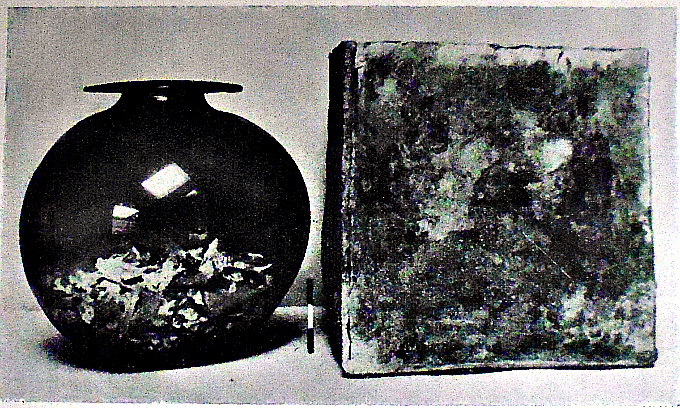
Roman Glass Funery Urn & Lead Cist from West Mersea Burial Mound (tumulus).

OS Grid Reference: TM 02257 14341. At the southeastern side of Barrow Hill at West Mersea on Mersea Island, overlooking Pyfleet Channel, in Essex, there is a large tree-covered mound which is a round barrow (tumulus). In this burial mound a Romano-British king was probably buried   at the end of the 1st Century AD, or in the early 2nd Century, so the story goes. However, there seems ‘now’ to be some uncertainty about the age of the monument. When the barrow was ex-cavated in 1912 a glass cinery urn was found in a lead container. This contained a child’s remains. Locally the barrow is called ‘The Mount’. The burial mound is 1½ miles north-east of St Peter & St Paul’s Church, West Mersea, and 9 miles south of Colchester. The island, which is 5 miles long, is reached by a causeway (southeast of Peldon) called ‘The Strood’ which crosses over the creek; then follow the East Mersea road for a ¼ of a mile, keeping to the left, until you reach Barrow Hill. The tumulus is to be found beneath the tall trees close by Barrow Hill farm.

The Historic England website says that: “The monument includes the known extent and buried remains of a Roman barrow situated on relatively high ground at the north-west edge of the central plateau of Mersea Island overlooking the Pyfleet Channel. The flat-topped conical mound mound is some 35m in diameter and 7m high. The top has a diameter of some 5m. There is no enclosing ditch. Excavations carried out by the Morant Club in 1912 found that the mound contained a burial dating from the late first to early second century AD. The burial chamber, sited slightly off-center, was dug into the original ground surface so that its floor was some 38cm beneath this level. The chamber measured some 45cm wide by 54cm high. A foundation of boulders and broken tile supported a floor of two roof tiles; seven courses of flanged roofing tiles formed the walls, with the two upper courses slightly corbelled to support the roof, which was made of a single tile some 54cm square. Within the burial chamber, the cremated remains of a child were found in a glass flask placed within a small lead casket with a wooden lid. The structure of the mound comprised a consolidated central core of impure quartz sand, above which was mixed gravel and sand. Following the 1912 excavations, a passage was constructed through the excavation trench to the burial chamber; this is extant and facilitates viewing of the inner chamber. All modern fence lines, railings, walls, made-up surfaces and the wooden Wendy house are excluded from the scheduling, although the ground beneath these features is included,” according to Historic England. See their website, below.

Benham’s (1946) says of the West Mersea Sepulchral Deposit, that: “A glass urn (containing bones) and the cist in which it was discovered. Exhumed from a large tumulus at Mersea, the deposit is supposed to have been in honour of a British chieftain (1st Century).” These antiquities were to be found in Colchester Castle Museum, but they are now in the Mersea Museum. Benham’s then adds, saying: “Roman Glass: Included in this collection is the magnificent glass urn, containing burnt human bones, found in a large barrow or tumulus at West Mersea.”   

Richmond (1963) tells of: “……….Another very large tomb was the circular mausoleum at West Mersea (Essex), a stone-revetted structure with earth fill, sixty-five feet in diameter, braced by radiating walls and marginal buttresses.”

Benham’s (1946) tells of other Roman remains on Mersea Island, saying that: “When some alterations were being made in West Mersea Hall, which stands near the church, about the year 1730, a fine Roman tessellated pavement was discovered. In the chancel of the church was found a pavement of red tesserae an inch-and-a-half square, forming rays of stars. From the diversity and continuity of these tesserae, extending nearly 100 feet from east to west, by about fifty from north to south, it has been conjectured that this grand mosaic pavement was not merely the groundwork of a general’s tent, but rather that the whole belonged to the villa of some Roman officer, who might have been invited by the delightfulness of the situation to make this his summer abode. In 1920 a Roman pavement was found in fixing a telegraph pole forty feet south of Yew Tree House, and a further portion of the same pavement was uncovered in 1931 in the garden of the house.

“West Mersea Church (St. Peter and St. Paul)…….The stone upon which the church font (which has a 13th century bowl) rests has been supposed to be the cupola of a Roman column. In December, 1896, not far from the church, the foundations of a circular building were unearthed. The ground plan of this building was that of a 65-ft. diameter wheel, with six spokes, and a central hexagon “axis” five feet across. The structure is Roman and is obviously the base of a large tomb, though it has been thought by some to have been a Roman lighthouse.”

The Historic England List Entry No. is 1019019.

Sources / References and related websites:-

Benham’s, Colchester — a history and guide, Benham And Company Limited, Colchester, 1946. 

Richmond, I. A., The Pelican History Of England — 1 Roman Britain, Penguin Books Ltd., Harmondsworth, Middlesex, 1963.

https://historicengland.org.uk/listing/the-list/list-entry/1019019

https://www.merseamuseum.org.uk/mmbarrow.php

https://www.eadt.co.uk/news/mersea-mystery-of-the-island-bones-is-finally-solved-1-2246793

https://colchesterheritage.co.uk/monument/mcc6928

https://en.wikipedia.org/wiki/West_Mersea

© Ray Spencer, The Journal of Antiquities, 2019.


Hare Hill Ring Cairn, Near Thornton-in-Craven, North Yorkshire

The Hare Hill ring cairn, near Thornton-in-Craven (closer-up).

The Hare Hill Ring Cairn, near Thornton-in-Craven, North Yorkshire.

OS Grid Reference: SD 92955 47705.  About ½ a mile to the south-east of Thornton-in-Craven, North Yorkshire,  is Hare Hill and  an early Bronze Age ring cairn or round barrow (tumulus). This ancient monument is on Hare Hill, close to footpaths which head northwest from Clogger Lane near Elslack. However, the burial cairn is now without its mound of earth and stones. At the south-east side is Low Hill, which might be a significant place-name here, and over at the northwest side, Stone Pit Hill. It was excavated back in the 1930s and 40s and many of the finds, including a large funerary urn, were deposited in the Craven Museum at Skipton. From the A56 Skipton Road near Thornton-in-Craven, turn (right) towards Elslack passing the hall, then right again onto Clogger Lane for ¾ of a mile and, after the woodland, take any of three paths (Pennine Way) on your right in a northwesterly direction onto the moor. Hare Hill being the second of the three lows hills in front of you.

Hare Hill Ring Cairn, Thornton-in-Craven. (Close-up of the cist).

Hare Hill Ring Cairn. Strange round-shaped stone within the barrow

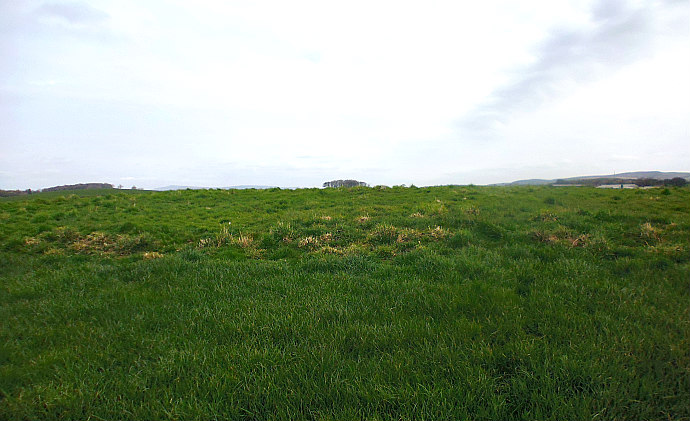
The round barrow monument atop Hare Hill on Thornton Moor     is an early Bronze Age ring cairn or cairn circle that has lost its covering mound of earth and stones, but its outer ditch just about survives at the NW and SW sides, and there is possibly an inner ditch. Its raised bank is about 0.7m (2.3 ft) high, while the whole monument has a diameter of roughly 24m (78.7ft) and a radius across of 13m (42.6 ft) x 12m (39.3 ft). However, considering how long ago that this burial mound was constructed it is in a reasona-bly well preserved state,  just a bit messed-around with in the middle! There are several stones towards the central part of the circle but as to whether these came from the burial cist or from the bank is not certain, and the stones may not be in their original positions? The signs of excavations here are all to clear to see with a small hollow and a large shaped stone above, and smaller ones inside it, which might have been the cist burial, while other small piles of stones can still be seen embedded into the grassy bank. There may have been a settlement in the vicinity of the ring cairn though there are no visible earthworks here.

The remains of the bank, ditch and barrow

Hare Hill urn in Craven Museum at Skipton.

The ring cairn was excavated back in the 1930s and 1940s by Mr Welbury Holgate (who was accompanied by his sisters) and, over a number of years, there were many interesting finds including a very large collared funery urn with patternation, which broke into many pieces on being unearthed from the stone cist, but it was eventually (partly) restored and deposited in The Craven Museum, Skipton. It’s thought that up to 21, mainly young people, were buried in the cairn between the Late Neolithic and Early Bronze Age periods of pre-history. There were other finds including charcoal deposits, flints, an axehead and bone pins or needles. There is more information on the Hare Hill site on the ‘OneGuyFromBarlick’ website: https://oneguyfrombarlick.co.uk/viewtopic.php?f=59&t=14401     

John & Phillip Dixon (1990) tells us that: “A Bronze Age collared urn displaying cord and jabbed impressions was found in a barrow on Hare Hill, Thornton-in-Craven. This is now on display in the Craven Museum, Skipton.” They also say: “A fine Bronze Age dagger was found in a field below the Manor House Residential Home, just up the road, in the 1960’s (SD 909484).”  

Sources / References & related websites:-

Dixon, John & Phillip, Journeys Through Brigantia Volume One: Walks in Craven, Airedale and Wharfedale, Aussteiger Publications, Barnoldswick, 1990.

https://oneguyfrombarlick.co.uk/viewtopic.php?f=59&t=14401

https://www.megalithic.co.uk/article.php?sid=35748

https://en.wikipedia.org/wiki/Craven

©Ray Spencer, The Journal of Antiquities, 2019.

2 Comments

Gilbeber Hill Earthwork, Near Greenberfield, Lancashire

Gilbeber Hill, near Greenberfield, viewed from the south.

Gilbeber Hill Earthwork near Greenberfield, Lancashire.

OS Grid Reference: SD 87627 48284. About halfway between Greenberfield and Bracewell, in Lancashire, is Gilbeber Hill (sometimes spelt as Gilleber), and an almost square-shaped earthwork consisting of a raised outer bank and, near the centre,   a small raised platform with a little stone. The rough, grassy earth-work has been considered to be a Roman camp, a Medieval enclo-sure, or perhaps a Civil War encampment from the 17th century! Bracewell was originally part of the West Riding of Yorkshire. The Roman road linking Ilkley in the east with Ribchester in the west runs close to Gilbeber Hill, the course of which is still to be found at Brogden Lane to the southwest. From the footpath (at east-side of Sewarage works) on Greenberfield Lane: head across the field to a second wooden gate, then continue on this footpath to the foot-bridge over Stocks Beck. Gilbeber Hill is the low, grassy hill on your left; the footpath runs around the base of the hill towards a third gate and then onto Gisburn Road. A similar earthwork is to be found on Hawber Hill ½ a mile to the northwest.

Gilbeber Hill Earthwork near Greenberfield. The Western side.

Gilbeber Hill Earthwork. The small raised feature at the SW side.

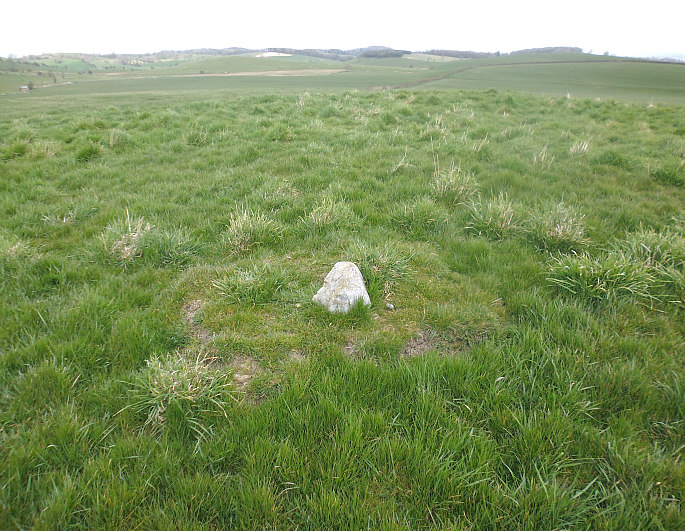
The rectangular-shaped earthwork atop Gilbeber Hill (drumlin) is a raised, grassy area with a visible bank around its edges which measures between 1-2 feet in height, and there are slight traces of an outer ditch. Nearer the centre at the W side is a small, raised square feature (platform) with a little stone standing upon it, but whether this ‘white stone’ was part of the earthwork structure is not known; it may have come from somewhere close by. At the E side is what might be an entrance? The earthwork is roughly 24m x 26m and 632-756 square yards with a parameter length of 101m covering 0.156 acres of the flat hilltop site. But was this a temporary camp from the late Roman period, or perhaps a Romano-British farmstead (similar to Bomber Camp near Coal Pit Lane)? or was it a medieval settlement/enclosure? or could it have been a Civil War encampment from the 1640s? – this we don’t know with any certainty. There don’t appear, however, to have been any Civil War camps in this part of west Craven, and so that theory must be dismissed.

John & Phillip Dixon (1990) say of the earthworks: “Near the settlement of Stock are two hill-top earthworks; one is sited above Stock upon Hawber Hill, the other is sited upon Gilbeber Hill, roughly 30 yards square and 27 yards square respectively. The Gilbeber earthwork displays signs of an outer ditch, and…….commands a view of the surrounding area that is bisected by the Roman road. There are over a dozen such hill enclosure sites in the western central Pennine area and none, other than the Bomber Camp/Primrose Hill sites, have been subject to archaeological study. At this stage it may be reasonable to view the Hawber and Gilbeber site as having their possible origins in the late Roman period. And, in the case of Hawber, may be related to some of the earthwork features around Stock Green that we consider may be a Romano-British settlement similar to that of Bomber Camp.”

John Dixon goes on to add: “Whitaker in his “History of Craven”, states that “tradition holds that they (the Hawber and Gilbeber earthworks) were constructed by the Royalist forces of Prince Rupert during their march through Craven in 1644. They consist of small square encampments and are strengthened by long rectilinear fosses, which descend along the slope of the hills on each side to the plane beneath.”

The PastScape / Historic England Monument No. is: 45403.

Sources / References and related websites:-

Dixon, John & Phillip, Journeys Through Brigantia Volume One: Walks in Craven Airedale and Wharfedale, Aussteiger Publications, Barnoldswick, 1990.

https://www.pastscape.org.uk/hob.aspx?hob_id=45403

https://www.pastscape.org.uk/hob.aspx?a=0&hob_id=45398

© Ray Spencer, The Journal of Antiquities, 2019


Altar Stone in Craigagh Woods, near Cushendun, Co. Antrim, Northern Ireland

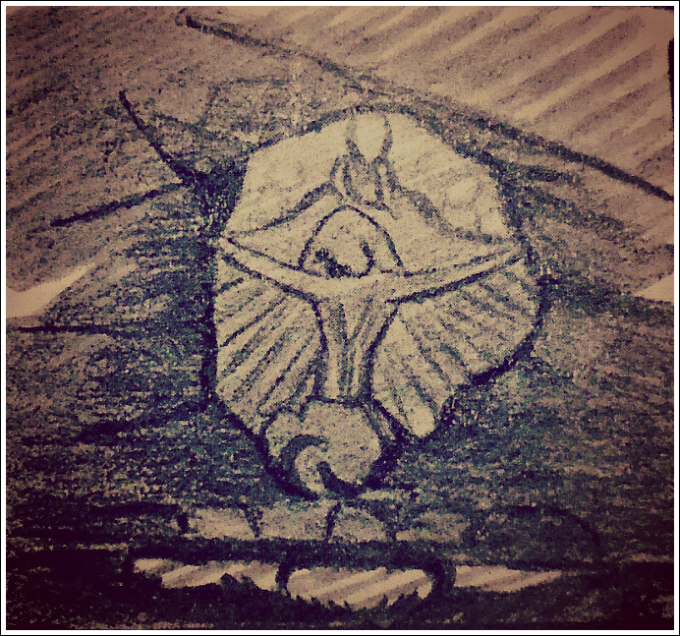
Carved altar-stone in Craigagh Woods drawn by Rosemary Garrett.

Irish Grid Reference: D 2308 3219. At the far south-eastern side of Craigagh Woods, Knockna-carry, near Cushendun, Co. Antrim, Northern Ireland, is the mysterious ‘Altar in the Woods’ which has a carved, oval-shaped stone with Christ crucified and an angel; there is also a faint inscription. This was probably brought to Ireland from a Scottish Island, possibly from Iona Abbey? Local Roman Catholics secretly held masses in Craigagh Woods during the troubled Penal Laws of the 17th and 18th centuries; these masses being held on a monthly basis, rather than every Sunday. But for Catholics the woods were a sacred meeting place much further back into time. About ¼ of a mile to the east is another religious site: St Patrick’s Church and the Gloonan Stone. From Cushendun for 2 miles take the Knocknacarry road over the river, then shortly after turn right, then left onto Glendun Road until you see Craigagh Wood on your right. Go through iron gate by the cottage and follow footpath north at the edge of the wood to the Altar Stone.

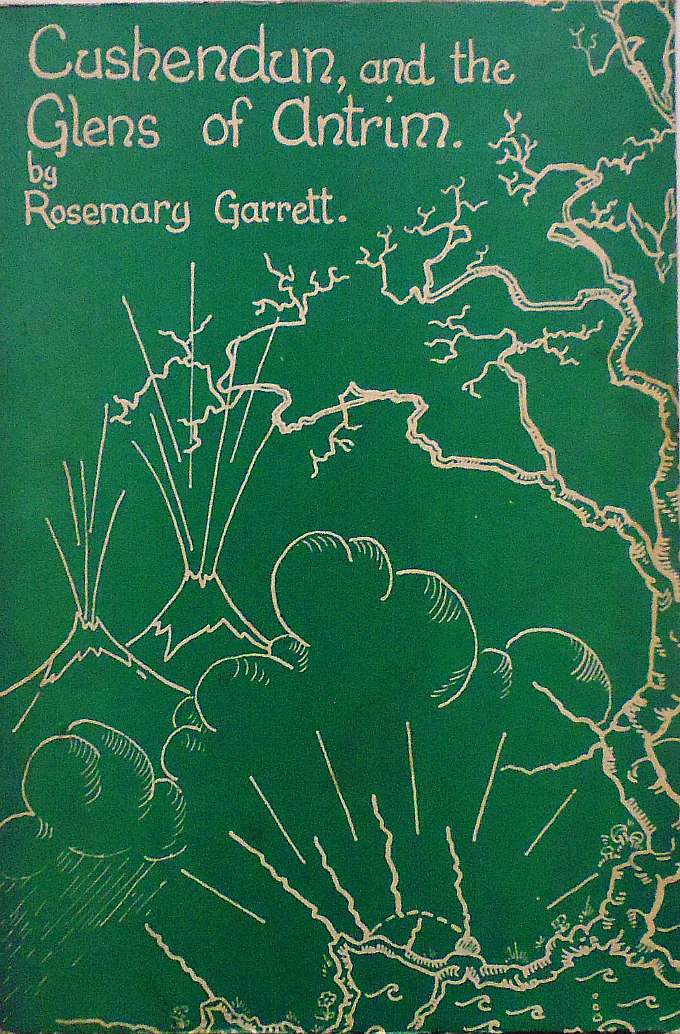
Cushendun, and the Glens of Antrim by Rosemary Garrett (1956)

Rosemary Garrett (1956) writes that: “If you go through this gate and up the little path towards the trees and stone walled enclosure, at the end of Craigagh Wood, you will see the well-known “Altar in the Woods”. This is a very ancient stone, the carving on it is now weather worn, but it is said to represent a Crucifix with a winged cherub above, there is also an inscription which is now almost illegible. This stone was brought from Scotland to be used as an altar, for worship by the Catholics in the days of the Penal Laws. So much is certain, but there is also a story, which appears to be correct, that the place was used for worship for many years before the stone was brought to it, because it was well hidden and easy for a number of Glensfolk to reach. They had no Altar, and simply worshipped among the trees using the old oak behind the present Altar, as a meeting place. There was a great wish for some-thing to mark the place as sacred, and the people had heard of a “good stone” in one of the islands — some say Iona — but the risk in obtaining this stone must have been great, for it was doubtless greatly treasured by its owners. Nevertheless, some men of the glens set off in a boat to get it, probably fearful too of the power that such a Holy thing might have. They got it, and it stands there now with its simple stone altar, a monument to their courage as well as to the persistence of the faith of the people. There is a lovely little Chapel near by now, built on the site of an ancient one, but still, every year in June crowds of people come to pray at the old Altar.”

Sources / References and related websites:

Garrett, Rosemary, Cushendun, and the Glens of Antrim, J. S. Scarlett & Son, Ballycastle, Northern Ireland, April 1956.

PENAL MASS SITES IN THE GLENS Rev. Patrick McKavanagh

https://en.wikipedia.org/wiki/Knocknacarry

The Gloonan Stone, Cushendun, Co. Antrim, Northern Ireland

© Ray Spencer, The Journal of Antiquities, 2019.

1 Comment

Roman Bath-House at Ribchester, Lancashire

Roman bath-house at Ribchester, Lancashire.

Roman bath-house remains, Ribchester.

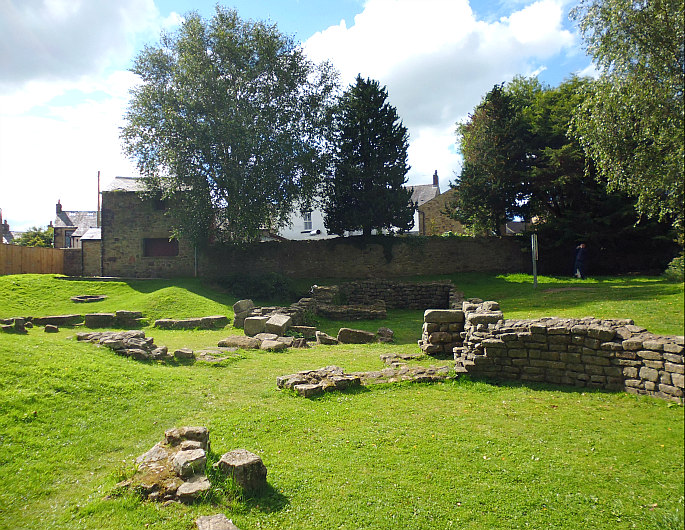
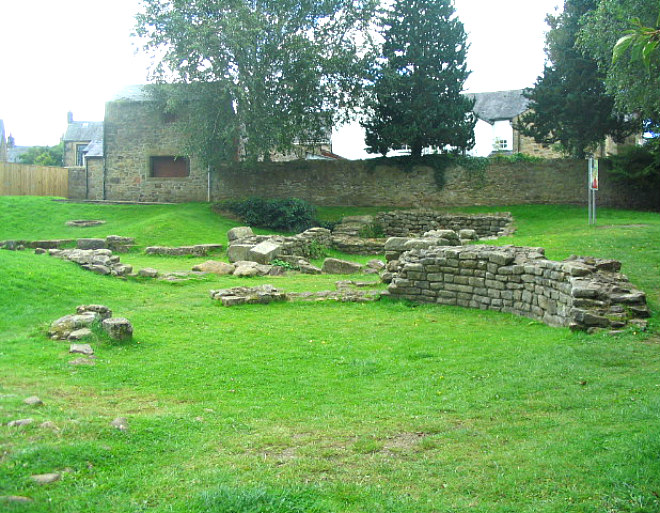
OS Grid Reference: SD 65090 35206. In the village of Ribchester, Lancashire, are the excavated foundations of Roman bath-houses, dating from around 100 AD, though there may have been an earlier Flavian structure here. The ruins are to be found in a secluded area at the back of the White Bull Inn and Water Street – at the north-western side of the River Ribble, and in an area of the village that is called Greenside. It would seem that the bath-house only survived for a few hundred years, if that, being built outside of the Roman fort of (BREMETENNACVM’s) ramparts. Excavations took place in 1978. The foundations of the bath-house are now well-looked after, with green lawns in between, and excellent information boards to boot! The White Bull Inn has four Doric or Tuscan columns supporting its front porch – two of which could have come from the bath-house, the fort or a temple? In the village from Church Street (south-side) follow the footpath (east) beside the river, and then northwest through the wooded area to the bath-house site.

John & Phillip Dixon (1993) give some good information regarding the bath-house remains. They tell that: “Another Roman feature to be viewed is the excavated Bath House, located at the rear of the White Bull. Recently erected explanation boards help one to pick out the outline of the bath house amid the crumbling piles of stones (the excavation was a costly disaster and much damage was done to floor tiles, walling etc.). 

“It consisted of a furnace room with three flues, the two southerly ones leading to the Caldarium (hot room) and the Tepidarium (warm room) respectively. The third leads to the Sudatorium (sweating room), this being round in shape. A fourth room on the south east of the building was the Frigidarium (cold room) with an apodyterium (changing room) adjacent to it. A stone-lined well stands on the south west corner of the site.”

Roman Bath House ruin

Roman Bath House foundations and Well.

The authors go on to say: “The building was erected in the 2nd century, with rebuilding work in later years. The whole structure was in use well into the late 4th century. On display inside the White Bull is a conjectured reconstruction in model form of what the bath house may have looked like in its heyday, along with a good example of a Samian ware bowl that was found hereabouts: Samian ware was first identified on the Greek island of Samos, hence its name. It is a fine hard red ware, burn-ished, with moulded designs, produced and exported throughout the Empire from the potteries of Gaul. This ‘terra sigillata’ was mass produced tableware, developed in slightly simplified versions of originally Italian prototypes. This type of pottery predominated until the Gaulish factories were forced to close during the revolts of around 250.” 

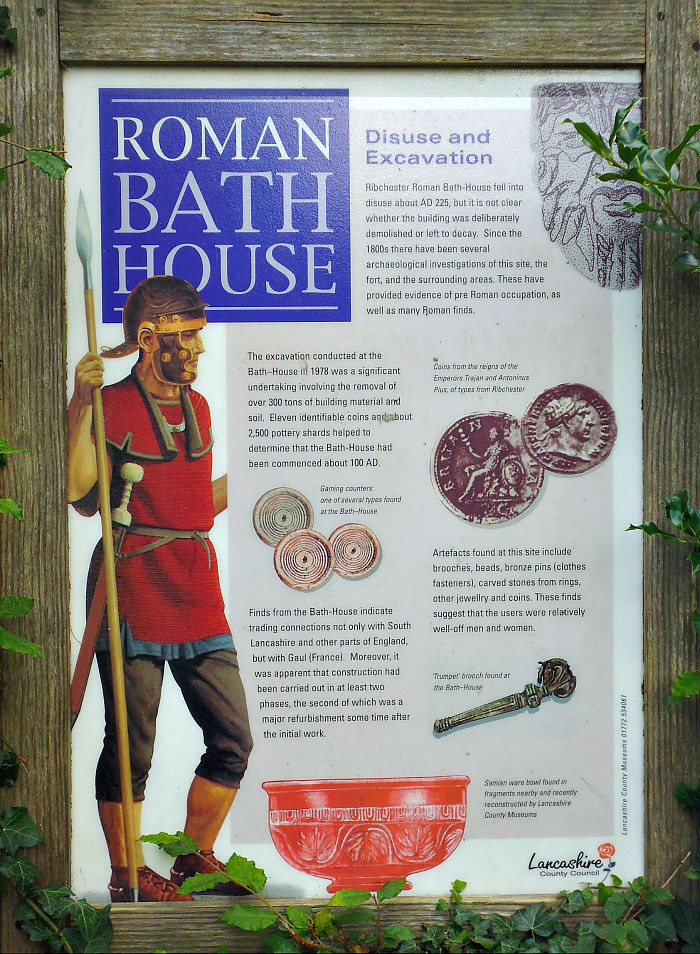
Richard Peace (1997) tells us more, saying that: “An explanatory board explains the complex system of underground heating. The baths were basically a version of the modern sauna, involving heating and cooling the skin then scraping off the exposed dirt with an instrument known as a stirgil. In the museum a small model reconstructs a cross section of the bath houses. The baths were situated some way away from the main fort so as not to constitute a fire hazard and a timetable existed to segregate female from military and male use.”

D. C. A. Shotter (1973) says of the site that: “Excavation has also revealed to the North of the fort the presence of a large vicus, which apparently grew around the road outwards to the North. This seems to have been occupied from the 1st to the 4th Centuries A.D. and in the early stages at least to have consisted largely of timber buildings. Buildings known to have been included in the vicus are a temple (known from an inscription) and a large bath-house, which was shown by excavation to belong to the 2nd Century and to overlie a Flavian predecessor.”

Jessica Lofthouse, writing in 1974, has nice things to say about Ribchester: “I like it for what it is, an honest to goodness community without any frills or attempt to exploit its undoubtedly rich past. No Ye Olde Praetorium Guest Home, or Minerva Café, or Agricola Gift Shoppe about Ribchester, but it has a good, compact Museum of Roman Antiquities, an hour in which is most rewarding.

The Information board at the bath-house.

“Tracking down the Romans is fun. Their mark is found in pillars intended for temples but now holding up the porch of the White Bull Inn, the quaint façade of the Stydd Almshouses and the church gallery. You can walk the fort earthworks west of the churchyard, gaze down on granary floor and hypocaust in the Museum gardens, and trace the foundations of a gateway through which the legionaries passed. The pleasant house at the church gates is on the site of the fort commandant’s H.Q. Within the churchyard, so green and immaculate, a gem among country graveyards, you may ponder on what lies beneath, on the forms of ritual practiced by the Romans within the fort………”

Lofthouse goes on to say: “For three centuries Bremetanacum was an active cavalry fort on Julius Agricola’s military highway linking Chester and Manchester  with the Wall. The Ribble fort was at the hub of five great roads. The camp contained within five and three-quarter acres.” 

For information on the Roman fort and museum at Ribchester see the following link:  https://thejournalofantiquities.com/2012/08/02/roman-ribchester-photos/

Sources / references and related websites:-

Dixon, John & Phillip, Journeys Through Brigantia — Volume Nine — The Ribble Valley, Aussteiger Publications, Barnoldswick, 1993.

Lofthouse, Jessica, Lancashire Countrygoer, Robert Hale And Company, London, 1974.

Peace, Richard, Lancashire Curiosities, The Dovecote Press Ltd., Stanbridge, Wimborne, Dorset, 1997.

Shotter, D. C. A., Romans in Lancashire, The Dalesman Publishing Company Ltd., Clapham, Lancashire, 1973. 

https://www.pastscape.org.uk/hob.aspx?hob_id=43639

http://news.bbc.co.uk/local/lancashire/hi/people_and_places/religion_and_ethics/newsid_8973000/8973921.stm

https://historicengland.org.uk/listing/the-list/list-entry/1005110

https://www.visitlancashire.com/things-to-do/ribchester-roman-bath-house-p782220

Ribchester’s Roman Bath House

© Ray Spencer, The Journal of Antiquities, 2019.  


1 Comment

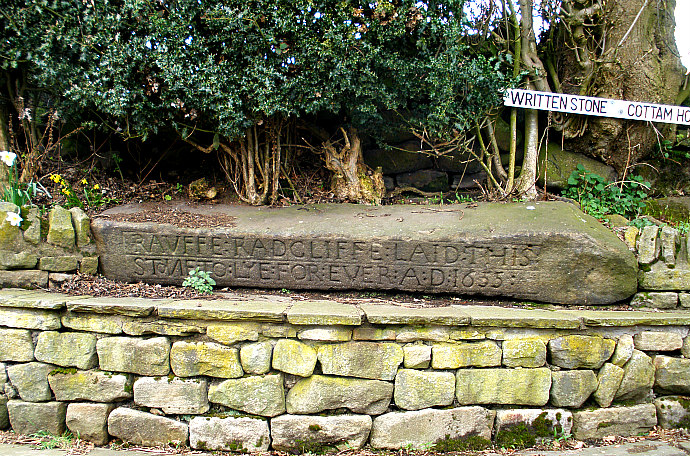
The Written Stone, Grimsargh Near Longridge, Lancashire

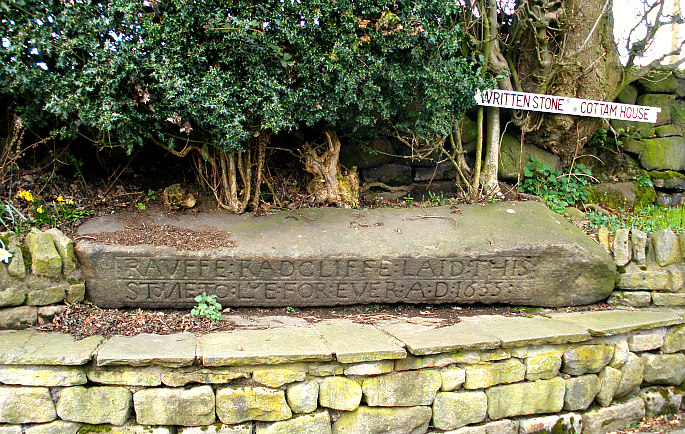
The Written Stone at Grimsargh, near Longridge, Lancashire.

OS Grid Reference: SD 62622 37892. At the northern end of Written Stone Lane at Grimsargh, near Longridge, Lancashire, is a very curious and mysterious stone slab, with an even stranger inscribed message carved onto it and the name Ralph Radcliffe (1655), although this very large lump of gritstone might be much older. This inscribed stone, known locally as ‘The Written Stone’, stands at the side of the lane close by the entrance to Written Stone Farm, originally called Cottam House. It became known as ‘the cursed stone’ after very strange and ghostly happenings took place when the farmer decided to try and move it, but he had to return the stone to its original position when ‘all hell let loose’, according to the legend. To reach this site from the east side of Longridge: head onto the B6243 for a couple of miles in the direction of Hurst Green. Passing the two Spade Mill reservoirs on your left continue for a short distance, then take the next (left) turning up Written Stone Lane; the stone is in the bank beside the entrance to Written Stone farm, on the left-hand side.

The Written Stone is a huge long lump of sandstone measuring 9 feet in length, 2 feet wide and 18 inches in depth, and is said to weigh several tonnes. There is a long inscription along the side of the stone in large letters dating back to the mid-17th Century. The message reads: RAVFFE: RADCLIFFE: LAID: THIS STONE TO LYE: FOR: EVER: A.D. 1655. It is, according to the legend, said that a terrible murder was committed here. The victim of this murder began to plague the conspirators – the Radcliffe family – who lived at Cottam House. Several members of Ralph Radcliffe’s family began to die in strange circumstances as if they were cursed in some way. In the hope of atoning for this terrible murder Mr Radcliffe had a large stone carved and an inscription written onto it; the hope being, perhaps, that the restless spirit would be calmed. But travelers going along the lane, which local people called Boggart Lane, began to report strange happenings – loud screeching sounds, bumps and bangs, ghostly appari-tions, people being pinched and their clothing being messed about with. All this was simply put down to a poltegiest trying to cause trouble.

The Written Stone is a long slab of gritstone with an inscription carved on its side.

Many years later when the Radcliffe family had moved away from Cottam House its new tenant decided to try and move the large stone so that he could put it into use as a “buttery stone” in his dairy. However moving the stone proved very difficult. It took six horses and many local people to actually move it. But during the removal a number of persons were injured and much noise seemed to eminate from the stone itself. When the said stone was finally moved to its new resting place the problems continued – anything placed upon it just fell off or was thrown off by unseen hands. During that first night “all hell let loose”, with loud bangs and clatterings, and other horrid noises. The next morning the farmer decided he’d had enough and the six horses and local folk were asked to move the stone back to its original site but, oddly enough this time only one horse was required – the stone almost moving of its own accord – seemingly the demonic spirit was eager to get back from whence it came and, from that day onwards the stone has not been moved or touched, according to the Legend. So peace and quiet returned to the country lane. Today, people walking past the stone seem unaware of its terrible history, but I wonder whether anyone dares to touch the stone or get too close to it. Let it be ‘a warning’ to anybody who might even consider trying to move, or take the stone away, from its “place of eternal rest” and, if you do, be ready for the consequences, or not.

Janet & Colin Bord (1980) tell about a doctor riding his horse along Written Stone Lane: “Late one night he was riding past the Written Stone…….when his horse became hysterical, and took off at a gallop, only stopping two miles further on. The doctor must have been feeling especially bold, for, despite this adventure, he decided to return to the Written Stone and face whatever had  frightened the horse. He rode up to the stone and issued a challenge, whereupon, in the words of Kathleen Eyre, describing the encounter in her Lancashire Legends, a shapeless mass materialized, seized him, plucked him from the saddle and almost squeezed the breath from his body. As soon as he was able, the doctor left the spot at a gallop.”

In recent times it has been suggested by a few people that the ‘Written Stone’ was brought down from the fell where it had perhaps been a standing stone, or that maybe it had once formed part of a stone circle, and as such it might have been a pagan altar-stone. Another theory is that it could possibly lay on the site of an earlier standing stone, according to Janet & Colin Bord (1980). I have heard it said that it might actually be an outlier. But from which stone circle did it come? as there are no such ancient monuments like that anywhere near here, so it must have travelled some distance. Written Stone Lane, also known as Boggart Lane, forms part of, or intersects with, a Roman road that links the forts of Ribchester and Lancaster.

The British Listed Buildings (BLB) Source ID number is:- 1147440. See Link below.

Sources/references and related websites:-

Bord, Janet & Colin, The Secret Country — More Mysterious Britain, Granada Publishing Limited, St Alban’s, Herts, 1980.

Dixon, John & Phillip, Journeys Through Brigantia, Volume Nine, The Ribble Valley, Aussteiger Publications, Barnoldswick, 1993.

Fields, Kenneth, Lancashire Magic & Mystery, Sigma Leisure, Wilmslow, Cheshire, 1998.

Howarth, Ken, Ghosts, Traditions & Legends of Old Lancashire, Sigma Leisure, Wilmslow, Cheshire, 1993.

http://northernantiquarian.forumotion.net/t307-the-written-stone-near-longridge

https://britishlistedbuildings.co.uk/101147440-the-written-stone-longridge#.XIBQ-VJCdjo

http://www.martintop.org.uk/blog/rauffe-radcliffe-written-stone-longridge

https://lancashirefolk.com/2015/01/16/written-stone-lane/

© Ray Spencer, The Journal of Antiquities, 2019.


St Martin’s Cross, Island of Iona, Argyll and Bute, Western Scotland

St Martin’s High Cross.*

OS Grid Reference: NM 28632 24504. At the western side of the Abbey Church on the Island of Iona, Argyll and Bute, Western Scotland, stands the richly sculptured ‘St Martin’s High Cross’, which is similar to some of the Irish high crosses. It is thought to date from the beginning of the 9th or the late 8th century AD, although some think it to be much earlier? This tall granite cross is probably the best preserved Celtic religious monument in the British Isles, displaying scenes from the Bible. It was set up on the island in dedication to the French saint, Martin of Tours, who was much venerated in the so-called Dark Ages, especially in Scotland, Wales and the far west of England, when St Columba (521-597) sailed over from Ireland to set up his celebrated monastery here on this Scottish island in 563 AD. The college quickly became a renowned centre of early monasticism and learning and, also a ‘Cradle of Celtic Christianity’. The Island can be reached by ferry firstly from Oban to Mull, and then a smaller ferry from Fiannphort, taking you across the narrow Sound of Iona, to the little village of Baile Mòr on the eastern side of the island.

Old Postcard: St Martin & St John’s High Crosses, Iona, Scotland.

St Martin’s High Cross on Iona stands over 14 feet high and, on its stepped base, well over 16 feet, and is made of red granite. It is very similar in sculptural design to some of the Irish high crosses, with its typical ring-head. One of its faces has scenes from the Bible, while the opposite face has Celtic-style decoration and bosses; but it is a beautifully and richly carved monument, which is thought to date from around 800 AD although some think it may actually date from the 6th Century – at which time it would have been set-up and dedicated to St Martin of Tours (320-401). So, we might ask: did St Columba have a hand in the setting up of the cross? There is a replica of the 8th or 10th Century St John’s Cross, the original is in the abbey museum (along with St Matthew’s Cross) and has a serpent with boss and spirals. St John the Evangelist was the apostle of Christ. There is also MacLean’s Cross though this is more recent, still, and dates from the 15th Century; it is named after a chief of the clan MacLean.

The Rough Guide (2000) tells us that: “Beside the road stands the most impressive of Iona’s Celtic high crosses, the eighth-century St Martin’s Cross, smothered with figural scenes – the Virgin and Child at the centre, Daniel in the lion’s den, Abraham sacrificing Isaac and David with musicians in the shaft below. The reverse side features Pictish serpent-and-boss decoration.”

The Canmore website tells us much more about St Martin’s Cross, saying: “This cross, whose name was recorded by Lhuyd in 1699, stands in a granite base…..21m W of the Abbey Church. It is carved from a single block of epidiorite, probably from the Argyll mainland, and is 4.3m in visible height by 1.19m in span. The diameter of the pierced ring is 1.09m and that of the armpits 0.24m. In the ends of the arms are vertical slots, open at the top, which may have housed ornamental panels rather than extensions for the arms. The angles bear roll-mouldings which on the W face extended below the lowest panel to flank an inscription, now indecipherable. The shaft of the E face bears three roundels of snake-and-boss ornament, a coarser variant of that in the same position on St John’s Cross. In the top of the shaft are seven interlaced bosses, each producing two snakes, and the largest of these is also one of the group of five high-relief bosses in the cross-head. That at the centre is set in a ring of nine small bosses linked by spirals, and in the side- arms each boss produces three snakes, while that in the top arm lies between two pairs of rampant leonine beasts. The E face of the ring bears knitted interlace.

Canmore also adds: “On the W face the lowest panels bears six bosses with intertwined serpents, followed by four rows of figure-scenes on an undivided field. (i) Two pairs of figures too simplified for indentication. (ii) A harper, seated with outstretched legs as on St Oran’s Cross and facing a kneeling man with a (?triple) pipe; a rectangle between them may represent a drum or a book symbolizing David’s authorship of the psalms. (iii) Abraham’s sacrifice, with a central figure holding a sword across one shoulder and grasping the hair of Isaac, whose arms are extended above a rectangular altar; the small winged figure of the angel stands at the left. (iv) The seated figure of Daniel between two rearing lions, with a lump which may be the head of another lion to the right. This theme may continue in the side-arms, where two passant leonine beasts flank a central roundel with the seated Virgin and Child between four small angels, the upper ones forming a canopy. The top arm bears three pairs of back-to-back leonine beasts with intertwined tails.” I Fisher 2001. See the Canmore website, below. The Canmore ID number is:- 21653. 

Derek Bryce (1989) says of St Martin’s Cross: “In Scotland, on the Isle of Iona, there is a cross known as St. Martin’s. Its front is decorated in a similar way to the Irish high crosses, with biblical scenes on the shaft, and the very centre of the cross has a representation of the Virgin and Child. The ornamentation on the back is, however, purely decorative. This cross stands on a square, stepped base.”

Joyce Miller (2000) adds some interesting info on Iona Abbey and St Columba: “Situated on the beautiful and peaceful island of Iona, this is where St Columba came to found a monastic community. He converted the Picts of mainland Scotland, ruled by Brude, to Christianity. Columba was born in Donegal in 521 and died in 597, and the Columba’s shrine, within the Abbey buildings, dates from the 9th century.

“The abbey was abandoned after raids by the Vikings but was re-established by Queen Margaret, wife of Malcolm Can-more, in the 11th century. Margaret is one of the few native saints still recognized by the present Roman Catholic church. The island was a major place of pilgrimage in medieval times, and there was a pilgrim’s route, marked by standing stones, across Mull.”

Miller goes on to say that: Two crosses – St Martin’s Cross and St John’s Cross – the latter a replica: the original is recon-structed and displayed in the Infirmary Museum – stand just outside the church. An extensive collection of sculptured stones and crosses, one of the largest collections of early Christian carved stones in Europe are held in the museum. The Black Stones of Iona were kept by St Martin’s Cross, and would reputedly turn black (or turn the oath-taker black) if somebody was lying when taking an oath. The last of the stones was apparently here until the end of 19th century, but has since gone.”

Sources and related websites:-

Bryce, Derek, Symbolism Of The Celtic Cross, Llanerch Enterprises, Felinfach, Lampeter, Dyfed, Wales, 1989.
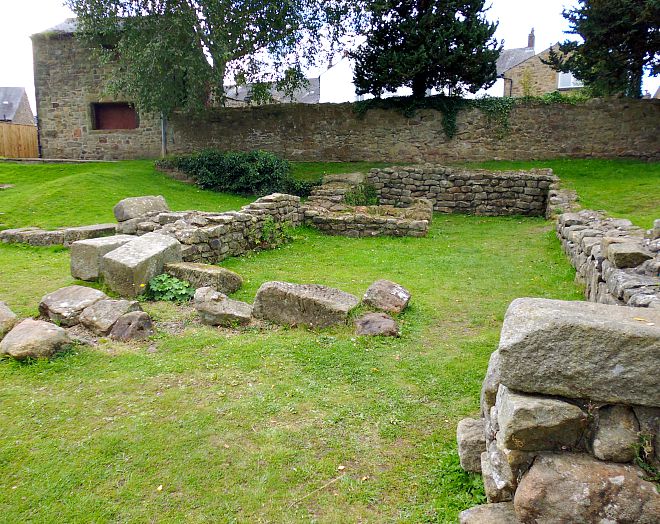
Miller, Joyce, Myth and Magic — Scotland’s Ancient Beliefs & Sacred Places, Goblinshead, Musselburgh, Scotland.
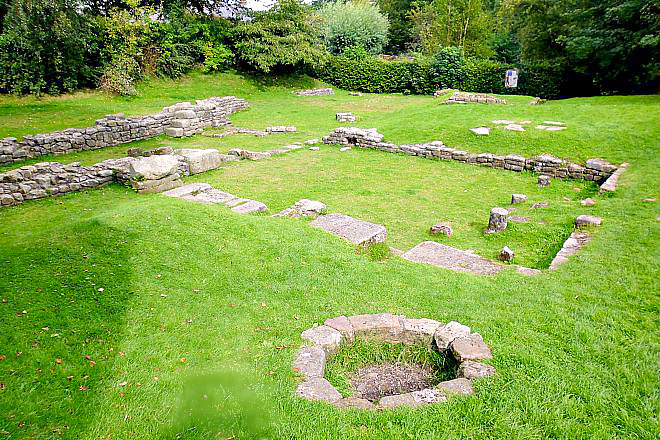
The Rough Guide, Scotland, Rob Humphreys, Donald Reid & Paul Tarrant, Rough Guides Ltd., London, 2000.

*Wonders Of The World, (fwd: by Sir Philip Gibbs K. B. E.), Odhams Press Ltd., London, 1930.

https://canmore.org.uk/site/21653/iona-st-martins-cross

https://www.historicenvironment.scot/archives-and-research/publications/publication/?publicationid=e9970fde-2118-4aad-9fec-a58a00a5d049

https://en.wikipedia.org/wiki/Iona

https://en.wikipedia.org/wiki/Iona_Abbey

https://orthodoxwiki.org/Iona

http://www.colmcille.org/iona/7-01

http://www.bl.uk/onlinegallery/onlineex/earlyphotos/s/006sta10370cc35u00011000.html

© Ray Spencer, The Journal of Antiquities, 2019.