The Journal Of Antiquities

Ancient Sites In Great Britain & Southern Ireland


Mount Cross, Near Cornholme, West Yorkshire

Mount Cross, West Yorkshire

Mount Cross, West Yorkshire

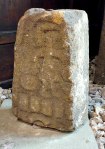
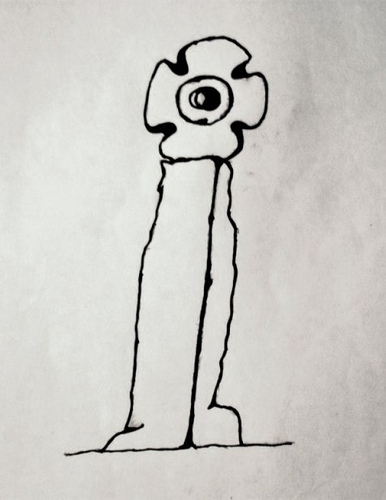
NGR SD 9146 2782. Mount Cross, also known as ‘Idol Cross’ and ‘Stiperden Cross’, stands at the southern edge of Stansfield Moor, 2 miles north of Cornholme close to the Long Causeway, Todmorden. The ancient cross is located near Kebs Road to the east of Lower Mount Farm. It is a 5-foot-high free-standing cross although some stones are wedged in at the base to stop it from falling over – the wheel head measures 65cm by 38cm in diameter. Although the carvings on the cross are quite worn there are traces of roll-moulding, vine scrolls and also what may be an incised calvary cross.

The cross, now a registered ancient monument, is thought by some historians to date back to the 7th century AD when it was used as a preaching cross by St Paulinus; the general consensus is that it dates from the 10th or 11th century. It was discovered buried beneath The Great Bridestones to the south-east – a place that was associated with pre-Christian pagan practices; this is perhaps why Mount Cross has also been connected with the same sort of goings on and why it has often been called a “Rude Stone” although in Christian times a “Rood Cross”. The monument lies on an old causeway that links both Yorkshire and Lancashire, so it would have also made a good marker stone or guidepost for travellers crossing the moors. Mount Cross is said to be the oldest religious monument in the Todmorden area.

Copyright © Ray Spencer, The Journal of Antiquities, 2012 (updated 2024).

St Andrew’s Church, Kildwick, West Yorkshire

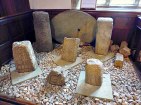
Cross fragments in St Andrew's Church, Kildwick.

Cross fragments in St Andrew’s, Kildwick.

OS grid reference: SE 0109 4586. Inside the church of St Andrew on Skipton road at Kildwick (Childeuic), near Keighley, west Yorkshire, are several lumps of stone that have Anglian/Viking decoration. They are most probably cross-shaft fragments that date from the mid-10th century AD and are carved with scrollwork designs, interlacing and cable-moulding etc. One of the lumps of stone shows Christ holding an L-shaped object, perhaps representing the Resurrec-tion. Another shows a man with arm upheld, and a beast on each side, possibly representing Christ as the Good Shepherd. These pieces of cross-shaft may have once formed part of the Saxon churchyard cross that was erected in 950 AD when the first church was built.

Cross fragment with figure of Christ.

Cross fragment with figure of Christ.

    These fragments of ancient crosses are at the south side of the church near the Choir Vestry. They were discovered built into the interior wall above the chancel arches (south side) in 1901 – during restoration work, and had been used as masonry when the church was lengthened in the 15th century. Also found in 1901 were some pieces of a stone coffin lid that was covered with herring-bone patterns – again probably dating from the late Saxon period, while a stone in a recess near the top of the doorway has a Maltese cross and a St Andrew’s cross carved onto it. The Octagonal font is of the 15th century and has a shield on each side with monograms or emblems. Close by there is an oak chest with three locks. The lid has a slot for “Peter’s Pence” money given as contributions for the support of the Pope in the Middle Ages.

Sources and related websites:-

Wood, Alec, History and Description of the Parish Church of St Andrew Kildwick-in-Craven, 1996.

Copyright © Ray Spencer, The Journal of Antiquities, 2012 (updated 2023).