The Journal Of Antiquities

Ancient Sites In Great Britain & Southern Ireland


Rey Cross Roman Camp, Stainmore, Cumbria

OS grid reference: NY 9004 1241. This is a difficult one to reach. You will need to park in one of the east-bound lay-bys beside the A66 Stainmore Pass dual carriageway on the summit and then find a stile allowing access to the earthworks of this 1st century AD Roman marching camp at Buzzard Hill. [A word of caution here please do be very careful as the road can be quite dangerous]. The almost rectangular-shaped earthworks are much more prominent once you get close up to the site. Most of the camp lies on the north side of the road, but a section (south-side) can be found on the opposite side of the A66, near the river Greta, although it is probably not worth crossing over the road for.

The camp was probably built sometime between 70-72 AD when the 6,000 strong IX legion under the Roman governor Quintus Petillius Cerialis came to the north of England to subdue the Brigantes and Venutius, husband of the warrior Queen, Cartamandua, then forming a rather tenuous alliance. Petilius later defeated and murdered Venutius at Stanwick c72 AD. The A66 follows the course of the Roman road between York (Eboracum) and Carlisle (Luguualium), but it seems the road was constructed slightly later than the marching camp in the early 1st century AD? eventually linking many camps, forts and fortlets along the way, including those nearby at Bowes Moor, Bowes (Lavatris), Maiden Castle and Brough (Verteris). It is, however, believed Rey Cross marching camp was only occupied for a temporary period, perhaps a few weeks, months or a year? The camp appears to have been re-occupied during the 3rd-4th centuries AD because some pottery has been excavated from that period.

The earthworks are spread over 20 acres or 296 metres from east to west and 144 metres north to south with fairly strong ramparts of stone and earth and, an external ditch. At the south side these ramparts still stand to a height of approx 6 feet in the centre and approx 20 feet wide at its base. But the northern ramparts are much more intermittent and less strong due to boggy ground conditions, indeed part of the northern section has sunk into the ground. There are traces of an external ditch at the north side measuring just 0.4 metres and, at the north-west just under 1 metre. During excavations in 1990-1 before the road was widdened into a dual carriageway, an external ditch at the eastern and western sides was found. This was some 2 metres wide and just under 1 metre deep with a berm of 1 metre in width. Near the north-east corner of the camp there is what is probably a Bronze-Age stone circle, something the Romans had clearly taken in to account.

There were at least 9 gateways (tituli) each being about 10 metres in width at the north, south, east and western sides of the camp; however, at the south-western side a couple of the south-eastern gateways have been obliterated by the A66 which bisects through this lower part of the earthworks, and recent limestone quarrying has not helped the situation. Three gateways at the north-side are still visible today. Close to the south-western side there is a small mound which sits where the quarrying occured, although this feature has, luckily, survived. This may well have been a small signal station? – there were others in an alignment sited at intervals along the Roman road, now the A66.
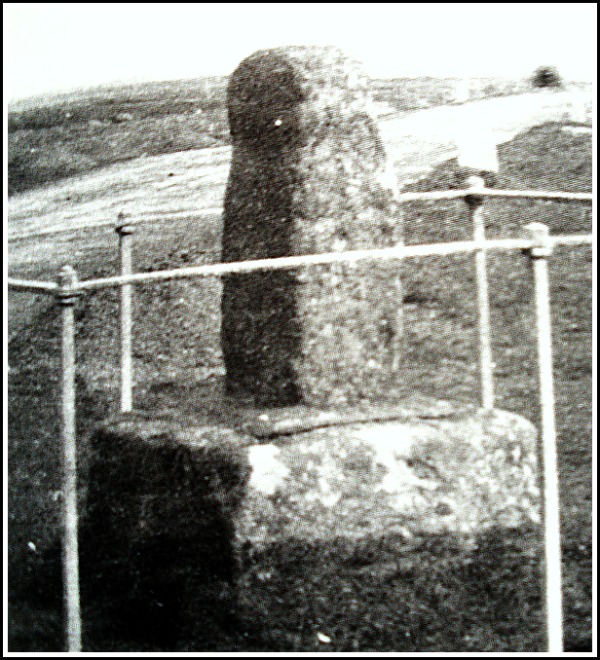
Rey Cross, Stainmore, Cumbria

In a lay by at the side of the A66 to the east of the Roman camp stands the stump and base of an Anglo-Saxon cross (Rey Cross), dating from c946 AD when it was set up by King Edmund of Northumbria to mark the boundaries between his own territory and Cumbria (Strathclyde). However, legend says that in c954 the Viking ruler of York, Eric Bloodaxe, fled from York into Cumbria, being murdered and buried here at that time. There is no evidence for that. The cross originally stood within the Roman camp, but in 1992 it was re-located to its present position when the A66 was widened. Sadly the wheel-head and the upper section of the shaft have long since disappeared, leaving just the worn stump socketed into a more modern lump of stone or concrete. The cross would originally have been 3 metres high. Today there are no signs of any Saxon carvings, the inclement weather conditions upon Stainmore having put paid to that.

Sources:-

Wilson, Roger J.A., – A Guide to the Roman Remains In Britain (Fourth Edition), Constable, London, 2002.

Transactions of the Cumberland and Westmorland Antiquarian and Archaeological Society (TCWASS), (2nd Series) xxxiv (1934) pages 50-61.
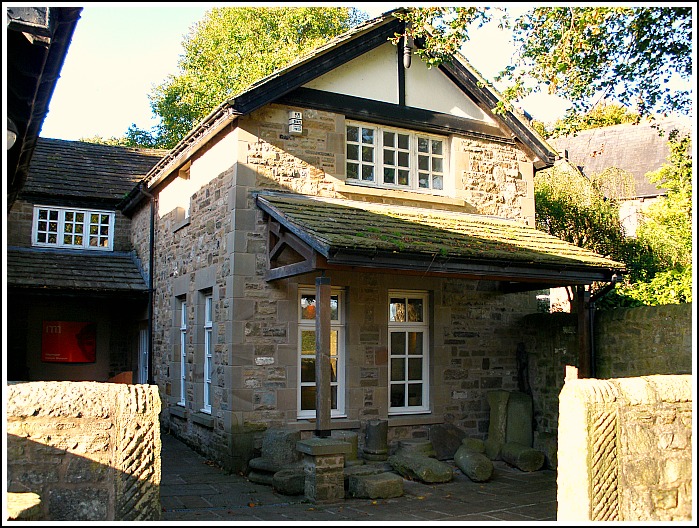
Ravenscar Roman Signal Station, East Yorkshire

OS grid reference: NZ 9811 0188. The village of Ravenscar is to be found on the east Yorkshire coast, some 10 miles north of Scarborough, and 1 mile north of Staintondale. 700 feet above the seashore on the stepped, grassy headland stands the Raven Hall Country House Hotel on Raven Hall road. The building is said to have been built over, or on the site of, a Roman signal station and a fort or, more likely a fortlet? There is some uncertainty about this. The nearest recorded Roman fort is at Leaso Rigg, some 9 miles to the west. Also of interest near the Hotel is the Peak Alum Works, which is now a site of great archaeological interest.

The signal station here at Ravenscar was one of a chain of warning beacons that stretched along the Yorkshire coast from the Humber estuary to Teesdale. They were probably built in c370 AD at a time when the north of England was being invaded from Scotland by Pictish tribes, and from across the north sea by Saxons. These beacons could be fired-up at short notice to warn Roman garrisons further along the coast of impending raids by invaders from both land and sea.

As was the case with the other signal stations, the one upon the headland above Ravenscar was built of stone and timber and would have had a large square-shaped tower with a beacon on top; a small courtyard would have run around the building, surrounded by high walls with look-out towers at angles along these walls and a ditch on the outside. A block-house for a small garrison of soldiers would have stood at the side or was attached to the signal station. Sometimes a fortlet was built along-side, which may have been what happened here. There is a rectangular earthwork in the garden of the hotel beside the cliff-edge – part of which at the extreme eastern-side has now gone over the edge. In the middle of this a square-shaped feature with low walls, recently excavated, would have been the beacon tower. This is probably all that now remains of the former signal station, the fortlet would have been where the hotel now stands. By about 405 AD the signal stations along the coast had been abandoned as Roman troops were recalled to Gaul, the people of Britain being left to look after themselves. In the 9th century the building was destroyed by Viking invaders.

A piece of stone from the foundations of the signal station was unearthed in 1774 when the original Raven Hall was being built (the hotel is now built on the site of the hall). This is now on display in Whitby museum. A latin inscription on the flat rectangular stone recalls the building of the tower and fort from the ground by Justinianus, the praepositus (Governor of the province) and Vindicianus, the magister (Prefect). The Latin inscription in full is: IVSTINIANUSPP VINDICIANVS MASBIERIVRR MCASIRVMEFC ACO.

Sources:-

de la Bedoyere, Guy., The Finds Of Roman Britain, Batsford, London, 1989.

Mead, Harry., A Prospect Of The North York Moors, Hutton Press, Beverley, East Yorkshire, 2000.

© Ray Spencer, The Journal of Antiquities, 2012 (up-dated 2019).


1 Comment

Ribchester Roman Fort, Lancashire

Roman Museum, Ribchester

Roman Museum, Ribchester

    OS grid reference SD 6500 3504. The pretty village of Ribchester, in the Ribble Valley, stands beside the banks of the river Ribble, 6 miles to the north-west of Blackburn. Ribchester’s Roman remains (the exca-vated granaries block) can be seen behind the Roman Museum, just off Church Street. The name Ribchester means ‘fort beside the Ribble’; and the Roman name for the fort is Bremetennacum Veteranorum.

Roman granaries block at Ribchester.

Roman granaries block at Ribchester.

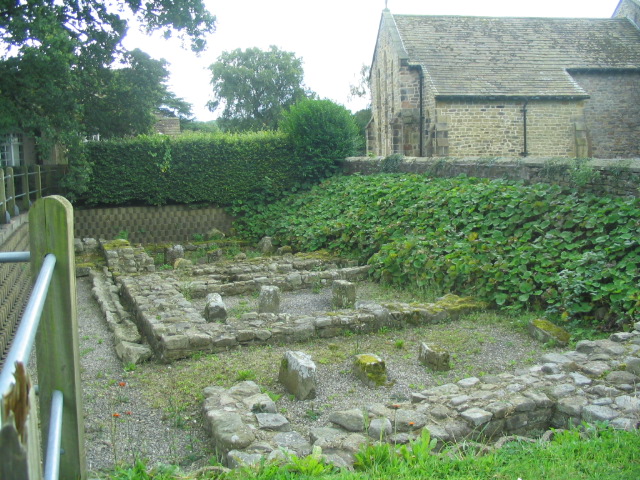
    The first infantry fort was built in 72-73 AD by the XXth legion from timber and turf, but in c120 AD the southern defenses of the fort were strengthened, then in the late 2nd century AD a stone fort was built within the original structure and garrisoned by cavalry. It was finally abandoned in the late 4th century AD. The fort would have had a garrison of up to 500 auxiliary soldiers. The foundations of the stone fort, including remains of the granaries and defenses are located at the back of the museum, while some earthworks can still be made-out behind the parish church and at the south-east side of the church in a field beside a footpath.

Roman Columns, Ribchester

Roman columns at Ribchester public house

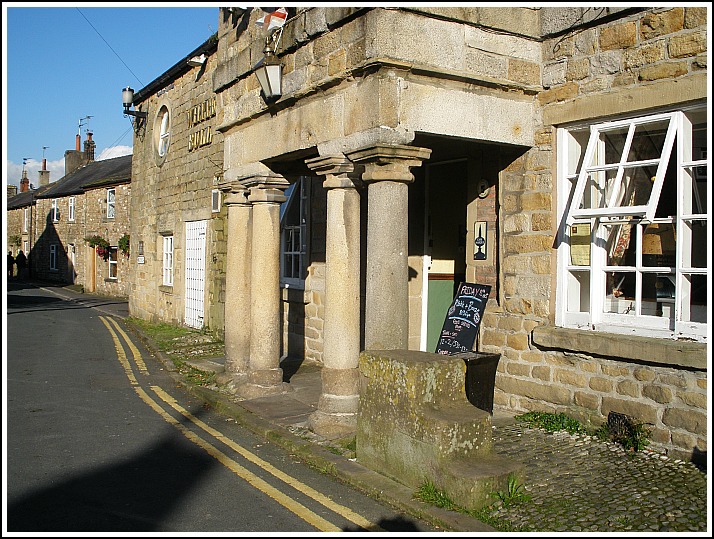
    Ribchester Roman museum, dating from 1914, has a replica of a decorated parade helmet, two Celtic stone-heads and many other interesting artefacts, including other finds from the Ribchester hoard discovered in 1796. At the back of the White Bull public house in Church Street, at the east-side of the village, are the remains of the Roman bath-house and, at least two of the stone columns (out of the four) that support the porch of the White Bull Inn, are thought to have come from the Roman fort – the other two are probably replicas. More than likely the columns came from the bath-house.


Kirk Sink, Gargrave, North Yorkshire

NGR: SD 9395 5356. The faint earthworks of the Roman villa known as Kirk Sink are located on a flat area of fertile farm-land close to the river Aire, half a mile south-east of Gargrave. At the southern edge of the Roman site is the railway line to Gargrave station and, just a little beyond that, a lane leads to the eastern side of Gargrave village.  The earth-works are on private land and in that respect access is difficult. A private house takes part of the far south-eastern part of the field in which the earthworks lie, though this does not appear to have caused any underlying problems with regard to the ancient site. Thank goodness for that! Surrounding the Roman site are traces of a ditched field system covering up to 100 acres.

Today the earthworks consist of two faint enclosures set slightly apart. These are probably different phases of construc-tion. The site measures 300 feet by 180 feet. But the actual site was late Iron Age in date, and there was some sort of settlement belonging to the Brigantes with timber and turf circular huts, one of which was still in existence during the Roman period but, then in the 2nd century AD the villa was built.  This building had a corridor with a central entrance, a mosaic floor and under-floor heating system. The bathhouse with its pillared hypocaust was detached from the villa. There was also a temple. At some point in the 3rd century the villa was abandoned; however, in the late 3rd or early 4th century AD, two new buildings were added along with a single square-shaped building, an administrative block, that may have been linked by a covered walkway to the other buildings/houses. These buildings appear to have been added to from time to time. In the late 4th century the place was finally abandoned altogether, or was it?

Plan of Kirk Sink Roman Villa, Gargrave.

Archaeological excavations took place here in the 18th and 19th centuries, but a major dig took place between 1968-75 conducted by the Yorkshire Archaeological Society in conjunction with Leeds University. Many of the finds were deposited at the Craven museum, Skipton, and at Cliffe Castle museum, Keighley. These include Samian ware, glass, bronze artefacts, cheese presses and many large and small pieces of tessera.

Garlick (1988) tells us that: “The site, in flat fields at Kirk Sink between the railway and the factory, has been examined by Mr. B. R. Hartley for the Yorkshire Archaeological Society. Finds in 1969 included coins, pottery, a large key, bill hook and an iron stylus or pen used for writing on wax tablets. The pottery and structural evidence shows the farmstead occupied down into the late 4th century. Gargrave is one of the few villas identified in the military zone and its total excavation will throw interesting light on Roman farming in an area of predominantly native farmsteads. Perhaps at one period it was the farm of a retired veteran from a nearby fort? Finds from the Kirk Sink excavations can be seen in the Craven Museum, Skipton. No villa sites are yet known further west.”

The original St Andrew’s church in the nearby village of Gargrave was built with robbed stone from the Kirk Sink site in the 10th-11th century, on what was a pre-Christian, pagan site. The present-day 16th-century church houses a number of carved fragments of 9th-century Anglo-Saxon/Norse cross(s). But was St Andrew’s the first church here? There is “some” evidence suggesting that an early British church was built on the site of Kirk Sink Roman villa – hence the name “Kirk”. This would perhaps have been a building something similar to a Celtic-style church. But there is a big question mark with regard to this. There was almost certainly a Roman temple here. So was the site occupied in the 5th or 6th century AD by a Celtic chieftain, quite possibly.

Sources / References:

Garlick, Tom, A Dalesman White Rose Guide — Roman Yorkshire, The Dalesman Publishing Company Ltd., Clapham, 1978.

© Ray Spencer, The Journal of Antiquities, 2012 (updated 2020).


Elslack Roman Fort, North Yorkshire.

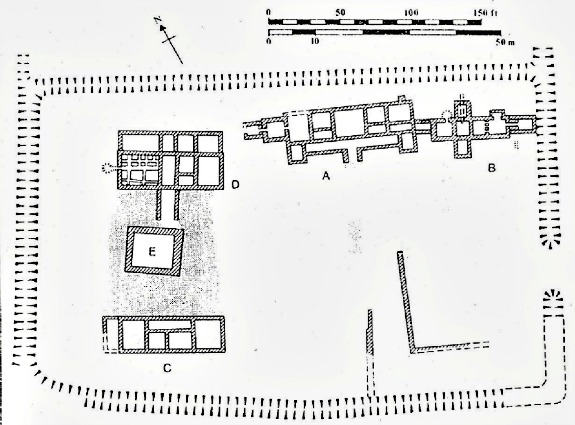
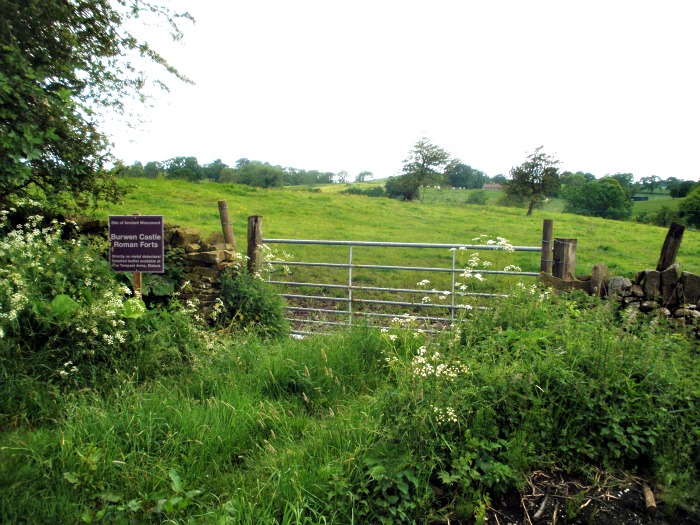
OS grid reference: SD 9259 4955. The solitary, rather forgotten earthworks of Elslack Roman fort or Burwen Castle lie just west of Elslack lane beside the disused railway line that linked Skipton with Colne, the course of which is now a pathway. The A56 Skipton road runs close by. A gate gives access to the site which is often quite boggy. There is not a great deal to see today, but if you look closely you can make out the earthworks that define the outer banks of this rectangular-shaped fort. The fort here at Elslack is probably Olenacum rather than what some experts claimed it to be, Olicana. The fort at Ilkley is known as Olicana or Verbeia?

The first fort was 345 feet (3 acres) within its ramparts; today’s site measures 608 feet by 406 feet, just over 5 acres, with the Thornton beck running close to the north-west edge of the site. It was built during the Flavian period about 80 AD when the area was ruled by the Brigantes. At first it was manned by an infantry garrison then later, in the 2nd century, by an auxiliary cavalry unit of upto 500 men. It was probably originally a small fortlet that was constructed with clay ramparts on top of stone foundations with a double ditch 24 feet in width. In the 2nd century AD the fort was levelled and replaced by a much larger stone-built fort and, then in c340 AD, another stone fortification was built on top of that and this is more or less what we see here today. But in 370 AD the site was abandoned and not long after that the Romans withdrew their legions from Britain for good.

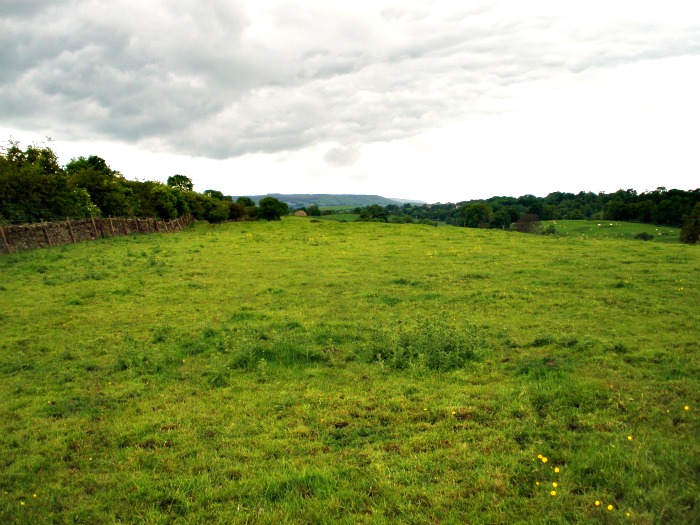
The defensive ramparts were up to 9 feet high and, at the western section up to 12 feet high, but erosion of the site has now altered that somewhat. As usual, there were four gateways, those at the western and eastern sides quite large, the two at the north and south sides were small. The south-east side of the fort has been almost destroyed by the course of the disused railway line, although a small section of the rampart is just visible at the opposite side of the path that now follows the bed of the railway line. The flat plateau between the earthworks is the interior of the fort. A low bank with small trees growing out of it running through the centre of the site is probably more recent in date, perhaps a field boundary, and does not appear to be part of the Roman fort.

In the early 1900s two excavations were carried out at the site. Finds included many animal bones, leather boots, a Samian bowl, coins of the Emperors Domitian and Constantine, part of a rotary quern and an artillery projectile from a Roman carroballista machine. These finds were deposited in the Craven Museum at Skipton. Then in the late 1980s a geophysical survery was undertaken here which identified a possible building just outside of the eastern rampart, although the interior of the fort did not reveal any buildings, indicating perhaps that they were completely destroyed in 370 AD. The Roman road from Ribchester (Bremetenacum) to Ilkley (Verbeia) and York (Eboracum) intersects here. It is only really visible to the south-west of the site and to the north-east, beyond The Tempest Arms public house.

Gate and signboard at Elslack Roman fort.

Elslack Roman Fort, North Yorkshire

Elslack Roman fort defences at the western side.

Copyright © Ray Spencer, The Journal of Antiquities, 2012 (updated 2025).


2 Comments

Caerhun Roman Fort, Caernarvonshire.

NGR: SH 7760 7040. The square-shaped earthworks of Caerhun (Canovium) Roman fort are located about a quarter of a mile east of the hamlet of Caerhun and along a lane that leads off the B5106 Conwy road east of Tyn-y-Groes, about 5 miles south of Conwy. The lane is signposted to St Mary’s church and actually goes through the south-west corner of the fort in order to reach the church.

The Romans built their temporary wooden fort with an earthen rampart and two ditches close to the west bank of the Afon Conwy (River Conwy) in 75 AD and, later in about 150 AD, they rebuilt it with stone. The 13th century church and churchyard of St Mary now occupies the north-east corner of the fort’s earthwork rampart. In 200 AD the fort was destroyed but it seems some form of occupation occurred in the 4th century, only to be completely destroyed in c400 AD. After that there may well have been a Romano-British occupation when a 5th or 6th century prince or king of Gwynedd called Rhun set up a camp or settlement here. Did Rhun found the first church on this site? Caerhun (Caer Rhun) takes its name from him.

Canovium’s earthwork ramparts are visible, especially at the south-side and at the south-east side of the churchyard, but can be better seen on aerial photographs of the area. The fort measured 140 metres by 80 metres . Crop marks within the defences mark where the buildings were situated, but the bath house stood outside the fort just to the west of the church – the earthworks from this are still visible. In 1926-9 archaeologists excavated the site and discovered a docking facility down by the river with signs of a jetty there. They also found Roman pottery, coins, a small stone with an inscription recalling the 10th legion (Leg.X), and possible remains of a villa. Obviously, the fort occupied a strategic position with the Roman road heading west to Segontium (Caernarvon), a major military fort, and Deva (Chester) to the east; the river just to the east of Canovium would have been a bridgehead which was well defended by the local garrison.

English: St Mary's Church, Caerhun Located wit...

St Mary’s Church, Caerhun  (Photo credit: Eirian Evans – Wikipedia)

St Mary’s church dates in part from the 13th century, especially the side walls of the nave, but mostly it is a 16th century building.  Monks from Maenan abbey are thought to have built the church. The east window is thought to be from the original church. In 1972 fifteen bones, three skulls and a child’s pelvis were discovered by the north wall where an ancient water stoup is now built into the wall close by the west door. Outside, a small square-shaped medieval stone showing Christ crucified is built into  the wall. Some of the stones from the Roman fort are incorporated into the walls of the church. All in all a very nice little church, in fact, the whole site is well worth a visit, even though not much of the Roman fort survives today.

Source / References:-

© Copyright Eirian Evans and licensed for reuse under this Creative Commons Licence.

https://en.wikipedia.org/wiki/St_Mary%27s_Church,_Caerhun

Copyright © Ray Spencer, The Journal of Antiquities, 2012 (updated 2025).


2 Comments

Y Gaer Roman Fort, Brecon, Powys

NGR: SO 0033 2966. The “almost” perfectly square-shaped earthworks of the Roman fort of Y Gaer (Brecon Gaer) or Bannium Cicucium are located on a low ridge in a farmer’s field about a quarter of a mile north of the A40, just to the west of Llanspyddid. The town of Brecon lies 1 mile to the east. Y Gaer farm is partly built over the northern defences and the site is on private land. It was built between 75-80 AD in the area held by the Silures tribe and manned by a garrison of 500 cavalrymen (Ala) from Vettones in Spain, along with some captured prisoners who were put to work on building the fort. The confluences of the rivers Usk and Ysgir straddle the valley close to the fort, something which the Romans were obviously aware of and would have considered to be an excellent place to build a fort.

The fort held a strategic position close to a major Roman road linking other camps and forts at Gobannium and Isca to the east, while to the west two temporary marching camps at Y Pigwn and other nearby forts at Alabum, Coelbren and Moridunum. But the first fort here was made of timber with earthen ramparts and two ditches, then in c140 AD this was replaced by a stronger, stone fortification that was built by the 2nd Spanish Augusta legion. However, the occupation here may have come to an end in 200 AD although, evidently, there were two more occupations during the 3rd and 4th centuries AD.

The walls stood to a height of 10 feet and there were guard towers at each rounded corner of the fort and three gatehouses – although four entrances were built in the centre of the N, W, S and E walls, that at the N side now built over by a farm building; altogether the fort measured 615 feet by 460 feet. The headquarters buildings, barrack block and granary were, as always, inside the walled defenses as was the bath-house which was attached to the barracks for ease of use – normally this would have been outside the walls, and outside the N gate was the cival settlement (vicus) for the labourers, many of whom were captured prisoners.

In 1924-5 the site of Y Gaer was excavated by Sir Mortimer Wheeler and most of the buildings uncovered during the period of the dig. A number of antiquities were discovered but, the most impressive artefact was the tombstone of a young cavalryman called Candidus, which is now housed in the Brecon museum. Today some of the walls are still visible, but with more recent stonework being built onto them, and the S and W gates remain as they were found. The earthen defences are visible along the sides of the fort at the W. S and E sides, that at the N side less so due to the “unfortunate” building of Y Gaer farm.

English: Cicvcivm - Brecon Gaer, near to Abery...

Y Gaer (Brecon Gaer). (Photo credit: Alan Bowring – Geograph (Wikipedia)


Photo © Copyright Alan Bowring and licensed for reuse under this Creative Commons Licence                                                                                                                                                                                                                                                                                                                                  Copyright © Ray Spencer, The Journal of Antiquities, 2012.


2 Comments

Castleshaw Roman Fort, Standedge, Greater Manchester

NGR: SD 9987 0963. High on the windswept Pennine moors to the north of the A62, where Bleak Hey Nook Lane intersects with Dirty Lane, is the area called Castle Hill, Standedge, on the borders of Greater Manchester and West Yorkshire. And, located between the two reservoirs (upper and lower), are the rectangular-shaped earthworks of the Roman fort of Castleshaw, known to the Romans as RIGODUNUM – ‘the royal fort’ or ‘the king’s fort’ – the name Castleshaw is of Celtic origins. But long before the Romans settled here at Castleshaw, the site was known to have been a Brigantean settlement, later becoming just a little bit of the Roman province of Brittannia.

Castleshaw

Castleshaw (Photo credit: The Armatura Press)

The Romans built the fort here during the Flavian period c79 AD, in order to protect their newly constructed road between Chester (Deva) and York (Eboracum) from the Brigantes tribe who had held the area. Up to 50 Roman auxiliary soldiers of the Spanish Cohors III Bracaraugustanorum regiment from Lusitania in northern Portugal were stationed here; the rest of the cohort were quartered at MAMUCIUM (Manchester), 10 miles away to the south-west. One wonders what these hardy Spanish soldiers thought to the often bleak weather conditions here on the Pennine moors.

The auxiliary fort or ‘fortified encampment’ at Castleshaw measured 380 x 330 feet, including the outer vicus, but less than that (360 feet by 300 feet) inside the defences or ramparts – the whole site covering between 2-3 acres (1-2 hectares) in total. Constructed from turf, clay and timber, it has an outer ditch measuring 5 feet wide at the rampart with an outer, smaller ditch. There were two main entrance gates at the western and eastern sides, probably double gates made from local timber and a smaller entrance at the north side; at each of the four corners of the fort there may have been watchtowers. although only one post hole has been excavated.

A plan of Castleshaw Roman fort drawn by antiq...

A plan of Castleshaw Roman fort drawn by antiquarian Francis Bruton (Photo credit: Wikipedia)

In 90 AD, the fort was abandoned for a temporary period, but in 105 AD it was re-occupied and turned into a fortlet. It was finally abandoned in 120 AD. The buildings inside the fort included a granary at the northern side, a barrack block at the east side, principia and praetorium in the central area and, also various storerooms or workshops at the south-west corner, while outside the fort, at the south side, the “vicus” was the civilian settlement where the families of the soldiers would have lived. There are traces of earthworks at this side and also at the north side, but no proper archaeological excavations have taken place either outside the fort or, indeed, inside. However, recently there have been excavations taking place at the site. I understand that Roman soldiers were not allowed to be married!

Copyright © Ray Spencer, The Journal of Antiquities, 2012 (updated 2015).


Filey Roman Signal Station, Carr Naze, East Yorkshire

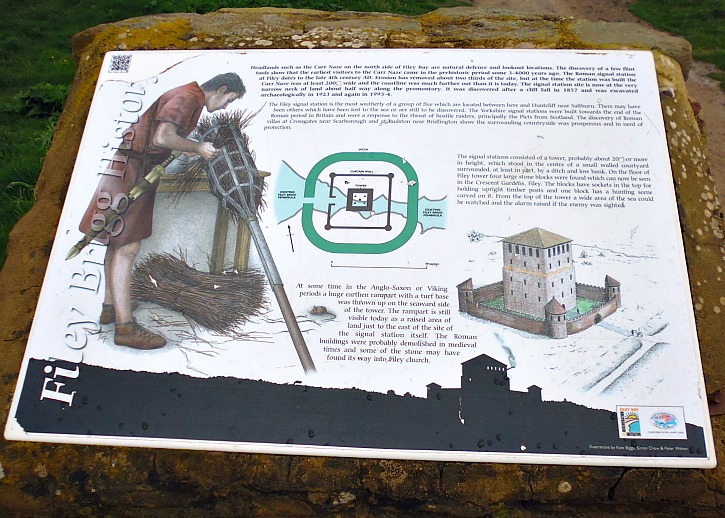
Information Board on Filey Brigg.

Information Board on Filey Brigg.

OS grid reference: TA 1268 8163. Close to the cliff edge at Carr Naze (Filey Brigg) at the north-eastern side of Filey and near to the Country Park is the “site of” some faint rectangular earthworks of Filey Roman Signal Station. This was the southernmost signal station of five along the Yorkshire coast, and was in use from roughly 375-410 AD; it was manned by a small garrison of soldiers, with the rocky ‘spittal’ (mooring place) below the cliffs being used as a natural harbour for Roman sailing vessels. Filey’s Roman signal station, along with the four others, would have formed a defence against attacks by sea-borne invaders from across the North Sea. The beacon on top of the tower would be lit when invading ships were spotted on the horizon, acting as a warning to the other stations along the coast so that evasive action could be taken. In a recent landslip part of the earthwork (two-thirds) at the eastern edge disappeared over the cliff and the rest of the site is in ever constant danger of going the same way.

Carved Roman Stones

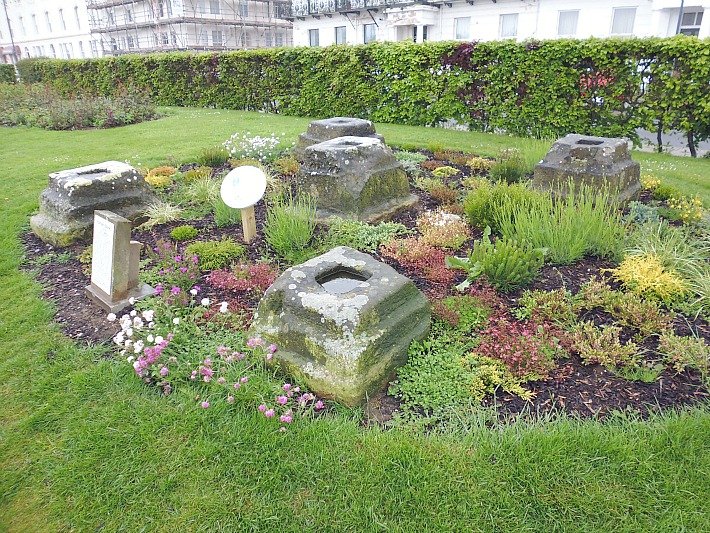
Carved Roman Stones in Crescent Gardens, Filey.

The station would have measured 50 metres across with the tower (beacon) at the centre 30 metres high and 14 metres square; the tower being surrounded by a walled structure or courtyard with a gate at the western side. In the mid-19th century the earthworks were quite visible as was its surrounding bank or rampart – most noticeable at the eastern side. Upon discovery of the signal station in November 1857 excavations took place at the request of a local reverend gentleman who owned the land and, five large stone blocks were dug up – these most probably supported the first floor of the tower itself; the five stones now stand in Crescent Gardens, Filey, each one having been nicely carved on all sides and having a square aperture 6 inches wide and 3 inches deep at the top, one has a faint carving of what could be a dog chasing a deer! Also, a wall and the foundations of the signal station were discovered some 4 feet below the ground.

Carved Roman Stone in Crescent Gardens, Filey.

Carved Roman Stone in Crescent Gardens, Filey.

Further excavations took place in 1927 and again in 1993-4 by Y.A.T with help from S.A.H.S funded by English Heritage and Scarborough Council – and a number of Roman artefacts were found including bronze coins, pottery and animal bones. Undoubtedly, the Roman signal station would have been an impressive sight when fired up and enough to scare any would-be invaders long before they reached the east coast. The earthworks of a post-Roman building (perhaps a Saxon chapel) can be seen at the east side of the signal station but this is, as yet, unrecorded. A three foot high bronze statue of the god Mercury was found in the eroded cliffs by the signal station – and now resides in The Rotunda Museum, Scarborough, along with a few other Roman finds from Carr Naze. The museum also houses the famous ‘Gristhorpe Man’ which was excavated in 1834. It is the skeleton of a Bronze-Age man who had been buried inside a hollowed-out oak tree near Gristhorpe Cliffs at Cayton, Scarborough (NGR TA 0937 8323). An information board now stands on the site of the Roman signal station, close by a World War II bomb crater.

Source:

Filey Bay Initiative Leaflet, Discover Filey, 1995. http://www.discoverfiley.org.uk

Copyright © Ray Spencer, The Journal of Antiquities, 2012.