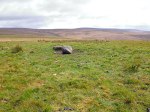
Hameldon Pasture Round Barrow I
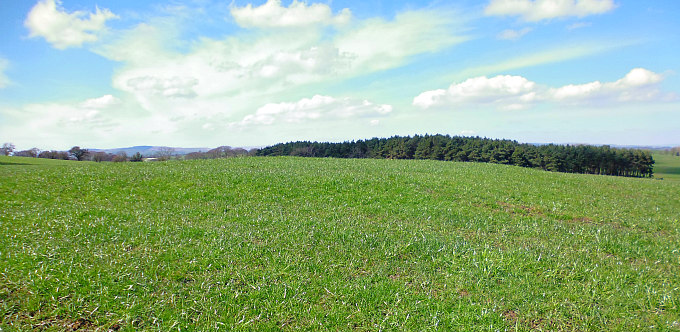
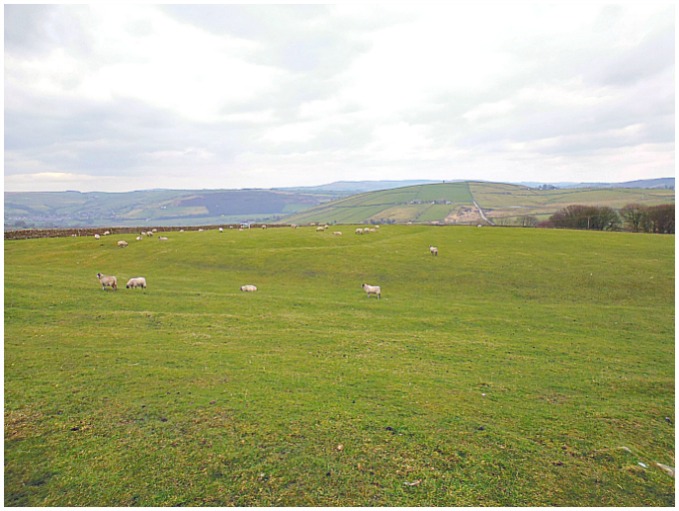
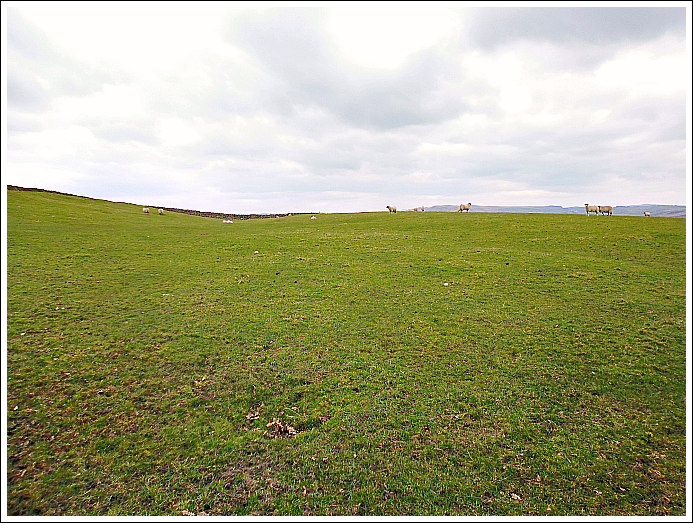
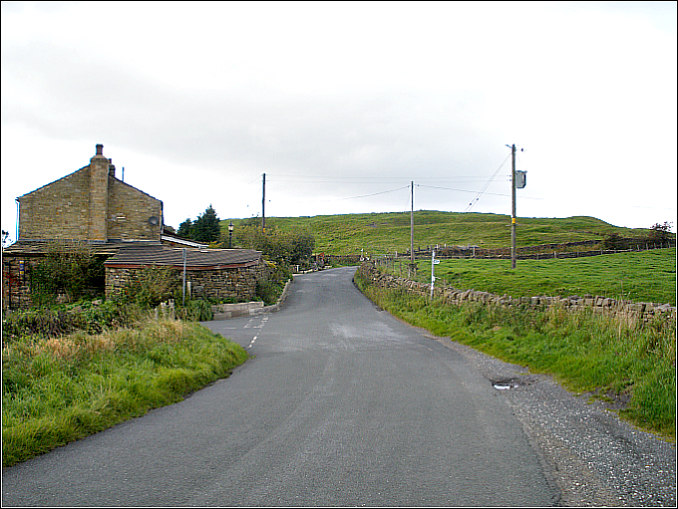
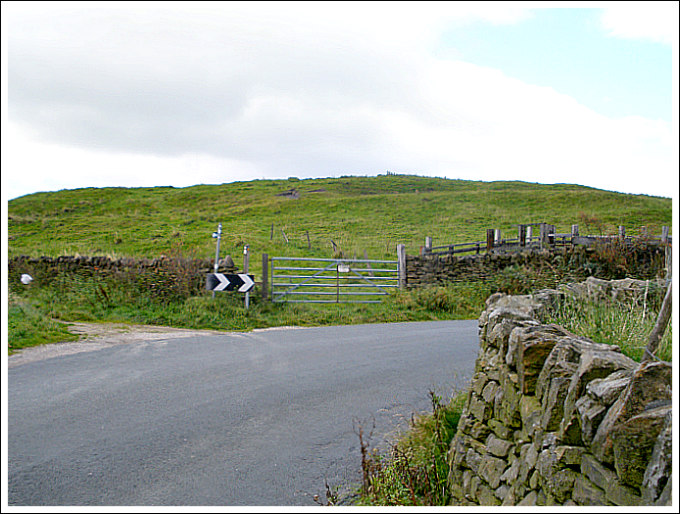
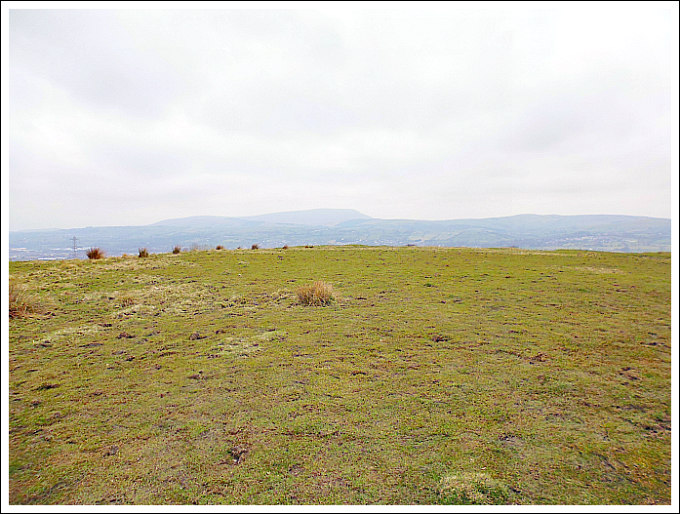
OS grid reference: SD 8914 3262. Upon the windswept Hameldon Pasture near Worsthorne, Lancashire, are two prehistoric round barrows, but often referred to as cairn circles or round cairns. The small hill on which they are located is also known as Little Hameldon Hill, and to the local people it is Worsthorne Hill. Unfortunately, both monuments are now ‘much’ destroyed and robbed of their stonework. The larger barrow is called Hameldon Pasture I, while the smaller one is Hameldon Pasture II. To reach the site take the Gorple Road at St John’s Church in Wors-thorne. Continue eastwards along this often quite rough track for about 1½ miles. Take the second footpath over the ladder stile on left-hand side (after power cables), then walk-on northwards for 290m to the hill and round barrows. The ladder stile was broken at the time of my visit and the footpath often quite boggy.
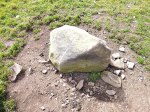
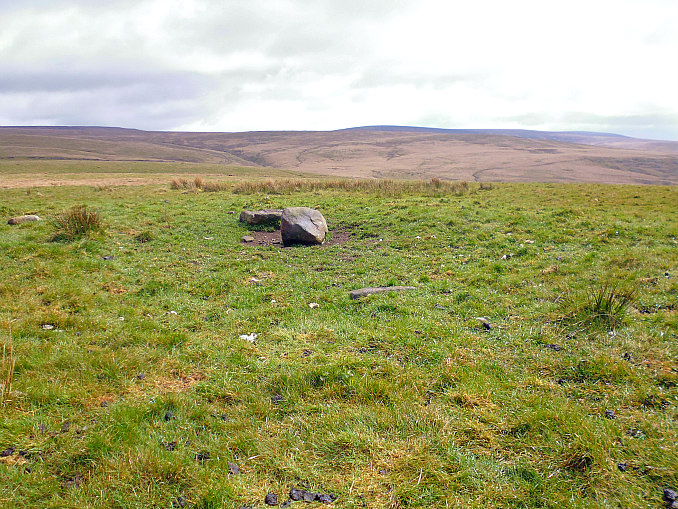
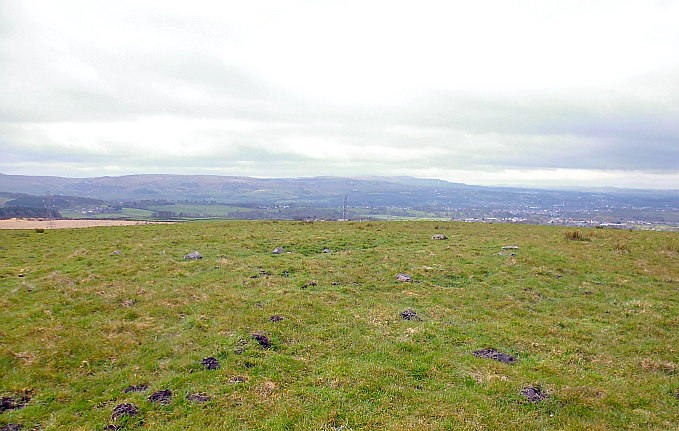
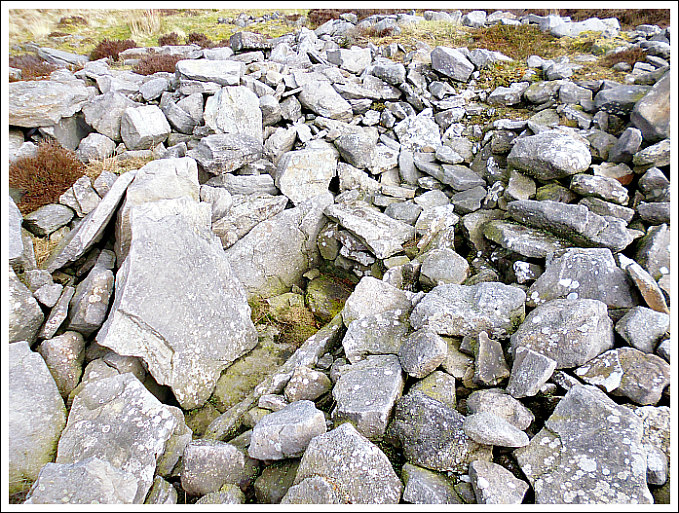
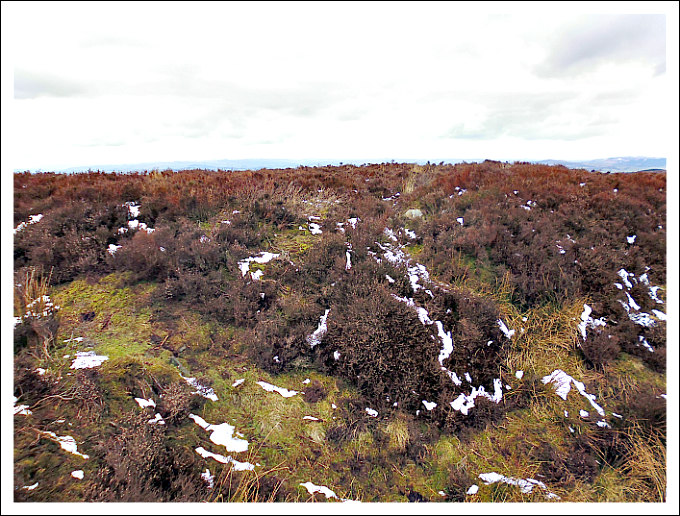
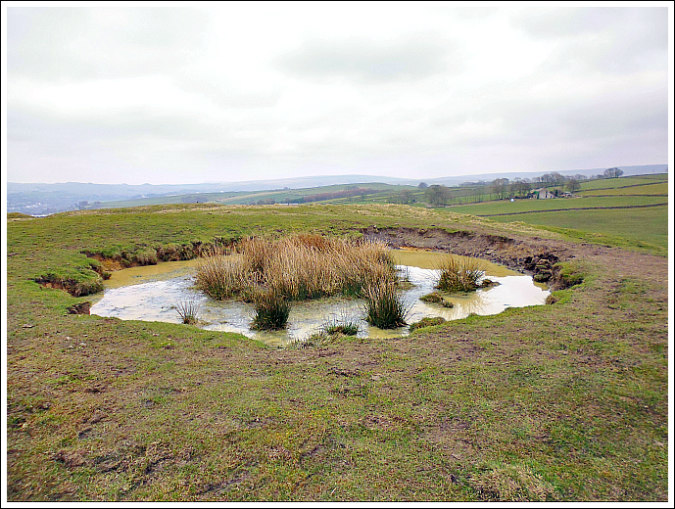
Hameldon Pasture Barrow I (showing the boulder at the centre).
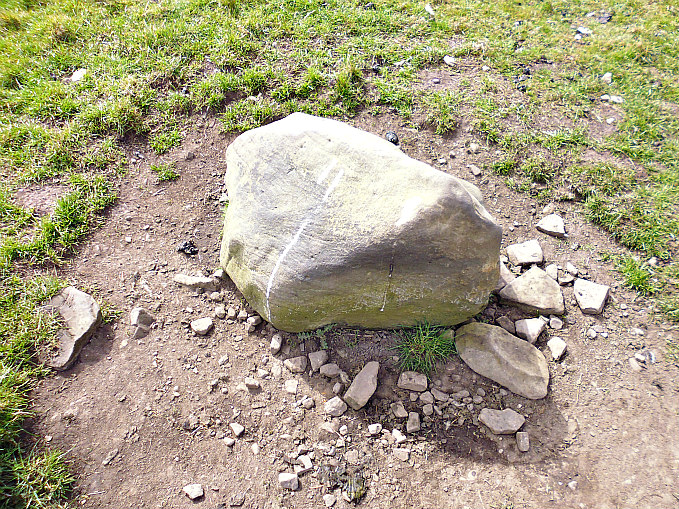
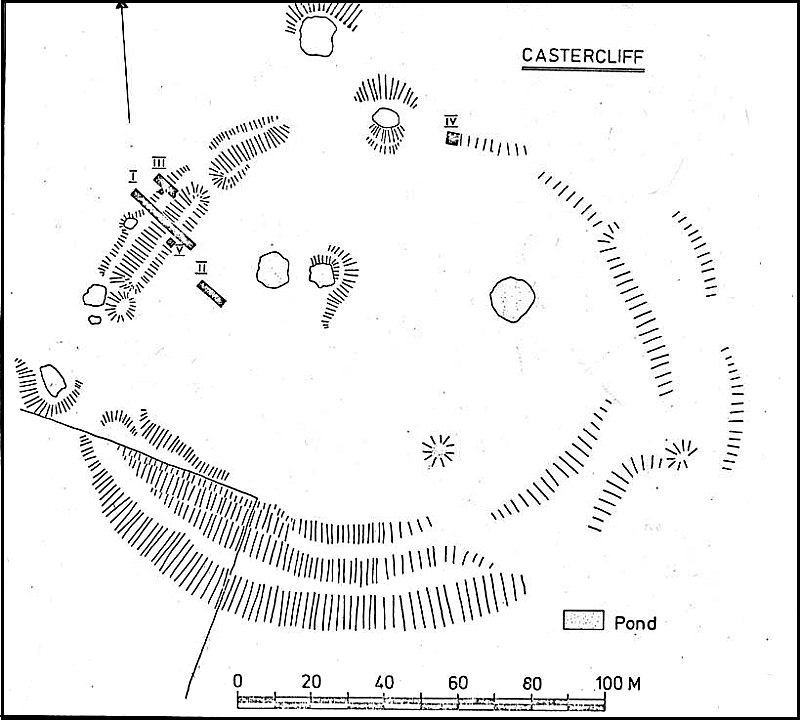
The larger of the two barrows (Hameldon Pasture I) is 0.3m high and has a circumference of 21m (almost 69 ft) but it is now much destroyed and difficult to make out in the grass. It was originally a bowl-shaped tumulus consisting of earth and stones – many of its stones having been robbed away and used in the walls down slope. At the centre there is a hollowed-out area 5m x 4m (16 ft x 13 ft) with two weather-worn gritstone boulders, the bigger one looks to have some tiny cup-marks at one side? A third, smaller boulder lies close by. When this barrow was excavated in 1886 a cist grave was found. This had two large flat stones covering it and other flat slabs at the sides and the ends. A number of arrowheads and tiny flints were also found.
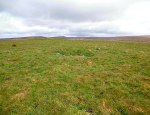
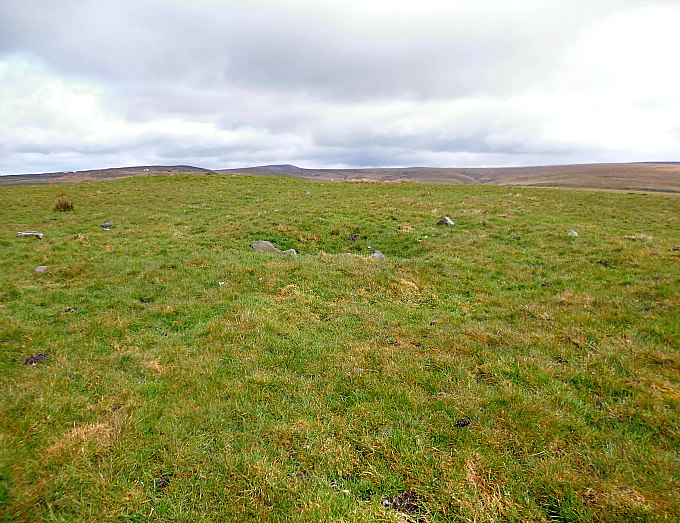
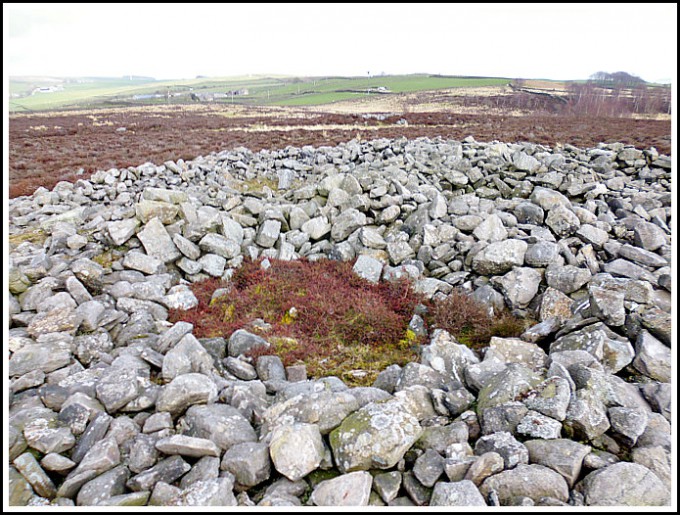
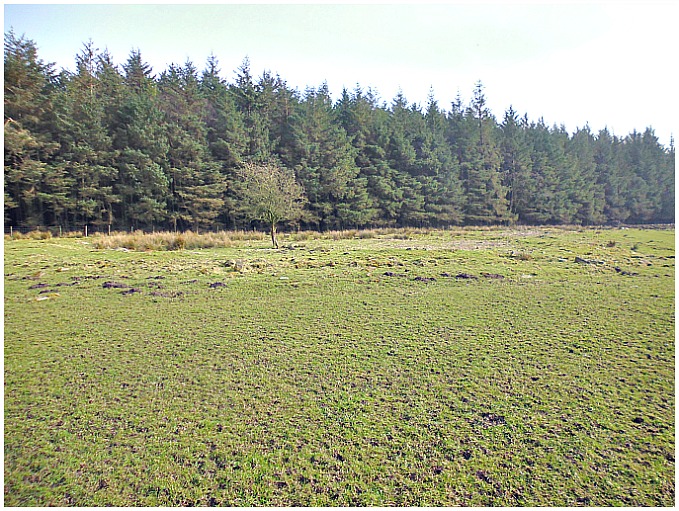
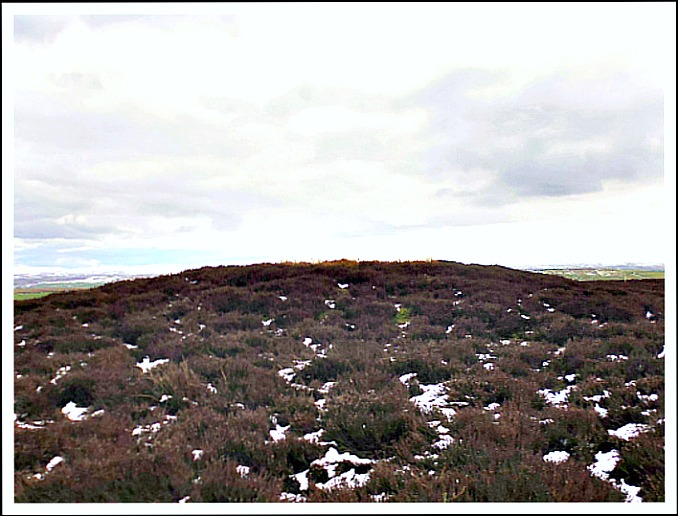
Hameldon Pasture Round Barrow II.
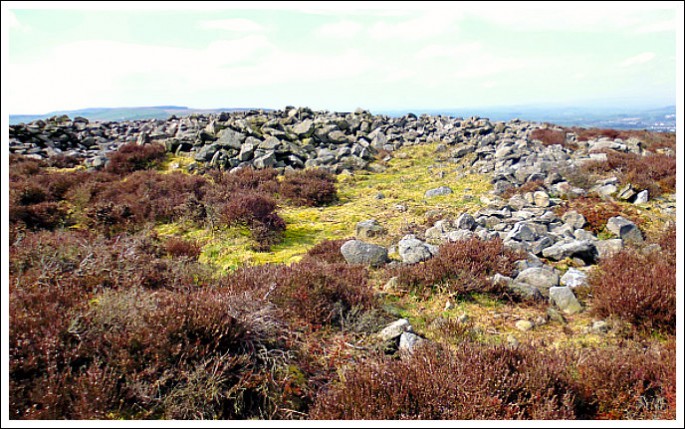
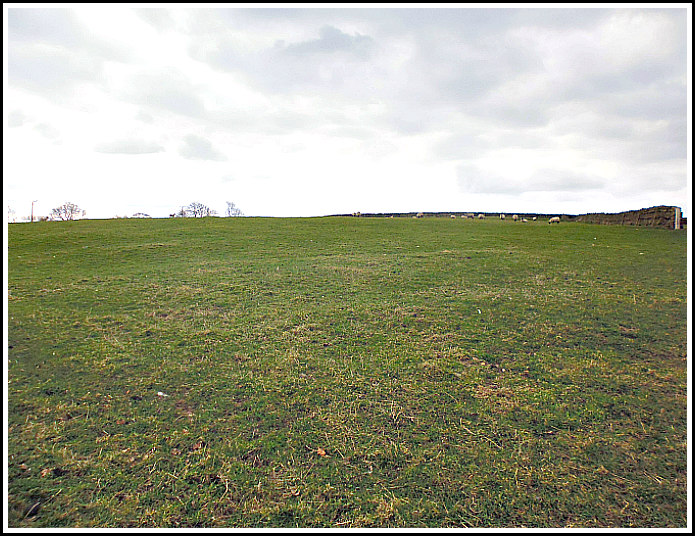
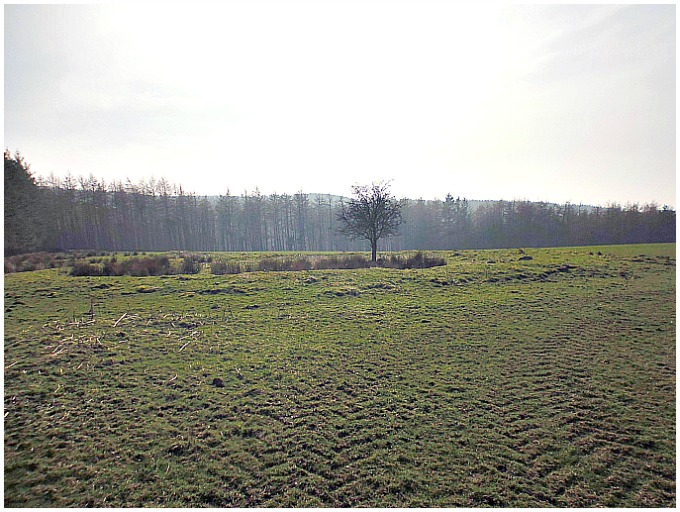
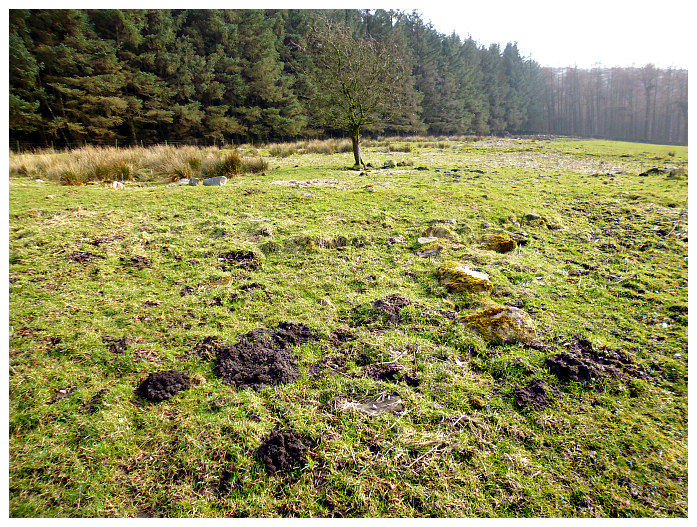
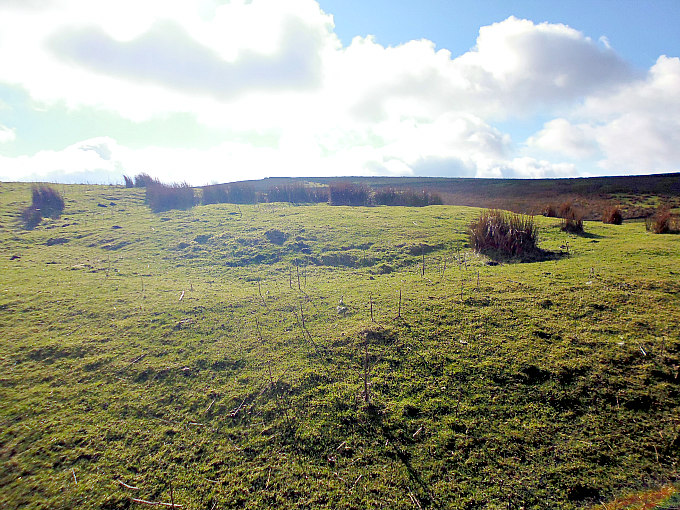
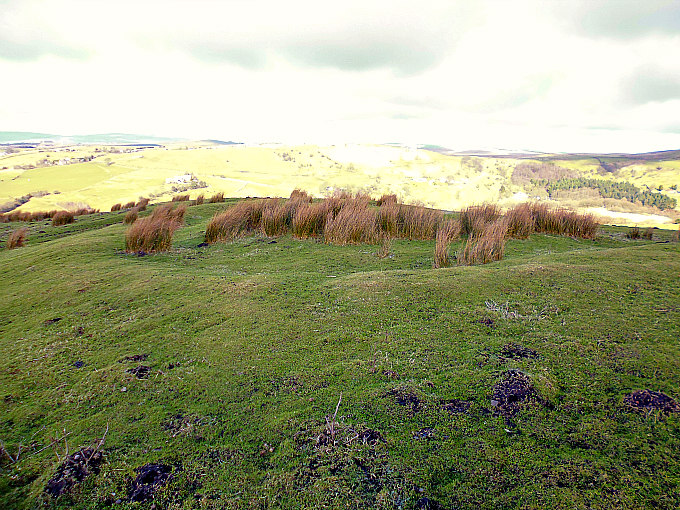
The second barrow lies 55m to the south-west at (SD 8912 3259) and is identified as ‘Hameldon Pasture II’. But it is also known as a round cairn or cairn circle. This much destroyed round barrow measures 12.5m x 10.8m (41 ft x 35 ft) and is 0.3m high. The large hollow (depression) at the centre is 2.5m x 1.5m (8 ft x 5 ft); there are traces of a second hollow. Several stones lie in the centre and around the edges – indicative of an outer kerb. When the cairn was excavated in 1843 by Mr Studley Martin*, of Liverpool, an undecorated urn containing the bones of an adult and child was found in a stone cist, but the stones from this have been robbed away for other use in the ‘immediate’ locality.
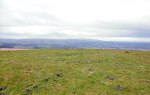
Hameldon Pasture Round Barrow II.
*Mr Studley Martin the 19th century Liverpool writer and antiquarian was a guest of the Reverend William Thursby of Ormerod House near Hurstwood, Burnley, Lancashire, in 1843. During his sojourn in the Burnley area he visited the two prehistoric barrows upon Hameldon Pasture, and was ‘seemingly’ delighted to find an undecorated funery urn in the smaller of the two tumuli. Martin was also associated with the prehistoric Calder Stones at Allerton, Liverpool.
Sources:-
Hall, Brian, Burnley (A Short History), Burnley and District Historical Society, 1977.
https://historicengland.org.uk/listing/the-list/list-entry/1008919
http://www.megalithic.co.uk/article.php?sid=11195
http://www.burnleyexpress.net/news/nostalgia/worsthorne-a-village-history-1-1688523
https://en.wikipedia.org/wiki/Worsthorne-with-Hurstwood
© Copyright, Ray Spencer, 2016.
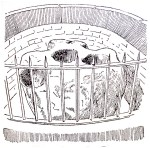
The Burton Stone on Burton Stone Lane, Clifton, York
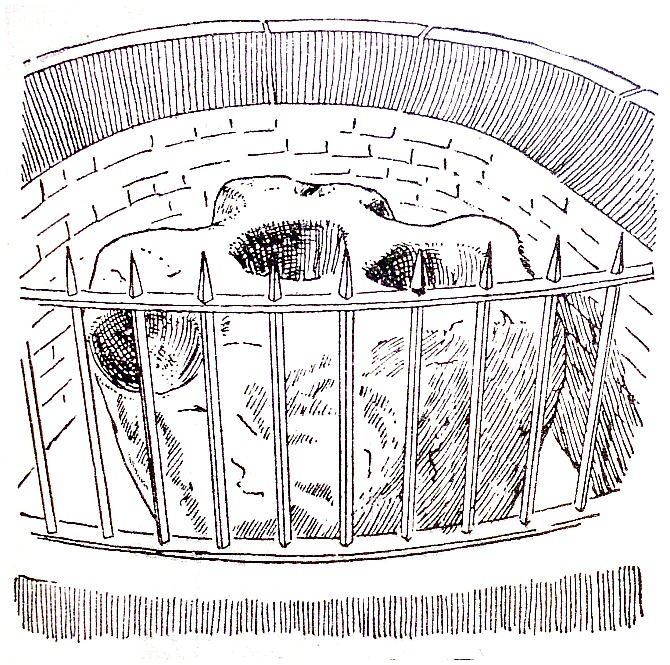
OS grid reference: SE 5960 5271. At the corner of Burton Stone Lane and in front of the Burton Stone Inn at Clifton, York, is the Medieval plague stone known as ‘The Burton Stone’. According to local legend, it was long ago a cross-base for perhaps three Medieval crosses, but in more recent centuries it had become a ‘plague stone’ and its three hollows (sockets) perhaps used as recepticals for vinegar! But whether the stone is in its original position is open to question. The stone now lies in a brick niche behind iron railings at the front of the Burton Stone Inn at the corner of Burton Stone Lane and the A19 Clifton Road, where prior to the pub there was an ancient chapel dedicated to St Mary. Clifton is a suburb of York. The city centre lies about 1 mile to the south down the A19 road.
The Burton Stone is a large lump of stone that is roundish in shape and at one side is shaped like a cross. It has three basin-like hollows that were originally socket holes for crosses, but over time these have been worn smooth by human hands. What happened to the crosses that stood in the socket holes is not known but they were probably associated with the Medieval chapel that stood on this site, and which was dedicated to St Mary Magdalene. The Burton Stone may have marked a city boundary or a line of jurisdiction.
The ancient chapel was perhaps a pilgrims’ chapel or a chapel-of-ease as York Minister is only a short walk down the road. But after the chapel’s demise the cross-base was put into use as a ‘plague stone’ and the three holes became receptacles for vinegar. Coins were also placed in the vinegar solution as a way of sterilization and then handed out to families affected by the plague, or cholera epidemics, which struck the city of York from 1604 onwards. Local legend says that Mother Shipton (1488-1561) the Yorkshire prophetess rested beside the Burton Stone in 1512 – at which time she also married Toby Shipton of York.
Sources:-
There is a photo of the stone on this website: http://www.jorvik.co.uk/burton-stone/
http://www.themodernantiquarian.com/site/7621/burton_stone.html#miscellaneous
The Automobile Association, The Illustrated Road Book Of England & Wales, London WC2, 1961.
© Copyright, Ray Spencer, 2016.
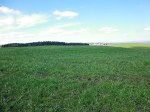
Primrose Hill Earthwork, near Gisburn, Lancashire
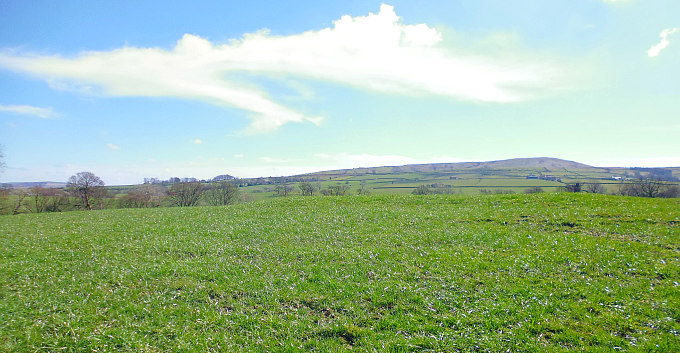
OS grid reference: SD 8476 4725. Near Coal Pit Lane – about 1 mile to the south-east of Gisburn, Lancashire, there is a small, square-shaped earthwork that sits upon the north-side of Primrose Hill. But unfor-tunately hardly anything is known about this solitary earthwork, apart from the probability that it dates from the Roman period. This earth-work is located beside a footpath close to Hesketh Farm. There are other Roman features in this area: 600m to the north-west is the well-defined earthwork known as Bomber Camp, and 500m to the south-east there are faint traces of the Roman road that runs from Elslack to Ribchester. The Primrose Hill earthwork can be reached from the A682 out of Gisburn, turning onto Coal Pit Lane for maybe ½ a mile, then walk along the footpath/track towards Hesketh House Farm. Via off to the north before the farm, then north-east along footpath (following tree line) for 160m to reach the low hill (Primrose Hill) on the right.
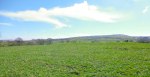
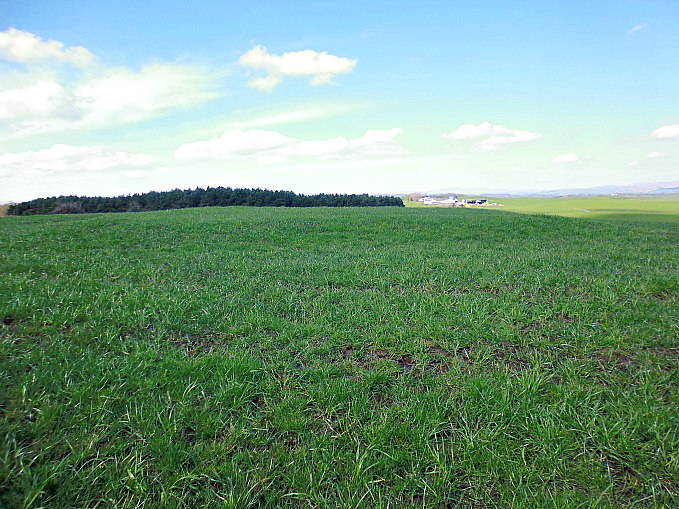
Primrose Hill Earthwork (in the foreground) near Gisburn, Lancashire,
This roughly square-shaped earthwork or earthen platform on Primrose Hill is about 1m (3 feet) high and 10m (nearly 33 foot) square. It is quite prominent when viewed close-up from just below the hill itself, but from further afield it is not particularly visible and would be easily walked passed. There is a dearth of information with regard to this site – although it is conjectured to have been a Roman watchtower or signal station – the later being more unlikely due to the smallness of the earthwork. A watchtower seems more plausible due to the feature being situated on a hill with lower ground on the N side and its nearness to a Roman road on the S. If this “were” a watchtower of the late Roman period, it would have been garrisoned by only ten soldiers at any one time. The thinking being that this particular watchtower never even saw the light of day, it was quickly abandoned and never begun, leaving just an earthen platform. The nearby Roman earthwork ‘Bomber Camp’ ended its days in a similar vane – only surviving for a short period of time towards the end of the 4th century AD.
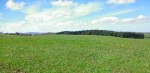
Primrose Hill Earthwork, near Gisburn, Lancashire.
The author John Dixon in his work ‘Journeys Through Brigantia’, (Volume One), says of this earthwork that: “During June 1971 the site was excavated by Alan King and the Chorley College of Education. No post-holes or masonry were found, nor any finds. There was no ditch around the earthwork, but the boulder clay of the mound contained sand-stone while the drift below was more calcareous, and so it was given to be man-made.” And so with the lack of any ‘good’ credible information this Roman earthwork, if that’s what it was, shall have to remain just a miscella-neous earthwork of uncertain date – at least until further information arises.
Sources:
Dixon, John & Phillip, Journeys Through Brigantia (Volume One), Walks in Craven, Airedale and Wharfedale, Aussteiger Publications, Barnoldswick, 1990.
Bomber Camp, Gisburn, Lancashire
© Copyright, Ray Spencer, 2016.
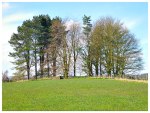
Little Painley tumulus, near Gisburn, Lancs.
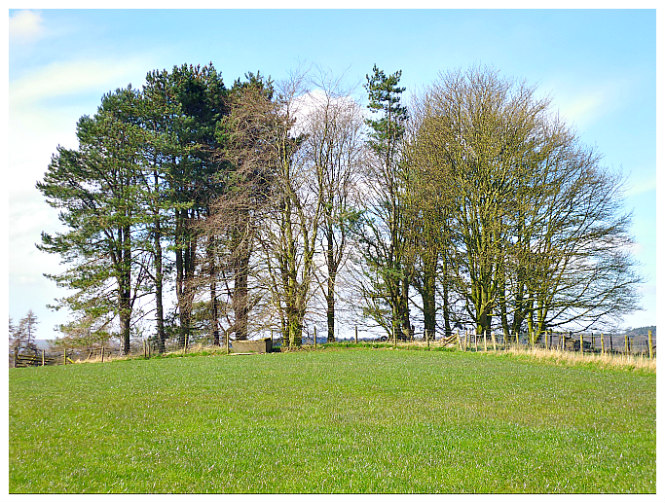
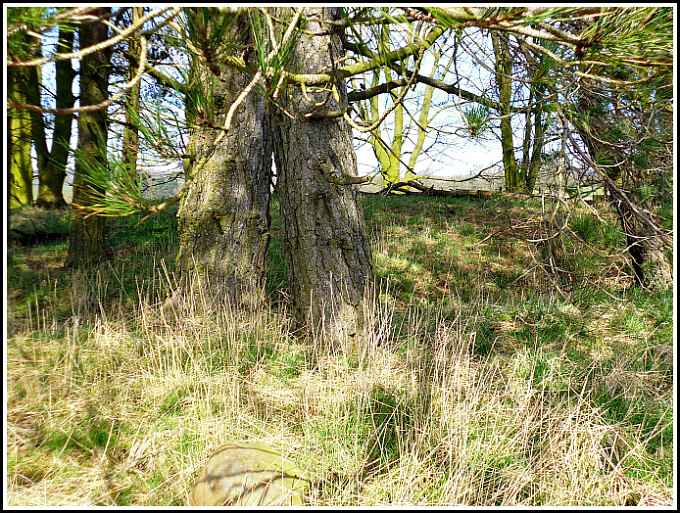
OS grid reference: SD 8284 5012. In the middle of a farmer’s field at Little Painley near Gisburn, Lancashire, there is a clump of tall trees which surround an ancient burial mound/bowl barrow. The very distinctive low mound is still quite prominent even after thousands of years. However, it is now surrounded by a barbed-wire fence and also the site is more difficult to reach from the road due to a gate and recently erected fences, although as these fields are for the growing of crops and vegitables in the Summer months, I suppose that is to be expected. The burial mound (tumulus) is located on the left-hand side of the A682 (Long Preston) road 1¼ miles to the north of Gisburn church and just past ‘The Temple’, which is an 18th century tree-clad mound. Little Painley prehistoric burial mound is situated on private land and on a low hill surrounded by fields that have crops growing in them in the Summer months. So, if you do wish to take a closer look, it is advisable to ‘keep’ to the fence side of the field.
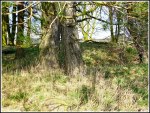
Little Painley Burial Mound, near Gisburn, close-up.
The barrow stands on a low hill at the eastern side of the River Ribble and is said to have a diameter of 20m (68 ft) and is maybe 2-3 feet high. It was built of earth and stones in the Bronze Age – sometime between 2,500-1,600 BC. There is a surrounding ditch 2.5m (6 ft) across and 0.5m (1 ft 6 inches) deep. At the SW side there are traces of an outer bank some 2.5m (6 ft) in width and about 0.3m ( nearly 1 ft) high, although these features are often hard to see properly due to the trees, and in the Summer months – the long grass. The trees here were planted in the 1960s. When this barrow was excavated in the early 1900s one or more collared funery urns of the ‘Pennine type’ were found indicating that there was probably a settlement near by. The author John Dixon in his work ‘Journeys Through Brigantia’ (Volume One), suggests the settlement was centred on Bolton-by-Bowland, where a number of Bronze Age axe heads have been found. It is perhaps likely, then, that a chieftain and his close family were buried here at the Little Painley barrow.
And John Dixon goes on to say: “These isolated finds provide a tantalizing insight into Bronze Age society. However, the evidence we have tends to pose as many questions as they resolve. A ditched bowl barrow is evidence of a society with a level of social organization capable of converting surplus economic value into funeral monuments. This society suppor-ted a primitive ceramic and metallurgy technology and must have conducted trade with people outside of Craven, and it was probably a hierarchical warrior society.”
Sir E.B. Tylor in his work of ‘Anthropology’ (Vol II) says something very similar. He says that: “Prehistoric burial-places in our own country are still wonders to us for the labour they must have cost their barbaric builders. Most conspicuous are the great burial-mounds of earth or cairns of stones. Some of the largest of these appear to date from the stone-age. But their use lasted on through the bronze-age into the iron-age.”
About ½ a mile to the north beside the River Ribble, just south of Paythorne bridge, stands Castle Haugh, a late 11th century earthwork consisting of a large ditched mound with a ‘motte’ at the centre. This stronghold was probably the residence of Roger the Poitevin, a Norman baron who held the lands around here. He is mentioned in ‘The Domesday Book’ (1086) under the entry for Bernulfeswick (Barnoldswick) in Craven.
Sources:
Dixon, John & Phillip, Journeys Through Brigantia (Volume One), Aussteiger Publications, Barnoldswick, 1990.
http://www.megalithic.co.uk/article.php?sid=11487
Tylor, Edward B. (Sir), Anthropology (Vol II), Watts & Co., London, 1946.
© Copyright, Ray Spencer, 2016.
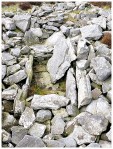
Bradley Long Cairn, near Farnhill, north Yorkshire.
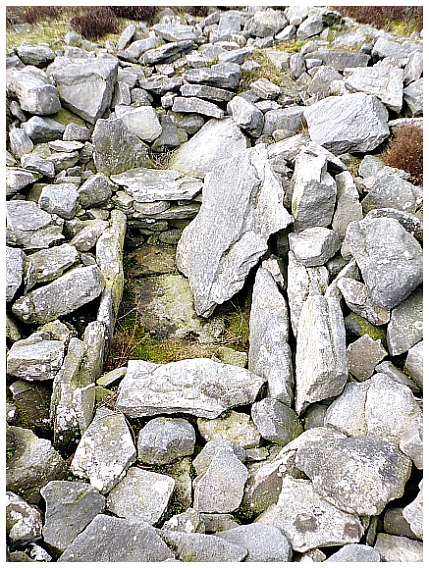
OS grid reference: SE 0092 4756. At the north-eastern side of Bradley Low Moor, near Farnhill, in north Yorkshire, is the Bradley Long Cairn, which is also known as ‘Bradley Long Barrow’ and sometimes ‘Black Hill Long Cairn’. Now, sadly, it is a large pile of stones and an uncovered oblong-shaped cist grave that has suffered from much disturbance over the years, and maybe robbery in some shape or form. Some 40m to the south-west is a much destroyed ring cairn, and yet a third cairn lies 50m to the north-west but this is hardly visible beneath the thick heather. The site can easily be reached from the hamlet of Farnhill, and then along Crag Lane which skirts the western-side of the moor. Just opposite the house go through the gate and follow the footpath up onto the moor in an easterly direction for 290m, then via off to the right in the direction of the wall for 360m. You will soon see the long barrow and ring cairn as piles of grey stones in the heather. The village of Kildwick is about a mile to the south.
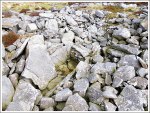
Bradley Long Cairn, near Farnhill, North Yorks.
The Bradley long cairn measures roughly 76m (249 ft) in length by 30m (98 ft) in width at its widest part and on its eastern flank it is up to 2.4m (8 feet) high, although it is difficult to make out due to the long heather which grows in abundance on the higher parts of the moor. Sadly the cairn has suffered greatly from disturbance over the years and maybe from robbery, especially at the E side; today its oblong-shaped cist grave is 1.5m deep and is open to the elements and its large flat covering stone broken up and partially missing, but its side stones are largerly still intact. In 1930 this Neolithic barrow was excavated by archaeologists and its funery contents (one single human burial) taken away to safety. The thinking is that during the Bronze Age a round cairn was built onto it at the S side. There is no sign of the earthern mound that would have formed the covering to this megalithic structure, only the piles of stones survives; some of the outer stones in the large pile are nicely shaped, while many others are very smooth – very typical of this grey gritstone.
Author John Dixon in his work ‘Journeys Through Brigantia’, volume one, tells us that: “The excavation revealed a stone cist, 6½ feet long and 3 feet wide, some 60 feet from the eastern end of the barrow. The cist was formed by four stone slabs set on end with a fifth forming a ‘capstone’. A sixth slab lay on the floor and this covered a deposit of unburnt but smashed human bones. Cremated were also found in the cist. The mound contained a number of standing stones, but none of these were formed a second cist. The barrow may represents a degenerate example of a megalithic chambered tomb.”
John Dixon goes on to tell us about the probable construction of Bradley Long Cairn. He says that: “The building of such a large monument would have consumed an appreciable share of the community’s time, energy and effort. Its construc-tion and use would to some extent have performed a community function, although it was probably directed by and for a small elite.
“The building of the tomb would take twenty or so able-bodied persons over thirty days. Such an investment of labour would have to be made over a period of time, and at times when there was little farming activity. It is reasonable to sup-pose that they used the labour potential availability of neighbouring groups to join in the construction work. Given a suitable incentive — a great feast with amusement and exchanges providing a forum for social intercourse, co-operative effort can work to build impressive monuments.
“The Bradley cairn reflects the importance of the social occasion and the passionate concern for the group status in Neolithic society. The long cairn would become the principal feature of the territory, which may itself have been known by the name of the monument. Its construction would be one of the steps such a group would have to take in order to estab-lish its identity with the regional clan.”
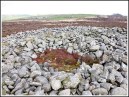
Black Hill Ring Cairn.
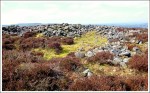
Black Hill Ring Cairn.
Some 40m to the south-west of the long cairn at (OS grid ref: SE 0087 4753) is a much destroyed round cairn. It is often referred to as the ‘Black Hill Cairn’. This round cairn from the Neolithic age is sadly now just a large pile of stones – with four slight depressions at intervals in the inner part of the monument – where they are no stones. These are perhaps the result of stone robbery, and not burials. This cairn measures approx. 30m x 24m.
And yet a third cairn which is also known as the ‘Black Hill Ring Cairn’ is only just visible 50m to the north-west at (OS grid ref: SE 0081 4756) but is now ‘virtually’ lost in the thick heather. This is a ring cairn or maybe a cairn circle, and it has a diameter of 20m. There is just a scattering of stones on its heather-clad mound.
Sources:
Dixon, John & Phillip, Journeys Through Brigantia, (Volume One), Walks in Craven, Airedale and Wharfedale, Aussteiger Publications, Barnoldswick, 1990.
https://historicengland.org.uk/listing/the-list/list-entry/1010440
http://www.megalithic.co.uk/article.php?sid=11624
http://www.megalithic.co.uk/article.php?sid=11625
Copyright © Ray Spencer, 2016.
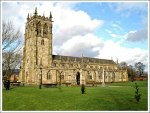
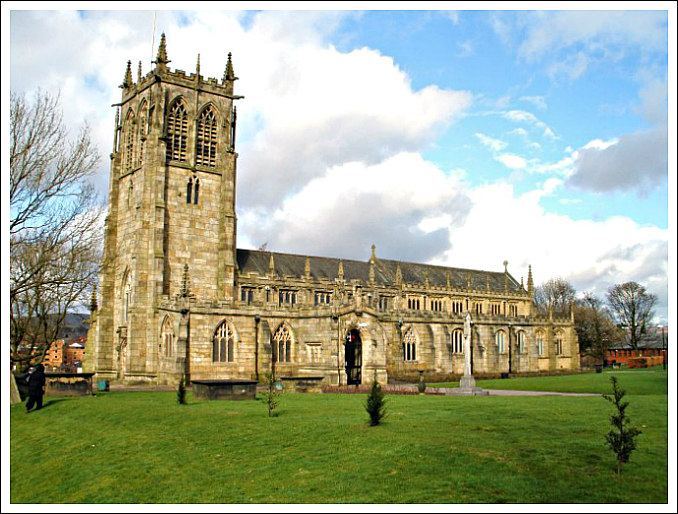
St Chad’s Church at Rochdale, Greater Manchester.
OS grid reference: SD 8964 1313. St Chad’s parish church stands upon a lofty ridge overlooking the River Roch and the town of Rochdale, Greater Manchester. The church is a very imposing edifice standing high above the equally imposing Victorian town hall and its famous clock tower. There was a church here in either the late Saxon period, or more likely just after the Norman conquest – the mid 11th to early 12th centuries – although that is open to question. There is a well-known legend that says there were problems with the siting of the first church which was being built on lower ground on the other side of the river, and that it had to be re-sited to the higher position that we see it today. The church can be reached from opposite the Town Hall carpark and by climbing the steep 124 steps up to Sparrow Hill.
Author Dennis Ball in his interesting book ‘Lancashire Pastimes’, says that: “A Saxon thane, Gamel, Lord of Rochdale, decided to build a church to St Chad on the banks of the river Roche. The foundations were dug and all the materials taken to the site. All the materials mysteriously disappeared and reappeared at the summit of the steep hill on the opposite side of the river. Gamel was very annoyed and blamed his workmen. He made them take all the materials back to the original site. This took the whole of the next day. That night they were again moved back to the top of the hill. But this time the culprits were seen by some of the workmen. They were goblins.”
Another, more lengthier interpretation of the legend, from the 19th century, is given by J. Harland & T. T. Wilkinson in ‘Lancashire Legends’, which is published in ‘The Secret Country’ by Janet & Colin Bord. They say: “Towards the close of the reign of William the Conqueror, Gamel, the Saxon thane, Lord of Recedham or Rochdale, being left in the quiet possession of his lands and privileges, was ‘minded, for the fear of God and the salvation of his immortal soul, to build a chapel unto St Chadde’, nigh to the banks of the Rache or Roach. According to Mr Roby, in his ‘Traditions’, a place was set apart on the north bank of the river, in a low and sheltered spot now called ‘The Newgate’. Piles of timber and huge stones were gathered in profusion; the foundations were laid; stakes having been driven, and several courses of rubble stone laid ready to receive the grouting or cement. In one night, the whole mass was conveyed, without the loss of a single stone, to the summit of a steep hill on the opposite bank, and apparently without any visible signs of the mode of removal. The Saxon thane was greatly incensed at what he supposed to be a trick of some of his own vassals, and threatened punishment; to obviate which, a number of the villeins and bordarii with great difficulty and labour con-veyed the building materials back to the site for the church; but again were they all removed in the night to the top of the hill. Gamel having learned the truth, sought counsel from Holy Church, and it was thereon resolved that the chapel should be built on the hill-top, as the unknown persons would not permit it to be erected on the site originally selected. This explains the chapel or church of St Chadde, still standing on a hill so high that one hundred and twenty-four steps were cut to accomplish the ascent, and enable the good people to go to prayers.”
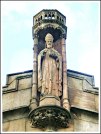
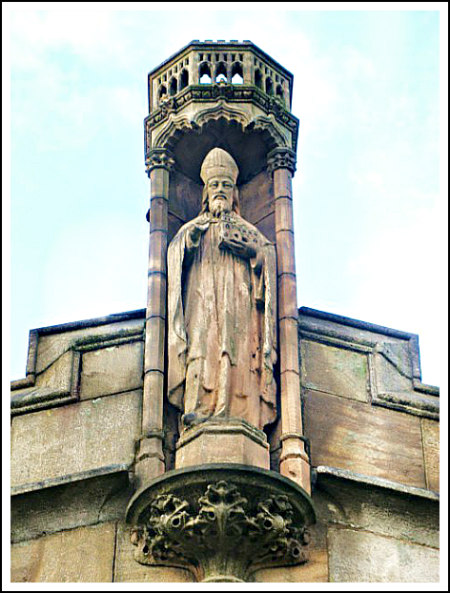
St Chad’s statue, Rochdale Parish church.
St Chad to whom Rochdale parish church is dedicated, was a 7th century northern churchman who became abbot of Lastingham in Yorkshire, and for a while he was bishop of York until St Wilfrid returned from France. Later, he was made bishop of the Mercians at Lichfield. He died in 672 AD and his feast day is held on 2nd March (Colin Waters ‘A Dictionary Of Saints Days, Fasts, Feasts And Festivals’). The town of Chadderton near Rochdale is probably named after St Chad.
There are no antiquities of great age within St Chad’s, although the Tudor pews are of some notable interest and parts of the church tower are ‘thought’ to date back to the late Saxon age, or more likely the early Norman period. The statue of St Chad high up on the outer south wall is particularly fine. The Lancashire poet John Collier (Tim Bobbin) 1708-86 is buried in the churchyard.
Sources:
Ball, Dennis, Lancashire Pastimes, Burnedge Press Limited, Royton, Greater Manchester, 1987.
Bord, Janet & Colin, The Secret Country, Granada Publishing Limited, St Albans, Herts, 1980.
The Automobile Association, The Illustrated Road Book Of England & Wales, London WC2, 1961.
Waters, Colin, A Dictionary Of Saints Days, Fasts, Feasts And Festivals, Countryside Books, Newbury, Berks, 2003.
© Copyright, Ray Spencer,
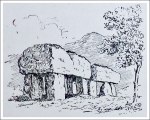
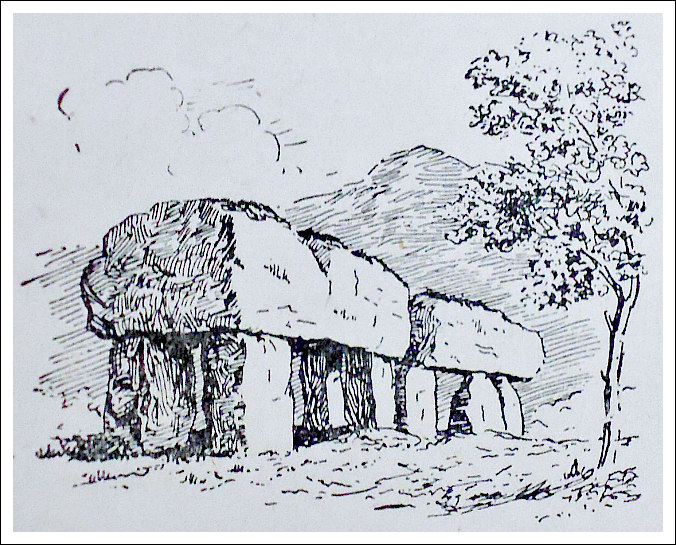
Cromlech at Plas Newydd, in Anglesey (Old Drawing)
OS grid reference: SH 5198 6972. Plas Newydd prehistoric burial chamber, cromlech or dolmen, stands just 300 metres north-east of the shoreline of the Menai Straits – at the south side of the island of Anglesey and, just opposite Plas Newydd House and Country Park – in whose “private” grounds it is situated. The site is 1½ miles south-west of Llanfair P.G. village and Menai Bridge, which links the Welsh mainland to the island. After the Menai Bridge and link road, take the A5 road, then the A4080 (Ffordd Brynsiencyn) road to the south-west for 1 mile. Take the first lane that runs off this road (south) to the NT Plas Newydd House. The ancient monument is just 150m to the south-east of the car park and on private land in front of the big house! And ½ a mile to the south, at the edge of the country park, is a second ancient monument, Bryn-yr-Hen Bobl, which is a chambered cairn.
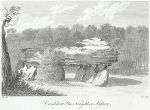
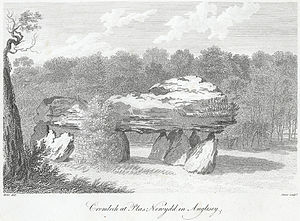
Cromlech at Plas Newydd, Anglesey by Caroline Metz, 1799, Wikipedia)
There are actually two burial chambers next to each other here, the larger one having a gigantic oblong-shaped capstone weighing many tonnes and measuring 3.5m x 3m, which is supported by five large and sturdy uprights, whereas the smaller chamber’s capstone is 2m x 1.7m and is supported by three smaller, round-shaped boulders. It would seem that the smaller monument acted as an antechamber (passage-way) to the larger monument. These burial chambers are said to date from the Neolithic age. Nearby, there are some boulders embedded in the ground – they are probably outliers – and maybe an indication that the burial site once covered a larger area than it does now. There is no sign today of the large earthen mound that would have originally covered these monuments, or did each burial chamber have its own separate covering mound?
Author Christopher Houlder in his work ‘Wales: An Archaeological Guide’, says of the site: “In parkland overlooking the Menai Strait is a megalithic tomb consisting of a main chamber 3 m by 2.4 m and a smaller antechamber, each with its own capstone, but there is no mound or other feature to give cultural definition.”
And likewise, author Jacquetta Hawkes, in her book ‘A Guide To The Prehistoric And Roman Monuments In England And Wales’, says of the site: “The Plas Newydd dolmen stands at the end of the drive between the mansion and a cricket field where it commands a view across the Straits. In such a place it at once suggests an eighteenth-century folly, an ornament to the house put up by some romantically minded peer. In truth, however, it is a genuine prehistoric monument of a rather unusual kind; there are two adjacent chambers, one larger than the other, with very massive uprights and capstones, separated by a single upright. It is possible, though not to my mind likely, that the smaller chamber was originally a passage or antechamber giving access to the larger.”
Plas Newydd burial chamber was first marked as a cromlech on the OS map of 1841 and as Burial Chamber on the 1947 map, and later ones. There was apparently an early reference and illustration in ‘Druidical Antiquities’ published by S. Hooper in April 1784, which shows two capstones with the larger one resting on five uprights, according to Chris Barber in his work ‘The Ancient Stones of Wales’.
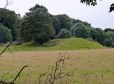
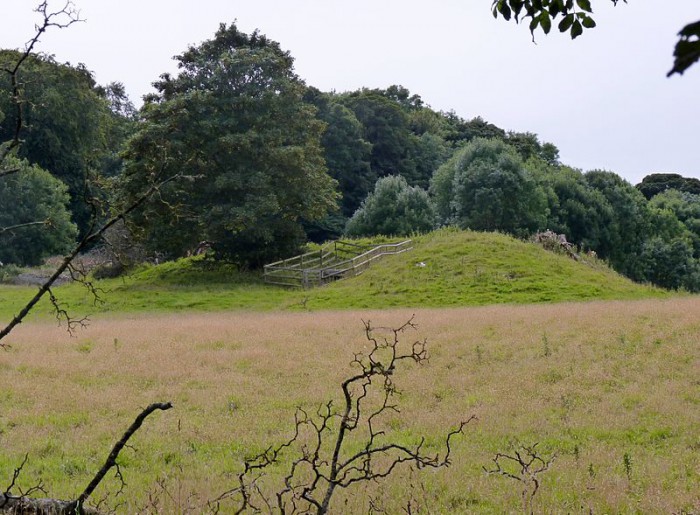
Bryn-yr-Hen-Bobl (photo credit: Robin Leicester – Wikipedia)
About ½ a mile to the south (OS grid ref: SH 5189 6900) and at the edge of the country park, there is another ancient monument. Again, it is on private land. This is Bryn-yr-Hen Bobl, a kidney-shaped grassy mound with a couple of trees on it – and a chambered cairn and funnel-shaped forecourt facing E. There is a revetted terrace some 12m wide extending 100m to the S. This megalithic burial tomb was excavated back in 1929, at which time some ‘earlier’ Neolithic artefacts were found, including stone axes, plain ‘western’ and Peterborough types of pottery. “The tomb contained the remains of at least twenty individuals”. (Houlder, 1978)
Sources:
Barber, Chris & Williams, John Godfrey., The Ancient Stones of Wales, Blorenge Books, Abergavenny, Gwent, 1989.
Hawkes, Jacquetta., A Guide To The Prehistoric And Roman Monuments In England And Wales, Cardinal, London, 1975.
https://commons.wikimedia.org/wiki/File:Bryn-yr-Hen-Bobl_Burial_Chamber,_Plas_Newydd,_Anglesey.jpg This photo is displayed under the terms of the Creative Commons Attribution-Share Alike 4.0 International license.
https://en.wikipedia.org/wiki/Plas_Newydd_(Anglesey)
http://www.coflein.gov.uk/en/site/93829/details/PLAS+NEWYDD+BURIAL+CHAMBER/
Houlder, Christopher., Wales: An Archaeological Guide, Faber, London, 1978.
Copyright © Ray Spencer, The Journal of Antiquities, 2016.
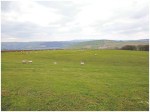
Babyhouse Lane Settlement from the south-west.
OS grid reference: SD 9719 4628. On the hills a mile or so to the south-west of Cononley, North Yorkshire, near the top end of Babyhouse Lane, there is an Iron Age settlement or camp. This is thought to have been a Brigantian outpost that was still in use in the late 1st century AD when Roman soldiers marched along the Roman road to the south-west and set up their fort at Elslack. For a time, the Brigantes got on to some extent with the Romans, but that was not to last for long and their settlements were soon to be abandoned, forever. Babyhouse Lane can be reached from Colne Road (A6068) near the Dog & Gun public house at Glusburn. Take the lane up onto Leys Lane, turning left at the top onto Babyhouse Lane, and then just after the junction of four lanes and the wooded area on the right, go through the second farm-gate and into the large walled field – here before you are the faint and grassy earthworks of the ancient settlement.
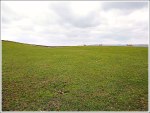
Babyhouse Lane Settle-ment viewed from SE.
At ground level, there isn’t a great deal to see apart from a few raised areas (low ramparts) in the middle of the field and, what are probably ditches around the edges; and the earthworks continue just beyond the wall at the N side. This pentagonal-shaped settlement measures approx. 91m x 85m and covers an area of just over 1 acre. At the W and S sides the ditch is more prominent – just before the land rises forming the bank (which seems not to be part of the earthwork), while over at the E side there is what could be an entrance. The settlement appears to be strategically placed to overlook the Aire Gap to the north-west. And the modern-day walls surrounding the earthworks give this former Brigantian, possible Romano-British settle-ment, the look of “still” being an enclosed site, even if today it is only to keep the sheep in! Sadly, nothing much else is known about this site.
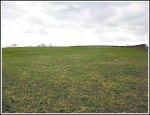
Babyhouse Lane Settlement viewed from the East.
The late John Dixon in his work ‘Journeys Through Brigantia’ , Volume One, says of the settlement here: “Just down Babyhouse Lane, over on the left, are the earthwork remains of an Iron Age/Romano-British settlement site, the earliest home of man in the area, being a pentagonal dtched earthwork with an entrance on the east and covering just over one acre.” While the author and antiquarian Harry Speight considered the ancient settlement on Babyhouse Lane to be of Danish origins. There are indeed some Scandinavian place-names around this area. Cononley is named after King Canute, according to Mr Speight. But it would seem that this is a late Iron Age-Romano-British site; and there are similar earthworks at Higher Scarcliff and Catlow Gill near Carleton Lane Head, a couple of miles to the north.
Sources:
Dixon, John & Philip., Journeys Through Brigantia, Volume One, Walks in Craven, Airedale and Wharfedale, Aussteiger Publications, Barnoldswick, 1990.
Check out this web blog by Jim Jarratt: http://www.jimjarratt.co.uk/walks/beaconsway/section2.html
Copyright © Ray Spencer, The Journal of Antiquities, 2016.
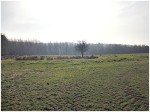
Standrise Earth Circle/Enclosure, near Carleton-in-Craven.
OS grid reference: SD 9418 4846. Standrise Earth Circle is located above Elslack Reservoir at the north-west side of Standrise Plantation, some 2 miles south-west of Carleton-in-Craven, North Yorkshire, there is a large Iron-Age earth circle or enclosure. This quite well-defined earthwork stands upon Elslack Moor. And 160m to the north-west, another, smaller enclosure is visible. The site can be reached from the country lane between Colne and Carleton-in-Craven, turning left just after the plantation onto Moor Lane, and just after the track to Mitton House go through the gate on the opposite side of the lane, then via left up the steep hill following the edge of the plantation until you reach a flat area of land, where directly in front of you is the ancient earth circle/enclosure. You can also reach it by heading east out of Elslack and coming up by way of Mill Fold.
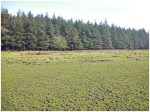
Standrise Earth Circle / Enclosure, near Moor Lane.
The earthwork is almost a perfect circle – but how did our ancient ancestors do that? It measures 34m across and 35m vertically (38 yards x 39 yards) and has an outer bank made of soil and stones, many of these stones being small boulders; the circular, raised bank is over 1 foot high in places and is quite a substantial construction. The stones that are scattered about the circle are the remnants of a wall that once traversed the eastern side of the earthwork. Near the centre of the circle are traces of a raised area, which could well have been a hearth. And there is a solitary tree near the middle of the circle! Could this ancient enclosure have been a Brigantian settlement that was in use prior to the Roman Conquest? Maybe it was the residence of a chieftain? A couple of miles to the west, we have the earthworks of ‘Burwen Castle’ Roman fort at Elslack, which was built in 80 AD, at a time when the Brigantes tribe held sway over the area, though this would soon turn in favour of Rome. This perhaps also saw the final abandonment or destruction of these Iron Age settlements.
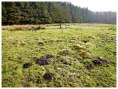
Standrise Earth Circle (outer bank).
160m to the north-west, near the crest of the hill at (OS grid ref: SD 9406 4861), there is a smaller circular enclosure, but very similar in construction to the other. This small circle measures approx. 14m x 15m. There is another earthwork or enclosure about 1 mile to the north-east at Higher Scarcliff, near Carleton Lane Head, and there is a possible cairn circle on the moor, above Rushbank farm, ½ a mile to the south-west of that. There are many other ancient enclosures and earthworks scattered around the Carleton, Lothersdale and Skipton areas, but too many to mention here.
The late John Dixon in his excellent book ‘Journeys Through Brigantia’, Vol 1, says that: Moor Lane which runs along the north-east side of Standrise Plantation over to Street Head farm, near Lothersdale, was probably a “minor” Roman road linking Keighley to Burwen Castle Roman fort at Elslack, which he calls Margery 721 or the M721!
Sources:
Dixon, John & Philip., Journeys Through Brigantia, Volume 1, Walks in Craven, Airedale and Wharfedale, Aussteiger Publications, Barnoldswick, 1990.
http://www.archiuk.com
http://www.archiuk.com/cgi-bin/web-archi.pl?
http://www.megalithic.co.uk/article.php?sid=35748
Copyright © Ray Spencer, The Journal of Antiquities, 2016.
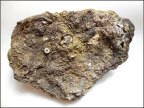
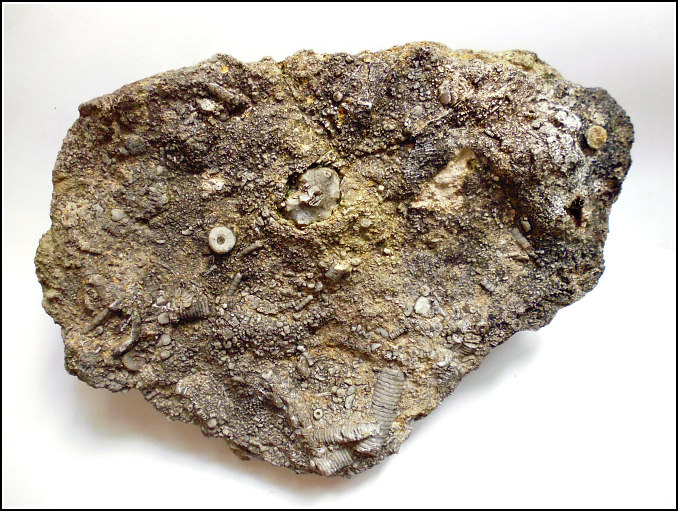
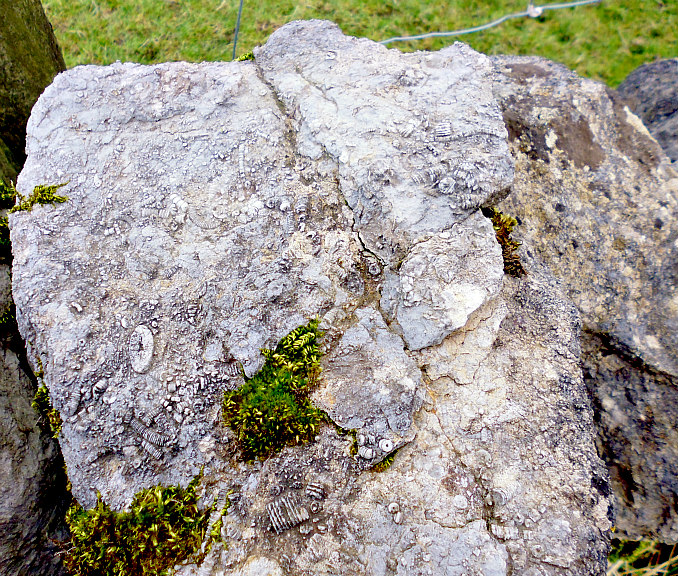
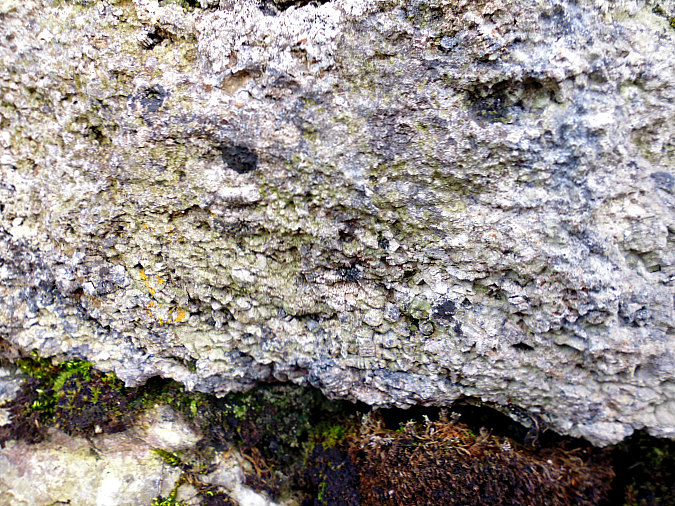
Rock with Crinoid Fossils From Twiston, Lancashire.
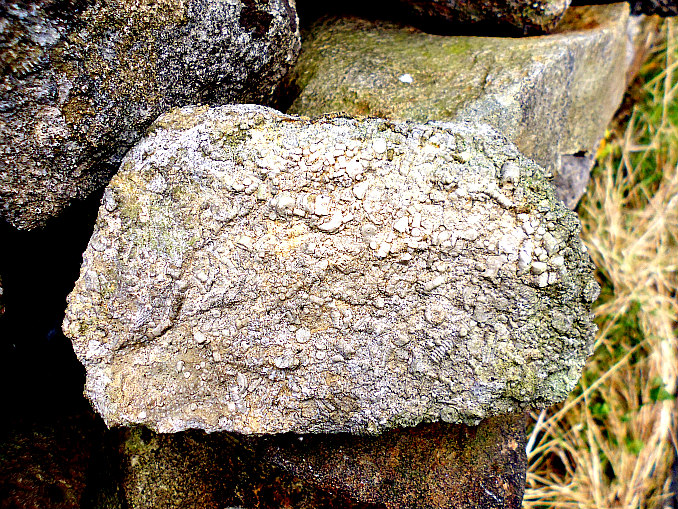
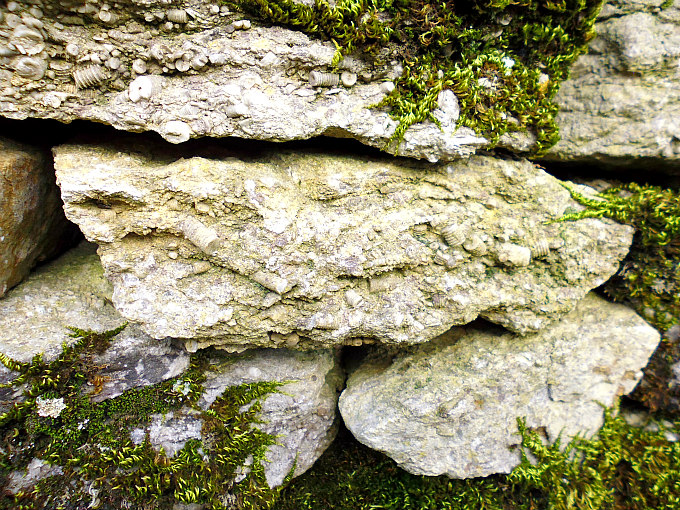
OS grid reference: SD 80919 44434. Something of a curiosity this one, maybe. In the wall along a stretch of the lane that runs through the long, narrow valley between Twiston and Downham, at the north-western side of Pendle Hill, in Lancashire, are lumps of locally quarried ‘Fossiliferous Limestone’ made up of crinoid and coral fossils, which date back some 500-300 million years to the Carboniferous period in Geological history. But what a delight it is to just wander along the lane looking at the fossil-covered stones that make up the walls, and there are literally thousands and thousands of them to be seen here.
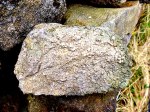
Rock with fossils at Twiston Nr Downham
These crinoid fossils are very varied in shape and form, but they are in essence tiny marine creatures which originated from the sea – so we know without doubt that this area was under water millions of years ago, with perhaps only the top of Pendle Hill visible at that time. The stones that make up the walls in Twiston may have been quarried from the Limestone ‘reef knolls’ – of which there are several in the Twiston and Downham area, or perhaps from Peach Quarry at Clitheroe (Os grid ref: SD 7569 4263). This quarry has now been filled in and grassed over. These ‘reef knolls’, as the name suggests, were also under-water millions of years ago.
There are ‘still’ three 19th century lime kilns in the Downham area; one of these stands beside the lane at Twiston, all of which points to the fact that Lime, in the form of a powder or “cornbrash”, was a much used local neccessity on farmers’ fields in the Pendle area, and is still used by local farmers today.
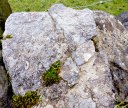
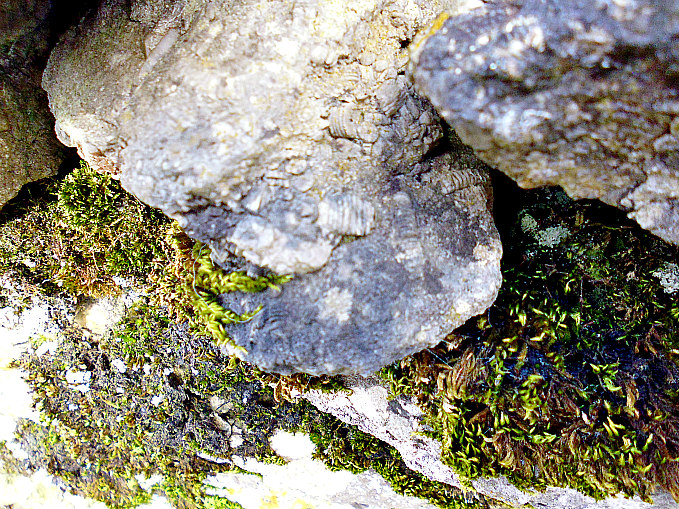
Rock with Crinoid Fossils, Twiston.
A significant feature of the valley landscape between Twiston and Clitheroe is the abundance of Crinoid Fossils in the stones making up the walls of field boundaries. This type of stone is called ‘Reef Limestone’. Crinoids are sometimes referred to as ‘sea lilies’ because of their resemblance to a plant or flower. In parts of England, the columns forming the stem were called ‘fairy money’, and their star-shaped cross sections was associated with the sun by ancient peoples, and given religious significance; indeed ancient people were said to be frightened by these strange fossil forms, as they did not know or realize what they were, and where they had originated.
Crinoids are in fact marine animals belonging to the phylum Ecinodermata and the class Crinoidea. An array of branch-ing arms (brachials) is arranged around the top of a globe-shaped, cup-like structure (calyx) containing the mouth and main body of the animal. In many fossil forms the calyx was attached to a flexible stem that was anchored to the seabed.
The phylum Echinodermata includes the starfish, sea urchins and sand dollars. The crinoids are a breed apart however, as they resemble an underwater flower. Some even have parts that look and act like roots anchoring them to the ocean floor. They are commonly called ‘sea lilies’. Their graceful stalks can be meters long. Other varieties have no stalks or root- like parts. They are commonly known as feather stars. Unlike the sea lilies the feather stars can move about on tiny hook- like structures called cirri.
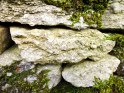
Rocks with fossils at Twiston, Lancashire.
Crinoids are still with us, but they are also some of the oldest fossils on the planet. They flourished in the Palaeozoic Era 541-254 million years ago. Although sometimes different in appearance from their fossil ancestors, living forms provide information about how fossil crinoids must have lived. The earliest come from the Ordovician the second period in the Palaeozoic. At least the earliest that everyone agrees on. There is a class called Echmatocrinus that date back to the middle of the Cambrian Period the first period in the Palaeozoic, but most palaeontologists don’t count them to be true Crinoids. Most of the Palaeozoic forms died out in the Permian the final period in the Palaeozoic Era. The few species that survived into the Mesozoic Era thrived. Many new species evolved during this time including the ancestors of the present-day class Articulata.
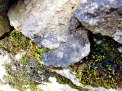
Rock with Crinoid fossils at Twiston.
These echinoderms created ‘forests’ on the floor of the shallow seas of the Palaeozoic and Mesozoic Era’s. There were so many in places, that thick limestone beds (reefs) were formed almost entirely from their body parts piled on top of each other. Crinoids fossilized readily and so there is an abundance of them to be found, mostly stalk fragments as in the photos. There are two reasons for this – the ocean floor is a good environment for fossilization to occur and Crinoid skeletons are made of calcareous plates.
Crinoids of today tend toward deeper waters. The stalked varieties are usually found in water over 200 meters deep, though some can be found 100 meters deep. The unstalked varieties, comatulids also live in deeper waters though generally not as deep as the sea lilies.
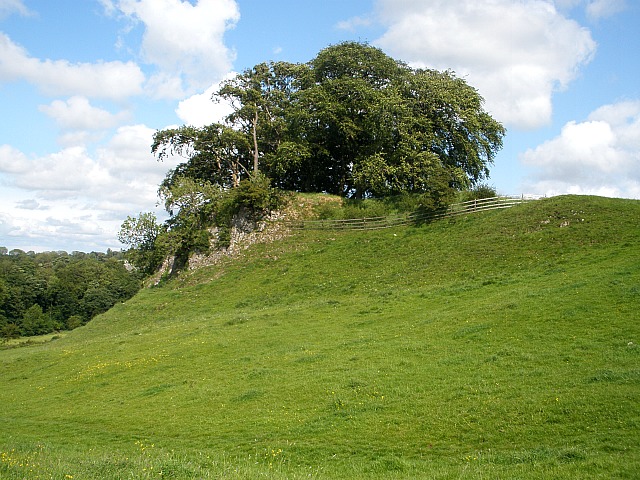
A reef knoll of which there are seven examples between Twiston and Clitheroe is a large pile of calcareous material on land that accumulated on the ancient sea floor, and was subse-quently uplifted due to the movement of the earth’s techtonic plates. At the time of this accumulation it may have had enough structure from organisms such as sponges to have been free-standing and to withstand the sea currents as material accumalted, and was probably an atoll. Another possibility is they are the remains of deep water coral. Such structures are thus often fossil rich.
These structures are often most clearly seen where the surrounding rocks are much softer and so can be eroded leaving the charcteristic knoll shaped hill features; Examples in the Yorkshire Dales lie on the north-side of the Mid Craven Fault. There is one set located around Thorpe (Skelterton, Butter Haw, Stebden, Elbolton, Thorpe Kail, Myra Bank and Hartlington Kail); another set is located around Malham (Burns Hill, Cawden, and Wedber); and also a set around Settle (High Hill and Scaleber).
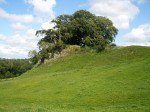
Limestone Reef Knoll near Downham in Lancashire.
The ‘Reef Knolls’ between Twiston and Clitheroe date from the Lower Carboniferous Period (358-323 Million Years ago) and have been subjected to numerous studies (the Carboniferous was the fifth period of the Palaeozoic Era). They were first described by Tiddeman (1889) who applied the term “reefs”. Subsequent workers (Parkinson 1926; Black 1952-54; Bathhurst 1959) all subscribed to the same name. They all believed that the knolls were composed of bio-organic material formed on a sinking sea floor with beds on all sides of the knolls showing an original dip away from the central core. In 1961 during the re-survey Earp raised objections to this hypothesis because of the apparent lack of reef-building faunas such as corals etc. to form the required wave-resistant structures and conglomerates, which should be present around such large knolls.
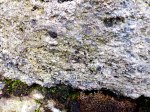
Rock with Crinoid Fossils at Twiston, Lancashire.
Then in 1972 the story of the Clitheroe Reefs would take a step forward with the work of Miller & Grayson following another re-survey of the linear knolls, which run from Twiston to Clitheroe (including Sykes, Gerna, Worsaw Hill the highest at 300 feet, Crow Hill at 100 feet high, Bellman/Salt Hill the longest at about 1 mile, and Castle Hill). They proposed that the knolls were formed as water lime-banks essentially mud banks upon which crinoids would have thrived their dead deposits accumulating over time, and then as the deposits were uplifted the surrounding shale (solidified mud) eroding to leave the ‘Reef’ Knolls as low hills in the landscape. Over the years they have been called many things: Reef Knolls, Bioherms, Knoll Reefs and Coral Reef Knolls. Following the re-survey however, the Clitheroe reefs are now termed ‘Waulsortian Mudmounds’ – as they were first described in a Belgian Geological Survey.
The Worsaw Hill reef knoll at Downham (OS grid ref: SD 7792 4322) has a Bronze-Age burial mound on its south-side and a cave near its base at the north-west side. And Worsaw End Farm was the setting for the 1961 film ‘Whistle Down The Wind’.
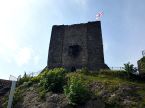
Clitheroe Castle.
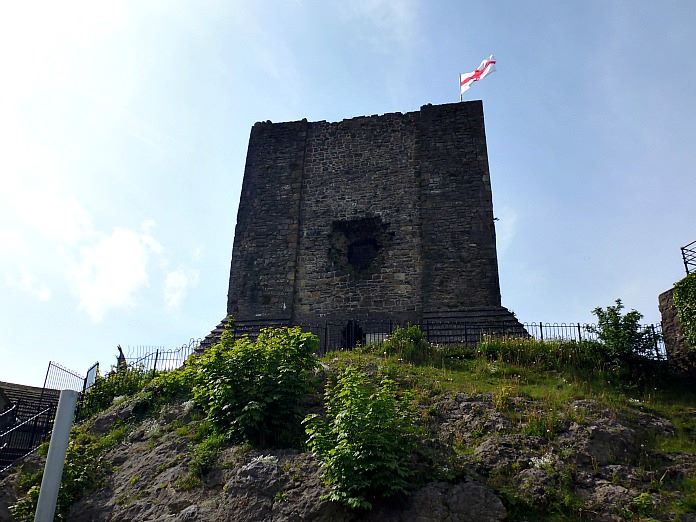
The focal point of Castle Hill, Clitheroe, is now the ancient Norman Keep. It is one of the smallest in England and one of the first stone buildings in Lancashire following the end of Roman Occupation. It was built by Roger de Poitou, who was the first Norman Lord of Clitheroe. The mound is comprised of light grey, unbedded micritic limestone, heavily jointed and calcite veined. Crinoid fossils together with gastropods and brachiopods can be seen. In the castle grounds is the Clitheroe Castle Museum and café. Over time the ‘Reefs’ and surrounding deposits have been quarried for stone – as at Salt Hill and Lane End. Such stone was then used for the walls which surround the fields in the area ‘in question’ between Twiston and Clitheroe.
Sources:
British Geological Survey HYPERLINK “http://www.bgs.ac.uk” http://www.bgs.ac.uk (Crinoids)
Chinery, Michael., A Pictorial Dictionary Of The Animal World, Sampson Low, Marston & Co. Ltd., London, 1966.
Roberts, John L., A Photographic Guide to Minerals, Rocks And Fossils, New Holland (Publishers) Ltd., London, 1998.
http://www.fossils-facts-and-finds.com (Crinoids)
‘The Clitheroe Reef Belt’, Craven and Pendle Geological Society, 2006.
http://www.kabrna.com/cpgs/craven/reef_belt.htm
© Ray Spencer, The Journal of Antiquities, 2016 (up-dated 2020).

 The Journal Of Antiquities
