The Journal Of Antiquities

Ancient Sites In Great Britain & Southern Ireland


3 Comments

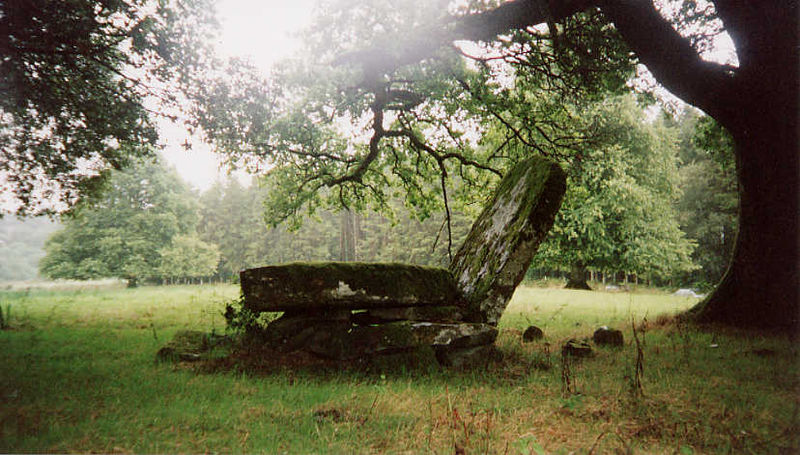
Druid’s Altar, Clooncoe, Co. Leitrim, Southern Ireland

Druid's Altar at Clooncoe, Co. Leitrim, Ireland (Photo credit: Wikimedia)

Druid’s Altar at Clooncoe, Co. Leitrim, Ireland (Photo credit: Wikipedia).

Irish grid reference approx N1046 9305. In the wooded grounds of Lough Rynn Castle, a 19th century building that is now a luxury hotel in 10,000 acres of land, stands a prehistoric monument. At the place called Druid’s Hill in the far south of the castle grounds between Lough Errew and Lough Rynn, south County Leitrim, there is a curious prehistoric antiquity shaped like a chair or a table, locally called the Druid’s Altar (Cloch an Draoi) or Clooncoe Cist. Unfortunately, this megalithic monument, sometimes referred to as a cist-grave, cromlech or dolmen, has been hidden away and perhaps rather forgotten due to it’s location on private land. It is situated beside a pathway beneath trees not far from the south-western shore of the small round-shaped Lough Errew (Erril) and close to the eastern shoreline of the much larger Lough Rynn and, the elongated Lough Clooncoe is just to the south, while the village of Mohill is two and a half miles to the north on the R202 road.

This solitary megalithic tomb known as The Druid’s Altar or Clooncoe Cist is an odd-shaped antiquity, dating from the Bronze-Age, roughly 2,000 to 3,000 BC; and certainly it does resemble a ‘table and chair’. The very large ‘recumbant’ capstone, if that is what it is, is 1.8 metres (5 feet 9 inches) in width and may originally have stood upright, although we don’t know this for certain. Beneath this horizontal slab there are some smaller, low stones which support the structure and, beneath these there is a small stone chamber (cist) also spelt as ‘kist’, which would have perhaps held the remains of a tribal chieftain from prehistory. At the east side another massive slab stands almost up-right though it leans slightly outwards. This stone measures 2.2 metres (7 foot 2 inches) high, 1.3 metres (3 feet 8 inches) across and about 0.30 metres (nearly 1 foot) in depth; the top of the stone is curved or rounded and could well be a “grave marker”, according to author Paul Swift in his work The Lakes of Ireland, now being published in the famous Ireland’s Own magazine. Or could the standing stone be the doorway to the tomb?

There is no real evidence to say that the druids ever used this megalithic structure as an altar for their religious rituals – that is merely myth and legend that has no substance in reality. Or does it? The Celtic term for this monument is “cromlech” meaning “crooked stone” usually a single chambered megalithic structure, whereas Dolmen (Dolmain) is the term for a portal tomb, grave or quoit – also a single chambered tomb; this name tends to be more prevelent in France, Spain and in other countries, even as far away as India. The term “dolmen” could be the same as “tolmen”, a hole stone or holed-entrance stone.

Sources:

Swift, Paul., The Lakes of Ireland, Ireland’s Own no. 5,421 November 29th, 2013, Ireland’s Own, Rowe Street, Wexford, Ireland.

http://www.megalithomania.com/show/site/754/clooncoe_kist.htm

http://www.irishmegaliths.org.uk/leitrim.htm


Lyd Well, Kemble, Gloucestershire

Commentarii de Bello Gallico, an account writt...

(Photo credit: Wikipedia)

OS grid reference SO 9896 9847. The ancient spring known as Lyd Well, Lydwell and sometimes the Roman Well is located in the corner of a field between the A433 (Tetbury road) and the A429 (Crudwell-Malmesbury road), about half a mile north of Kemble village. It is a short distance south of the old disused Thames and Severn canal, beside an area of trees and bushes and an old wind-pump. The name ‘Lyd’ is Old English and means ‘loud well’. In the dry, summer months it is difficult to find, but in a long wet spell of weather it is in full flow. This is now considered by historians to be the source of the river Thames, rather than at Thames Head 1 mile to the north-west, where the water has given up the ghost and where all there is to be seen today is a small circle of stones on the ground and a hidden stone gulley close by. Even the reclining statue of ‘Old Father Thames’ had to be re-located from Thames Head to St John’s lock at Lechlade due to vandalism, in 1974; and a bit further north-west is Seven Springs on the river Chun, another possible source of the Thames, with at least 5 of the springs still evidently flowing into a large 8-foot-high stone-built pool. Here, a Latin inscription on a stone tablet claims that this is the actual true source: HIC TUUS O TAMESINE PATER SEPTEMGEMINUS FONS. The other problem being that there are several springs in this particular area. Just to add to the confusion, some of these are said to be at least 14 feet deep, and even as much as 30 feet deep in some cases.

Cirencester (Corinium Dobunnorvum) Roman town and the Fosse Way are another 3 miles due north-east of Lyd Well and, so the theory is that Roman soldiers would have known this spring and may have even placed offerings into the water; certainly they would have drank of the once clear, cold water after a long march along the nearby Roman road, a short section of the Fosse Way linking up with Exeter (Isca Dumnoniorum) in the south-west of England and running in a north-easterly direction towards Lincoln (Lindum), which is now the section of the A433 road between Kemble Airfield and Cirencester. A number of objects of Roman antiquity have been found in the Thames. To the Romans the river was referred to as Tamesa or Tamesis – this being the first recorded account in ‘Commentarii De Bello Gallico’ the written work of Julius Caesar’s exploits in Britain in the early days of the Roman Empire (55-54 BC). But in the Celtic Age the river was probably a derivative name for Tame and Isis (Tameisis) old pagan gods or a single river divinity of myth and legend. The first ‘real’ record of Lyd Well comes from ‘The Doomsday Book‘ of 1086 AD.

Statue of Father Thames, alongside St John's L...

Old Father Thames,  Lechlade, (Photo credit: Wikipedia)

The spring called Lyd Well emerges from a large circular hole covered with an iron grate and flows out into an even larger stone-lined pool which is often overflowing or ‘positively gushing’ with water; the quickly flowing water then heads along a water course that gradually gets more and more noticeably like a stream and, after some miles forming something more like a river in one’s eyes towards Cricklade. In wet weather the gushing, thundering water is quite forceful and very loud – hence the name Lyd Well. Long ago the water was clear and, probably drinkable, but this is not the case today, and it’s “not” advisable to drink it. I don’t know whether the water ever had any healing qualities, apart from being cold and crystal clear to drink when one was very thirsty – maybe up until the 17th century or earlier than that at least.

In the 16th century John Leland the noted royal antiquarian came to view the sources of the Thames and, later in the late 18th century William Combe also viewed these river sources and wrote about them in his celebrated work ‘History of the Pricipal Rivers of Great Britain’ (1794). No doubt other notary people from the last two hundred years or so have also tried to find the true source of the river Thames.

Sources:

Prichard, Mari & Carpenter, Humphrey., A Thames Companion, (2nd edition), Oxford University Press, Oxford, 1981.

Bord, Janet & Colin., Sacred Waters, Paladin (Grafton Books), London, 1986.

Combe, William., History of the Principal Rivers of Great Britain, John & Josiah Boydell, London, 1794.

http://thames.me.uk/s02380.htm

http://en.wikipedia.org/wiki/Fosse_Way

Copyright © Ray Spencer, The Journal of Antiquities, 2013.


Walsingham Shrine, Norfolk.

English: The statue of Our Lady of Walsingham,...

Our Lady of Walsingham. Photo: Wikipedia)

OS grid reference TF 9360 3678. Walsingham the famous English ‘Marian’ shrine and pilgrimage centre in north Norfolk is actually made up of two villages, Little and Great Walsingham, some 5 miles north of Fakenham and 20 miles east of King’s Lynn on the A148. In the grounds of the Augustinian priory ruins at Little Walsingham just south of Holt road, founded in 1153, 1162 or 1169? by Geoffrey de Favarches, are two holy wells that were dedicated to the Blessed Virgin Mary (Our Lady of Walsingham), but today these have, sadly, become wishing wells. Geoffrey de Favarches, son of Richeldis, who had visions of the Virgin Mary in 1061, having visited the Holy Land had vowed to build a religious house on his land at Walsingham when he returned to England. He did not go back on his vow. Geoffrey was also associated with endowing Castle Acre priory in Norfolk, which had been founded earlier in c.1090 by William de Warenne, Earl of Suffolk.

The two healing wells are located just a short distance to the east of the turreted monastic archway, all that remains of the priory church (east side gable end), now a rather forlorn-looking ruin standing all alone, but which in earlier times was a very grand religious house that had strong links to the shrine of Our Lady (which had stood at the north side of the priory church) and the healing wells. There are other ruins here, notably the west end of the refectory, dating from around 1300, and other ruins including gatehouse and frater. To add to the religious buildings, a Franciscan friary was established in 1347, as a hospice for poor travellers, under the patronage of Elizabeth de Burgh, Countess of Clare, despite much opposition from the Augustinian canons of the priory who thought this would be a distraction for pilgrims coming to their house. Walsingham priory was dissolved in 1538 even though King Henry VIII had himself earlier visited the ‘Catholic’ shrine and left a candle burning there! – the friary was abandoned at the Dissolution in the same year, although some ruined walls from that building are still visible including guest-house and church, but today these stand on private land.

It was here in 1061 that the lady of the manor of Little Walsingham, Richeldis de Favarches, who had earlier been married to a Norman lord, had at least three visions, one of the Virgin Mary on her own who instructed her to build a replica of the holy house (Santa Casa) at Nazareth, one of Our Lady with baby Jesus and another of St Joseph. This was done and a chapel and wooden shrine were established two years later. During the Middle Ages Walsingham became something of a place of pilgrimage and, this even more so in later centuries when kings, queens, the nobility and also the poor and disabled came to the Slipper Chapel, at Houghton St Giles, on what was the best known of the pilgrim routes to complete the 1 mile journey to the Roman Catholic shrine itself without shoes (barefooted). The Slipper Chapel fell in to ruin in 1538, but was restored by the local Catholic community in the 1890s; and later in 1914 it became the National Catholic Shrine to Our Lady – to where thousands of pilgrims come every year from all over the world. The Slipper Chapel houses a very lovely statue of the Blessed Virgin Mary (Our Lady of Walsingham) and baby Jesus.

During the 14th and 15th centuries Walsingham had become known as ‘little Nazareth’ and even the ‘English Holy Land’- such was the fame of the place at this time in history. In 1931 an Anglican shrine was established near the priory ruins and a well was discovered where the foundations were to be built – this well was rather ‘curiously’ found to be connected up to the two healing wells, and so it too has curative properties. Today it is a renowned place of pilgrimage for Anglo-Catholics, Roman Catholics and, the Orthodox Churches, both in this country, and in Europe. According to the author David Pepin in his book Discovering Shrines And Holy Places, “For many twentieth-century pilgrims the annual pilgrimage to Walsingham is a highlight of the Christian year”. And it still is in the 21st century.

The two circular healing wells, with a larger square-shaped pool between them began to flow “again” at the instigation of the Blessed Virgin Mary, having been dried up for some considerable time; they were almost certainly pre-Christian, pagan springs. Our Lady instructed the saintly and, wealthy widow, Richeldis, to build a shrine and chapel that would represent the holy house at Nazareth; from which time the water in the two stone basins, close-by, became ‘effacious with healing qualities’ that would miraculously cure such ailments as: stomach problems and headaches etc. There also existed a chapel of St Lawrence at or beside the healing wells, but this has long since vanished. The small Romanesque entrance with a round-headed doorway and nice carvings was re-erected here in the 19th century but it originally stood eleswhere as part of the priory buildings. The two wells are covered with decorative iron lids and the larger bathing pool is often covered over. Also at one time a worshippers’ stone stood between the wells to allow pilgrims to sit and perform their usual water rituals.

Sources:

Butler, Lionel & Wilson-Given, Chris., Medieval Monasteries of Great Britain, Michael Joseph Limited, London, 1979.

Bord, Janet & Colin., Sacred Waters, Paladin (Grafton Books), London, 1986.

Reader’s Digest., Folklore Myths and Legends of Britain, (2nd Edition), Reader’s Digest Association Limited, London, 1977.

Pepin, David., Discovering Shrines And Holy Places, Shire Publications Ltd., Princes Risborough, Aylesbury, Bucks, 1980.

Bottomley, Frank., The Abbey Explorer’s Guide, Kaye & Ward Ltd., London, 1981.

Photo (top)  https://en.wikipedia.org/wiki/Our_Lady_of_Walsingham#/media/File:Our_Lady_of_Walsingham_III.JPG

https://en.wikipedia.org/wiki/Walsingham

http://www.catholictradition.org/Mary/walsingham.htm

http://www.feorag.com/wells/hope/norfolk.html

Copyright © Ray Spencer, The Journal of Antiquities, 2013 (updated 2024).


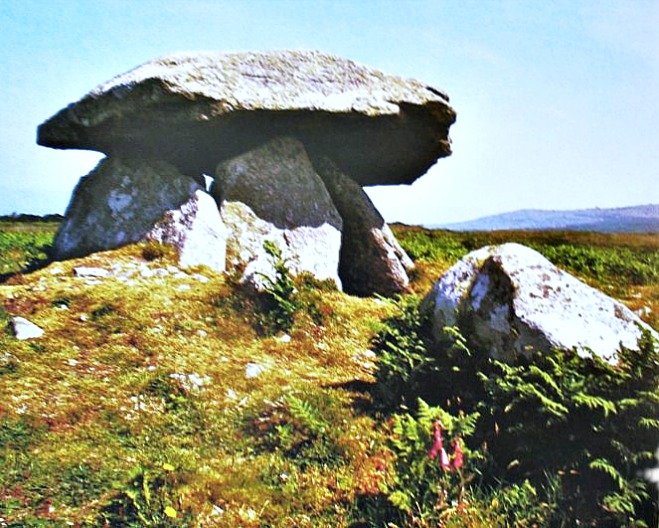
Chun Quoit, Morvah, Cornwall

Chun Quoit, Cornwall

Chun Quoit, Cornwall

OS grid reference 4021 3395. On the windswept moorland of south Cornwall at the northern edge of Woon Gumpus Common stands the famous and well-preserved mushroom-shaped Neolithic burial chamber or portal dolmen, Chun Quoit, which is also sometimes called a cromlech (cromlech being a Welsh term). It’s not an easy monument to get to but it is probably best reached from footpaths coming off the B3318 (north road) to the west and walking in a north-easterly direction. The author John Hillaby in his book ‘Journey through Britain’ sums up the approach to the ancient burial chamber like this: “It loomed up over the horizon like a huge stone mushroom”. A quoit is the Cornish term for a burial chamber, of which there are several in this part of the country. The little village of Morvah lies about 1 mile to the north on the B3306 road, while the Cornish town of Penzance is 4 miles east on the Lanyon-Madron road.

In myth and legend giants used these megalithic monuments for games practise and, according to author Sally Jones in her work ‘Legends of Cornwall’, she says “It is easy to see why it was said to be the plaything of the local giants in their games of bob-button and why a group of Saxon kings are thought to have used it for a dining table” though “here” she is referrering to another megalithic tomb, Lanyon Quoit, a mile to the south-east. They are though just like giant tables with supporting legs and, so down the centuries have come to be called prehistoric ‘table tombs’. We can still see table tombs in old graveyards in Britain today

Chun Quoit - Morvah - Cornwall - UK

Chun Quoit, Cornwall (Photo credit: Wikipedia)

Chun Quoit sits within a low, round-shaped mound 35 feet in diameter, all that now remains of the original soil mound (round barrow) that covered the burial chamber before erosion took over. A number of small outer boulders stand in this kerbed mound that was probably the forecourt. The quoit stands proudly over 7 feet in height with a huge boat-shaped granite capstone that sits quite comfortably on it’s 3 upright granite stones all roughly 5 feet high; but at one end it overhangs – looking precariously like it could slide off at any time – this is because a fourth upright stone has itself slipped to one side and does not “now” support the monument. The rounded (convex) capstone measures 10 feet by 9 feet and is over 2 feet thick; and is said to have a single cup-mark. Almost certainly it weighs several tonnes. Its inner chamber is closed or blocked off by the 3 large upright stones thus stopping any would-be intruder from entering the grave and so allowing the body and soul of the dead chieftain to ‘rest in peace’. It obviously worked too, because anyone would have great difficulty squeezing through to the chamber’s inner sanctum. Chun Quoit is thought to date back between 4,000-6,000 years to the Neolithic Age. The name ‘Chun’ means ‘House on the Downs’.

Some 300 yards (100 metres) to the east of Chun Quoit are the round-shaped earthworks of an Iron-Age hillfort, Chun Castle, which is more recent in date, roughly 2,000 years or so. But all around this area there are other prehistoric sites:- Lanyon Quoit, the sacred Men-an-Tol holed fertility stone with its adjacent phallic stone, and the Men Screfys standing stone, being just three other local antiquities within a couple of miles. This particular part of Cornwall appears to have been a Neolithic trading route to and from the coast of Brittany and probably northern Spain as well.

Sources:

Sykes, Homer., Mysterious Britain, Cassell Paperbacks (Cassell & Co), London, 2001

Hillaby, John., Journey through Britain, Paladin Books (Granada Publishing Ltd)., London, 1983.

Jones, Sally., Legends of Cornwall, Bossiney Books, St Teath, Bodmin, Cornwall, 1980.

http://www.stone-circles.org.uk/stone/chun.htm

http://www.cornishancientsites.com/Chun%20Quoit%20&%20Castle.pdf

Copyright © Ray Spencer, The Journal of Antiquities, 2013 (updated 2025).


Church of St Mael and St Sulien, Corwen, Denbighshire, Wales

Cross-Shaft in Corwen churchyard (Jeff Buck - Geograph)

Cross-Shaft in Corwen churchyard (Jeff Buck – Geograph)

OS grid reference SJ 0788 4341. Near the centre of the little town of Corwen, in the Dee Valley, beside Chapel street and London road (A5) – stands the parish church of St Mael and St Sulien, a building that dates back to the 12th-15th centuries, although there was an earlier, Norman church on this site as far back as the 12th century and, probably even further back to the 6th century AD. The church houses a small collection of antiquities that are well worth viewing. In the porch there is a strange-shaped stone in the wall that could pre-date the church, and above the priest’s door a flat stone bearing an incised cross; also an ancient font and medieval tomb. Out in the churchyard a Celtic cross-shaft stands upon a pre-historic stone base that has what are ‘considered to be’ cup markings. The town of Llangollen is 11 miles to the east on the A5, while the historic town of Ruthin lies some 10 miles to the north along the winding A494 road.

The first church, whether that be in the 6th century or the 11th century, according to legend, it was built where a large and ancient pointed stone stood – as it could not be built eleswhere because a “voice” from a higher place (not of this world) had warned against it. At some stage this large pointed stone 6 feet in length was incorporated into the wall of the north porch, but it is difficult to see it today as the porch has been plastered over. Local people called it the ‘Thumb Stone’ or ‘Pointed Stone’. It could well pre-date the church and be pre-historic in date. It is also known in Welsh as ‘Carreg y big yn y fach rhewllyd’ or “the pointed stone in the icy corner.” On the outer south wall of the church, above the priest’s door, a large flat stone lintel has an incised Celtic-style consecration cross carved onto it, possibly dating from the early Christian period. Local people believed that this mark was actually the impression made by Owain Glyndwr’s dagger when he hurled it at the church in a fit of rage from Pen-y-Pigyn hill overlooking the town; and ever since it has been referred to as ‘Glyndwr’s Dagger Stone’. Glyndwr (1349-c.1445) led the Welsh in a revolt against King Henry IV. A few others have suggested the dagger or spear was thrown by Owain, King of Gwynedd, from Caer Drewyn in the 12th century? Also in the church a Norman font of circa 1100, a dug-out wooden chest and a beautifully carved 14th century memorial tomb to Iorweth Sulien, a previous rector of the church.

In the round-shaped churchyard near the porch stands a slender Celtic preaching cross-shaft, dating from between the 9th to 12th centuries, which sadly, has a broken head. It is made of granite and is 7-foot (2.2) metres high. There is interlacing on the broken cross-head (capital) and some other decoration on the shaft, including a small incised Latin cross. The cross stands on a large, circular (octagonal) base stone that is 5 foot 3 inches in diameter and 1 foot in depth; this stone is ‘thought’ to date back to the Bronze Age and has what are considered to be 7 depressions or cup-marks (is this the only cup-marked stone in Wales), quite possibly, and could it have come from a pre-historic burial site that once stood in the churchyard or close by? where there was originally an alignment of stones.

The dedicatees of the church St Mael and St Sulien were, according to the Legend, Christian missionaries who came to Wales from Brittany in 516 AD along with St Cadfan, St Padarn, St Cynllo and St Tydecho. However, it is quite plausible St Mael never existed at all because Corwen church now adopts St Michael the Archangel as it’s second patron, in a way dropping St Mael, although the name is very similar. But St Sulien is remembered in north Wales – indeed he was the cousin of St David. Sulien or Silian went on to establish a number of churches in northern Wales, including Llansilin and Llandyssil in Powys and Capel-St-Silin in Cardiganshire, but over time he has become confused with another saint called Tysilio. In later life we are told: Sulien settled at Luxulyan in Cornwall but returned to Brittany and died there. He has a feast day on the 13th May. At Tyn Llan near Llansilin, Powys, there is a holy well named for him (Ffynnon Silin) and there is a St Sulien’s holy well (Ffynnon Sulien) near Rug Chapel – west of Corwen on the A494 road.

Sources:

Barber, Chris., More Mysterious Wales, Paladin (Grafton Books), London, 1987.

Gregory, Donald., Country Churchyards In Wales, Gwasg Carreg Gwalch, Capel Garmon, Llanrwst, Gwynedd, 1991.

Jones, Francis., The Holy Wells Of Wales., University of Wales Press, Cardiff, 1992.

Spencer, Ray., Historic Places In Wales – An Exploration of the Fascinating and Mysterious (unpublished manuscript), Nelson, Lancashire, 1991.

Spencer, Ray., A Guide to the Saints Of Wales and the West Country, Llanerch Publishers, Felinfach, Lampeter, Dyfed, 1991.

http://www.cpat.demon.co.uk/projects/longer/churches/denbigh/72143.htm

http://wellhopper.wordpress.com/2012/02/16/ffynnon-sulien-corwen/

Copyright © Ray Spencer, The Journal of Antiquities, 2013 (updated 2024).


Bakewell Churchyard Crosses, Bakewell, Derbyshire

Bakewell Cross, in the churchyard of Bakewell ...

Bakewell Cross,  (Photo credit: JeremyA Wikimedia)

OS grid reference SK 2156 6848. In All Saints’ churchyard on Church Lane, near the centre of Bakewell, Derbyshire, stand two rather weather-beaten Anglo-Saxon, Mercian-style crosses known collectively as Bakewell Churchyard Crosses. The tallest of the crosses has lost its head, rather sadly, while the smaller cross known as ‘Beeley Cross’ is what you might call ‘a stumpy shaft’, although it has the best surviving carved decoration of the two. Inside the porch there is a large collection of Anglo-Saxon and Norman stones and, in the church itself another collection of ancient stones known as ‘The Bateman Collection’. The town of Bakewell in the centre of the Peak District National Park is on the A6 Derby to Manchester road, and Matlock is some 8 miles to the south-west on the A6, whilst Buxton lies 9 miles to the west on the very same road.

Near the east wall of the parish church, beside the outer wall of the Vernon Chapel, stands the best-known of the two crosses here; however it’s carvings are now quite warn and most of the head is missing and because of this it is only around 8 feet high now. It is said to date from the 7th to 9th centuries AD and is very similar to the Eyam Cross in Derbyshire, although that particular cross retains it’s head! The cross was almost certainly carved here at Bakewell as there was apparently a thriving stone-carving operation going on, supplying the northern part of the ‘Kingdom of Mercia’ – that’s why there are so many carved crosses and stones in this ‘one’ place. The cross originally stood at a cross roads just south of Hassop village about 1 mile north of Bakewell. On the east face three large vine-scrolls with grapes in their centres and vine leafs in the spaces around the scrolls; at the bottom a cross in a circle and at the top, below the damaged head, a creature holding something in it’s paw and it’s long tail curled around it’s back, while above that a horse is trampling on a human figure? The west face has four arched panels showing the Annunciation, a figure holding a cross, another figure holding a horn and a figure that is now worn away. These figures might be Odin and Loki from pagan Norse mythology. On the north and south faces scrolls turning in opposite directions. The north face also has a crucifixion scene with soldiers on either side, one with a spear and the other holding a sponge. The cross-base is a large, unhewn lump of stone but probably not as old as the cross?

The carvings on the smaller 10th century cross known as ‘Beeley Cross’, which is 5 feet 4 inches high, are better preserved. This cross was dug up in a field at Holt House 1 mile north of Darley Dale or, alternately it was dug up from beside the Chatsworth to Alfreton road (B6012) near Screetham farm at Beeley during the 19th century and, later brought to All Saints’ churchyard, Bakewell. Carved onto this cross there are circles (spheres) linked-together (top and bottom) on all it’s four faces, varying in size, with slightly smaller spheres inside and crosses or wheel-like patterns (banding) across these or, according to Neville T.Sharpe in his excellent book ‘Crosses of the Peak District‘ “interlaced carving with the interstices filled with small hemespheres” – reminicent apparently to the Saxon cross at Hope church, Derbyshire. There is other decoration too including groups of dots in circles. The cross-base is perhaps of a late medieval date and stands at 2 foot high and 2 foot 7 inches wide with nicely chamfered corners.

In the south porch (now the main entrance) there is an amazing collection of upto 40 Anglo-Saxon stones, some quite large, piled one on top of the other; there are cross-fragments, pieces of grave-covers, of all shapes and sizes, as well as some grotesque ‘Celtic’ stone heads that may in fact be medieval, while on the opposite side there are carved Norman stones. At the rear of the church another pile of ancient stones known as The Bateman Collection, named after Thomas Bateman (1821-61) the English antiquarian and archaeologist who collected them together in 1842. Among this collection are a number of cross-shaft pieces. These were restored to the church in 1899 after residing in the Weston Park Museum at Sheffield. The 14th century font is carved with various figures and the rood-screen dates from the 15th century. Standing against the outside wall a collection of medieval coffins, shaped to fit the bodies that were in them! All Saints’ is a partly Norman and Early English church, but they was undoubtedly a Saxon church of the 7th century here before the present-day building, perhaps even a Romano-British settlement?

Sources:

Sharpe, Neville T., Crosses Of The Peak District, Landmark Publishing Limited, Asbourne, Derbyshire, 2002.

Clarke, David., Ghosts & Legends of the Peak District, Jarrold Publishing, Norwich, 1991.

Jones, Lawrence E. & Tricker, Roy., County Guide To English Churches, Countryside Books, Newbury, Berkshire, 1992.

Pickford, Doug., Earth Mysteries of the Three Shires, Churnet Valley Books, Leek, Staffordshire, 1996.

http://archaeologicalresearchservices.com/projects/bakewellcross.htm

http://www.derbyshireheritage.co.uk/Menu/Ancient/crosses/Beeley-cross.php


2 Comments

Cawthorn Roman Camps, North Yorkshire

English: Cawthorn Roman Camps. Cawthorn Roman ...

Cawthorn Roman Camps (Photo credit: Martin Norman – Geograph)

OS grid reference SE 7842 9011. On the North Yorkshire Moors at the edge of the Tabular Hills, above Rosedale Abbey and Goathland, stand the well-defined and grass-covered earthworks, ramparts and ditches of what are called Cawthorn Roman Camps; actually one Roman practice camp and two small Roman forts, side by side, just north of the road called High Lane between Newton on Rawcliffe and Cropton, some 4 miles to the north of Pickering. They are surrounded by woodland. A fairly well-preserved stretch of Roman road (Wade’s Causeway) runs due north over Wheeldale Moor from Cawthorn to Lease Rigg where there was another small Roman fort; originally it may? have connected up with the Roman camp, fort and settlement at Malton (Derventio or Delgovia?) further to the south and was perhaps 20-25 miles in length. But did the Roman road turn east at Lease Rigg and head to the coast at Ravenscar? Cawthorn camp and it’s adjoining forts were built in the late 1st to early 2nd centuries AD. At the southern-side of the earthworks are two prehistoric burial sites (tumuli) and there’s another tumulus at the north-west-side, all of which pre-date the Roman earthworks. The Whitby road (White Way Heads) is 5 miles to the east.

The two small forts, annexe and camp are identified as ABCD. In the centre between the two forts is the temporary marching (practise) camp, which has been referred to as a ‘siege camp’ by some Roman historians. Cawthorne camp C is unusually-shaped like a coffin (elongated) and measures roughly 300 feet by 850 feet about 4-5 acres – and is located between forts D and A. There are three gateways, at the eastern-side only, and these are protected on the outsides by claviculae (cuspate gates) in the ramparts. What maybe gaps at the north-west and south-western corners could have also been ‘initially‘ gateways but these were probably closed up. But the camp has no real ‘robust‘ defensive ramparts, or very little, apart from what appear to be back-filled ditches, unlike those of fort D. The defensive ramparts surrounding the adjourning rectangular-shaped fort D are well-preserved and are 4-5 metres high, while the outer ditches or ‘workings’ are called ‘Stracathro-type’ and are some 3 metres wide and 0.7 metres in height; this fort slightly overlaps the camp at the south-eastern side and is of a later date of construction. It seems likely the camp and forts were built by the legions from York (Eboracum). Fort A with it’s annexe B (extension) at the eastern-side of the site is less well-defined; it has 4 gateways opening into the annexe section, now a low earthwork of 3 metres high. The adjoining annexe has two gateways north and south sides. These two cover an area of around 6 acres. Apparently the forts and camp here at Cawthorn were occupied in more recent times – at periods during the Dark Ages and the Viking Age, the 6th-10th centuries AD.

But why did the Romans build these forts and camp together high up on the Yorkshire Moors. Was it a show of military strength to the northern, British tribes, or was it to protect the Roman road, or even the high ground and the defense of their forts to the north-west and south. More likely they were built simply to house Roman garrisons who were on military manoeuvres and, others who were here to build the Roman road that is so well-preserved, even today. Almost certainly the soldiers could see the east coast from here and the many signal stations (warning beacons) that were situated along that coast. The site was excavated between 1924 and 1929 and the conclusion being that the camp and forts had been occupied twice for short periods only, maybe some 6 to 10 years apart, and that construction took place somewhere between 80-120 AD. Some pottery and glass beads were found during these archaeological digs.

The short stretch of Roman road, known in Yorkshire as Wade’s Causeway, runs for 12 miles between Cawthorn Roman camps and Lease Rigg Roman fort, but originally it may have started at the Roman settlement of Malton and, from Lease Rigg ran east to the coast at either Ravenscar or Whitby, a distance of 25 miles, though there is much uncertainty about this. Today, it is quite well-preserved though the top section has long since eroded away leaving it’s bare foundation stones underneath, but it’s water gulleys or ditches can still be seen at either side, allowing rain water to run off. According to legend, the road was built by an 11th century giant called Wade (Wadda) of Viking birth, who lived with his wife Bell, also a giant, at Mulgrave Castle near Whitby. Bell or Bella apparently carried large stones in her apron to help her husband build both the castle and road, according to the Legend. Their son was the famous Wayland the Smith of Viking legend!

At the southern edge of the site, in woodland, there are two prehistoric burial sites (tumuli) that pre-date the Roman earthworks by 1,500 years, dating from the Bronze-Age. These are located at SE 7845 8987 (south-side) and SE 7790 8980 (south-west side). A third tumulus, of Iron-Age date, can be found at the north-west side of fort D at SE 7780 9010. Well worth checking out.

Sources:-

Boyes, Malcolm & Chester, Discovering The North York Moors, Smith Settle Ltd., Otley, West Yorkshire, 1996.

Cawthorn Roman Camps

Jones, Rebecca H., Roman Camps In Britain, Amberley Publishing, Stroud, Gloucestershire, 2012. 

Pastscape:  http://www.pastscape.org.uk/hob.aspx?hob_id=60589

Roman Britain.Org: http://www.roman-britain.org/places/cawthorn.htm


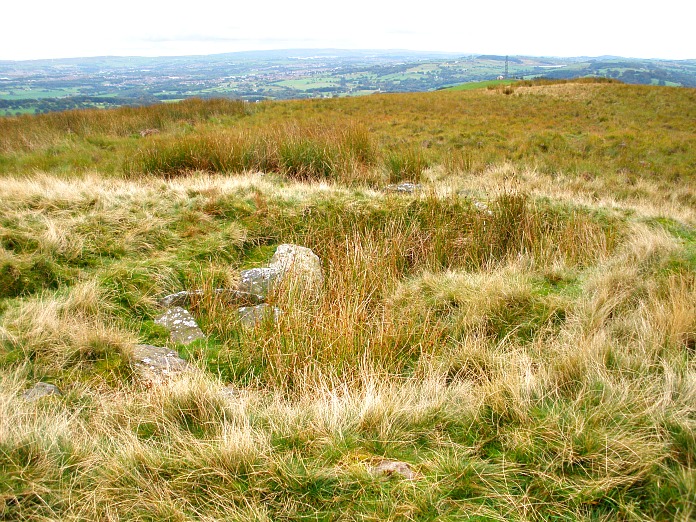
Jeppe Knaves Grave, Sabden, Lancashire

Jeppe Knaves Grave, Sabden, Lancashire

Jeppe Knaves Grave, Sabden, Lancashire

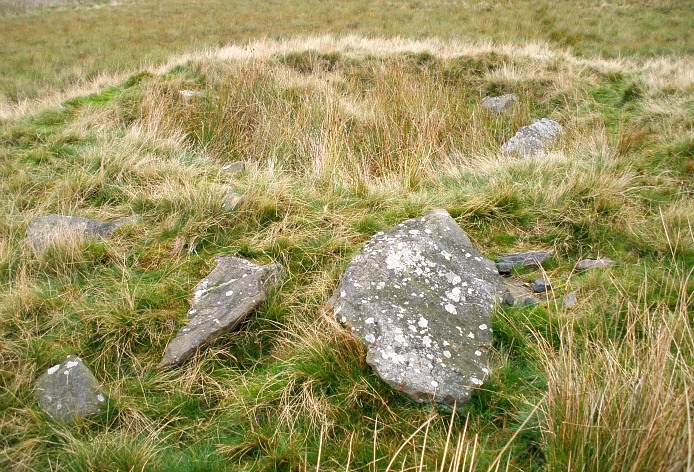
OS grid reference SD 7599 3782. On Wiswell moor above Sabden, in Lancashire, stands the prehistoric site known as Jeppe Knaves Grave, said to be named after a 14th century robber who was buried here, but it is in fact a Bronze-Age cairn that is now much mutilated and in a bit of a ‘sorry state’, although its rounded-shape can still be seen with a hollow at the centre. There are a number of footpaths heading to the site: it can be reached from Wiswell and Spring Woods (Clerk Hill road) on the A671, near Whalley, or from the Nick of Pendle along the road that runs between Sabden and Clitheroe over Pendleton Moor, where there are a number of car parking areas. From here there are at least three footpaths that reach the site – the lower one (an ancient trade route) taking you through Wilkin Heys farm where you will need to ask for permission; the other two paths will get you there but one or two ladder stiles will have to be negotiated! The moor can also be ‘quite boggy’ in times of inclement weather. In his book Pendle Hill and Its Surroundings, by Dr Spencer T. Hall, the author says “From Whalley it will be tolerably easy to find a route up by Wiswell to Pendle Hill”. He also mentions coming up via Padiham, Higham, Sabden, Clitheroe, Chatburn, Downham and Worston.

Jeppe Knaves Grave.

Jeppe Knaves Grave.

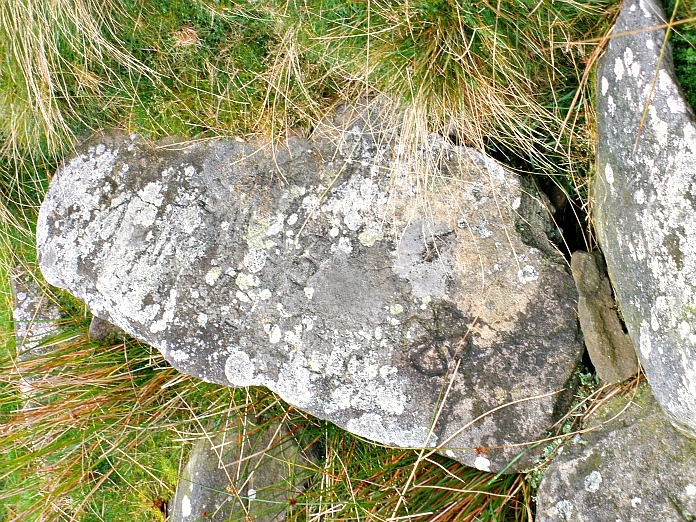
In any case, best to head for the concrete trig point/pillar known as ‘The Rough’ no s4675 (at 315 feet) on Wiswell Moor, and then walk along the path (430 metres) to the south-west over the ladder stile, past the shepherd’s rock shelter, and there ahead down in the turf and heather is the prehistoric round cairn with it’s stones scattered about both on the inside and around the edge. In the book ‘Journeys Through Brigantia (Volume Nine) The Ribble Valley’ by John & Phillip Dixon, the authors say: “To the west of Wilkin Heys, just below the triangulation point, is a small depression in the moorland turf containing rocks and stones of various sizes. Upon the largest stone are inscribed the words ‘JEPPE KNAVE GRAVE’ and a cross. The stone is said to mark the final resting place of Jeppe Curteys, a local robber who was decapitated for his crimes in the first year of Edward III, 1327”.

Jeppe Knaves Grave (Inscribed Stone)

Jeppe Knaves Grave (Inscribed Stone)

The circular-shaped cairn is about 15 or 16 metres in diameter (22 feet) and its stone-filled hollow in the middle is 5 metres by 3 metres. An outer ring of stones, which vary in size can be made out amongst the grass, but it is not particularly circular. Some larger stones make up the cairn (tumulus) itself but are in a somewhat tumbled, mutilated state. Some historians believe this was originally a chambered tomb of the Neolithic Age, though in fact it probably dates from the Bronze-Age. At the side there is a large stone with a worn inscription that says: JEPPE KNAVE GRAVE as well as a small incised florrated cross, thought to have been carved in the 1960s by boy scouts. According to the legend, Jeppe Curteys (Geoffrey Curtis), a highwayman, was hanged for his crimes of robbery in 1327, and was subsequently buried here at this solitary spot (in a pre-Christian grave) on Wiswell Moor. The word “knave” is usually taken to mean ‘a wrongdoer’, but it could also be the Norse word for a boy, youth or servant. The suggestion is that is much more likely to be an earlier prehistoric or Dark-Age burial site for some noble chieftain, and so pre-dating the highwayman by a few thousand years. But, we may never really know the true answer with regard to this ancient site.

About 1 mile to the north-west of Jeppe Knaves Grave at Carriers Croft near Pendleton is another (possible) Bronze-Age site. Here in 1968 a circular earthwork was discovered and, during excavations there in 1968-75 three collared urns and other antiquities were found. These finds were put on display in Clitheroe Castle Museum. There are two other Bronze-Age sites in this area too. Just 215 metres to the north of Jeppe Knaves grave at Harlow (SD759 380) in the direction of Parker Place on the opposite side of the road from the Well Springs inn, at Nick of Pendle, along a footpath (SD776 390), there is another earthwork that may be prehistoric in date? (See John & Philip Dixon’s book – Journeys Through Brigantia (Vol 9) The Ribble Valley). Also, there are a number of glacial erratic boulders in the area, some having been used to prop up farmers’ walls! or put into use as marker stones.

Sources:

Dixon, John & Phillip, Journeys Through Brigantia (Volume 9) The Ribble Valley, Aussteiger Publications, Barnoldswick, 1993.

Hall T, Spencer Dr., Pendle Hill and Its Surroundings, (orig. published 1877) re-published by Landy Publishing, Staining, Blackpool, 1995.

http://pendletonvillagehistory.webs.com/bronzeagediscoveries.htm

Copyright © Ray Spencer, The Journal of Antiquities, 2013.


St Maelog’s Cross, Llowes, Powys

St Maelog's Cross, Llowes

St Maelog’s Cross, Llowes

OS Grid Reference SO 1923 4172. St Maelog’s Cross can be found inside the parish church of St Maelog in the village of Llowes, just off the A438, some 2 miles west of Hay on Wye, Powys. The cross-slab was probably carved in the early Christian period, although the stone itself is said to be of a prehistoric date. It originally stood at Croes Faelog in the Begwn hills to the north-west of Llowes, but in the 12th century it was erected in the churchyard; then in 1956 the monument was placed, for safety reasons, inside the church. The village takes its name from a St Llywes who may have had a hermitage here, but when St Maelog arrived from ‘the north’, he allowed him to settle in this place (Llowes) and build a small monastery or a church? More likely his monastery originally stood at Croes Faelog.

The cross-slab is said to weigh a massive 3 tonnes, stand to a height of 7 feet, is 3 feet in width, and to date probably from the 6th or 7th century AD. On the front face there is a well-defined and quite impressive carved Celtic cross that stands out in high relief from the surface. It is a fairly simple style of cross made up of small and large diamond-shaped inside squares with strong borders running from top to bottom, forming a wheel-type cross at the top. However, the carved cross on the opposite side was added in the 11th century and is quite crude, compared to the front side, and not that special. The slab is thought to be a prehistoric standing stone; the cross being carved onto it to Christianise the pagan stone by Celtic missionaries who came to the area in the so-called Dark Ages after the Roman withdrawal from Wales sometime between the 5th and 7th centuries AD. The church was largely rebuilt in the mid-19th century and the only antiquity from the earlier, medieval church is the font which may be 12th century?

St Maelog, Meulog or Meilig was a native of Clydeside in Scotland who became a soldier in the 6th century but decided to abandon that life, for a Christian one. He was of the family of Caw Cawlwyd, a chieftain of noble descent. His brothers were said to be St Caffo and St Gildas the Historian. It seems he first settled on the Isle of Anglesey (c 510) where he became a follower of St Cybi; there is a church dedication for him at Llanfaelog, Anglesey. Later, after an education under St Cadoc at the monastic college of Llancarvan, south Glamorgan, he became a Christian missionary at Llowes (c 540) and evangelized around the area as far as the Begwns. Maelog is also known to have visited Ireland, where he goes under the name St Malloc, and to have died in Brittany about c 590 AD.

Celtic Cross, Llowes.

Celtic Cross, Llowes.

A well-known local and rather fanciful legend says that a 12th-century giantess called Moll or Malwalbee (Maude de St Valerie) of Hay Castle got the stone, or pebble in her case, caught in her apron while at Glasbury and, because it started to annoy her she decided to throw it across the River Wye from her castle at Hay to where Llowes church now stands; the pebble was, in fact, St Maelog’s Cross! In the book ‘The Story of Brecknock’ by Wendy Hughes we are told that: “she re-built Hay Castle in a night carrying stones in her apron”. Maude was actually the wife of William de Braose, Lord of Hay Castle. The slab has come to be referred to in legend as ‘Malwalbee’s Stone’. There is said to be a stone effigy of Moll in St Mary’s church, Hay on Wye. Maude’s husband, William de Braose, also held Abergavenny Castle, 18 miles to the south. By all accounts, he was not a nice person and was known as “the Ogre of Abergavenny” according to Wendy Hughe’s book. William de Braose murdered the Welsh chieftain, Sitsylt ap Dyfnwal of Castell Arnallt, near Clytha on Christmas Day in 1176 during a banquet held at the lord’s castle in Abergavenny. The relatives of Sitsylt later destroyed Abergavenny Castle (c 1182) while de Braose was away, but they were unable to find the murderer. His notoriety caught up with him eventually, and de Braose died a penniless beggar in France, 1211.

Sources:-

Hughes, Wendy., The Story of Brecknock, Garreg Gwalch, Llanrwst, Gwynedd, Wales, 1995.

Barber, Chris., More Mysterious Wales, Paladin (Grafton Books), London, 1987.

Spencer, Ray., A Guide to the Saints Of Wales and the West Country, Llanerch Enterprises, Felinfach, Lampeter, Wales, 1991.

Palmer, Roy., The Folklore of (old) Monmouthshire, Logaston Press, Little Logaston Woonton Almeley, Herefordshire, 1998.

http://grandterrier.net/wiki/index.php?title=Sant_Maeleg

With thanks also to The Megalithic Portal http://www.megalithic.co.uk/article.php?sid=26155

Copyright © Ray Spencer, The Journal of Antiquities, 2013 (updated 2024).


Clonmacnois Monastic Site, County Offaly, Southern Ireland

Clonmacnois Cathedral (photo credit: JohnArmagh - Wikipedia).

Clonmacnois Cathedral (photo credit: JohnArmagh – Wikipedia).

Irish grid reference N0099 3066. The monastic site of Clonmacnois or (Cluain Mhic Nois) meaning ‘the fields of the hogs of Nos’, stands within a walled monastic enclosure beside the banks of the River Shannon near Shannonbridge, Co. Offaly, Southern Ireland. It dates from 545 AD when St Ciaran (Kieran) 512-545, son of a chariot-maker from Rathcrogan, Co. Roscommon (Connaught), founded a great monastic establishment here, surrounded on the landward side by boggy land. There are three 9th-century crosses, two round towers (one of which is still intact), up to 200 grave-slabs from the 8th-12th centuries, the ruins of eight roofless churches and also St Ciaran’s Cathedral, and many other interesting antiquities. Clonmacnois was once referred to as ‘a monastic city’ that originally had 105 monastic buildings, before the Vikings and, later the Normans came here in 1179, and, very sadly, destroyed many of them. In 1552-3 the site and its remaining buildings were badly damaged by the terrible atrocities following the Dissolution of the Monasteries, ’caused by’ the “English”. Clonmacnois lies just north of the R444 ‘Back Road’ between Moate and Shannonbridge, while the town of Athlone is 4 miles to the north on the M6/R446 roads.
.

Cross of the Scriptures, Clonmacnois.

Cross of the Scriptures.

Perhaps one of the finest and best preserved of the the high crosses (now partially restored) is that called ‘The Cross of the Scriptures’ (the Western Cross), dating from the early 9th century AD, near the west door of the cathedral. It stands at 4 metres (13) feet high and is made of sandstone; the front face shows scenes from the Life of Christ and other biblical scenes. The bottom panel (front) shows King Dermaid, son of Fergus, or of Aed? of the southern Ui Neill clan, helping St Ciaran the disciple of St Finnian of Clonard to build the first section of his monastery in AD 545 – with what could be a tree in between them? At the base of the cross, there are scenes showing horses pulling a cart and, warriors riding on horses. An inscription recalls ‘a prayer for Colman who made this cross for King Flan’. The other two 9th-century sculptured high crosses – ‘the North Cross’ is badly damaged and the South Cross beside Temple Dowling is also quite damaged, but both still very rich in Celtic-style carvings.

.

One of the two round towers stands to its original height of 17 metres and was used as a bell-tower for Temple Finghin (or St Finghin’s church), while the other, O’Rourke’s Tower, is damaged at the top, but is still some 20 metres high. Of the remaining churches, The Nuns’ Church is perhaps the best. This dates from 1167 and is Irish-Romanesque in style; the carved chancel arch has beautiful geometric design-work; also the ruined St Ciaran’s Cathedral, which replaced an earlier 9th-century cathedral, probably dates from the 13th or maybe 14th century, and has some beautiful carved figures of saints above the north doorway; the west doorway dates from 1200. The collection of 200 grave stones inscribed with crosses and inscriptions in prayer-form are now housed in the visitor centre at the site, and there are another 500 smaller stones, some very fragmented. One stone, in particular, is round-shaped with a hole in the centre and a large incised-lettered inscription to the memory of SECHNASACH, an abbot who died in 928 AD; and another grave slab with an elaborate Latin cross has an inscription in prayer format to the memory of MAELFINNIA, an abbot of Clonmacnois who died in 921 AD. These stones would have marked the graves of former abbots of the 7th-9th centuries AD and, also a number of high kings of Mide, Brefni, Tara and Connacht. There are also three richly carved cross-shafts with Celtic ornamentation, but they are without their cross heads.

.

Cross of the Scriptures (panel), Clonmacnois.

Cross of the Scriptures (bottom panel)

St Ciaran, however, only lived for another seven months after the foundation of his monastery, dying at the age of thirty-three in 545 AD, or possibly 549 AD of yellow fever, according to some historians in the field of Irish monasticism. But undoubtedly this is one of Ireland’s “greatest monastic centres”, with much still remaining from the Early Christian period, although many of its monastic buildings are now in a somewhat ruinous state. Clonmacnois was regarded as ‘A Cradle of Celtic Christianity’ for 600 years. A hoard of Hiberno-Norse coins, dating from the late 11th century, was dug up close to the site in 1979 by a group of school children, and a number of other monastic antiquities including implements, bones and an ornamental twisted gold rod and copper-alloy ring, thought to be Hiberno-Norse. To the west of the monastic site and just north of St Ciaran’s National School, are the earthworks and walls of a Norman castle. The famous Clonmacnois crozier is now displayed in the National Museum of Ireland in Kildare Street, Dublin.

Sources:-

https://en.wikipedia.org/wiki/Clonmacnoise

King, Heather.A (Editor)., Clonmacnois Studies Vol 1 Seminar Papers 1994, Duchas The Heritage Service, Dublin, 1998.

Scherman, Katharine, The Flowering of Ireland – Saints, Scholars & Kings, Victor Gollancz Ltd., London, 1981.

Reader’s Digest., Illustrated Guide To Ireland, The Reader’s Digest Association Limited, London, 1992.

Bord, Janet & Colin., Mysterious Britain, Paladin (Granada Publishing), London, 1984

With thanks also to ‘The Megalithic Portal’ http://www.megalithic.co.uk/article.php?sid=27062

Copyright © Ray Spencer, The Journal of Antiquities, 2013 (updated 2025).


2 Comments

St Mary-Le-Gill Church, Barnoldswick, Lancashire

St Mary-Le-Gill Church, Barnoldswick

St Mary-Le-Gill Church, Barnoldswick

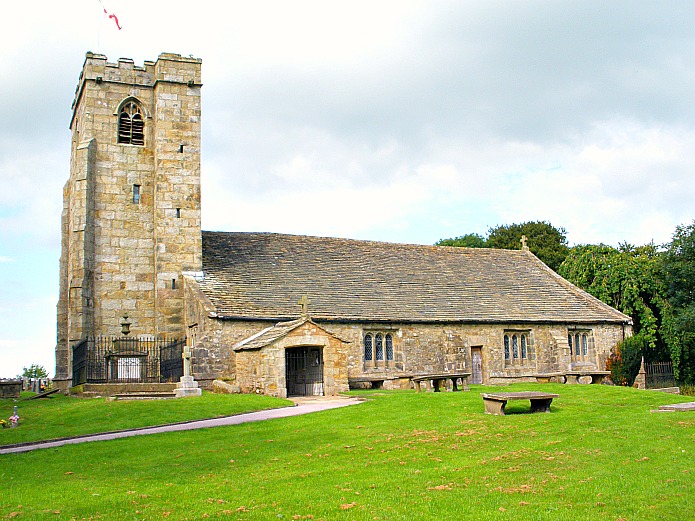
OS grid reference SD 8930 4801. The picturesque St Mary-Le-Gill Church near Barnoldswick is something of a hidden gem that can be found up Ghyll Lane (often spelt as ‘Gill’) off the B6252 Skipton road, at Coates, about 1 mile northeast of the town that used to be a part of west Craven or north Yorkshire until 1974, but is now in Lancashire, just about! The hamlet of Greenberfield with the Leeds and Liverpool canal running through it is half a mile west of the church, while the town of Skipton is about 8 miles to the north-east on the A56 and A59. The name Gill (Ghyll) is the Yorkshire name given to the stream, in this case Gill Syke, that runs southwards from the churchyard and cemetery along the western edge of Ghyll golf course towards Rainhall, while the place-name ‘Coates’ probably means “cottages” – Coates being a grange/farm of Sawley Abbey near Clitheroe.

A Norman foundation, there was a monastic church on the site in 1157, built by Cistercian monks from Kirkstall Abbey near Leeds, West Yorkshire, some 10 years after another group of Cistercian monks from Fountains Abbey in North Yorkshire had tried unsuccessfully to sustain a foundation in the area, but they had failed due to the ‘very’ inclement weather conditions encountered there along with other problems. In the book Medieval Monasteries of Great Britain by Lionel Butler and Chris Given-Wilson, the authors say: “the land was unproductive, however, and the community was plagued by robbers”. The land for a small abbey had been granted to 13 monks and 10 lay brothers from Fountains Abbey under abbot Alexander in 1147 – by Henry de Lacy, Earl of Lincoln, but by 1152 the foundation had been abandoned and left to decay. In the book ‘Outstanding Churches in Craven’ by Val Leigh and Brian Podmore – the authors add a comment from one of the monks saying: “We stayed there for some years, suffering many discomforts of hunger and cold, partly by reason of the inclemency of the air, and immoderate plague of waters, partly because of the Kingdom being disturbed, robbers many times wasted our goods”. The Cistercian abbey of Kirkstall near Leeds was founded in 1152 by the monks who had left Barnoldswick. A few years later, apparently, the Pope decreed that the monks must build a church ‘as a replacement’ at ‘Bernulfswic’ because they had failed to keep their abbey going there. However the monks, maybe out of malice, decided to build the church dedicated to St Mary about one-and-a-half miles from the original site of their failed abbey, which was located on the western edge of the present town at Monkroyd (Townhead). There are no remains, only slight earthworks there today. More likely they sited the church on ‘St Mary’s Mount’ at Ghyll to provide a place of worship between Bernulfswic, Marton and Thornton-in-Craven as a kind of atonement ie penance.

In the excellent book ‘Journeys Through Brigantia’ (vol 1) Walks in Craven, Airedale and Wharfedale, by John* and Phillip Dixon – the authors say: “And indeed what a place for quiet reflection this churchyard is amid the willow-herb, brome, wild-thorn and old English rose that play for space among the tangled stones”, a statement that I like because I think ‘that’ more or less sums up the place as you walk up through the lovely churchyard – when the place has been left alone for some considerable time, but just as nice when the grass and foliage has been cut back as was the case when I visited.

The Perpendicular church tower of the present-day building looks very grand, dating from the early 16th century, while nothing much remains of the 12th-century Norman foundation, apart from an arch above an inner door; there is an inscribed stone on the south wall of the tower that reads: CCCCCXXIIII that should have read 1524 but the ‘M’ is missing! Outside, at the side of the porch, there is a medieval stone coffin that is now full of soil. This may have once contained the body of one of the monks who came here to help build the church or the abbey.

Inside the church much of the timbered roof dates from the 13th century, while the font with Jacobean canopied cover is 14th century; at the side of this there is a nice Medieval holy water stoup (piscina). In the sanctuary (north wall) stands the credence table, carved with three swords in fess, representing the arms of Kirkstall Abbey and its monks who came back to build the church. The wooden three-decker pulpit is of 1620 and above it an octagonal sounding board. Notice the south door which has a beam that would have been placed across the door during invasions by Scottish armies, keeping the local people who were taking refuge, secure. Above the door is the 12th-century Norman arch, the last remnant perhaps of the 12th-century Norman foundation. The dark oak box pews date from the 17th century, and there is a warden’s and constable’s box pew in the south aisle. There are many interesting old gravestones in the churchyard, two of which date from the early 17th century, and are well-embedded into the ground.

There are a number of prehistoric settlements and earthworks in the area and a number of finds have come to light in recent times; a Bronze-Age sword was found here at Ghyll, and several Celtic stone heads have been discovered within a few miles, including one at Great Hague house, Kelbrook, and also a Bronze Age collared urn was dug up at nearby Hare Hill, Thornton-in-Craven, according to John* and Phillip Dixon in their work ‘Journeys through Brigantia’ (vol 1).

*[This site page is dedicated to the memory of my dear friend and author John Dixon, of Clitheroe, who very sadly passed away in September 2012].

Sources:-

*Dixon, John & Phillip., Journeys through Brigantia (Vol 1) Walks in Craven, Airedale and Whafedale, Aussteiger Publications, Barnoldswick, 1990.

Leigh, Val & Podmore, Brian., Outstanding Churches in Craven, Bradford Diocesan Board of Finance in conjunction with Val Leigh Publications, Settle, North Yorkshire, 1985.

Butler, Lionel & Wilson-Given Chris., Medieval Monasteries of Great Britain, Michael Joseph Limited, London, 1979.

Copyright © Ray Spencer, The Journal of Antiquities, 2013 (updated 2024).


Carne Beacon, Veryan, Cornwall

Carne Beacon, Cornwall (photo credit: Mick Sharp)

Carne Beacon, Cornwall (photo credit: Mick Sharp)

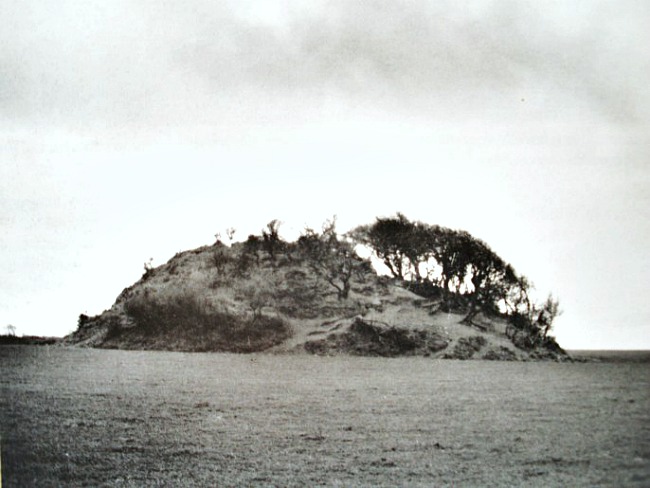
NGR:  SW 9126 3863. On the hilltop overlooking the beautiful Gerrans Bay in south Cornwall stands a fairly prominent ancient burial mound or round barrow (tumulus), dating from prehistoric times, rather than the more recent so-called Dark Ages, as was often thought from the Cornish legend of the saintly King Gerrenius. The man-made mound known as ‘Carne Beacon’ is covered in trees, bushes and grass and stands at the south side of a farmer’s field (near Churchtown farm) ringed by a barbed-wire fence, but with a gate at one side for access. The site can be reached from the village of Veryan, 1 mile to the north, or from the hamlet of Carne half a mile south, via footpaths around the edges of the field where the mound is located. The A3078 St Just and Tregony road is roughly one-and-a-half miles to the west of Carne Beacon. Just to the north of the ancient burial mound are the earthworks of an Iron-Age fort or settlement known as ‘the Veryan Rounds’.

Carn Beacon is between 15 and 28 feet (up to 6 metres) in height, depending on which part of it you’re standing on, and it has a cir-cumference around the base of 370 feet (113 metres). During World War II it was used as a lookout post; a concrete pillar can still be seen on the top of the mound from this structure. It is considered to be the largest Bronze Age burial mound in England. According to the ‘often accepted’ legend, a golden boat with golden oars was buried inside the mound in the 6th century AD along with a Dark-Age king; the boat in question had been rowed across Gerrans Bay from Dingerrin carrying the body of the saintly King Gerrenius (Geraint) of Dumnonia (Devon) who had died in his palace there circa 555 AD. But there was also a St Geraint or Gerran who lived about the same time and founded the church of St Gerrans-in-Roseland, which has rather added confusion to the legend, perhaps, although we know that a certain King Geraint figured in the ‘Register of Llandaff’ concerning St Theliau (Teilo) a 6th century Welsh churchman who had cause to travel through this part of the country on his travels to Brittany at that particular time and was well received by that king; so are the two saints Gerrenius and Geraint one and the same, quite probably. One legend informs us that St Just, son of King Geraint, had been converted to Christianity by the Irish female saint, Boriana (Buryan). St Just in Roseland, Cornwall, is named for him. A St Geraint is commemorated on the 16th of May. Some accounts also confuse things more by saying that King Gerrenius lived in the 7th or 8th century?

The antiquarian, John Whittaker, in his work ‘The Ancient Cathedral of Cornwall’ says that “when Gerrenius died, he was brought from his castle of Dingerein and ferried with great pomp across Gerrans Bay in a barge plated with gold”. The site of Dingerein or Dingerrin castle, a sort of crescent-shaped earthwork, can be found near Trewithian, Cornwall, some 4 miles to the west of Carne Beacon. It seems that the good Dr Whittaker never got the chance to excavate the great mound, even though the local people had got word that he was going to do so and had been given the ‘day off’ work for this wonderful event.

English: Carne Beacon

Carne Beacon (Photo credit: Tony Atkin – Wikipedia)

In 1855 the mound was finally excavated, but sadly, or perhaps unfortunately, no golden boat with golden oars was found – only a cist-type grave inside slabs of stone, like a small chamber, was found along with some ashes of burnt bones and charcoal. Whether these ashes were those of King Gerrenius of Dumnonia we may never know. But this very ‘fanciful’ legend has proved to be a good story told down the centuries. The cist grave (cairn) would most probably date from the Bronze Age. The almost circular-shaped earthworks a short distance to the north of Carne Beacon is all that now remains of an Iron-Age hillfort or settlement that is locally called ‘the Rounds’, ‘Veryan Rounds’ or ‘the Ringarounds’.

Sources:

https://en.wikipedia.org/wiki/Veryan

Whittaker, John Dr., The Ancient Cathedral of Cornwall History Surveyed, (2 vols), London, 1804.

Westwood, Jennifer, Gothick Cornwall, Shire Publications Ltd., Princess Risborough, Buckinghamshire, 1992.

Readers Digest., Folklore Myths and Legends of Britain, Readers Digest Association Limited., London, 1977.

Farmer, David., The Oxford Dictionary of Saints, (5th Edition), Oxford University Press, 2004.

Spencer, Ray., A Guide to the Saints of Wales and the West Country, Llanerch Enterprises, Lampeter, Dyfed, 1991.

National Trust: http://www.nationaltrust.org.uk/roseland/things-to-see-and-do/view-page/item944365/

Copyright © Ray Spencer, The Journal of Antiquities, 2013 (updated 2024).


1 Comment

St Benet’s Abbey, Holme, Norfolk

English: Ruins of St Benet's Abbey on the Rive...

Ruins of St Benet’s Abbey (Photo credit: Richard Harvey Wikipedia)

OS grid reference TG 3832 1564. On a slightly raised area of land just a little north of the River Bure at Holme, Norfolk, lie the quite solitary remains of St Benet’s Abbey – with its church and gatehouse. A little to the north there are some more earthworks and fish ponds from what was once a large, thriving religious foundation. To the north-west of the ruins an old windmill now, alas, without its roof and sails looks forlorn but is, in fact, a more recent building built on the abbey’s lands which are said to have once covered up to 35 acres, and around which the ruins of the abbey’s gatehouse, built in the 14th century, still stands (on private land), although in a somewhat ruinous state, but under preservation. The abbey was originally built on what was an island called Cow Holm, surrounded by marshy land and the rivers Bure and Ant, which meet each other at this point.

According to documented evidence the site was first inhabited back in the early 9th century by an Anglo-Saxon, Benedictine monastery, then later the Vikings invaded the area and destroyed the abbey, but in the early 11th century a larger, more influential Benedictine abbey was established on the site. The ruins are difficult to reach from the A1062 near Ludlam, half a mile north via trackways and paths, but rather easier to reach by boat on the nearby River Bure, in what is a nice part of the Norfolk Broads. The city of Norwich lies roughly 7 miles south-west on the A1151, while Great Yarmouth is 10 miles to the south-east along the A149 on the Norfolk coast.

About 800 AD a hermitage and chapel existed here with Suneman as the founder but he was murdered by Viking invaders; then a small Anglo-Saxon monastery for Benedictine monks was established here but not a great deal is known about it and it did not last long because Viking invaders pillaged and destroyed the building in 870 AD; it’s unclear as to what happened to the monks, if they survived at all? The place lay abandoned and ruined until about 960 or perhaps 980 when the abbey was partly rebuilt by Wulfric the hermit and, by 1019-20, King Cnut granted the abbey and its ‘lands’ to the Benedictine order once again, and they then extended, enlarged and fortified the building under the first abbot, Elfsige, making it into a thriving and quite wealthy religious centre of learning. King Cnut ruled from 1016 to 1035.

During the Middle Ages the abbey of St Benet’s (named after St Benedict, founder of the order) prospered and eventually owned upto 35 acres of land here, and elsewhere; some accounts put this at 80 acres. The monks founded two hospices for the sick at Horning, Norfolk, and another for the poor at Great Hautbois, Norfolk; and there were also dependencies at Bury St Edmunds, Suffolk, and Rumburgh, Suffolk; they also had charge of many local churches. The monks farmed the land around their abbey and kept fish ponds – they were probably very self-sufficient. By 1539 only a handful of monks were allowed to remain at St Benet’s and in 1545 it was finally abandoned and the remaining monks expelled by bishop Rugge of Norwich who had been given their land by King Henry – much of the stone being robbed away and used in the local area, or further afield in Norwich; only the gatehouse has survived and scant walls of the church, dating from 1270. The abbey did, however, survive the Dissolution of the Monasteries and for this reason the current Bishop of Norwich can still call himself ‘abbot of St Benet’s Holme’.

English: St Benet's Abbey - the gatehouse The ...

St Benet’s Abbey Photo credit: Ian Russell Geograph


Today some of the abbey walls still stand but are only a shadow of what height they would originally have been. At the east end the stone altar supports a wooden cross of recent date. Around the site, just to the north, there are numerous other foundations of the conventual buildings, precinct wall, earthworks and even the monks fishponds. The abbey gatehouse, to the north-west, is in a ruined state but is under preservation. The conical-shaped windmill dates from about 1760-80 but no longer has its roof or sails; it was later used as a drainage mill and wind-pump. A causeway across the marshes was built by the monks and is still just visible to the west and there are traces of boundary ditches and banks, marking the extent of the abbey’s lands much further to the west close to Horning (St Benedict’s) church. Choir stalls from the abbey can be seen in nearby St Helen’s church, Ranworth.

.

Sources & References:-

https://en.wikipedia.org/wiki/St_Benet%27s_Abbey

Bottomley, Frank., The Abbey Explorer’s Guide, Kaye & Ward, London, 1981.

Butler, Lionel & Wilson-Chris Given., Medieval Monasteries of Great Britain, Michael Joseph Ltd., London, 1979.

Pastscape: http://www.pastscape.org/hob.aspx?hob_id=133454#aRt

Norfolk Archaeological Trust: http://www.norfarchtrust.org.uk/stbenets

Copyright © Ray Spencer, The Journal of Antiquities, 2013.


2 Comments

St Govan’s Chapel, Bosherston, Pembrokeshire, Wales

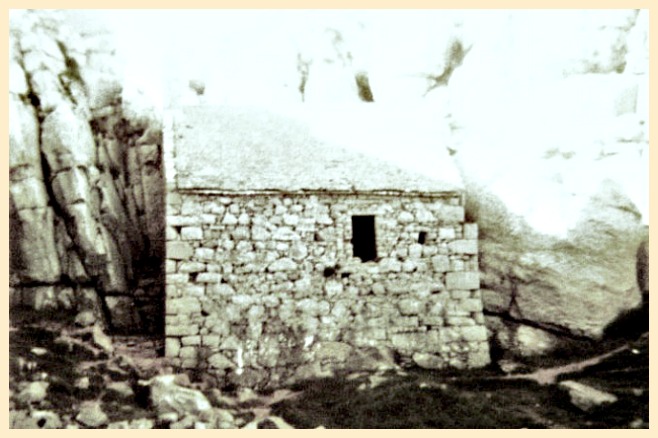
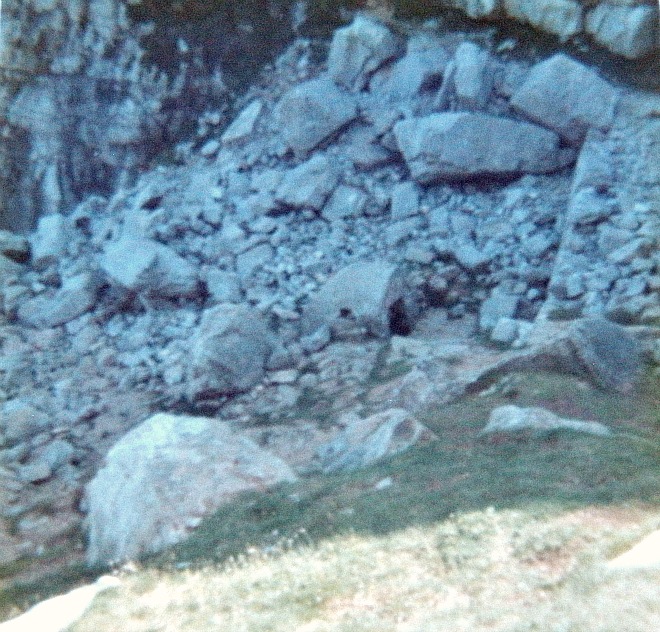
St Govan's Chapel in Pembokeshire c.1972

St Govan’s Chapel in Pembrokeshire 1970s

OS grid reference SR 9669 9296. At the church of St Michael & All Angels in Bosherston village take the road opposite (Buckspool lane) out of the village for about 1 mile. If there is an MOD sign displayed you may not be able to proceed any further for a few hours due to military training on the firing range. There is a car-parking area on Travallen Downs by The Pembrokeshire Coast Path – just above the medieval chapel of St Govan which nestles down on the rocky shoreline below the precipitous cliffs of St Govan’s Head. A flight of stone steps leads down between a large ravine in the cliffs into the ancient little building; the number of steps varies between 50-70 but there are said to be 52 steps all told. However, it is difficult to count the exact same number coming back up again! Near the chapel there is a dried-up holy well called Ffynnon Govan (St Govan’s Well). The place has been regarded as a sacred and holy pilgrimage site since the Middle Ages, a place where miracles of healing were wrought in past times; even the soil is said to be curative. The county town of Pembroke is roughly 7 miles to the north on the B4319.

The little chapel solidly built of limestone is said to date from the 13th century – being restored at that time, so I think we can assume that there was an earlier chapel on this site, possibly one founded by the saint himself. Inside the building measures 18 feet by 12 feet and it’s roof is vaulted. At the eastern side an entrance leads to a hermit’s cell in the cleft of a huge limestone boulder. According to the often-told legend: the saint was pursued here by marauding sea pirates; he hid in the cleft of the great boulder which then closed up, hiding him from view, or his hermit’s attire matched the rock thus he became invisible. You can still make out some marks in the boulder that were made by the saint’s fingers when he hid here back in the 6th century AD. If you make a wish while standing in the cleft of the rock, facing the wall, your wish will be granted, hopefully!

At the side of the hermit’s cell is a stone altar beneath which, according to legend, St Govan is buried. A holy water stoup (piscina) is built onto the wall and, beneath this a spring of water runs out of the ground but is never said to run across the chapel floor, though it has been known to happen! The spring is said to have miraculous healing properties. There is a recess in the wall (aumbrey) that may have been used for sacred vessels or perhaps relics, and there are some solid-looking stone seats up against the wall. The little bellcote on the roof did once possess a bell but this was long ago lost to the sea; it can apparently still be heard ringing on stormy nights from beneath the turbulent waves off shore, foretelling an impending disaster at sea. Another tale put forward says the bell was stolen by pirates, but later rescued by sea nymphs who placed it inside a rock near the chapel. It was said that if you struck the rock the bell would ring out.

Ffynnon Govan (St Govan's Well)

Ffynnon Govan (St Govan’s Holy Well).

Some steps lead down below the chapel to a rock-strewn area and St Govan’s holy well (Ffynnon Govan) covered over by a stone hood. However, this well has been dry for a long time now, but up until the mid 19th century it was the site of many healings with crutches being left by previously crippled pilgrims as a votive offering. Red soil that is found around the chapel site was used in a poultice form to cure sore, itchy eyes, and it is still said to be effective today! Francis Jones in his well-known work ‘The Holy Wells of Wales’ says about this well: “On the cliff side by St. Govan’s Chapel, Bosherston parish : especially famous in the cure of failing eyesight, lameness, and rheumatism.” “Near the well is a deposit of red clay formed by rock decomposition, and great virtue was attached to it : a poultice of this was applied to limbs and eyes, and the patients then lay there for several hours in the sun.”

So who was St Govan? It is strongly believed that he was St Gobhan who founded the monastery of Dairinis-Insula near Wexford, Ireland, about the year 530 AD and was a follower of St Ailbhe, bishop of Emlech (Emily) in County Tipperary. Gobhan (Govan) came as a missionary to south-west Wales in old age and became a friend of St David. He may have been present when St David died in 589 AD? Gobhan became a hermit in south-west Pembrokeshire and lived out the rest of his life in a cell beside the rocky cliffs, now known as St Govan’s Head. His feast day is celebrated on 26th March. He died towards the end of the 6th century, and is the patron saint of builders. However, some individuals have tried to link the name Govan with Gawain, King Arthur’s knight who supposedly retired to this hermitage after the death of Arthur, or to a St Cofen, daughter of King Brychan. This is unlikely. And St Ailbhe, mentioned earlier, also came to Wales and baptised Wales’ future patron St David, at Porthclais. He is called Aelbyw or Elvis and was said to have dwelt in the area to the east of Solva – at St Elvis farm, now named after him.

At Bosherston in the medieval church of St Michael, a stained-glass window shows St Govan as a bearded old man holding a model of his chapel; another window shows St David, patron St of Wales. The churchyard has a 14th-century preaching cross with a tiny carved head near the top, which is thought to represent Christ. It stands on two-tiered steps that enabled it to be used as a sort of stone crucifix. The cross was found in the 16th century having survived the Reformation; the head was placed on top of a standing stone that may date back to pre-Christian times or the Dark Ages?

Sources:

Spencer, Ray., Historic Places In Wales – An Exploration of the Fascinating and Mysterious, (Unpublished manuscript), Nelson, Lancashire, 1991.

Spencer, Ray., A Guide to the Saints Of Wales and the West Country, Llanerch Enterprises, Felinfach, Lampeter, Dyfed, 1991.

Jones, Francis., The Holy Wells of Wales, University of Wales Press, Cardiff, 1992.

Barber, Chris., Mysterious Wales, Paladin (Grafton Books), London, 1987.

Copyright © Ray Spencer, The Journal of Antiquities, 2013.

.


2 Comments

Chesterton Roman Fort, North Staffordshire

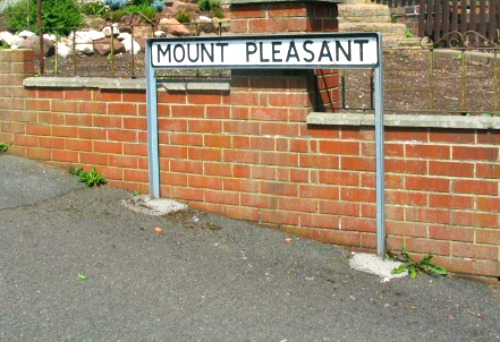
Mount Pleasant Sign at Chesterton.

Mount Pleasant Sign at Chesterton.

OS grid reference SJ 8302 4900. This Roman site in north Staffordshire is a difficult one to examine in any real detail as there are no tangible signs of earthworks showing up from the late 1st century fort, or what’s left of it, which is partly buried under Chesterton High School (now known as Chesterton Community Sports College) between Mount Pleasant and Castle Street and the recreation fields at the back where there are some very faint, linear crop-marks. Was Chesterton the Roman town (vicus) of Mediolanum – about which some Roman historians have alluded to? Quite possibly, but still some uncerainty.

From what is known the auxiliary fort was built in the early Flavian period circa 70 AD after an earlier temporary fort at Trent Vale (Stoke on Trent) – a few miles to the south had been abandoned. The fort was apparently linked to a temporary Roman marching camp at Loomer Road, 400 yards to the south, where the Roman Catholic church of St John now stands, and it’s earthworks are still said to be visible at the south-east side of the church. And at Holditch, some 800 metres to the south-east, there was a Romano-British settlement of the late 1st to early 2nd century AD. Here a number of Roman artefacts were excavated. The town of Newcastle under Lyme is one and half miles to the south of Chesterton on the A34, at the north-western edge of The Potteries.

The northern section of the fort lies under the high school buildings and the southern section under the fields and recreation areas at the back, and roughly following the field boundarie there – where some very faint linear crop marks can be made out in the large field. Apparently the mainly timber-built fort was parallegram-shaped (rectangular) and measured 365 yards by 300 yards, according to Pastscape, which would be around 4 acres all told, so a medium to large-sized auxiliary fort on the Roman road called RYKNELD STREET, which ran from Derventio (Derby) in the east to the fort at Rocester and, in the west to Salinae (Middlewich), Condate (Northwich) or, according to some, Kindeston, and then on to Deva (Chester). The fort at Chesterton would have held a cohort of 500 to 600 soldiers quite comfortably, I would imagine.

After the demolition of a house called ‘Mount Pleasant’ in 1969 excavations were carried out on the site of the fort for a period of 2 years. A defensive bank running alongside the lane, at the north-west side, was found and also the defenses of the south-eastern side, but sadly no antiquities of any note, apart from a stray silver coin found by a pupil during a school dig [June 2013], and some early Flavian pottery from the ditch. From what is known, however, its timber rampart was 20 feet wide and at the front of this two ditches made from clay and turf were some 20 yards wide; the rampart apparently was shortened or cut back and then the inner-most ditch (15 feet wide and 6 feet deep) with a square-shaped drainage channel, was filled in.

The fort appears to have been built in “one” construction phase rather unusually, perhaps, whereas many Roman forts had two or even three phases of construction. A clay oven and the remains of the cook house were discovered – the latter had been built onto the timber rampart. Between 1593 and 1603 the antiquarian, Sampson Erdeswick, recalled in his work ‘A Survey of Staffordshire’ that the surviving walls were of “marvellous thickness”. So if we take that at face value the ramparts were made of stone-worked walling of some kind – probably sandstone fragments in hard clay, although sadly all that was either robbed away or bulldozed as there are no visible signs of any stonework today. The north-west corner of the fort abutted up against a sandstone outcrop which helped form the defenses there. There was a bath-house on the site though it is uncertain whether this was situated inside or, on the outside of the fort – they were usually outside.

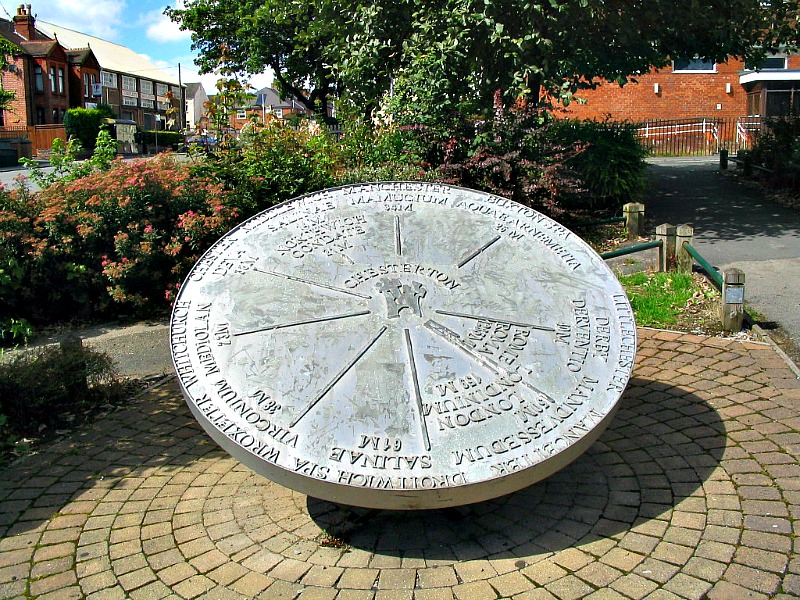
Chesterton Mileage Disc 2000

Chesterton Mileage Disc 2000

The nearby Roman marching camp at Loomer Road, Chesterton, measured 325 feet by 315 feet around 2 acres and was square-shaped; its earthworks are still visible at the south-east side of the Roman Catholic church of St John the Evangelist, while the Romano-British settlement at Holditch further to the south-east has all but vanished. However, quite a lot of pottery has been found on the site, as well as a pottery figure of Venus, glass beads and a bronze bell. At Trent Vale a pottery kiln from the Roman period was excavated, and at Lightwood near Longton, a hoard of Roman coins was unearthed. Many of these artefacts can be seen in the Newcastle Under Lyme museum in Brampton Park. There are some Roman antiquities from the Trent Vale site on display in The Potteries Museum at Hanley, Stoke-on-Trent. And the Chesterton mileage disc set up at the Millennium in 2000 can be found at the corner of London road (B5500) and Wolstanton road (B5369) in Chesterton and is part of the ‘Midlands Heritage Forum’. The disc displays the mileage in ‘Roman miles’ between various Roman forts and towns in England with Chesterton at the centre. Also, at ‘The Apedale Heritage Centre’ on Loomer Road, Chesterton, Newcastle-under-Lyme, there is part of the wall from a Romano-British building, information on the site at Holditch and the invasion of Britain in AD 43.

Sources:-

Erdeswick, Sampson, A Survey Of Staffordshire, J.B.Nichols & Son, London, 1844, 22.

Pastscape website http://www.pastscape.org/hob.aspx?hob_id=75834

www.roman-britain.org  http://www.roman-britain.org/places/chesterton.htm

www.webbaviation.co.uk  http://www.webbaviation.co.uk/gallery/v/staffordshire/Newcastle-under-Lyme/ChestertonRomanFort-fb31891.jpg.html

http://www.apedale.co.uk/index.php/museum

Thanks also to Barrie Collinson for the info on The Apedale Heritage Centre.

Copyright © Ray Spencer, The Journal of Antiquities, 2013 (updated 2024).

.