The Journal Of Antiquities

Ancient Sites In Great Britain & Southern Ireland


1 Comment

Medieval Stone Carving In Marsden Park, Marsden, West Yorkshire

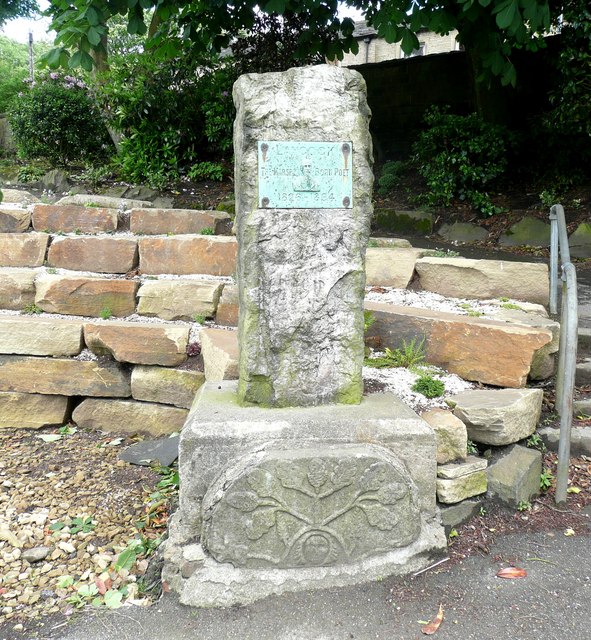
The Laycock Memorial in Marsden Park by Humphrey Bolton (Wikimedia)

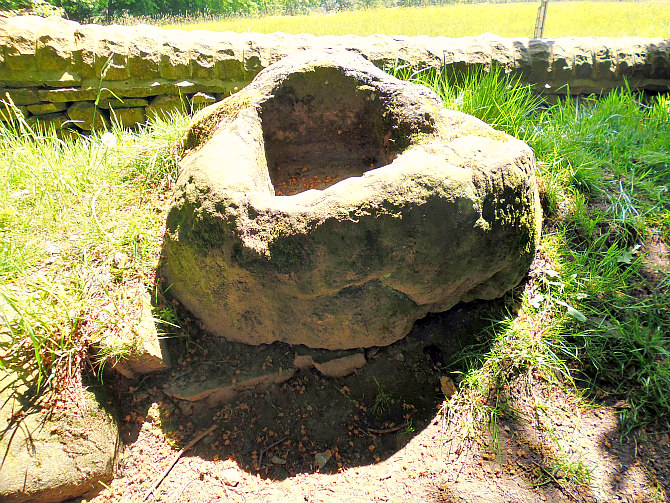
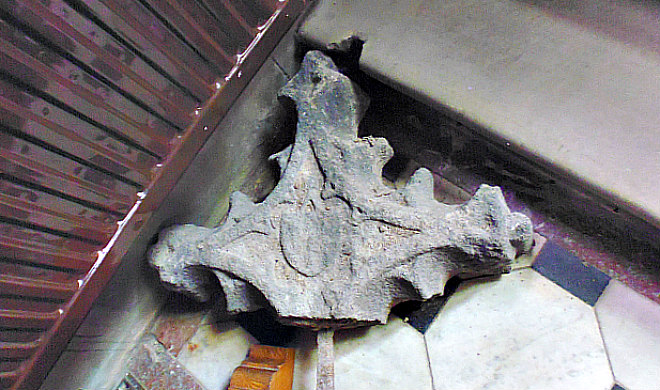
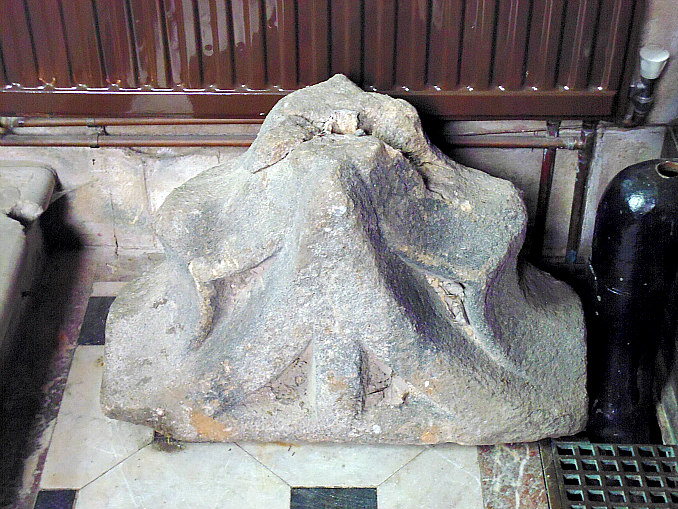
   OS Grid Reference: SE 05080 11474. At the base of a memorial to the Lancashire poet Samuel Laycock in Marsden Park at Marsden, 8 miles southwest of Huddersfield, west Yorkshire, there is  a curious carved stone, which has been called  ‘Celtic’  by local historians down the years. It is strangely carved with elements of nature that do indeed seem to be “Celtic” in origin. However, the stone is more likely to be late medieval. But where did this curious carved stone come from? No one seems to know. Maybe it came from some Medieval church or priory (though there is no record of that), or from some sacred grove beside a riverbank. The monument was actually set up to commemorate the Lancashire dialect poet Samuel Laycock (1826-93) who was born in Marsden, but his poetry was mostly about Lancashire and the ‘hardships’ of the Cotton Industry. Laycock died in Blackpool, Lancashire. The monument with its curious carved stone stand close by the bandstand in Marsden Park near Carrs Road. So just head for the bandstand and the monument is on the other side – just opposite the war memorial – dedicated to local men who died in the Great War.

Celtic Stone in Marsden Park, at Marsden, west Yorkshire.

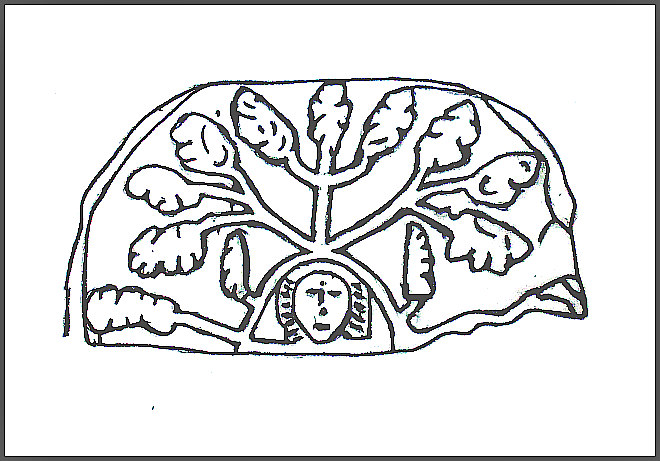
   Apparantly the curious carved stone was found at Marsden in the late 19th century and then in 1911 it was seen fit to place it at the base of Samuel Laycock’s memorial in Marsden Park. But why? Maybe it was seen as ‘a fitting tribute’ to such a great poetic genius for Samuel Laycock was just that. The stone is thought to be Late Medieval and to date probably from somewhere be-tween the 14th-16th centuries, but could it be much earlier? A few local historians have con-sidered it to be Celtic in origin! Well at least the carvings look to be Celtic! And also carved on the stone is what looks to be the head of a Celtic sun god with sunrays radiating from it. Or is this carving a depiction of ‘The Tree of Life’- maybe. Another theory being that the oval-shaped face is that of a Celtic saint complete with a halo; the crown of oak leaves being associated with saints of the Old British Church both in folklore and literature.

   In an article called Reading the Environment by David Fletcher & David Ellis in the ‘Pennine’ magazine (1980) we are told about this curious Celtic stone in Marsden Park. They say that: “At the base of this modest monument is a mysterious stone carved in low relief depicting an oval-shaped face with a garland or crown of oak leaves, acorns and flowers. This stone was found somewhere in Marsden  during the last century, no-one seems to know exactly where, but the local worthies realizing its antiquity placed it at the feet of the local bard when his memorial was erected in 1911. Nothing could be more appropriate because it is my opinion that this mysterious stone can introduce us to a people who inhabited the Pennines for perhaps a thousand years—the Celts.”

   Fletcher and Ellis go on to say that: “The symbolic head with an oval face, and the crown of oak leaves suggest to me that this was part of a pagan shrine and who knows, perhaps it was the focus of worship in a sacred grove by the river Colne.”

Sources and other related websites:-

Fletcher, David & Ellis, David, (Reading the Environment article), Pennine magazine (No 5), Pennine Heritage Ltd., Pennine Development Trust, Hebden Bridge, West Yorks, June/July 1980.

https://commons.wikimedia.org/wiki/Category:Marsden,_West_Yorkshire#/media/File:The_Laycock

http://northernantiquarian.forumotion.net/t350-stone-in-marsden-park-marsden-west-yorkshire

https://en.wikipedia.org/wiki/Marsden,_West_Yorkshire

https://en.wikipedia.org/wiki/Samuel_Laycock

A Marsden Poetry Trail

                                                                                  © Ray Spencer, The Journal Of Antiquities, 2017.


Harnessing a Volcano by Fabricio Sarti.

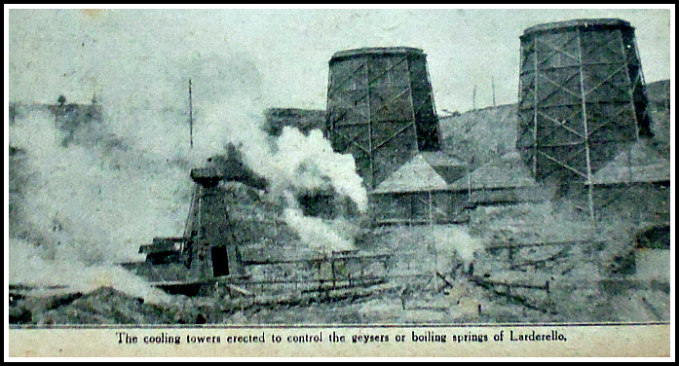
Larderello, Italy (volcanic geyers & cooling towers).

Larderello in Italy.

“The following is an account of the remarkable industrial and commercial uses to which Italian engineers have succeeded in putting the volcanic forces which exist in the sub-soil of certain parts of Italy, together with some of the grotesque mishaps which were brought about by the applica-tion of volcanic power to domestic purposes.

    “If you could be heated, laundried, lighted, bathed, and have your cooking done, without any trouble, and all for next door to nothing; if into the bargain you could raise spring cabbages for a mere trifle, and new potatoes all the year round, not to speak of obtaining all the motive and hydraulic power you required, you would probably wish to move into a neighbourhood where such desirable conditions prevailed.

    “As a matter of fact, there is a place where all this—and a great deal more exists, but it is situated in a somewhat inaccessible part of Italy, rather too far off, under existing conditions, to catch the Tube to the City, or the Elevated Railroad to Broadway.

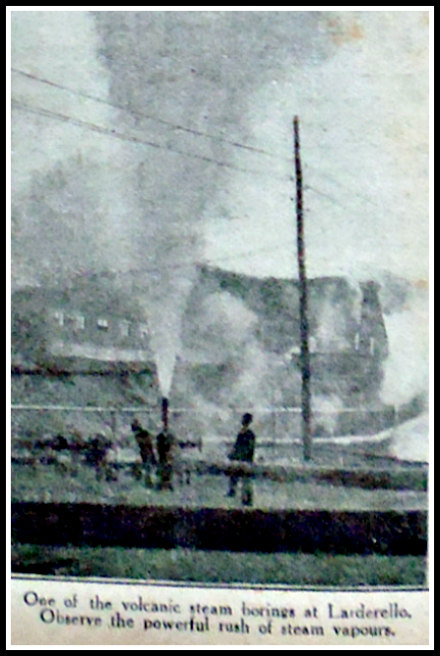
Larderello, Italy, (volcanic steam geyser).

Larderello, Italy, (volcanic steam geyser).

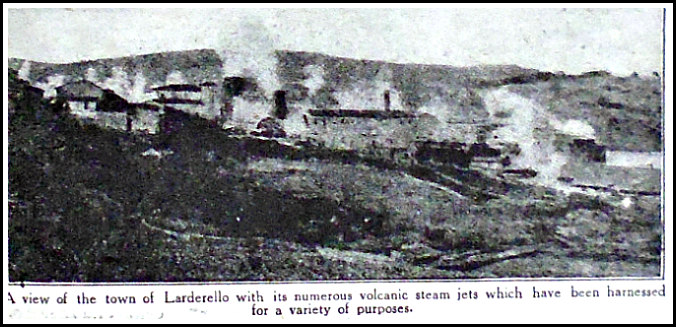
   “The district of Pisa, in Tuscany, is largerly of volcanic origins. In some parts of the province, and more especially in the neighbourhood of the little town of Larderello, the boiling  springs which exist in the subsoil issue to the surface in the form of numerous and powerful “gushers” or “geysers” of hot  vapour or steam. These gushers, or jets of steam, are known locally as “saffioni,” and the evaporated steam finds its way into a large number of small pools or “lagoni.” Though these jets of steam issuing through fissures in the granite, must have existed for many thousands of years, it was not  until about a hundred years ago that they were discovered to contain a substance of great commercial value. Some scientists visiting the pools, or “lagoni,” found out  that the waters contained, in a state of dissolution, a very considerable quantity of boracic acid. It was soon discovered that the boracic acid came from the jets of steam issuing from the soil near by, and, provided means could be invented to evaporate the waters of the “lagoni,” the boracic acid would fetch a good price.

   “Boracic acid was discovered in 1702, but as it has never been found possible to synthesize the product with a view to its artificial manufacture, chemists are dependent upon natural sources for its supply. Until comparatively recent times, boracic acid was in great request as an antiseptic, but has now been replaced by other and more powerful substances. Boracic acid continues, however, to be in great demand, both in its crude form and in the form of the various boraxes derived from it, for soldering, enameling, glazing, and dyeing purposes. It is likewise used in the manufacture of soap, and even as a substitute for that useful article.

   “Most of the boracic acid in use to-day comes from Italy, especially from the Pisa district. Recently, huge deposits have been located in Asia Minor, but the war has prevented the development of these deposits for industrial purposes.

   “The “saffioni” found around about Larderello are saturated with the acid, which, as the steam evaporates into the pools, settles at the bottom of the “lagoni.” It is supposed that the streams of hot steam passing at great pressure, and at a high temperature, through the underground fissures of the rock, act as a dissolvent upon the tourmaline in the granite, and separate the acid from the boron, carrying it automatically along to the surface.

   “The first attempts made to evaporate the waters of the “lagoni,” so as to secure the acid, were very primitive. Ovens were bored around the pools. These ovens were filled with wood, and kept alight until the waters had evaporated. This was a long and tedious process, and by the time the boracic acid was secured it proved so costly as scarcely to pay for production.

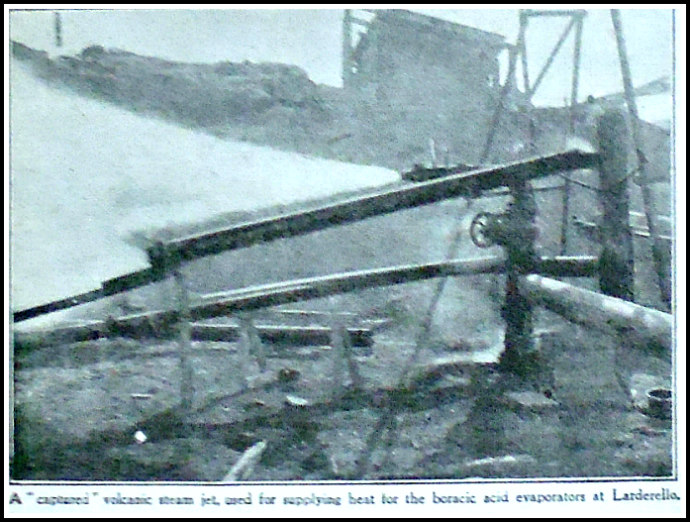
Larderello, Italy (a captured volcanic steam jet).

Larderello, Italy (a captured volcanic steam jet).

   “Other and more modern processes were afterwards tried, but none of them proved satisfactory until an Italian engineer hit upon the very simple idea of utilizing the “saffioni,” or steam jets themselves, as the heating power for the evaporization of the acid-laden waters. The natural pools into which the jets of steam projected the acid they contained were abandoned altogether, and around the aperture of each “saffioni” or jet of hot vapour, as it issued from the soil, there were built small reservoirs of rough masonry jointed with clay.These were filled with water from the pools, and the action of the hot vapour churning the water soon brought it almost to boiling-point. At the end of twenty-four hours it was found that the water contained about one and a half per cent. of acid. By means of a wooden pipe the water was conveyed into a second reservoir built round a second “saffioni,” where it was further enriched by acid. After being transferred into half-a-dozen different reservoirs built round different jets, the water was sent into a decanting tub or basin, where it deposited the earthy impurities held in suspense.

   “From the decanting basin the water is sent into special evaporators. These evaporators consist of long wide sheets of un-dulated lead, two hundred and fifty feet in length and eight feet wide, turned up at each side. These leaden sheets are placed on an incline, and the acid-charged waters trickle slowly over the wavy sheets of lead, which are heated by hot steampipes passing underneath. As the acid-charged water trickles over the hot, wavy, leaden plates it evaporates under the action of the heat, and deposits the boracic acid.

The Town of Larderello, Italy, with its volcanic steam geysers.

The Town of Larderello, Italy, with its volcanic steam geysers.

   “The hot steam is derived directly from the natural vapour underground, but instead of utilizing the ordinary “saffioni,” or vapour-jets, for the purposes, it was considered preferable to make separate artesian borings to a distance of one-hundred feet or so underground. The steam was tapped with such force, that unless special precautions had been taken beforehand the rush of subterranean vapour would have caused a serious accident. Indeed, the artesian borings brought up steam-jets with a pressure of no less than nine atmospheres at a speed of one-hundred and seventy-five yards to the second, and at the great heat, in some borings, of one-hundred and ninety degrees Centigrade or six-hundred and forty degrees Fahrenheit.

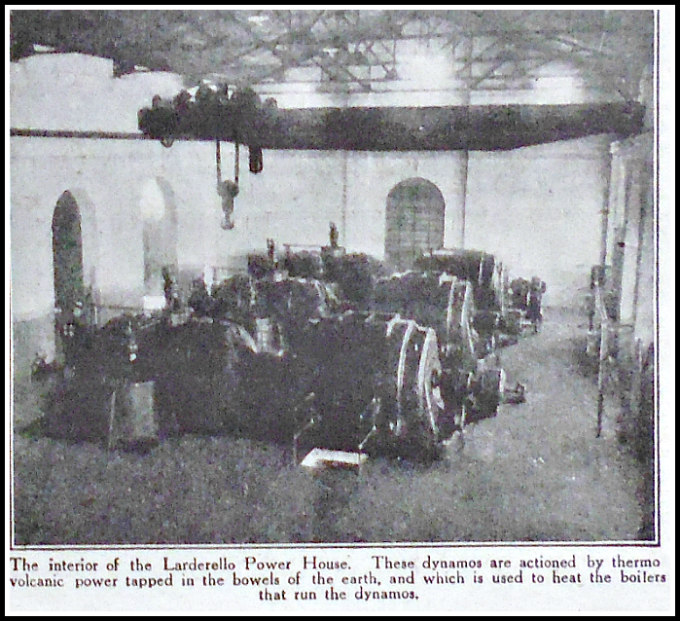
   “The discovery that such vast subterranean power lay at the disposal of the engineers soon led to the installation of powerful dynamos. It was first found necessary to purify the stream of its gaseous matters, for otherwise the machinery would have quickly become corroded.

   “Within a few years the engineers had tapped, by short artesian borings, quite a number of “hydro-volcanic” power-jets. A single one of these, the “Ponta Anna” bore, produces two-thousand three-hundred horse-power, whilst another, the “Venella” bore, produces one-thousand two-hundred and sixty horse-power. 

Interior of the Larderello power house.

Interior of the Larderello power house.

   “The power-houses were soon supplying hydro-volcanic energy to a considerable number of factories, and in what was formerly a deserted district there sprang up the town of Larderello. Not only so, but there ensued the natural desire to turn this volcanic power to domestic use, and some of the engineers and factory managers had their dwellings fitted up with piping, so as to get heat in winter and fuel for cooking, for the heat is sufficiently great to bake a joint in an oven in half an hour. It is, however, dangerous to “monkey about” with the subterranean forces of Nature, and early experiences were accompanied by a number of accidents and mishaps.

   “One of the factory engineers, whose house had been fitted with the hydro-volcanic heating apparatus, was aroused in the middle of a heavy sleep by a roaring sound like a locomotive blowing off steam. He turned on the electric light—which was also supplied by the dynamos worked by volcanic power—to discover a geyser of boiling water bubbling up in the middle of his bedroom and filling the room with steam. He had just time to jump out of bed and make his way out into the street in his dressing-gown, when the geyser assumed gigantic proportions and burst with a roar through the roof of the house, soon reducing the entire building to pulp. It seems that, in some way, the control cap of one of the main tubes, as the steam issued from the bore, had become partially unscrewed, with the result that the full force of the bore had found its way into the engineer’s house and burst the hot-water piping under the floor of his bedroom.

   “It took several hours before the geyser could be got under control.

   “On another occasion an Italian cook, on returning from market and entering her kitchen, was horrified and amazed to discover the whole of her pots and pans on the long kitchen range jumping about as though bewitched. The range was heated by steam radiators from one of the volcanic bores, and the metal of the radiators was of an undulating wavy form. Owing to a sudden increase in the subterranean velocity of the steam jet from the bore, the steam had ruptured the control cocks and had come throbbing through the heaters in jerks, imparting a gyratory movement to every one of the kitchen utensils on the range.

   “One morning, too, a stout factory manager had such a fright, whilst in his bath, that he resolved never again to take any baths the water of which was supplied by hydro-volcanic process. The bath was fitted with a hot and cold douche apparatus which, instead of descending from the roof over the bath, came from an aperture in the bottom of the bath-tub, in the form of an “ascending” douche, as it is called.

   “On that particular occasion the main geyser from one of the bores had suddenly taken on a “spurt” of two or three minutes, causing the hot water in the main pipe to rush with increased velocity, and rupturing the control tap. The water, in the form of a hot and cold mixed “douche,” suddenly shot up from below the bath with such tremendous force as to rupture the rivets and send the man taking his bath three or four feet into the air before he could recover himself. Happily the mixture of cold with hot water prevented what might have been a serious accident.

   “The municipal laundry, in which all the hot water is supplied from the bores, is another luxury due to the existence of hydro or thermo-volcanic power. Before the scientific system of controlling the steam at the output of the bores was brought to its present state of perfection, it not infrequently happened that a sudden wave  of “power” would play havoc with the machinery which supplied the hot water to the laundry. On one occasion all the “laundry” of the town of Larderello was sent flying in all directions, and there being a high wind blowing at the time – many of the articles were recovered in the plain several miles away. All these little mishaps no longer occur, so perfectly are the main thermic-power bores now under control. 

   “The Larderello “saffioni” are invaluable to the local market gardeners, who are so able to regulate the heat of their hot-houses as to produce fruit and vegetables in abundance all the year round.

   “The Larderello vapour jets and the intelligent industrial use to which they have been put by Italian engineers have attracted the attention  of scientists to the immense possibilities that lie in the systematic and rational utilization of the hidden subterranean forces of Nature.”

Source of information:-

Sarti, Fabricio, The article ‘Harnessing a Volcano’ was published in ‘The Wide World Magazine – An illustrated Monthly Of True Narrative’, Vol. XLII – October 1918 To March 1919. George Newnes Ltd., Southampton St., Strand, London.

                                                                  © Ray Spencer, The Journal Of Antiquities, 2016.


The Lake of Soda by George Frederic Lees

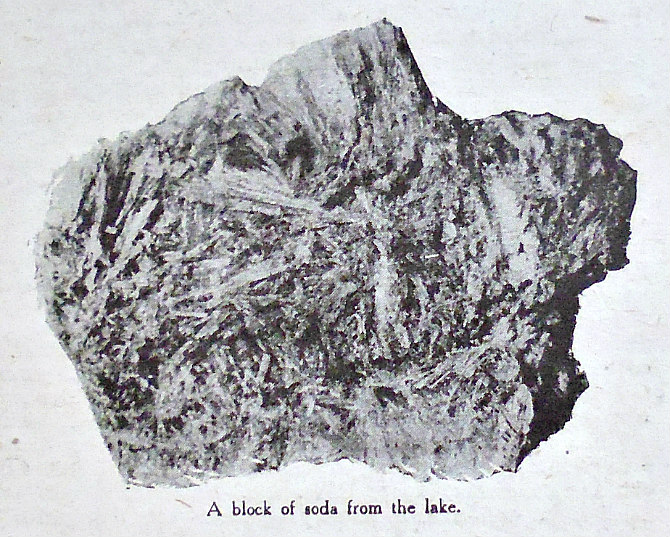
A block of Soda from the lake.

A block of Soda from the lake.

                               The Story of a Wonderful Natural Curiosity of British East Africa                                      “The following  article is a  striking instance of  the immense and  sometimes  inexhaustible wealth which is waiting to be exploited in British possessions in Africa. Much of that wealth is  still hidden, but in the case of Lake Magadi—a lake of solid natural soda covering an area of some thirty square miles—it was there for any enterprising explorer to discover and report to the right quarters. The story of the commercial development of this great Colonial asset adds a fresh chapter to the ever-enthralling romance of British industry.

   “In every quarter of the City of London, Romance is to be found by those who search for it dili-gently. Many an engrossing story of adventure or exploration, involving the lives of men, the overcoming of wellnigh insu-perable difficulties, and the expenditure of vast sums of money, which in itself  required no small amount of courage, lies hidden in office records, until the historian of the so-called minor events of the world happens upon it and forthwith disen-tangles it from a mass of commercial verbiage, always tedious of perusal and often covered with the dust of years. A romantic episode may lurk beneath the most innocent-looking phrase in the minute – book of a board of directors—some such common-place note as this:

    “”The attention of the board, at its meeting on such-and-such a date, was called to the commercial possibilities of this or that, in consequence of which they decided to dispatch a confidential agent to the spot mentioned to verify the statements made to them.”

   “Could there be a less promising starting-point for a story of discovery and adventure? So devoid of the slightest tinge of romance is such a bald statement that there is a risk of the searcher passing it over disdainfully. And yet, if he continues his investigations, he may indeed find that a very pretty tale of human endeavor, coupled with the unfolding of many curious said-issues, hangs thereon for his own and his readers’ delectation.

   “To take a concrete case, it happened that, some ten years ago, a certain explorer entered the office of a firm of City mer-chants, and made certain “”representations of the great importance and value”” of a curious lake in British East Africa. So it was set down in the minute-book, but what he actually said to the heads of the firm was somewhat as follows:—

Lake Magidi in Uganda.

Lake Magadi in Uganda.

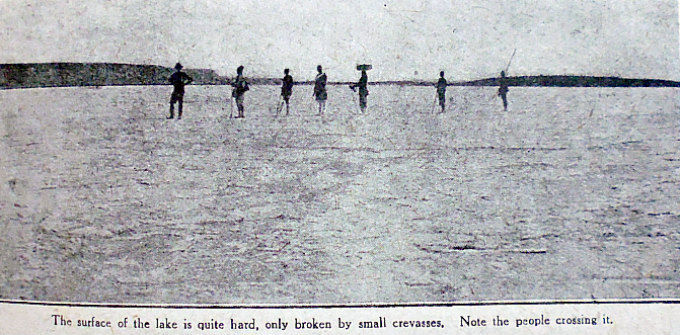
   “”The lake looks for all the world like an ice-field, and when the photographer showed us his  prints I might have imagine, but for the figures of the natives with their bare legs and scantily-clothed bodies, that we were a part of explorers in the Arctic regions. Mile upon mile of the great white expanse of soda and the hot springs of Magadi stretch around, with here and there a big block of alkaline deposit. A most remarkable sight. There must be millions upon millions of tons of the stuff. Of course, it opens up vast possibilities commercially. Only you will have to get the soda to the coast and so on to the ships, and that means building a branch to the Uganda Railway’s ocean port at Kilindini, or thereabouts.”

   “This declaration naturally aroused the greatest interest. It is not every day that a discovery with “vast possibilities commercially” is announced in the City, and if this lake of soda did really exist, was not a mere figment of the explorer’s imagination, his listeners had no need to be told that it might become a veritable gold-mine. The demand for soda is universal. Instinctively the partners began to pass the manifold users of soda in review.

   “Soda crystals are used in practically every household the world over for washing purposes. Carbonate of soda (otherwise known as soda ash) and caustic soda are largely used in numerous industries, as, for instance, by soap, glass, and paper makers, as well as by textile manufacturers for printing, bleaching, and dyeing, etc; whilst bicarbonate of soda is used for the manufacture of baking powder and mineral water.

   “The prospect was alluring. True, this commercial proposition  would mean the investment of a few hundred thousand pounds—probably up to half a million sterling—in addition to a good deal of hard work. But think of the return : a steady annual profit running into millions ! Unquestionably (the firm decided, after discussing the matter in all its bearings) they must institute an inquiry and, if the report they had heard were substantiated, see what could be done to secure the rights over these invaluable soda deposits.

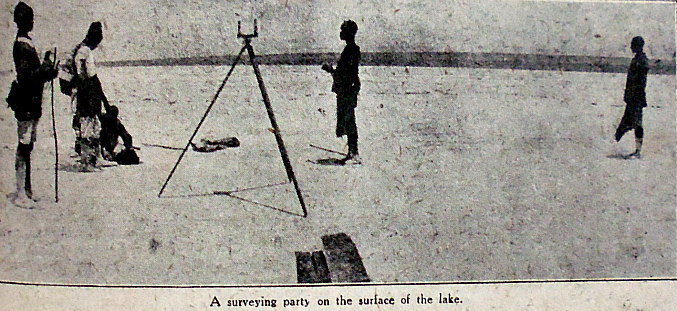
Surveying party on Lake Magadi in Uganda.

Surveying the lake.

   “Accordingly, Messrs. M. Samuel and Co. sent a confidential representative to British East Africa to verify the explorer’s statements. And this he did, many months later, by bringing back with him large samples taken from thirty-five different places over the whole area of Lake Magadi, which he described in even more glowing colours than his predecessor had done.

   “This conclusive evidence clinched the matter. The firm at once entered on protracted negotiations with the Colonial Office, and obtained from the Crown Agents for the Colonies, acting on behalf of the Government, an agreement, giving them the option of acquiring  direct from the Government about three hundred and twenty-four square miles of territory, including Lake Magadi, for a period of ninety-nine years, with the right of working the soda (subject to the rights of natives to take soda from the deposit for their own purposes), and of constructing a line of railway connecting the deposit with the main line of the Uganda Railway.

   “These preliminary steps having been taken, a fully-equipped surveying expedition was sent out in November, 1909, under Mr. Frederic Shelford, a well-known railway engineer who had done valuable survey work in Africa. The other leading members of the expedition were Mr. W. H. Levy and Mr. A. E. Herz, two directors of the company that had been formed to exploit the lake of soda; Mr. A. H. Endemann, who had studied on the spot the question of the most suitable mechanical appliances for dealing with the deposits; and Mr. Arthur Trobridge, who  had been engaged in the soda business for many years, and whose report was therefore looked forward to with considerable interest.

   “The expedition reached its destination, after an uneventful march from Magadi Junction, the nearest point on the Uganda Railway, on December 1st, and found , immediately prior to its arrival, that considerable rain had fallen. Consequently the whole of the lake, inclusive of some sand flats at its southern end, was covered with water, in depth from six inches to one foot. This was distinctly disappointing. However, it soon became evident that this was only a temporary inconvenience, and, indeed, by the time the explorers left the district ten days afterwards the water had considerably subsided, and a large area of the surface was already dry.

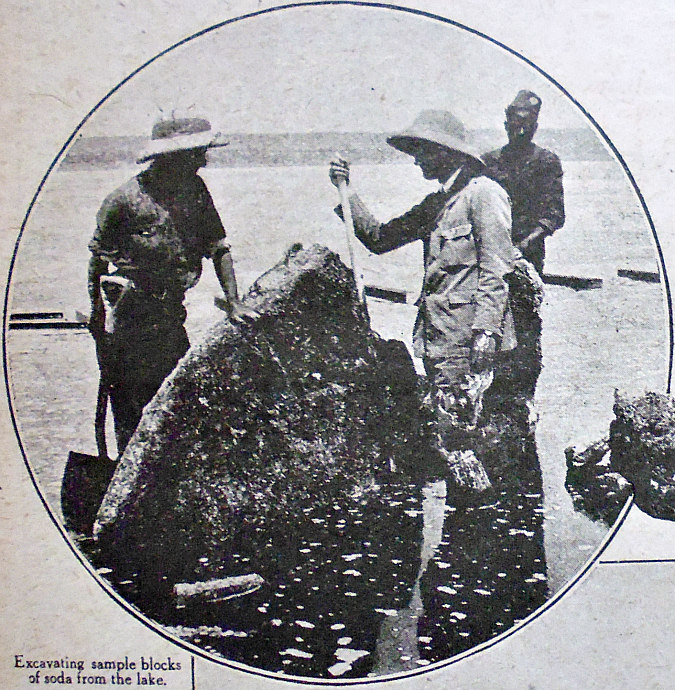
Excavating soda blocks from Lake Magadi.

Excavating soda blocks from Lake Magadi.

   “According to Mr. Trobridge, who drew up an exceedingly interesting report, the surface of the lake always become dry in this way shortly after the stoppage of the rains; and this conclusion was borne out by his former visit in October, 1904, “”when the whole of the surface was dry with the exception of a margin about thirty yards wide. The solid portion, which comprised practically the whole of the lake, was perfectly level and dry on the surface; but wherever the surface was broken up liquor rose to its level, and when the crystalline blocks were removed the liquor drained from the interstices of the crystals. The great purity of the crystalline soda is un-doubtedly due to the presence of this comparatively large quantity of soda in solution —technically known as ‘mother liquor’—distributed throughout the mass. Apart from the fact that the surface of the soda deposit becomes dry very soon after the rains have ceased. I also ascertained that during the rains the surface is never covered with so much water as to interfere in any way with the economic working of the deposit. For many years Indians have been removing soda from the lake, and they do so without paying any attention to the season.”

   “As to the chemical and physical character of the soda, they were found to be uniform over the whole surface of the deposit, as has been confirmed by the examination of numerous samples taken at widely-distant points both in 1909 and on the occasion of Mr. Trobridge’s previous visit in 1904. The crystalline deposit cleaved readily into blocks from which the “mother liquor” drained rapidly, leaving a friable mass of crystals.

   “The explorers also came to the noteworthy conclusion that there was good reason to assume that the deposit of soda extends to the full depth of the lake, the above-mentioned “mother liquor” only filling the interstices of the crystals. They sank a bore-hole in the lake through a continuous mass of crystalline soda to a depth of nine-feet, but with the primitive boring tools at their disposal they found it very difficult to proceed farther. Indeed, in view of the enormous bulk of soda thus disclosed they saw no practical object to be attained by boring to a greater depth.

   “Further, there were evidences, runs the report, that the quantity of soda already in the lake is being continually augmented. In addition to many surface springs and streams discharging considerable quantities of soda into the lake, there were evidences of large springs in the bed of the lake itself, which intrude saturated soda liquor. On the removal of the soda already crystallized the liquor which takes its place at once starts to reform the crust. The Indians engaged in this soda industry informed Mr. Trobridge that the crystalline mass is replaced so rapidly that they rework the same spots year after year. Of this he found full confirmation on examining several poles which they had been using to break up the soda and had left in the holes thus made. These poles were firmly set in a solid mass of crystals which had been formed around them, and Mr. Trobridge and his colleagues removed several large blocks of soda in which such poles were embedded. On examination they found this reformed soda of the same composition and purity as the permanent deposit.

   “In view of the fact that the crystalline soda is divided into several distinct horizontal layers, which are readily separated from each other, and for economy in working. Mr. Trobridge recommended that operations be confined to the upper layers, which he estimated contain about forty million tons in sight. As this vast quantity would be continually replaced, the lower layers would appear to have little more than theoretical interest. Should, however, it be deemed necessary to work these lower layers to the depth of nine feet, as disclosed by their bore-hole, he estimated that the total crystalline soda would be about two hundred million tons.

   “Two hundred million tons of soda capable of being converted, by very simple treatment, into a “soda ash” of great density, and equal in chemical purity to any soda ash on the market—a practically inexhaustible stock, since, as soon as part of the deposit is removed, it begins to form again. Think of the enormous profit to be drawn from such a source of wealth as that. Counting all expenses, the fortunate merchants who had got wind of this business deal came to the conclusion that a profit of at least twenty shillings per ton of soda products might be expected. Rarely does it fall to the lot of a City firm to see a profit of at least two hundred millions sterling in view.

   “Mr. Frederic Shelford’s report on the feasibility and cost of constructing the branch railway whereby the vast soda deposits of Lake Magadi could be rendered accessible was equally encouraging. He examined the country between the lake and the Uganda Railway, and eventually selected a route which was afterwards carefully surveyed in detail by the railway survey party.

   “No further evidence was required to prove that a great industrial future awaited the properly-organized exploration of this lake of soda of British East Africa. So work was started on the railway, which in due course was completed; wharves at the coastal terminus and oil tanks at Kilindini were constructed, and works, offices, etc., were erected at Magadi. Moreover, the company that had been formed erected extensive works at Irlam, near Manchester, and in Calcutta for the manufacture of soda crystals and bicarbonate of soda from Magadi soda ash. In brief, after 1911-12 the business was in full swing and quickly proved that those who had embarked on the enterprise were not mistaken in taking a sanguine view of the future prospects of this part of East Africa. But with the coming of war, work was naturally interfered with. Lake Magadi, lying within thirty miles of the frontier of German East Africa, came within the war zone, and what that means need not be unduly dwelt upon. Suffice it to say that the branch line from the lake to the Uganda Railway and vice versâ was found useful for the transport of other things than soda.”

Source of information:-

Lees, George Frederic, The article ‘The Lake of Soda’ was published in ‘The Wide World Magazine – An Illustrated Monthly Of True Narrative’, Vol. XLII – October 1918 To March 1919. George Newnes Ltd., Southampton St., Strand, London.

                                                 © Ray Spencer, The Journal Of Antiquities, 2016.


1 Comment

Simon’s Cross, Simonstone, Near Padiham, Lancashire

Simon's Cross near Simonstone, Lancashire.

Simon’s Cross near Simonstone, Lancashire.

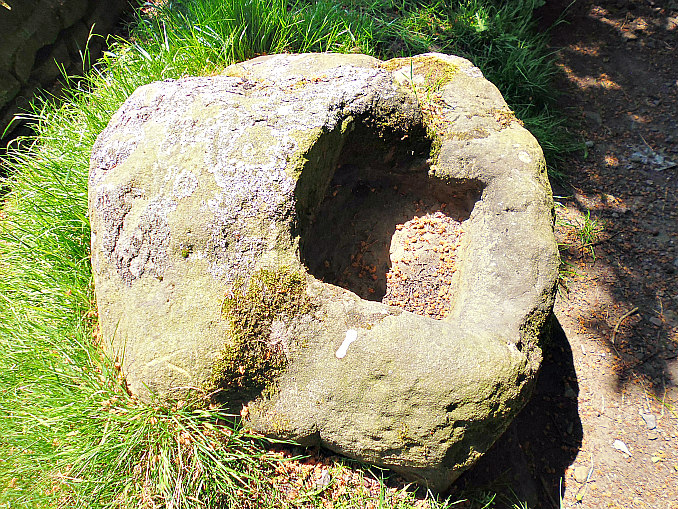
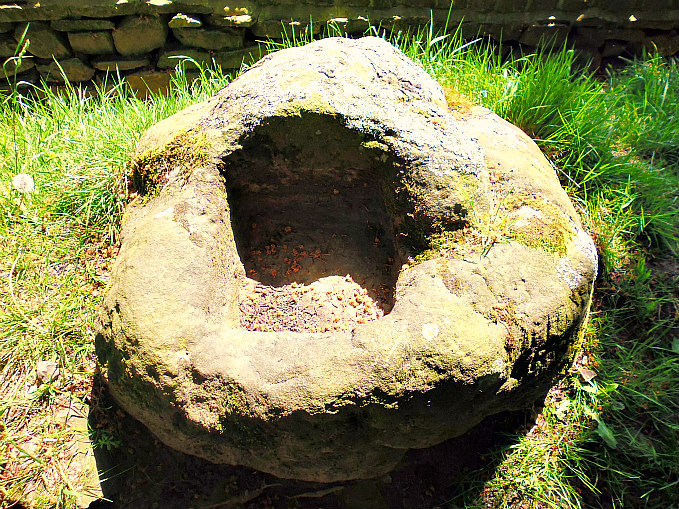
    OS grid reference: SD 7760 3609. Upon White Hill and just beside Shady Walks at the north-side of Simonstone, near Padiham, Lanca-shire, is a large boulder with a deep socket hole. This is, in fact, the cross-base of a Medieval wayside cross which was known locally as ‘Simon’s Cross’, ‘Simon’s Stone’ or sometimes ‘Wart Well’. Very little is known about its history and who it was named for, or who actually erected the cross. There are inscriptions carved into the sides of the cross-base. The stone can be reached from the A671 (Whalley Road) in Simonstone, then via School Lane and Trapp Lane for ¾ of a mile, passing Higher Trapp Hotel on the left. Just before the top of the lane where the woodland begins go through the wooden kissing gate – the cross-base is beside the wall. Just opposite the cross-base is the beginning of a long and overgrown woodland trench, and the track running alongside this is known locally as Shady Walks!

Simon's Cross at Simonstone, Lancashire.

Simon’s Cross (from above).

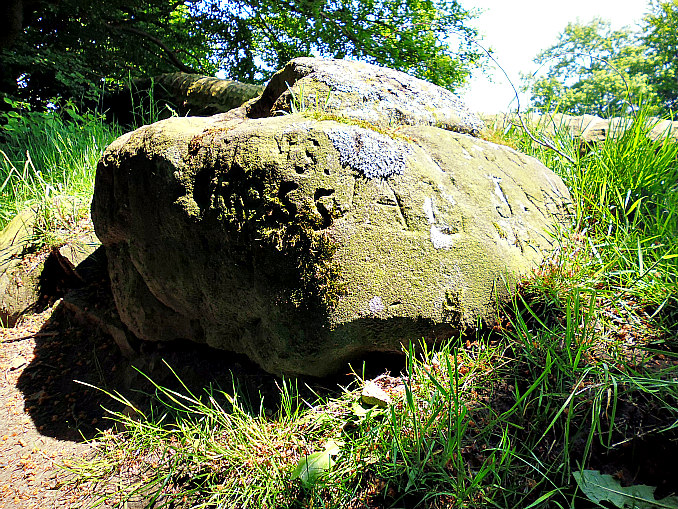
    This large, natural and round-shaped boulder, known as ‘Simon’s Cross’ is roughly 4½ ft wide and just over 2 ft high and is thought to weigh 2-3 tonnes. Its socket hole is 1 ft wide and 10′ deep. But it is not always full of rain-water. When it does contain water it is locally called ‘Wart Well’ as it is said to be a cure for warts, or it used to be? When I visited there was no water in the socket hole. On the side of the boulder the words ‘SIMON’S CROSS’ are carved along with a faint cross symbol and some Latin-type letters: maybe J A M and J W and a date that looks like 1860. The cross-shaft that would have fitted into this boulder having long since disappeared, but where did it go to?

Simon's Cross (side view).

Simon’s Cross (side view).

Simon's Cross (close-up of the 'Wart Well').

Simon’s Cross (close-up of the ‘Wart Well’).

    Simon’s Cross originally marked the parish boundary of Simonstone and Read, and was perhaps set up in the late 13th or early 14th century by Simon de Read, or could it have been Simon de Altham in the 14th century? It could also, perhaps, be named after a member of the Whitaker family of Simonstone? But we may never know. Simonstone takes its name from any of these characters. And maybe the monks of Whalley Abbey had some connection with the cross as it may have stood on land owned by that religious house, but the main landowners between here and Clitheroe were the de Lacys. Maybe this was a wayside cross to which pilgrims on-route to the abbey could congregate at – and say prayers for a safe journey – the cross acting as a sort of waymarker. The stone for the building of Whalley Abbey is ‘said’ to have come from quarries at Read and Simonstone.

    “The deep, overgrown trench alongside the path in Shady Walks was a drift mine for the extraction of fire clay”, according to the 1992 book ‘Walks In Lancashire Witch Country’ by Jack Keighley. This industrial quarry working runs beside the woodland track for about ½ a mile.

Sources and related web-sites:-

Clayton, John A., The Lancashire Witch Conspiracy, Barrowford Press, 2007.

http://www.british-history.ac.uk/vch/lancs/vol6/pp411-416

http://www.british-history.ac.uk/vch/lancs/vol6/pp503-507

http://news.bbc.co.uk/local/lancashire/hi/people_and_places/religion_and_ethics/newsid_8142000/8142400.stm

Keighley, Jack, Walks In Lancashire Witch Country, Cicerone, 1992.


The Burton Stone, Clifton, York

The Burton Stone on Burton Stone Lane, Clifton, York

The Burton Stone on Burton Stone Lane, Clifton, York

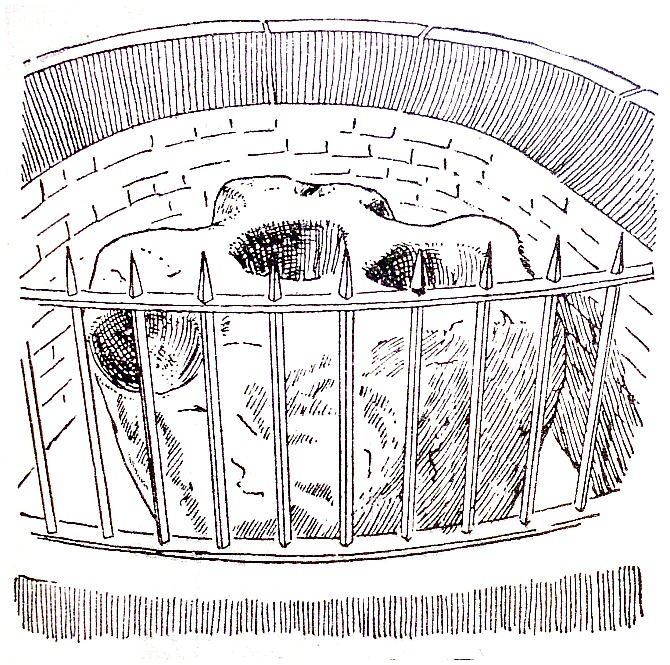
    OS grid reference: SE 5960 5271. At the corner of Burton Stone Lane and in front of the Burton Stone Inn at Clifton, York, is the Medieval plague stone known as ‘The Burton Stone’. According to local legend, it was long ago a cross-base for perhaps three Medieval crosses, but in more recent centuries it had become a ‘plague stone’ and its three hollows (sockets) perhaps used as recepticals for vinegar! But whether the stone is in its original position is open to question. The stone now lies in a brick niche behind iron railings at the front of the Burton Stone Inn at the corner of Burton Stone Lane and the A19 Clifton Road, where prior to the pub there was an ancient chapel dedicated to St Mary. Clifton is a suburb of York. The city centre lies about 1 mile to the south down the A19 road.

    The Burton Stone is a large lump of stone that is roundish in shape and at one side is shaped like a cross. It has three basin-like hollows that were originally socket holes for crosses, but over time these have been worn smooth by human hands. What happened to the crosses that stood in the socket holes is not known but they were probably associated with the Medieval chapel that stood on this site, and which was dedicated to St Mary Magdalene. The Burton Stone may have marked a city boundary or a line of jurisdiction.

    The ancient chapel was perhaps a pilgrims’ chapel or a chapel-of-ease as York Minister is only a short walk down the road. But after the chapel’s demise the cross-base was put into use as a ‘plague stone’ and the three holes became receptacles for vinegar. Coins were also placed in the vinegar solution as a way of sterilization and then handed out to families affected by the plague, or cholera epidemics, which struck the city of York from 1604 onwards. Local legend says that Mother Shipton (1488-1561) the Yorkshire prophetess rested beside the Burton Stone in 1512 – at which time she also married Toby Shipton of York.

Sources:-

There is a photo of the stone on this website:  http://www.jorvik.co.uk/burton-stone/

http://www.themodernantiquarian.com/site/7621/burton_stone.html#miscellaneous

The Automobile Association, The Illustrated Road Book Of England & Wales, London WC2, 1961.

© Copyright, Ray Spencer, 2016.


1 Comment

Fossil Valley, Twiston Near Downham, Lancashire

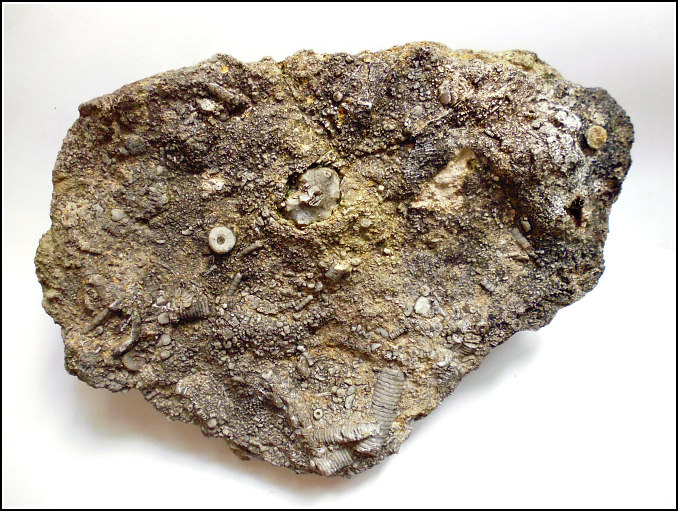
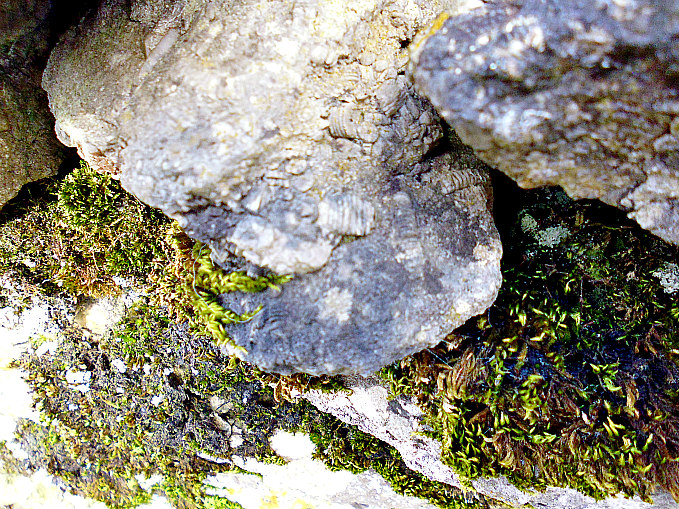
Limestone Rock with Crinoid Fossils From Twiston, Lancashire.

Rock with Crinoid Fossils From Twiston, Lancashire.

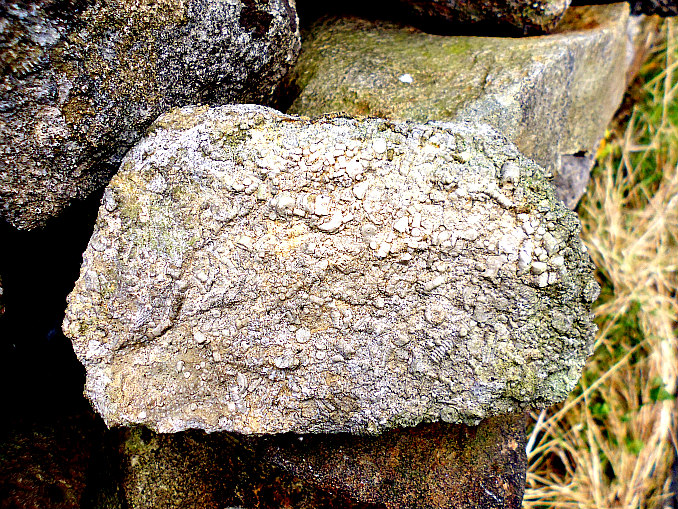
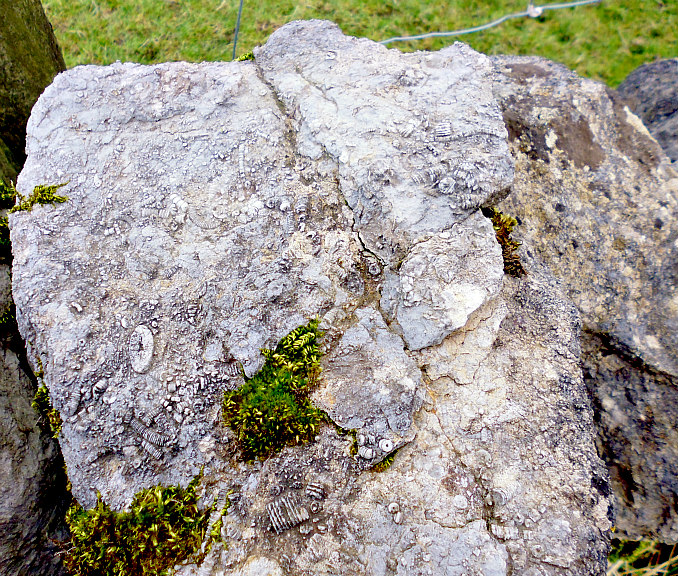
OS grid reference: SD 80919 44434. Something of a curiosity this one, maybe. In the wall along a stretch of the lane that runs through the long, narrow valley between Twiston and Downham, at the north-western side of Pendle Hill, in Lancashire, are lumps of locally quarried ‘Fossiliferous Limestone’ made up of crinoid and coral fossils, which date back some 500-300 million years to the Carboniferous period in Geological history. But what a delight it is to just wander along the lane looking at the fossil-covered stones that make up the walls, and there are literally thousands and thousands of them to be seen here.

Rock with fossils at Twiston Nr Downham

Rock with fossils at Twiston Nr Downham

These crinoid fossils are very varied in shape and form, but they are in essence tiny marine creatures which originated from the sea – so we know without doubt that this area was under water millions of years ago, with perhaps only the top of Pendle Hill visible at that time. The stones that make up the walls in Twiston may have been quarried from the Limestone ‘reef knolls’ – of which there are several in the Twiston and Downham area, or perhaps from Peach Quarry at Clitheroe (Os grid ref: SD 7569 4263). This quarry has now been filled in and grassed over. These ‘reef knolls’, as the name suggests, were also under-water millions of years ago.

There are ‘still’ three 19th century lime kilns in the Downham area; one of these stands beside the lane at Twiston, all of which points to the fact that Lime, in the form of a powder or “cornbrash”, was a much used local neccessity on farmers’ fields in the Pendle area, and is still used by local farmers today.

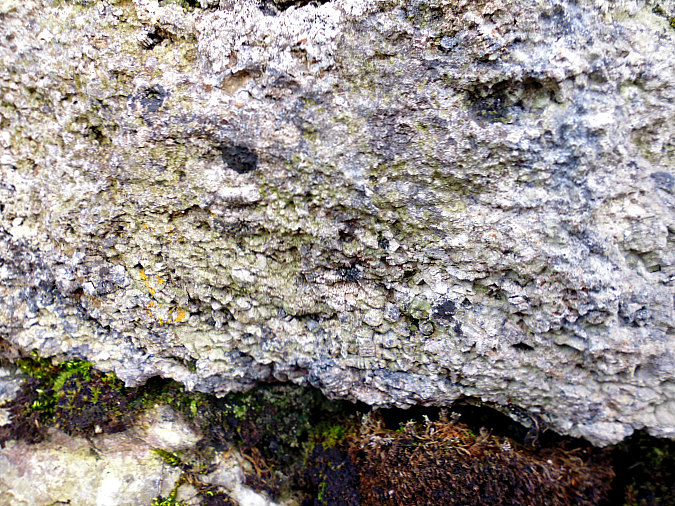
Rock with Crinoid Fossils at Twiston near Downham.

Rock with Crinoid Fossils, Twiston.

A significant feature of the valley landscape between Twiston and Clitheroe is the abundance of Crinoid Fossils in the stones making up the walls of field boundaries. This type of stone is called ‘Reef Limestone’. Crinoids are sometimes referred to as ‘sea lilies’ because of their resemblance to a plant or flower. In parts of England, the columns forming the stem were called ‘fairy money’, and their star-shaped cross sections was associated with the sun by ancient peoples, and given religious significance; indeed ancient people were said to be frightened by these strange fossil forms, as they did not know or realize what they were, and where they had originated.

Crinoids are in fact marine animals belonging to the phylum Ecinodermata and the class Crinoidea. An array of branch-ing arms (brachials) is arranged around the top of a globe-shaped, cup-like structure (calyx) containing the mouth and main body of the animal. In many fossil forms the calyx was attached to a flexible stem that was anchored to the seabed.

The phylum Echinodermata includes the starfish, sea urchins and sand dollars. The crinoids are a breed apart however, as they resemble an underwater flower. Some even have parts that look and act like roots anchoring them to the ocean floor. They are commonly called ‘sea lilies’. Their graceful stalks can be meters long. Other varieties have no stalks or root- like parts. They are commonly known as feather stars. Unlike the sea lilies the feather stars can move about on tiny hook- like structures called cirri.

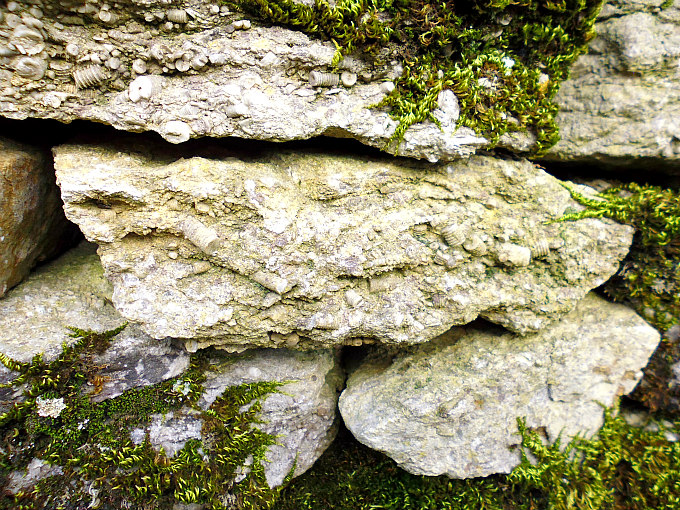
Rocks with fossils at Twiston, Lancashire.

Rocks with fossils at Twiston, Lancashire.

Crinoids are still with us, but they are also some of the oldest fossils on the planet. They flourished in the Palaeozoic Era 541-254 million years ago. Although sometimes different in appearance from their fossil ancestors, living forms provide information about how fossil crinoids must have lived. The earliest come from the Ordovician the second period in the Palaeozoic. At least the earliest that everyone agrees on. There is a class called Echmatocrinus that date back to the middle of the Cambrian Period the first period in the Palaeozoic, but most palaeontologists don’t count them to be true Crinoids. Most of the Palaeozoic forms died out in the Permian the final period in the Palaeozoic Era. The few species that survived into the Mesozoic Era thrived. Many new species evolved during this time including the ancestors of the present-day class Articulata.

Rock with Crinoid fossils at Twiston, Lancashire.

Rock with Crinoid fossils at Twiston.

These echinoderms created ‘forests’ on the floor of the shallow seas of the Palaeozoic and Mesozoic Era’s. There were so many in places, that thick limestone beds (reefs) were formed almost entirely from their body parts piled on top of each other. Crinoids fossilized readily and so there is an abundance of them to be found, mostly stalk fragments as in the photos. There are two reasons for this – the ocean floor is a good environment for fossilization to occur and Crinoid skeletons are made of calcareous plates.

Crinoids of today tend toward deeper waters. The stalked varieties are usually found in water over 200 meters deep, though some can be found 100 meters deep. The unstalked varieties, comatulids also live in deeper waters though generally not as deep as the sea lilies.

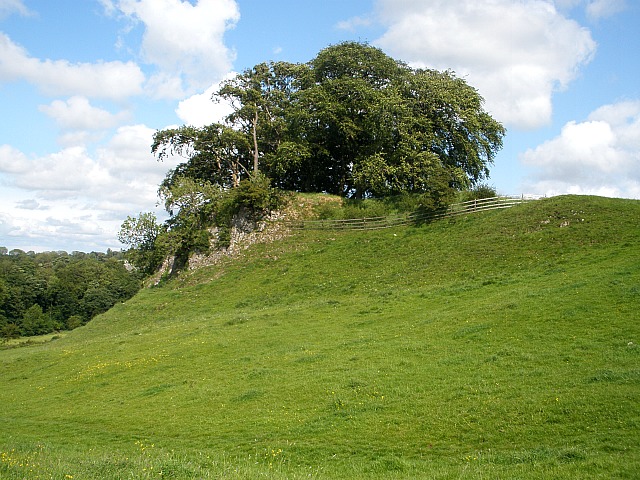
A reef knoll of which there are seven examples between Twiston and Clitheroe is a large pile of calcareous material on land that accumulated on the ancient sea floor, and was subse-quently uplifted due to the movement of the earth’s techtonic plates. At the time of this accumulation it may have had enough structure from organisms such as sponges to have been free-standing and to withstand the sea currents as material accumalted, and was probably an atoll. Another possibility is they are the remains of deep water coral. Such structures are thus often fossil rich.

These structures are often most clearly seen where the surrounding rocks are much softer and so can be eroded leaving the charcteristic knoll shaped hill features; Examples in the Yorkshire Dales lie on the north-side of the Mid Craven Fault. There is one set located around Thorpe (Skelterton, Butter Haw, Stebden, Elbolton, Thorpe Kail, Myra Bank and Hartlington Kail); another set is located around Malham (Burns Hill, Cawden, and Wedber); and also a set around Settle (High Hill and Scaleber).

Limestone Reef Knoll near Downham in Lancashire.

Limestone Reef Knoll near Downham in Lancashire.

The ‘Reef Knolls’ between Twiston and Clitheroe date from the Lower Carboniferous Period (358-323 Million Years ago) and have been subjected to numerous studies (the Carboniferous was the fifth period of the Palaeozoic Era). They were first described by Tiddeman (1889) who applied the term “reefs”. Subsequent workers (Parkinson 1926; Black 1952-54; Bathhurst 1959) all subscribed to the same name. They all believed that the knolls were composed of bio-organic material formed on a sinking sea floor with beds on all sides of the knolls showing an original dip away from the central core. In 1961 during the re-survey Earp raised objections to this hypothesis because of the apparent lack of reef-building faunas such as corals etc. to form the required wave-resistant structures and conglomerates, which should be present around such large knolls.

Rock with Crinoid Fossils at Twiston, Lancashire.

Rock with Crinoid Fossils at Twiston, Lancashire.

Then in 1972 the story of the Clitheroe Reefs would take a step forward with the work of Miller & Grayson following another re-survey of the linear knolls, which run from Twiston to Clitheroe (including Sykes, Gerna, Worsaw Hill the highest at 300 feet, Crow Hill at 100 feet high, Bellman/Salt Hill the longest at about 1 mile, and Castle Hill). They proposed that the knolls were formed as water lime-banks essentially mud banks upon which crinoids would have thrived their dead deposits accumulating over time, and then as the deposits were uplifted the surrounding shale (solidified mud) eroding to leave the ‘Reef’ Knolls as low hills in the landscape. Over the years they have been called many things: Reef Knolls, Bioherms, Knoll Reefs and Coral Reef Knolls. Following the re-survey however, the Clitheroe reefs are now termed ‘Waulsortian Mudmounds’ – as they were first described in a Belgian Geological Survey.

The Worsaw Hill reef knoll at Downham (OS grid ref: SD 7792 4322) has a Bronze-Age burial mound on its south-side and a cave near its base at the north-west side. And Worsaw End Farm was the setting for the 1961 film ‘Whistle Down The Wind’.

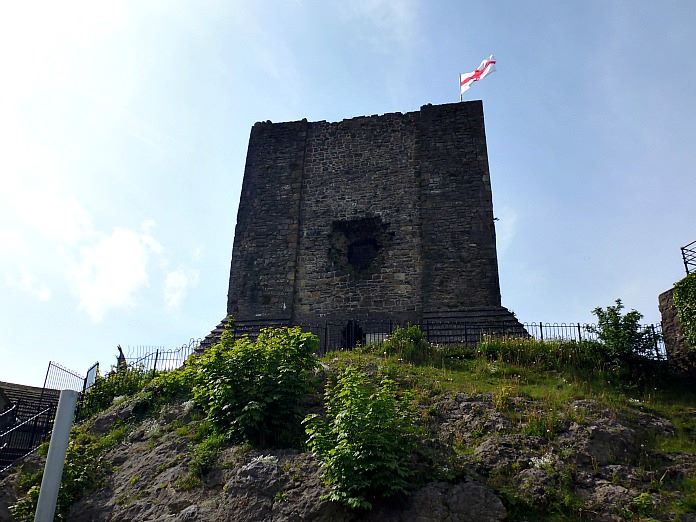
Clitheroe Castle.

Clitheroe Castle.

The focal point of Castle Hill, Clitheroe, is now the ancient Norman Keep. It is one of the smallest in England and one of the first stone buildings in Lancashire following the end of Roman Occupation. It was built by Roger de Poitou, who was the first Norman Lord of Clitheroe. The mound is comprised of light grey, unbedded micritic limestone, heavily jointed and calcite veined. Crinoid fossils together with gastropods and brachiopods can be seen. In the castle grounds is the Clitheroe Castle Museum and café. Over time the ‘Reefs’ and surrounding deposits have been quarried for stone – as at Salt Hill and Lane End. Such stone was then used for the walls which surround the fields in the area ‘in question’ between Twiston and Clitheroe.

Sources:

British Geological Survey HYPERLINK “http://www.bgs.ac.uk” http://www.bgs.ac.uk (Crinoids)

Chinery, Michael., A Pictorial Dictionary Of The Animal World, Sampson Low, Marston & Co. Ltd., London, 1966.

Roberts, John L., A Photographic Guide to Minerals, Rocks And Fossils, New Holland (Publishers) Ltd., London, 1998.

http://www.fossils-facts-and-finds.com (Crinoids)

‘The Clitheroe Reef Belt’, Craven and Pendle Geological Society, 2006.

http://www.kabrna.com/cpgs/craven/reef_belt.htm

© Ray Spencer, The Journal of Antiquities, 2016 (up-dated 2020).


The Headless Cross, Anderton, Lancashire

The Headless Cross, Anderton, Lancashire.

The Headless Cross, Anderton, Lancashire.

    OS grid reference: SD 6189 1301. The Headless Cross, also called the Grimeford Cross, stands near the old village stocks at Anderton in Lancashire, to the east of the M61 motorway, and is ‘said’ to date from the late Anglo-Saxon period – the 11th century. Anderton is a suburb of Adlington. It is located beneath trees on a grassy area at the junction of Grimeford Lane, Rivington Lane and Roscoe Lower Brow, opposite the Millstone public house. Over time it has been used as a sundial and a guidepost for directions to nearby towns – its cross-head having being taken to nearby Rivington church. The remaining shaft is decorated on all its four sides with carvings which are rather strange, if not curious, and most unlike other Saxon wayside crosses of a similar date. It may originally have marked the “true” centre of Grimeford village though this does not now exist According to local legend, there used to be a medieval chapel with an underground tunnel close to where the cross now stands, and also there have been a number of reports of ghostly happenings in this area – locally these ghostly, poltergeist-like characters, being referred to as boggarts!

    The pre-Conquest cross was apparently discovered during the construction of the Lower Rivington Reservoir (1852) – the bottom section was brought to its present position, while the top section showing a helmeted Viking figure was sent to the Harris Museum at Preston, and the cross-head displayed in Rivington church, a few miles away. It has taken on the look of a stone bird-table! But it used to have a sun-dial on top of its flat plinth and it has been in use as a guide-post, giving directions to the towns of Blagburn, Boulton, Preston and Wiggin. Today the cross-shaft is around 3 feet high but originally it would have been double that. On the front there is the lower part of a human fugure (two legs) which is presumably the same figure as that on the shaft in Preston museum! On its other three faces there are geometric ‘wavy lines’ in the form of Greek frets (T-frets) within a trellis, and also vinescrolls. The flat stone on top of the shaft is post Medieval and the base-stone is much more recent.

Sources:

Grimeford Cross, Adlington, Lancashire

http://www.megalithic.co.uk/article.php?sid=11076

http://lancashirefolk.com/2013/11/17/20/

The AA, The Illustrated Road Book Of England & Wales, The Automobile Association, London WC2, 1961.


2 Comments

The Three Ancient Bridges, Wycoller, Lancashire

Pack-horse bridge at Wycoller, Lancashire.

Pack-horse bridge at Wycoller, Lancashire.

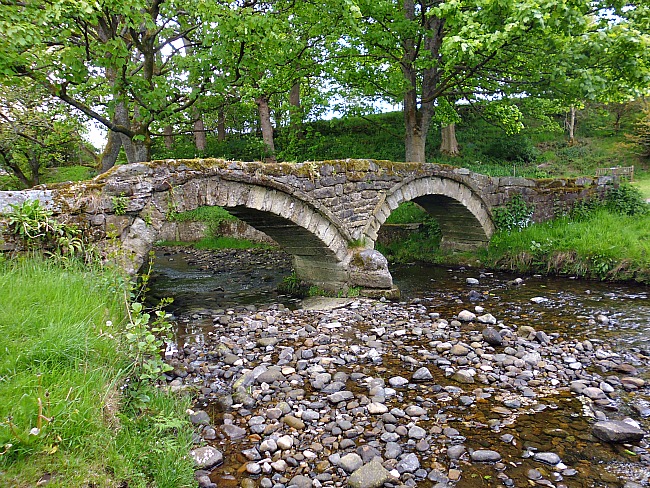
    OS grid reference: SD 932383 39247. The secluded little village of Wycoller nestles in a narrow valley 1½ miles to the east of Trawden, Lancashire, but it is well-known for its three ancient bridges which have stood over the beck for hundreds, if not thousands of years. They have even outlived Wycoller Hall which stands ruined and desolate. But each of the bridges has its very own tale to tell. There are actually seven bridges in the village but the pack-horse, clapper and clam bridges are of historic interest because of “their” great ages. Wycoller is easily reached on country lanes from Trawden. Park up at the large carpark ½ a mile to the west and walk into the village along the footpath at the side of the lane. There is a small carpark for disabled people close to the café.

The pack-horse bridge, Wycoller, Lancashire.

The pack-horse bridge, Wycoller, Lancashire.

    The famous pack-horse bridge is a two-arched structure spanning Wycoller beck. It is sometimes called Sally’s Bridge after one of the Cunliffe family who lived in the hall opposite the bridge in the 18th century. Historians have argued about its age, but none of them are certain, but it is thought to either date from the 13th century or the 15th. Its construction is a bit of an oddity, in that the arches are not equal to each other and the structure’s base-stone boulders are not level, giving the bridge a somewhat precarious appearance because of that – author John Bentley in his fascinating book ‘Portrait of Wycoller’, alludes to this. The coping stones along the sides of the bridge are significant in that some of them have faint cup-marks in them, indicating that they were brought down from a prehistoric site on the moors above Wycoller and used in the bridge’s construction. When walking over the bridge ‘you need’ to take care owing to the smoothness of the paving slabs which have endured hundreds of years of use.

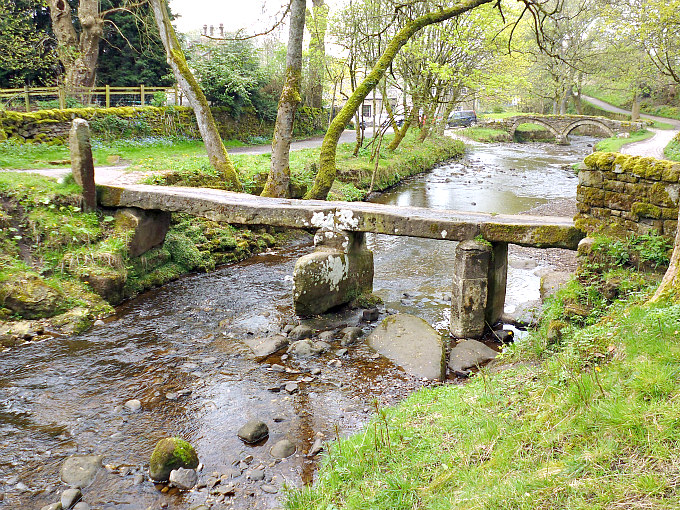
The Clapper Bridge at Wycoller, Lancashire.

The Clapper Bridge at Wycoller, Lancashire.

    Clapper bridge, sometimes called the Druids’ Bridge, Weavers’ Bridge or the Hall Bridge, is just a short distance along the beck. This is a primitive structure but of massive proportions consisting of three flat gritstone slabs resting on two stone piers, one being a round-shaped boulder, the other a thinner pillar-shaped stone that looks quite fragile, but it is in fact very strong. It was originally a two-slab bridge sup-ported on one central pier. However the bridge has succumbed to floods over the years and has had to be reconstructed a few times. Its three slabs are heavily worn by hundreds of years of use. There is a legend that says this bridge led to a grove where druids practiced their strange rituals; there is no sign of this mystical grove or amphitheatre today, and the handloom weavers of Wycoller have long-since hung up their clogs! The clapper bridge is thought to date from the 16th-17th century, though a few historians ‘think’ it might date from before the Norman conquest (Bentley, John, 1993).

The Clam bridge, Wycoller, Lancashire.

The Clam bridge, Wycoller, Lancashire.

    And the third bridge, the clam bridge, is located ¼ of a mile along the track that runs beside the beck in Wycoller Dene. This ancient bridge is formed by one single gritstone slab which is some 12 feet long. It rests at one end on the bank, while on the other side it is propped up on some large stones, but it is very secure even though it might look like it is about to fall into the beck. At one time there was a wooden safety rail at one side and the holes for this can still be seen. The clam bridge is ‘often’ said to date from the Bronze or Iron Age and to have originally stoop up-right on the moors to the north east (as a standing stone – menhir), but there again it probably only dates from the 15th or 16th century. The long slender slab is well-worn and great care should be taken when crossing it. In the floods of 1989-90 the clam bridge was brought crashing down. It has sometimes been mistaken for a tree trunk lying across the beck and at a distance it does indeed look like that.

    The author John Dixon in his work ‘Historic Walks Around The Pendle Way’, came to the conclusion that the three Wycoller bridges were of ‘a mid-16th century’ date. He adds that: “The majority of bridge building was undertaken after the Dissolution of the monasteries when a moderate number of masons became unemployed and were wandering the countryside finding work on many of the new bridges which were required as roads became busier and wooden bridges and fords became inadequate.”

Sources:

Bentley, John., Portrait of Wycoller, Wycoller Country Park Project, Nelson, 1993.

Dixon, John & Mann, Bob., Historic Walks Around The Pendle Way, Aussteiger Publications, Barnoldswick, 1990.

http://www.megalithic.co.uk/article.php?sid=26761

http://www.megalithic.co.uk/article.php?sid=26767


Church of St John the Divine, Holme-In-Cliviger, Lancashire

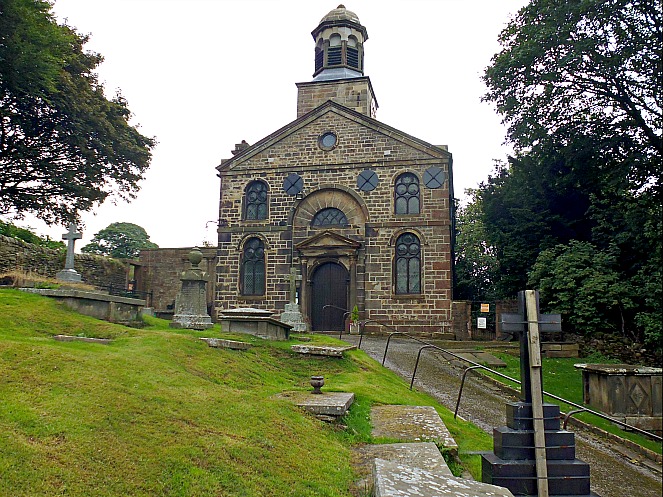
Church of St John The Divine, Holme-in-Cliviger.

Church of St John the Divine, Holme-in-Cliviger.

OS Grid Reference: SD 8763 2852. On Burnley road (the A646) at Holme Chapel, Cliviger, also called Holme-in-Cliviger, is the late 18th century church of St John the Divine, or sometimes St John the Evangelist. The building houses two sections of a late medieval cross-head, which may have come from the ruins of Whalley Abbey in Lancashire. The present church stands close to the site of a 16th century chantry chapel that had fallen into disrepair and had to be demolished (1788) – the present church being built upon the hill through the benefices of the Whitaker family of Holme, Cliviger, between 1888-1894, in particular Dr T. D. Whitaker, the eminent historian and antiquarian. Also of interest in the church are the beautifully carved 15th century misericord stalls, 19th century font, pulpit and wall tablets. St John’s is located opposite The Ram Inn, Holme Chapel, 2 miles south-east of Burnley and 5 miles north-west of Todmorden

Top Section of Gothic Cross-Head at St John The Divine Church, Holme-in-Cliviger.

Top Section of Gothic Cross-Head at St John’s.

On display in the chancel of St John’s, at either side of the altar, are two sections of sculptured stonework – two parts that make up an ornate late Medieval cross-head of the 15th century. Originally, the two sections were fixed together and stood on the top of a stone gateway at the south side of the church. In recent years the cross-head had become unsafe and so it was brought into the church. It has been described as ‘being in the style of Gothic’ from the late Medieval period. On the front the Sacred Heart with the five wounds of Our Lord’s passion affixed to a cross are depicted; the three cross-arms are intricately carved with crockets – while the lower stem goes down through a narrow arched shape with short, stepped crocketing to the sides of that.

Bottom Section of Cross-Head at St John's, Holme-in-Cliviger.

Bottom Section of Cross-Head at St John’s, Holme-in-Cliviger.

It would seem that the cross-head was brought to St John’s from the ruins of Whalley Abbey, Lancashire, in the late 18th century by Reverend Dr Thomas Dunham Whitaker (1759-1821), an eminent historian, writer and antiquarian, whose family had lived for hundreds of years at ‘The Holme’ in Cliviger, and who was responsible for building St John’s in c 1790, at a cost of £870, which was “defrayed by the Whitaker family.” It is believed that two members of the Whitaker family had ‘actually’ resided at Whalley Abbey in the 15th century, but whether they were in hiding because of ‘their Roman Catholic faith’, we do not know. The church of St John is a beautiful sandstone building (in the Doric/Classical style) with parapet and a nice little cupola, or bell-turret, on its roof, according to the delightful work ‘All O’er t’Parish, by Peter Pomeroy & The Urban Studies Group of The Burnley Teachers’ Centre, 1983. St John’s was enlarged in 1897. It is a Grade II listed building.

Also in this church, there are two very beautifully carved 15th century oak misericord stalls, which again are thought to have been brought here from Whalley Abbey by Dr T. D. Whitaker. We also learn of Dr Whitaker’s great interest in what turned out to be a Roman ceremonial helmet and mask at Ribchester. This came to light when a child was seen kicking around a strange-shaped object. Whitaker arranged for the object to be taken for examination, and later it was found to be a highly decorated Roman artefact. A replica is on display in Ribchester Roman Museum, while the original is in the British Museum, again according to Peter Pomeroy & The Urban Studies Group, 1983.

A fine bust of Dr T. D. Whitaker can be seen in St John’s church along with some wall tablets of the Ormerod and Whitaker families, a 19th century alabaster font and a painting of General Scarlett (1799-1871), the heavy brigade hero of Balaclava in the Crimean War, whose grave is in the churchyard. The present pulpet replaces an earlier three-decker pulpet and sound-board, which was apparently purchased in Leeds and was “perhaps” originally brought from the ruins of Kirkstall Abbey; the old pulpet having become dilapidated and unusable due to its age.

Source:-

https://en.wikipedia.org/wiki/Thomas_Dunham_Whitaker

Pomeroy, Peter I. & The Urban Studies Group of The Burnley Teachers’ Centre., All O’er t’Parish – A Second Stroll Around Cliviger, Lancashire County Council Library and Leisure Committee, 1983.

Copyright © Ray Spencer, The Journal of Antiquities, 2015.


The Ebbing And Flowing Well, Giggleswick, North Yorkshire

Ebbing and Flowing Well, Giggleswick (photo credit: Humphrey Bolton for Geograph)

Ebbing and Flowing Well, Giggleswick (photo credit: Humphrey Bolton for Geograph)

NGR: SD 8039 6538. The Ebbing and Flowing Well is, perhaps rather annoyingly, located at the side of the busy B6480 (Old Clapham road) out of the village of Giggleswick, about two-thirds of the way up the steep and ‘often very busy’ Buck Haw Brow, opposite Settle Golf-course. It’s about 1 mile north-west of Giggleswick and one-and-three-quarter miles from the town of Settle. The rocky and tree-covered Giggleswick Scar, formed from the South Craven Fault, towers above the curious holy well, which has long been famous for its abilities to “ebb and flow” though this does not occur as much as it used to do – due probably to the mining that now takes place over and on top of the scar, or some other atrocity. I should point out here that ‘it is quite dangerous to stand and view the well’ as there is a constant flow of vehicles rushing past the site and, it is therefore very difficult, if not dangerous to attempt to take photographs – so please “be warned” and do please stay very safe.

The well has been famous over the centuries for its strange and curious ability to ‘ebb and flow’, indeed so much so that in the past local people have tried to dig down below the well in order to find out ‘why it does this’, though probably without actually establishing what causes such a thing to take place, if it really does, and now on rare occasions. We take the word “ebb” to mean flow back, fall, drain and subside, and the word “flow” to mean issue forth, pour forth, pour outward, refill and well-up. So is that what the well does? When the well does flow it flows under the road to emerge in a wet, muddy mess, on the opposite side of the road and, sometimes flows over the road itself, but mostly it simply wells up to fill its square-shaped stone chamber, and then without much warning drains-away and ‘goes back’ into the limestone scar – probably from one of the deep caves that is undoubtedly linked-up with the well somewhere along the way. Author Brian Spencer in his book ‘The Visitor’s Guide To The Yorkshire Dales, says of this strange phenomenon:

“On the rare occasions that the well functions, it rapidly drains, and then after a pause refills itself. This is due to a unique double chambered cave somewhere behind the well which causes a sudden syphoning effect inside the hole and temporarily cuts off the flow of water.”

   In the much-acclaimed tome ‘Folklore Myths and Legends of Britains’, by Reader’s Digest, we are given a more Folklore-ish angle to this:

“Near to Giggleswick Scar is an oddity of nature, the Ebbing and Flowing Well. An explanation for its behavior is that a nymph who was being chased by a satyr prayed to the gods for help. They turned her into a spring of water, which still ebbs and flows with her panting breaths. 

The 17th-century highwayman, John Nevison, is said to have evaded capture by letting his horse drink at the well. The water gave the horse strength and Nevison escaped by leaping from the top of a cliff, still known as Nevison’s Leap.”

In the past a few historians have tried to associate the Ebbing and Flowing Well with a local north-country saint – in this case St Alkelda – who is still venerated at the church in Giggleswick and, also at the church in Middleham, North Yorkshire, where she is said, according to the legend, to have been murdered by two Danish women in c 800 AD, or maybe in the 10th century so say some. Alkelda was an Anglo-Saxon princess and also a ‘devout’ Christian. One day she was approached by two pagan women who murdered her with a ‘thick scarf’ which they pulled tightly around her neck; this terrible crime probably took place where the church of Sts Mary & Alkelda now stands, or ‘maybe’ beside the well that is also named for her; and the church houses some fragments of a 15th-century stained-glass window which depicts the saint’s martyrdom.

The church of St Alkelda at Giggleswick apparently still uses water from the Ebbing and Flowing Well in its baptism services and, “a 19th century stained-glass window depicts the spirit of the well in the form of an angel hovering above the waters. This is a Christianised version of the pagan water-spirits, called undines”, according to author Bill Anderton in his work ‘Guide To Ancient Britain’. But did St Alkelda even exist because her name could simply be a corruption of the Old English words ‘Hal Keld’ (Halig Keld) – meaning “holy well”. The renowned author Jessica Lofthouse explains this in her book ‘Lancashire Countrygoer’, she says:

“Ghikel was probably a Norseman whose “wick” or farm was here. Also the ebbing and flowing well, not so far away, was a “gugglian” or bubbling spring: the wick by the gurgling well could be a derivation. But who caresor whether or no there was a Saxon Princess martyred at the hand of pagan Danes to give St. Alkelda’s its name. Or was the well where the Celts worshipped a spirit of water, later sanctified as a holy well, and as the “helig keld” did it give the first church its unusual name?”

   Authors Janet & Colin Bord in their renowned work ‘Sacred Waters’, have little if anything to say about the well only that: “Sadly the well no longer ebbs and flows.”

Sources:

Anderton, Bill., Guide To Ancient Britain, Foulsham, Slough Berkshire, 1991.

Bord, Janet & Colin, Sacred Waters, Paladin Books, London W1X, 1986.

http://www.geograph.org.uk/photo/925879   © Copyright Humphrey Bolton and licensed for reuse under this Creative Commons Licence.

https://megalithix.wordpress.com/2008/09/12/ebbing-flowing-well-giggleswick-north-yorkshire-holy-well/

Lofthouse, Jessica., Lancashire Countrygoer, (second edition), Robert Hale, London SW2, 1974.

Reader’s Digest, Folklore Myths And Legends Of Britain, (Second Edition), The Reader’s Digest Association Limited, London, 1977.

Spencer, Brian., The Visitor’s Guide To The Yorkshire Dales, Hunter Publishing Inc., Edison, NJ, USA, 1986.

Copyright © Ray Spencer, The Journal of Antiquities, 2015 (updated 2024).


1 Comment

St Chad’s Well, Tinedale Farm, Spen Brook, Lancashire

St Chad's Well, Near Tinedale Farm, Spen Brook, Lancashire.

St Chad’s Well, Near Tinedale Farm, Spen Brook, Lancashire.

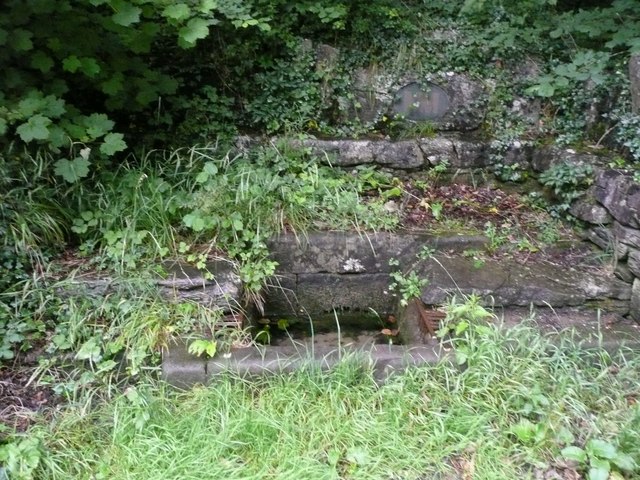
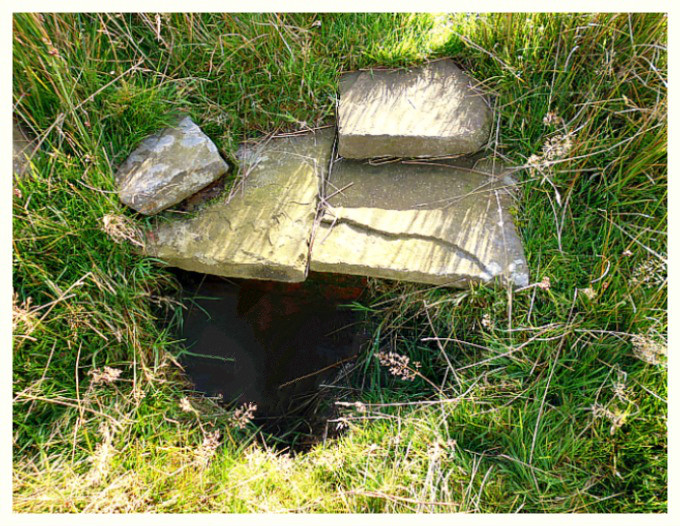
   St Chad’s Well is located in a boggy field with reed beds, just east of Tinedale Farm, 1 mile south of Newchurch-in-Pendle. From above Hoarstones, Fence, go north along the country lane, then at the very top walk along the straight farmtrack with a sign for Rigg of England and Tinedale Farm. After a while take the second wall-style leading into the field. At the centre of this, often boggy field where the power cables intersect, look for a large area of reeds, here hidden away is the largerly forgotten holy well. It is covered by two flat stones, together measuring 3 feet across, while the well-basin is roughly 1 foot in depth, and is lined at one side by brickwork (which looks recent). There is a layer of mud at the bottom, but the water is quite clear ‘upon cupping’ one’s hands in the water, though probably ‘not drinkable’ today!

St Chad's Well near Tinedale Farm, Spen Brook.

St Chad’s Well

   According to local legend St Chad, a 7th century Anglo Saxon saint, who became Archbishop of York, came to this area during his travels in the north of England. However it is more likely one of his many disciples came here and dedicated the well to his master. It is though, as we already know, a pre-Christian well/spring. I am not aware of any cures happening at this well, though I’m not saying they didn’t happen here long ago. I am told that the water was used by local farms in the area of Tinedale, according to a gentleman who is a member of ‘The Pendle Forest Historical Society’. The well is “now” only marked on old maps of the area. Regarding St Chad, who died in 672 AD, one or two historians have ‘suggested’ albeit tenuously, that the village of Chatburn, near Dowham, is named after the well-known northern saint, though there does not appear to be any credible link with the saint to the actual place.  However, the name is usually taken to mean Ceatta’s Stream in the ‘Old English’ form – meaning Ceatta/Ceada (a personal name) and burn (a stream); the two other forms of Chad’s name are, of course, Ceadda and Ceatta! 

   The local author/historian John A. Clayton informs us in his excellent book ‘Burnley And Pendle Archaeology – Part 1 – Ice Age to Early Bronze Age’, that: “in 1978 a small stone bust, possibly of the Romano-British goddess Sulis/Minerva, was discovered near to the well.” And he says: ‘This, along with Roman pottery recently found by [himself] in nearby Sabden Fold, strongly suggests that the ridge-top site [above the holy well,] sitting as it does on a major ancient trade route, was of importance in the Roman Iron Age.” The ridge-top site which Clayton alludes to is called ‘Standing Stone Height’.

    The well stands close to an ancient trackway, which apparently pilgrims used in order to get to Whalley Abbey, 4 miles to the north-west. Tinedale (Tynedale) farm is “said” to be haunted, and it was associated at the beginning of the 17th century with the Pendle Witches, who met at Malkin Tower, a scant ruin to the north of the farm – between the farms of Bull Hole and Moss End, according to the late John Dixon in his work ‘Historic Walks Around The Pendle Way’. Tinedale farm dates from 1750 but the original building was of 1600. In this area, too, we are told ‘the ancient fire festival of Beltaine’ used to take place – long ago back in the mists of time.

Sources:

Clayton, John A., Burnley And Pendle Archaeology – Part 1 – Ice Age to Early Bronze Age, Barrowford Press, 2014.

Dixon, John & Mann, Bob., Historic Walks Around The Pendle Way, Aussteiger Publications, Barnoldswick, 1990.

Farmer, David., Oxford Dictionary of Saints, Oxford University Press, 2004.

http://kepn.nottingham.ac.uk/map/place/Lancashire/Chatburn

Copyright © Ray Spencer, The Journal of Antiquities, 2015 (updated 2024).


Haken’s Mound, Preesall, Lancashire

Preesall War Memorial on the B5270 Lancaster Road.

Preesall War Memorial on the B5270 Lancaster Road.

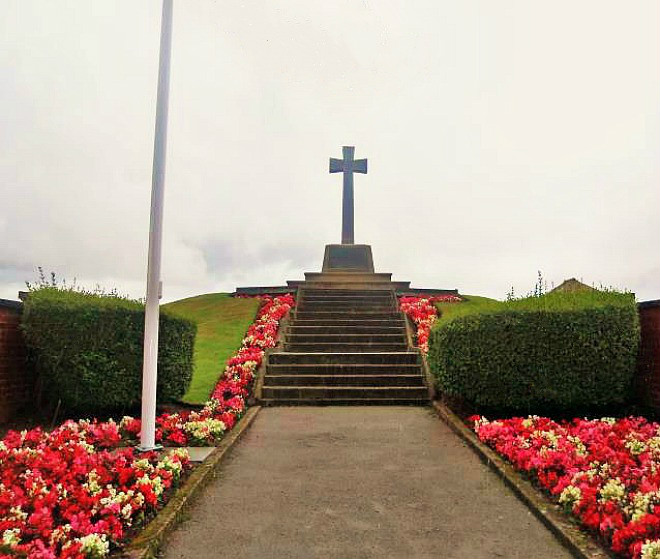
OS grid reference SD 3601 4822. This is one of those strange curiosities that do seem to crop up every so often. Haken’s Mound, also known as ‘Haakon’s Mound’ and ‘The Mount’ is, in fact, the Preesall war memorial near St Oswald’s church on the B5270 Lancaster road. The large, grassy mound always has well-tended flowers at its entrance and up to the monument, and on top of the large mound, there is a substantial memorial cross which commemorates the fallen of the two World Wars. According to ‘the’ local legend and, to some extent “myth” Haken or Haakon, an early 10th century Viking chieftain, who settled half a mile or so up the road at Hakensall in Knott-End-On-Sea, was buried inside the mound that is today known as ‘The Mount”. Whether there is any real truth in this I do not know – we will probably never know. The war memorial is located halfway between St Oswald’s church and B5377 Stalmine turning, while the very pretty seaside village of Knott End is half a mile in the opposite direction along Lancaster Road.

The story goes that: At some point in the early 10th century AD Haken, an invading Viking chieftain, sailed up the Wyre estuary (maybe in a longboat) and, just inland between Fleetwood and Knott End, founded a settlement at a place now called Hackensall – today the medieval Hackensall Hall on Whinny Lane (OS grid ref: SD 2874 5394) stands more or less on that site. The original hall (a defensive moated building) was built in 1190; the building there today is of 1656; it was built by the Fleetwood family. In the 19th century the hall was greatly renovated by Sir James Bourne. According to “the” Legend, it is said from his settlement, Haken laid siege to the area, pillaging and murdering, but I feel that here we have much embellishment added to the actual legend itself – and one “must” be very wary of this fact. Conversely, it may be that Haken was simply a seafaring Norseman who had come to the area and wanted to lead a quiet, unassuming life there.

The Mount at Preesall, Lancashire.

The Mount at Preesall, Lancashire.

As to whether Haken or Haakon was still a pagan, I don’t know, but I suppose it’s possible that he was a Christian, or had recently become one? After his death this Viking chieftain was buried nearby and a large mound built over his grave. Today this burial mound near St Oswald’s church, Preesall, is locally called ‘The Mount’ or ‘Haakon’s Mound’ and it still looks very impressive, made more so ‘perhaps’ by the war memorial cross standing on top. Alas, today, there are no visible signs (earthworks) of Haken’s settlement at Hackensall, only Hackensall road and Hackensall Hall are reminders. But we will never know archaeologically whether the Viking chieftain lies buried within the mound, due to the fact that it is protected as a war memorial.

There are a few historians that have tried to link King Cnut, himself a Norseman, with Knott End with regards to the meaning of the place, but it seems that that is ‘not’ the case as most tend to agree “now” that it takes its name from a “knot”- a hillock that is located above the estuary. This knot or hillock probably refers to the golf course above the shoreline at Knott End, just to the north-west of Hackensall Hall. A ghostly horse (boggart) is ‘said’ to haunt the hall.

In the delightful little book ‘The Lancashire Coastal Way And The Wyre Way’, by Ian & Krysia Brodie, we are enlightened about the possible meaning of Knott End: “The large sandbank off Knott End is called Bernard’s Wharf – reputedly after St Bernard. Many small birds, including knot and dunlin, feed here in the nutrient-rich mud. One story says Knott End derives from these birds, another that the Norse marked the channel of the Wyre with a chain of knots or cairns, the final one being the Knott End!” There is a church named for St Bernard on Hackensall Road.

In 1926 a hoard of Roman coins was dug up in the vicinity of Hackensall Hall, 500 to be precise, which later came to be known as the Hackensall Hoard. The coins were found beneath a stone and had been placed inside a leather bag. “Whilst the bag was originally found to contain around 500 coins, only 339 now have their whereabouts known” (Ian & Krysia Brodie, 1993). Some of the coin hoard was eventually given to The Revoe Museum in Blackpool, while more coins went to museums and galleries across the north-west of England.

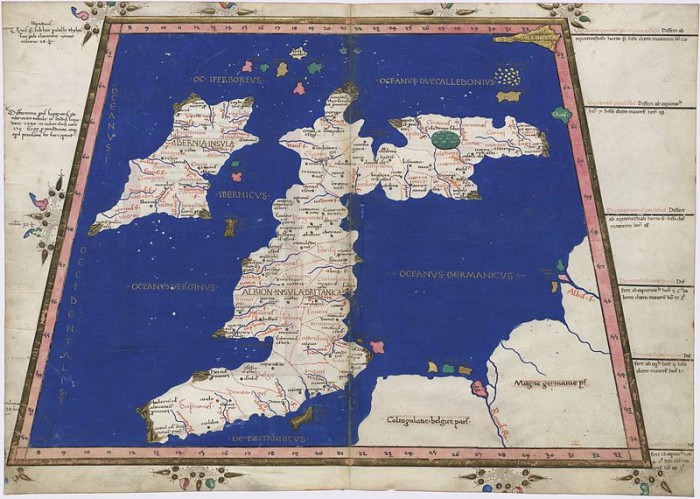
   In the work ‘Romans in Lancashire’ by D. C. A. Shotter, we are told of the possibility that the mouth of the Wyre estuary, a safe and sheltered anchorage between Fleetwood and Knott End, was in use as a port in Roman times and that the great Ptolemy, who lived in the 2nd century AD, referred to it as such: “More important, however, for the present purpose is the reference in Ptolemy to the site which he names as PORTUS SETANTIORUM……this could have been the Roman name for Lancaster; alternatively, many have felt that the site has at some time been overwhelmed by the sea, and lies off the coast at the mouth of the Wyre.”

Sources:

Brodie, Ian & Krysia., The Lancashire Coastal Way And The Wyre Way, Lancashire County Books, Preston, 1993.

http://www.pastscape.org.uk/hob.aspx?hob_id=39399&sort=2&type=&rational=a&class1=None&period=None&county=1306799&district=None&parish=None&place=&recordsperpage=10&source=text&rtype=&rnumber=&p=465&move=n&nor=6188&recfc=4000

http://www.preesalltowncouncil.org/about-preesall.pl

Shotter, D. C. A., Romans in Lancashire, Dalesman Publishing Company Ltd., Clapham, Yorkshire, 1973.

Copyright ©  Ray Spencer, The Journal of Antiquities, 2015 (updated 2925).


Sambo’s Grave, Sunderland Point, Lancashire – An Article by Cliff Astin

Sambo's Grave, Sunderland Point, Lancashire (photo credit: Rwendland for Wikipedia)

Sambo’s Grave, Sunderland Point, Lancashire (photo credit: Rwendland for Wikipedia)

   Os grid reference: SD 4222 5594. I recently came across this interesting article by Cliff Astin in his series called ‘Digging Deeper into Graves’ which appeared in the August 1996 edition of the ‘Really Lancashire’ magazine  A Magazine for the Red Rose County. I thought that it would be good to share this on here for all to read. The well-tendered grave is located at the far western side of Sunderland Point, close to the coast. To reach the site from Overton walk 1 mile south-west along a track crossing the northern and western edges of the Lune estuary (please check the tides) as there are deep river channels. On reaching Sunderland Point (SD 4266 5598) walk the length of the ‘Lane’. At the far western side of the lane walk 100m south on a footpath. Here in the corner of a field lies Sambo’s Grave. Children have left flowers, painted pebbles and tiny little wooden crosses at the graveside.

   [I would like to apologize about the name “Sambo” but it is the one that is “always” given for this site and, also for any other “offensive” words that appear here, they are not the “words” that I would have given, but they are the ones that “still” seem to crop up in this world of ours. To me that is very sad.]

   “Sunderland Point was, for purposes of shipping, the predecessor of Glasson Dock, which in turn was superseded as the most important port in our area by Lancaster. Should you choose to visit Sunderland Point, take care to check the tide tables before setting out in order to leave time to wander along the shoreline and to accommodate your return. On reaching the shore, walk to your left until you see a marker indicating ‘Sambo’s Grave’ – a fascinating burial spot but also a somewhat disgusting and misplaced instance of contemporary superiority and man’s inhumanity to man on the part of the local inhabitants of the day. Happily, this has been tempered by later and greater understanding and kindness albeit mainly on the part of our young ones.”

   “About 1730 a negro boy who had been acting as a sea captain’s servant arrived at Sunderland Point in one of the ships from the West Indies. Because it took some time to unload and re-freight the vessel, this negro – they called him Sambo, I suppose nobody bothered to ask him his real name – was accommodated at one of the inns. There are no inns at Sunderland Point now but formerly there were two. His master, the sea captain, meanwhile went off to Lancaster to attend to some business affairs, whereupon the negro slave took it into his head that in this alien foreign-speaking land he had been abandoned. He became so worried and depressed that he refused to take any food and in a very short time he died. Here’s where the inhumanity comes in.”

   “The “good Christians” of the parish could not tolerate the idea of a black heathen being buried in consecrated ground and so at a spot on the lonely western side close to the shore (it is now one corner of a field) sailors buried Sambo coffinless covered only with his own clothes.”

   “In 1796 (sixty years later) the reverend James Watson, the recently retired headmaster of Lancaster grammar school, was shown the burial spot. By now, Sunderland Point had become popular with visitors so James Watson collected a shilling from every willing visitor and placed on the site a monumental stone containing, in the centre on a copper plate, the following inscription:-” Here lies Poor Sambo, A Faithful  Negro who (attending his master from the West Indies), Died on his arrival at Sunderland.

   “Whenever you visit this site today you will find pathetic but loving little offerings from local children in the form of daisies, buttercups or other wildflowers in jam jars and crosses made from twigs or lolly sticks, for the local schoolchildren and other visitors have taken Sambo into their hearts. Happily in Sunderland Point today Sambo is the most remembered resident.”                                                                                                                                                                                                                                                                                                                                                                                                                                                            Full sixty Years the angry Winter’s Wave
Has thundering daſhd this bleak & barren Shore
Since Sambo‘s Head laid in this lonely Grave
Lies still & ne’er will hear their turmoil more.

Full many a Sandbird chirps upon the Sod
And many a Moonlight Elfin round him trips
Full many a Summer’s Sunbeam warms the Clod
And many a teeming Cloud upon him drips.

But still he sleeps _ till the awakening Sounds
Of the Archangel’s Trump new Life impart
Then the Great Judge his Approbation founds
Not on Man’s Color but his_Worth of Heart

James Watſon Scr.               H.Bell del. 1796

Sources:-

Astin, Cliff., Sambo’s Grave (article), Really Lancashire – A Magazine for the Red Rose County, Issue No. 2, August 1996, Landy Publishing, Staining, Blackpool, Lancs.

https://en.wikipedia.org/wiki/Sambo%27s_Grave

Copyright © Ray Spencer, The Journal of Antiquities, 2015 (updated 2024).


Beneath The Waves – An Article by Paul Harris

Ptolemy Cosmographia (Wikipedia)

Ptolemy Cosmographia (Wikipedia)

Looking through some of my old ‘Prediction’ magazines, I came across a fascinating historical article by Paul Harris. This article appeared in the June 1995 edition of the magazine and is all about the sunken lands, lost cities, kingdoms and islands (one of which has ‘perhaps’ given rise to the famous legend and perhaps myth of Atlantis) which are reputed to lie around the coastline of the British Isles. I thought that other people might like to read this, and so here it is “quoted” in full. The author says:

“The coastline of Britain is constantly under attack from the sea with vast tracts of land having been lost over the centuries, while medieval ports find themselves stranded inland by the action of longshore drift and estuarine silting. With this ever-changing scenario it is not surprising that many tales are told of one-time kingdoms, cities and islands now lost beneath the waves.”

“One of the most extensive of these ‘lost lands’ would seem to be that reputed to lie under Cardigan Bay, Wales. Known as Cantrer Gwaelod, or Bottom Cantred, this land was said to be 40 miles in length, 20 in breadth, containing 16 cities and protected from the sea by a series of dykes.”

“According to a tale told in the Welsh Triads, a dyke-keeper, being drunk, left open some sluice gates which inevitably led to the overwhelming of Cantre Gwaelod by the sea. It is now said that church bells can be heard tolling mournfully from their undersea locations at certain times and that, at low tide when the water is clear, buildings can be seen beneath the shallow sea.”

The Triads date the flood as ‘the time of Ambrosius.’ Since Ambrosius was the Celtic leader between about 460AD and 480AD, the flood must have occurred then. So what evidence exists to support the local belief and the Triad story?

“Well, firstly, there are long pebble ridges that stretch out to sea here. They look like abandoned sea defences and are often assumed so to be. Also, there are megalithic remains in the shallower parts of Cardigan Bay.”

Submerged Forest Ceredigion Coast (photo credit: Richerman for Wikipedia)

Submerged Forest Ceredigion Coast (photo credit: Richerman for Wikipedia)

“Indisputably then, there were islands off this coast during the Neolithic and Bronze Age periods that have since been submerged, thus leaving the megalithic structures beneath the sea and indicating that the sea level has risen since then. Also, there are fossil remains of forests that must have existed in the warm period after the end of the last Ice Age. These are now only exposed at low tide.”

 “This raising of the sea level, though, affected the whole of Britain, not just Cardigan Bay, and certainly occurred prior to the ‘time of Ambrosius.’ It seems, therefore, that the indications of former land, now submerged, may have given rise to the legend of Cantrer Gwaelod, not the other way round. The Triads story may refer to the flooding of a small island elsewhere. Indeed, it bears an uncanny resemblance to the story of the island of Ker Is which, according to Celtic sources, sank off Brittany during the 6th century.”

“So what of the sea defences? These apparently are natural formations. Indeed, it was not even suggested that they were submerged sea walls until the 17th century, according to folklore researcher and author, Jennifer Westwood.”

Lyonesse                                                                                                                                                                                                   
Land's End (Looking West) Photo Credit: Carcharoth (Commons) for Wikipedia

Land’s End (Looking West) Photo Credit: Carcharoth (Commons) for Wikipedia

“Evidence is much stronger, however, for the fabled lost land of Lyonesse, no doubt the best known of our legendary sunken kingdoms. Its capital, the City of Lions, is said to have existed in the area of the Seven Stones, which lie seven miles west of Land’s End.”

 “Lyonesse itself supposedly extended from the Cornish peninsula to the Scilly Isles, contained many towns and villages and a total of 140 churches. The lost land also has a place in Arthurian legend; but did it ever exist?”

 “Certainly the Scilly Isles themselves were one island as recently as the period of the Roman occupation, there being reliable descriptions of the Silvram insulam or Scilly Isle in 240AD and by Suplicius Severus in about 400AD. Furthermore, the islands themselves show signs of inundation since the pre-Roman Iron Age, there being huts and walls from this period still visible in the shallow waters between the islands. This, with the Roman reports mentioned above and the Arthurian legend of Lyonesse, strongly suggests the existence of a lost land here at least into the 5th century.”

“Perhaps the flood described in the Welsh Triads sank Lyonesse, too? Or did all these Celtic legends arise from just one event? Whatever, the timing of this particular submergence seems fairly clear. As for the depth of the submergence, investigations during the 1950s and 1960s put this as 14ft since the Iron Age.”

“This is enough to link some of the Scillies together, particularly with the aid of sea defenses, but not enough to allow the area from the Scillies to Land’s End to be above sea level in its entirety, though parts such as the Seven Stones reef would be. To allow the whole of the legendary land of Lyonesse to be above sea level would require a drop of 60ft in ocean depth. The last time that this was the case was toward the end of the last Ice Age, some 9,000-10,000 years ago, perhaps stretching back into prehistory.”

East Coast                                                                                                                                                                                                
Plan Of Goodwin Sandbank (photo credit: Claus Ableiter for Wikipedia)

Plan Of Goodwin Sandbank (photo credit: Claus Ableiter for Wikipedia)

“Moving around the coast to Kent, we come to the Straits of Dover and off the coast near Deal lie the Goodwin Sands, grave for upwards of 50,000 mariners over the centuries. At  low tide the sands can be exposed to such an extent that it is possible to land on them.”

 “Named after Earl Goodwin, the sands were once the island of Lomea, so tradition tells us. Apparently, the Earl neglected to maintain the island’s sea defences and, in the ‘Martinmas Storm’ of 1099, it was overwhelmed and never reclaimed.”

“Core samples taken from the Sands show that the ‘island’ is basically only a sand bar with a bedrock of chalk much deeper than sea level. However, in the past, the rivers Stour and Wantsum emptied much more silt into the sea near here, possibly leading to the sustenance of a much more pronounced sandbank than exists today. If this is so, there may be a basis to the legends.”

“What is factual beyond doubt, however, is the constant erosion of this coast by the sea to a quite spectacular degree. The Isle of Sheppey, on the North Kent coast, is eroding at an alarming rate. On the north coast of the island is the town of Minster. During the Middle Ages this was situated in the centre of the island! Further north, all along the coast of East Anglia, lonely, windswept  clifftops overlook dark, choppy  seas where once human activity took place and spectral church bells supposedly toll.”

 Dunwich                                                                                                                                                                                                  
Ruin of All Saints Church, Dunwich, 1904 postcard (Wikipedia)

Ruin of All Saints Church, Dunwich, 1904 postcard (Wikipedia)

“One ‘lost city’ here is very well documented: Dunwich, on the Suffolk coast between Southwold and Sizewell. It was once a prosperous port situated on the River Blyth and became the capital of Saxon East Anglia reaching its peak during medieval times. But in January 1326 disaster struck. In one night three churches and over 400 houses were swept away in a great storm and one million tons of shingle and sand banked up across the harbor mouth, cutting off the River Blyth and diverting it northwards.”

 “Dunwich died, its trade killed by this sudden lack of a harbour. The population declined as merchants moved away and its sea defences were neglected. By the mid 17th century the marketplace was awash and house after house, street after street, fell over the crumbling cliffs into the advancing sea. Now, all that remains is a church, a ruined priory, a pub and a few houses.”

Atland                                                                                                                                                                                                        
Map of Doggerland c8,000 BCE (photo credit: Max Naylor for Wikipedia)

Map of Doggerland c8,000 BCE (photo credit: Max Naylor for Wikipedia)

“Travelling north eastwards across the North Sea brings us to the vicinity of the Dogger Bank, today the shallowest part of the sea between Britain and Scandinavia but at one time a large, populated island. Evidence for this has been found in the form of Mesolithic implements found in the material dredged from the Dogger Bank. The period during which a large island existed here would have been towards the close of the last Ice Age when the sea level was some 60-70ft lower than at present. However, there is a belief that a large island called Atland existed here until 2193BC when it was overwhelmed by tidal waves caused by volcanic activity.”

 “Atland is described in a mysterious book that appeared in London in 1876 called the Oera Linda Book and subtitled ‘from a manuscript of the 13th century.’ The original was in the Frisian language and told of Atland and its inhabitants, the disaster that overwhelmed them and the subsequent history of the survivors who, it is said, carried civilisation across the world to, among other places, Egypt, Crete and Greece and were said to be the ancestors of the Celtic races.”

“Experts thought the book a forgery dating back to about the 1730s. Certainly this is a distinct possibility, especially as some of the contents do not seem credible. For instance, the survivors of Atland did not found the civilization in Egypt; this was already well advanced by 2193BC. Also, why were only the Mediterranean countries settled by Atland survivors and not Britain, France and Holland which were much nearer? Furthermore, there has been no volcanic activity for many millions of years.”

Atlantis                                                                                                                                                                                                     
Athanasius Kircher's Atlantis Map (Mundus Subterraneus 1669) Wikipedia

Athanasius Kircher’s Atlantis Map (Mundus Subterraneus 1669) Wikipedia

“None of this, however, prevented Robert Scrutton publishing the contents of the Oera Linda book in 1977 in his The Other Atlantis. Naturally parallels are drawn with Plato’s Atlantis which is thought to be the same place – after all the name is surely too similar to be coincidence? Maybe so but it is  equally likely to indicate a deliberate attempt to emulate the Atlantis account.”

“Nevertheless, Scrutton draws attention to traditions of a major catastrophe of a flood-like nature in the northern hemisphere in times past, recorded in the Welsh Triads and, as we have seen earlier, there may be a basis of fact in those accounts.”

“What is certain is that today’s sea level is higher than it was in the past and is still rising. Also, large tracts of land have been lost to the sea and, no doubt, given rise to many legendary stories around our coasts.”

“What is also clear is that such disasters can happen at any time; the devastating East Coast floods of 1953 and 1978 are evidence of this. What has been may be again.”

[If you have found the above article interesting and would like to find out more about this particular topic, then please read the book ‘Lost Cities And Sunken Lands’ by Nigel Pennick, published by Capall Bann, 1997].

Sources:

Harris, Paul., ‘Beneath The Waves’ (article in Prediction magazine), June 1995, Volume 61, Number 6, Croydon, Surrey.

https://en.wikipedia.org/wiki/Cantre%27r_Gwaelod

https://en.wikipedia.org/wiki/Cantre%27r_Gwaelod

https://en.wikipedia.org/wiki/Land%27s_End

https://en.wikipedia.org/wiki/Goodwin_Sands

https://en.wikipedia.org/wiki/Dunwich

https://en.wikipedia.org/wiki/Dogger_Bank

https://en.wikipedia.org/wiki/Atlantis

Copyright © Ray Spencer, The Journal of Antiquities, 2015 (updated 2025).


2 Comments

The Saxon Shore Forts Of South-East England And East Anglia

Map of The Saxon Shore Forts (Wikipedia)

Map of The Saxon Shore Forts (Wikipedia)

   There were originally 10 or possibly even 11 ‘Saxon Shore Forts’ (Litus Saxonicum) commanded by an officer with the title of ‘Comes litoris Saxonica per Britanniam’ or ‘Count of the Saxon Shore’. Most were built in the late third century though others have an earlier origin. Richborough incorporates older buildings, as does Reculver. Dover was already a militarised site. Nine are referred to in the Notitia Dignitatum, a military text from the late 4th early 5th century. A 10th fort may have existed at Walton Castle, near Felixstowe, but this has now been lost to the sea.

   The forts are all similar in that they are located near sea harbours or river estuaries, suggesting that their purpose was to prevent sea-borne invaders getting inland. Each could support a substantial garrison either infantry or sailors. All are of a similar structure – massive walls with bastions for mounting ballistae and surrounding ditches and, ramparts for extra protection.

    A parallel defence system contemporary with the Saxon Shore Forts the Litus Saxonicum exists on the other side of the Channel from Mardyck near Calais to the estuary of the Garonne. However this system is not as close knit with five of these forts not on navigable rivers. Rather the issue here seems to be the defence of key positions rather then a shoreline.

    From the north we have Brancaster (Branodunum) OS grid ref: TF 7821 4404 located between Burnham Market and Hunstanton, covering 6 ½ acres of standard trapezoidal shape, and with walls 9 foot thick of which nothing now remains above ground.

Mid-19th Century Illustration of Burgh Castle (Wikipedia).
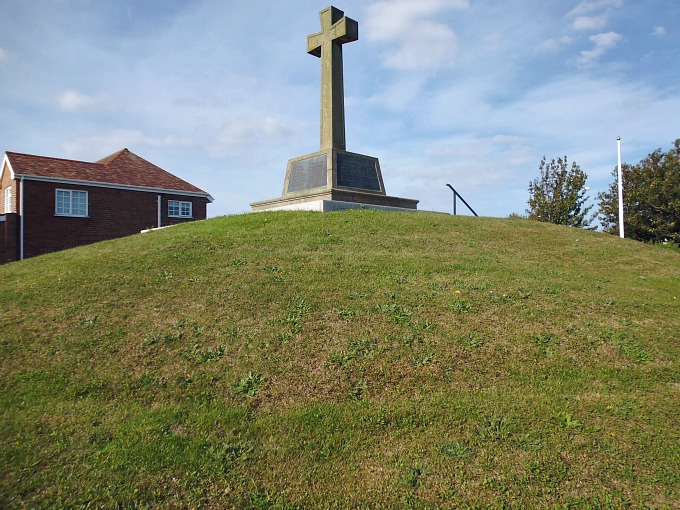
Mid-19th Century Illustration of Burgh Castle (Wikipedia).
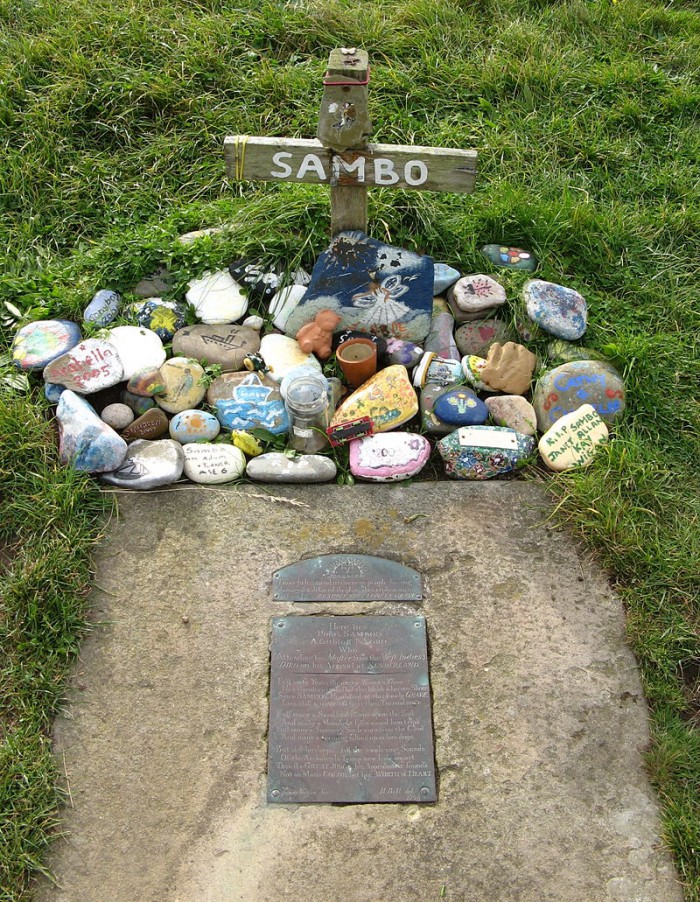
   Then Burgh Castle (possibly Gariannonum) OS grid ref: TG 4745 0461 is now well back from the sea with walls 11 foot in width and in places still 15 foot in height enclosing 5 acres. Three sides of the walls remain. Six bastions appear to have been added at a later date after the fort was constructed.

    Further south in Essex lies Bradwell (OS grid ref: TM 0313 0810) on the Blackwater Estuary (possibly Othona) with sections of 3 walls originally surviving, one with a bastion.

    On the Watsum River in Kent lies Reculver (Regullium) OS grid ref: TR 2274 6930 which was once on a broad waterway between the Isle of Thanet and the coast, but now sadly eroded by the sea. The walls of this fort were 8 feet thick surrounding an enclosure of standard Roman shape and protected by a ditch and earth rampart. Much has been lost to the sea. Also of note at Reculver are the ruins of a church founded about AD 669 by Egbert, King of Kent. There was a nave 37 feet long and a chancel with an apse. The towers, which remain, were added in the 12th Century.

Richborough Roman/Saxon Fort (photo credit: Midnightblueowl for Wikipedia).

Richborough Roman/Saxon Fort (photo credit: Midnightblueowl -Wikipedia).

   Richborough (Rutupiae) beside the river Stour at (OS grid ref: TR 3245 6018) has perhaps the most imposing remains, and the longest history. It is possible that this is where the Romans landed in AD43 under the command of Aulus Plautius. Defensive ditches have been found enclosing a large area. And 40 years later a marble monument in the form of a triumphal arch 82 feet tall with a façade of Italian granite was erected ‘possibly’ to commem-orate the event. The foundations remain. There is also evidence of occupation in the 2nd Century, when it seems to have been a civilian settlement with temples, an amphitheatre and a mansio (hotel). A fort with earth ramparts with triple ditches remains of which are extent dates from the second half of the third century with a stone walled fort of standard Roman shape and bastions replacing it soon after. At this time also the monument was converted into a look-out post. Finds from archaeological digs are housed in the site museum.

    Dover (Dubris) OS grid ref: TR 3193 4133 lies buried under the modern town (Queen Street) and is more famous for its Pharos (lighthouse) explored elsewhere on this web site. The Fort dates from the 2nd Century – being reused later as part of the ‘Saxon Shore’ defence.

    Lympne (Portus Lemanis) lies on Romney Marsh (on private land) OS grid ref: TR 1170 3420 and is marked by a few walls tilted at odd angles and, an east gate. The fort appears ho have been constructed as an irregular pentagon rather than of the usual trapezoidal shape.

Pevensey Castle Roman Walls (photo credit: Mortimer - for Wikipedia).

Pevensey Castle Roman Walls (photo credit: MortimerCat – for Wikipedia).

   Pevensey (Anderida) OS grid ref: TQ 6388 0504 lies at the mouth of the River Ashbourne in Sussex. Excavations here have shown evidence of wooden buildings. Pevensey is unusual in that the walls defer from the usual square plan into an irregular oval enclosing some 10 acres. The 12-foot thick walls initially look Medieval, but are in fact largely Roman. Bastions were placed at intervals around the wall and still look very imposing today. Not only did the Normans reuse the castle building, a keep on the south eastern side, but it was again reused in the second world war; a pair of machine gun posts can be seen as can a ‘pillbox’ on top of one of the bastions.

    Porchester (Portus Adurni) in Hampshire. On Verne Hill overlooking Portland Harbour OS grid ref: SU 6242 0452, completes the group. Of a square shape the walls have gates on the west and east and a defensive ditch surrounding them. There were originally 20 bastions and 14 survive. Archaeological evidence shows that a high status Anglo Saxon residence was established later within the walls. Again the building seems to have impressed the Normans. They resurfaced the walls and built a keep in the northwest corner. Other buildings followed in the 12th, 13th and 14th centuries. In the Southwest corner there is also a large church – part of an Augustan Priory built in 1133.

    For most of the 19th and 20th Centuries two theories held sway over the reasons for the development of the Saxon Shore defences. The first was that they were there to control an existing settlement of Saxon migrants (there is some evidence of Saxon settlers in the archaeological records), the second to prevent Saxon marauders from plundering that part of the coast. Whilst this was probably the case with the second half of the 4th Century, it was not really the case with the 3rd Century, and archaeological evidence (coins) now suggests they were built in the late 3rd Century when the Saxons were presenting as troublesome pirates rather then invaders intent on plunder. It is more likely that they were established by the Gallic Emperor Cariusus – mentioned elsewhere on this website. It has also been suggested the forts were established to protect the supply of goods back and forth from and to the continent. All four theories may have merit at different times during the 3rd and 4th Centuries.

Antoninianus Carausius Coin (photo credit: Classical Numismatic Group, Inc. - for Wikipedia).

Antoninianus Carausius Coin c 290 AD (photo credit: Classical Numismatic Group, Inc. – for Wikipedia).

   Carausius reigned from 286 to 293. According to the 4th Century writer Eutropius Carausius was of Belgic origin, had joined the fleet and had rapidly risen through the ranks bringing him to the attention of the Tetrarch – the two emperors and their two assistant Caesars who ruled the Roman world. He was put in charge of dealing with the Saxon Pirates but allegations were made against him that he had been allowing the Saxons to continue their piratical activities apprehending them and seizing their loot for himself. Recalled and fearing the worst he set himself up as Emperor in Northern Gaul and Britain. This theory suggests the forts were built by Carausius to defend his territory against the might of Rome. But the Tetrarch’s resources were stretched and Cariusius was tolerated instead. In 293 the Tetrarchy recovered Northern Gaul weakening Carausius’ position and leading to his assassinated by his Chief Minister, Allectus. Constantius Chlorus took his time but recovered Britain for the Empire in 296/7; Allectus being defeated and killed near Farnham.

    Archaeological evidence shows that during the 4th Century the forts continued in use probably supplanted with a series of signal-stations, which could have provided warnings of incursions, using fire and smoke. When Rome withdrew from Britain at the beginning of the 5th Century the forts fell into disrepair. Internal buildings were mainly of wood so they disintegrated leaving just the walls as a reminder of what had been. 700 years later the walls were still standing and some of the forts were requisitioned by the Normans as defensive positions, as status symbols and, as accommodation for the elite of the new invaders.

Sources: Cottrell, Leonard., ‘The Roman Forts of the Saxon Shore’, HMSO, 1964.

https://en.wikipedia.org/wiki/Saxon_Shore

https://en.wikipedia.org/wiki/Richborough_Castle

https://en.wikipedia.org/wiki/Anderitum

https://en.wikipedia.org/wiki/Carausius