The Journal Of Antiquities

Ancient Sites In Great Britain & Southern Ireland


1 Comment

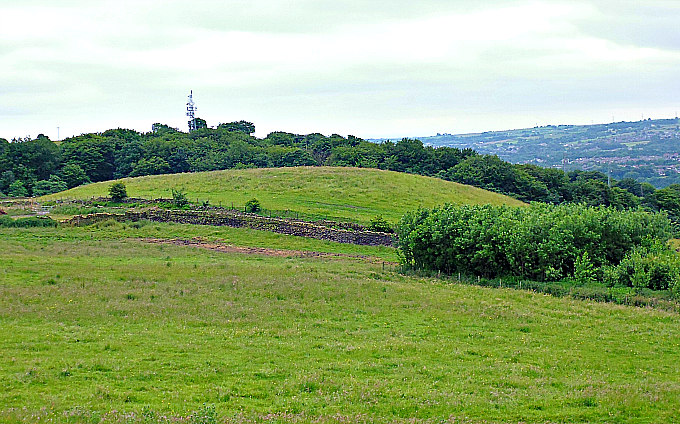
Round Dikes Earthwork, Addingham Low Moor, West Yorkshire

Round Dikes on Addingham Low Moor (from above).

Round Dikes on Addingham Low Moor (from above).

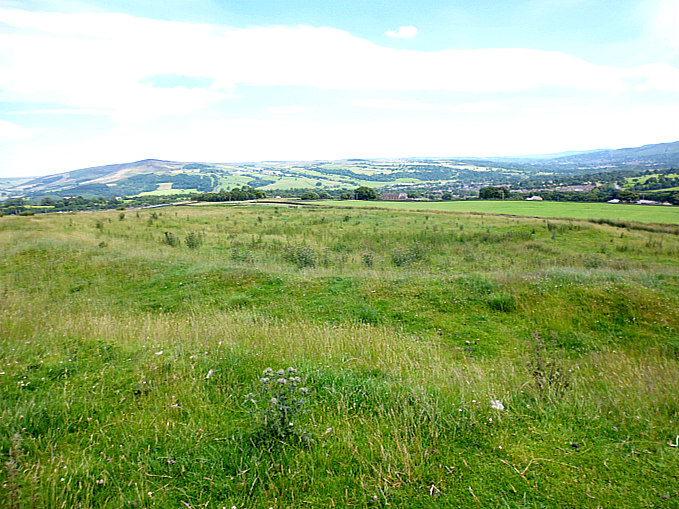
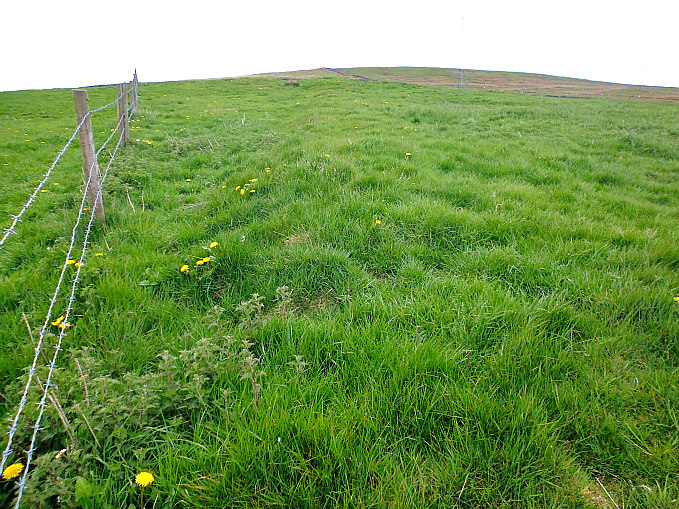
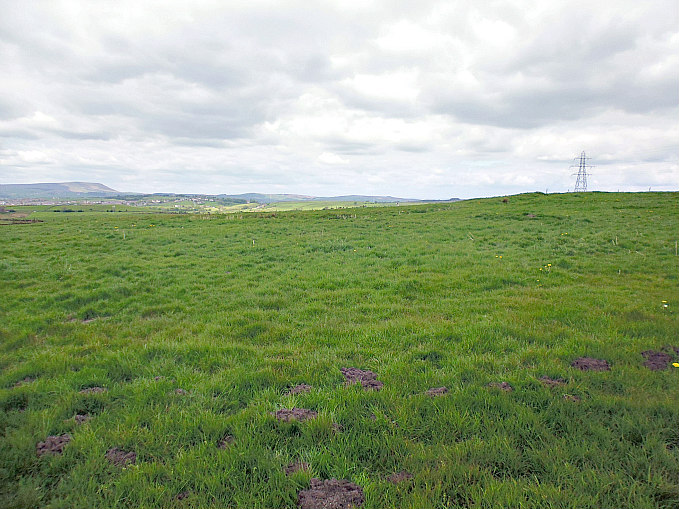
NGR: SE 0551 5012. Quite a substantial Iron Age earthwork situated below Counter Hill on Addingham Low Moor, West Yorkshire, that is locally called ‘Round Dikes’, ‘Round Dikes Camp’ and ‘Round Dikes Settlement’. This enclosed and almost oval-shaped earthwork on the moors to the east of Crossbank Road also supports a Bronze Age burial mound, but unfortunately this is now badly mutilated. There are traces of an associated linear earthwork to the south-east of the site, and another burial mound, although this is now hardly recognizable at ground level. Round Dikes Earthwork can be reached from Crossbank Road, where a footpath runs northeast towards Counter Hill, through a couple of fields and over a couple of wall stiles for 400m. Just before the earthwork, there are some gates and a short muddy path. The grassy earthwork is now in front of you!

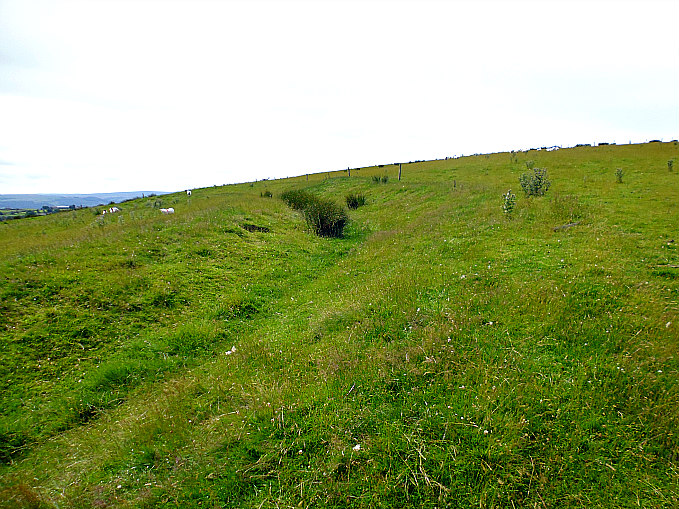
Round Dikes Earthwork, Addingham Low Moor (the north side).

Round Dikes Earthwork,  (the north side).

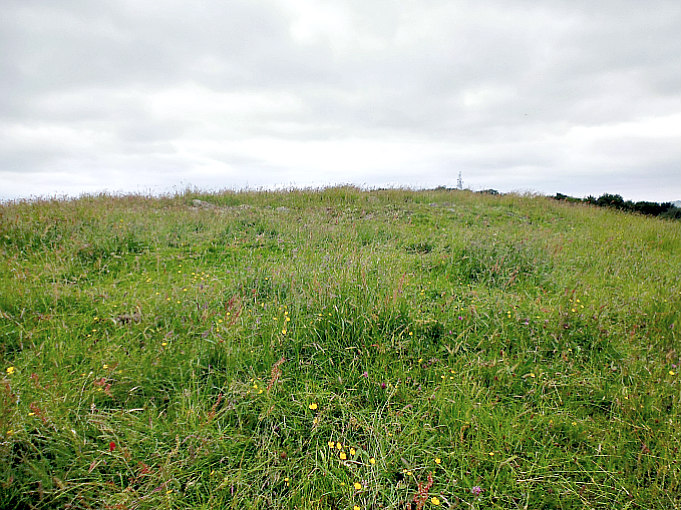
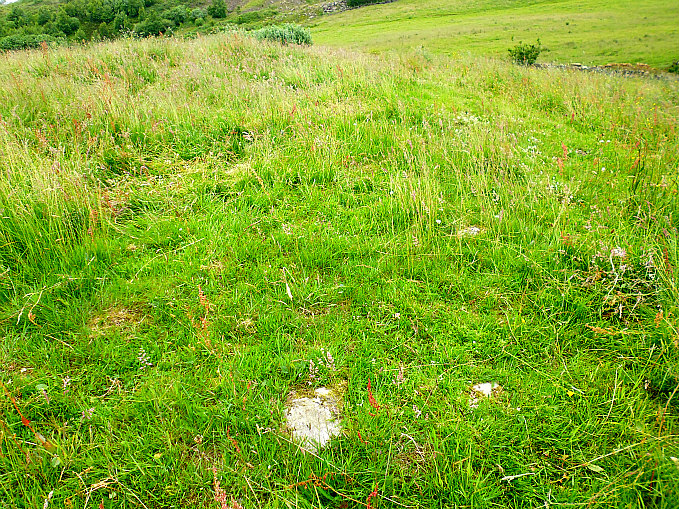
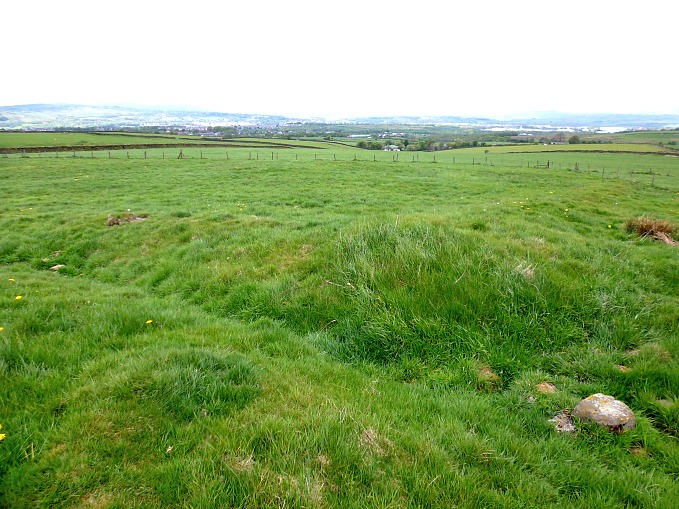
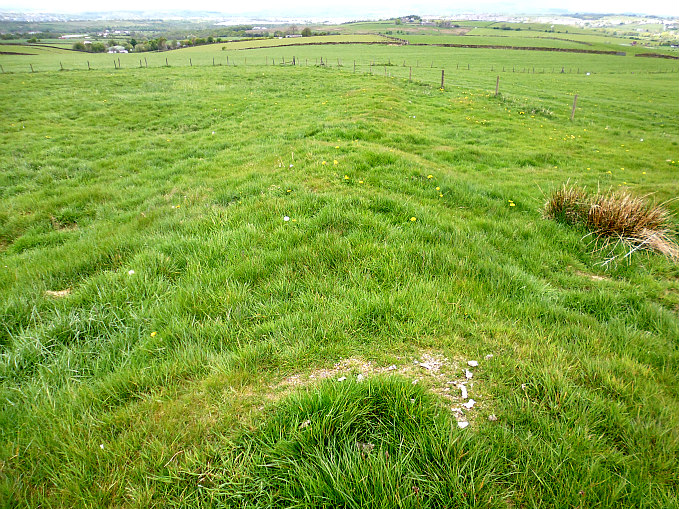
Round Dikes Earthwork roughly measures 87m x 79m and is oval-shaped. It has a well-defined ditch with banks running around an inner area which would have been the camp or settlement’s inner sanctum; the banking at the north side is very prominent and is 4-5 feet high in parts, whereas the banking further around the site is slightly less at 3-4 feet high. However, it is thought this was a non-defensive camp or “entrenchment” probably of the Iron Age, and not of the Roman period. The inner part of the site probably contained maybe nine hut circles and some hearths, according to John Dixon in his work ‘Journeys Through Brigantia’ – Volume One. At the south-east side there is what looks to be an entrance, and close to that and just inside the camp’s enclosure, a spring which is now almost lost in reed beds! The ditch and banking at the south side is almost lost in dense foliage and reed beds, and the spring makes for very boggy conditions here.

It would seem that the people of the Iron Age kept their stock: cattle, sheep, goats, pigs and maybe horses close to them and always within the bounds of their settlements or enclosures.

The author J. C. Barringer in his work ‘The Yorkshire Dales’, says of these Iron Age people and their enclosures: These complexes of small enclosures were bounded by stone banks and contained round huts of about fifteen feet in diameter. The inference to be drawn from the archaeological evidence is that Iron Age peoples occupied many of the limestone plateau above the main valley floors and that they were agriculturalists to the extent of growing crops of oats and perhaps rye in their small enclosures.”

He goes on to say: ‘Their small enclosures near their huts may have been crop growing areas, but most of their territory must have been used for grazing stock. The grazing of hillsides, would of course, hold back tree growth and in the case of goats severely inhibit it, so maintaining the clearance of the woodlands and perhaps increasing it in some areas.”

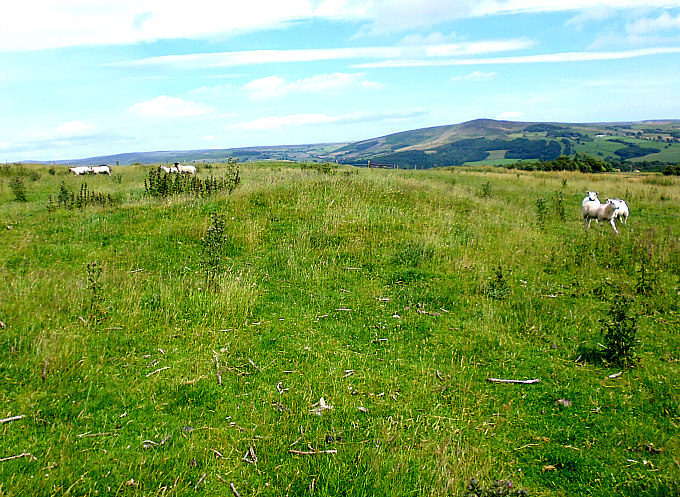
Round Dikes Earthwork. Bronze Age Bowl Barrow (between the sheep!)

Round Dikes Earthwork. Bronze Age Bowl Barrow (between the sheep!)

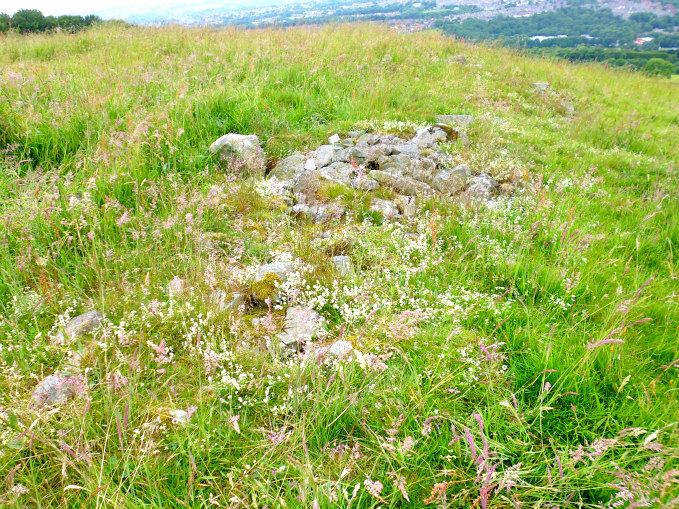
Near the south side of the site there is a small but very mutilated mound or bowl barrow which must be ascribed to the Bronze Age. This grassy mound is about 4 feet high but it is very damaged with a hollowed-out part at one side – due perhaps to robbery, or maybe from some illegal archaeological diggings in the past. So the site was obviously in use as a settlement long before the round dikes were built. And 200m further downhill to the southeast there are traces of a linear earthwork which was probably an extended part of the Round Dikes Camp. There is also another tumulus (bowl barrow) just below this earthwork at (grid ref: SE 0584 4993), although this has been largely lost due to ploughing of the field.

About ¾ of a mile to the west, at Woofa Bank, there is another large oval-shaped Iron Age enclosure with associated earthworks over to the north and east, and there is an interesting tumulus (bowl barrow) on the trackway (Millennium Way) to the south.

Sources and related websites:-

Barringer, J. C., The Yorkshire Dales, The Dalesman Publishing Company Ltd., Clapham, 1982.

Dixon, John & Phillip, Journeys Through Brigantia – Volume One – Walks in Craven, Airedale and Wharfedale, Aussteiger Publications, Barnoldswick, 1990.

https://en.wikipedia.org/wiki/Addingham

http://www.pastscape.org.uk/hob.aspx?hob_id=48311

http://www.ancientmonuments.info/en31498-late-prehistoric-enclosed-settlement-known

http://www.armadale.org.uk/rounddykes.htm

Copyright © Ray Spencer, The Journal of Antiquities, 2016 (Updated 2024).


1 Comment

St Helen’s Well, Draughton, North Yorkshire

St Helen's Well, near Draughton, North Yorks.

St Helen’s Well, near Draughton, North Yorks.

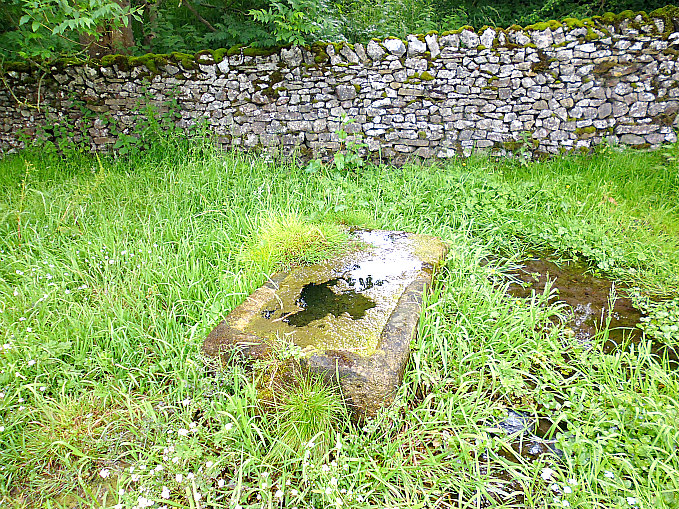
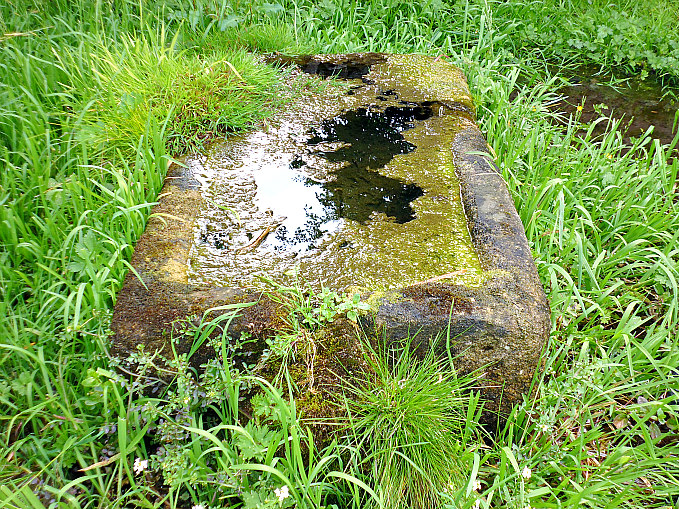
    OS grid reference: SE 0274 5326. In the corner of a field close to a wall beside the busy A59 road ½ a mile north of Draughton, north Yorkshire, is the ‘now’ much neglected and almost forgotten St Helen’s holy well. The well or spring, or what remains of it, is located close to Holywell Halt on the heritage railway line that is run by The Embsay & Bolton Abbey Steam Railway; the pretty little halt and the bridge opposite are both named after the well. The site can be reached from the A59 road between Skipton and Bolton Bridge. It is on the Draughton side of the road just before the railway bridge and on the opposite side of the road from the lay by. A wall stile hidden underneath some trees and bushes gives access to a footpath which passes close to the well. However, beware of the main road as there are vehicles coming along at often fast speeds.

St Helen's Well near Draughton, North Yorks.

St Helen’s Well near Draughton, North Yorks.

    St Helen’s holy well or spring is now very neglected and almost forgotten. It is in fact a large stone trough or tank measuring about 5 feet in length by about 2 feet wide, with a curved outlet at one end, and it looks to be quite deep. A metal pipe used to supply the stone trough with water from ‘a spring’ in the grassy bank opposite, but this has now gone and so the trough is replenished by rain water and overflows onto the surrounding ground which, at the time of my visit, was flooded with muddy water and very boggy. But when the ground is dried out I believe a flat area of ground with stones and pebbles can be seen around one side of the stone trough. Unfortunately, the stone trough is now used by thirsty cattle! The well was mentioned by Guy Ragland Phillips in his work ‘Brigantia’, in the mid-1970s.

    So just how old is this holy site and has St Helen or Helena (248-330 AD) always been associated with the well? At a guess I would say it is Medieval although the spring was here way, way back. It was obviously a pre-Christian spring. So maybe the saint, who was the mother of the Roman emperor Constantine the Great, was accepted as patron of the spring here in the the early Medieval period – at which time the cultus of St Helen was particularly strong in the Craven Dales. There is another St Helen’s Well at Eshton near Gargrave, north Yorkshire. But we know that St Helena was ‘not’ a native of Yorkshire, nor was she from anywhere else in Britain – despite what some early scholars say.  She was born at Drepanum in Bithynia, Asia Minor, later to be called Helenopolis. St Helena journeyed to the Holy Land and according to tradition she re-discovered the true cross (Holy Cross) on which Christ was crucified.

Sources and related websites:-

http://www.halikeld.f9.co.uk/holywells/north/holywl1.htm

http://www.le.ac.uk/users/grj1/helen.html

https://en.wikipedia.org/wiki/Helena_(empress)

Phillips, Guy Ragland, Brigantia, Routledge & Kegan Paul Books, London, 1976.

© Copyright, Ray Spencer, 2016.

Standing Stones At Stones, Near Todmorden, West Yorkshire

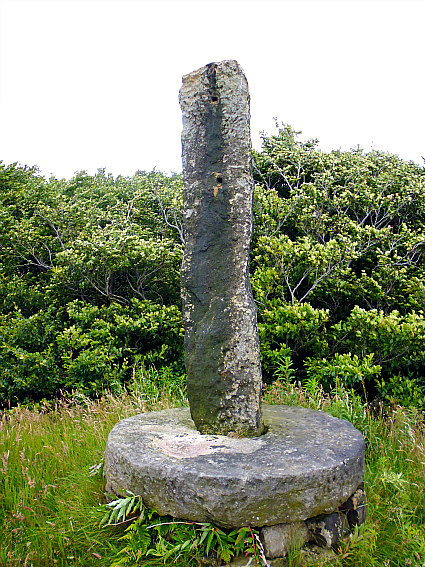
Tall standing stones at the hamlet of Stones, near Todmorden.

Tall standing stone at the hamlet of Stones, near Todmorden.

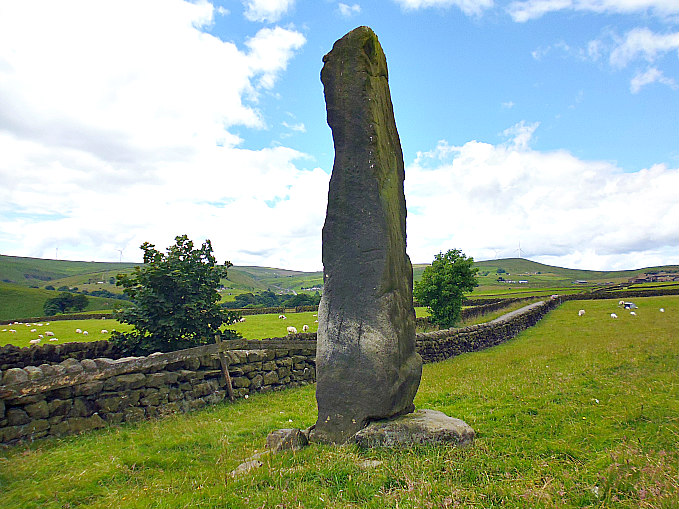
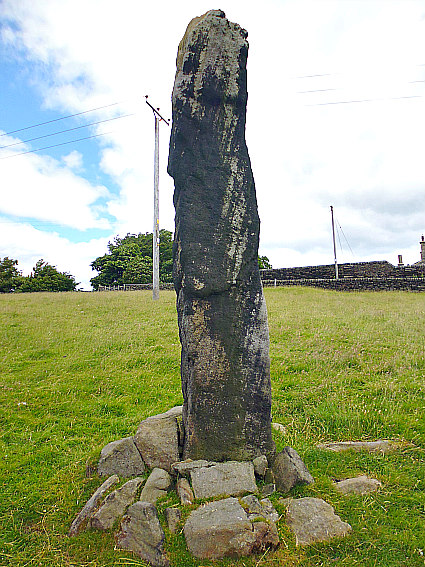
    OS grid reference: SD 9252 2359. There are three standing stones at the hamlet of Stones near Todmorden, West York-shire, but in this case they seem to be reasonably “modern” in date. This off-the-beaten-track hamlet with the name “stones” is a curious one. It seems to be ‘in another time or realm of its own’, but an idyllic one. It lies just south-west of the imposing Victorian ediface Dobroyd Castle, once home to the industrious Fielden family of Todmorden. At least one of the standing stones was erected in the early 19th century, while the other two were put up around the same time or a bit later – perhaps in more recent times? And there is a fourth stone but this is recumbent and now lies in front of a well. To reach these standing stones it is best to drive into Bacup town centre, then the A681 (Bacup Road) through Sharneyford, and at Cloughfoot turn left onto the steep Sour Hall Road, then turn right onto Parkin Lane which soon becomes Stones Lane. The tallest of the stones is in front of you on the left-hand side. It will, however, be difficult to find a parking place on this narrow lane and difficult to turn around again!

Stone No 1 viewed from different angle.

Stone No 1 viewed from a different angle.

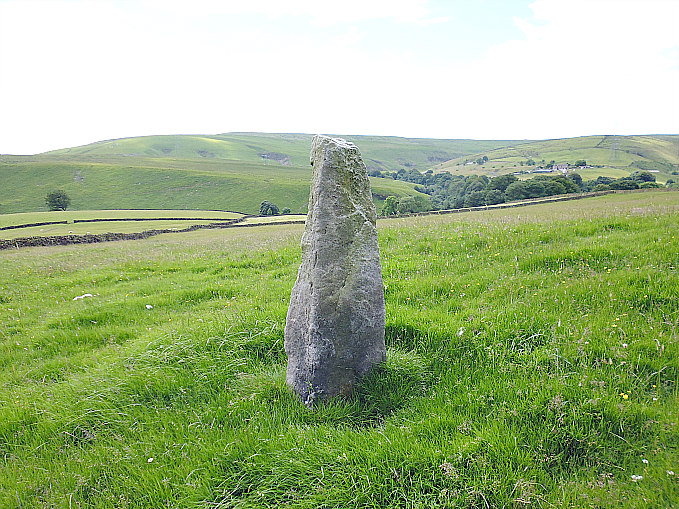
    The tallest of the three standing stones known as (No 1) is said to be 12 feet high and can be found in a farmer’s field beside Stones Lane and just to the west of Stones Farm. It is a hefty pillar of grey-black millstone grit from a local quarry that was obviously long exposed to the industrial chimney smoke of Todmorden in days gone by. We don’t really know when the gigantic stone was set up, and whether this is its original position, though it looks to be well supported at its base by a number of sturdy stones. It may have been erected after the Battle of Waterloo in 1812, rather like the other standing stone over to the north on the hillock called Centre Hill, or maybe this stone was placed here following another, perhaps, more recent battles like those of The Great War 1914-18. This seems more likely as there is evidence saying it was placed here in 1921, but other than that, we may never really know with any certainty. It is the fourth tallest standing stone in Yorkshire (Billingsley, John, ‘Folk Tales from Calderdale – Volume 1’.

Standing stone on Centre Hill. This is known as Stone No 2.

Standing stone No 2 on Centre Hill.

Stone No 2 on Centre Hill (from a different angle).

Stone No 2 on Centre Hill (from a different angle).

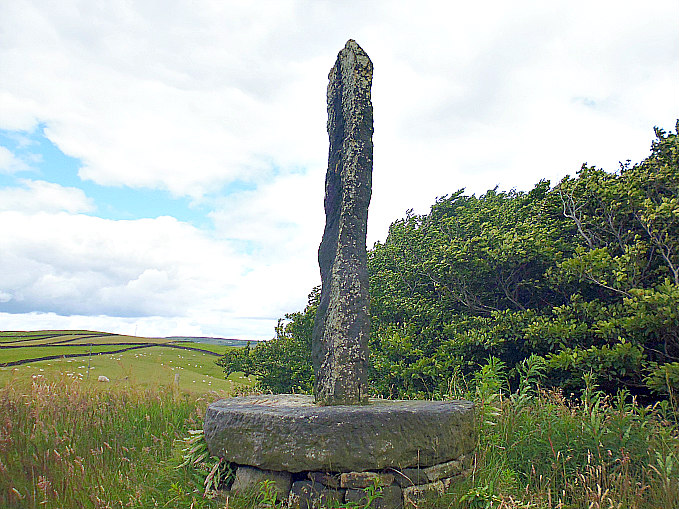
    The slightly shorter and thinner standing stone known as (No 2) stands atop a grassy hillock called Centre Hill (OS grid ref: SD 9254 2369) which is partly surrounded by a wooded area at the south-side and, just below that, a private residence called Model Farm. It is located some 95m north-east of, but more or less, in the same field as Stone No 1, although there is a low wall in between this and the little hillock.  This particular stone is held in place through the central hole of a large millstone – which is in turn supported below that on some other flat stones arranged in an equally circular fashion. We do know, however, with some sort of certainty that this stone was brought to its present position after 1812 and erected to commemorate ‘The Battle of Waterloo’. Centre Hill was originally the site of a beacon, according to author Paul Bennett, The Northern Antiquarian. It looks as if this standing stone has at some point been used as a gatepost!

Stone No 3 at Stones Lane, near Todmorden.

Stone No 3 at Stones Lane, near Todmorden.

Stone No 4 lies in front of the well near Stones Lane.

Stone No 4 lies in front of the well near Stones Lane.

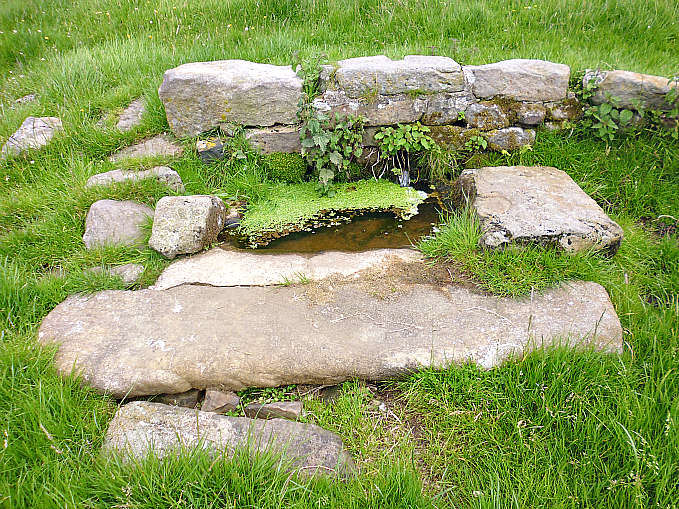
    Standing stone No 3 is located at the east side of a farmer’s field some 330m to the north-west along Stones Lane (OS grid ref: SD 9225 2380). It stands at just 4½ feet high and is a thin pillar compared to the other two stones, but it is quite a nice little standing stone. We do not know when this stone was placed here though it looks as if it might have been here for a much longer period of time. A little to the south of this stone, close to the wall, there is a well that has a ‘good’ constant supply of fairly clear water that comes down from the low hillside above. At the front of the well there is a 5 foot long, flat recumbent stone; this is considered to be the former standing stone No 4. The spring apparently began to flow or re-emerge when the stone was being dug-up, according to Paul Bennett, The Northern Antiquarian. However, this well is not marked on recent OS maps nor are any of the standing stones for that matter!

    I think that in the recent past there were many other standing stones here but unfor-tunately these have been dug up and moved elsewhere in the locality, many being broken up and put to use in nearby walls.  The standing stones can be photographed from Stones Lane, but a word of caution here:  It is ‘unwise to climb over the walls’ to look at these standing stones.  There are gates, however, and if the farmer is driving along the lane in his tractor he might open these gates to allow access for one to get up closer!

Sources and related websites:-

Billingsley, John, Folk Tales from Calderdale, Northern Earth, Mytholmroyd, Hebden Bridge, West Yorkshire, 2008.

Stones Farm, Todmorden, West Yorkshire

http://www.megalithic.co.uk/article.php?sid=10342

http://davidraven-uk.blogspot.co.uk/2010/01/stones-of-stone-lane-in-er-stone-near.html

https://en.wikipedia.org/wiki/Dobroyd_Castle


1 Comment

Worsaw Hill Burial Mound, near Downham, Lancashire

Worsaw Hill burial mound in the shadow of Pendle Hill.

Worsaw Hill burial mound stands in the shadow of Pendle Hill.

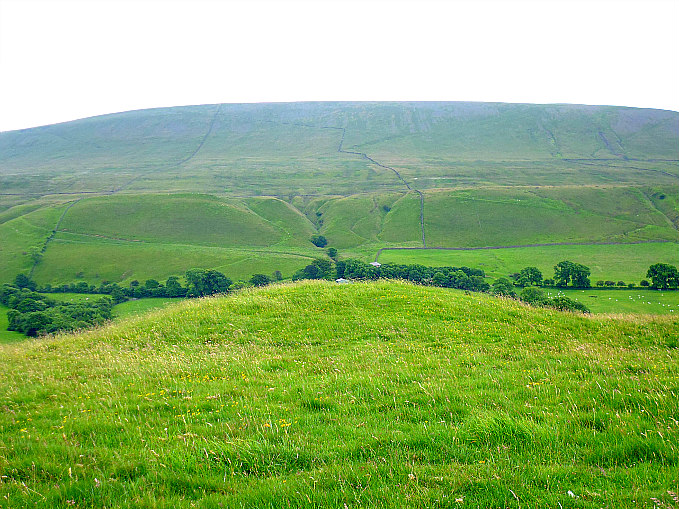
    OS grid reference: SD 7793 4321. About halfway between the Pendle villages of Downham and Worston, Lancashire, is the 725 foot high Worsaw Hill, which is a Limestone reef knoll. At the south-eastern side of the summit there is a small, grassy mound that is thought to be a Bronze Age burial mound, although very little is known about its history. There are also faint earthworks on the top of the hill which might be the remains of an ancient settlement? And there is a cave near the base of the hill. The lower slopes and outcrops are good for fossil hunting, while the walls around the periphery of the hill are excellent for “crinodia” enthusiasts! From West Lane, just up the lane from the entrance to Radbrook Farm, follow the footpath on the opposite side of the lane up past the barn, keeping to the side of the hill for maybe another ½ mile. At the far north-east side of the hill walk up the lower slope to the summit and, close to the south-east side, the small circular mound is in front of you. From here you get an excellent panoramic view of Pendle Hill’s western flanks.

Worsaw Hill bowl barrow (as seen from the south).

Worsaw Hill bowl barrow (as seen from the south).

Worsaw Hill bowl barrow (as seen from the south)

Worsaw Hill bowl barrow (close up from the south)

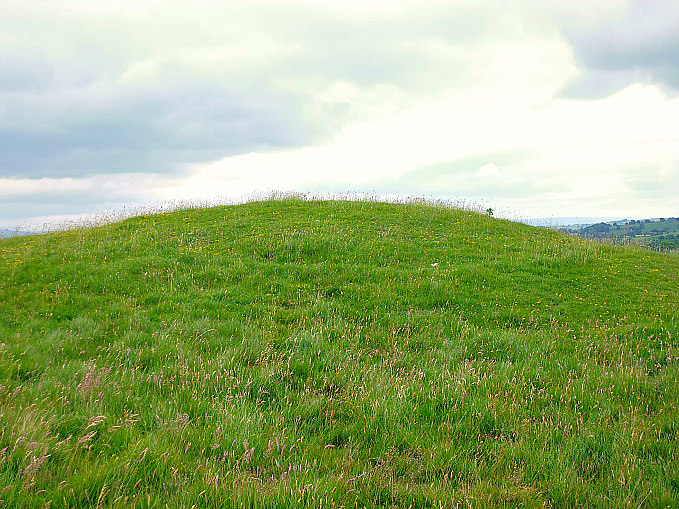
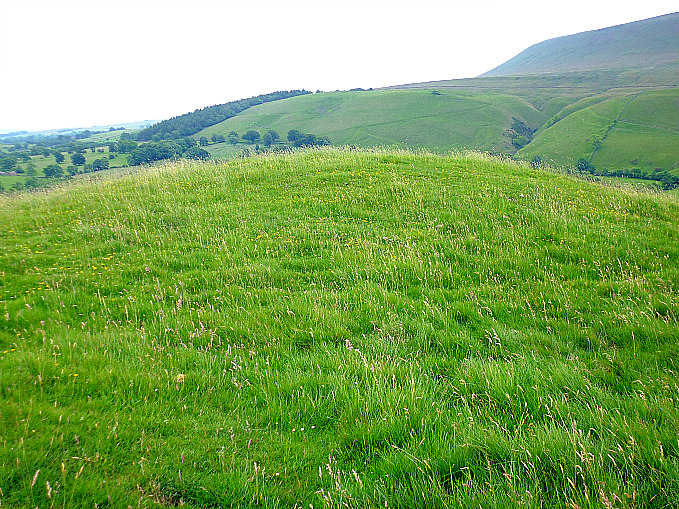
    The burial mound, or bowl barrow, at the SE side of the summit of Worsaw Hill is thought to date from the Bronze Age. It is a round-shaped grassy mound that looks to be in a reasonably good condition, although there is a hollow at the centre, but whether this was caused by some  past archaeological excavation, or whether the central chamber has fallen in, or something else, we don’t know with any certainty. It is 5-6 feet in height though originally it would have been higher; and it measures about 16m x 13m (52ft x 42ft). There looks to have been ‘some’ sort of ancient settlement close by the mound as there are faint traces of rectangular earthworks, but whether this is of the same age as the barrow, we don’t know. Maybe it was a quarry-workers’ settlement as there are many bell pits and outcrops both on the summit and around the bottom of the hill. Limestone was obviously quarried here – the walls around the base of the hill being testament to this. At the base of the hill (NW side) there is a small cave and some think there was an ancient settlement close-by that. And there was perhaps a Romano-British settlement, farmstead, or signal station at nearby Worston, which is near a Roman road – the course of which can be seen at the western-side of the village.

   W. R. Mitchell (2004) says that “When a prehistoric barrow was opened on Worsaw, human remains were found, possibly those of a chieftain who, it is romantically assumed, had been laid to rest facing Pendle.”

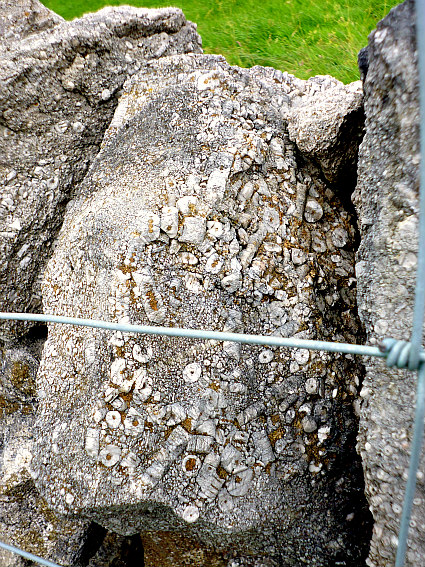
Crinoid fossils in Limestone wall.

Crinoid fossils in Limestone wall.

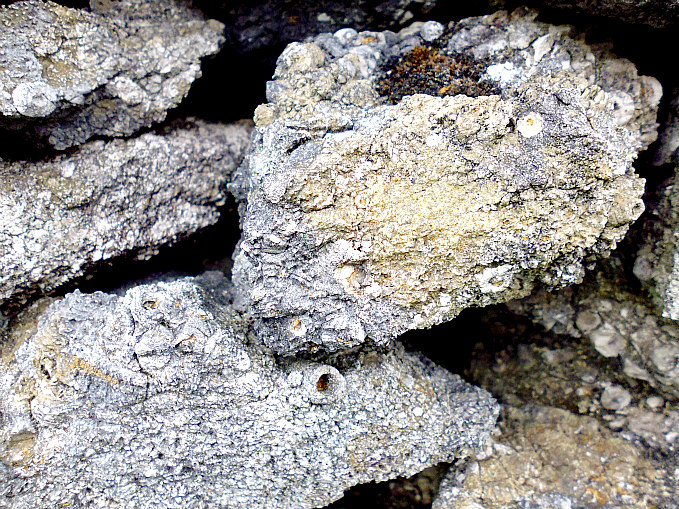
Crinoid fossils at Worsaw Hill in Lancashire.

Crinoid fossils at Worsaw Hill in Lancashire.

    Worsaw Hill, which is joined together with Crow Hill, are Limestone reef knolls, or mud mounds, that were formed over 300 million years ago in the Carboniferous period – at which time they lay beneath the sea, only the top of Pendle Hill would have been visible. Worsaw Hill is the largest reef knoll in the area, another being the one upon which Clitheroe Castle stands, which is part of the Clitheroe Limestone Formation that lies within the Chadian Stage. This ‘reef belt’ of Limestone stretches from Clitheroe to Worston and Downham to Chatburn. Other smaller reef knolls are to be seen around Downham, Twiston and Chatburn. Fossilised crinoidia which are tiny marine creatures, freshwater sea lilies, and corals are very evident in the Limestone quarried from these knolls, and also in the outcrops and scars on their side slopes. Often the walls around these knolls are built of Limestone with crinoid fossils.

    The authoress Jessica Lofthouse says of this area: “A thousand years ago Anglian farmers with an eye on good well-drained limestone pastures, sweet herbage for their flocks and herds, chose to settle down in a green land among coral reef knolls. One was Crow Hill, joined by Ridge to Worsa Hill named after one of their leaders. So Worsa’s Tun came into being. A little west of the settlement was a Roman highway; legionaries travelled it between  Ribchester and York, but now as a grass-floored track gone back to Nature walkers in high Summer need protection from beds of nettles which choke it. The bypass did not obliterate the line of it.”

Sources and related websites:-

Dixon, John & Phillip, Journeys Through Brigantia – Volume Nine – The Ribble Valley, Aussteiger Publications, Barnoldswick, 1993.

Fossil Valley, Twiston Near Downham, Lancashire

http://www.kabrna.com/cpgs/craven/reef_belt.htm

https://b.geolocation.ws/v/E/4080662/worsaw-hill/en

https://en.wikipedia.org/wiki/Worston

Lofthouse, Jessica, Lancashire Countrygoer, Robert Hale, London, 1974.

Mitchell, W. R., Bowland And Pendle Hill, Phillimore & Co. Ltd., Chichester, West Sussex, England, 2004.

                                                      © Ray Spencer, The Journal of Antiquities, 2017.


Whitelow Cairn near Shuttleworth, Greater Manchester

Whitelow Hill and Cairn, Shuttleworth, from a nearby hill.

Whitelow Hill and Cairn, Shuttleworth, from a nearby hill.

Whitelow Cairn (looking up to the Western side).

Whitelow Cairn (looking up at the Western side).

    OS grid reference: SD 8049 1627. On Whitelow Hill up above the village of Shuttleworth, near Ramsbottom, Greater Manchester, there is a prehistoric cairn, cairn circle, or ring cairn, on what was a sacred hill to the ancient people – the “low” part of the the site’s name being evident in this case. The burial mound is quite a ‘large and prominent feature’ and in the centre there is a cist grave, which is now almost destroyed. Whitelow cairn can be reached from the A56 (Manchester Road) in Shuttleworth, opposite the Bury Old Road turning. Walk up the “very rocky” Whitelow road to the east for 180m, branching off to the right around the edge of Whitelow Hill for another 220m. There is a gate on the right. It is best to proceed by this gate up to the hill and the cairn, which is at the north side.

Whitelow Cairn (north-west side).

Whitelow Cairn (outer bank north-west side).

Whitelow Cairn (outer bank south-east side).

Whitelow Cairn (outer bank south-east side).

    The large oval-shaped cairn here at Whitelow measures 26m x 24m and has a diameter of 27m. It has a well-defined outer ‘stone’ bank or kerb, especially N and E sides, that is slightly raised. There are some large stones embedded at intervals at the S side, some beneath the grass, whereas the kerb at the E, N and W sides has smaller stones, in little piles, at intervals on top of the slightly raised bank; the kerb at the N side is quite a prominent feature and can be seen from the hill to the north-west. At the centre of the ring cairn is an inner cairn or cist burial, now almost destroyed but still with its pile of stones. The hole or hollow can clearly be seen underneath the stones. Some of these stones clearly look to be shaped and would have originally made up the burial chamber, the large stone looks as if it originally covered the grave? but nothing much remains of that now as many of the stones have gone to be used in nearby walls. Adjacent to the cist, just a few feet away, is a larger stone on its own.

Whitelow Cairn (cist grave at the centre).

Whitelow Cairn (cist grave at the centre).

Whitelow Cairn (cist grave from the north).

Whitelow Cairn (cist grave from the north).

    Excavations were carried out at Whitelow Hill between 1960-62 by Bury Archaeological Group. Twelve or thirteen cremations were discovered – five or six of these cremations being in collared urns. Also found were flint and chert flakes, two clay studs, and two halves of a bronze awl, all dating from the early Bronze Age (the first half of the second millennium BC). Apparently, there used to be at least three more cairns in this area, all situated close to the lane (the old Bury road) which runs to the east of the main site, though these have, sadly, been lost to quarrying and farming. That being the case with Bank Lane Cairn, just north of Whitelow Hill. However, there are what ‘might be’ two cairns (tumuli), although now very faint, in the field over to the southeast at SD 8058 1612 close by the kennels on Bury Old Road. However, these two “possible” circular features are not recognisable at ground level. The finds from Whitelow Cairn are housed in Bury Museum.

Sources and related websites:-

http://www.chronologyandidentity.wordpress.com

http://www.buryarchaeologicalgroup.co.uk/whitelow.html

http://www.gmmg.org.uk/our-connected-history/item/cinerary-urn/

http://www.oocities.org/ramsbottom_bury_uk/

https://en.wikipedia.org/wiki/Shuttleworth,_Greater_Manchester

© Copyright, Ray Spencer, 2016.

1 Comment

Simon’s Cross, Simonstone, Near Padiham, Lancashire

Simon's Cross near Simonstone, Lancashire.

Simon’s Cross near Simonstone, Lancashire.

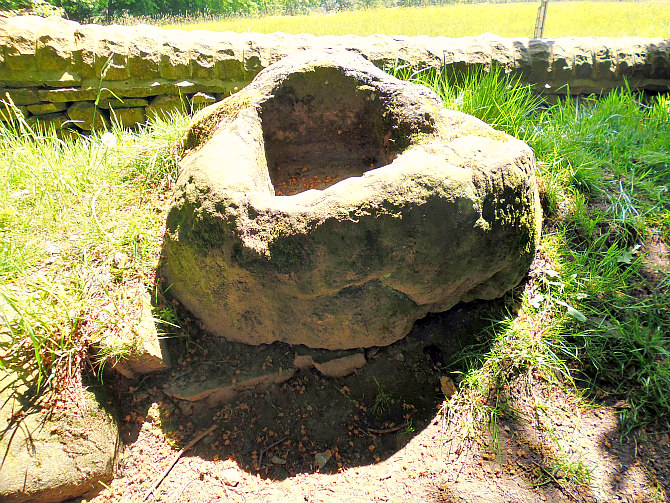
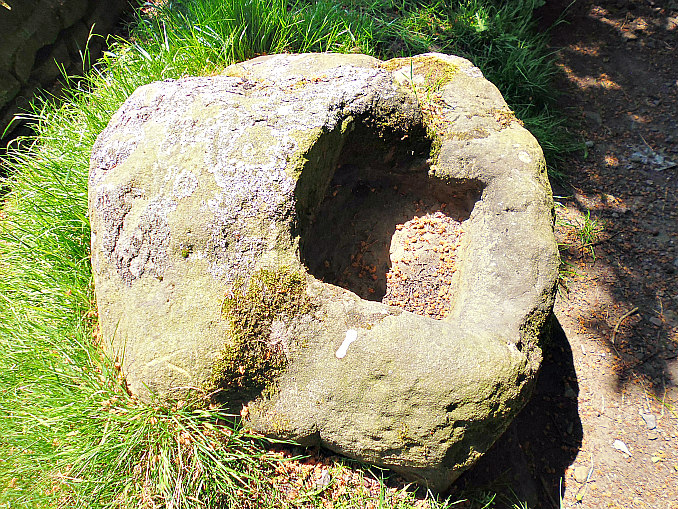
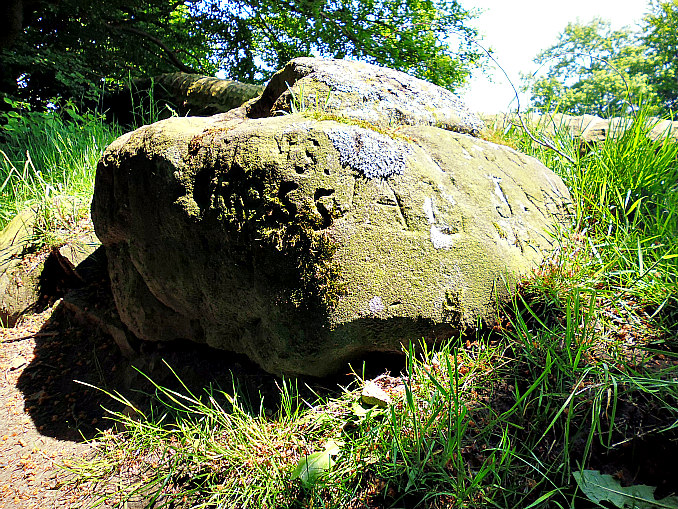
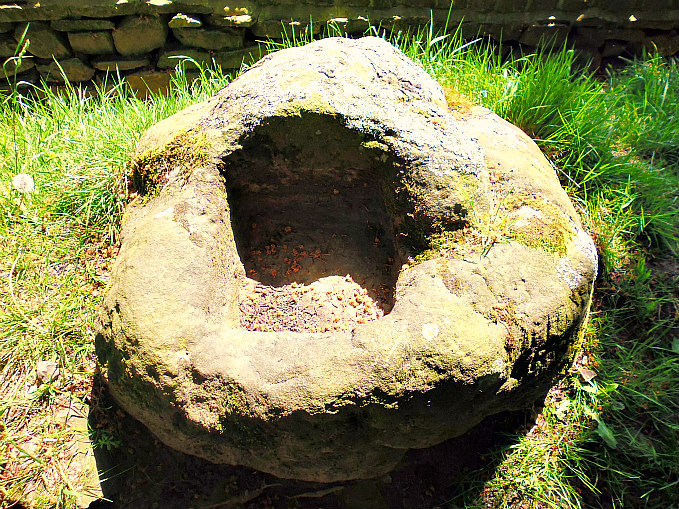
    OS grid reference: SD 7760 3609. Upon White Hill and just beside Shady Walks at the north-side of Simonstone, near Padiham, Lanca-shire, is a large boulder with a deep socket hole. This is, in fact, the cross-base of a Medieval wayside cross which was known locally as ‘Simon’s Cross’, ‘Simon’s Stone’ or sometimes ‘Wart Well’. Very little is known about its history and who it was named for, or who actually erected the cross. There are inscriptions carved into the sides of the cross-base. The stone can be reached from the A671 (Whalley Road) in Simonstone, then via School Lane and Trapp Lane for ¾ of a mile, passing Higher Trapp Hotel on the left. Just before the top of the lane where the woodland begins go through the wooden kissing gate – the cross-base is beside the wall. Just opposite the cross-base is the beginning of a long and overgrown woodland trench, and the track running alongside this is known locally as Shady Walks!

Simon's Cross at Simonstone, Lancashire.

Simon’s Cross (from above).

    This large, natural and round-shaped boulder, known as ‘Simon’s Cross’ is roughly 4½ ft wide and just over 2 ft high and is thought to weigh 2-3 tonnes. Its socket hole is 1 ft wide and 10′ deep. But it is not always full of rain-water. When it does contain water it is locally called ‘Wart Well’ as it is said to be a cure for warts, or it used to be? When I visited there was no water in the socket hole. On the side of the boulder the words ‘SIMON’S CROSS’ are carved along with a faint cross symbol and some Latin-type letters: maybe J A M and J W and a date that looks like 1860. The cross-shaft that would have fitted into this boulder having long since disappeared, but where did it go to?

Simon's Cross (side view).

Simon’s Cross (side view).

Simon's Cross (close-up of the 'Wart Well').

Simon’s Cross (close-up of the ‘Wart Well’).

    Simon’s Cross originally marked the parish boundary of Simonstone and Read, and was perhaps set up in the late 13th or early 14th century by Simon de Read, or could it have been Simon de Altham in the 14th century? It could also, perhaps, be named after a member of the Whitaker family of Simonstone? But we may never know. Simonstone takes its name from any of these characters. And maybe the monks of Whalley Abbey had some connection with the cross as it may have stood on land owned by that religious house, but the main landowners between here and Clitheroe were the de Lacys. Maybe this was a wayside cross to which pilgrims on-route to the abbey could congregate at – and say prayers for a safe journey – the cross acting as a sort of waymarker. The stone for the building of Whalley Abbey is ‘said’ to have come from quarries at Read and Simonstone.

    “The deep, overgrown trench alongside the path in Shady Walks was a drift mine for the extraction of fire clay”, according to the 1992 book ‘Walks In Lancashire Witch Country’ by Jack Keighley. This industrial quarry working runs beside the woodland track for about ½ a mile.

Sources and related web-sites:-

Clayton, John A., The Lancashire Witch Conspiracy, Barrowford Press, 2007.

http://www.british-history.ac.uk/vch/lancs/vol6/pp411-416

http://www.british-history.ac.uk/vch/lancs/vol6/pp503-507

http://news.bbc.co.uk/local/lancashire/hi/people_and_places/religion_and_ethics/newsid_8142000/8142400.stm

Keighley, Jack, Walks In Lancashire Witch Country, Cicerone, 1992.


1 Comment

Grace Dieu Priory, Near Belton, Leicestershire

Grace Dieu Priory ruins, Leicestershire.

Grace Dieu Priory ruins, near Belton, Leicestershire.

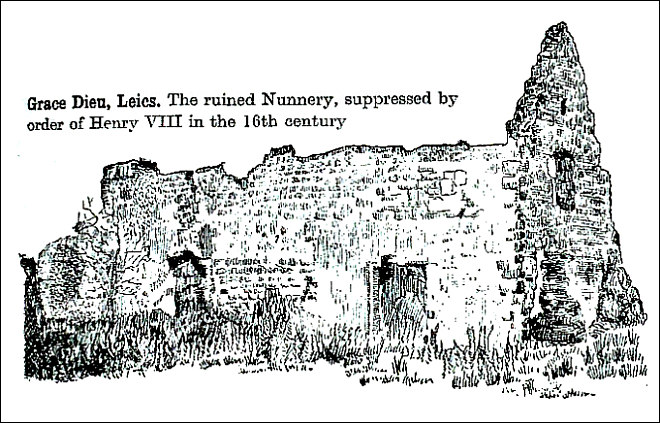
    OS grid reference: SK 4353 1835. The sad, crumbling ruins of Grace Dieu priory, a 13th century religious house, lie just to the east of the A512 Ashby Road and Grace Dieu brook – about halfway between the villages of Belton and Thringstone, Leicestershire. Since about the middle of the 16th century the priory buildings have been left to fall into decay and crumble away, with only the walls and gable-ends standing tall at what was, back in the Middle Ages, a large priory of Augustine (Augustinian) canonesses, with an attached hospice for the poor and infirm. The ruins are 500m north-west of Abbey Ford farm and just south of where Ashby Road meets with Gracedieu Lane, south of Belton.

    The priory of Grace Dieu (Grace of God) was founded in 1239 by Roesia (Rose) de Verdon, who was a noblewoman and landowner from Belton, and dedicated to St Mary, God and the Holy Trinity. Agnes de Gresley was the first prioress. It was in essence an “independent” religious house of Augustinian canonesses (also known as the White Nuns of St Augustine), and apparently a ‘strict’ order of sisters. This was probably the only house of the order in England. The walls and gable-ends of the nave (church), chapter-house and south range are still standing, although now roofless and skeletal and with much stonework missing, windows now  gaping holes, and walls only half their original height; the nave (E side) is perhaps the best preserved part and is entered through a stone archway. After the Dissolution and subsequent “late” closure of the house in 1538-9 much of the stonework was used in order to build the attached private residence. There are only scant foundations of the kitchens, infirmary (guest house) and late 14th century hospice for the poor and infirm, which only ever housed 12 local people at any one time. The nearby earthworks are probably the priory’s fishponds.

    After 1539 the priory ruins were sold and then a private mansion house was built beside the ruins, much of the stonework coming from the priory walls. In the mid-17th century it was sold again to a wealthy lawyer of Garendon Abbey. It was he who added to the priory’s destruction. By 1730 the religious buildings were in a very ruinous state, with only two large sections remaining, but with their roofs still intact. In the 1830s the ruins were again sold off. Today the ruins are said to be the haunt of a ghostly figure who has been referred to as ‘the white lady’. This is perhaps the ghost of Agnes de Litherland, the last prioress? The tomb of the foundress Roesia de Verdon was originally in the priory church, but this was taken for safety to St John’s Church at Belton. She apparently inaugurated an annual fair in the village, which is still held in late May or early June, mainly for the sale of horses (Folklore Myths and Legends of Britain).

Sources and other related web-sites:-

Bottomley, Frank, The Abbey Explorer’s Guide, Kaye & Ward Ltd., Kingswood, Tadworth, Surrey, 1981.

https://en.wikipedia.org/wiki/Grace_Dieu_Priory

http://www.britainexpress.com/counties/leicestershire/abbeys/grace-dieu.htm#main-content

http://www.gracedieupriory.org.uk/

Reader’s Digest, Folklore Myths and Legends of Britain, Reader’s Digest Association Limited, London, 1977.

The AA, The Illustrated Road Book of England & Wales, The Automobile Association, London, 1961.

Wright, Geoffrey N., Discovering Abbeys and Priories, (Third Edition), Shire Publications Ltd., Princess Risborough, Bucks, 1994.

© Copyright, Ray Spencer, 2016.

Hitching Stone, Near Cowling, West Yorkshire

Hitching Stone on Keighley Moor.

Hitching Stone on Keighley Moor.

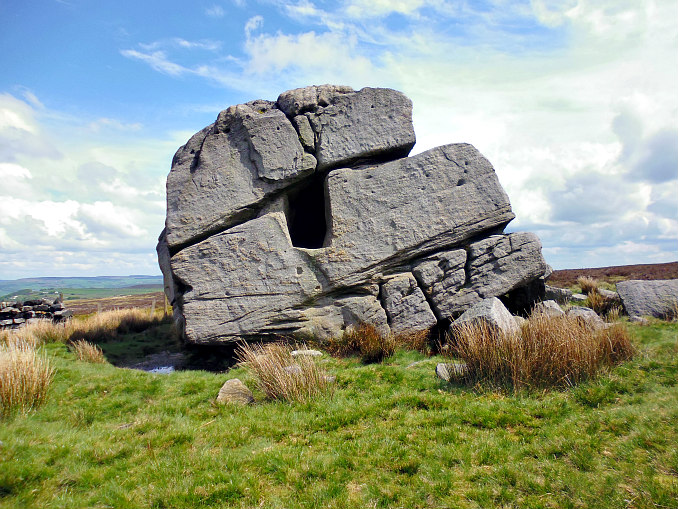
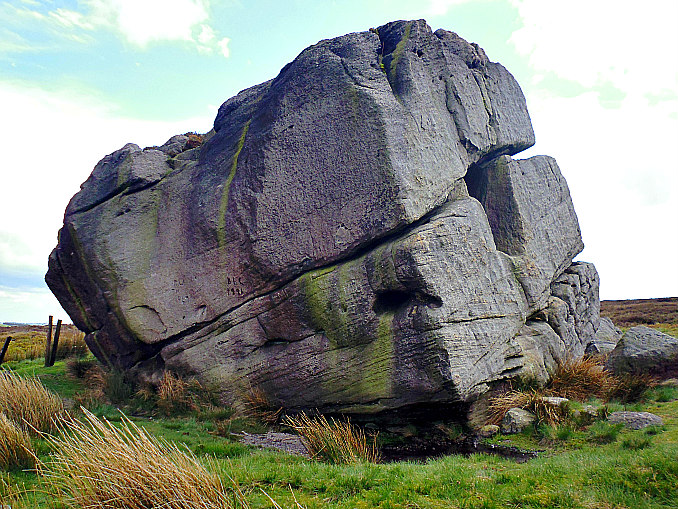
    OS grid reference: SD 9866 4170.  At the western side of Keighley Moor, between Cowling and Keighley, stands a huge gritstone boulder called ‘Hitching Stone’. The stone stands on the Lancashire—Yorkshire border and also parish boundaries. Hitching Stone is, in fact, an erratic boulder which was deposited here many thousands of years ago by a retreating glacier at the end of the last Ice Age. There are some interesting myths and legends associated with this huge boulder, not all of them being plausible. The stone can be reached from Buckstone Lane to the east of Cowling. There is a small car park for Wainman’s Pinnacle. Take either of the two footpaths opposite this car park and head south onto the moor for around 880m; the footpaths cross some quite boggy land and a couple of streams, but keep close to the wall all the way to Hitching Stone. You can’t really miss it as the huge boulder stands out on the landscape for several miles!

Hitching Stone (closer up) north and west faces.

Hitching Stone (closer up) the north and west faces.

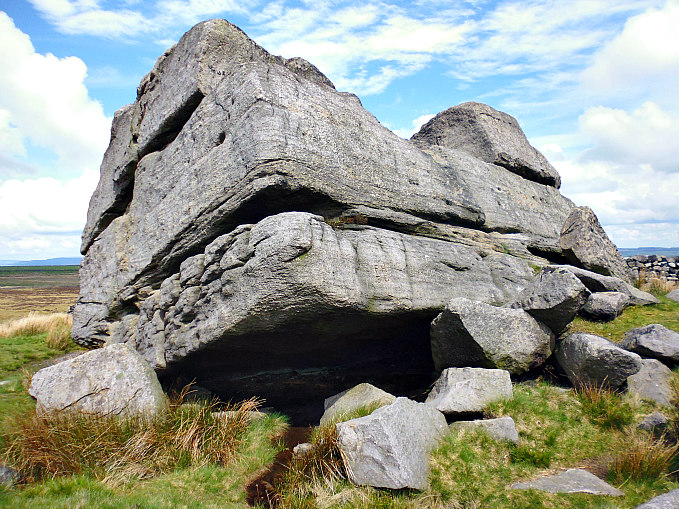
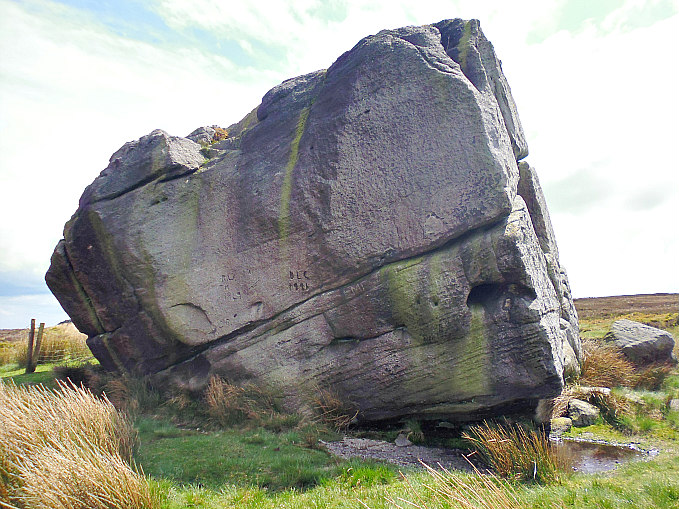
    Hitching Stone is a huge, almost square-shaped block of gritstone that is probably as large as a small house, well it is 21 feet high, and is almost 30 feet long and 25 feet wide, and is said to weigh well over 1,000 tonnes. It probably originally came from Earl Crag up above Cowling, which is just over a mile to the north. At the last Ice Age 12,000-14,000 years ago the great boulder was scooped up by a retreating glacier, and as it moved southwards the ‘object’ was deposited in its current location – rather like it was ‘hitching a lift’, and that might be where the name “Hitching” comes from, or a giant carried the stone from Rombald’s Moor – though that giant could have been the retreating glacier! Another legend says a witch from Ilkley pushed or threw the stone across the moor to its current position! It is reputed to be Yorkshire’s largest boulder.

Hitching Stone (west face showing fissure and hole).

Hitching Stone (west face showing fissure and rectangular hole).

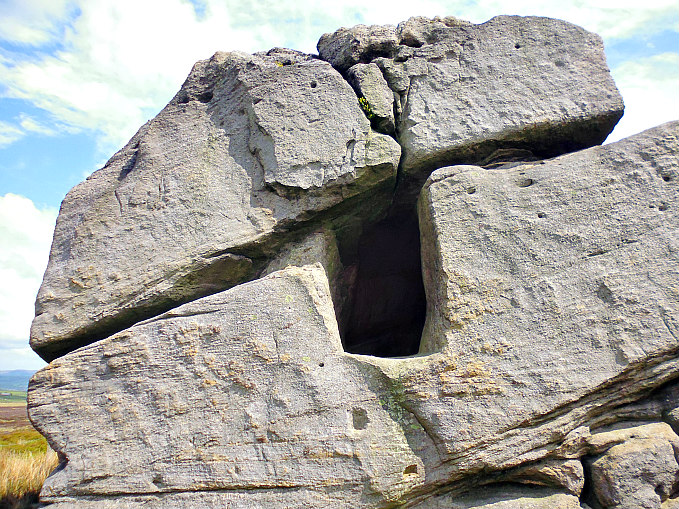
    About half-way up the west face of the stone is a large rectangular-shaped dark hole (recess)which seems to go quite along way into the stone, similar perhaps to a tiny cave, but it would seem that a large stone of a ‘different type’ was originally embedded into it; this eventually eroded away leaving the large, natural hole. This has sometimes been called ‘The Druid’s Chair’- harking back to more ancient, magical times, perhaps. Just above that is a long fissure (tube) that runs through the whole of the N and W faces. This fissure was originally filled by a fossilized tree which eroded away leaving the massive crack across the stone, almost cutting the top half in two. On the top of the stone there is a hollowed-out basin that is 3 foot deep and usually filled with rainwater; indeed this natural pool of water is never said to dry-up even in hot, dry conditions.

Hitching Stone (the south-east side).

Hitching Stone (the south-east side).

     Paul Bennett in his highly acclaimed work ‘The Old Stones of Elmet’, says of Hitching Stone: “It is a likely contender as a British omphalos, or ‘culture of the universe’ stone. Our other omphalos contender, the Ashlar Chair ten miles to the east, is just visible on the distant horizon. Its geomantic virtues represent the forces of life, death, rebirth and Illumination.” Bennett goes on to say that: “As a centre-point to the many regions it is little surprise the Hitching Stone was used as the meeting place of ancient councils and local parliaments. This tradition only stopped in the eighteenth century. Prior to this, folklore tells us it was used as a council moot by the pre-christian priests (druids). In similar tradi-tion this giant boulder was also the site of markets and Lammas fairs held in early August—the last of which was held in 1870. Such gatherings originated in pre-Christian times and it is likely that the gatherings here were part of a tradition which went back several thousand years.”

Hitching Stone (north face).

Hitching Stone (north face).

    In the book “The Pendle Zodiac’ by Thomas Sharpe, we are told more about the solstice alignment and sighting point with regard to ‘Hitching Stone’. The authors says: “The Hitching Stone is a glacial erratic, which seems to have been guided through this recursive field to its present position at the centre of the innermost polygon (vortex effect). This may have happened because even up until the end of the last glaciation, the Earth would have been relatively ethereal and less physically dense than it is today. It partly explains why the calibration curves of radiometric dating, using the half-lives of radioactive isotopes, are generally inconsistent. Then of course, the subtle fields may likewise guide migratory birds  shown to have a magnetic sense. For instance, over the West Sussex migratory wetlands of Pulborough Brooks is centred a replica polygon. The Hitching Stone, then, as well as marking an old county boundary, has become an entelechy in itself, and nesting within its attractor field it really exists between two worlds.”

    Sharpe goes on to say that: “Local tradition claims that the Winter Solstice sunrise is from behind the Hitching Stone, when viewed from the cup-marked and aptly named ‘Winter Hill Stone’. In the same fashion…..the Vernal Equinox sunrise (from) behind the Hitching Stone is in alignment with Pendle Hill.” The Winter Hill Stone is roughly 500 yards to the north-west of Hitching Stone.

Sources and related websites:-

Bennett, Paul, The Old Stones of Elmet, Capall Bann Publishing, Milverton, Somerset, 2001.

https://thejournalofantiquities.com/tag/hitching-stone-on-keighley-moor-in-west-yorkshire/

http://www.megalithic.co.uk/article.php?sid=10059

http://philipcoppens.com/hitchingstone.html

http://www.bradfordhistorical.org.uk/boundary.html

Sharpe, Thomas, The Pendle Zodiac, Spirit Of Pendle Publishing, 2012.

© Copyright, Ray Spencer, 2016.


Ring Stones Earthwork, Worsthorne, Burnley, Lancashire

Ringstones Earthwork near Worsthorne, Lancashire.

Ring Stones Earthwork Worsthorne, Lancashire. South-eastern side.

    OS grid reference: SD 8863 3301. On Worsthorne Hill above the two Swinden reservoirs at the east side of Burnley, Lancashire, there is a rectangular-shaped earthwork which has often been considered to be Iron Age in date, but it appears to be Romano-British, and most probably mid to late 4th century AD. It is similar in design to the Bomber Camp Earthwork, near Gisburn, Lancashire. This quite large site is also called ‘Slipper Hill Earthwork’ and ‘Hameldon Pasture Earthwork’. It is conjectured to have been a Romano-British farmstead, or maybe a temporary camp, although without any “real” concrete information that is still ‘open to question’. The site can be reached from St John’s Church in Worsthorne. From here take the Gorple road going eastwards on what becomes a rough track for about ¾ of a mile. Take the track on the left just after Brown Edge Farm, climb over two stiles and continue along here for 600m, eventually climbing a 3rd and 4th wall stile. The site is in the field to the right. There is a stile but it’s on the wrong-side of the earthwork; so the two gates are in the way and the site seems to be on ‘private land’. You can probably reach the earthwork from a path at the the north-western side of the field.

Ring Stones Earthwork (western side)

Ring Stones Earthwork (western rampart looking south).

    This quite large rectangular earthwork measures 56m x 41m and has very well-defined outer banks (ramparts) that are curved at the corners, and there are also prominent ditches. The outer banks (ramparts) are 3 feet high in places, especially at the S, W and N sides – the bank at the E side is not quite as high. At the E and W sides the ditches are quite well-defined. The NE side has what could be an entrance with extended banks at either side running out from the earthwork for 15m – and a trackway or path traversing from east to north-west across the inside of the site, although these could be a more recent features? The NW side has a circular (banked) feature with large stones inside, which could perhaps have been a 17th century lime kiln? At the W and NW sides, in particular, the outer banks (ramparts) have large and small stones embedded into them at intervals – an indication of how these were built. At the NW side a second, smaller earthwork measuring 18 yards square can just be made out – although this is now very faint in the ground and only just visible.

Ring Stones Earthwork. The western rampart.

Ring Stones Earthwork. (Western rampart looking north).

    The author Walter Bennett in his acclaimed work ‘History of Burnley’ did a survey of the earthworks in 1946. In this he called the site: “an enclosure that is 50 yards square with ramparts 2 yards wide and 1 yard high with an outer ditch 2 yards wide.” He says of the smaller enclosure: “It is 18 yards square.” He goes on to say: “the site was excavated in 1925 at which time a gateway 7 yards wide at the SW side was paved with boulders laid in a gravel foundation. At the S side there was a drain. A regular course of large stones flanked the gateway entrance at either side, and a floor of gravel and flat stones or cobbles. The rampart was built of earth and stones. There was a well-constructed road 7 feet wide which ran towards Bottin Farm on the Worsthorne to Roggerham road.” This is ½ a mile to the west. Could this have been the ancient straight trackway which runs back down to Gorple Road, or another track that heads north-west from the site to Swinden?

Ring Stones Earthwork (from the south-east).

Ring Stones Earthwork (from the south-east).

    But what makes this site interesting is the fact that a smaller, square-shaped earthwork feature joins onto the larger one at the north-western side, although this is fainter and more difficult to make out at ground level. So was this also a Romano-British farmstead, or was it something else? Almost certainly it was linked to, or was part of, the larger farmstead. It may be that this structure, and the larger one, only lasted for a short period of time because at that ‘time’ in Late Roman Britain, especially in the northern parts of the empire, daily life was becoming difficult with warring factions and tribal infighting on the increase – the Roman army now almost incapable of holding these rebellious northern, British tribes back. And soon the Roman army would retreat back to Gaul. Britanniae would then be left to its own devices! But the question must be asked: what was this Late Roman farmstead or camp doing here at the east side of Burnley?

Sources and related web-sites:-

Bennett, Walter, History Of Burnley – Vol I, Burnley Corporation, 1946.

Hall, Brian, Burnley (A Short History), Burnley and District Historical Society, 1977.

http://www.pastscape.org.uk/hob.aspx?hob_id=45317

https://historicengland.org.uk/listing/the-list/list-entry/1009488

Ring Stones, Worsthorne, Lancashire


Strathpeffer Pictish Stone, Easter Ross, Scotland

Strathpeffer Pictish Stone, Easter Ross, Scotland.

Strathpeffer Pictish Stone, Easter Ross, Scotland.

    OS grid reference: NH 4849 5850. At the edge of a field at the north-eastern side of the village of Strathpeffer, in Easter Ross, Scotland, stands a 7th century Pictish symbol stone known as ‘Clach an Tiompain’ or Tuideain (The Eagle Stone) – ‘Stone of the Turning’ or ‘The Sounding Stone’. The stone was ‘said’ to have marked a battle that took place in 1411 between two warring Scottish clans, and there was also a 17th century ‘prophetic’ legend associated with the stone. It is located at the edge of a field beside a line of trees at the north-eastern edge of the village – just off Nutwood Lane – and 85m south-east of Nutwood House – the stone lies 150m west of the A834 (Dingwall road). About 1 mile to the east along the A834 is St Clement’s kirk, Dingwall, and in the kirkyard a second Pictish stone.

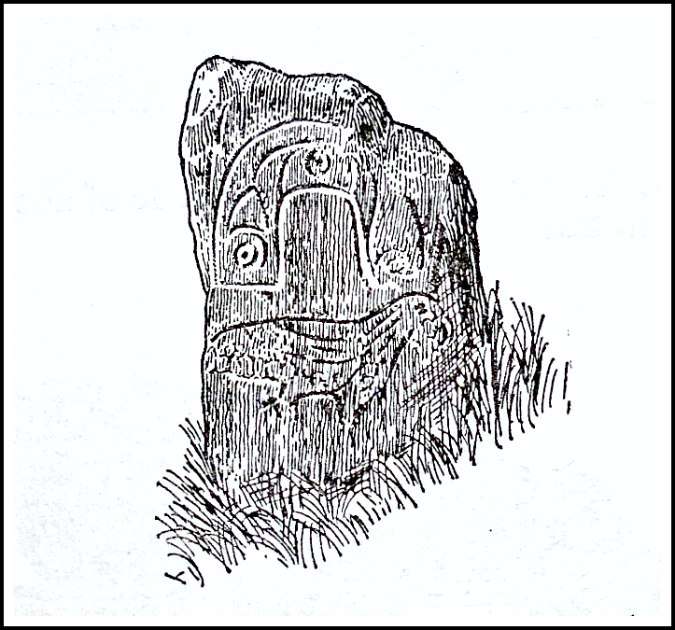
    This Class I Pictish symbol is thought to date from the 7th century at which time the Pictish kingdom was ruled by the powerful King Bridei, son of Bili. It is made of contorted blue gneiss and is 2 ft 8′ high (81cm), according to Elizabeth Sutherland in her work ‘The Pictish Guide’. It is 24′ wide x 10′ thick. On its front (SE) face are carved two Pictish symbols: an eagle and above that an arched horse-shoe which has tiny circles with dots in them at the bottom of both arches and, another slightly larger circle with a tiny circle and dot inside that at the top – which are held by curved strands almost forming two more circles. There are no carvings on the reverse side. Sutherland says the eagle represents St John the Evangelist and means: justice and truth, while the arched horse-shoe signifies ‘a rainbow bridge between this and the other world’. The stone has suffered from slight damage at the top right side due to being moved about on a couple of occasions; it originally stood further down the hill in the direction of Dingwall, but was brought to its current position in 1411. It has also come to be referred to, in more recent times perhaps, as ‘the Marriage Stone’.

    The stone was traditionally said to stand on, or near, the site of an early 15th century battle between two Scottish clans: the Munros and MacDonalds – the clan Munro being victorias. Curiously the Munro clan symbol is the eagle! Local legend has it that the slain of the Munroe clan lie buried around the stone. The Mackenzie clan seemingly ‘also’ had some involvement here. And there was also a legendary ‘prophetic’ claim made by the 17th century Highland prophet Coinneach Odhar – better known as Brahan Seer (who was of the clan Mackenzie). He said that if the stone “fell” for a third time the Strathpeffer valley would flood right up to the stone (Sutherland, 1997). Linked to the Strathpeffer stone is the Dingwall Pictish Symbol Stone. This stands in the kirkyard at the left-side of the entrance path to St Clement’s kirk, but this is now badly weathered – Anthony Jackson ‘The Pictish Trail’. So were these two stones originally ‘a pair’?

Sources and related web sites:-

https://canmore.org.uk/site/12458/strathpeffer-clach-an-tiompain

http://www.megalithic.co.uk/article.php?sid=7191

https://en.wikipedia.org/wiki/Clach_an_Tiompain

http://www.historic-uk.com/HistoryUK/HistoryofScotland/The-Brahan-Seer-the-Scottish-Nostradamus/

Jackson, Anthony, The Pictish Trail – A traveller’s Guide To The Old Pictish Kingdoms, The Orkney Press Ltd., St Ola, Kirkwall, Orkney, 1989.

Sutherland, Elizabeth, The Pictish Guide, Birlinn Limited, Edinburgh, 1997.

The AA, Illustrated Road Book Of Scotland, The Automobile Association, London, 1963.

© Copyright, Ray Spencer, 2016.

Lundin Links Standing Stones, Fife, Scotland

Lundin Links Standing Stones, in Fife.

Lundin Links Standing Stones, in Fife.

    OS grid reference: NO 4048 0271. On the third fairway of the Lundin Links Ladies Golf Course, in Fife, Scotland, there are three very tall prehistoric standing stones which are arranged in a sort of circle. They are located just 120m to the north of the Old Manor Hotel, off the A915 (Leven road) at Lundin Links Golf Course, and directly opposite Pilmuir Road. There is an entrance to the site on Woodielea road, a further 500m along the Leven road (at the east side of the golf course), where you will need to ‘ask for permission’ to visit the stones. They can’t really be missed, though, as they stand out quite clearly on the greens of the third fairway. The village of Lower Largo is 1 mile to the east along the A915 (Leven road).

    The three very tall sandstone pillars, originally there was a fourth, stand like ancient sentinels over the green lawns of the golf course. They stand close together in a sort of circle, or a rectangle of 100 feet x 30 feet, in what is called a ‘four-poster circle’. The tallest and most oddly-shaped stands at a very tall 17 feet, while the other two are 15 feet high and 13 feet high respectively; the smaller stone being pointed at the top and the middle-height stone having a broad girth. In the early 1700s, a cist grave was excavated here which yielded a number of human bones. A fourth stone had originally stood at the NE side, but this had apparently fallen down, or had been broken and knocked down at the end of the 18th century, maybe due to vandalism. These standing stones are said to be aligned with Comrie Hill, Perth & Kinross, but there may also be an alignment with Largo Law to the east?

Sources and related websites:-

http://www.megalithic.co.uk/article.php?sid=24405

Lundin Links, Largo, Fife

http://www.ancient-scotland.co.uk/site/108

http://www.scotlandsplaces.gov.uk/record/rcahms/32656/lundin-links-standing-stones-lundin/rcahms

https://en.wikipedia.org/wiki/Lundin_Links

The AA, Illustrated Road Book Of Scotland, The Automobile Association, London, 1963.

© Copyright, Ray Spencer, 2016.

Worsthorne Hill Stone Circle, Near Burnley, Lancashire

Worsthorne Hill Stone Circle.

Worsthorne Hill Stone Circle, near Burnley, in Lancashire.

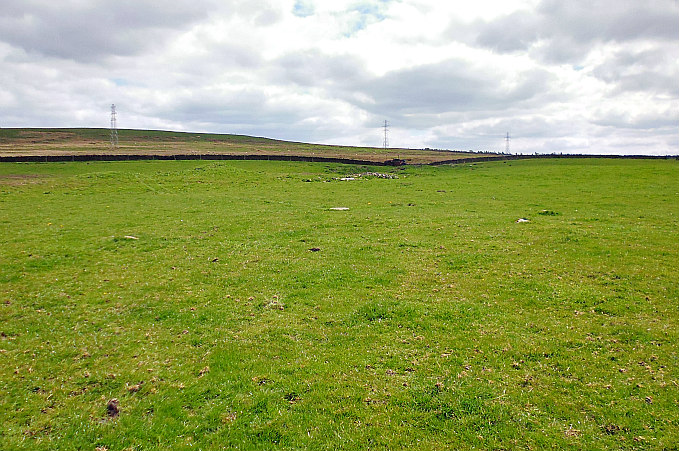
    OS grid reference: SD 8845 3276. On Worsthorne Hill to the east of Burnley, Lancashire, and close to Swinden Reservoirs, stands a prehistoric stone circle. Though it is not the usual type of stone circle with stones standing upright. This site is also known as ‘Hameldon Pasture Stone Circle’ and sometimes ‘Slipper Hill Stone Circle’. It has also been referred to as a ‘cairn circle’- and was stated as such on earlier OS maps. To reach the site take the Gorple Road at St John’s Church in Worsthorne. Continue eastwards on this often quite rough track for about ¾ of a mile. Take the track on the left just after Brown Edge Farm, climb over two stiles and continue along the here for 270m, climbing a 3rd wall stile. At the old rusting steamroller, walk to the right down the dry water course for 150m. Here in front of you is what remains of the stone circle – now partly surrounded by a landfill site and field debris scattered about, which is quite appalling to say the least, being right next to an ancient site. A second rusty old road-repairing vehicle can be seen beyond the circle!

Worsthorne Hill Stone Circle, near Burnley.

Worsthorne Hill Stone Circle, near Burnley.

The "possible" cup-marked stone in the stone circle.

The “possible” cup-marked stone in the stone circle.

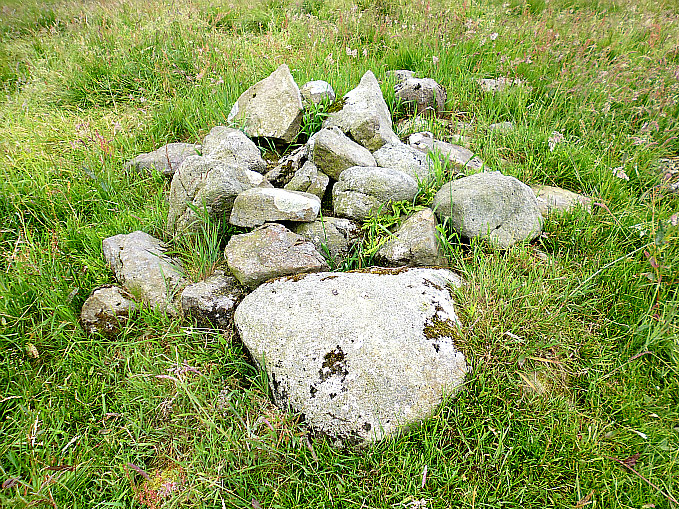
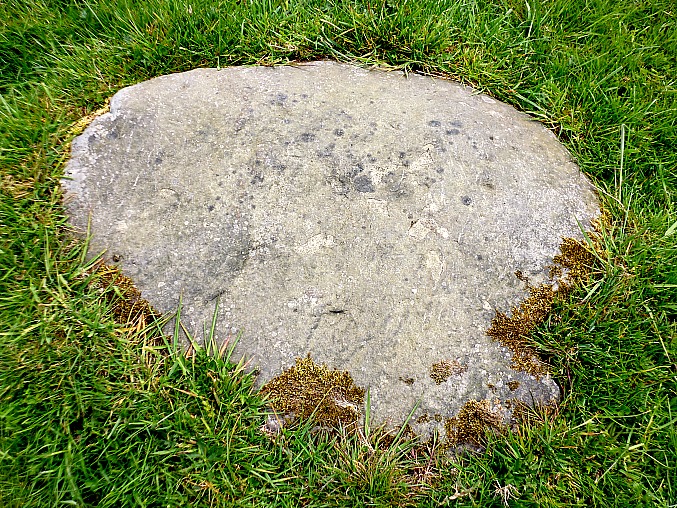
There is not a great deal to see of this so-called stone circle, if that’s what it is.?  Today only 5 recumbent stones remain in a sort of circle, though there may be 2 or 3 others buried under the grass tufts. The largest of the 5 stones at the E side may also have originally been underneath the grass; this stone is about 2 ft vertically. It could ‘possibly’ have a number of tiny cup-marks on its surface where the circular lichen features are visible, or were these made by something else? There is a faint earthen circle, but this feature of is ‘now’ difficult to make out; and it has been suggested by some that the stones were part of an outer kerb. It roughly measures 15m x 12m. So was this a cairn circle? Probably not as there is no burial mound nor any visible sign of one now. This ancient monument probably dates from the Bronze Age.

[At the time of my visit it looked like a vehicle, of sorts, had been driven across the circle as they’re were tyre marks].

Sources:-

http://www.ancientmonuments.info/en23723-ring-cairn-on-slipper-hill

https://en.wikipedia.org/wiki/Worsthorne

© Copyright, Ray Spencer, 2016.

2 Comments

The Collingham Saxon Crosses, West Yorkshire

    OS grid reference: SE 3900 4609. At the north-east side of Collingham village, west York-shire, stands the ancient parish church of St Oswald, a building dating back to pre-Conquest times. The church houses two Anglo-Saxon cross-shafts and also a few other interesting antiquities: there is an ancient stone coffin lid, a cresset stone, a stone with a consecration cross and some 17th century grave slabs. St Oswald’s parish church is located on Church Lane just to the north of the Leeds to Wetherby road the A58 (Main Street), and the river Wharfe is 100m to the north of the church; the village of Collingham is now regarded as a suburb of Leeds – the city centre being about 2 miles to the south-west.

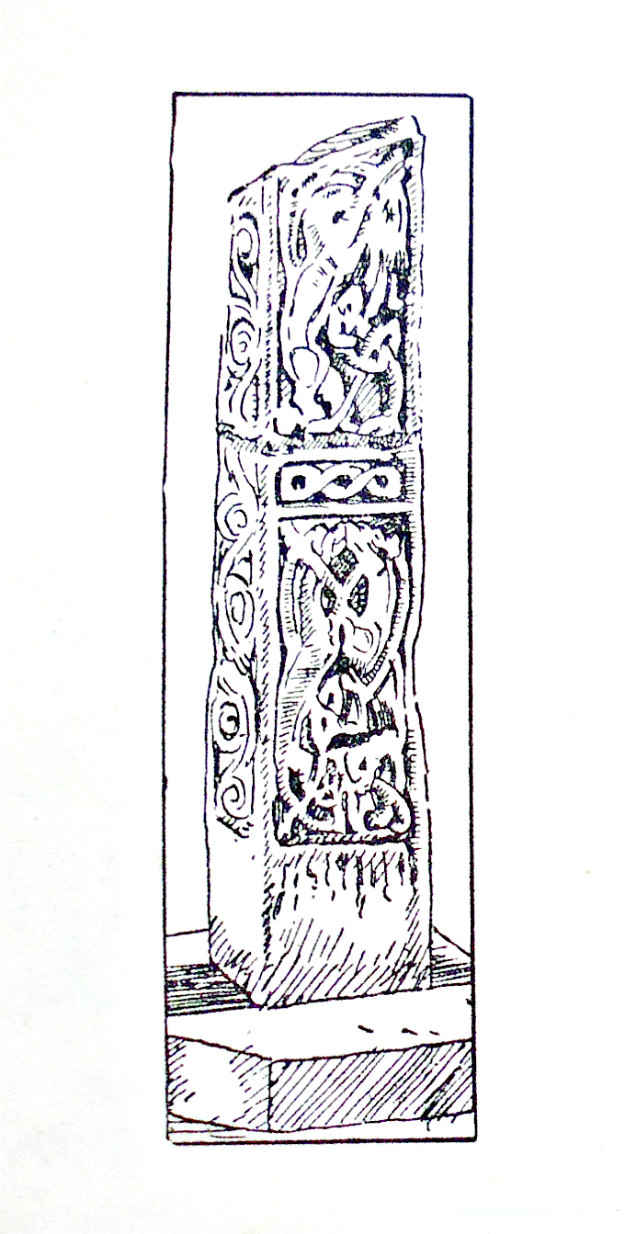
The Runic Cross.

The Runic Cross.

    The taller and more impressive of the two shafts which stand at the east end of the aisle is called ‘The Runic Cross’ or ‘The Aerswith Cross’, and may date from the late 9th century AD. This is made up of two sections joined together. It is carved with three intertwined dragons, two of which are in opposition to the other. These creatures are of the Viking “Jelling” style of designwork that was flourishing in the 9th-10th century AD. There is also scrollwork, interlacing and knot-work which is more Anglo Saxon in origin. Around the base of this shaft there is a runic inscription which has not yet been deciphered.

    According to the authoress Ella Pontefract in her delightfully beautiful work ‘The Charm Of Yorkshire Churches’, this stone cross….. “has been thought to have been used at the dedication of a monastery built by Queen Eanflaed in the 7th century in memory of Oswini whom her husband had caused to be murdered.” Pontefract goes on to say that “the finding of the runic cross has also been thought to indicate Collingham as the site of the monastery of Ingetlingum, not Gilling, as Bede recorded.”  W.G. Collingwood (1854-1932) the English author and antiquarian, however, does not find the name, Oswini, on the runic inscription, and so he dates the cross as late as the 9th century AD, the Transitional period between Anglian and Danish.

     St Eanflaed or Enfleda (d 704) was the daughter of King Edwin of Northumbria. She was abbess of Whitby. In 651 her husband King Oswiu of Bernicia murdered his own brother, Oswini, and Eanflaed then persuaded her husband to found the monastery of Gilling in reparation for his sins. In 670 after her husband’s death she became abbess of Whitby, north Yorkshire. Glastonbury Abbey ‘claimed’ to have the relics of St Eanflaed (David Farmer, 2004). The first abbot of Gilling, west Yorkshire, was called Trumhere. Some scholars think the monastery of Gilling was in North Yorkshire, near Ripon?

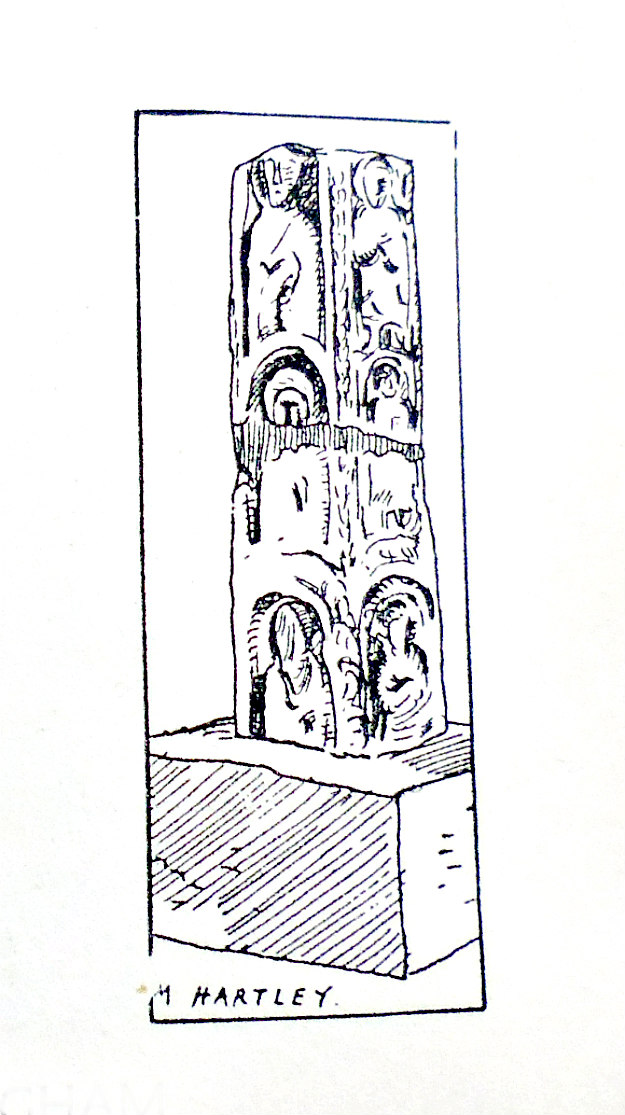
The Apostles Cross.

The Apostles Cross.

    The shorter cross-shaft is called ‘The Apostles Cross’ and, like the Runic Cross, it was dug up from the floor of the church during restoration work between 1840-41. It is said to date from the beginning of the 9th century AD.

     This shorter cross-shaft is made up of two sections joined together, and is so named because it is adorned with representations of eleven Apostles with halos and each in their own round-headed arch. It is quite probably part of a much taller Anglian cross – the top section of which is missing. However, it is conject-ured that two of these ‘Apostolic figures’ could perhaps be representations of Christ, and the Virgin Mary with the Christ-child? There is also cable-pattern moulding design. The date of this cross had been fixed at about 800 AD, although it is generally now considered to date from the 9th-10th century AD. Also housed in the church is a cross-arm and sections of other crosses, which again date from pre-Conquest times.

    There is also a rare cresset stone. The authoress Ella Pontefract says of this stone: “An 8th century cresset is interesting, a flat, round stone with a cup-shaped hollow in the centre in which a light burnt perpetually before the sanctuary, and seven smaller cups round the edge for the days of the week. Their lights were used to relight cottage fires if accidentally extinguished.”

    On the west window-sill there is a Medieval stone coffin lid with sculptured cross. Built into the north vestry wall is part of a consecration cross, while at either sides of the south door there are interesting 17th century grave slabs. The south wall still has traces of Saxon workmanship, and Early English columns supporting the arches of the arcades survive. Author Frank Bottomley gives a bit more detail in his work ‘Yorkshire Churches’. He says that: “Apart from Perp. tower, exterior reflects heavy restoration of 1841 but some of fabric may be A/S. North arcade c. 1200 and aisle Perp.”

Sources:-

Bottomley, Frank, Yorkshire Churches, Alan Sutton Publishing Limited, Stroud, Gloucestershire, 1993.

Farmer, David, Oxford Dictionary Of Saints, Oxford University Press, 2004.

https://en.wikipedia.org/wiki/Gilling_Abbey

http://www.megalithic.co.uk/article.php?sid=11513

Pontefract, Ella, The Charm Of Yorkshire Churches, The Yorkshire Weekly Post, Leeds, 1937. [The two illustrations of the cross-shafts in Collingham church are by Marie Hartley, daughter of the authoress Ella Pontefract].

© Copyright, Ray Spencer, 2016.

1 Comment

The Walton Cross, Hartshead, West Yorkshire

    OS grid reference: SE 1761 2379. The Walton Cross stands beside a footpath at the western side of Hartshead village, in Kirklees District, west Yorkshire. But in fact it is now only part of what was originally quite a tall Anglo Saxon preaching cross, dating perhaps from the 9th or 10th century, but the carvings on this ancient cross-base are outstandingly beautiful. It is located 20m along a footpath running off the B6119 (Windy Bank Lane) and opposite Second Avenue. It is at the north-side of Walton Farm. Originally, it stood in a field on private land, but a kindly, caring farmer who bought the land decided to build a footpath running directly to the cross. About ¼ of a mile to the south-east is St Peter’s church, an 11th century building but with more recent work, too. There is a holy well (Lady Well) near the church.

    The Walton cross-base stands at 1.5m (5 feet) in height and 1.1m (3 ft 6′) in width. It is a highly sculptured block of gritstone with large, double-edged panels on its sides that have beautiful designs and imagery. It was conjectured to date from between 900-1000 AD. Scholars now date it to the 11th century. According to Ella Pontefract in her masterpiece of work ‘The Charm Of Yorkshire Churches’: the west face has a cross (large rosette knot) within a circle that is supported by two winged figures, while the east face has a tree with two birds on each side, maybe a representation of ‘the Tree of Life’, a Viking image, and the north and south faces have interlacing knotwork – reminiscent perhaps of Celtic workmanship. Long ago this wayside preaching cross (waymarker) would have stood very tall, maybe 15 feet, and how beautiful it must have looked, but sadly, the rest of the cross has long since disappeared – though to where it went we do not know. It is also interesting to know that originally the Walton Cross may have been painted in bright colours. The circle with rosette knot is the logo for ‘The West Yorkshire Archaeological Service‘.

    The authoress goes on to say that: W.G. Collingwood the English author and antiquary (1854-1932) suggested that the cross is the “Wagestan” (Wage Stone), which was mentioned in the 12th century foundation charter of Kirkless Priory, near Mirfield, west Yorkshire. The socket hole at the top of the cross-base is often filled with water that is, or was, used to cure warts, and a few coins are sometimes deposited in the water!

Sources:-

Bull, Malcolm, The West Yorkshire Archaeology Service (WYAS), The Calderdale Companion.

http://www.archaeology.wyjs.org.uk/vikingweb/hartshead.htm

Click on this web-blog by Kai Roberts:  https://lowercalderlegends.wordpress.com/tag/hartshead/

http://wyrduk.blogspot.co.uk/2013/02/hartshead-church-walton-cross-and-robin.html

Pontefract, Ella, The Charm Of Yorkshire Churches, The Yorkshire Weekly Post, Leeds, 1937.

© Copyright, Ray Spencer, 2016.

Hameldon Pasture Round Barrows, Worsthorne, Lancashire

Hameldon Pasture Round Barrow I

Hameldon Pasture Round Barrow I

    OS grid reference: SD 8914 3262. Upon the windswept Hameldon Pasture near Worsthorne, Lancashire, are two prehistoric round barrows, but often referred to as cairn circles or round cairns. The small hill on which they are located is also known as Little Hameldon Hill, and to the local people it is Worsthorne Hill. Unfortunately, both monuments are now ‘much’ destroyed and robbed of their stonework. The larger barrow is called Hameldon Pasture I, while the smaller one is Hameldon Pasture II. To reach the site take the Gorple Road at St John’s Church in Wors-thorne. Continue eastwards along this often quite rough track for about 1½ miles. Take the second footpath over the ladder stile on left-hand side (after power cables), then walk-on northwards for 290m to the hill and round barrows. The ladder stile was broken at the time of my visit and the footpath often quite boggy.
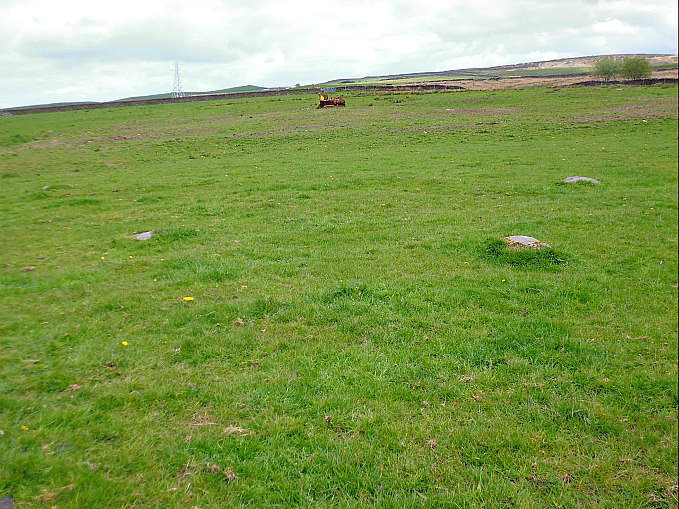
Hameldon Pasture Barrow I showing the boulder at the centre.

Hameldon Pasture Barrow I (showing the boulder at the centre).

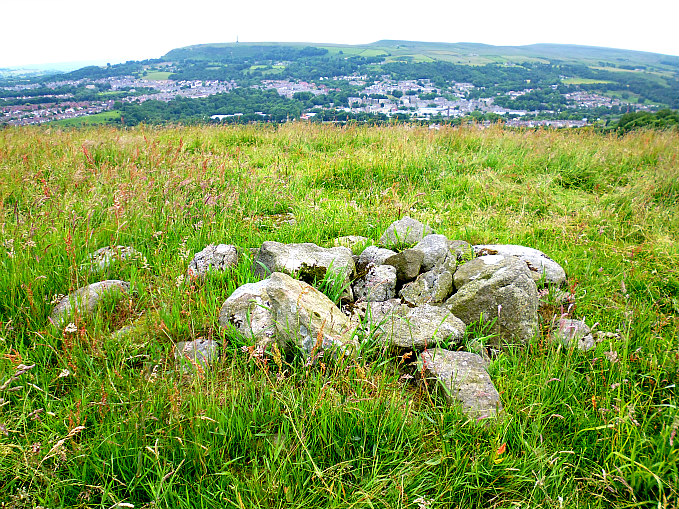
    The larger of the two barrows (Hameldon Pasture I) is 0.3m high and has a circumference of 21m (almost 69 ft) but it is now much destroyed and difficult to make out in the grass. It was originally a bowl-shaped tumulus consisting of earth and stones – many of its stones having been robbed away and used in the walls down slope. At the centre there is a hollowed-out area 5m x 4m (16 ft x 13 ft) with two weather-worn gritstone boulders, the bigger one looks to have some tiny cup-marks at one side? A third, smaller boulder lies close by. When this barrow was excavated in 1886 a cist grave was found. This had two large flat stones covering it and other flat slabs at the sides and the ends. A number of arrowheads and tiny flints were also found.

Hameldon Pasture Round Barrow II.

Hameldon Pasture Round Barrow II.

    The second barrow lies 55m to the south-west at (SD 8912 3259) and is identified as ‘Hameldon Pasture II’. But it is also known as a round cairn or cairn circle. This much destroyed round barrow measures 12.5m x 10.8m (41 ft x 35 ft) and is 0.3m high. The large hollow (depression) at the centre is 2.5m x 1.5m (8 ft x 5 ft); there are traces of a second hollow. Several stones lie in the centre and around the edges – indicative of an outer kerb. When the cairn was excavated in 1843 by Mr Studley Martin*, of Liverpool, an undecorated urn containing the bones of an adult and child was found in a stone cist, but the stones from this have been robbed away for other use in the ‘immediate’ locality.

Hameldon Pasture Round Barrow II.

Hameldon Pasture Round Barrow II.

    *Mr Studley Martin the 19th century Liverpool writer and antiquarian was a guest of the Reverend William Thursby of Ormerod House near Hurstwood, Burnley, Lancashire, in 1843. During his sojourn in the Burnley area he visited the two prehistoric barrows upon Hameldon Pasture, and was ‘seemingly’ delighted to find an undecorated funery urn in the smaller of the two tumuli. Martin was also associated with the prehistoric Calder Stones at Allerton, Liverpool.

Sources:-

Hall, Brian, Burnley (A Short History), Burnley and District Historical Society, 1977.

https://historicengland.org.uk/listing/the-list/list-entry/1008919

http://www.megalithic.co.uk/article.php?sid=11195

http://www.burnleyexpress.net/news/nostalgia/worsthorne-a-village-history-1-1688523

https://en.wikipedia.org/wiki/Worsthorne-with-Hurstwood

© Copyright, Ray Spencer, 2016.